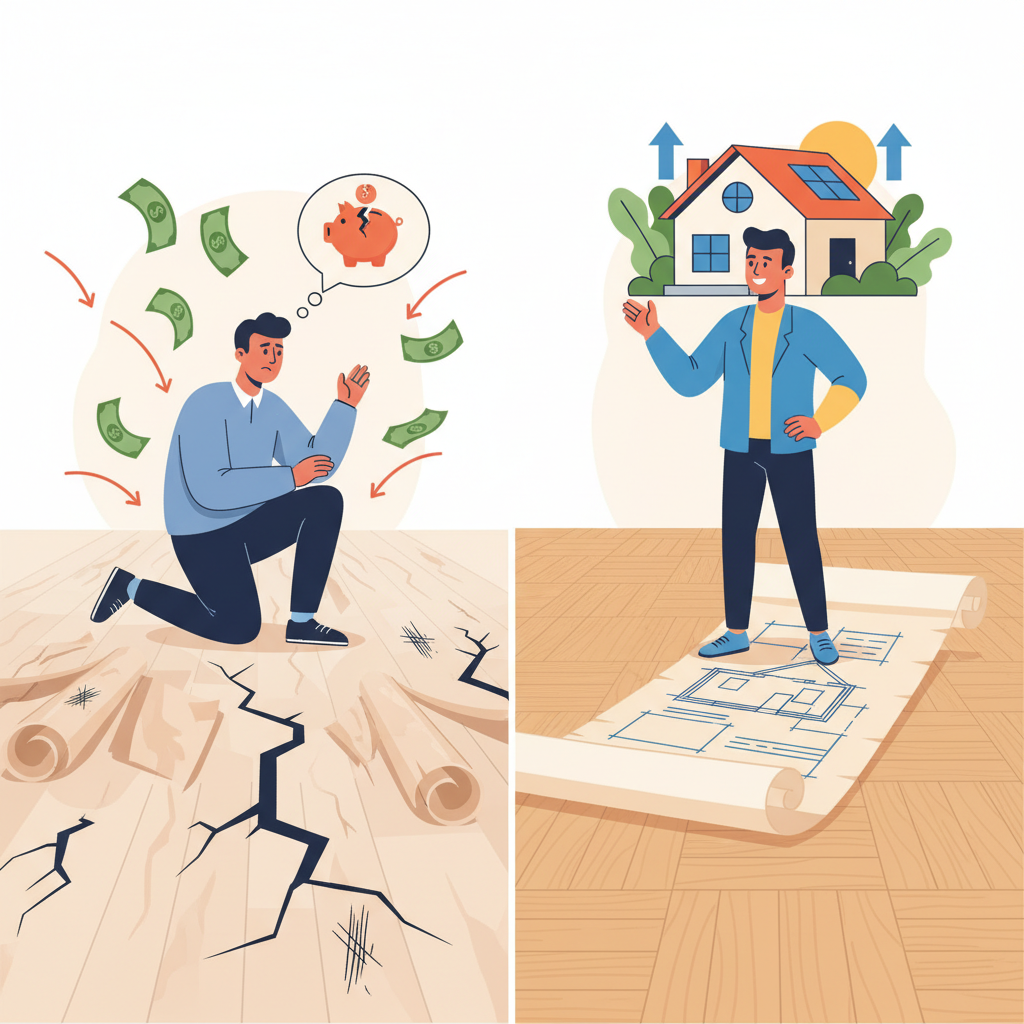
There is a distinct, sinking feeling that accompanies the first deep scratch on a newly installed floor. For many homeowners, the excitement of a renovation quickly fades into the frustration of easily damaged house floors. Whether it is peeling laminate, cracked tiles, or deeply gouged hardwood, the cycle of frequent flooring replacement costs is a massive financial drain and a constant source of household disruption.
If you find yourself repeatedly sinking money into surface-level fixes, it is time to shift your perspective. True durability cannot be bought in a simple box of planks; it requires a foundation-first approach. Welcome to the “Forever Floor Blueprint.” In this comprehensive guide, we will move beyond superficial aesthetics to solve flooring failures at their structural roots. We will demystify the concept of “adamantine flooring,” explore the engineering behind permanent floor stability, and provide an authoritative roadmap to making a once-in-a-lifetime flooring investment.
- Diagnosing the Root Cause: Easily Damaged Floors vs. Unstable Foundations
- Permanent Floor Stability Solutions: The Foundation-First Approach
- What is Adamantine Flooring? Defining Ultimate Durability
- The Durability Matrix: Most Durable Flooring Options for Homes
- The Economics of Longevity: Total Cost of Ownership (TCO)
- Flawless Execution: How to Install Adamantine and Durable Flooring
- Conclusion
- References & Authoritative Sources
Diagnosing the Root Cause: Easily Damaged Floors vs. Unstable Foundations
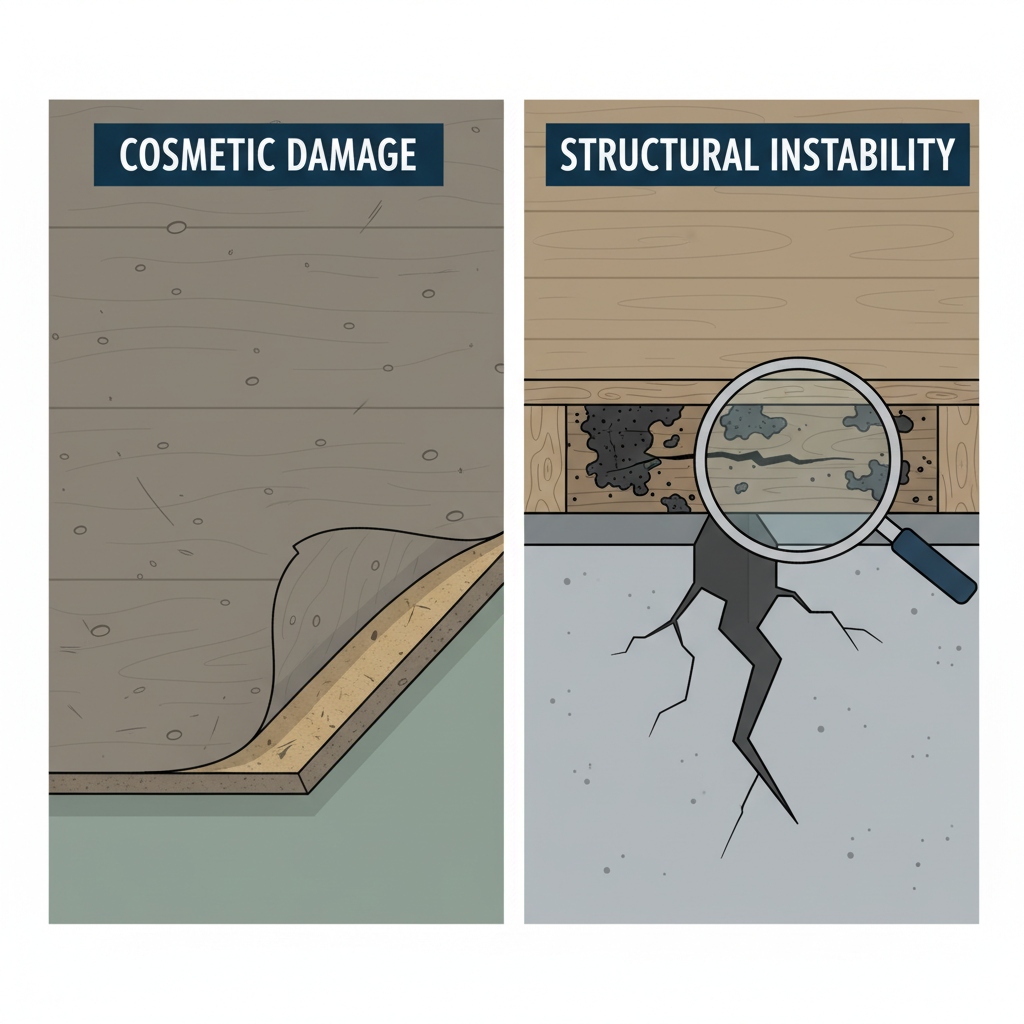
Before you spend another dollar attempting to upgrade your home, you must understand exactly why your current floors are failing. Many homeowners confuse cosmetic surface damage—often caused by cheap materials or harsh lifestyle factors—with critical structural instability.
To stop the cycle of easily damaged house floors, we must act as diagnosticians. According to the World Floor Covering Association (WFCA), improper indoor humidity levels (falling outside the ideal 30-50% range) are responsible for over 60% of early hardwood floor failures [1]. However, if your floors are sagging or bouncing, the issue runs much deeper. The International Residential Code (IRC) outlines strict safety standards for home construction, specifically noting that floor deflection (sagging) exceeding the L/360 limit (the span of the floor divided by 360) indicates severe structural instability that must be addressed before any new surface is laid [2].
Symptom Checker: Why Do My Floors Scratch and Dent So Easily?
If your floors feel solid underfoot but look terrible, you are likely dealing with material or maintenance failures. Homeowners frequently ask, “Why do my hardwood floors scratch so easily?” or “Can humidity ruin laminate floors?” The answers lie in the composition and care of the materials.
For instance, budget-friendly laminate flooring often utilizes a Low-Density Fiberboard (LDF) core, which is highly susceptible to moisture expansion and denting. Upgrading to a High-Density Fiberboard (HDF) core significantly improves impact resistance. Furthermore, the way you clean your floors plays a massive role in their longevity. The Institute of Inspection, Cleaning and Restoration Certification (IICRC) warns that utilizing improper, highly acidic, or abrasive cleaning agents strips the protective wear layer off hard surface floors, leading to premature scuffing and scratching [3]. Simple preventative measures, such as using proper felt furniture pads and avoiding harsh chemicals, can dramatically extend the life of standard flooring.
Warning Signs of an Unstable Home Flooring Foundation
Cosmetic scratches are frustrating, but an unstable home flooring foundation is a serious safety hazard. If you are wondering, “What causes a floor to feel bouncy or spongy?” or “How do I know if my floor joists are failing?”, you need to look beneath the surface.
Floors that slope, bounce noticeably when walked across, or cause diagonal cracks in the adjacent drywall are screaming for structural attention. The root cause is rarely the flooring material itself. In fact, moisture damage and subsequent wood rot in crawlspaces account for over 50% of unstable first-floor foundations. Important Note: Always consult a licensed structural engineer if you suspect foundation failure. When attempting to diagnose these issues, safety is paramount. The American Society of Home Inspectors (ASHI) provides rigorous standards for identifying structural defects, emphasizing the need for proper protective gear and caution when inspecting potentially compromised crawlspaces and floor joists [4].
Permanent Floor Stability Solutions: The Foundation-First Approach
Once you have diagnosed the root cause of your flooring woes, you can implement permanent floor stability solutions. This foundation-first approach ensures that the subfloor is perfectly leveled, structurally sound, and capable of supporting premium materials for decades to come.
Structural Reinforcements: Joists, Jacks, and Polyjacking
If your floor joists are compromised, surface-level fixes are useless. Homeowners often ask, “What is the best way to reinforce floor joists?” The answer depends on the severity of the damage. According to the Structural Building Components Association (SBCA), “sistering” joists—the process of fastening a new piece of lumber alongside a damaged joist—can increase floor load capacity by up to 50% when executed to engineering standards [5].
For concrete slab foundations that have sunk or settled, homeowners frequently wonder if polyjacking is a permanent solution. Unlike traditional mudjacking, which uses a heavy cement slurry, modern high-density polyurethane foam (polyjacking) is lightweight, waterproof, and incredibly strong. Data from the Concrete Network confirms that polyjacking is an authoritative slab stabilization technique capable of supporting up to 6,000 lbs per square foot, offering a permanent lift and leveling solution for concrete subfloors [6].
Choosing the Best Flooring for Homes That Settle
Even with structural reinforcements, older homes will experience minor seasonal movement. So, what is the best flooring for long-term home stability in a house that settles? The secret lies in material flexibility.
Rigid materials fight against foundation movement, which is why large-format ceramic or porcelain tiles are 80% more likely to crack in homes with active foundation settlement. Conversely, flexible, floating floors—such as high-quality Luxury Vinyl Plank (LVP)—can accommodate up to 1/4 inch of subfloor height variation over a 10-foot span. The American Society of Civil Engineers (ASCE) highlights the importance of matching material flexibility to residential foundation stability, noting that decoupling the surface material from the moving subfloor is a highly effective engineering strategy for long-term durability [7].
What is Adamantine Flooring? Defining Ultimate Durability
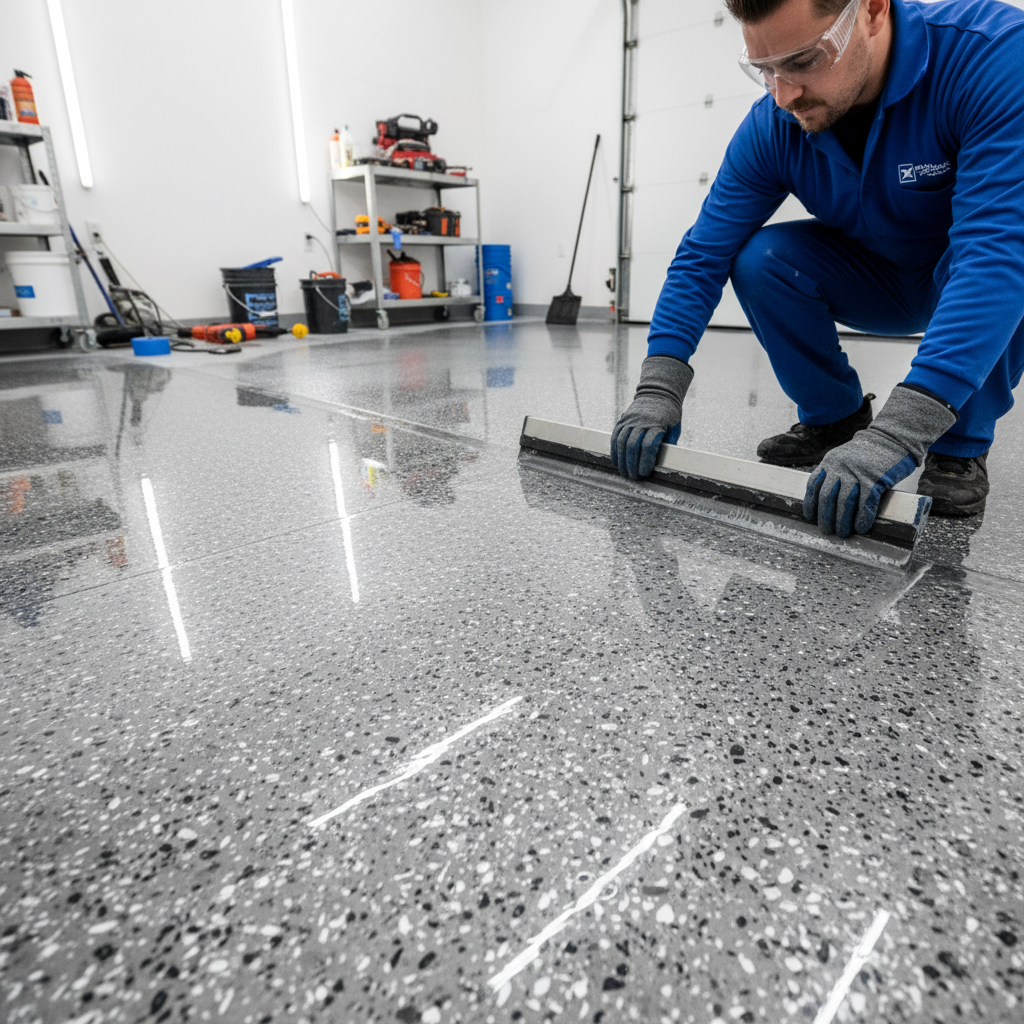
With a stable foundation secured, we can explore the pinnacle of surface resilience: adamantine flooring. In fantasy literature, “adamantine” refers to an unbreakable, indestructible material. In the real-world residential and commercial flooring industry, it refers to advanced, industrial-grade epoxy and polyurethane composite blends designed to withstand extreme punishment.
The Science of Adamantine-Grade Coatings
What exactly is adamantine flooring made of, and is it suitable for residential homes? Unlike standard, off-the-shelf garage epoxies that chip and peel under hot tires, adamantine-grade coatings are highly engineered chemical composites. According to peer-reviewed data published in the Journal of Materials in Civil Engineering, these advanced polyurethane and polyaspartic blends boast staggering compressive strengths exceeding 10,000 PSI [8].
These coatings are entirely suitable for residential applications—particularly in garages, basements, and modern industrial-style living spaces—where extreme abrasion resistance is required. The Society for Protective Coatings (SSPC) sets stringent standards for these high-durability floor coatings, establishing authoritative definitions that separate true adamantine-grade materials from inferior, consumer-grade paints and standard epoxies [9].
Lifespan and Warranties: How Long Does Adamantine Flooring Last?
When investing in premium coatings, homeowners naturally ask: “How long does adamantine flooring last?”, “Does it fade over time?”, and “What is the warranty?”
Under heavy residential use, a professionally installed adamantine-grade floor has an expected lifespan of 30 to 50 years. It is crucial, however, to distinguish between “functional lifespan” (how long the floor maintains its structural integrity and protects the concrete) and “aesthetic lifespan” (how long it looks brand new before minor surface micro-scratches appear). Thanks to UV-stable topcoats, modern adamantine floors resist the yellowing and fading that plague older epoxies. Standardized testing methods for floor wear conducted by the American Society for Testing and Materials (ASTM) prove that these advanced composites last up to 5 times longer than standard epoxy coatings before showing significant wear [10]. Consequently, top manufacturers frequently back these systems with 20-year to lifetime residential warranties.
The Durability Matrix: Most Durable Flooring Options for Homes
Not every room in your house is suited for a poured adamantine coating. For living rooms, bedrooms, and kitchens, you need to evaluate the most durable flooring options for homes using a “Durability Matrix”—a system that matches your specific lifestyle (pets, heavy traffic, kids) to objective material scores.
Objective Metrics: Janka, PEI, and AC Ratings Explained
To cut through marketing hype, you must learn to read standardized flooring specifications. If you are considering hardwood, look at the Janka hardness scale. The National Wood Flooring Association (NWFA) utilizes this scale to measure the force required to embed a steel ball halfway into the wood [11]. For example, Hickory boasts a Janka rating of 1820, making it vastly more dent-resistant than standard Red Oak.
For tile, the Porcelain Enamel Institute (PEI) wear rating is the gold standard. The PEI scale ranges from 1 to 5, and the institute confirms that tiles with a PEI rating of 4 or 5 are engineered to withstand the heaviest residential and light commercial traffic without showing wear [12]. Additionally, true porcelain tile has a water absorption rate of less than 0.5%, making it virtually impervious to spills. For laminate, look for Abrasion Class (AC) ratings of AC4 or AC5 for maximum residential durability.
The 100-Year Floor: Hardwood, Stone, and High-Mil LVP
When homeowners ask, “What flooring has the longest lifespan?” or “What is the most durable flooring for dogs?”, the answers vary by category.
Solid hardwood and natural stone are the ultimate long-lasting floors. A 3/4-inch solid hardwood floor can be sanded and refinished multiple times, giving it a potential lifespan of over 100 years. This longevity makes it an incredibly environmentally sustainable choice, as it rarely ends up in a landfill.
However, for active households with large dogs and high moisture risks, Luxury Vinyl Plank (LVP) has become the modern standard. The durability of LVP is dictated by its clear wear layer, measured in “mils” (thousandths of an inch). The Resilient Floor Covering Institute (RFCI) sets industry standards for resilient flooring, noting that a wear layer of 20-mil or higher provides exceptional, long-term residential durability against pet claws and heavy foot traffic [13].
The Economics of Longevity: Total Cost of Ownership (TCO)
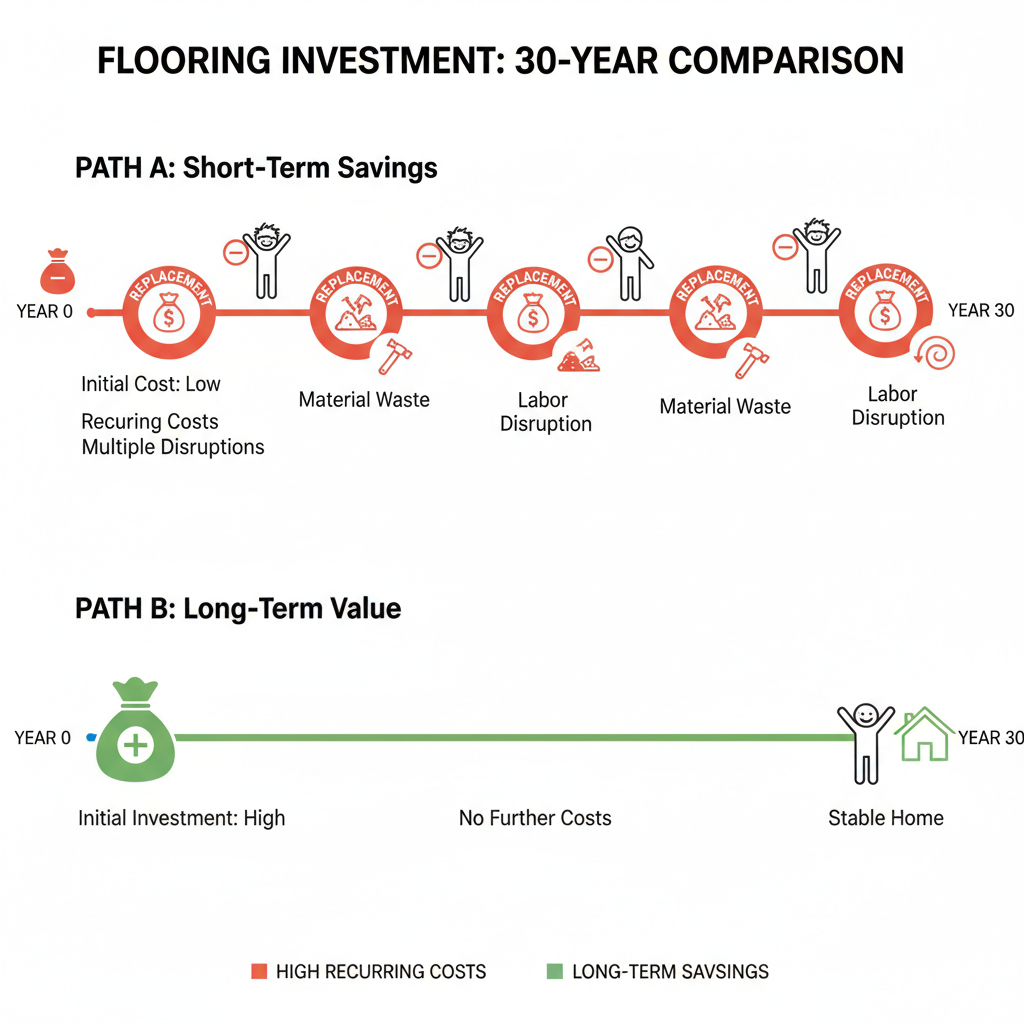
It is easy to suffer sticker shock when pricing out premium, durable home flooring. However, evaluating flooring based solely on the upfront purchase price is a financial trap. To truly understand the value of your investment, you must calculate the Total Cost of Ownership (TCO).
The Hidden Costs of Cheap Flooring
Why do you keep having to replace your laminate floors? Because cheap materials fail quickly under normal living conditions. The hidden costs of frequent flooring replacement costs go far beyond the price of the new planks.
According to RSMeans Data, the industry standard for construction cost estimating, the labor required to remove and dispose of old, failed flooring adds an average of $1.50 to $3.00 per square foot to your replacement project [14]. When you factor in the “inconvenience cost”—the time lost, the need to move furniture, and the disruption to your daily life—the math heavily favors premium materials.
Authoritative data from Remodeling Magazine’s Cost vs. Value Report substantiates these long-term ROI claims [16]. Investing in a premium floor with a 25-year lifespan yields a 40% lower Total Cost of Ownership compared to buying a cheap 10-year floor and paying to replace it twice. Furthermore, the National Association of Realtors (NAR) reports that when you upgrade to durable flooring, you can expect to recoup a 70% to 80% Return on Investment (ROI) at the time of home resale [15].
Flawless Execution: How to Install Adamantine and Durable Flooring
The finest adamantine coating or the most expensive imported tile will fail miserably if installed incorrectly. The final step in the Forever Floor Blueprint is flawless execution. Whether you hire a professional or attempt a complex DIY, you must understand the rigorous preparation required to install adamantine flooring and other premium materials.
Rigorous Prep: The Secret to Adamantine Adhesion
How do you prep a concrete floor for an adamantine coating? The answer is aggressive mechanical profiling. You cannot simply sweep the floor and roll on a high-performance coating.
The International Concrete Repair Institute (ICRI) dictates that concrete must be mechanically ground using diamond grinders to achieve a Concrete Surface Profile (CSP) of 2 or 3 [17]. This process opens the pores of the concrete, allowing the adamantine base coat to wick into the slab and create a permanent mechanical bond. Furthermore, a calcium chloride moisture test is absolutely mandatory. Trapped hydrostatic pressure will blow the coating right off the floor; in fact, improper surface preparation and ignored moisture issues cause 80% of all high-performance floor coating failures. Because this preparation involves heavy machinery and silica dust, adherence to Occupational Safety and Health Administration (OSHA) safety protocols for using concrete grinders and handling chemical coatings is strictly required [18].
Seamless Transitions: Upgrading Your Home’s Flooring
When you finally upgrade to durable flooring, you will likely face the challenge of transitioning between different rooms and materials. Homeowners frequently ask, “How do I transition between two different types of durable flooring?” and “Can I install new flooring over existing tile?”
Seamless transitions require careful planning regarding floor heights. You may need to utilize specific underlayments to raise a thinner LVP floor to meet a thicker hardwood floor, ensuring a flush, trip-free transition. Additionally, achieving a professional look requires undercutting door jambs and casings so the new flooring slides neatly underneath, rather than caulking around them. As for installing over existing tile, the Tile Council of North America (TCNA) provides authoritative guidelines, stating that it is only safe to install new flooring over existing tile if the original tile is perfectly bonded, crack-free, and properly prepped to accept the new adhesive or underlayment [19].
Conclusion
The Forever Floor Blueprint proves that true, adamantine durability is never just skin deep. It is the meticulous combination of a stable, structurally sound subfloor and premium, objectively tested surface materials. By moving away from cheap, temporary fixes and embracing a foundation-first approach, you can permanently stop the frustrating cycle of easily damaged floors and frequent replacements.
The long-term financial benefits of the Total Cost of Ownership (TCO) model are clear: doing it right the first time saves you thousands of dollars, endless disruption, and significantly boosts your home’s resale value. We strongly encourage you to assess your current subfloor health today. If you suspect underlying issues, consult with a licensed structural engineer to address foundation concerns, and begin planning your permanent flooring upgrade with confidence.
Structural Advice Disclaimer: Information regarding foundation stability, joist reinforcement, and load-bearing capacities is for educational purposes. Always consult a licensed structural engineer before making structural modifications.
References & Authoritative Sources
- World Floor Covering Association (WFCA). (N.D.). Guidelines on Indoor Humidity and Hardwood Floor Longevity. Retrieved from WFCA industry standards data.
- International Code Council. (2026). International Residential Code (IRC). Safety standards for floor framing, deflection limits, and foundations.
- Institute of Inspection, Cleaning and Restoration Certification (IICRC). (N.D.). Standards for Hard Surface Floor Maintenance and Repair.
- American Society of Home Inspectors (ASHI). (N.D.). Standards of Practice for Identifying Structural Defects.
- Structural Building Components Association (SBCA). (N.D.). Engineering Standards for Floor Trusses and Joist Reinforcement.
- Concrete Network. (N.D.). Authoritative Information on Slab Stabilization Techniques and Polyjacking.
- American Society of Civil Engineers (ASCE). (N.D.). Guidelines on Residential Foundation Stability and Material Flexibility.
- Journal of Materials in Civil Engineering. (N.D.). Peer-Reviewed Data on Floor Coating Durability and Compressive Strength.
- Society for Protective Coatings (SSPC). (N.D.). Standards for Industrial and High-Durability Floor Coatings.
- American Society for Testing and Materials (ASTM). (N.D.). Standardized Testing Methods for Floor Wear and Abrasion Resistance.
- National Wood Flooring Association (NWFA). (N.D.). Janka Hardness Scale Data and Wood Floor Longevity.
- Porcelain Enamel Institute (PEI). (N.D.). PEI Wear Ratings for Tile Durability.
- Resilient Floor Covering Institute (RFCI). (N.D.). Industry Standards for Resilient Flooring Durability and Mil Thickness.
- RSMeans Data. (2026). Industry Standard for Construction and Material Cost Estimating.
- National Association of Realtors (NAR). (2026). Data on Flooring Upgrades and Home Resale Value ROI.
- Remodeling Magazine. (2026). Cost vs. Value Report: Authoritative Data on Renovation Costs and ROI.
- International Concrete Repair Institute (ICRI). (N.D.). Standards for Concrete Surface Profiles (CSP) and Preparation.
- Occupational Safety and Health Administration (OSHA). (N.D.). Safety Protocols for Using Concrete Grinders and Chemical Coatings.
- Tile Council of North America (TCNA). (N.D.). Authoritative Guidelines on Tile Installation and Substrate Preparation.
