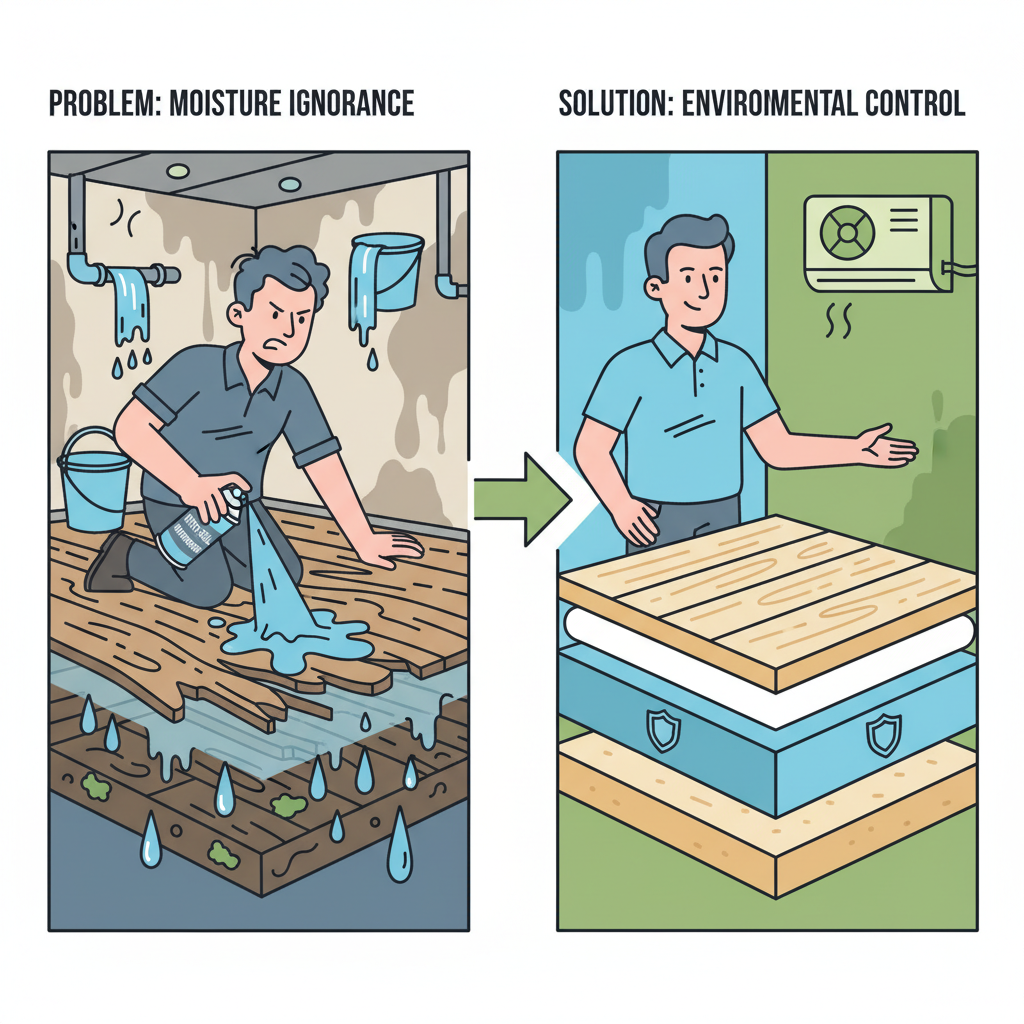
There is a unique kind of heartbreak that comes with watching a newly installed, expensive floor begin to buckle, cup, or swell. For homeowners in high-humidity regions or property managers dealing with damp basements, indoor flooring moisture damage represents not just a cosmetic failure, but a significant financial loss. The core of the problem often lies in a widespread misunderstanding: most consumers focus entirely on purchasing “waterproof” surface materials, completely ignoring the underlying environmental conditions and subfloor realities that dictate a floor’s lifespan.
This guide moves beyond basic marketing jargon to offer a definitive, systems-based approach to climate-proofing your floors. By bridging material science—including ultra-durable “adamantine” solutions—with subfloor diagnostics and HVAC integration, we will explore how to permanently solve and prevent moisture-related flooring failures. Whether you are troubleshooting an existing problem or planning a new installation, this comprehensive roadmap will help you select, install, and maintain a truly resilient floor.
- The Science of Dimensional Stability and Indoor Moisture
- Demystifying Adamantine Flooring for Extreme Environments
- Top Humidity-Adaptable Flooring Solutions for Homes
- The Anatomy of a Truly Moisture-Proof Floor Installation
- Diagnostic Triage: Fixing Warped, Cupped, and Swollen Floors
- Conclusion
- References & Authoritative Sources
The Science of Dimensional Stability and Indoor Moisture
To successfully navigate flooring options, one must first understand how materials react to their environment. Most flooring materials, particularly wood and wood-based composites, are subject to “hygroscopic expansion.” This technical term simply means that the material absorbs and releases moisture from the surrounding air, expanding when humidity is high and contracting when it drops.
According to the Forest Products Laboratory (FPL), wood flooring can expand up to 1/4 inch across a 10-foot span when relative humidity increases from 35% to 55% [1]. This dramatic shift underscores why finding stable flooring for climate changes is critical. Preventing floor warping from moisture requires managing this hygroscopic expansion through a combination of material selection and environmental control.
Top-Down vs. Bottom-Up Moisture: Diagnosing the Threat
When discussing indoor flooring moisture damage, it is vital to distinguish between two distinct threats: top-down and bottom-up moisture. Top-down moisture is exactly what it sounds like—surface spills, pet accidents, or wet shoes. Most modern “waterproof” floors are designed specifically to handle this type of exposure.
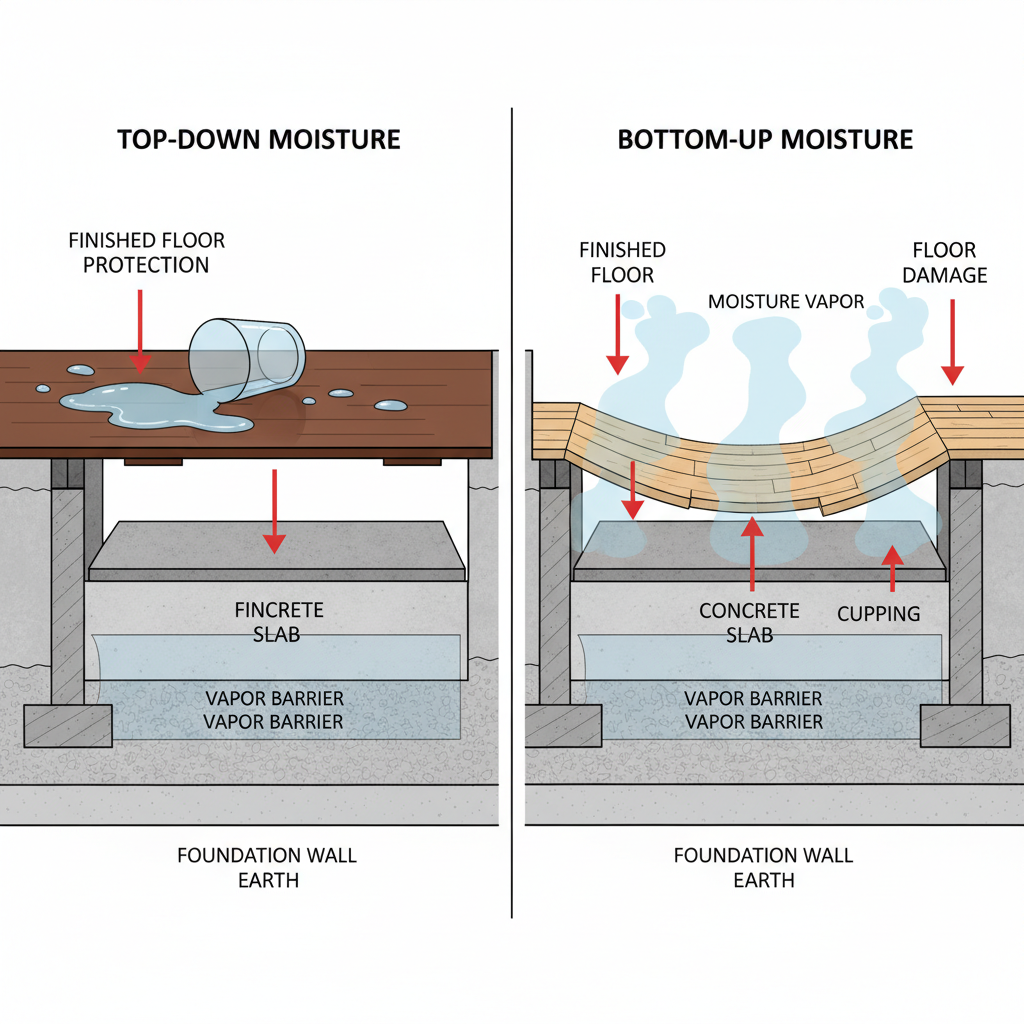
Bottom-up moisture, however, is the silent killer of floors. This occurs when systemic vapor emissions rise from unsealed concrete slabs or damp crawlspaces. As noted by experts from the American Society of Home Inspectors (ASHI), “Moisture doesn’t just stay in the dirt of a crawlspace; through the stack effect, moisture vapor is drawn upward, permeating the subfloor and attacking the finished flooring from beneath” [2]. Failing to address bottom-up moisture is the leading cause of installation failures.
The Crucial Role of HVAC in Flooring Longevity
The secret to the best flooring for high indoor humidity often isn’t the floor itself, but the HVAC system regulating it. Maintaining a consistent indoor climate is just as important as the flooring material you choose.
Standards set by ASHRAE (American Society of Heating, Refrigerating and Air-Conditioning Engineers) emphasize the importance of climate control for indoor air quality and building material preservation [3]. The ideal indoor relative humidity for most flooring types is between 30% and 50%. When HVAC systems, whole-home humidifiers, or dehumidifiers work in tandem to keep the environment within this sweet spot, the risk of hygroscopic expansion is drastically reduced.
Demystifying Adamantine Flooring for Extreme Environments
When searching for the ultimate in durability, you may encounter the term “adamantine flooring.” Often used as a buzzword, it is essential to shift this from a marketing concept to a technical discussion. Adamantine flooring refers to surfaces engineered for extreme hardness and resilience, making them highly relevant for commercial spaces, garages, or homes subjected to severe wear and fluctuating humidity.
To understand the durability of these surfaces, material scientists often reference the Mohs hardness scale, which measures scratch resistance [4]. True adamantine-level floors score exceptionally high, offering a level of protection that standard residential floors cannot match. Furthermore, these industrial coatings must adhere to rigorous performance metrics, such as those established by The Society for Protective Coatings (SSPC) [5].
What Exactly is ‘Adamantine’ Flooring?
Adamantine flooring is not a single natural material you can harvest; rather, it is a classification of extreme hardness typically achieved through advanced chemistry. This includes high-performance polyaspartic coatings, specialized industrial epoxies, and densely treated, polished concrete.
Industrial coating formulators explain that the chemical curing process of these materials creates a tightly cross-linked polymer network. This network is what gives adamantine flooring its impenetrable surface, rendering it highly resistant to impacts, chemical spills, and surface abrasions.
Moisture Vapor Transmission Rates (MVTR) in Industrial Coatings
While polyaspartics and epoxies are incredibly hard, utilizing adamantine flooring for fluctuating humidity requires a deep understanding of subfloor vapor emissions. Even the hardest surface can fail if trapped moisture builds up pressure beneath it.
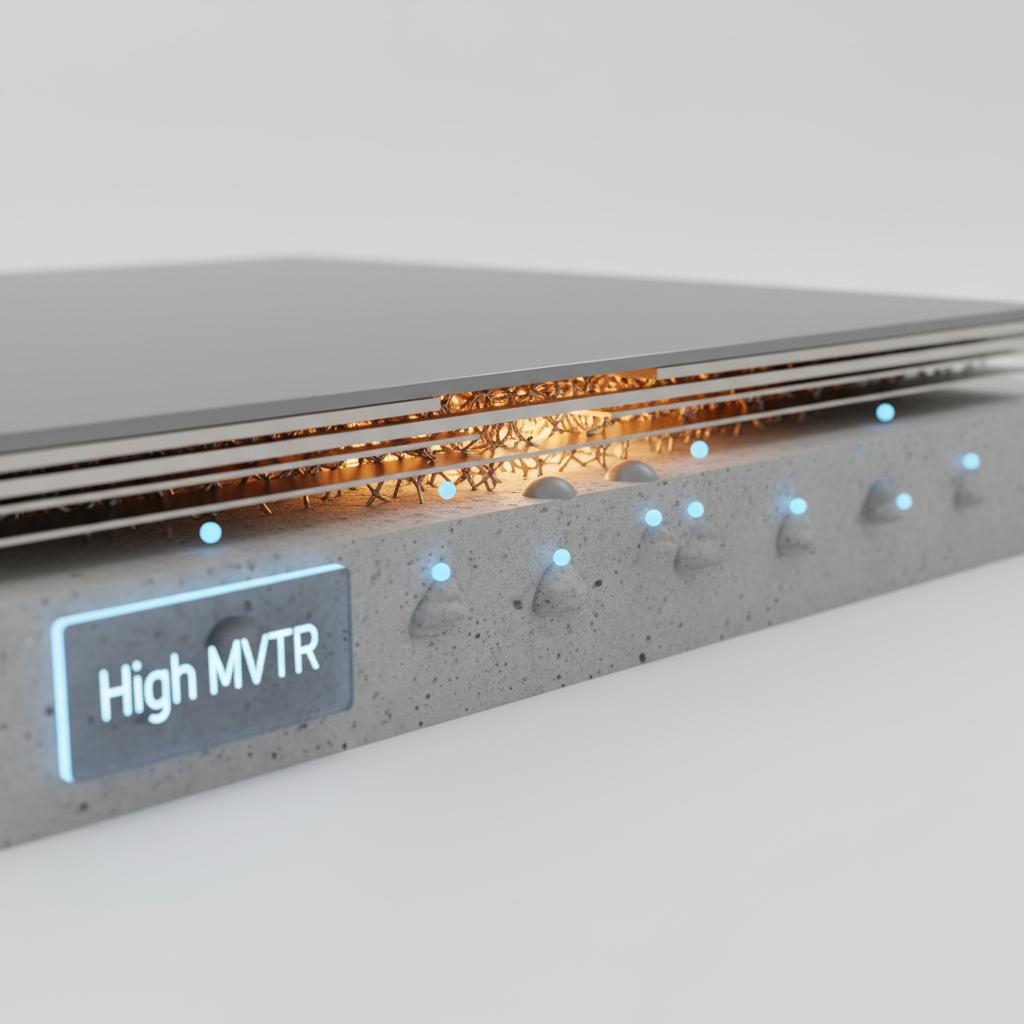
This introduces a critical technical metric: Moisture Vapor Transmission Rate (MVTR). MVTR measures the speed at which water vapor passes through a material. If a concrete slab has a high MVTR and is sealed with an impermeable adamantine coating without a proper moisture-mitigating primer, the hydrostatic pressure will eventually cause the coating to blister and delaminate. The International Concrete Repair Institute (ICRI) provides strict concrete moisture guidelines that must be followed to ensure these ultra-hard coatings bond correctly and withstand rapid humidity shifts [6].
Top Humidity-Adaptable Flooring Solutions for Homes
For residential spaces, the goal is to find humidity resistant flooring that balances aesthetics with dimensional stability. The World Floor Covering Association (WFCA) provides excellent consumer guidelines for selecting materials based on environmental demands [7].
To simplify your search for the best flooring for high indoor humidity, consider this Climate-Match Matrix:
- High Humidity (50%+ RH) / Wet Rooms: SPC Vinyl, Porcelain Tile, Polyaspartic Coatings.
- Moderate/Fluctuating Humidity (35%-55% RH): Engineered Hardwood, WPC Vinyl, High-Quality Laminate.
- Low/Dry Humidity (Below 30% RH): Solid Hardwood (with integrated humidification), Engineered Hardwood.
SPC and WPC Vinyl: The Kings of Dimensional Stability
When it comes to humidity adaptable flooring solutions, rigid core vinyl products lead the pack. Stone Plastic Composite (SPC) and Wood Plastic Composite (WPC) are engineered specifically to resist environmental changes.
SPC, in particular, is a marvel of material science. Because its core is constructed from a mixture of limestone powder and stabilizers, it is incredibly dense and virtually impervious to moisture. The Multilayer Flooring Association (MFA), which sets standards for rigid core products, notes the exceptional performance of these materials [8]. In fact, SPC flooring has a dimensional stability rate of less than 0.1% expansion/contraction in extreme humidity, making it an ideal choice for tropical climates or damp basements.
Engineered vs. Solid Hardwood in Humid Climates
Homeowners who desire the authentic look of wood but need stable flooring for climate changes should look to engineered hardwood. Unlike solid hardwood, which is milled from a single piece of timber and expands uniformly across its grain, engineered wood relies on physics to fight moisture.
Engineered hardwood features a top veneer of real wood adhered to a core of high-quality plywood or high-density fiberboard (HDF). This core is built using a cross-ply construction—layers of wood stacked with their grains running in alternating directions. The National Wood Flooring Association (NWFA) confirms that this structural design restricts the wood’s natural tendency to move [9]. Because the alternating layers fight against each other’s expansion, engineered hardwood is up to 50% more dimensionally stable than solid hardwood due to its cross-ply construction.
Porcelain and Ceramic Tile: The Waterproof Standard
For areas guaranteed to see heavy moisture—like bathrooms, laundry rooms, or flood-prone basements—porcelain and ceramic tile remain the gold standard for moisture proof flooring. Tile is 100% waterproof on its surface. However, achieving a fully waterproof system requires attention to the materials beneath and between the tiles.
The Tile Council of North America (TCNA) emphasizes that while the tile itself won’t be damaged by water, the grout lines and subfloor must be protected [10]. Utilizing sealed epoxy grouts and uncoupling membranes (which also protect the tile from cracking during subfloor temperature shifts) ensures the installation remains pristine.
The Anatomy of a Truly Moisture-Proof Floor Installation
A successful flooring project requires a paradigm shift: you are not just laying down planks; you are building a system. A true moisture proof floor installation encompasses everything from the dirt beneath your home to the baseboards on your walls.
The International Residential Code (IRC) outlines strict building code requirements regarding vapor retarders and moisture management [11]. Furthermore, nearly all manufacturers will void their warranties if specific moisture proofing steps are skipped. Emphasizing these installation protocols is the only way to guarantee longevity.
Mandatory Subfloor Moisture Testing
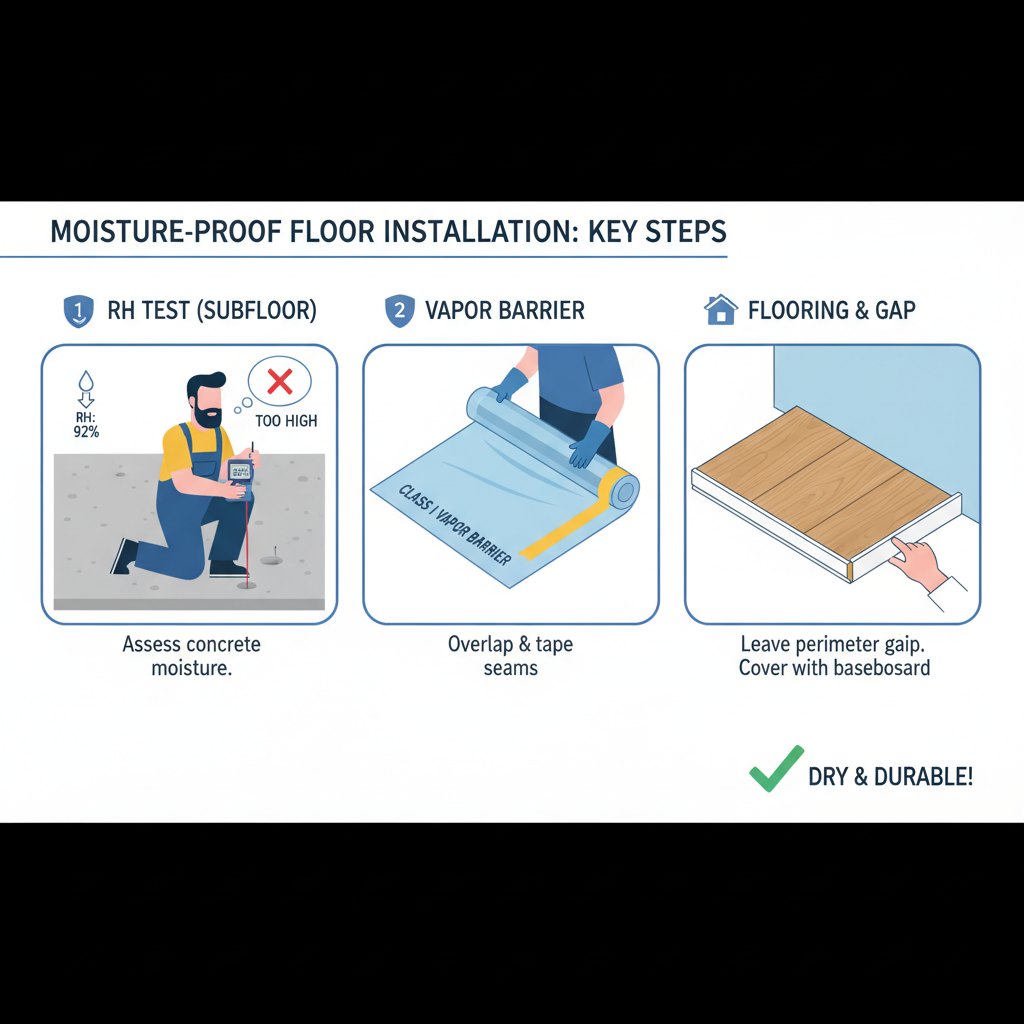
Before a single plank or tile is laid, mandatory subfloor moisture testing must occur. You cannot simply look at a concrete slab or plywood subfloor and declare it dry.
For concrete, professionals rely on protocols established by ASTM International. The ASTM F1869 Calcium Chloride Test measures the moisture vapor emission rate from the surface of the slab, while in-situ Relative Humidity (RH) testing involves drilling small holes into the concrete to measure the moisture deep within the slab [12]. Only when these tests confirm the subfloor is within the manufacturer’s acceptable moisture limits can the moisture proof floor installation proceed.
Selecting the Right Vapor Barrier and Underlayment
If subfloor moisture is present (which is almost always the case in basements or over crawlspaces), selecting the correct vapor barrier is the next line of defense in preventing floor warping from moisture.
Vapor retarders are categorized by their “perm rating,” which measures how much moisture vapor can pass through them.
- Class I vapor retarders (like 6-mil polyethylene sheet plastic) have a perm rating of 0.1 or less and are considered impermeable—ideal for over concrete slabs.
- Class II vapor retarders (like kraft-faced fiberglass batts) have a perm rating between 0.1 and 1.0.
- Class III vapor retarders (like standard latex paint) have a perm rating between 1.0 and 10.0.
Choosing the right underlayment with an appropriate integrated vapor barrier ensures bottom-up moisture never reaches your finished floor.
Acclimation and Expansion Gaps: Non-Negotiable Steps
Even the most stable flooring for climate changes needs time to adjust to its new home. The National Wood Flooring Association (NWFA) Installation Guidelines heavily emphasize the necessity of an acclimation period [13]. This involves leaving the flooring materials in the installation room, with the HVAC system running at normal living conditions, for several days prior to installation.
Equally non-negotiable are perimeter expansion gaps. Because floating floors (like SPC, laminate, and engineered wood) expand and contract as a single unit, they must have space to move. Leaving a 1/4-inch to 1/2-inch gap around the entire perimeter of the room—hidden later by baseboards or quarter-round—prevents the floor from buckling when seasonal humidity peaks.
Diagnostic Triage: Fixing Warped, Cupped, and Swollen Floors
If you are already dealing with warped floors from humidity, rapid diagnosis and triage are essential. Understanding the specific terminology of flooring failures can help you communicate effectively with contractors or insurance adjusters.
Look out for “efflorescence” (a white, powdery residue on concrete or tile grout indicating moisture vapor passing through), “delamination” (when the layers of engineered wood or industrial coatings separate), and “spalling” (the flaking or breaking apart of a concrete subfloor). If the indoor flooring moisture damage is extensive, navigating insurance claims can be complex; the Insurance Information Institute (III) advises documenting all damage meticulously and proving that the issue was sudden and accidental rather than a long-term maintenance failure [14].
Identifying the Damage: Cupping vs. Crowning vs. Swelling
Visual identification is the first step in treating warped floors from humidity.
- Cupping occurs when the edges of a wood plank are higher than its center, creating a concave shape. This almost always indicates bottom-up moisture from the subfloor.
- Crowning is the opposite—the center of the plank is higher than the edges. This often happens if a cupped floor is sanded flat before it has fully dried; once the moisture leaves, the edges shrink back down, leaving the center raised.
- Laminate edge swelling happens when moisture penetrates the seams of a laminate floor, causing the HDF core to expand permanently.
A critical DIY warning: sanding swollen laminate is a catastrophic mistake. Unlike solid wood, laminate has a micro-thin photographic wear layer. Sanding it will instantly destroy the floor, revealing the composite core beneath.
When to Dry vs. When to Replace
If you catch floor swelling from humidity early, you may be able to save the floor. The Institute of Inspection, Cleaning and Restoration Certification (IICRC) sets the industry standards for water damage restoration and structural drying [15].
For solid wood floors that are cupping due to a recent, singular moisture event, deploying commercial-grade desiccant dehumidifiers and specialized floor-drying mats can extract the moisture and allow the planks to lay flat again over several weeks. However, if dealing with laminate that has swollen at the seams, engineered wood that has delaminated, or adamantine coatings that have blistered due to hydrostatic pressure, total replacement of the affected area is the only viable solution.
Hidden Dangers: Mold and Structural Rot
The most severe consequence of indoor flooring moisture damage isn’t the aesthetic ruin of the floorboards—it is what happens beneath them. Untreated moisture trapped between a vapor barrier and a subfloor, or within a damp crawlspace, creates the perfect breeding ground for toxic hazards.
The Environmental Protection Agency (EPA) issues strict guidelines on indoor mold and air quality, noting the severe respiratory risks associated with prolonged exposure [16]. It is a stark reality that mold can begin to grow on damp organic materials, like wood subfloors, within 24 to 48 hours. If you suspect hidden moisture damage, addressing the structural rot and remediating the mold must take precedence over laying down a new surface material.
Conclusion
Achieving a truly moisture-proof and climate-stable floor requires looking far beyond the surface material. It demands a comprehensive, systems-based approach that respects the science of hygroscopic expansion. By integrating proper HVAC control, executing rigorous subfloor moisture testing, utilizing the correct vapor barriers, and selecting scientifically backed materials—whether that is residential SPC vinyl or industrial adamantine coatings—you can permanently protect your home from the heartbreak of warped and swollen floors. Before you purchase your next floor, we strongly encourage you to conduct a whole-home moisture audit or consult with a certified flooring installer to test your subfloor’s relative humidity levels.
Disclaimer: Information provided regarding mold remediation and structural subfloor damage is for educational purposes. Always consult a certified home inspector or IICRC-certified restoration professional for severe moisture issues.
References & Authoritative Sources
- Forest Products Laboratory (FPL). (N.D.). Wood-Moisture Relations. United States Department of Agriculture Forest Service.
- American Society of Home Inspectors (ASHI). (N.D.). Systemic Moisture Diagnosis and Crawlspace Vapor Transmission.
- ASHRAE (American Society of Heating, Refrigerating and Air-Conditioning Engineers). (N.D.). Standards for Indoor Humidity and Air Quality.
- Mohs Hardness Scale. (N.D.). Standard metrics for material surface durability and scratch resistance.
- The Society for Protective Coatings (SSPC). (N.D.). Industrial Coating Standards and Performance Metrics.
- International Concrete Repair Institute (ICRI). (N.D.). Concrete Moisture Guidelines and Moisture Vapor Transmission Rates (MVTR).
- World Floor Covering Association (WFCA). (N.D.). Consumer Guidelines for Flooring Selection in High-Humidity Environments.
- Multilayer Flooring Association (MFA). (N.D.). Performance Standards for Rigid Core Products (SPC/WPC).
- National Wood Flooring Association (NWFA). (N.D.). Wood Behavior in Humid Conditions and Dimensional Stability.
- Tile Council of North America (TCNA). (N.D.). Ceramic and Porcelain Tile Waterproofing Standards.
- International Residential Code (IRC). (N.D.). Building Code Requirements on Vapor Retarders and Moisture Management.
- ASTM International. (N.D.). ASTM F1869 (Calcium Chloride Test) and In-Situ Relative Humidity (RH) Testing Protocols.
- National Wood Flooring Association (NWFA). (N.D.). Installation Guidelines: Acclimation Periods and Expansion Gaps.
- Insurance Information Institute (III). (N.D.). Coverage Guidelines for Sudden and Accidental Moisture Damage.
- Institute of Inspection, Cleaning and Restoration Certification (IICRC). (N.D.). Water Damage Restoration and Structural Drying Standards.
- Environmental Protection Agency (EPA). (N.D.). Guidelines on Indoor Mold and Air Quality.
