If you have ever stared in dismay at a peeling epoxy coating, warped vinyl planks, or a damp, musty carpet in your lower level, you are not alone. Homeowners pour thousands of dollars into basement renovations, only to watch their investment succumb to easily scratched surfaces and the devastating effects of hidden moisture. The market is flooded with confusing “waterproof” marketing jargon that often overpromises and underdelivers, leaving you back at square one.
The harsh reality of the remodeling industry is that 80% of all basement flooring failures are not caused by defective products, but by a fundamental misunderstanding of below-grade building science—specifically, hidden moisture and inadequate subfloor preparation.
Welcome to the “Lifetime Basement Blueprint.” This comprehensive guide moves beyond temporary aesthetic fixes to reveal the contractor-grade building science behind truly indestructible floors. We will provide a definitive decision matrix for your renovation, alongside a deep dive into next-generation Adamantine coatings—the ultimate, 100% waterproof solution designed to ensure you never have to replace your basement floor again.
- Diagnosing the Deep: Basement Moisture Flooring Problems
- The Subfloor Imperative: Preparing for Durable Basement Floors
- The Adamantine Advantage: Ultimate Waterproof Basement Floor Solutions
- The Contractor’s Decision Matrix: How to Choose Basement Renovation Flooring
- Execution: Installing Adamantine Flooring & Durable Upgrades
- Conclusion
- References & Authoritative Sources
Diagnosing the Deep: Basement Moisture Flooring Problems
Before you can even think about aesthetics, you must establish immediate authority over the environment beneath your feet. The root cause of almost all basement moisture flooring problems is the relentless force of water. However, to effectively combat it, you must understand the critical difference between liquid water seepage (which you can see) and invisible vapor transmission (which you cannot).
According to the Building Science Corporation, the vapor permeance and dew points in below-grade environments create a unique microclimate where moisture is constantly trying to equalize [1]. Even if your concrete slab looks bone dry, it is highly porous. In fact, concrete slabs can emit up to 15 pounds of moisture vapor per 1,000 square feet per 24 hours. When you place a non-breathable, non-waterproof material over that slab, the trapped moisture condenses, leading to efflorescence, adhesive failure, and eventually, mold.
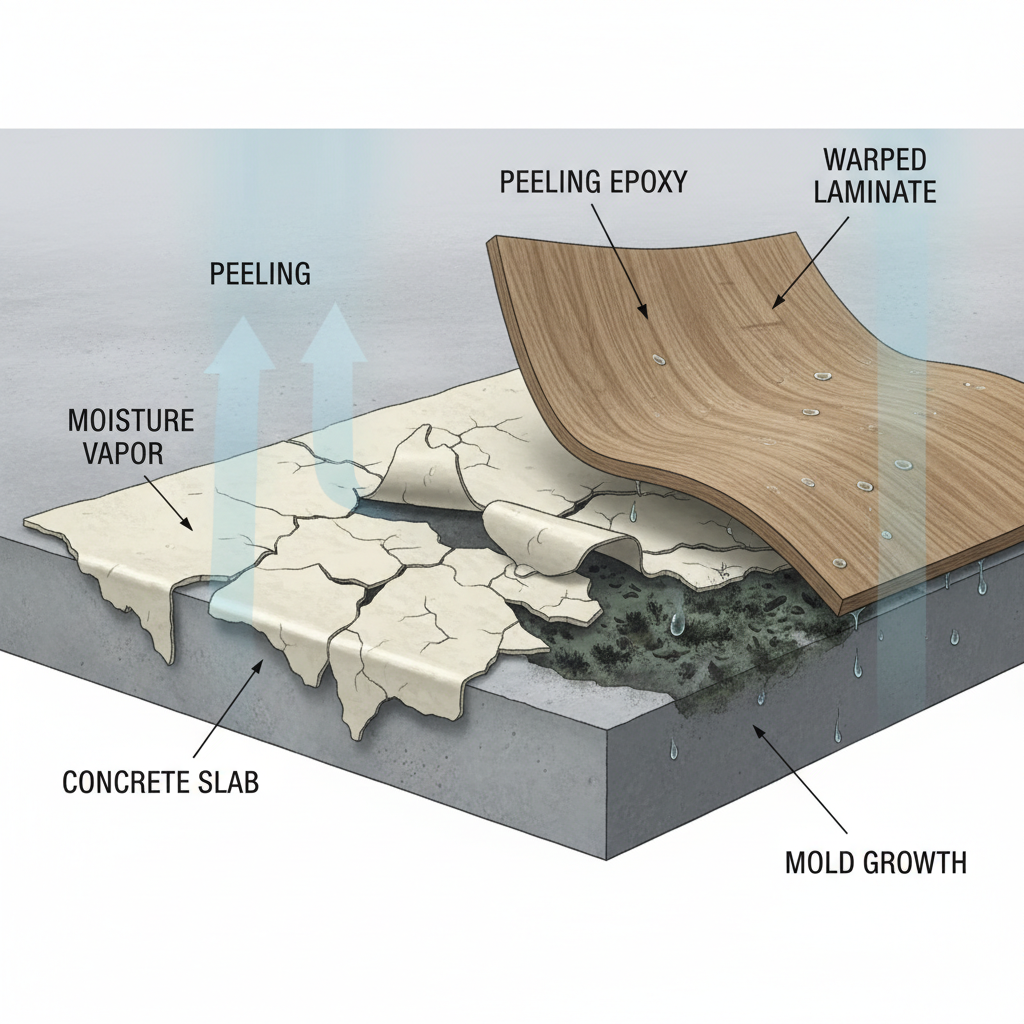
The Environmental Protection Agency (EPA) and the Institute of Inspection, Cleaning and Restoration Certification (IICRC) warn that mold can begin to grow on damp organic materials—like carpet pads or laminate backing—within just 24 to 48 hours of water exposure [2].
Triage & Recovery: Saving Water Damaged Basement Floors
If you are currently researching water damaged basement floors because you have just experienced a flood or severe leak, your immediate priority is safety and triage.
First, identify the water source. If the flooding involves Category 3 water (black water containing pathogens, such as a sewage backup or external floodwaters), strict sanitization protocols are mandatory. Any porous flooring materials, including carpets, laminate, and even some luxury vinyl planks with attached organic cork underlayments, must be safely removed and discarded.
Before any new flooring can be installed, the concrete slab must be thoroughly dried and sanitized to prevent secondary damage and structural mold.
The Contractor’s Truth: DIY vs. Professional Restoration
It is tempting to rent a few fans and tackle water damage yourself, but knowing when to call a professional is vital. If the water damage is extensive, involves Category 3 water, or has sat for more than 48 hours, you should immediately contact an IICRC-certified water damage restoration technician. They possess the commercial-grade dehumidifiers, moisture meters, and antimicrobial treatments necessary to ensure the slab is truly dry and safe before you invest in new flooring.
The Subfloor Imperative: Preparing for Durable Basement Floors
The most expensive, durable basement floors on the market will fail catastrophically if installed over a compromised subfloor. Exposing the reality of subfloor preparation is critical, as it is the most overlooked step in how to choose basement renovation flooring.
Before laying down a single plank or pouring a drop of coating, you must test your concrete slab for moisture. Do not rely on guesswork. Follow ASTM International standards by performing a calcium chloride test or an in-situ relative humidity (RH) probe test to accurately measure vapor emission rates [3]. A simple plastic sheet test—taping a 2×2 foot square of clear plastic to the concrete for 48 hours to check for condensation—can also serve as a preliminary red flag.
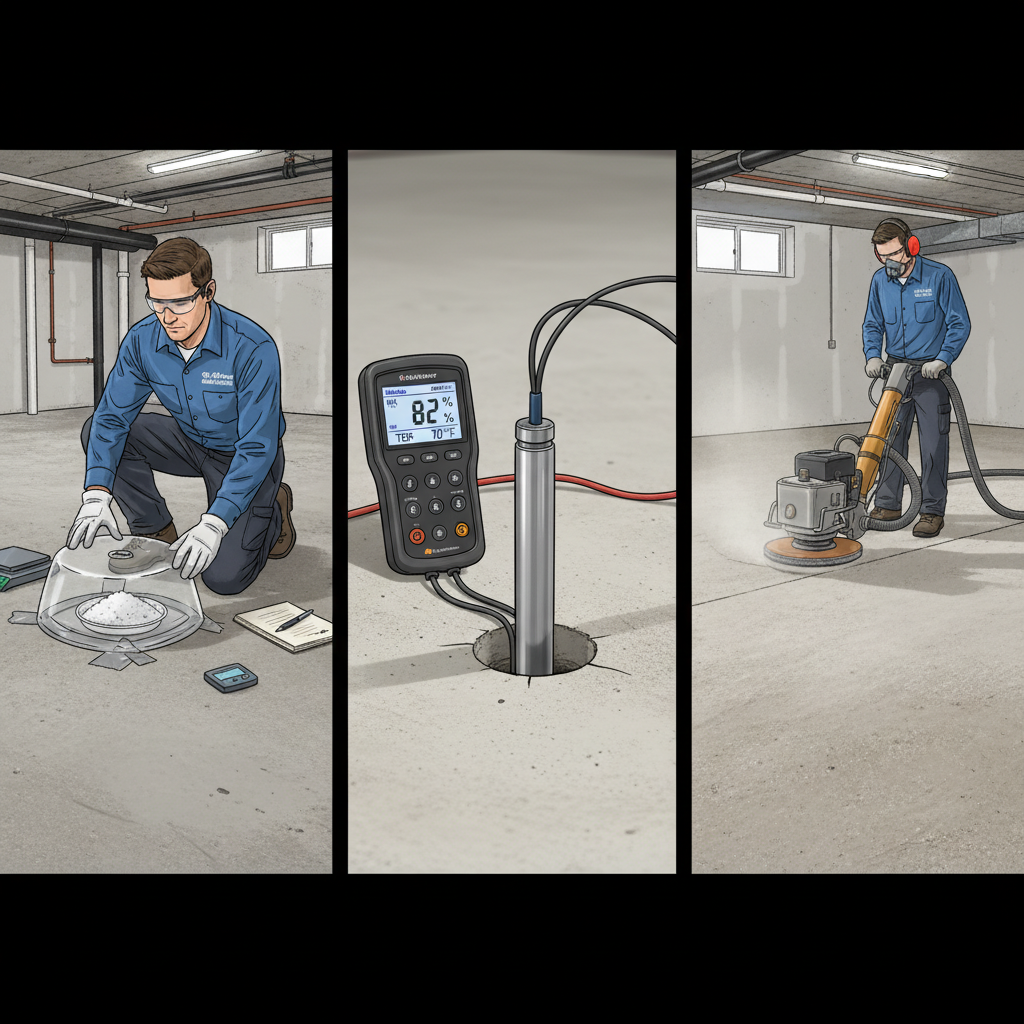
The statistics are sobering: 80% of high-performance floor coating failures are directly due to improper concrete surface preparation. You cannot simply sweep the floor and expect a lifetime bond.
Concrete Surface Profiling (CSP) & Leveling
For durable basement renovation flooring, particularly premium coatings, the concrete must be mechanically profiled. This involves grinding or shot blasting the surface to open the concrete’s pores, removing old sealers, paints, and laitance (a weak layer of cement dust).
The International Concrete Repair Institute (ICRI) standardizes this texture through a measurement called the Concrete Surface Profile (CSP) [4]. For high-grade coatings to achieve a permanent mechanical bond, a CSP of 2 or 3 (resembling the texture of medium-grit sandpaper) is absolutely mandatory. Once profiled, the floor must be meticulously leveled using a moisture-tolerant self-leveling underlayment to fill low spots and cracks, ensuring a flawless canvas for your new floor.
The Adamantine Advantage: Ultimate Waterproof Basement Floor Solutions
If you are seeking the pinnacle of waterproof basement floor solutions, look no further than Adamantine flooring. Representing an emerging, highly specialized niche in ultra-durable, industrial-grade coatings, Adamantine is the premium, “lifetime” solution for residential basements.
Unlike traditional paints or cheap DIY epoxies that sit on top of the concrete, Adamantine coatings feature an incredibly high molecular density. They chemically bond with the profiled concrete to create an impermeable, indestructible surface. Peer-reviewed data on ultra-hard polymer floor coatings, such as those published in the Journal of Materials Science, highlight the superior cross-linking chemistry that gives these materials their extreme resilience [5].
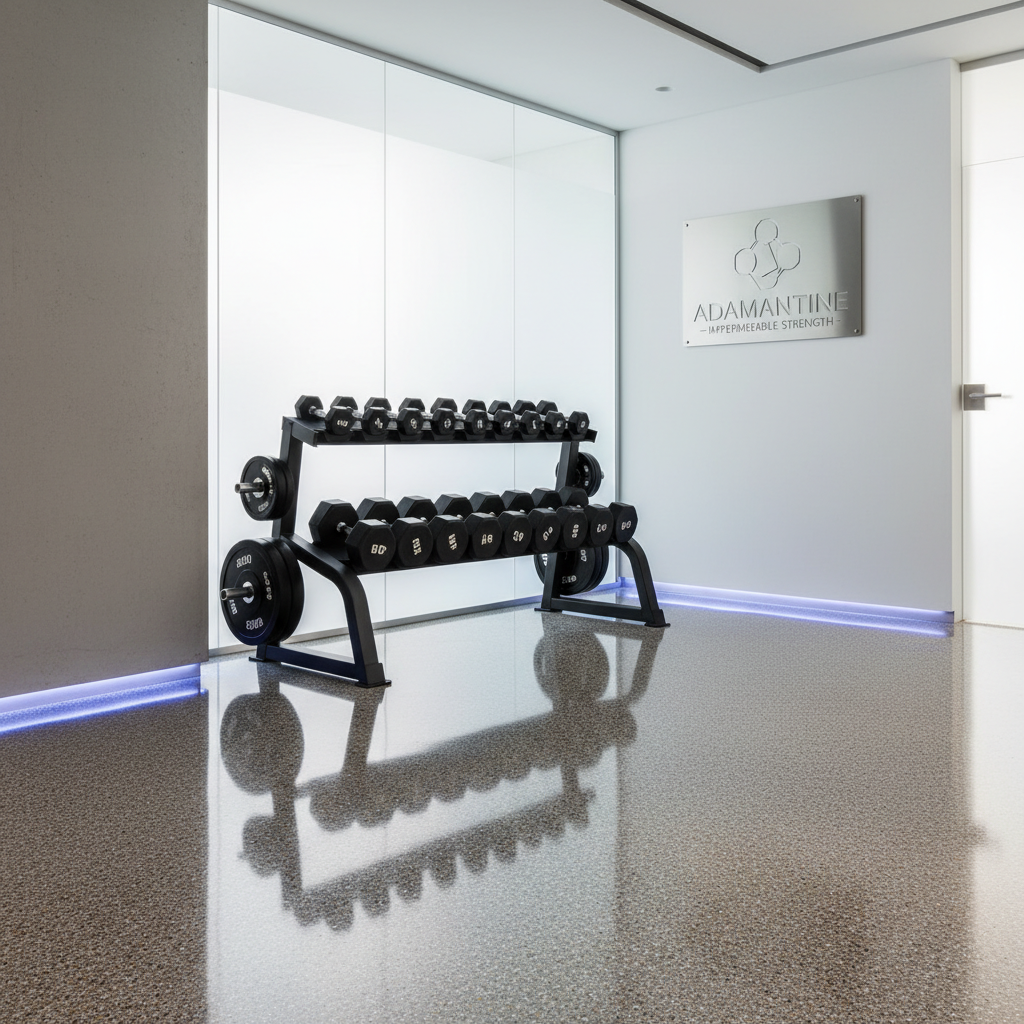
The data speaks for itself: Adamantine-grade coatings typically offer a Mohs hardness rating of 7 or higher, outperforming standard residential epoxies by up to 300% in abrasion resistance.
Waterproof Adamantine Basement Flooring Options & Aesthetics
When exploring waterproof adamantine basement flooring options, homeowners are often surprised by the aesthetic versatility. Adamantine is not just a dull, industrial gray. It can be customized with metallic pigments, quartz broadcasts, or decorative vinyl flakes to mimic the look of granite, marble, or terrazzo.
It is crucial to understand the difference between topical waterproof coatings (which can peel if moisture pushes from below) and penetrating waterproof systems like Adamantine. Because of its deep chemical bond, a properly installed Adamantine floor creates a seamless, non-porous surface that can withstand up to 12 lbs of hydrostatic pressure per 1,000 square feet—far exceeding the capabilities of standard paints and ensuring true waterproofing from the ground up.
Adamantine vs. Standard Epoxy & LVP: A Cost-Benefit Analysis
When evaluating the best durable flooring for basement renovations, a transparent, long-term ROI comparison is essential. While Adamantine flooring requires a higher upfront investment and professional installation, its lifecycle cost is significantly lower than the alternatives.
The Durability Scorecard (Vetted by Certified Flooring Inspectors):
- Adamantine Coatings:
- Compressive Strength: 10,000+ PSI (Virtually indestructible under heavy gym equipment or tools).
- Mohs Hardness: 7+ (Highly scratch-resistant).
- Lifespan: 20+ years with minimal maintenance.
- Standard Residential Epoxy:
- Compressive Strength: 3,000 – 5,000 PSI.
- Mohs Hardness: 3 – 4.
- Lifespan: 3 – 7 years (High risk of hot-tire pickup and peeling if moisture is present).
- Luxury Vinyl Plank (LVP):
- Compressive Strength: Variable (Prone to denting under heavy static loads).
- Mohs Hardness: N/A (Measured in wear-layer mils).
- Lifespan: 10 – 15 years (Waterproof from the top down, but can trap moisture underneath, leading to mold).
The Contractor’s Decision Matrix: How to Choose Basement Renovation Flooring
If Adamantine does not fit your specific aesthetic vision or budget, you need a structured decision tree for how to choose basement renovation flooring.
First, verify that your chosen material meets the definitions of 100% waterproof resilient flooring as outlined by the Resilient Floor Covering Institute (RFCI) [7]. Exclude anything merely labeled “water-resistant.”
Next, consider your use-case and local building codes. For example, if you are installing a thick subfloor system and heavy engineered tile, you must reference the International Residential Code (IRC) to ensure your new flooring thickness does not cause your staircase riser heights to fall out of compliance, creating a tripping hazard [6].
- For Home Gyms & Workshops: Adamantine coatings or heavy-duty interlocking rubber tiles over a vapor barrier.
- For Playrooms & Living Spaces: Stone Polymer Composite (SPC) Rigid Core LVP, which offers warmth and aesthetics while remaining 100% waterproof.
Solving the ‘Easily Scratched Basement Flooring’ Dilemma
Pet owners and those with heavy furniture frequently battle easily scratched basement flooring. To solve this, you must understand the mechanics of abrasion. While hardwoods use the Janka hardness scale, vinyl and laminate use different metrics.
According to the North American Laminate Flooring Association (NALFA) testing standards, you should look for specific durability ratings [8]. If you choose SPC Rigid core LVP, it must have a minimum 20-mil wear layer to withstand dog claws and sliding chairs. For laminates, insist on an AC4 or AC5 Abrasion Class rating, which is certified for high-traffic and commercial use, ensuring your floor remains pristine.
Execution: Installing Adamantine Flooring & Durable Upgrades
The execution phase of installing adamantine flooring and other durable basement renovation flooring is highly technical. While some homeowners are ambitious DIYers, premium coatings demand strict adherence to environmental controls.
If you attempt this yourself, you must follow the Manufacturers’ Technical Data Sheets (TDS) flawlessly regarding exact mixing ratios, induction times, and curing windows. Furthermore, industrial coatings emit volatile organic compounds (VOCs) during the curing process. You must provide adequate indoor ventilation and wear appropriate respirators, strictly adhering to Occupational Safety and Health Administration (OSHA) safety guidelines [9]. Because of the narrow application windows and required specialized equipment (like shot blasters), hiring a certified professional is strongly recommended for Adamantine.
Retrofitting: Safe Removal of Old Floors
Renovating an older basement brings its own set of challenges, particularly the safe removal of old floors. You will likely encounter stubborn cutback adhesives, failing leveling compounds, and potential health hazards.
If your home was built before the 1980s, you must exercise extreme caution before tearing up old 9×9 vinyl tiles or black mastic adhesive. The Environmental Protection Agency (EPA) safety standards dictate that these materials must be tested for asbestos by a certified professional before removal [10]. Never grind, sand, or scrape suspect materials, as this releases dangerous asbestos fibers into the air.
Conclusion
The “Lifetime Basement” philosophy is built on a foundation of building science: true durability starts with rigorous moisture mitigation and flawless subfloor preparation. Only when the concrete canvas is perfected can high-performance materials like Adamantine coatings or 20-mil SPC LVP truly shine. By investing in these critical steps, you protect your home from the nightmare of water damage, mold, and premature flooring failure.
Don’t let another renovation fall short. Contact a certified local flooring contractor today to evaluate your concrete slab, test your moisture levels, and see if an Adamantine upgrade is the right durable solution for your basement.
Disclaimer: The information provided in this article is for educational purposes only. Readers are strongly advised to consult certified professionals for asbestos testing (especially in older homes), severe mold remediation, and structural moisture mitigation before attempting any DIY flooring installation or demolition.
References & Authoritative Sources
- Building Science Corporation. (N.D.). Moisture Dynamics and Vapor Permeance in Below-Grade Environments.
- Environmental Protection Agency (EPA) & Institute of Inspection, Cleaning and Restoration Certification (IICRC). (N.D.). Guidelines for Mold Cleanup and Water Damage Restoration.
- ASTM International. (N.D.). Standards for Testing Moisture Vapor Emission Rates in Concrete.
- International Concrete Repair Institute (ICRI). (N.D.). Standards for Concrete Surface Profiles.
- Journal of Materials Science. (N.D.). Performance and Durability of Ultra-Hard Polymer Floor Coatings.
- International Residential Code (IRC). (N.D.). Basement Finishing and Egress Regulations.
- Resilient Floor Covering Institute (RFCI). (N.D.). Industry Standards for Waterproof Resilient Flooring.
- North American Laminate Flooring Association (NALFA). (N.D.). Testing Standards for Scratch and Wear Resistance.
- Occupational Safety and Health Administration (OSHA). (N.D.). Safety Guidelines for Indoor Ventilation and VOCs.
- Environmental Protection Agency (EPA). (N.D.). Asbestos Safety Standards in the Home.
