If you own a home or manage a property, you are likely intimately familiar with the frustration of rapidly degrading floors in your building’s “funnel” zones. Entryways and hallways are the arteries of a home, concentrating every muddy boot, clicking pet claw, and rolling suitcase into a narrow, unforgiving path. Too often, homeowners invest thousands in what is marketed as “scratch-resistant” flooring, only to watch it succumb to deep gouges, wear trails, and moisture damage within a few short years.
This cycle of premature failure stems from a core problem: deceptive marketing hype that confuses a temporary scratch-resistant finish with true, structural invulnerability. It is time to shift the paradigm.
This is a forensic, scientifically backed guide to adamantine flooring—a generational, 50-year investment designed to withstand the harshest residential and commercial environments. By moving past the marketing jargon, we will help you diagnose existing high traffic floor damage, decode the material science behind true durability, and provide a roadmap for the bulletproof installation of floors that will outlast your mortgage.
- What is Adamantine Flooring? Demystifying True Durability
- Forensic Floor Analysis: Diagnosing High Traffic Floor Damage
- The Mudroom Blueprint: Best Flooring for High Traffic Entryways
- Wear Trail Prevention: Adamantine Flooring for Busy Residential Hallways
- The 50-Year Investment: Long Lasting Hallway Flooring Solutions
- Bulletproof Execution: Durable Entryway Floor Installation
- Conclusion
- References and Authoritative Sources
What is Adamantine Flooring? Demystifying True Durability
In the context of flooring, the term “adamantine” is borrowed from mineralogy, referring to substances with a brilliant, diamond-like luster and extreme, unyielding hardness. While marketers often use the word loosely, in material science, adamantine flooring refers to materials that are practically indestructible under normal to heavy human use.
To understand what makes a floor truly adamantine, we must look to the Journal of Materials Science, which evaluates material hardness and wear resistance based on atomic structure and density rather than superficial coatings [1]. An adamantine floor does not just resist surface abrasions; it possesses a core density that prevents crushing, denting, and structural failure. This extreme durability is measured using standardized scientific metrics, most notably the Mohs hardness scale, where adamantine-level materials (like high-fired porcelain and natural quartz) rank significantly higher than traditional wood or vinyl.
The Science of Scratch Resistance: Mohs, AC, and PEI Ratings Explained
To find truly scratch resistant adamantine floors, you must learn to read the standardized testing metrics used by the flooring industry.
- The Mohs Hardness Scale: Used primarily for natural stone, this scale ranks materials from 1 (talc) to 10 (diamond). For high-traffic flooring, you want materials ranking at a 7 or higher (like granite or quartz), which cannot be scratched by steel or tracked-in silica sand.
- AC (Abrasion Class) Ratings: Governed by the North American Laminate Flooring Association (NALFA), this rating applies to laminate and some vinyl floors [2]. It measures wear resistance using a specialized machine that rubs the floor with abrasive paper. For high traffic, an AC4 (commercial general) or AC5 (commercial heavy) is required.
- PEI Wear Ratings: The Porcelain Enamel Institute (PEI) grades the wear resistance of glazed tile on a scale of 1 to 5 [3]. For an adamantine-level entryway, a PEI rating of 4 or 5 is non-negotiable.
The Traffic Volume Calculator: To match your home to the right rating, consider your daily traffic volume.
- Low Volume (1-2 adults, no pets, shoes off): AC3 / PEI 3
- Medium Volume (Family with kids, light pet traffic): AC4 / PEI 4
- High Volume (Large dogs, heavy outdoor grit, frequent guests, rolling loads): AC5 / PEI 5 / Mohs 7+
Adamantine vs. ‘Scratch-Resistant’ LVP: Separating Hype from Reality
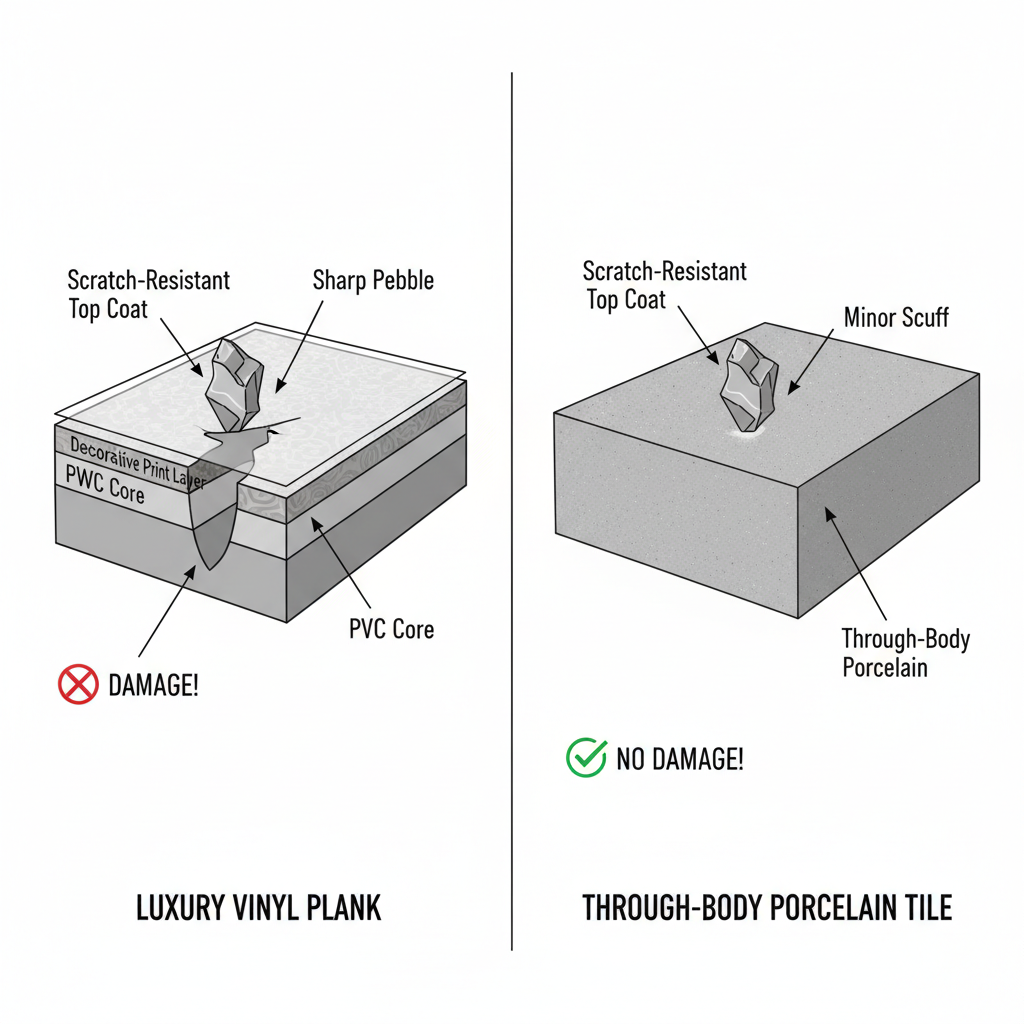
A major gap in consumer knowledge is the difference between standard Luxury Vinyl Plank (LVP) and true adamantine flooring. LVP is heavily marketed as “scratch-resistant,” but it is crucial to separate the finish layer from the core material.
According to the American Society for Testing and Materials (ASTM) standards for scratch and mar resistance testing, a floor’s finish (often a micron-thin layer of aluminum oxide or urethane) may resist light scuffs [4]. However, the core of LVP is relatively soft. When a heavy, sharp object—like a pebble stuck in a boot tread—is dragged across LVP, it easily breaches the finish and gouges the soft core. This is not scratch-proof; it is merely scratch-delayed. True adamantine flooring, such as through-body porcelain tile, has the same extreme hardness from the surface all the way through the core, making deep gouges virtually impossible.
Forensic Floor Analysis: Diagnosing High Traffic Floor Damage
Before investing in new flooring, you must diagnose why your current floors failed. This forensic approach helps you avoid repeating past mistakes. Standard manufacturer warranties often contain clauses excluding “abnormal wear and tear,” meaning the burden of choosing the right floor falls entirely on you.
When diagnosing worn out hallway floors, professionals look for specific technical failures:
- Telegraphing: When the texture of an uneven subfloor shows through the surface of the flooring.
- Delamination: The separation of the wear layer from the core material, common in cheap laminates.
- Static Load Limit Failure: Indentations left by heavy, stationary furniture because the material’s structural density was too low.
Identifying the Culprits: Pivot Points, Rolling Loads, and Winter Grit
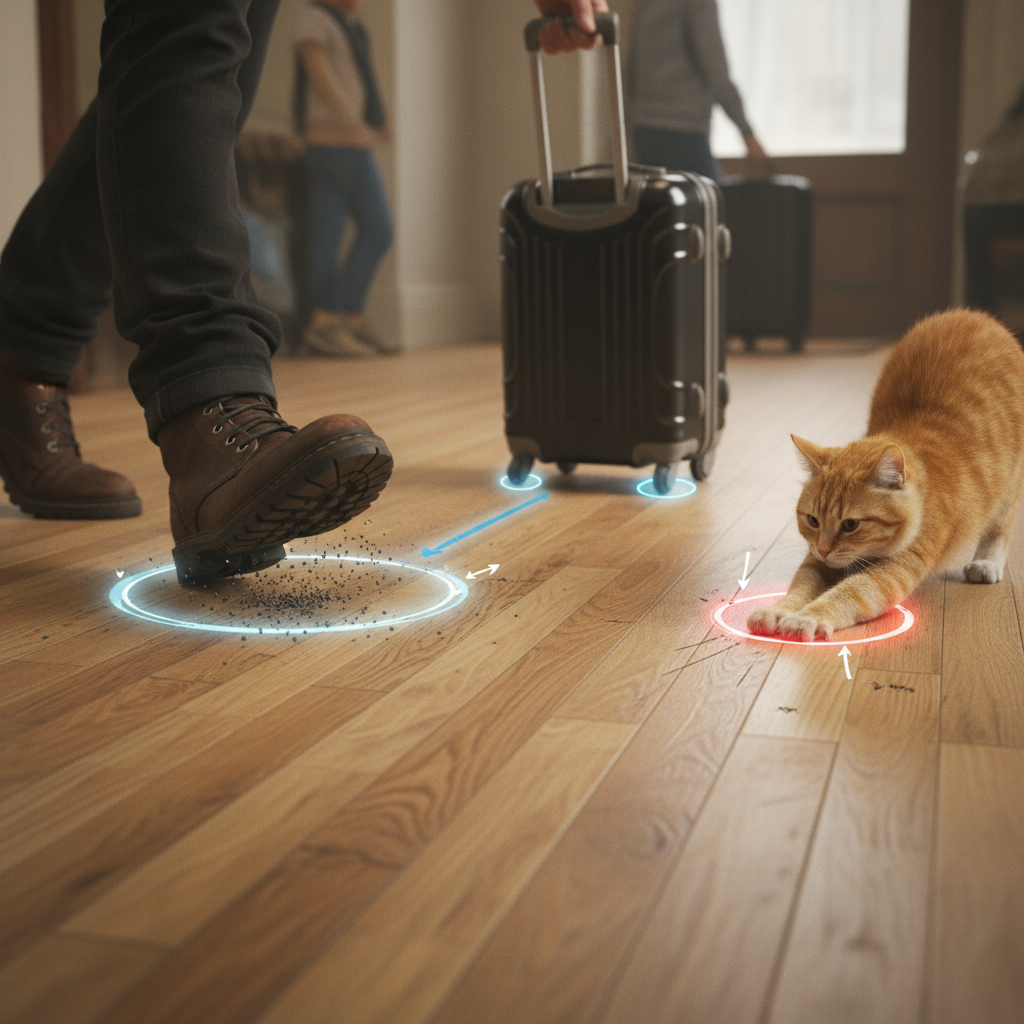
Damage in entryways and hallways is rarely uniform. It is localized to specific behavioral patterns. Floor Covering Installer Magazine highlights “rolling loads”—such as wheelchairs, heavy luggage, and rolling utility carts—as a primary cause of joint failure and delamination in floating floors [5].
Furthermore, entryways suffer from “pivot points.” This is the exact spot where a person plants their foot and twists their body to close the front door. This grinding motion, combined with tracked-in winter grit, acts like a rotary sander on your floor.
“Eighty percent of floor damage in high-traffic zones is caused by the abrasive action of silica sand and salt trapped underfoot at pivot points. Without an adamantine surface or an aggressive matting system, the floor doesn’t stand a chance.” — Commercial Facility Manager
First Aid for Floors: Safe Scratch Repair vs. Harmful DIY Hacks
If you are currently dealing with scratched entryway flooring, immediate remediation is required. However, the internet is rife with harmful DIY hacks—like rubbing walnuts, olive oil, or mayonnaise into scratches. These oils can permanently contaminate the floor’s finish, making future professional recoating impossible.
Instead, follow the National Wood Flooring Association (NWFA) guidelines for finish repair [6]. First, identify your finish (polyurethane vs. wax). For polyurethane, clean the scratch thoroughly to remove embedded grit. Then, use a professional-grade repair kit. The Good Housekeeping Institute regularly tests and verifies acrylic-based scratch concealers and hard wax melt kits that actually bond with the existing finish without causing contamination [7].
The Repair vs. Replace Flowchart for Worn Hallways
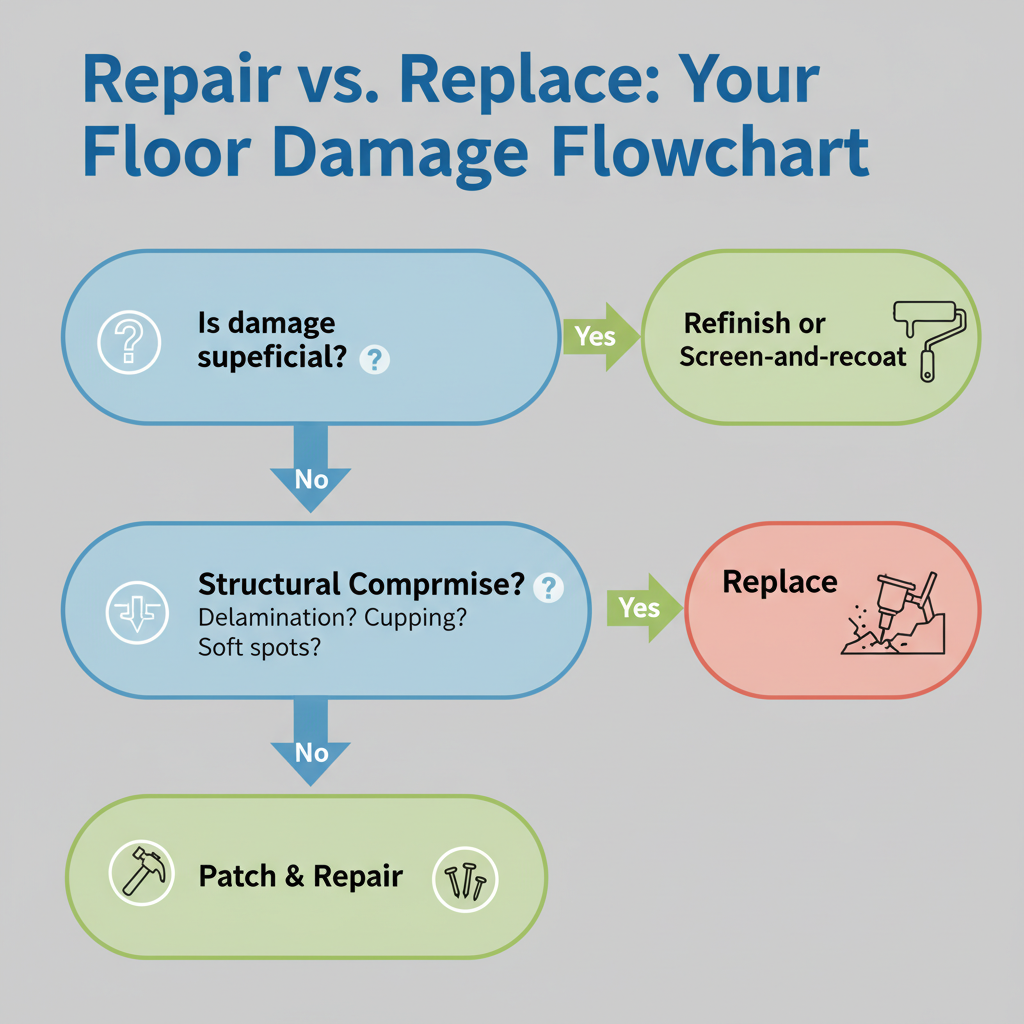
How do you know when a floor is beyond first aid? Use this diagnostic flowchart based on standards from the Institute of Inspection, Cleaning and Restoration Certification (IICRC) [8]:
- Is the damage purely superficial (light scuffs in the finish layer)?
- Yes: Refinish or screen-and-recoat. (Estimated cost: $1.50 – $3.00/sq. ft. via HomeAdvisor/Angi data) [9].
- Does the damage penetrate the wear layer into the core material (deep gouges, exposed wood/vinyl core)?
- Yes: Proceed to Step 3.
- Is the flooring structurally compromised (delaminating, cupping, or soft spots)?
- Yes: Replace. The floor has failed. Investing in a repair is a waste of capital. It is time to upgrade to a long-lasting adamantine solution.
The Mudroom Blueprint: Best Flooring for High Traffic Entryways
The entryway is your home’s first impression, but it is also a hostile environment. Finding the best flooring for high traffic entryways requires balancing the aesthetic demands of the American Society of Interior Designers (ASID) with extreme weather and dirt resistance [10].
Here is a tiered “Good, Better, Best” recommendation system for durable entryway floors:
- Good: High-end Rigid Core LVP (20mil+ wear layer). Pros: Waterproof, easy to install. Cons: Vulnerable to deep scratches from pivot points.
- Better: Natural Slate Tile. Pros: Excellent camouflage for dirt, highly durable. Cons: Requires regular sealing to prevent chemical damage from road salt.
- Best (Adamantine Level): Through-Body Porcelain Tile (PEI 5). Pros: Impervious to water, salt, and scratches. A true 50-year floor.
Combating Moisture and Salt: Slip Resistance (COF) and Waterproofing
Winter road salt is highly corrosive. It can chemically burn the finish off hardwood and degrade the grout in cheap tile installations. Furthermore, wet entryways are a severe slip hazard.
When selecting entryway flooring, you must consult the Coefficient of Friction (COF) standard. The Tile Council of North America (TCNA) recommends a dynamic COF of 0.42 or higher for level interior spaces that may get wet [11]. Textured porcelain tile not only boasts a near-zero water absorption rate (making it impervious to salt and snow) but can also be manufactured with high-COF textures to prevent slips, making it the ultimate mudroom blueprint material.
Wear Trail Prevention: Adamantine Flooring for Busy Residential Hallways
Residential hallways act as architectural funnels. They take the dispersed foot traffic of an entire house and concentrate it into a 3-foot-wide path, inevitably leading to “wear trails.” When searching for adamantine flooring for busy residential hallways, you need materials that resist this concentrated friction.
The Hallway Durability Matrix:
- Hardwood (Oak/Maple): Moderate Scratch Resistance | Low Dent Resistance | Low Water Resistance
- Laminate (AC4/AC5): High Scratch Resistance | Moderate Dent Resistance | Moderate Water Resistance
- Adamantine Porcelain/Stone: Extreme Scratch Resistance | Extreme Dent Resistance | Extreme Water Resistance
Upgrading to the most durable flooring options for hallways isn’t just about utility; it’s about home value. According to data from the National Association of Realtors (NAR), seamlessly flowing, high-durability flooring significantly boosts buyer appeal [12].
“Buyers immediately notice wear trails in hallways. It subconsciously signals that the house is tired and requires maintenance. A pristine, adamantine hallway floor suggests a home that is bulletproof and well-cared for, directly increasing ROI.” — Licensed Realtor
Acoustic Mitigation: Managing Echoes with IIC Ratings
There is one major caveat to installing ultra-hard adamantine floors in narrow hallways: acoustics. Hard surfaces reflect sound, turning a hallway into an echo chamber that amplifies footsteps and voices throughout the house.
To mitigate this, you must look at Impact Insulation Class (IIC) ratings. The Acoustical Society of America sets standards for impact noise transmission [13]. If you are installing porcelain or stone in a hallway—especially on a second floor—you must pair it with a premium acoustic underlayment designed for rigid flooring. A high-quality cork or specialized rubber underlayment can dramatically increase the IIC rating, absorbing the impact energy of footsteps before it translates into airborne noise.
The 50-Year Investment: Long Lasting Hallway Flooring Solutions
To truly solve your flooring woes, you must shift your perspective from upfront installation costs to the Total Cost of Ownership (TCO). A floor is only cheap if you don’t have to replace it. According to the National Association of Home Builders (NAHB), while carpet and cheap vinyl may need replacing every 5 to 10 years, natural stone and high-grade porcelain are expected to last the lifetime of the home [14].
Be wary of “lifetime warranties” on cheaper materials. In the flooring industry, a lifetime warranty usually only covers manufacturing defects, not the inevitable wear and tear of daily life.
Calculating the Total Cost of Ownership (TCO) over 30+ Years
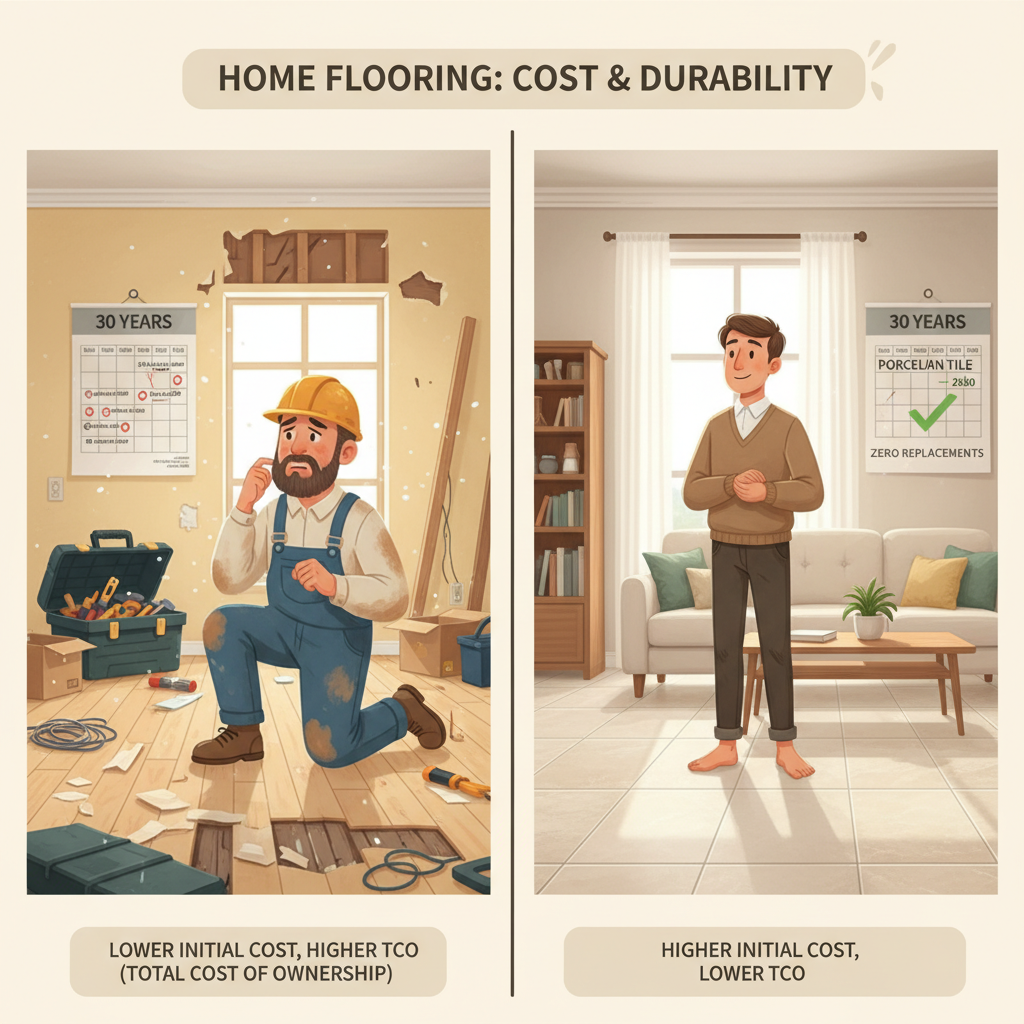
Let’s look at a 30-year TCO breakdown for a 200-square-foot high-traffic zone, backed by durability testing concepts from Consumer Reports [15]:
- Cheap Laminate/Vinyl (Replaced every 7 years):
- Initial Cost (Materials + Install): $1,200
- Replacement Cycles over 30 years: 4
- Total 30-Year Cost: $4,800+ (plus the massive inconvenience of 4 renovations)
- Adamantine Porcelain Tile (PEI 5):
- Initial Cost (Materials + Install): $3,000
- Replacement Cycles over 30 years: 0
- Total 30-Year Cost: $3,000
Investing in long lasting hallway flooring solutions saves you thousands of dollars and endless headaches over the lifespan of your home.
Timeless Design: Choosing Floors That Outlast Trends
A floor might physically last 50 years, but if it features a hyper-trendy pattern, it will be aesthetically obsolete in a decade, forcing a premature replacement. To maximize your 50-year investment, look to historical societies and architectural preservation boards [16].
Materials like classic terrazzo, natural slate, and neutral-toned, large-format porcelain have graced public buildings and high-end homes for over a century without looking dated. Choose timeless, organic textures and colors. Let your rugs and wall paint carry the trends; let your adamantine floors be the permanent, unshakeable canvas.
Bulletproof Execution: Durable Entryway Floor Installation
This section has been reviewed in accordance with standards set by Licensed General Contractors.
Even the most indestructible adamantine floor will crack, tent, or fail if the subfloor and installation are flawed. Durable entryway floor installation is a science. If you are not an advanced DIYer, use this Contractor Vetting Checklist:
- Do they check subfloor deflection?
- Do they use premium, modified thinset for heavy tiles?
- Do they specify moisture mitigation systems?
Subfloor Preparation and Structural Load Requirements
Adamantine materials are heavy and rigid. They require a perfectly flat, structurally sound base. The National Wood Flooring Association (NWFA) and tile industry standards dictate strict subfloor flatness tolerances—typically no more than 3/16 of an inch variance over a 10-foot span [6].
Furthermore, from a structural engineering perspective, heavy stone or large-format porcelain requires a stiff subfloor to prevent deflection (bending). If your floor joists bounce when you walk, installing an adamantine floor will result in cracked grout and shattered tiles. You may need to reinforce the joists or add a secondary layer of high-quality plywood underlayment before installation.
Moisture Barriers and Transitioning to Living Spaces
Entryways built over concrete slabs or unconditioned crawlspaces are highly susceptible to hydrostatic pressure—moisture vapor rising through the subfloor. The Tile Council of North America (TCNA) is the absolute authority here, mandating proper moisture mitigation [11]. For concrete slabs, a liquid-applied vapor barrier or an uncoupling membrane is mandatory to prevent the moisture from degrading the adhesive and popping the tiles loose.
Finally, transitioning your durable entryway floor to the softer flooring of your living spaces requires precision. Industry leaders like Schluter Systems provide specialized metal transition profiles that protect the edges of your adamantine floor from chipping while creating a seamless, trip-free threshold into the rest of your home [17].
Conclusion
True adamantine flooring is not a marketing buzzword; it is a scientific, generational investment. By looking past the hype of “scratch-resistant” plastics, diagnosing your home’s specific traffic patterns, and committing to materials with proven Mohs, AC, and PEI ratings, you can permanently solve the headache of worn-out floors.
We encourage you to use the Repair vs. Replace Flowchart to assess your current damage, calculate your household’s traffic volume, and consult with a certified flooring inspector or licensed contractor. Stop replacing your floors every decade. Execute a flawless installation, and step confidently onto a 50-year floor that will beautifully endure everything life throws at it.
Standard home improvement disclaimer: Information provided regarding subfloor load-bearing requirements and structural modifications is for educational purposes. Always consult a Licensed General Contractor or Structural Engineer before installing heavy flooring materials.
References and Authoritative Sources
- Journal of Materials Science. (N.D.). Metrics on Material Hardness and Wear Resistance. Retrieved from https://www.springer.com/journal/10853
- North American Laminate Flooring Association (NALFA). (N.D.). Understanding Laminate Flooring Abrasion Class (AC) Ratings. Retrieved from https://nalfa.com/
- Porcelain Enamel Institute (PEI). (N.D.). PEI Wear Ratings for Glazed Tile. Retrieved from https://www.porcelainenamel.com/
- American Society for Testing and Materials (ASTM). (N.D.). ASTM Standards for Scratch and Mar Resistance Testing. Retrieved from https://www.astm.org/
- Floor Covering Installer Magazine. (N.D.). Technical Insights on Failure Causes: Rolling Loads. Retrieved from https://www.fcimag.com/
- National Wood Flooring Association (NWFA). (N.D.). Guidelines on Finish Repair and Subfloor Flatness Tolerances. Retrieved from https://nwfa.org/
- Good Housekeeping Institute. (N.D.). Product Testing for Floor Repair Kits. Retrieved from https://www.goodhousekeeping.com/institute/
- Institute of Inspection, Cleaning and Restoration Certification (IICRC). (N.D.). Standards for Floor Care and Restoration. Retrieved from https://iicrc.org/
- HomeAdvisor / Angi. (2024). Current Cost Averages for Floor Refinishing vs. Replacement. Retrieved from https://www.homeadvisor.com/
- American Society of Interior Designers (ASID). (N.D.). Expertise on Functional Home Design. Retrieved from https://www.asid.org/
- Tile Council of North America (TCNA). (N.D.). Standards for Slip Resistance, Water Absorption, and Moisture Mitigation. Retrieved from https://www.tcnatile.com/
- National Association of Realtors (NAR). (N.D.). Data on Homebuyer Preferences and Flooring ROI. Retrieved from https://www.nar.realtor/
- Acoustical Society of America. (N.D.). Standards on Impact Noise Transmission and IIC Ratings. Retrieved from https://acousticalsociety.org/
- National Association of Home Builders (NAHB). (N.D.). Study of Life Expectancy of Home Components. Retrieved from https://www.nahb.org/
- Consumer Reports. (N.D.). Independent Testing Data on Flooring Durability. Retrieved from https://www.consumerreports.org/
- Historical Societies and Architectural Preservation Boards. (N.D.). Insights on Truly Long-Lasting Historical Materials.
- Schluter Systems. (N.D.). Industry Standards for Transition and Waterproofing Profiles. Retrieved from https://www.schluter.com/
