It is a familiar and uniquely frustrating scenario for discerning homeowners and commercial facility managers alike: you invest heavily in premium, “ultra-durable” flooring, only to watch the plank edges chip, peel, and separate within the first year. The marketing brochures promised invincibility, boasting about thick wear layers and impenetrable finishes. Yet, high-traffic zones quickly tell a different story.
The harsh reality of the flooring industry is that a thick wear layer cannot protect a weak edge or a soft core. When a floor fails prematurely, the surface is rarely the culprit; the structural vulnerabilities lie at the seams.
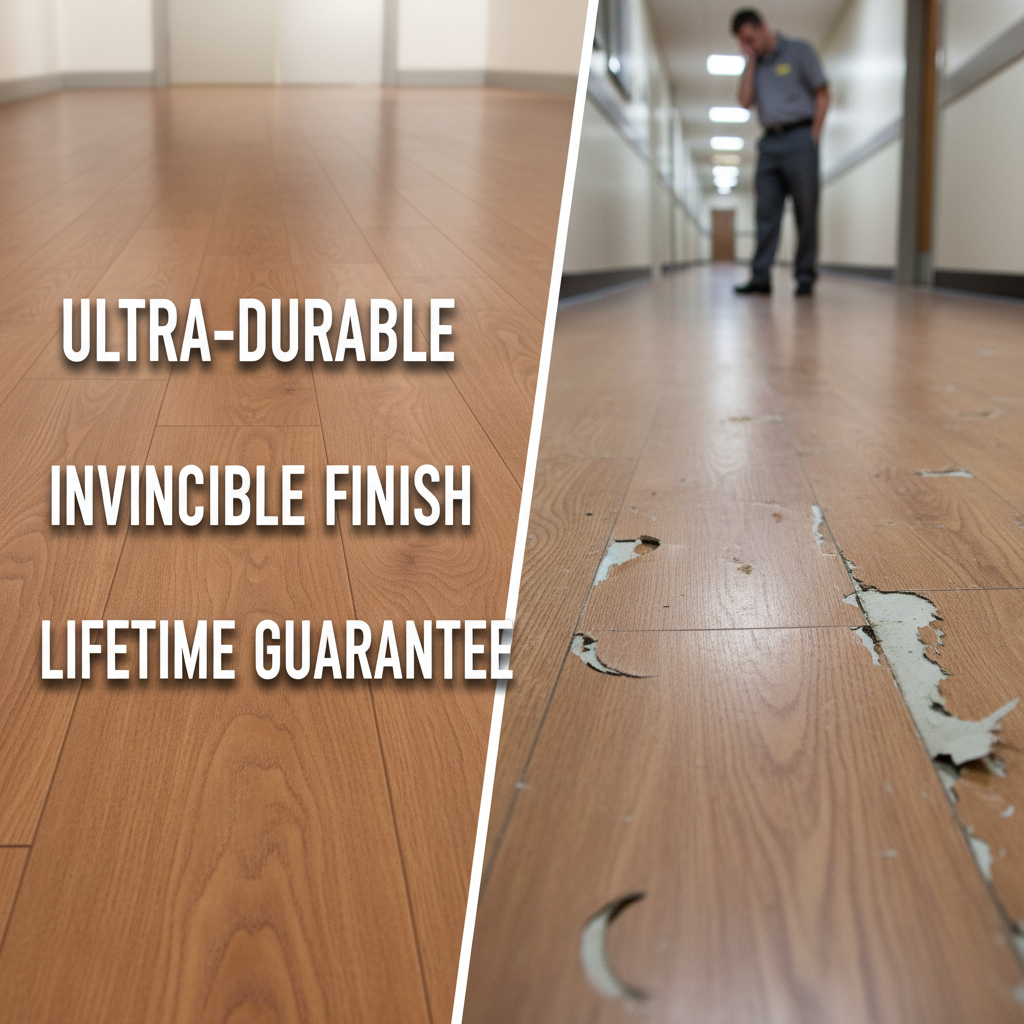
This comprehensive, science-backed guide moves beyond superficial marketing fluff to reveal the true mechanics of high-traffic floor durability. We will decode industry jargon like “adamantine” safeguards, analyze the critical role of core density (SPC vs. WPC), and explore the physics behind advanced edge protection technologies like pressed bevels. If you want to stop chipped plank edges forever and understand the forensic science of true chip-resistant flooring, this is your definitive roadmap.
- The Anatomy of Floor Failure: Why High-Traffic Floor Wear Targets the Edges
- Decoding ‘Adamantine Flooring’: Marketing Jargon vs. Material Science
- The Physics of Flooring Edge Protection: Profiles and Technologies
- Core Density: The True Secret to Chip-Resistant Flooring
- Forensic Diagnostic Guide: Identifying and Fixing Damaged Flooring Edges
- The Ultimate Buyer’s Checklist for High-Traffic Floor Durability
- Conclusion
- References & Authoritative Sources
The Anatomy of Floor Failure: Why High-Traffic Floor Wear Targets the Edges
When evaluating high-traffic floor wear, most consumers mistakenly focus on general surface scratching. However, structural failure almost always begins at the perimeter of the plank. The edges and locking joints are the most vulnerable components of any floating floor system. In fact, industry data reveals that edge chipping and joint failure account for over 30% of laminate flooring warranty claims [1].
Why do these specific areas fail? According to insights from IICRC-certified flooring inspectors, entryways and hallways experience up to five times more abrasive wear than bedrooms [2]. This is due to a combination of tracked-in particulate matter (dirt and grit acting like sandpaper) and the concentrated pivot motions of foot traffic. The World Floor Covering Association (WFCA) provides strict guidelines distinguishing between normal “wear and tear”—like superficial surface scuffs—and premature structural failure, which includes compromised, damaged flooring edges [3].
Surface Wear vs. Structural Edge Vulnerability
To truly understand wear-resistant floor edges, we must differentiate between cosmetic damage and structural failure. Surface wear typically manifests as micro-scratches in the polyurethane finish. Over time, these microscopic abrasions scatter light, causing the dreaded “dulling” effect in high-traffic funnels. While unsightly, this does not compromise the floor’s integrity.
Physical edge crushing, on the other hand, is a structural failure. If a plank has a weak edge profile, the locking mechanism can snap under pressure, or the top layer can shear off entirely. A massive 20-mil wear layer is practically useless if the edge it sits upon is brittle or poorly supported.
The Hidden Culprit: Subfloor Preparation and Plank Flex
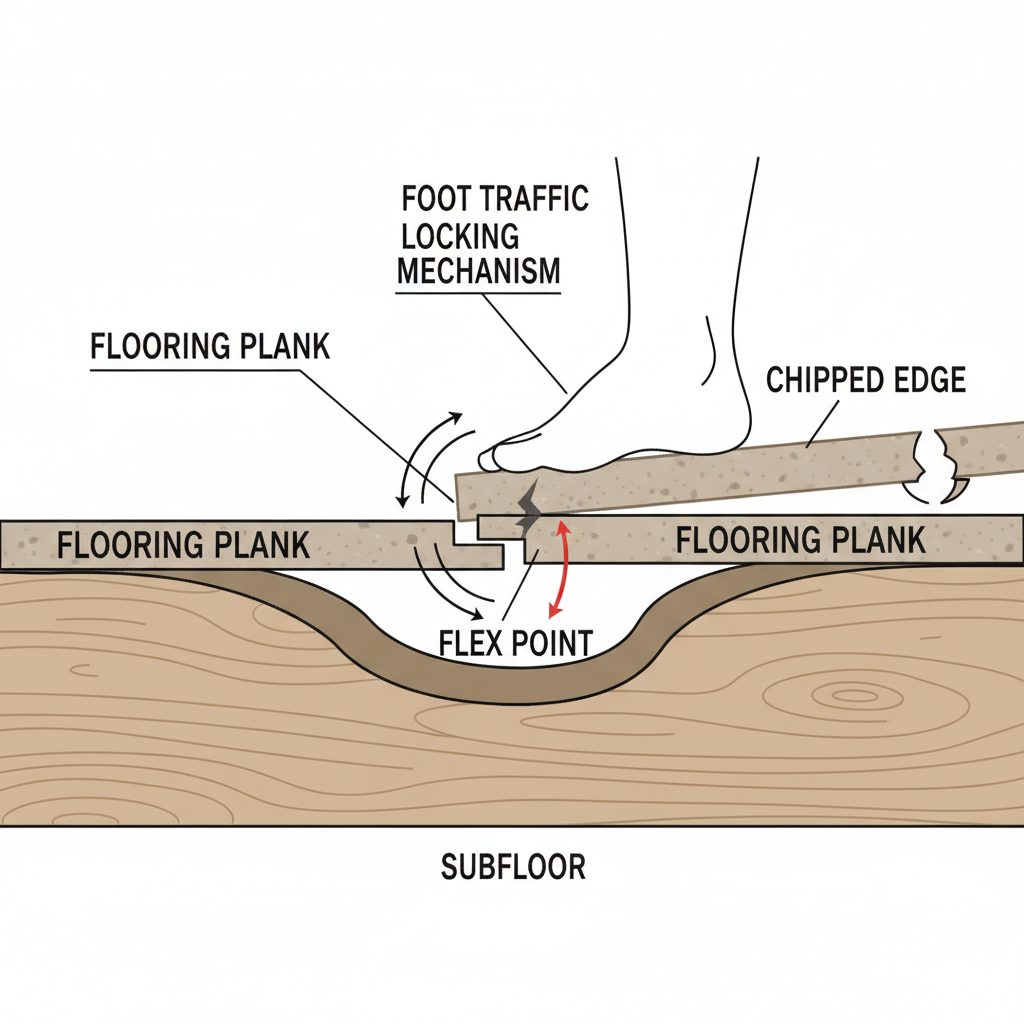
If you are researching how to prevent flooring edges from chipping, the most critical answer lies beneath the planks. The root cause of the vast majority of chipped floor plank edges is an uneven subfloor.
When a subfloor has dips or high spots, the flooring planks bridge those gaps. As foot traffic passes over the void, the plank flexes downward. This constant micro-bending stresses the locking mechanisms, eventually causing the edges to peak, rub together, and snap. The data is staggering: improper subfloor preparation—specifically unevenness exceeding 3/16 of an inch over a 10-foot radius—is cited in 60% of early edge wear and chipping cases [4]. The National Wood Flooring Association (NWFA) Technical Manuals serve as the gold standard for these subfloor preparation tolerances, emphasizing that a flat subfloor is the ultimate edge protector [5].
Decoding ‘Adamantine Flooring’: Marketing Jargon vs. Material Science
In the quest for ultimate durability, consumers frequently encounter terms like “Adamantine flooring” or an “Adamantine plank safeguard.” But what does this actually mean?
In materials science, “adamantine” refers to a non-metallic, brilliant luster, historically associated with the hardness and light-refracting qualities of diamonds. In the flooring industry, however, it is often used as aggressive marketing jargon for extreme hardness. To separate fact from fiction, we must look to the Mohs hardness scale, a standard detailed in Materials Science and Engineering journals [6].
True adamantine-grade safeguards rely on advanced chemical makeups, typically infusing standard polyurethane finishes with microscopic particles of Aluminum Oxide or Ceramic Bead technologies. Aluminum oxide ranks at a 9 on the Mohs scale (just below a diamond at 10). When these minerals are embedded into the wear layer, they create a shield that drastically reduces micro-scratching. However, as industrial coatings experts point out, while these ultra-premium coatings offer exceptional surface scratch resistance, they do not inherently prevent edge chipping if the core material beneath them is soft [7].
The Physics of Flooring Edge Protection: Profiles and Technologies
Safeguarding plank edges from high-traffic wear requires a close look at manufacturing techniques. How the edge of a plank is milled and treated directly dictates its lifespan.
Pressed Bevels vs. Cut Bevels vs. Square Edges
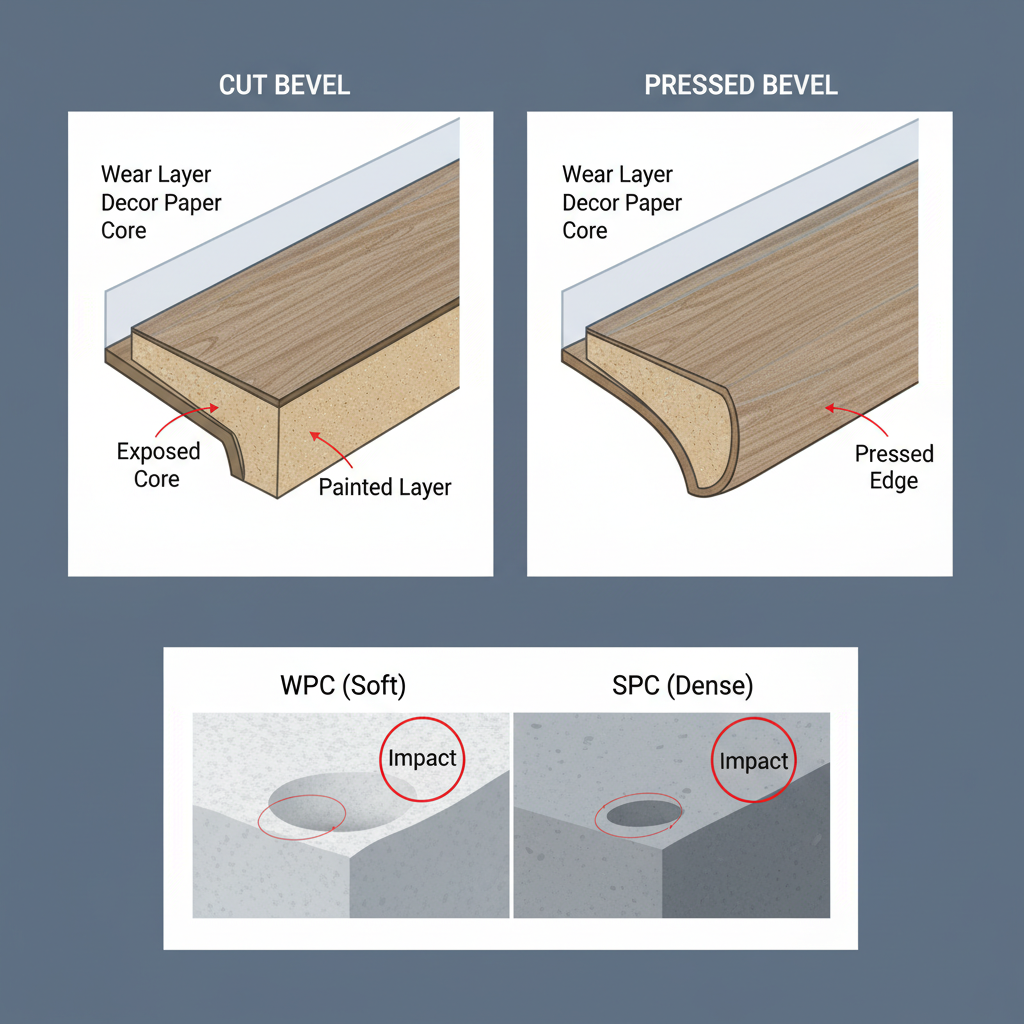
The physics of flooring edge protection comes down to impact deflection.
- Square Edges: These planks meet flush, creating a seamless look. However, the sharp 90-degree angle is highly susceptible to catching shoes, dropped objects, and sliding furniture, making them chip easily.
- Cut Bevels (or Painted Bevels): The edge is milled away at an angle to create a V-groove, and the exposed core is then painted to match the decor. While this hides slight subfloor imperfections, it leaves the core vulnerable to moisture and impact.
- Pressed Bevels: This is the pinnacle of wear-resistant floor edges. Instead of cutting the edge, the manufacturer uses extreme heat and pressure to “press” the wear layer and decor paper down over the edge of the plank.
According to technical data sheets and wood science manufacturing studies, pressed bevel edges increase edge impact resistance by up to 25% compared to traditional cut bevels because the core is never exposed [8]. Furthermore, testing standards defined by the North American Laminate Flooring Association (NALFA) consistently show that pressed bevels offer superior resistance to edge swell and impact [9].
Locking Mechanism Strength: Drop-and-Lock vs. Angle-Angle
The way planks connect also plays a vital role in edge durability. “Angle-Angle” systems (like the patented Uniclic technology) require planks to be angled in on both the long and short sides. This creates an incredibly tight, high-tension joint that distributes weight evenly and resists separation under heavy loads. Conversely, some “Drop-and-Lock” systems (like certain Valinge iterations), while easier for DIY installation, can sometimes feature a more brittle plastic clip on the short edge that is more susceptible to cracking under heavy commercial rolling loads if the subfloor is not perfectly flat [10].
Core Density: The True Secret to Chip-Resistant Flooring
It is time to shift the paradigm of high-traffic floor durability. The true secret to chip-resistant flooring is not the surface wear layer; it is the core material density. A floor’s ability to resist dropping heavy items and edge crushing relies entirely on what is underneath the surface.
SPC vs. WPC: Why Core Material Dictates Impact Resistance
In the realm of luxury vinyl, the core debate centers on SPC (Stone Plastic Composite) versus WPC (Wood Plastic Composite). WPC incorporates foaming agents, making it softer, warmer underfoot, and more prone to denting. SPC, however, utilizes a limestone-dense core.
Because SPC is incredibly rigid, it prevents the wear layer from puncturing or chipping upon impact. If you drop a heavy steel pan on WPC, the soft core compresses, and the rigid wear layer on top cracks or chips. If you drop it on SPC, the dense limestone core refuses to yield, saving the surface. Objective testing reveals that SPC flooring has a 40% higher impact resistance rating compared to standard WPC [11]. This is why independent flooring inspectors and commercial facility managers consistently choose SPC for high-traffic environments [12].
Understanding AC Ratings for Commercial Durability
For laminate flooring, the objective metric for durability is the AC (Abrasion Class) rating system, governed by NALFA Taber test definitions [13]. This test involves a machine spinning abrasive wheels against the flooring surface.
To achieve an AC5 rating—the gold standard for heavy commercial use—the flooring must withstand over 6,000 revolutions on the Taber abrasion test before showing significant wear [14]. When searching for the best chip resistant flooring for high traffic, an AC4 or AC5 rating guarantees a product engineered to withstand severe abuse.
Forensic Diagnostic Guide: Identifying and Fixing Damaged Flooring Edges
If you are currently dealing with damaged flooring edges, identifying the root cause is essential before attempting a fix. Use this forensic diagnostic matrix to determine why your floor is failing.
Symptom -> Likely Cause -> Fix
- Symptom: Peaking (Edges pushing upward into a tent shape).
- Likely Cause: Lack of expansion space. The floor has expanded due to temperature or humidity, hit the wall, and has nowhere to go but up.
- Fix: Remove baseboards and undercut the perimeter planks to restore the required 1/4-inch expansion gap.
- Symptom: Crushing or Splintering (Edges physically broken or shattered).
- Likely Cause: Heavy rolling loads (like office chairs) or severe point-load impact on an uneven subfloor.
- Fix: Plank replacement. Install commercial-grade transition strips in high-traffic doorways to protect exposed edges.
- Symptom: Peeling or Swelling (The wear layer is delaminating from the core at the seam).
- Likely Cause: Moisture intrusion. Data shows moisture accounts for over 70% of edge swelling and subsequent peeling damage in laminate and engineered floors [15].
- Fix: Identify and stop the moisture source. Utilize NWFA calcium chloride testing protocols to check concrete subfloor emissions [16]. Replace affected planks.
Step-by-Step Edge Repair and Preventative Maintenance
When addressing how to prevent flooring edges from chipping, preventative maintenance is key. Minor cosmetic chips can often be remedied using color-matched acrylic putty or wax filler kits. However, structural failures require plank replacement.
Before attempting repairs, review your manufacturer warranty documents (such as those from Mohawk or Shaw). Forensic flooring inspector methodologies clearly differentiate between installation errors (no expansion gap), user error (heavy rolling loads without a mat), and actual material defects (delamination under normal conditions) [17]. Most warranties cover manufacturing defects, but explicitly exclude edge damage caused by improper subfloor leveling or moisture—which are considered installation failures.
For preventative care in wet zones, licensed flooring contractors often recommend applying a manufacturer-approved, flexible silicone edge sealant around the perimeter of the room (under the baseboards) to prevent topical water from reaching the vulnerable cut edges of the planks [18].
The Ultimate Buyer’s Checklist for High-Traffic Floor Durability
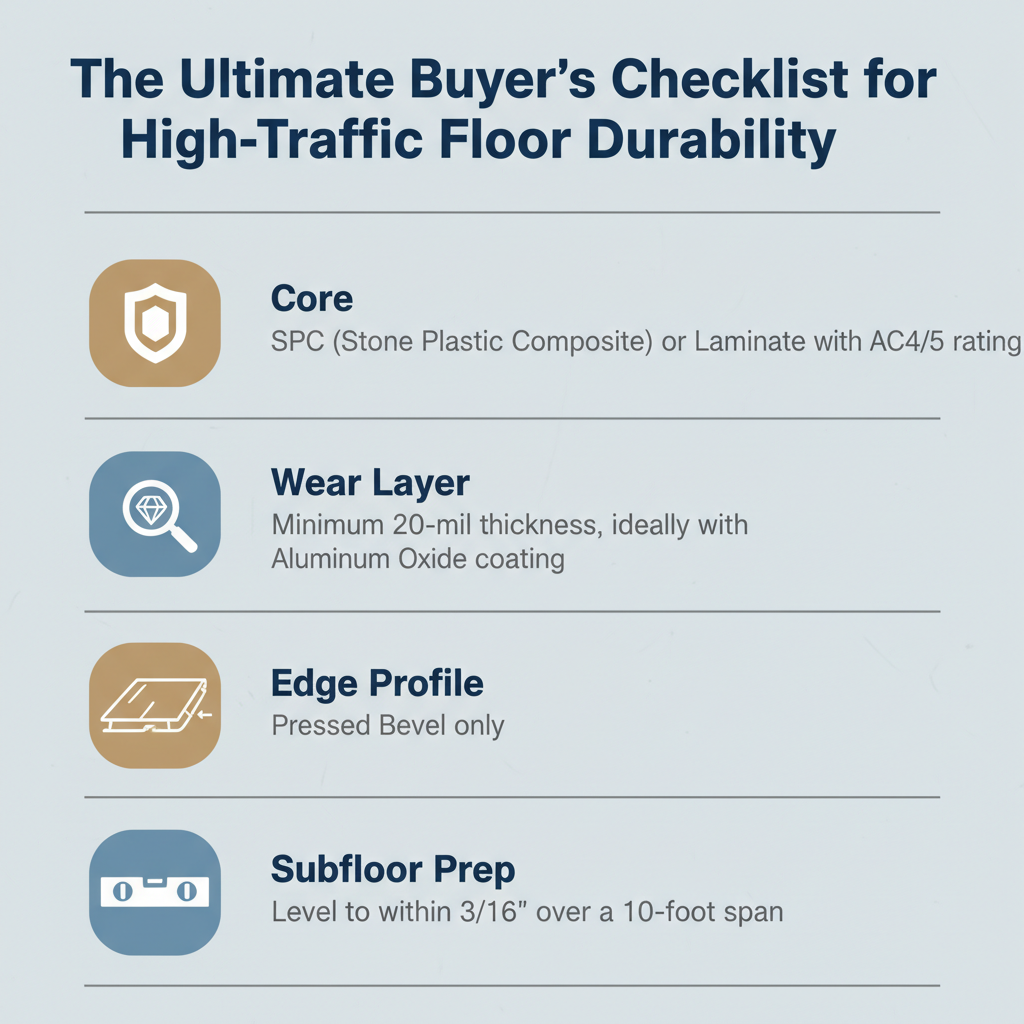
To ensure your next investment survives the rigors of a busy environment, abandon the marketing hype and rely on this objective, tiered purchasing framework.
Top Specs for Residential (Heavy Traffic, Pets, Kids):
- Core: SPC (Stone Plastic Composite) or Laminate with an AC4 rating.
- Wear Layer: Minimum 12-mil to 20-mil thickness.
- Edge Profile: Pressed bevel or micro-bevel (avoid square edges).
- Subfloor Prep: Level to within 3/16″ over a 10-foot span.
Top Specs for Commercial (Retail, Hospitality, Office):
- Core: High-density SPC or Laminate with an AC5 rating.
- Wear Layer: Minimum 20-mil to 28-mil thickness, ideally with an Aluminum Oxide (“adamantine”) coating.
- Edge Profile: Pressed bevel only.
- Locking System: Angle-Angle locking mechanism for maximum joint tension.
Conclusion
True flooring durability and edge protection go far beyond a thick wear layer or flashy “adamantine” marketing claims. Bulletproofing a high-traffic floor requires a synergy of dense core materials like SPC, advanced manufacturing techniques like pressed bevels, and, most importantly, meticulous subfloor preparation. Understanding this science is the only way to prevent costly premature failures and ensure your investment stands the test of time.
Before you purchase your next floor, we highly encourage you to check your subfloor levelness, utilize our Durability Spec Checklist while shopping, and consult a certified NWFA installer for a professional site evaluation.
Disclaimer: The diagnostic and repair information provided is for educational purposes. Always consult your specific flooring manufacturer’s warranty guidelines and a certified flooring installer before attempting structural repairs or applying aftermarket edge sealants.
References & Authoritative Sources
- Floor Covering Installer (FCI) Magazine. (2022). Analysis of Laminate and Vinyl Warranty Claims: The Edge Vulnerability.
- Institute of Inspection, Cleaning and Restoration Certification (IICRC). (N.D.). Identifying High-Traffic Wear Patterns in Hard Surface Flooring.
- World Floor Covering Association (WFCA). (2021). Consumer Guide to Flooring Warranties: Wear and Tear vs. Structural Failure.
- National Wood Flooring Association (NWFA). (2019). Technical Manual: Subfloor Preparation and Tolerances.
- National Wood Flooring Association (NWFA). (2019). Installation Guidelines: The Importance of Flatness.
- Journal of Materials Science and Engineering. (2020). Application of the Mohs Hardness Scale in Modern Industrial Polyurethane Coatings.
- Paint & Coatings Industry Magazine. (2023). Evaluating Aluminum Oxide and Ceramic Bead Technologies in Resilient Flooring.
- Wood and Fiber Science Journal. (2018). Impact Deflection and Edge Compression in Pressed Bevel vs. Milled Edge Flooring Profiles.
- North American Laminate Flooring Association (NALFA). (2022). Standard Testing Methodologies for Edge Swell and Impact Resistance.
- Floor Covering Weekly. (2021). Contractor Insights: Locking Mechanisms and High-Traffic Commercial Loads.
- Consumer Reports. (2023). Independent Durability and Drop Tests: SPC vs. WPC Flooring.
- ASTM International. (2021). Standard Test Method for Measuring Wear and Indentation of Resilient Floor Covering.
- North American Laminate Flooring Association (NALFA). (N.D.). Understanding Abrasion Class (AC) Ratings and Taber Testing.
- Floor Covering News. (2022). Commercial Flooring Trends: The Rise of AC5 Laminates.
- InspectAPedia. (2020). Forensic Analysis of Flooring Failures: Moisture Intrusion and Delamination.
- National Wood Flooring Association (NWFA). (2019). Technical Manual: Moisture Testing Protocols and Calcium Chloride Limits.
- Independent Forensic Flooring Inspectors Association. (2021). Diagnostic Methodologies for Edge Peaking and Crushing.
- ProTradeCraft. (2022). Best Practices for Edge Sealing Floating Floors in High-Moisture Zones.
