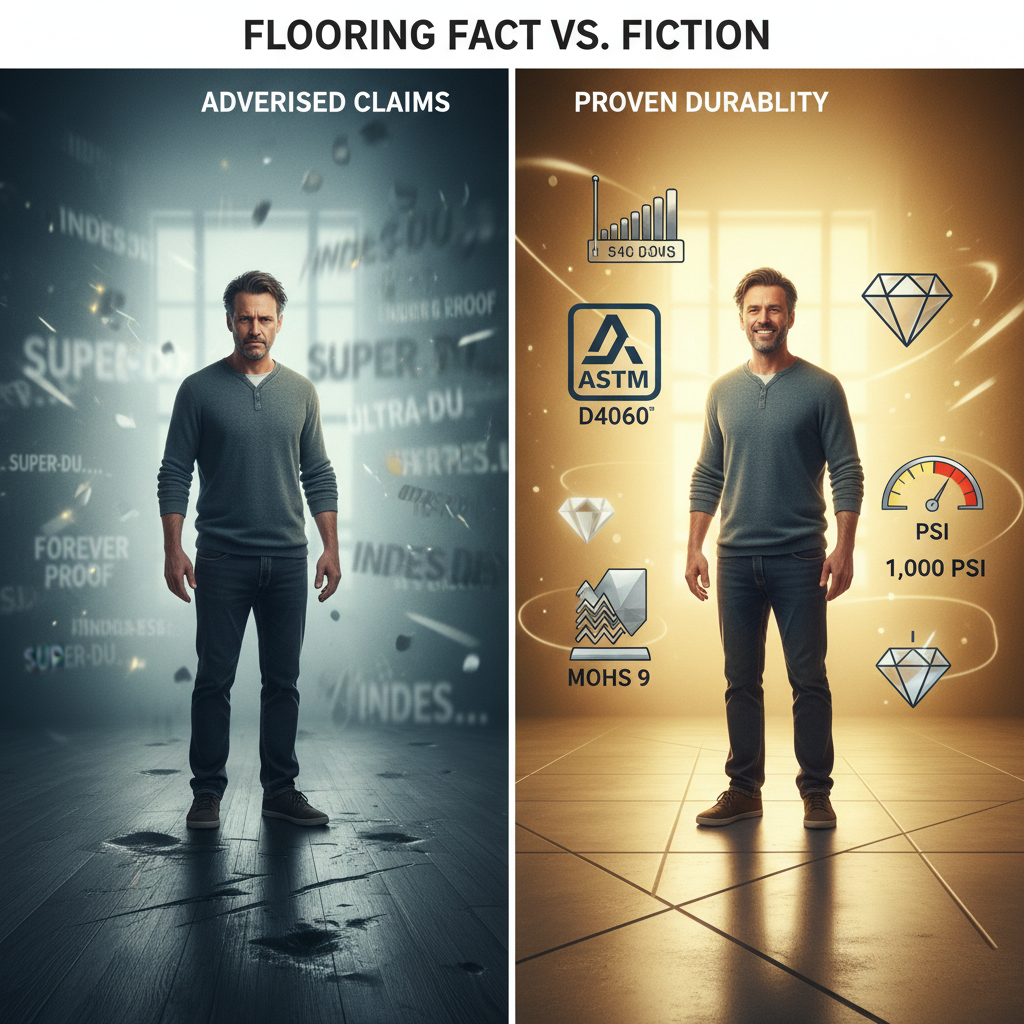
If you are a proactive homeowner with an active family or large pets, you have likely experienced the deep frustration of watching a beautiful, newly installed floor succumb to premature scratching, denting, and moisture damage. The cycle of installing, damaging, and replacing easily damaged home flooring is not just aesthetically displeasing; it is a massive drain on your finances. In the search for a permanent solution, you have probably encountered vague marketing buzzwords promising “adamantine” or “indestructible” surfaces. But what do these terms actually mean?
This guide will demystify diamond-hard flooring by stripping away the marketing jargon and grounding your choices in objective material science, structural engineering insights, and real-world financial data. By understanding the science of durability, you can confidently navigate the market, secure a massive 20-year return on investment (ROI), and make a permanent, high-strength upgrade that truly protects your home.
- Decoding ‘Adamantine’: What Exactly is Diamond-Hard Flooring?
- Top High-Strength Flooring Materials for Ultimate Home Protection
- Diamond Hard Surface Flooring Options: The Chemistry of Finishes
- The 20-Year ROI: Benefits of Adamantine Flooring for Homes
- Triage and Repair: Dealing with Easily Damaged Home Flooring?
- Preventing Floor Wear and Tear: The Ultimate Maintenance Schedule
- Evaluating Scratch Resistant Flooring Solutions
- Upgrading to Adamantine Floors: Installation and Structural Realities
- Conclusion
- References & Authoritative Sources
Decoding ‘Adamantine’: What Exactly is Diamond-Hard Flooring?
In mythology and fantasy, “adamantine” refers to a material of impenetrable, diamond-like hardness. In the residential flooring market, however, adamantine flooring is not a specific, singular material you can harvest from the earth. Rather, it is a descriptive marketing term utilized to represent ultra-durable, virtually indestructible flooring solutions, such as advanced composites, treated concrete, or high-grade porcelain.
To separate genuine high-strength flooring from exaggerated marketing claims, we must look to industry-standard material classifications. According to Floor Covering Weekly, the authoritative publication for flooring trends and material data, true durability must be categorized by objective, measurable metrics rather than brand promises [1]. When a manufacturer claims a floor is “diamond-hard,” that claim should be verifiable through established scientific scales, most notably the Mohs hardness scale, which measures a material’s resistance to scratching.
The Science of Durability: Mohs Scale and ASTM Standards
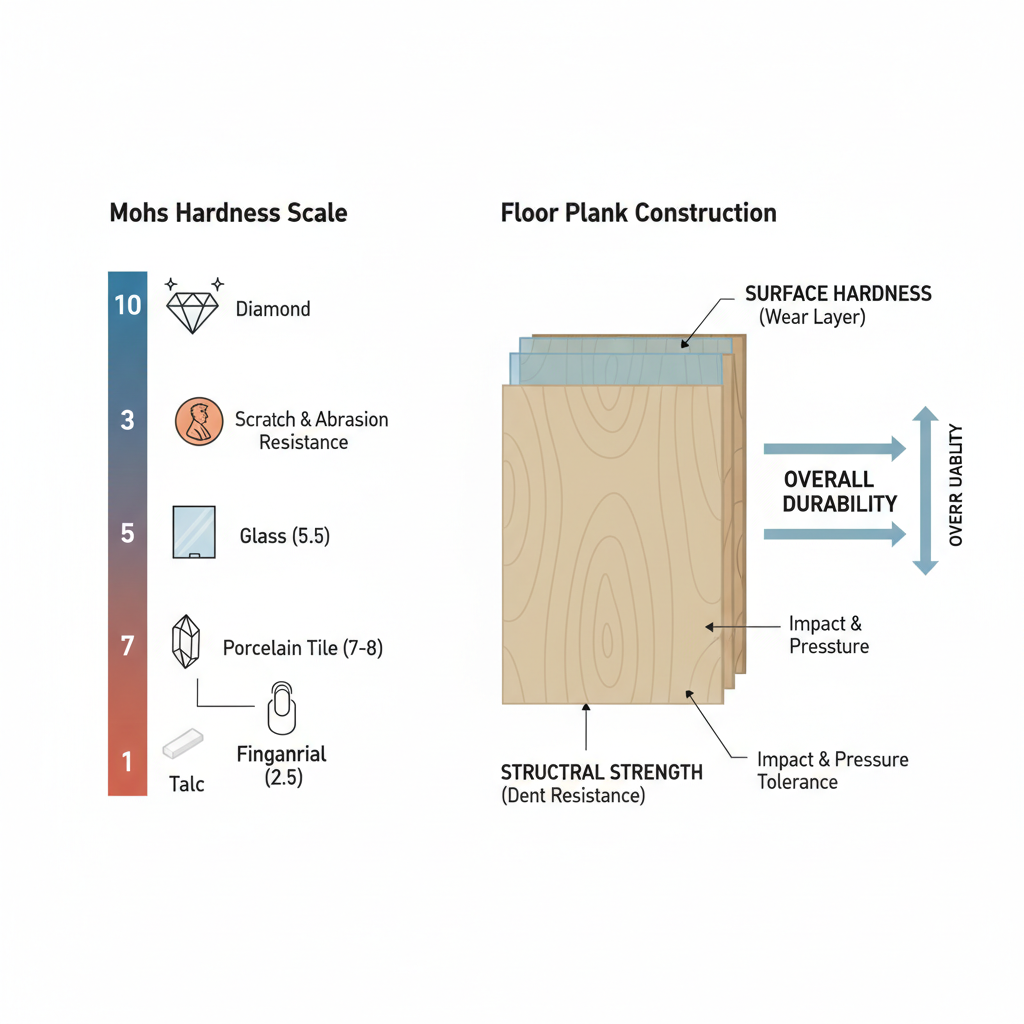
Objective durability is not a guessing game. The Mohs scale of hardness, which ranks materials from 1 (talc) to 10 (diamond), is a critical tool for evaluating diamond-hard flooring. For example, high-quality porcelain tile rates at a 7 to 9 on the Mohs hardness scale, making it one of the absolute hardest residential flooring options available on the market today.
Beyond scratch resistance, overall wear is measured using rigorous testing protocols. ASTM International provides the gold-standard test methods for abrasion resistance [2]. When evaluating premium floors, look for products that publish their ASTM testing results, proving they can withstand the repetitive friction of heavy foot traffic, moving furniture, and active pets without losing their finish.
Surface Hardness vs. Structural Strength
A common pitfall for homeowners is confusing a floor’s surface finish with its core strength. As noted by certified material science engineers and flooring inspectors, there is a critical distinction between a hard surface finish (the wear layer) and structural hardness (the core material’s dent resistance). You can have a wood floor with a diamond-hard surface coating that prevents scratches, but if the underlying wood is soft, dropping a heavy cast-iron pan will still cause a visible dent. True adamantine flooring requires a synergy of both an impenetrable surface and a high-density core.
Top High-Strength Flooring Materials for Ultimate Home Protection
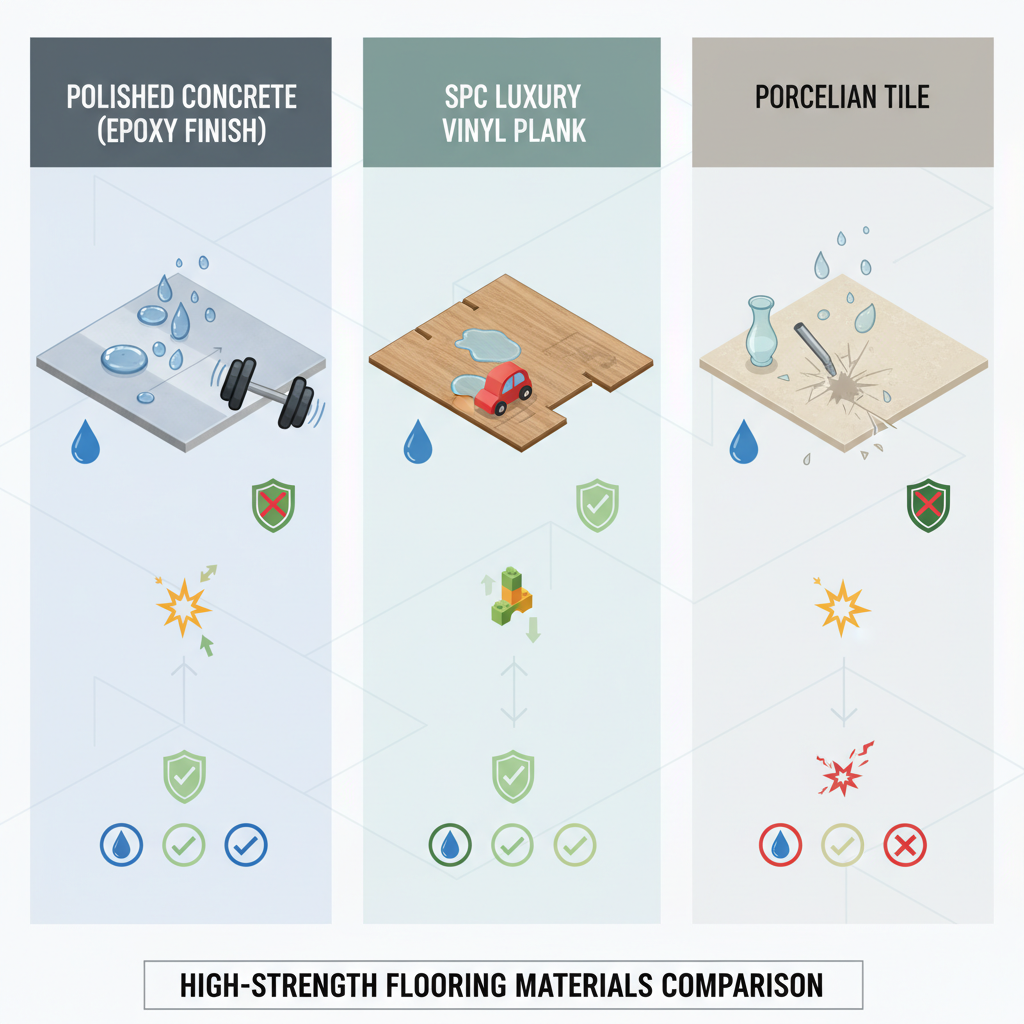
Translating industrial-grade strength into residential spaces requires evaluating materials across a “Durability Matrix”: water resistance, scratch resistance, and impact resistance. By scoring materials across these three vectors, we can identify the most durable flooring for home protection. The Tile Council of North America provides rigorous specifications for hard-surface tiles, setting the benchmark for what constitutes high-strength performance in wet and high-impact environments [3].
High-Strength Residential Concrete and Epoxy
Once reserved for warehouses and factories, high-strength flooring like treated concrete and epoxy is increasingly crossing over into residential garages, basements, and modern living spaces. The strength of concrete is measured in PSI (Pounds per Square Inch) compressive strength. According to the American Concrete Institute (ACI), standard residential concrete typically sits at 2,500 to 3,000 PSI [4]. In contrast, high-strength concrete flooring engineered for maximum durability typically exceeds 6,000 PSI. When paired with a commercial-grade epoxy coating, this creates a seamless, impact-resistant surface that is virtually impervious to household damage.
Rigid Core Luxury Vinyl (SPC) and Porcelain Tile
For traditional living spaces, Stone Plastic Composite (SPC) rigid core luxury vinyl and porcelain tile are the reigning champions of the Durability Matrix. Luxury Vinyl Plank (LVP), specifically SPC, holds over 30% of the resilient flooring market due to its exceptionally high durability-to-cost ratio and 100% waterproof properties. While SPC offers excellent dent and water resistance with a slightly softer underfoot feel, solid porcelain tile remains the undisputed king of raw, diamond-hard impact and scratch resistance.
Diamond Hard Surface Flooring Options: The Chemistry of Finishes
If you are purchasing engineered wood or seeking to upgrade an existing floor, the secret to diamond hard surface flooring options lies in the chemistry of the factory finishes. Modern flooring utilizes advanced chemical coatings to create a microscopic armor over the core material. Peer-reviewed data from the Journal of Coatings Technology and Research highlights the immense protective capabilities of advanced finishes like aluminum oxide and polyaspartic coatings [5]. Polyaspartic coatings, for instance, offer industrial-level abrasion resistance and UV stability, making them superior to traditional epoxies for sunlit rooms and garages.
The Power of Aluminum Oxide Coatings
The most significant advancement in pre-finished flooring is the integration of aluminum oxide. Suspended within the urethane wear layer during the manufacturing process, these microscopic crystals create a virtually scratch-proof surface. Statistically, aluminum oxide finishes can increase hardwood floor scratch resistance by up to 10 times compared to traditional polyurethane coatings. If you want the aesthetic of real wood with the resilience of adamantine flooring, an aluminum oxide factory finish is non-negotiable.
The 20-Year ROI: Benefits of Adamantine Flooring for Homes
Middle-of-funnel buyers often hesitate at the premium price tag of ultra-durable floors. However, evaluating the benefits of adamantine flooring for homes requires a long-term perspective. According to Remodeling Magazine’s annual Cost vs. Value report, premium, long-lasting materials consistently yield higher long-term financial returns than budget alternatives that require frequent replacement [6]. Furthermore, data from the National Association of Realtors confirms that high-quality, hard-surface flooring significantly boosts home value retention and buyer appeal [7].
Lifetime Maintenance Savings and Resale Value
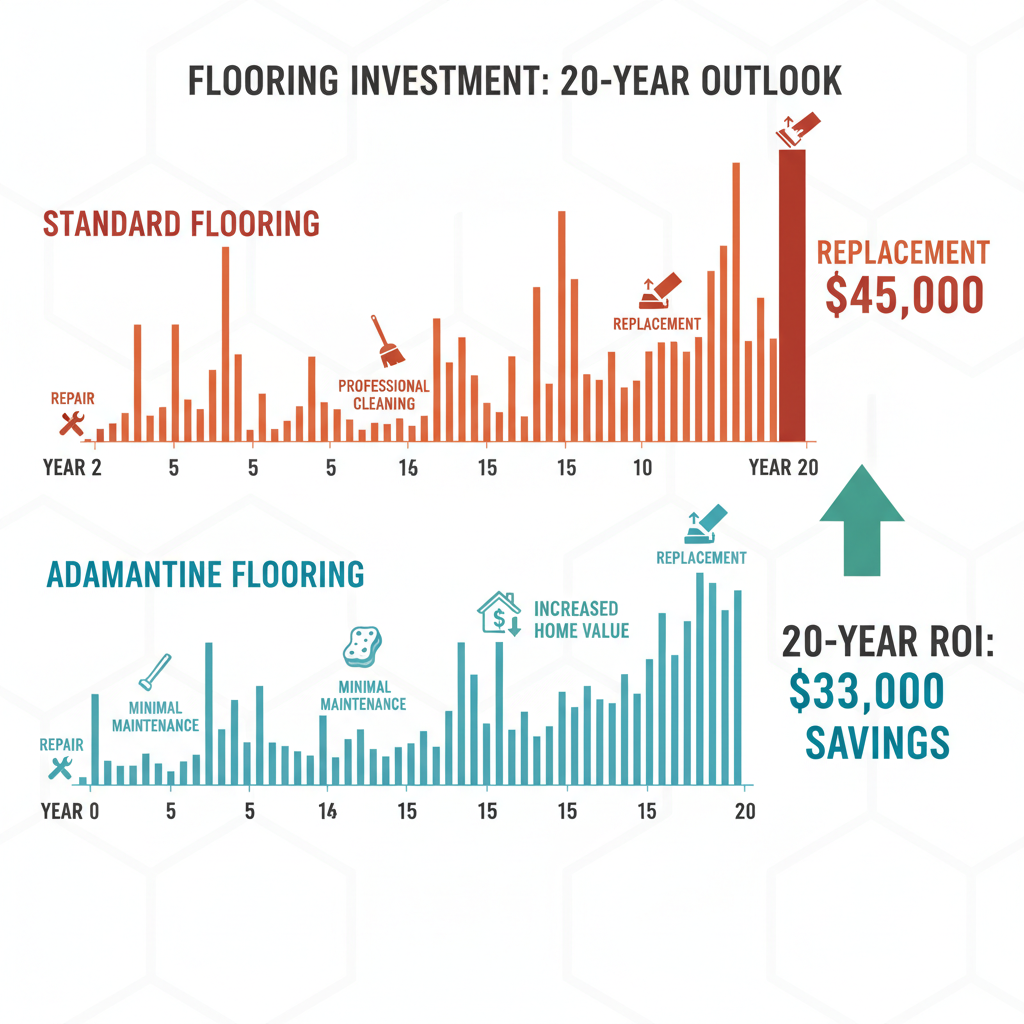
When you run a 20-year cost-benefit analysis, the math heavily favors indestructibility. Ultra-durable flooring can reduce lifetime maintenance and replacement costs by up to 40% over a 20-year period compared to standard carpet or cheap laminate. You eliminate the costs of professional carpet cleaning, deep scratch refinishing, and the inevitable tear-out and replacement cycles. (We highly recommend utilizing a downloadable 20-Year Flooring ROI Calculator to model these savings based on your specific square footage).
Triage and Repair: Dealing with Easily Damaged Home Flooring
If you are currently living with easily damaged home flooring, you are likely experiencing buyer’s remorse. Before ripping everything out, it is vital to diagnose the damage. The National Wood Flooring Association (NWFA) provides authoritative guidelines on acceptable wear, damage assessment, and maintenance [8]. Certified floor restoration specialists emphasize that understanding the nature of the damage is the first step to mitigating it.
Visual Triage: Surface Scratches vs. Deep Wood Gouges
To resolve scratched hardwood floor issues, you must perform a visual triage to distinguish between clear-coat damage and structural wood penetration. A surface scratch only affects the reflective finish and can often be minimized, whereas a deep gouge exposes the raw wood beneath. Wood Floor Business magazine notes a crucial caveat for modern floors: while traditional polyurethane finishes can often be lightly sanded and spot-repaired, modern aluminum oxide finishes are so incredibly hard that they are notoriously difficult to spot-repair without specialized professional equipment [9]. If an aluminum oxide floor suffers a deep gouge, board replacement is often the only viable fix.
Preventing Floor Wear and Tear: The Ultimate Maintenance Schedule
Even the highest-strength floors benefit from proactive care. Preventing floor wear and tear requires a consistent maintenance schedule. The Institute of Inspection, Cleaning and Restoration Certification (IICRC) sets the global standards for hard surface maintenance [10]. They strongly recommend using specific, non-damaging cleaning chemicals with a neutral pH level, as highly acidic or alkaline cleaners can slowly etch and degrade even the toughest factory finishes over time.
Protective Gear: Pads, Mats, and Rugs That Actually Work
The most effective maintenance is preventative mechanical protection. Brand-agnostic, heavy-duty felt furniture pads and high-quality entry mats designed to trap abrasive dirt are your first line of defense. Industry data shows that the proper use of felt pads and entry mats can extend the life of hard surface floor finishes by 30% to 50%. By stopping grit at the door and cushioning heavy furniture legs, you prevent the micro-abrasions that dull a floor’s appearance.
Evaluating Scratch Resistant Flooring Solutions
When shopping for scratch resistant flooring solutions, never take a salesperson’s word at face value. You must look for independent lab testing results. Consumer Reports is renowned for its independent, rigorous testing of home goods and flooring durability, providing unbiased data on how floors hold up to simulated household abuse [11].
How to Test Flooring Samples at Home
You can and should implement a clear, reproducible testing methodology at home before purchasing. Order samples of your top choices and subject them to realistic abuse: drag a heavy set of keys across the surface, press a dog nail clipper into the finish, and leave a puddle of water on the seam for 24 hours. While conducting these tests, remember to weigh the cons of even the best floors to maintain an objective perspective. For instance, while porcelain tile will effortlessly survive the key test, it is also cold underfoot and unforgiving if a glass is dropped on it.
Upgrading to Adamantine Floors: Installation and Structural Realities
Upgrading to adamantine floors is a major architectural transition. If you are ready to install protective home flooring, you must account for the unique structural challenges posed by heavy, premium materials. The National Association of Home Builders (NAHB) provides strict standards on premium home upgrades and structural remodeling, emphasizing that ultra-hard materials often require significant subfloor preparation [12].
Structural Load Requirements: Dead Load vs. Live Load
High-end residential architects warn that homeowners frequently overlook structural load requirements. Heavy materials like thick natural stone, large-format porcelain, or specialized high-strength concrete add massive “dead load” (permanent weight) to your home’s framing. Before installing these materials on a second story or over a basement, your floor joists may require professional reinforcement to prevent dangerous sagging or structural failure.
DIY vs. Pro: Vetting a Contractor for High-Strength Floors
While DIY installation is popular for floating vinyl planks, true high-strength floors demand professional expertise. The World Floor Covering Association (WFCA) offers unbiased consumer guides on installation standards and contractor selection [13]. Keep in mind that professional installation accounts for roughly 50% of the total cost of a new hard-surface flooring project. When vetting a contractor, ensure they possess the specialized tools required (such as wet saws with diamond blades for porcelain) and understand strict subfloor leveling tolerances—often requiring the subfloor to be flat within 3/16 of an inch over a 10-foot span to prevent rigid materials from cracking under pressure.
Conclusion
The journey from deciphering vague “adamantine” marketing jargon to understanding the real science of Mohs hardness, PSI, and structural installation empowers you to make a permanent, protective upgrade to your home. By investing in true diamond-hard, high-strength flooring, you not only eliminate the daily stress of easily damaged floors but also secure a massive 20-year ROI through eliminated replacement costs and boosted property value. Stop settling for floors that can’t handle your life. Download our free “20-Year Flooring ROI Calculator” and “Ultimate Floor Maintenance Checklist” to start planning your indestructible home upgrade today.
Disclaimer: Structural modifications and heavy flooring installations should be evaluated by a licensed structural engineer or general contractor. Cost estimates are for informational purposes.
References & Authoritative Sources
- Floor Covering Weekly. (N.D.). Industry standard publication for flooring trends and material classifications. Retrieved from Floor Covering Weekly.
- ASTM International. (N.D.). Standard test methods for abrasion resistance. Retrieved from ASTM International.
- Tile Council of North America. (N.D.). Authoritative body on hard-surface tile specifications. Retrieved from Tile Council of North America.
- American Concrete Institute (ACI). (N.D.). Standards for concrete strength and mix designs. Retrieved from American Concrete Institute.
- Journal of Coatings Technology and Research. (N.D.). Peer-reviewed data on the durability of aluminum oxide and polyurethane finishes. Retrieved from Journal of Coatings Technology and Research.
- Remodeling Magazine. (N.D.). Cost vs. Value report. Retrieved from Remodeling Magazine.
- National Association of Realtors (NAR). (N.D.). Data on home value retention and buyer preferences based on flooring types. Retrieved from National Association of Realtors.
- National Wood Flooring Association (NWFA). (N.D.). Authoritative guidelines on wood floor maintenance, acceptable wear, and damage assessment. Retrieved from National Wood Flooring Association.
- Wood Floor Business. (N.D.). Leading trade magazine detailing professional repair techniques and finishing chemistry. Retrieved from Wood Floor Business.
- Institute of Inspection, Cleaning and Restoration Certification (IICRC). (N.D.). Global standards for hard surface maintenance and cleaning. Retrieved from IICRC.
- Consumer Reports. (N.D.). Independent, rigorous testing of home goods and flooring durability. Retrieved from Consumer Reports.
- National Association of Home Builders (NAHB). (N.D.). Authoritative data and standards on premium home upgrades and structural remodeling. Retrieved from NAHB.
- World Floor Covering Association (WFCA). (N.D.). Unbiased consumer guides on installation standards and contractor selection. Retrieved from WFCA.
