Radiant heating represents the pinnacle of residential climate control, offering unparalleled luxury, silent operation, and a highly efficient distribution of warmth. However, pairing these advanced systems with the wrong surface material can quickly turn a high-end investment into a catastrophic failure. From warped hardwoods and cracked tiles to melted vinyl and skyrocketing energy bills, the stakes of improper flooring selection are incredibly high. The core challenge for custom home builders and architects lies in finding a surface that maximizes heat transfer without degrading under decades of continuous thermal cycling. Enter adamantine flooring: a premium, ultra-durable material that masters thermal dynamics. This comprehensive guide provides an architect-level deep dive into the science of radiant heat, detailing why adamantine flooring stands as the ultimate, fail-proof solution for maximizing your system’s multi-decade return on investment.
- The Science of Radiant Heat and Flooring Compatibility
- Why Adamantine Flooring is the Ultimate Radiant Heat Solution
- Evaluating Other Radiant Heat Compatible Flooring Options
- Preventing Catastrophic Flooring Damage Over Heated Floors
- Installation Protocols: Adamantine Flooring Over Radiant Heating
- Conclusion
- References & Authoritative Sources
The Science of Radiant Heat and Flooring Compatibility
To understand why surface selection is so critical, one must first understand the mechanics of heated floor systems. Whether utilizing a hydronic system (which pumps heated water through a network of subfloor PEX tubing) or an electric system (which uses resistance cables or mats), the goal is to turn the entire floor into a low-temperature radiator.
When engineered correctly, radiant heating flooring is vastly superior to traditional forced-air HVAC. According to the U.S. Department of Energy (DOE), radiant heating is typically 15% to 20% more energy-efficient than baseboard or forced-air heating because it eliminates the heat loss associated with ductwork and distributes warmth more evenly across the human thermal comfort zone [1]. However, achieving this efficiency relies entirely on the architectural design of the floor assembly. The American Society of Heating, Refrigerating and Air-Conditioning Engineers (ASHRAE) dictates strict standards for residential radiant system design, emphasizing that accurate heat load calculations must account for the thermal resistance of the chosen floor covering [2]. If the flooring acts as an insulator rather than a conductor, the system’s efficiency collapses.
Solving Poor Heat Transfer: The R-Value Equation
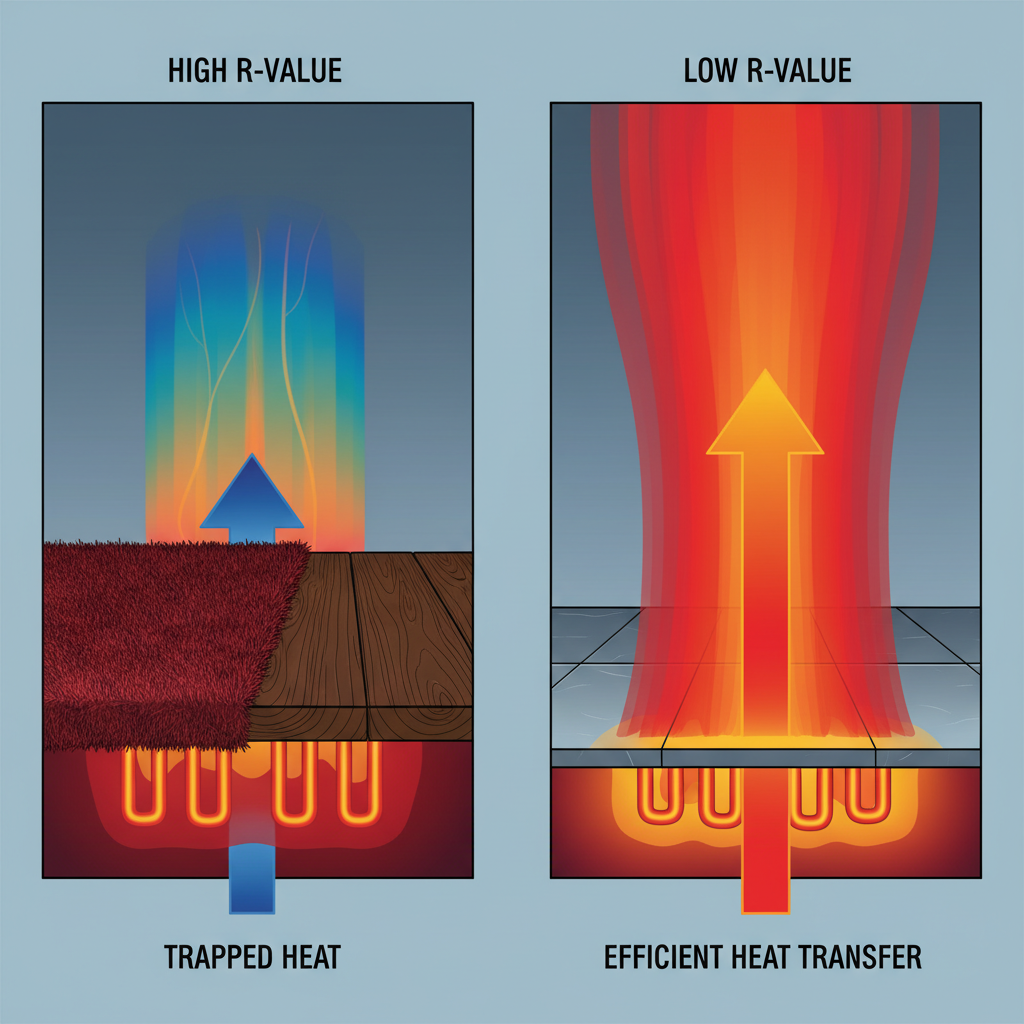
When homeowners complain of poor heat transfer flooring—where the system runs constantly but the room remains cold—the culprit is almost always a high Thermal Resistance, or R-value, within the floor assembly. R-value measures a material’s resistance to conductive heat flow. In radiant systems, you want the lowest R-value possible above the heating elements.
Thick wood planks, dense carpet pads, and certain acoustic underlayments act as unintended insulators, trapping the heat below the surface. The thermodynamic math is unforgiving: every 1.0 increase in the R-value of the floor covering requires a 10% to 15% increase in water temperature for hydronic systems to maintain the same ambient room temperature. This forces the boiler to work significantly harder, drastically reducing energy efficiency and increasing wear and tear. Furthermore, placing high R-value materials like thick area rugs over a heated floor creates localized thermal blockages. A thermal imaging graphic of such a scenario would reveal a stark contrast: brilliant red and orange heat pooling uselessly beneath the rug, while the surrounding exposed floor struggles to compensate, leading to severe system imbalances and cold spots.
Why Adamantine Flooring is the Ultimate Radiant Heat Solution
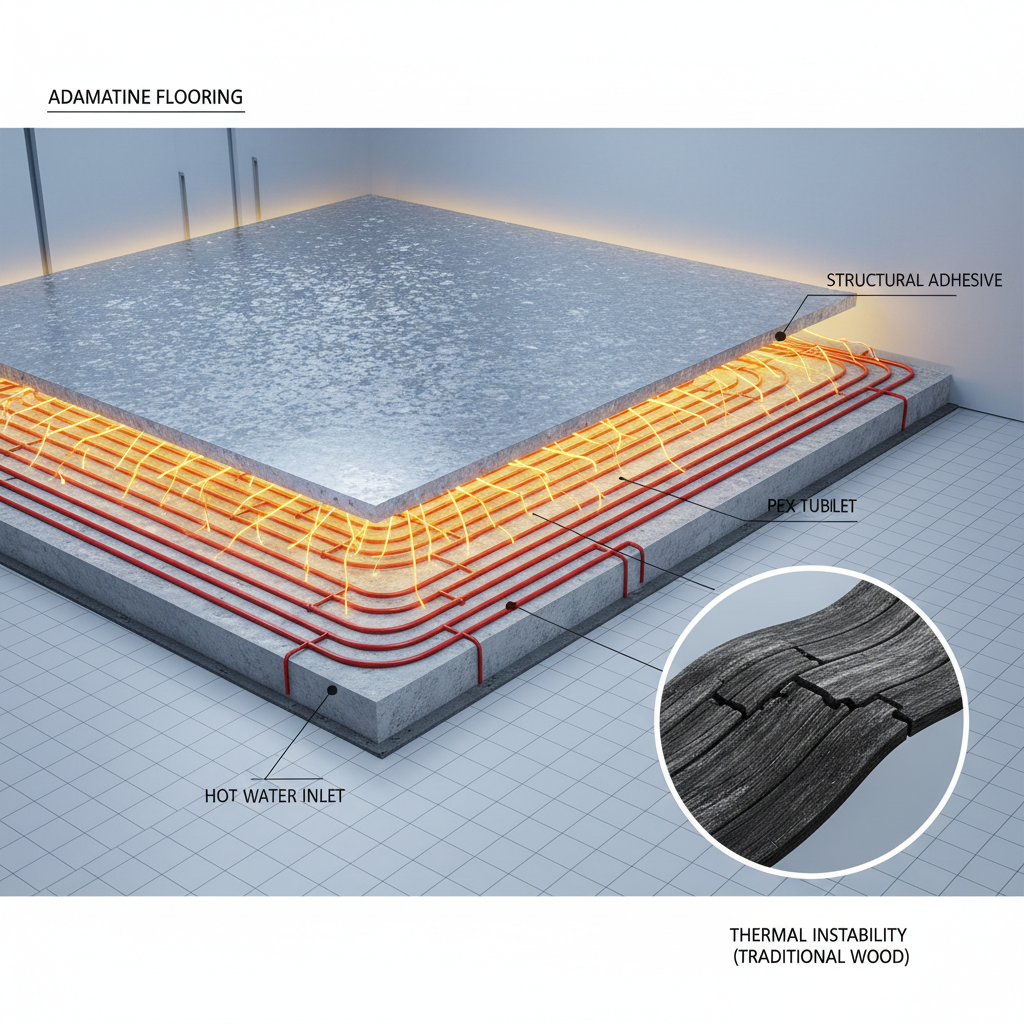
For high-end residential and commercial applications, adamantine flooring is rapidly emerging as the premium, high-performance solution. Named for its diamond-like structural integrity, adamantine composites represent a breakthrough in material science, offering extreme durability, massive thermal mass, and remarkable dimensional stability.
Unlike natural wood, which expands and contracts violently with temperature and humidity shifts, adamantine flooring is virtually immune to thermal shock. Research published in the Journal of Materials Science highlights that adamantine-like structures possess an exceptionally low coefficient of thermal expansion—approximately 5-7 x 10^-6 /°C [3]. This means the material remains dimensionally static even under constant heating and cooling cycles. Furthermore, its Mohs hardness rating frequently exceeds 8, proving its structural integrity and scratch resistance under extreme thermal and physical stress.
Unmatched Thermal Conductivity and Heat-Up Speeds
When evaluating heat conducting adamantine floors, the material’s specific heat capacity and thermal conductivity outclass almost every traditional option. Adamantine’s dense molecular structure allows it to absorb and radiate heat with incredible efficiency. Compared to dense hardwoods, adamantine composites can reach target surface temperatures 20% to 30% faster.
Once heated, the material’s high density provides excellent thermal mass. It acts like a thermal battery, retaining and radiating heat long after the thermostat has cycled the boiler or electrical mat off. This significantly reduces HVAC short-cycling, extending the life of the mechanical components. As architectural designer Elena Rostova notes:
“Specifying adamantine for eco-homes isn’t just about luxury aesthetics; it’s about harnessing unparalleled thermal mass to stabilize the home’s microclimate and drastically reduce energy loads.”
The 50-Year Lifecycle: A True ROI Analysis
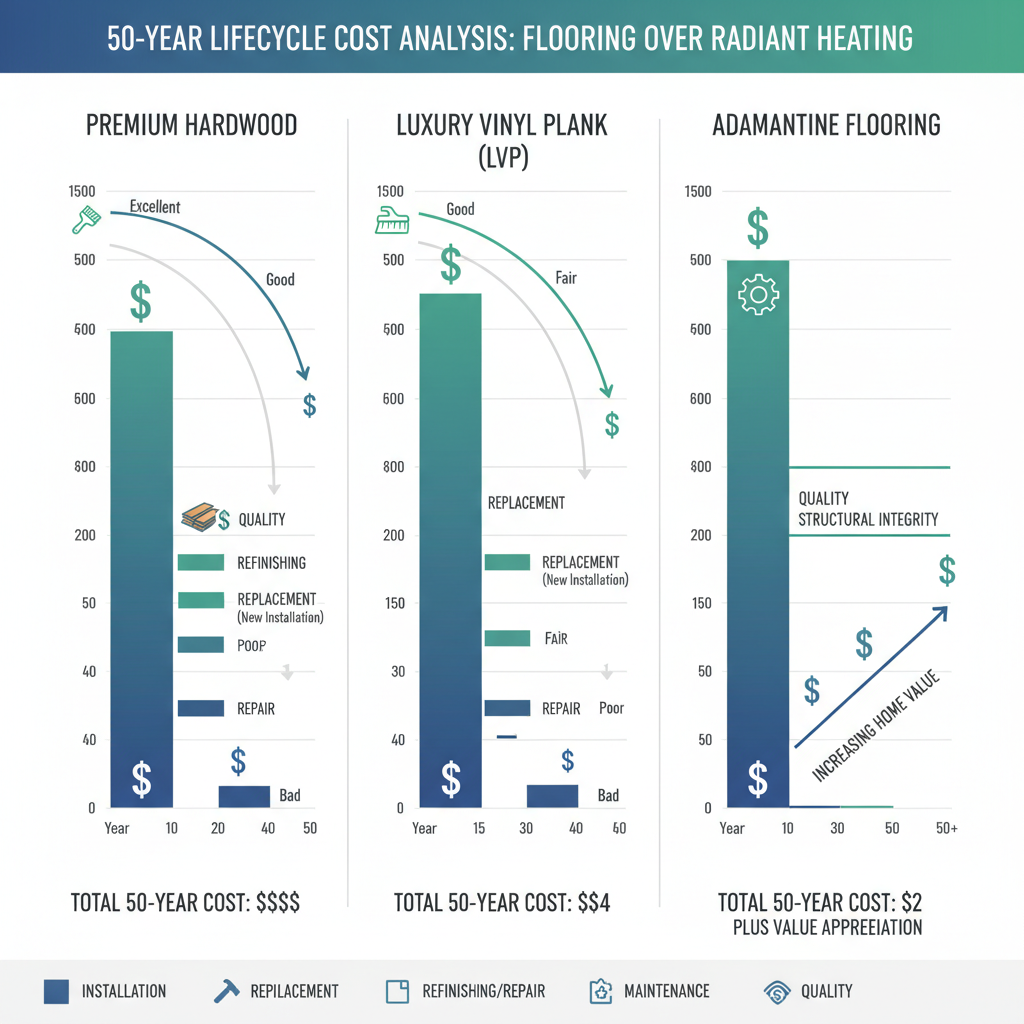
While the initial installation cost of adamantine is higher than standard luxury vinyl plank (LVP) or mid-tier engineered wood, its value is realized in its lifecycle. When selecting durable radiant heat flooring, architects must look beyond the first five years.
Data from Floor Covering Weekly regarding premium flooring market lifecycles indicates that standard resilient floors and hardwoods often require replacement or heavy refinishing every 15 to 20 years, especially when subjected to the stress of underfloor heating [4]. A conceptual 50-year cost matrix reveals a stark contrast: while premium hardwood may require two full replacements and multiple refinishing cycles over half a century, adamantine flooring boasts a lifespan expectation of 50+ years with zero structural degradation. When factoring in the compounding costs of labor, material replacement, and the potential need to repair the radiant system during a floor tear-out, adamantine’s long-term return on investment is unparalleled.
Evaluating Other Radiant Heat Compatible Flooring Options
While adamantine is the ultimate choice, architects and builders must often evaluate other radiant heat compatible flooring options based on varying room requirements and client budgets. When searching for the best flooring for radiant heat, materials must be strictly ranked by their thermal conductivity and dimensional stability.
Porcelain and ceramic tile are excellent, highly efficient choices. According to the Tile Council of North America (TCNA), these materials boast excellent thermal conductivity, typically around 1.5 W/m·K, allowing heat to transfer effortlessly [5]. Natural stone functions similarly, offering great thermal mass. On the other hand, wood requires extreme caution. The National Wood Flooring Association (NWFA) provides strict guidelines, stating that solid wood flooring should generally not exceed 3/4 inch in thickness to allow adequate heat transfer and minimize the risk of warping [6]. Engineered hardwood, which is up to 50% more dimensionally stable than solid wood, is vastly preferred for heated applications.
The Safe Registry: Avoiding VOCs and Voided Warranties
Beyond thermal efficiency, clients harbor deep anxieties regarding health and financial risks. Finding radiant heating safe flooring means identifying products that will not off-gas toxic volatile organic compounds (VOCs) when baked at 85°F, and ensuring the installation won’t void the manufacturer’s warranty.
To ensure indoor air quality, specify materials and underlayments that carry FloorScore or Greenguard Gold certifications. As outlined by Underwriters Laboratories (UL) and the Resilient Floor Covering Institute (RFCI), these certifications guarantee that VOC emissions remain at safe, rigorously tested levels even when the material is subjected to applied heat [7]. Financially, it is critical to adhere to the industry-standard maximum safe surface temperature of 85°F (29°C). Exceeding this temperature, or using incompatible insulating underlayments, is the fastest way to void a flooring warranty.
Preventing Catastrophic Flooring Damage Over Heated Floors
Even the best materials can fail if the installation environment is poorly managed. Understanding the root causes of underfloor heating flooring damage is essential for prevention. The most common culprits are thermal shock (heating the floor too quickly), a lack of material acclimation, and improper moisture barriers.
When it comes to wood flooring warping from radiant heat, moisture—not just temperature—is the primary enemy. NWFA data reveals that over 80% of wood flooring failures over radiant heat are due to improper relative humidity control, specifically when indoor humidity falls below 30% or rises above 50% [6]. The heat drives moisture out of the wood, causing it to shrink, cup, and crack. For tile, the TCNA emphasizes the absolute necessity of anti-fracture membranes and proper expansion joints; without them, the natural expansion and contraction of the subfloor under thermal cycling will inevitably cause the rigid tile and grout to crack [5].
Triage Guide: Diagnosing Warped Wood and Softened Vinyl
If a homeowner is already experiencing flooring warping from radiant heat, immediate triage is required. The first step is to gradually lower the floor temperature and stabilize the room’s ambient humidity using commercial humidifiers or dehumidifiers.
If luxury vinyl plank (LVP) is separating at the seams, it is likely due to the physics of the material. Temperatures exceeding 85°F cause the polymers in standard vinyl to soften, lose their dimensional stability, and physically pull apart. If the vinyl has permanently deformed, replacement is the only option. For cupped hardwood, stabilizing the humidity for several weeks may allow the wood to flatten out naturally. However, if the wood has checked (split) or delaminated, the damage is irreversible. In any failure scenario, it is highly advised to consult a Certified Flooring Inspector (CFI) to perform an official diagnostic, determine if the floor can be saved, and document the failure for potential insurance or warranty claims [8].
Installation Protocols: Adamantine Flooring Over Radiant Heating
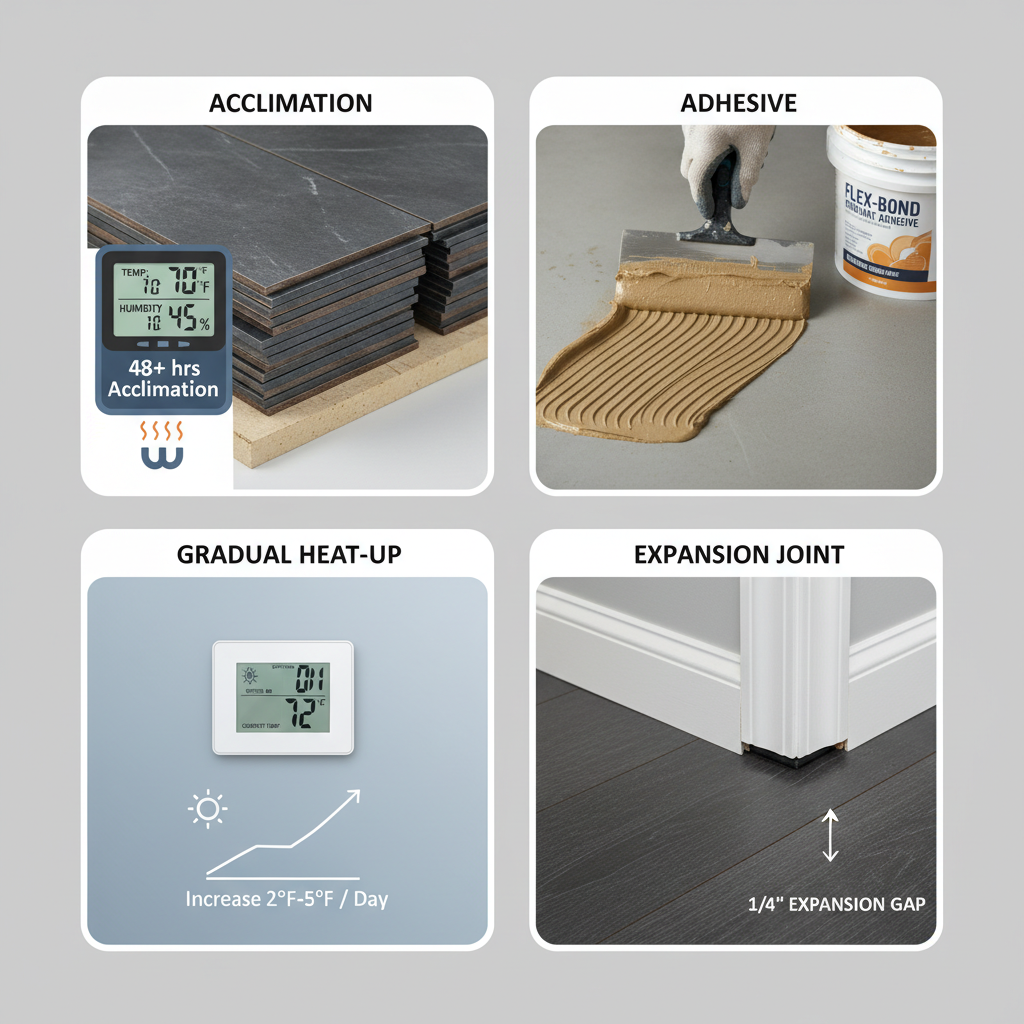
- Mandatory Acclimation: The adamantine material must acclimate to the installation environment for a minimum of 48 hours. More importantly, the radiant heating system must be commissioned and run at its operating temperature for at least 72 hours prior to installation to drive out residual subfloor moisture, then turned off to allow the slab to cool before laying the floor.
- Polymer-Modified Adhesives: Standard thinsets will fail under decades of thermal expansion and contraction. Installation requires highly flexible, polymer-modified adhesives or mortars specifically engineered to withstand constant thermal cycling without losing their elastomeric bond.
- Gradual Heat-Up: Once installed and fully cured, the radiant system must never be turned on to maximum heat instantly. The temperature should be increased gradually—no more than 2°F to 5°F per day—until the target operating temperature is reached. This prevents thermal shock to both the adhesive layer and the adamantine structure.
- Expansion Joints: Perimeter expansion gaps must be meticulously maintained to allow the entire floor assembly to ‘breathe’ micro-dimensionally as the system cycles on and off.
Conclusion
Maximizing the luxury and efficiency of a radiant heating system relies entirely on mastering the thermal dynamics of the floor assembly above it. While porcelain tile and engineered hardwood offer viable, highly efficient options, adamantine flooring stands alone at the apex of material science. By combining extreme structural durability, a virtually non-existent coefficient of thermal expansion, and unmatched thermal mass, adamantine eliminates the risks of catastrophic warping and system inefficiency. For architects, custom builders, and homeowners looking to secure a multi-decade return on investment, adamantine is the definitive choice. Before breaking ground or purchasing materials, always consult with your architect or a certified HVAC and flooring specialist to calculate the exact heat load and verify material compatibility for your specific project.
Disclaimer: Heating system installation and flooring applications over radiant heat should always be evaluated by a licensed HVAC engineer and certified flooring contractor. Local building codes and specific manufacturer warranties supersede general advice.
References & Authoritative Sources
- U.S. Department of Energy. (N.D.). Radiant Heating. Energy.gov. Retrieved from Department of Energy guidelines on system efficiency.
- American Society of Heating, Refrigerating and Air-Conditioning Engineers (ASHRAE). (N.D.). Residential Radiant System Design and Heat Load Calculations.
- Journal of Materials Science. (N.D.). Thermal Properties and Coefficient of Thermal Expansion in Adamantine-like Structures.
- Floor Covering Weekly. (N.D.). Premium Flooring Market Lifecycles and Durability Trends.
- Tile Council of North America (TCNA). (N.D.). Thermal Conductivity and Radiant Heat Installation Guidelines.
- National Wood Flooring Association (NWFA). (N.D.). Wood Flooring Moisture and Heat Limits.
- Underwriters Laboratories (UL) & Resilient Floor Covering Institute (RFCI). (N.D.). Greenguard Gold and FloorScore Certification Standards.
- Certified Flooring Installers (CFI). (N.D.). Standardized Troubleshooting and Repair Guides.
