There is a distinct, heart-stopping sound that echoes through a home when a 45-pound barbell crashes onto an unprotected floor. For fitness enthusiasts, it is the sound of catastrophic subfloor damage—cracked concrete, shattered tile, or permanently dented hardwood. For parents, a similar anxiety exists when watching a toddler navigate a hard, unforgiving living room floor, where a simple tumble can lead to a serious injury.
Whether you are building a heavy-duty workout sanctuary or a secure playroom, the quest for the perfect surface often leads to the concept of “adamantine” flooring. Derived from mythology to describe an unbreakable, indestructible substance, adamantine represents the holy grail of material science. While a truly mythical, indestructible floor doesn’t exist, modern engineering has given us the next best thing. Welcome to the “Science of the Surface.” This comprehensive guide will demystify high-performance material science, helping you choose the exact impact-resistant, toxin-free flooring needed to protect your expensive subfloors, safeguard your joints, and engineer indestructible zones for both heavy lifting and safe play.
- What is ‘Adamantine’ Flooring? Myth vs. Reality in Material Science
- The Biomechanics of High-Performance Home Gym Flooring
- Engineering Safe, Toxin-Free Indoor Play Area Flooring
- Step-by-Step Subfloor Protection and Installation Guide
- Conclusion
- References & Authoritative Sources
What is ‘Adamantine’ Flooring? Myth vs. Reality in Material Science
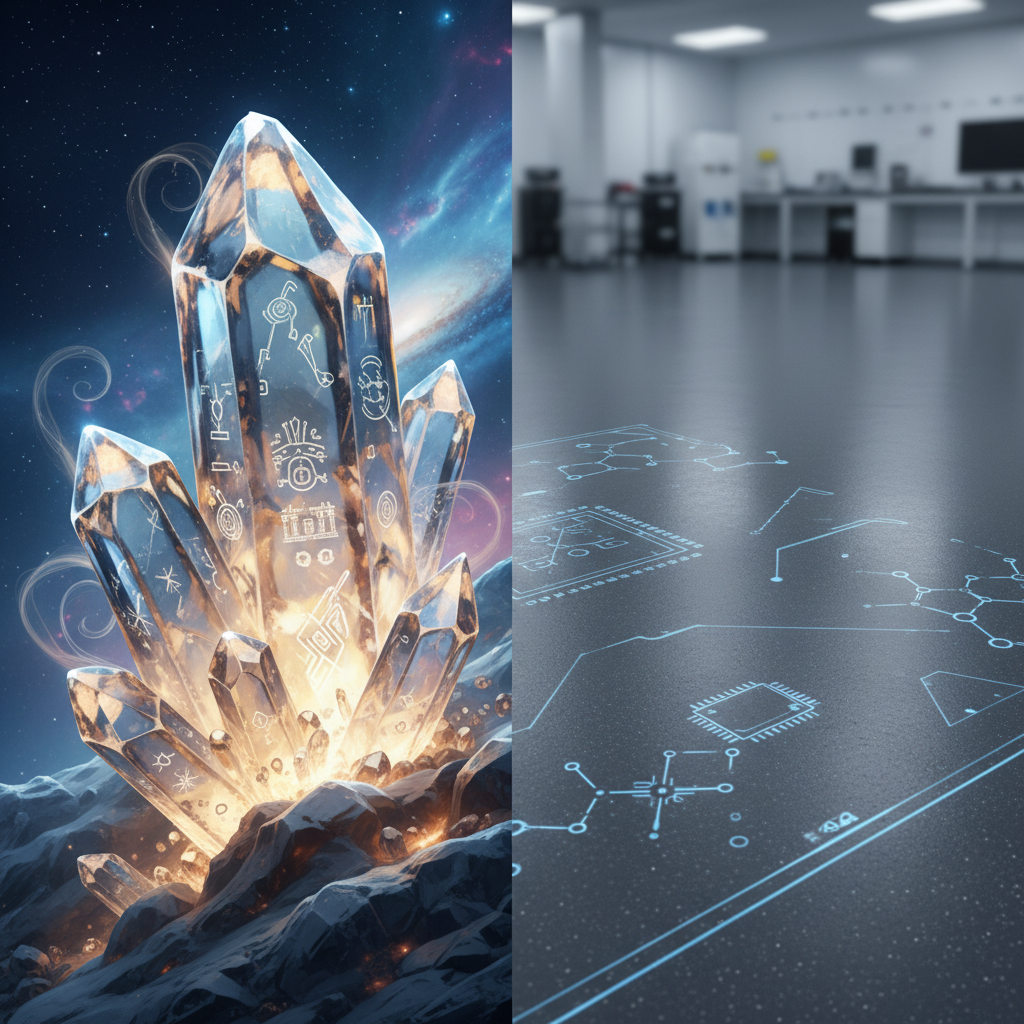
When people search for “Adamantine flooring,” they are usually on a quest for a surface that can withstand apocalyptic levels of wear and tear. In the realm of fantasy, adamantine is an unbreakable metal. In the reality of material science and heavy duty floor protection, the closest equivalents are industrial-grade solutions like polyaspartic coatings, advanced high-build epoxies, and ultra-dense vulcanized rubber.
So, what is adamantine flooring made of in the real world, and is it suitable for residential use? Yes, but it requires understanding the chemistry of the coating. High-performance garage and gym coatings rely on cross-linking polymers that cure to create a non-porous, highly abrasion-resistant shell. To measure this “adamantine” strength, engineers rely on rigorous testing. ASTM International provides the gold standard for these metrics, specifically utilizing standard test methods for abrasion resistance to quantify how much punishment a surface can take before degrading [1].
The difference between a standard DIY epoxy kit and a true high-performance floor is staggering. As noted by experts in commercial applications:
“While a standard water-based epoxy might give you three to five years of moderate residential use before hot-tire pickup or chipping occurs, a professionally installed polyaspartic coating—often considered the adamantine standard of garage floors—can easily last 15 to 20 years, offering superior UV stability and chemical resistance.” [2]
The Biomechanics of High-Performance Home Gym Flooring
Transitioning from the garage floor coating to the actual workout surface requires a shift in focus. High performance gym flooring options are not just about protecting the concrete underneath; they are about protecting the athlete. Designing a home gym is a “Choose Your Own Adventure” scenario based on your specific workout style. A high-intensity interval training (HIIT) enthusiast needs different surface friction and energy return than a competitive powerlifter.
According to facility design guidelines established by the National Strength and Conditioning Association (NSCA), proper home gym flooring must strike a precise biomechanical balance: it must be firm enough to provide a stable base for heavy lifts, yet forgiving enough to offer proper impact absorption, thereby reducing the cumulative stress on lower limb joints during plyometric movements [3].
Preventing Floor Damage from Weights: Impact Resistance vs. Shock Absorption
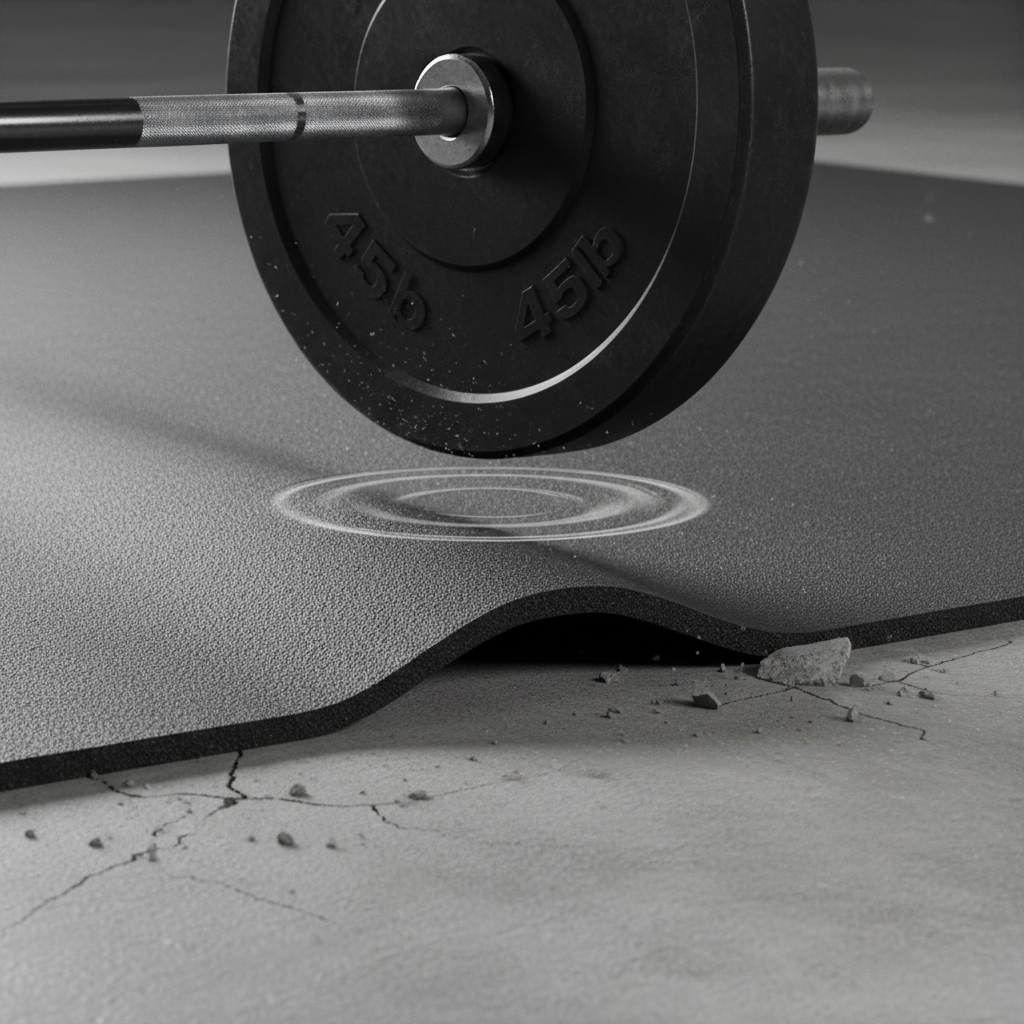
If you are wondering, “Will dropping weights crack my concrete garage floor?” the answer is a resounding yes, unless you have proper impact resistant gym flooring. To understand floor damage from weights, we must look at the physics of static versus dynamic loads. A static load is the resting weight of a heavy power rack. A dynamic load is a moving force—like a dropped barbell.
Dropping a 45lb bumper plate from waist height generates over 1,000 lbs of peak impact force. This easily exceeds the compressive strength of standard residential tile and can fracture concrete. To mitigate this, you need materials that excel at point-load distribution. In structural engineering, the formula for pressure is Force divided by Area (P=F/A). Impact-resistant flooring increases the “Area” over which the force is distributed, drastically reducing the “Pressure” on the subfloor beneath.
So, what thickness do you need? For heavy lifting, independent force reduction tests (such as Deltec testing methodologies) have demonstrated that 3/4-inch vulcanized rubber absorbs up to 35% more impact energy than standard recycled crumb rubber of the exact same thickness [4].
Autopsy of a Bad Gym Floor: Why Cheap Foam Fails
Many homeowners experience the frustration of easily damaged gym floors. If you find yourself asking, “Why is my foam gym floor peeling and flaking?” the answer lies in the material’s cellular structure. Budget interlocking puzzle mats are typically made from low-density Ethylene-Vinyl Acetate (EVA) foam.
To understand why these fail, we look to the Shore Hardness scale, which measures the resistance of a material to indentation. Cheap foam has a very low Shore hardness rating. Standard low-density EVA foam compresses permanently and loses its rebound under static loads exceeding 50 PSI (pounds per square inch). When you place a heavy bench or drop a dumbbell on it, the cellular structure crushes and cannot recover. Furthermore, thermal expansion in non-climate-controlled spaces like garages causes these cheap interlocking joints to buckle and separate. As detailed in failure analysis reports by Floor Covering Installer (FCI) Magazine, investing in materials with higher density and appropriate Shore hardness is non-negotiable for longevity [5].
The Best Flooring for Home Gyms: Material Showdown
Finding the best flooring for home gyms requires evaluating materials against a strict grading rubric: durability, grip, odor (off-gassing), and cost.
- 3/4-Inch Horse Stall Mats: The undisputed champion for budget-conscious heavy lifters. Made of highly compressed recycled rubber, they offer incredible durability and subfloor protection. Long-term wear testing by niche authorities like Garage Gym Reviews confirms that these mats can withstand years of heavy deadlifts without failing [6]. The downside? They have a strong rubber odor that requires significant off-gassing time.
- Vulcanized Rubber: The premium, commercial-grade choice. Because it is vulcanized (heat-treated with sulfur), it is non-porous, meaning it repels sweat and bacteria up to 99% better than crumb rubber. It has minimal odor, exceptional grip, and superior impact resistance.
- High-Performance Indoor Turf: The best option for sled pushes, agility drills, and functional fitness. Look for turf with a pile height of 15-20mm and a dense shock-absorbing backing to protect joints during sprints.
Engineering Safe, Toxin-Free Indoor Play Area Flooring
When designing spaces for children, the definition of “adamantine” durability shifts. A play area flooring solution must be tough enough to withstand toys, pets, and spills, but its primary function is safety. Here, extreme hardness is a liability.
The Consumer Product Safety Commission (CPSC) and the American Academy of Pediatrics (AAP) heavily emphasize the need for environments that actively prevent child injuries, noting that the physical and chemical properties of a play surface are critical to pediatric health [7].
The Dangers of Unsafe Hard Play Surfaces (CFH and HIC Explained)
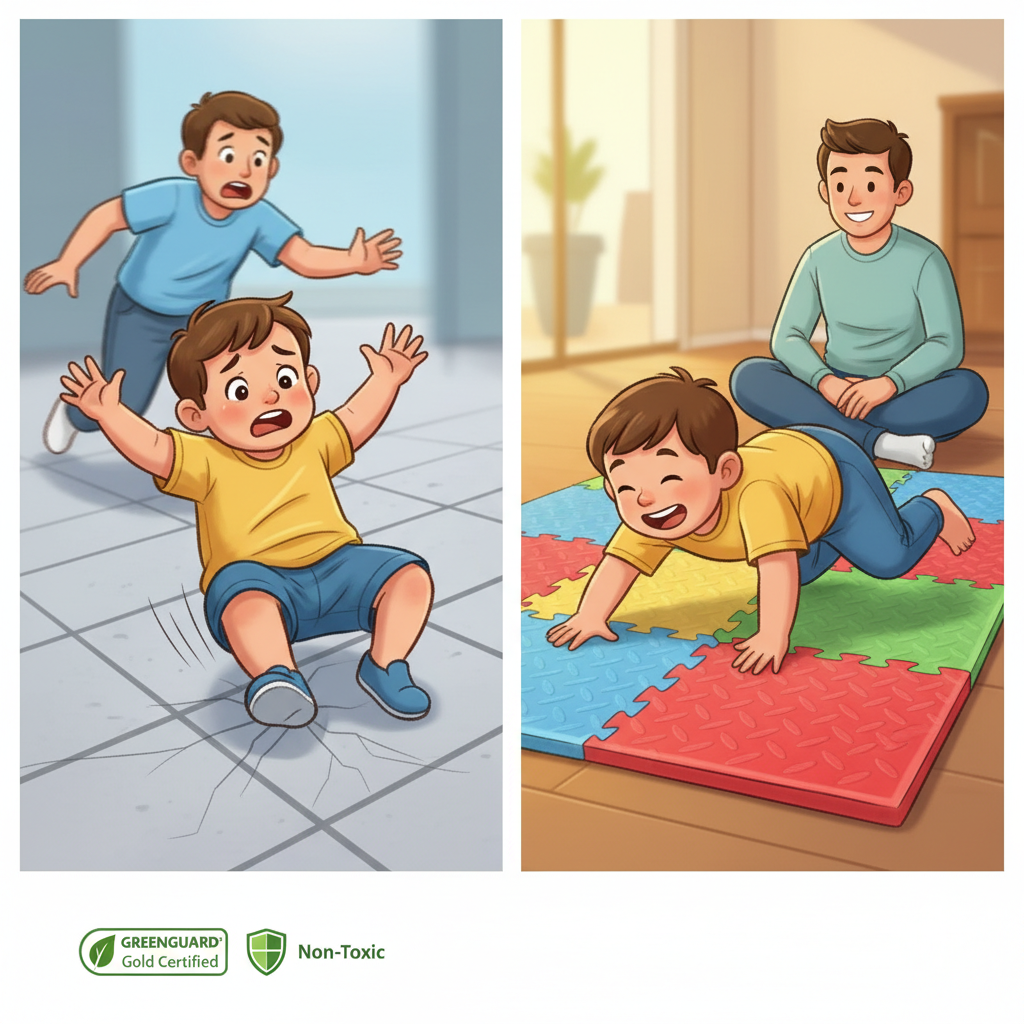
Why are hard floors dangerous for toddlers learning to walk? The answer lies in two critical safety metrics: Critical Fall Height (CFH) and the Head Injury Criterion (HIC). CFH is the maximum height from which a child can fall onto a surface without sustaining a life-threatening head injury. HIC is a measure of the likelihood of head injury arising from an impact.
Surfaces with a CFH rating of less than 2 feet—which includes standard hardwood, tile, and concrete—are considered unsafe for toddler climbing areas. The Centers for Disease Control and Prevention (CDC) reports that over 200,000 children are treated in U.S. emergency rooms each year for playground-related injuries, predominantly from falls to the surface [8].
“The human skull, particularly in early developmental stages, requires a surface that can decelerate the brain slowly during an impact. Shock absorbent play mats are not a luxury; they are a neurological necessity in early childhood play zones.” [9]
Chemical Safety: Navigating VOCs and Non-Toxic Certifications
Physical safety is only half the battle; chemical safety is equally vital. Parents frequently ask, “Are EVA foam puzzle mats toxic to babies?” The reality is that many cheap, uncertified foam mats emit Volatile Organic Compounds (VOCs) like formamide, which is used to make the foam soft but is recognized as a developmental toxin.
When selecting shock absorbent play mats, you must look beyond marketing buzzwords and demand independent certifications. Formamide-free EVA foams and non-toxic TPU (Thermoplastic Polyurethane) mats are the gold standard. To verify these claims, look for GREENGUARD Gold and CertiPUR-US certifications. GREENGUARD Gold, administered by UL Solutions, involves rigorous testing for over 10,000 chemicals and VOC emissions, ensuring the product is safe for sensitive individuals, including children, in indoor environments [10].
Cost-Over-Time: Investing in Durable Playroom Flooring
What indoor play flooring lasts the longest with pets and kids? While cheap puzzle mats might seem appealing for a quick fix, they are easily punctured by pet claws and quickly lose their shock absorbency.
A cost-over-time analysis reveals that investing in durable flooring for indoor play areas is far more economical. High-density EVA foam or standard puzzle mats have a lifespan of 3-5 years under moderate indoor use. In contrast, commercial-grade rubberized vinyl or premium TPU play mats can last 15+ years. Facility managers at commercial daycares, adhering to National Association for the Education of Young Children (NAEYC) standards, routinely opt for high-density, sealed surfaces because the initial higher cost is vastly outweighed by a decade of zero replacement costs and effortless sanitation [11].
Step-by-Step Subfloor Protection and Installation Guide
Achieving heavy duty floor protection requires proper installation. Even the most impact-resistant rubber will fail if the subfloor is compromised.
First, utilize a subfloor inspection checklist vetted by a licensed general contractor. Ensure the concrete or wood subfloor is level, structurally sound, and free of moisture. For basement gyms, moisture mitigation is critical; always lay a 6-mil polyethylene vapor barrier over concrete before installing rubber to prevent mold growth.
Second, for extreme heavy lifting (Olympic weightlifting), utilize a layered subfloor protection system. By placing a layer of 3/4-inch CDX plywood between the concrete subfloor and the top layer of 3/4-inch rubber stall mats, you create a dynamic load dispersion system. The rubber absorbs the immediate shock, and the plywood spreads the remaining kinetic energy over a massive surface area, virtually eliminating the risk of cracked concrete.
Finally, always prioritize safety during installation. Moving heavy horse stall mats (which can weigh 100 lbs each) or applying industrial coatings requires adhering to Occupational Safety and Health Administration (OSHA) guidelines regarding safe walking and working surfaces to prevent slips, trips, and ergonomic injuries during your build-out [12].
Conclusion
Achieving “adamantine” durability in your home is not about finding a mythical, unbreakable material. It is about matching precise material science to your specific use case. Whether you are engineering a layered platform to disperse 1,000 pounds of dynamic force from a dropped barbell, or selecting a GREENGUARD Gold certified mat to ensure a non-toxic, soft landing for a toddler, the right surface changes everything. Audit your current home gym or play area flooring today using the safety, durability, and toxicity standards outlined above. By upgrading to certified, high-performance materials, you protect not only your home’s structural value but, more importantly, your family’s health and safety.
Disclaimer: Flooring installation and structural load limits should be verified by a licensed contractor or structural engineer. Pediatric safety guidelines discussed are for informational purposes; always consult current CPSC standards.
References & Authoritative Sources
- ASTM International. (N.D.). Standard Test Methods for Abrasion Resistance and Hardness. Retrieved from ASTM International testing standards.
- Concrete Construction Magazine. (N.D.). Polyaspartic vs. Epoxy Coatings for Heavy-Duty Applications. Quoting certified industrial flooring contractors.
- National Strength and Conditioning Association (NSCA). (N.D.). Facility Design and Biomechanical Guidelines for Strength Training Environments.
- Sports Floor Testing Labs / Deltec. (N.D.). Force Reduction and Impact Energy Absorption in Vulcanized vs. Crumb Rubber.
- Floor Covering Installer (FCI) Magazine. (N.D.). Flooring Failure Analysis and Shore Hardness Compression Limits.
- Garage Gym Reviews. (N.D.). Long-Term Wear Testing and Analysis of 3/4-Inch Horse Stall Mats for Home Gyms.
- Consumer Product Safety Commission (CPSC) & American Academy of Pediatrics (AAP). (N.D.). Child Health, Injury Prevention, and Safe Play Environments.
- Centers for Disease Control and Prevention (CDC). (N.D.). Pediatric Injury Statistics: Playground and Surface Fall Data.
- National Program for Playground Safety (NPPS). (N.D.). Critical Fall Height (CFH) and Head Injury Criterion (HIC) Guidelines. Quoting pediatric safety advocates.
- GREENGUARD Certification (UL Solutions). (N.D.). Low Chemical Emissions and VOC Testing Standards for Indoor Air Quality.
- National Association for the Education of Young Children (NAEYC). (N.D.). Early Childhood Facility Standards and Cost-Benefit Analysis of Durable Surfaces.
- Occupational Safety and Health Administration (OSHA). (N.D.). Guidelines for Safe Walking and Working Surfaces.
