In the high-stakes environment of industrial facility management, flooring failures are more than just an aesthetic nuisance—they are a massive operational and financial liability. Trip-and-fall accidents caused by uneven floor transitions or chipped edges cost businesses an average of $50,000 per incident. Beyond the immediate safety hazards and legal ramifications, progressive flooring damage leads to costly maintenance downtime and equipment wear. The primary culprits? Heavy dynamic loads, particularly from forklift traffic, which systematically destroy vulnerable floor transitions and seams.
Moving beyond generic floor care, this article serves as the definitive engineer’s playbook. By bridging material science and facility management, we will explore how to permanently eradicate edge chipping and seam failure using adamantine flooring principles and industrial-grade fortification.
- The Science of Extreme Durability: Understanding Adamantine Flooring
- Diagnosing Vulnerabilities: Why Edges Chip and Seams Separate
- Mechanical Fortification: The Best Edge Protection for Adamantine Floors
- Chemical Reinforcement: Securing and Sealing Floor Seams
- Triage and Repair: Fixing Chipped Edges Permanently
- Mitigating Everyday Flooring Wear: A Facility Manager’s Guide
- Conclusion
- References & Authoritative Sources
The Science of Extreme Durability: Understanding Adamantine Flooring
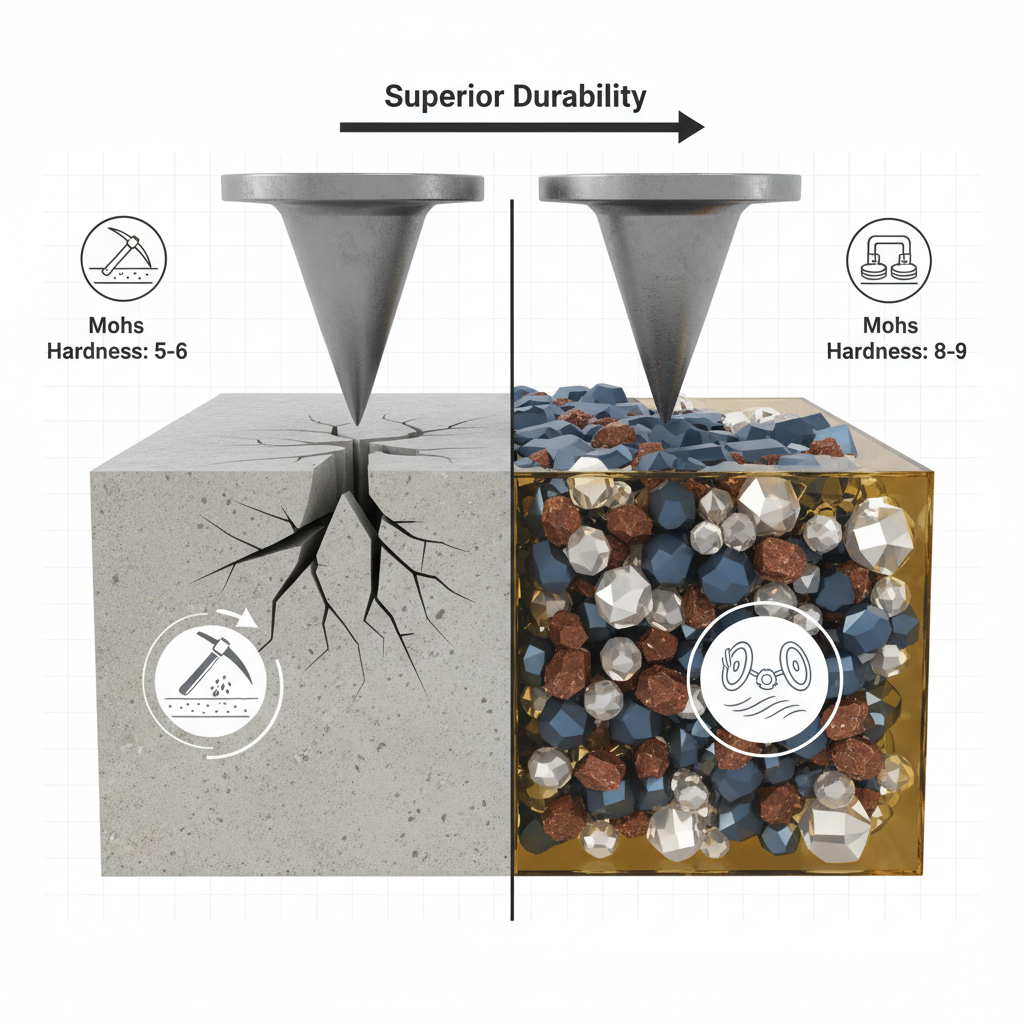
Adamantine flooring represents the pinnacle of ultra-durable, industrial-grade flooring solutions. Unlike standard commercial epoxy or residential luxury vinyl plank (LVP), adamantine systems utilize specialized epoxy blends heavily fortified with hardened aggregates—such as quartz, aluminum oxide, or corundum. To understand this durability, we look to the Mohs hardness scale, which measures a material’s resistance to scratching. While standard concrete might rank around a 5 or 6, the aggregates used in adamantine flooring routinely score between 8 and 9, approaching the hardness of diamonds.
This exceptional material composition allows adamantine-fortified floors to withstand up to 15,000 PSI of compressive strength, vastly outperforming standard concrete slabs. When evaluating lifecycle costs, facility managers must factor in maintenance downtime. While the initial cost per square foot of adamantine flooring is higher than standard polyurethane or epoxy coatings, it increases the floor’s lifespan by an average of 40% in heavy manufacturing zones. The American Concrete Institute (ACI) recognizes these high-compressive-strength, aggregate-fortified surfaces as the gold standard for industrial flooring environments subjected to extreme point loads [1].
Measuring True Wear Resistance: The Taber Abrasion Test
When sourcing wear-resistant flooring, it is critical to look past marketing claims and demand empirical data. The industry standard for measuring this durability is the Taber Abrasion Test. In this standardized methodology, a flooring sample is mounted on a rotating turntable and subjected to the friction of abrasive wheels under a specific weight. The wear resistance is then calculated based on the mass of the material lost after a set number of cycles.
According to ASTM International standards for standardized testing methods, a commercial-grade wear-resistant flooring system typically features a wear layer of 20 mil or higher [2]. However, adamantine and industrial epoxy systems are measured differently due to their monolithic nature. Taber abrasion tests show that hardened industrial epoxy loses less than 50mg per 1,000 cycles, showcasing an incredible resistance to everyday flooring wear caused by dragging pallets, foot traffic, and abrasive dust.
Diagnosing Vulnerabilities: Why Edges Chip and Seams Separate
Even the most robust adamantine floor has an Achilles’ heel: its transitions. Unprotected floor edges account for a staggering 60% of premature flooring failures in commercial settings. To stop this degradation, we must perform a vulnerability assessment based on physics and environmental factors.
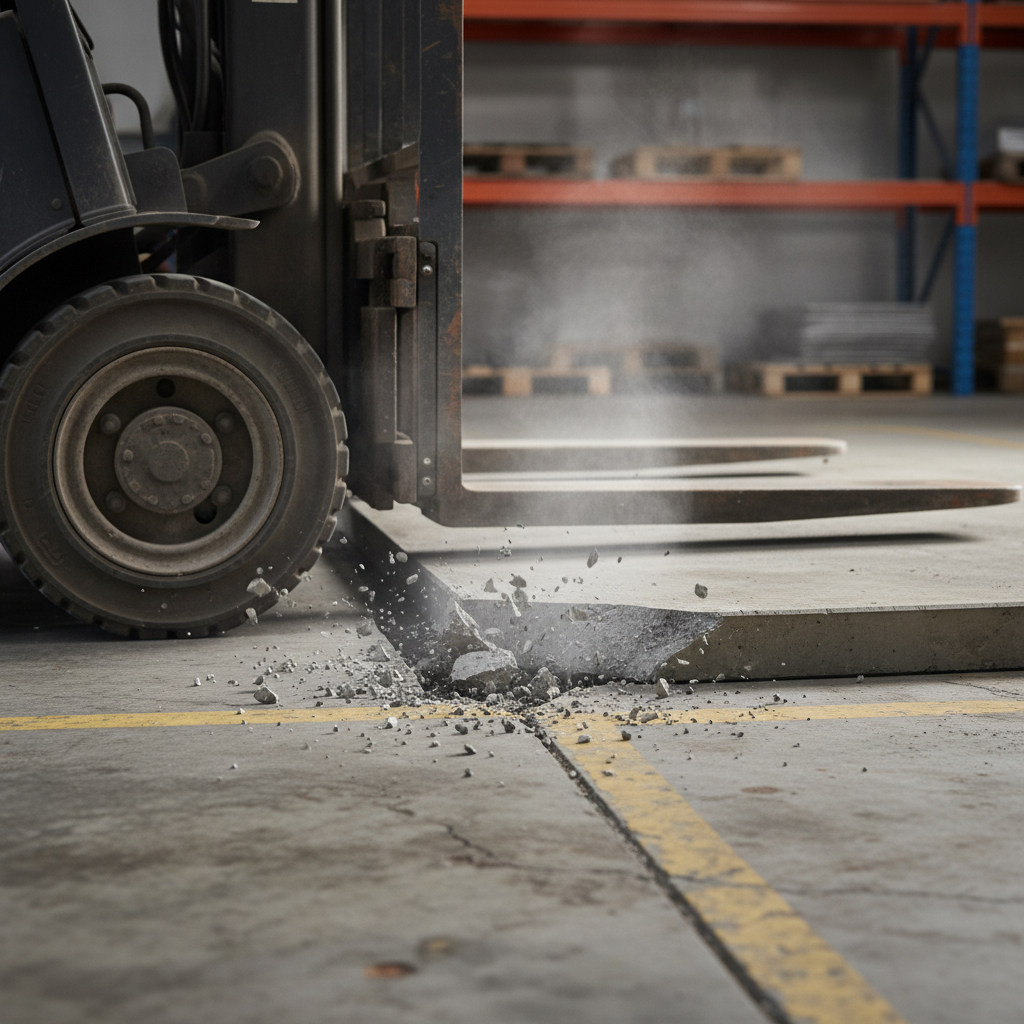
Chipped flooring edges almost always occur at unprotected transition zones where dynamic loads transfer from one surface to another. Forklift impact at these unprotected transition seams causes 85% of industrial floor edge spalling. Simultaneously, floor seam separation is frequently driven by the physics of thermal expansion and contraction. As HVAC systems cycle and facility temperatures fluctuate, concrete slabs and flooring materials expand and contract at different rates, placing immense shear stress on the seams.
The Hidden Culprit Behind Floor Seam Separation
While facility managers often blame weak adhesives for floor seam separation, the true root cause usually lies beneath the surface. Excessive concrete moisture is responsible for 80% of resilient floor seam separations. When moisture vapor emits from the concrete subfloor, it breaks down adhesives and causes the flooring material to warp, leading to inevitable seam failure.
Preventing wear on floor seams requires rigorous substrate testing before installation or repair. The ASTM F2170 standard test method dictates using in-situ probes to measure the relative humidity (RH) within the concrete slab. According to industry guidelines, including those from the Resilient Floor Covering Institute (RFCI), concrete RH must be below 85% before installation can proceed safely [3] [4]. Ignoring this metric guarantees that fluctuating temperatures and trapped moisture will force seams open.
Mechanical Fortification: The Best Edge Protection for Adamantine Floors
To safeguard these vulnerable transitions, mechanical fortification is non-negotiable. Finding the best edge protection for adamantine floors requires evaluating materials against the brutal realities of forklift traffic and chemical spills.
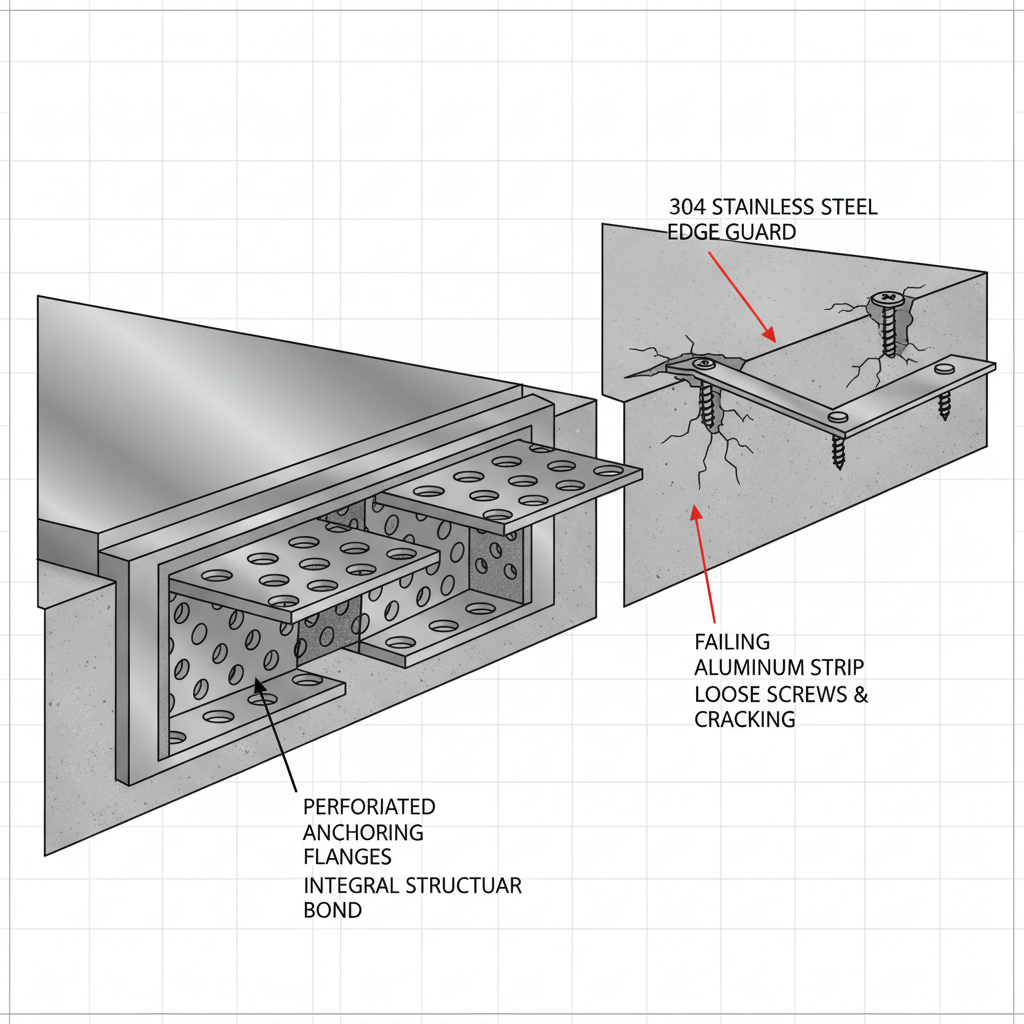
While aluminum transition strips are common in commercial spaces, they are wholly inadequate for industrial zones. Stainless steel 304 profiles offer 5x the impact resistance of standard aluminum profiles, making them the superior choice for dry warehouses. For facilities exposed to harsh chemical washdowns or food processing environments, upgrading to 316 stainless steel is recommended for maximum corrosion resistance. Furthermore, the recommended minimum thickness for forklift traffic edge guards is 1/4 inch (6mm) to prevent the profile from crushing under point loads, a specification supported by guidelines from the Steel Construction Institute [5].
Installation Engineering: Continuous Anchoring Flanges
Knowing how to protect adamantine flooring edges is just as important as selecting the right adamantine edge guards. The secret to indestructible edge protection lies in the anchoring leg design embedded in the wet mortar or concrete substrate.
Surface-mounted, screw-down transition strips will eventually vibrate loose under the dynamic load of heavy machinery. Instead, industrial edge guards must feature continuous anchoring flanges—perforated legs that are fully embedded into the substrate during installation. Data shows that edge guards with continuous anchoring flanges offer 40% better pull-out resistance than screw-down models. This ensures the edge guard becomes a structural part of the floor, adhering to American Institute of Steel Construction (AISC) standards for concrete embedment and load transfer [6].
Navigating ADA Compliance and OSHA Safety Standards
Implementing floor edge protection is not just about preserving the facility; it is a matter of strict legal compliance. Chipped flooring edges and abrupt transitions are prime trip hazards.
When installing edge guards, facility managers must explicitly reference ADA guidelines, which require transition profiles to be no higher than 1/2 inch with a beveled edge to accommodate wheelchairs and pedestrian traffic safely [7]. Furthermore, OSHA Standard 1910.22 (Walking-Working Surfaces) mandates that any changes in level greater than 1/4 inch require mitigation to prevent workplace accidents [8]. The National Safety Council (NSC) routinely highlights uneven floor transitions as a leading cause of workplace slip, trip, and fall hazards, making compliant edge protection a critical risk management strategy [9].
Chemical Reinforcement: Securing and Sealing Floor Seams
Where mechanical edge guards protect perimeters, chemical reinforcement is required to secure the joints and seams within the flooring field. It is vital to understand the difference between static seams (which do not move) and dynamic seams (expansion joints designed to absorb slab movement). Using standard tape to reinforce floor seams is a temporary, inadequate solution that will quickly fail under shear stress.
The engineering principles of joint load transfer, as outlined by the American Society of Civil Engineers (ASCE), dictate that a seam must be able to transfer the weight of a dynamic load (like a forklift wheel) across the gap without deflecting [10]. For sheet flooring, cold welding PVC seams creates a molecular bond equal to 80% of the original flooring material’s strength, resulting in a 100% waterproof and highly durable joint that effectively prevents wear on floor seams.
Selecting a Durable Floor Seam Sealant: Polyurea vs. Polyurethane
For poured concrete or adamantine epoxy expansion joints, selecting a durable floor seam sealant requires a scientific breakdown of sealant chemistries.
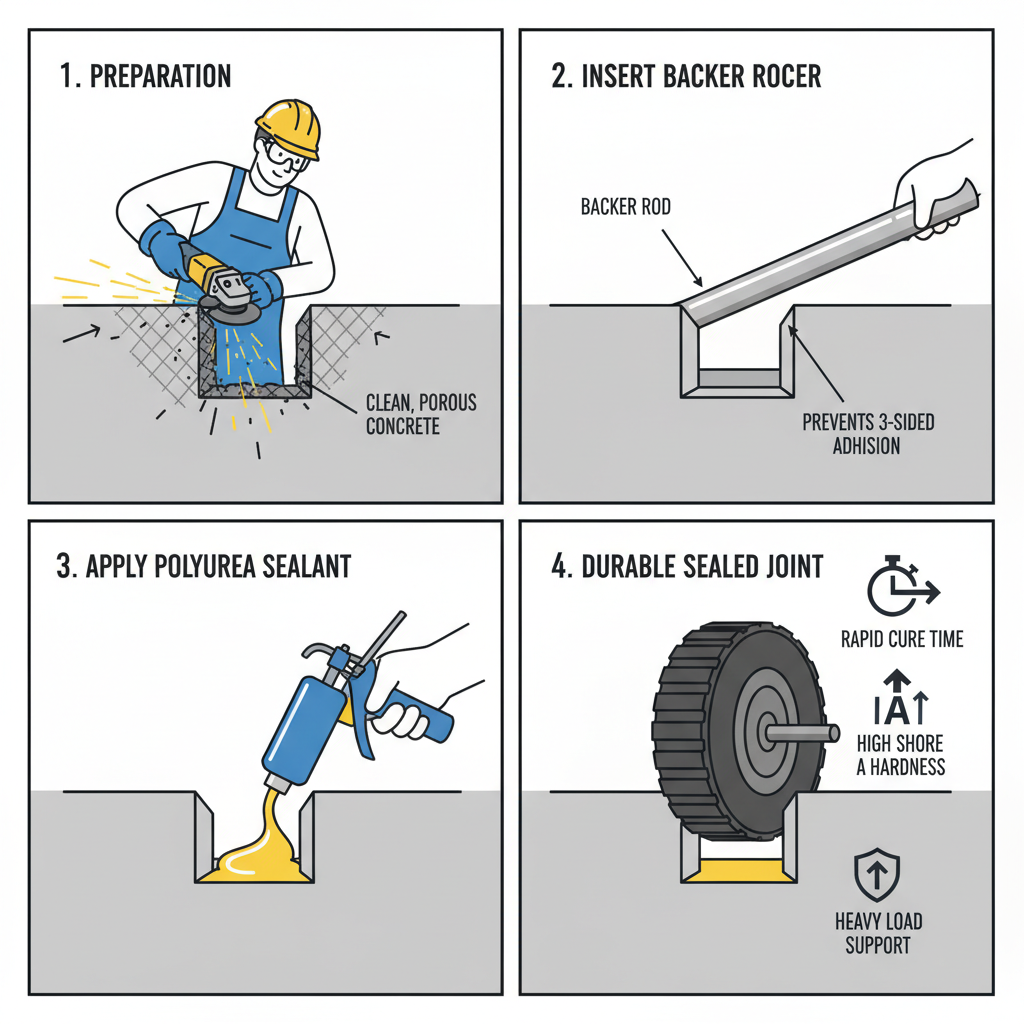
Polyurethane sealants are highly flexible, offering up to 25% joint movement capability for expanding and contracting seams. However, they can take days to cure fully and may be too soft for heavy point loads. In contrast, polyurea sealants are the ultimate choice to reinforce floor seams in high-traffic industrial zones. Polyurea sealants cure in under 2 hours, can withstand forklift traffic the exact same day, and can still absorb up to 15% movement. Both the Sealant, Waterproofing and Restoration Institute (SWR Institute) and the Adhesive and Sealant Council (ASC) recognize polyurea as a superior elastomeric technology for rapid-return-to-service industrial applications [11] [12].
Proper Joint Preparation Techniques
Even the most durable floor seam sealant will fail without proper joint preparation. Before applying any chemical filler, the seam must be meticulously prepared. This involves grinding the inner walls of the joint to expose clean, porous concrete, followed by thorough industrial vacuuming to remove all dust.
Next, backer rods must be installed at the correct depth to prevent three-sided adhesion, allowing the sealant to expand and contract freely. For industrial settings subjected to hard-wheeled forklift traffic, the chosen joint filler must cure to a specific Shore A hardness—typically 80 or higher—to support the wheel load and protect the joint edges from spalling.
Triage and Repair: Fixing Chipped Edges Permanently
When a facility already suffers from chipped flooring edges, immediate triage is required. First, assess the severity of the chip. If it creates a height differential greater than 1/4 inch, apply a temporary, high-visibility safety tape or a rapid-curing patching compound to mitigate the immediate OSHA trip hazard.
For a permanent structural repair that aligns with how to protect adamantine flooring edges long-term, standard concrete patch will not suffice. Facility managers must utilize industrial-grade structural adhesives and epoxy mortar. Epoxy mortar repairs can cure to an astonishing hardness of 10,000 PSI, far exceeding the strength of the surrounding standard concrete. During the repair, it is highly recommended to chamfer (bevel) the edge of the repair zone. Chamfering alters the physics of the impact, distributing dynamic loads from forklift wheels more evenly across the transition rather than allowing them to strike a sharp, vulnerable 90-degree corner.
Mitigating Everyday Flooring Wear: A Facility Manager’s Guide
True wear-resistant flooring requires an ongoing, proactive maintenance strategy. Mitigating everyday flooring wear extends the lifecycle of your adamantine investment and prevents minor abrasions from becoming major structural failures.
According to the ISSA (The Worldwide Cleaning Industry Association) standards for floor care, the first line of defense is stopping abrasion before it enters the building [13]. Proper walk-off matting (extending 15-20 feet from the entrance) captures 80% of dirt and moisture before it reaches the main floor. This prevents silica dust and debris from acting like sandpaper under forklift tires and foot traffic. Furthermore, chemical maintenance is critical. Using incorrect pH cleaners can degrade floor finishes up to 50% faster. Always use neutral pH, industrial-grade cleaners specifically formulated for adamantine or epoxy surfaces to maintain the integrity of the wear layer.
Conclusion
Achieving true flooring longevity in an industrial setting requires moving away from reactive patching and embracing a proactive, engineered approach to vulnerable edges and seams. By understanding the material science behind adamantine durability, investing in heavy-duty mechanical edge guards with continuous anchoring flanges, and utilizing advanced polyurea sealants, facility managers can effectively bulletproof their floors against extreme wear. The ROI of this approach is clear: drastically reduced maintenance downtime, elimination of OSHA trip hazards, and a floor that withstands the brutal realities of heavy industrial traffic. Facility managers are strongly encouraged to conduct a comprehensive floor vulnerability audit—utilizing ASTM moisture testing and OSHA trip hazard guidelines—and to consult with a certified commercial flooring engineer to develop a custom fortification plan.
The information provided is for educational purposes. Always consult a certified commercial flooring contractor and structural engineer before undertaking heavy-duty industrial flooring modifications or repairs.
References & Authoritative Sources
- American Concrete Institute (ACI). (N.D.). Standards and Guidelines for Industrial Concrete and Flooring. Retrieved from authoritative industry standards.
- ASTM International. (N.D.). Standard Test Method for Abrasion Resistance of Organic Coatings by the Taber Abraser. Retrieved from authoritative industry standards.
- ASTM International. (N.D.). ASTM F2170 – Standard Test Method for Determining Relative Humidity in Concrete Floor Slabs Using in situ Probes. Retrieved from authoritative industry standards.
- Resilient Floor Covering Institute (RFCI). (N.D.). Recommended Installation Practices for Resilient Floor Coverings. Retrieved from authoritative industry standards.
- Steel Construction Institute. (N.D.). Guidelines on Steel Durability and Alloy Selection for Industrial Applications. Retrieved from authoritative industry standards.
- American Institute of Steel Construction (AISC). (N.D.). Standards for Steel Embedment and Concrete Anchoring. Retrieved from authoritative industry standards.
- Americans with Disabilities Act (ADA). (N.D.). ADA Standards for Accessible Design: Floor and Ground Surfaces. Retrieved from authoritative legal guidelines.
- Occupational Safety and Health Administration (OSHA). (N.D.). OSHA Standard 1910.22 – Walking-Working Surfaces. Retrieved from authoritative legal guidelines.
- National Safety Council (NSC). (N.D.). Workplace Slip, Trip, and Fall Hazard Prevention Guidelines. Retrieved from authoritative industry standards.
- American Society of Civil Engineers (ASCE). (N.D.). Principles of Load Transfer in Concrete Slabs and Joints. Retrieved from authoritative industry standards.
- Sealant, Waterproofing and Restoration Institute (SWR Institute). (N.D.). Technical Guidelines for Elastomeric Sealants. Retrieved from authoritative industry standards.
- Adhesive and Sealant Council (ASC). (N.D.). Industry Standards for Chemical Sealants and Polyurea Applications. Retrieved from authoritative industry standards.
- ISSA – The Worldwide Cleaning Industry Association. (N.D.). Commercial Floor Care and Matting Standards. Retrieved from authoritative industry standards.
