Every year in North America, moisture-related flooring failures cost homeowners and the construction industry over $1 billion in remediation and replacement [1]. For anyone undertaking a basement remodel, this staggering statistic highlights a harsh reality: below-grade environments actively destroy standard floors. The traditional approach of simply laying down a “waterproof plank” and hoping for the best is a recipe for disaster.
Welcome to the definitive Basement Flooring Blueprint. This guide moves beyond marketing myths to help you master the building science of your home’s lowest level. By learning to diagnose root-cause moisture issues and engineer fail-proof subfloor systems, you can protect your investment. Furthermore, we will introduce next-generation adamantine flooring—a premium, ultra-durable hybrid technology that stands as the ultimate lifetime solution for below-grade flooring.
- The Building Science of Below-Grade Environments: Why Floors Fail
- The Diagnostic Triage: Assessing and Prepping Your Basement
- Adamantine Flooring: The Next-Generation Basement Solution
- Top Waterproof Flooring Alternatives for Below-Grade Installations
- Step-by-Step: Durable Below-Grade Floor Installation Best Practices
- Conclusion
- References & Authoritative Sources
The Building Science of Below-Grade Environments: Why Floors Fail
To successfully install basement flooring, you must first shift your focus from aesthetic choices to the hostile environment your floor must survive. Understanding the physics and chemistry of a concrete slab is the only way to prevent catastrophic below-grade flooring failures and chronic basement moisture flooring issues.
Demystifying Concrete Moisture: Capillary Action & Hydrostatic Pressure
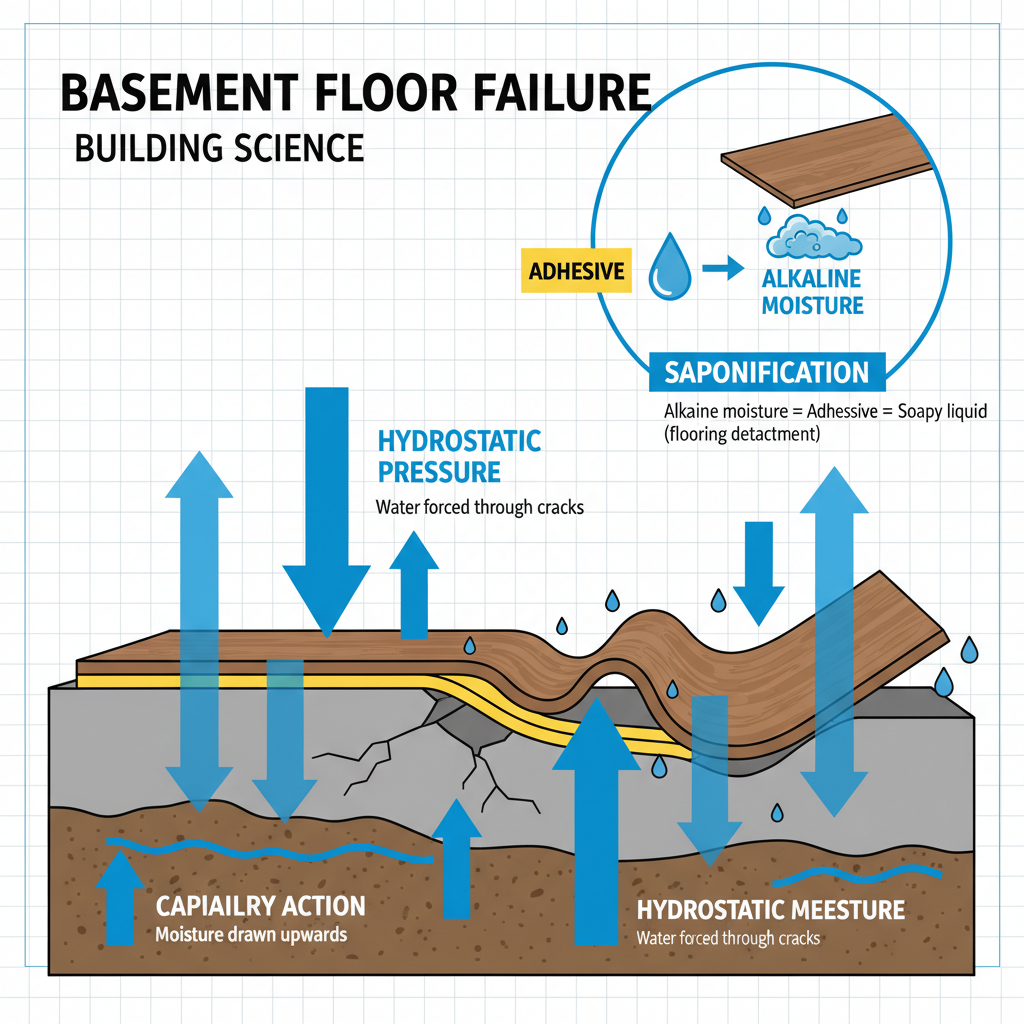
Concrete may look solid, but at a microscopic level, it acts like a rigid sponge. This porosity leads to two primary damp basement floor problems: capillary action and hydrostatic pressure. According to foundation experts at Polyguard, capillary action is the physical process where concrete draws moisture upward from the surrounding damp soil through its microscopic capillaries, regardless of gravity [2].
Hydrostatic pressure, on the other hand, occurs when the water table rises, physically forcing liquid water through foundation cracks and porous concrete. If you lay a floor without addressing these invisible forces, the moisture will inevitably become trapped beneath your new surface, leading to mold, buckling, and rot.
The Hidden Killers: High Alkalinity (pH) and Adhesive Saponification
When evaluating why below-grade flooring failures occur, especially in glue-down applications, the culprit is rarely just water—it is chemistry. Forensic engineering analyses by CEP Forensique reveal that as moisture travels through a concrete slab, it carries highly alkaline salts to the surface [3].
When this alkaline moisture mixes with standard flooring adhesives, a chemical reaction called saponification occurs. Saponification literally turns the flooring adhesive into a soapy, oozing liquid, completely destroying the bond. This is why industry authorities like INSTALL Floorcovering Professionals mandate strict moisture and pH testing before any adhesive is applied to a basement slab [4].
Condensation and the Dew Point: Why Summer Makes Basements Damp
Not all damp basement floor problems come from the ground; many come from the air. Understanding the thermodynamics of the “dew point” is crucial for diagnosing moisture. In the summer, warm, humid air enters the basement and comes into contact with the naturally cool concrete slab. If the slab temperature is below the air’s dew point, condensation forms directly on the floor.
The University of Minnesota Extension (UMN), an authority on building science and indoor air quality, emphasizes the importance of differentiating between active hydrostatic leaks and passive summer condensation [5]. To prevent condensation and protect your flooring, UMN recommends maintaining indoor basement humidity strictly between 30 and 50 percent using a high-capacity dehumidifier.
The Diagnostic Triage: Assessing and Prepping Your Basement
Laying new flooring over an actively damp concrete slab guarantees a costly failure. Transitioning from problem identification to actionable preparation is the most critical phase of a durable below-grade floor installation. True waterproof basement flooring solutions require meticulous testing and a properly engineered subfloor stack.
Visual Inspections vs. Professional ASTM Moisture Testing
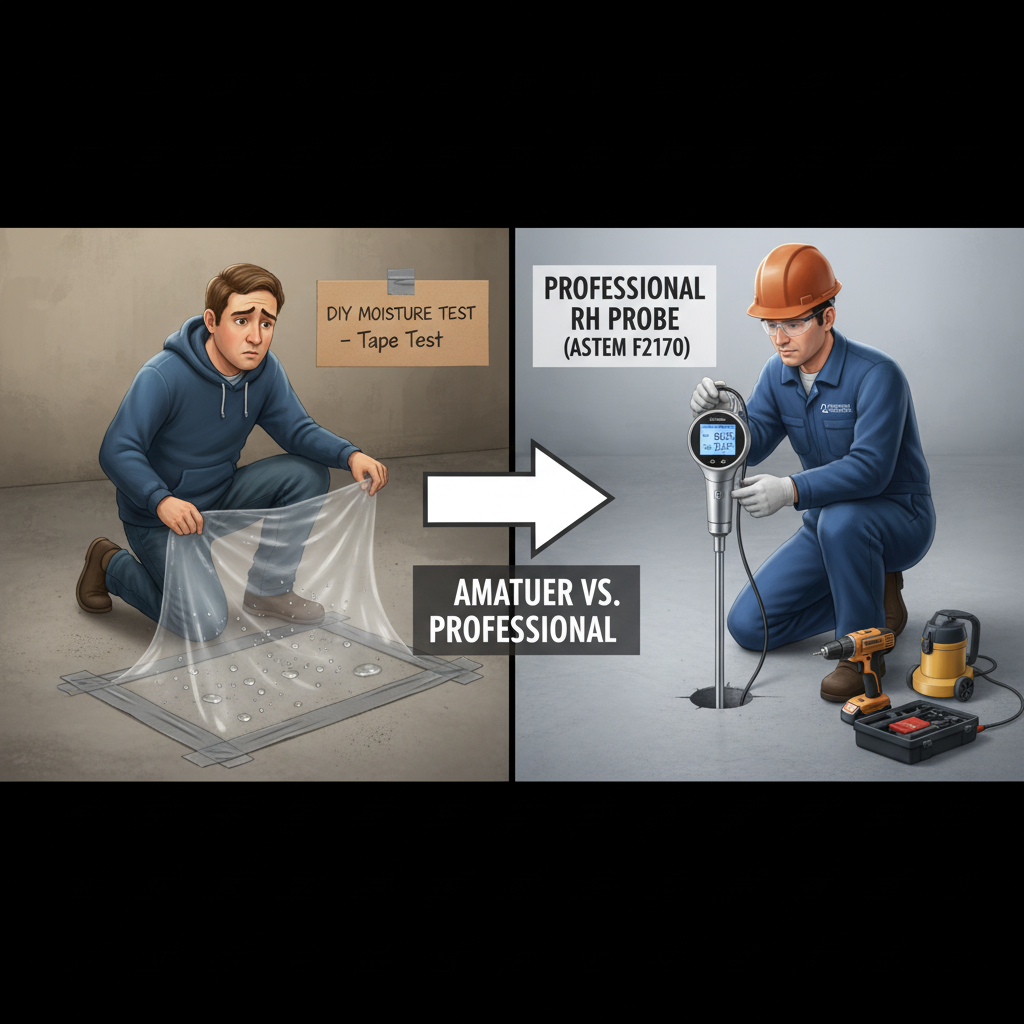
Many DIYers rely on the outdated “tape test”—taping a piece of plastic to the floor for 24 hours to see if condensation forms. While this might indicate a severe problem, it is entirely insufficient for diagnosing complex basement moisture flooring issues.
To maintain manufacturer warranties and ensure a successful installation, professional ASTM (American Society for Testing and Materials) testing is required. INSTALL standards dictate the use of in-situ Relative Humidity (RH) probes (ASTM F2170) or Calcium Chloride tests (ASTM F1869) to accurately measure the moisture vapor emission rate deep within the concrete, rather than just on the surface [4].
The Fail-Proof Subfloor Stack: Vapor Barriers vs. Insulated Systems
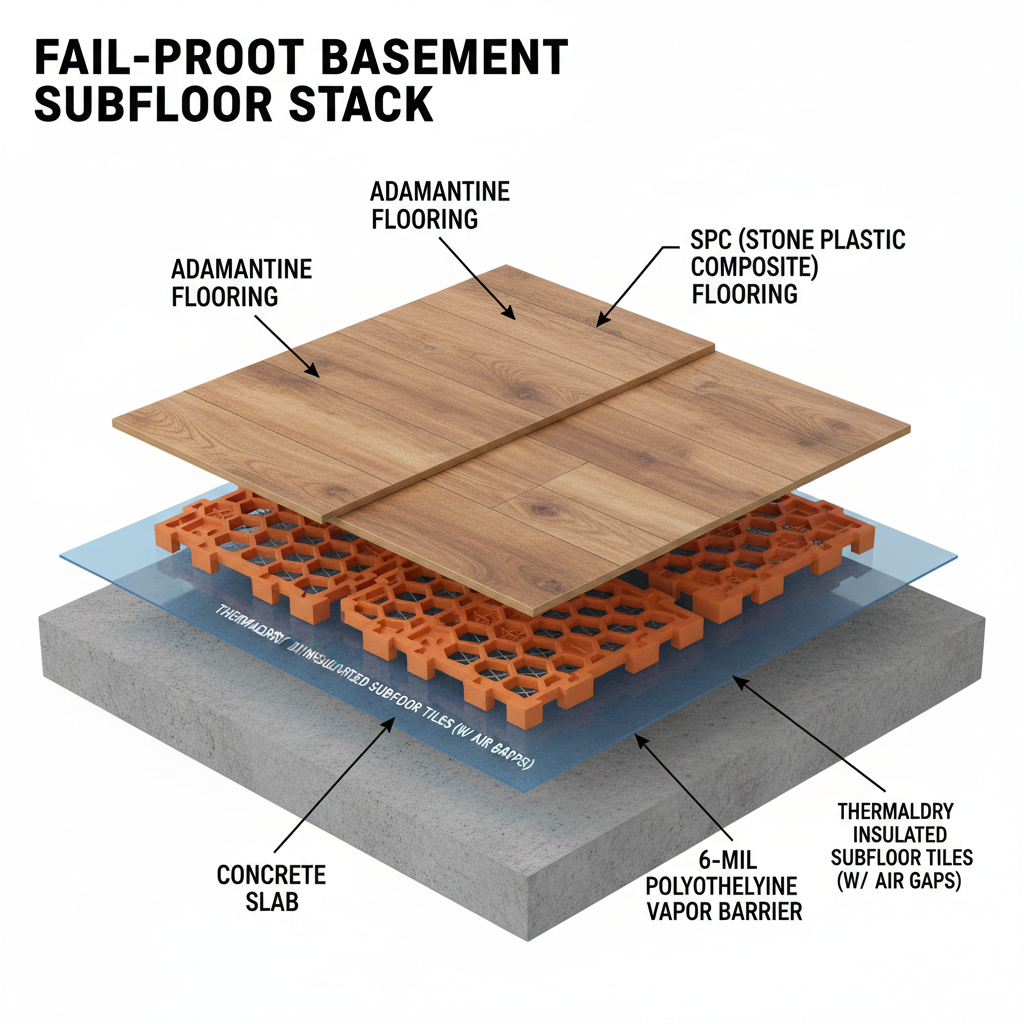
A dangerous misconception in home remodeling is that waterproof flooring stops mold. In reality, if you place a waterproof plank directly over damp concrete, it traps the moisture underneath, creating a perfect dark, damp breeding ground for mold. Therefore, waterproof basement flooring solutions require a subfloor stack.
At the absolute minimum, building codes require a 6-mil polyethylene vapor barrier (costing roughly $0.25 to $0.50 per square foot) with seams overlapped by at least 12 inches and heavily taped. However, for a premium installation, insulated interlocking subfloor systems offer superior performance. Innovators like Basement Systems have engineered raised plastic tiles (such as ThermalDry) that provide a vital thermal break, elevating the floor off the cold concrete and allowing trapped moisture to dissipate, significantly warming the floor underfoot [6].
Adamantine Flooring: The Next-Generation Basement Solution
For homeowners seeking a no-compromise upgrade, adamantine flooring represents the pinnacle of basement flooring technology. Bridging the gap between authentic hardwood aesthetics and the absolute waterproof capabilities of synthetic planks, adamantine moisture resistant floors are the premium choice for high-traffic, below-grade renovations.
What is Adamantine Flooring? (Aluminum Oxide & Hybrid Construction)
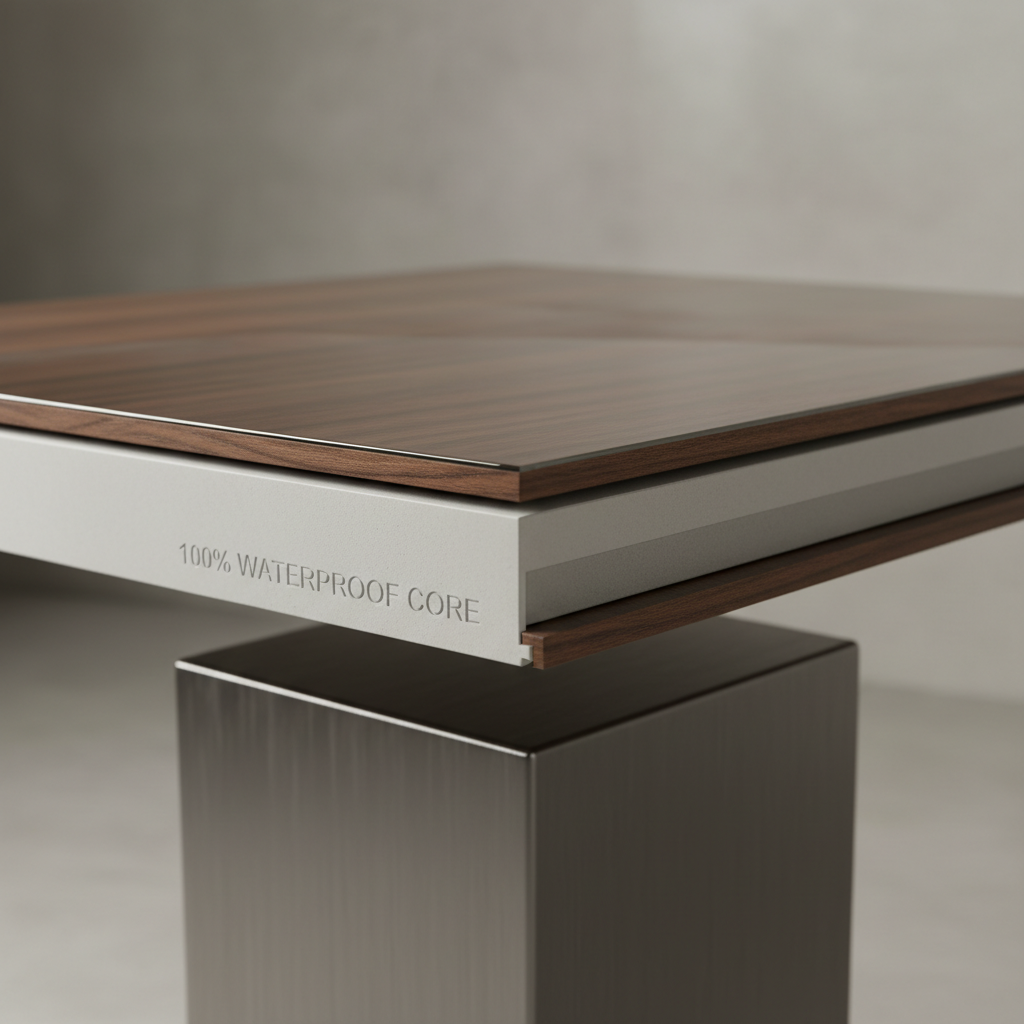
Adamantine flooring utilizes a specialized hybrid construction. Unlike standard vinyl, it features a highly engineered, 100% waterproof rigid core topped with a real wood veneer that has been densified and sealed with proprietary technology.
The secret to its extreme durability lies in its finish. According to technical specifications from Adamantine.info, these floors utilize an aluminum oxide coating that provides three times greater scratch resistance than traditional polyurethane finishes [7]. This chemical engineering ensures the floor is not only immune to basement moisture but is also engineered for a 25+ year durability lifespan, easily withstanding pets, moving furniture, and heavy home gym equipment.
Adamantine vs. Luxury Vinyl Plank (LVP): A Cost-Benefit Analysis
When considering adamantine flooring for basement remodels, it is essential to compare it against the industry standard: Luxury Vinyl Plank (LVP). While LVP is highly effective, adamantine offers a distinct premium advantage.
Wood scientists at AHF Products, leaders in densified wood technology, note that these hybrid adamantine finishes offer up to six times the dent resistance and four times the scratch resistance of standard wood flooring [8]. While adamantine carries a higher upfront premium than standard LVP, the cost-benefit analysis heavily favors adamantine in high-traffic basements. Its superior thermal comfort, authentic wood feel, and strict below-grade warranty conditions make it a true lifetime investment, eliminating the replacement costs associated with scratched or dented vinyl.
Top Waterproof Flooring Alternatives for Below-Grade Installations
While adamantine is the premium tier, a comprehensive look at the best flooring for below-grade installations must include other viable options. When evaluating waterproof flooring options for basements, it is critical to understand the structural difference between “water-resistant” (which will eventually swell and fail) and “100% waterproof” materials.
SPC and WPC Luxury Vinyl Plank: The Mold-Proof Standard
Resilient flooring, particularly luxury vinyl, commands a massive 34.2% of the U.S. flooring market share, and for good reason [8]. It is the accessible all-star of waterproof flooring options for basements.
However, not all LVP is created equal. Experts at Leicester Flooring and CV Floors and Blinds emphasize the structural difference between WPC (Wood Plastic Composite) and SPC (Stone Plastic Composite) cores [9] [10]. WPC offers more cushioning but can be susceptible to extreme temperature shifts. SPC, made with limestone powder, is incredibly rigid and dimensionally stable. Costing roughly $2 to $5 per square foot, a high-quality SPC luxury vinyl plank is 100% synthetic, meaning it provides zero organic food source for mold, even if water infiltrates the basement.
Ceramic and Porcelain Tile: The Ultimate Waterproof Option
For absolute water immunity, ceramic and porcelain tile remain top contenders for the best flooring for below-grade installations. Tile is entirely unaffected by hydrostatic pressure or flooding.
However, tile comes with distinct drawbacks in a basement setting. It is inherently cold underfoot and lacks acoustic dampening, making a basement echo. Furthermore, installing large-format porcelain tiles on uneven basement slabs presents significant challenges; without meticulous subfloor leveling, the tiles will suffer from “lippage” (uneven edges that pose a tripping hazard).
Step-by-Step: Durable Below-Grade Floor Installation Best Practices
Even the highest quality adamantine or SPC floor will fail if the installation methodology is flawed. A truly durable below-grade floor installation relies heavily on the preparation and techniques used by licensed contractors.
Leveling the Slab and Floating vs. Glue-Down Applications
A successful durable below-grade floor installation begins with a perfectly flat surface. Basements naturally slope toward floor drains. To prevent “drop and click” interlocking flooring systems from failing under humidity fluctuations—where insufficient notch thickness snaps under pressure—the slab must be leveled. This often requires pouring self-leveling concrete compounds and strictly adhering to their required curing times before laying the floor.
Because of the risks of high alkalinity and adhesive saponification discussed earlier, floating floors (which lock together and rest over a vapor barrier without adhesive) are generally preferred over glue-down applications in basements. Floating floors also require proper expansion gaps at the perimeter to allow the material to expand and contract with seasonal basement temperature shifts.
Handling Floor Drains and Radiant Heating
Complex basement topographies require specialized installation tactics. When installing floating waterproof systems around essential floor drains, precise cutting and the use of waterproof silicone sealants at the transition points are necessary to maintain the floor’s integrity while allowing the drain to function.
Additionally, many homeowners wish to combat the cold concrete by installing radiant heating. According to comprehensive material analyses by BuildDirect, both premium LVP and adamantine hybrid floors are highly compatible with below-floor radiant heating systems, provided the heating system is embedded in the concrete or placed in a specialized above-floor track system that distributes heat evenly without exceeding the flooring manufacturer’s temperature limits [11].
Conclusion
Treating your basement as a unique, highly demanding building science environment is the only way to guarantee a successful renovation. A lifetime below-grade floor requires more than just picking a color; it demands diagnosing concrete moisture, building a fail-proof subfloor stack with proper vapor barriers, and selecting a genuinely 100% waterproof material.
Adamantine flooring stands out as the ultimate solution, offering an unparalleled combination of premium authentic aesthetics, extreme scratch resistance, and total moisture immunity. Before you begin your next project, start by conducting an ASTM moisture test on your slab, and consider ordering samples of adamantine flooring to experience its waterproof hybrid core and incredible durability firsthand.
Standard Construction/DIY Disclaimer: Information provided is for educational purposes. Always consult with a licensed structural engineer or certified basement waterproofer for active leaks, structural foundation issues, or severe moisture remediation before installing flooring.
References & Authoritative Sources
- Independent Floor Testing & Inspection (IFTI). (N.D.). Data on Moisture-Related Flooring Failures and Remediation Costs. Retrieved from industry data on concrete moisture vapor emission.
- Polyguard. (N.D.). Capillary Action and Foundation Moisture Barriers. Retrieved from technical explanations of concrete physics.
- CEP Forensique. (N.D.). Forensic Engineering Analysis of Below-Grade Joint and Material Failures. Retrieved from forensic engineering reports on adhesive saponification.
- INSTALL Floorcovering Professionals. (N.D.). Industry Standards for Installation Training, Failure Prevention, and Moisture Testing. Retrieved from INSTALL guidelines.
- University of Minnesota Extension (UMN). (N.D.). Indoor Air Quality, Moisture Mechanisms, and Mold Prevention. Retrieved from academic authority on building science and thermodynamics.
- Basement Systems. (N.D.). Proprietary Waterproof Subfloor Technology and Thermal Breaks. Retrieved from engineered subfloor specifications.
- Adamantine.info. (N.D.). Proprietary Technology Claims, Finish Specifications, and Hybrid Construction Data. Retrieved from primary manufacturer technical data.
- AHF Products / Robbins. (N.D.). Densified Wood Flooring Technology and Resilient Flooring Market Share Data. Retrieved from wood science and industry analysis.
- Leicester Flooring. (N.D.). Professional Installation Methodologies and Subfloor Technical Specs. Retrieved from structural comparisons of WPC and SPC.
- CV Floors and Blinds. (N.D.). Comparisons Between Traditional and Modern Waterproof Materials. Retrieved from flooring material analysis.
- BuildDirect. (N.D.). Flooring Material Durability and Radiant Heat Compatibility. Retrieved from below-grade installation comparisons.
