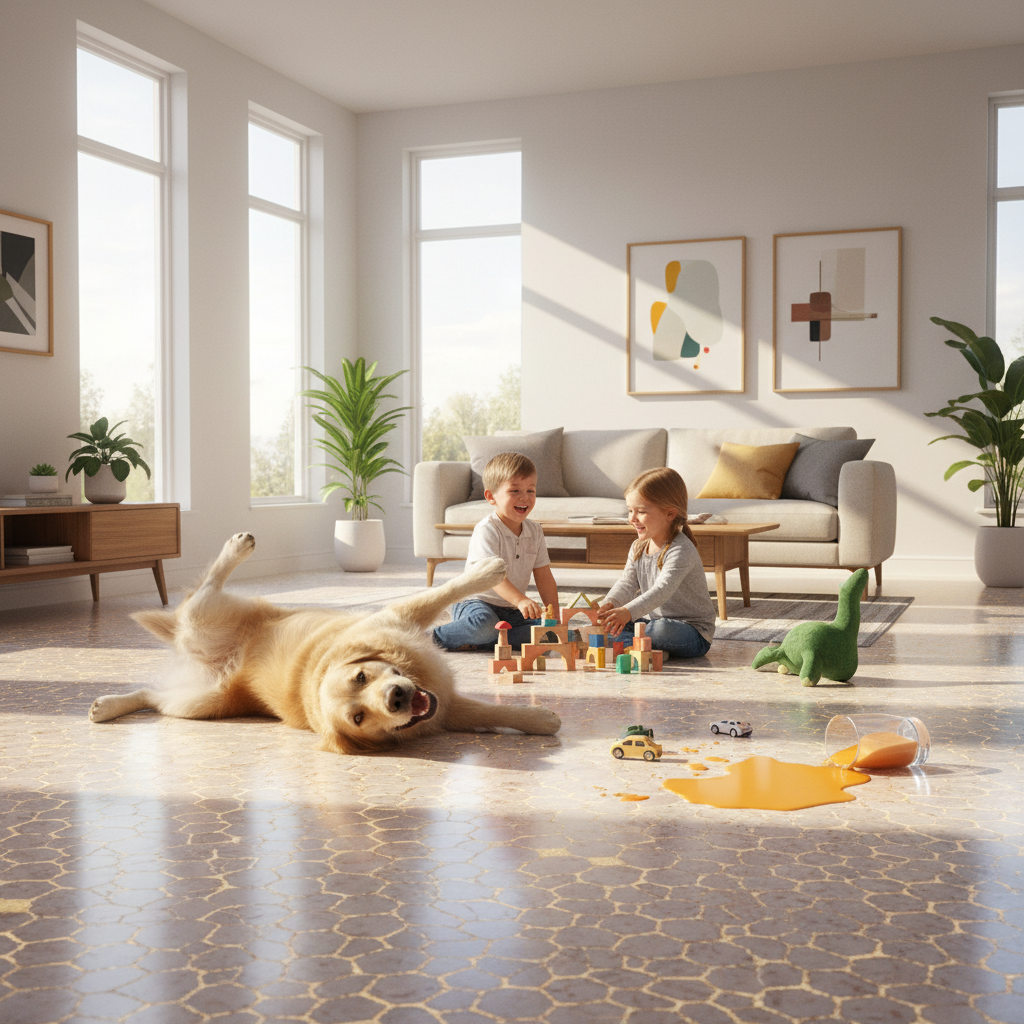
Between the frantic scrabble of pet claws, the inevitable toddler spills, and the relentless parade of heavy foot traffic, daily family life is a beautiful, chaotic mess. Unfortunately, it is also a gauntlet that rapidly degrades standard, builder-grade floors. If you are a homeowner or property investor with an active household, you have likely felt the frustration of watching a newly installed floor succumb to scratches, dents, and water damage within just a few years. In the desperate search for a solution, you are immediately bombarded with confusing marketing buzzwords like “adamantine” and “lifeproof,” which often obscure the actual material science behind the products.
It is time to cut through the jargon. Welcome to the “Forever Floor” Matrix—a science-backed, stage-by-stage blueprint designed to demystify wear layers, prioritize safety and acoustics, and provide actionable advice for choosing, maintaining, and repairing ultra-durable flooring. Whether you are future-proofing a nursery or fortifying a mudroom against a pack of golden retrievers, this guide will help you invest in a floor that adapts seamlessly to every stage of family life.
- Decoding the Jargon: Adamantine, Lifeproof, and Material Science
- The Family Floor Matrix: Best Flooring for Growing Families
- Transitional Design: Versatile Home Flooring for Every Stage
- Flooring Wear and Tear vs. Actionable Damage: A Triage Guide
- Conclusion
Decoding the Jargon: Adamantine, Lifeproof, and Material Science
The durable flooring market is saturated with terminology designed to sell, rather than educate. To make an informed, long-term investment, homeowners must translate these marketing buzzwords into objective material science metrics. When evaluating scratch resistant family floors, the most critical specifications to understand are AC (Abrasion Class) ratings for laminate and “mil” (one-thousandth of an inch) thickness for the wear layers of vinyl.
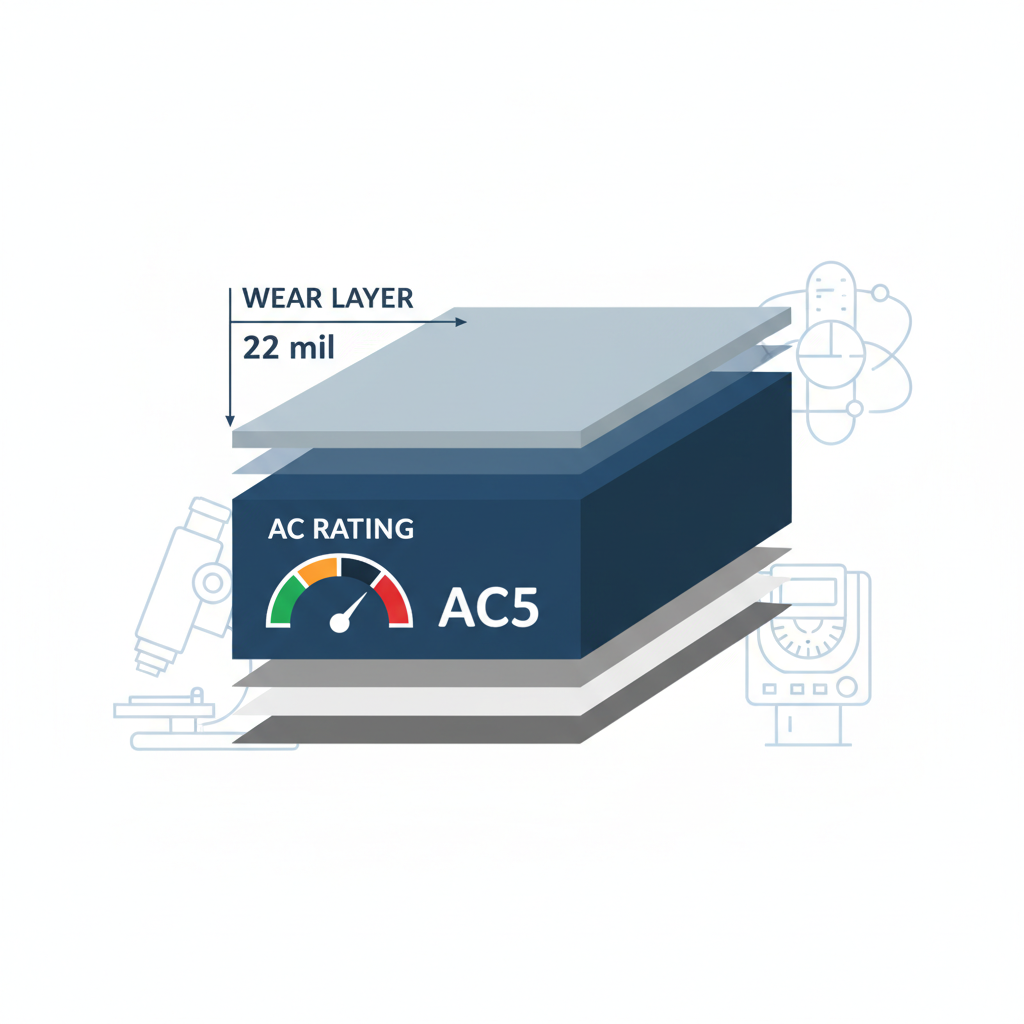
True durability isn’t just a promise; it is measured and verified. Authoritative bodies like ASTM International provide standardized testing protocols, such as the ASTM D4060 test for abrasion resistance, which objectively measures how much wear a coating or surface can withstand before failing [1]. By looking for these standardized metrics rather than flashy product names, you can buy with absolute confidence.
What Does ‘Adamantine Flooring’ Actually Mean?
In the consumer market, “adamantine flooring” is often used as a buzzword to imply extreme, near-mythical hardness. However, in material science and industrial applications, achieving this level of indestructibility requires specific chemical compositions and structural densities. When we talk about adamantine-level durability, we are usually comparing industrial-grade epoxy to advanced polyaspartic coatings, or looking at ultra-hardened ceramics.
For instance, industry data reveals that polyaspartic coatings are up to 4x stronger and more abrasion-resistant than traditional epoxy, making them a true “adamantine” choice for garages and heavy-traffic utility spaces [2]. If you prefer a residential aesthetic, high-grade porcelain tile can reach an 8 or 9 on the Mohs hardness scale, making it nearly impervious to standard household scratches. As noted by experts in Concrete Construction Magazine, understanding these industry standards for floor coatings and concrete preparation is what separates a floor that lasts five years from one that lasts fifty [2].
The Truth About ‘Lifeproof’ and Rigid Core Vinyl
The term “lifeproof flooring” has dual meanings: it is a highly specific, proprietary brand name of Luxury Vinyl Plank (LVP), but it has also been adopted generically by consumers to describe any ultra-durable, 100% waterproof flooring. The secret to the success of rigid core vinyl lies in its layered construction.
Independent flooring durability and scratch-resistance testing, such as those conducted by Consumer Reports, emphasize that the protective topcoat is the true hero of these products [3]. Lifeproof LVP typically features a minimum 6 mil to 22 mil wear layer depending on the product tier, dictating whether it can survive a quiet home office or a hallway doubling as a dog run. Furthermore, the structural integrity of these planks relies on a rigid PVC core that prevents telegraphing from minor subfloor imperfections up to 3/16 inch, ensuring a smooth, flawless finish even over older, slightly uneven subfloors.
The Family Floor Matrix: Best Flooring for Growing Families
Finding the best flooring for growing families requires balancing competing needs: you need 100% waterproofing for spills, high scratch resistance for pets, slip resistance for toddlers, and acoustic comfort to maintain a peaceful home. The Family Floor Matrix is a comprehensive guide to achieving this perfect equilibrium.
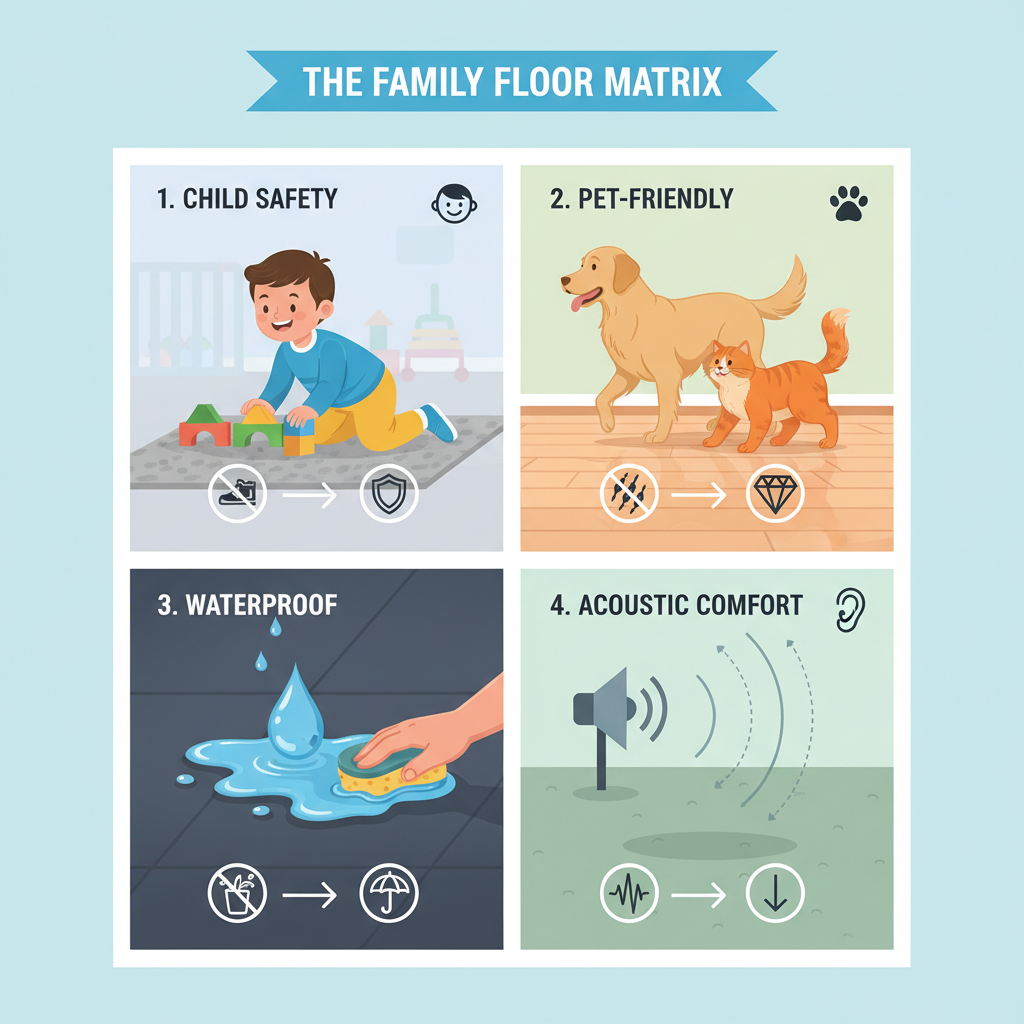
When evaluating family friendly flooring, it is crucial to establish a maintenance cheat sheet tailored to your chosen material—knowing whether to use a damp mop, a specialized pH-neutral cleaner, or a dry vacuum can double the lifespan of your floors. Furthermore, integrating pediatric safety guidelines regarding slip hazards and indoor air quality ensures that your home is not just durable, but fundamentally safe.
Waterproofing and Scratch Resistance for Kids and Pets
When searching for durable flooring for kids and pets, the dual threats of liquid spills and sharp claws must be addressed simultaneously. Luxury Vinyl Plank (LVP) and high-quality laminate are the reigning champions here, provided you select the right specifications. Laminate flooring requires a minimum 12mm construction and an AC4 or AC5 wear rating for maximum durability against heavy impacts and large dogs.
For those who prefer the authenticity of real wood, understanding the “traction factor” and material density is key. Harder wood species like oak, hickory, or maple have higher Janka hardness ratings, making them significantly less prone to pet scratches than softer woods like pine or walnut. According to data provided by Pacific Mat & Commercial Flooring, referencing Janka hardness charts is an essential step in pet-friendly wood selection [4].
Safety First: Slip Resistance and Low-VOC Materials
A critical content gap in many flooring guides is the failure to address the toxicity and VOC (Volatile Organic Compound) off-gassing of synthetic materials and the adhesives used in their installation. For toddlers learning to walk and spending their days crawling on the floor, indoor air quality is paramount.
To ensure safety, always look for FloorScore certifications, which prove the recommendation of low-VOC materials. The Resilient Floor Covering Institute (RFCI) acts as the governing body for this FloorScore certification data, ensuring products meet stringent indoor air quality emissions criteria [5]. Additionally, the American Academy of Pediatrics (AAP) provides comprehensive home safety and asthma guidelines, emphasizing the importance of selecting flooring with adequate slip resistance and hypoallergenic properties to protect developing respiratory systems [6].
Solving the ‘Echo Chamber’: Acoustics and Underfoot Comfort
One of the most frequent complaints in modern, open-concept homes is the “echo chamber” effect created by sweeping expanses of hard flooring. The acoustic impact of pet nails clicking and children running can dramatically increase household stress.
To put this into perspective, traditional carpet provides a noise reduction coefficient (NRC) of up to 0.55, significantly dampening household noise compared to hard surfaces [7]. If you are installing rigid core LVP or laminate, you must compensate for this loss of sound absorption. Recommend specific core constructions—such as a rigid stone core paired with an integrated EVA foam or cork underlayment—for superior impact resistance and sound deadening. Authoritative insights from Carpet One highlight that prioritizing the acoustic and cushioning properties of family flooring is essential for long-term underfoot comfort and a peaceful living environment [7].
Transitional Design: Versatile Home Flooring for Every Stage
A home is not static; a playroom today may become a teenager’s lounge tomorrow, and eventually a quiet home office. Transitional design focuses on future-proofing your home using versatile home flooring for every stage. This involves bridging the gap between residential aesthetics and commercial durability.
When planning for the long term, it is wise to compare the lifecycle costs of different materials. For instance, evaluating the 20-year cost of a floating laminate floor (which can be easily unclicked and replaced as trends or needs change) versus permanent tile (which requires costly demolition) can heavily influence your investment strategy. Additionally, exploring LEED-certified flooring options ensures that your pursuit of longevity also aligns with eco-conscious, sustainable building practices.
Zoning Your Home for Durability
One of the most effective strategies for durable lifestyle flooring is “zoning.” This concept involves using ultra-durable, waterproof porcelain tile for wet zones (mudrooms, kitchens, bathrooms) and transitioning to engineered hardwood or premium LVP for living zones, all unified by a cohesive color palette.
If you choose engineered wood for your living spaces, you must understand its structural composition. Unlike solid wood, engineered wood consists of a plywood or fiberboard core topped with a real wood veneer. Because of this veneer, many engineered floors can only be sanded 1-2 times over their lifespan, while some cannot be refinished at all. For the porcelain zones, which can be unforgivingly cold and hard, it is highly recommended to install radiant heating systems to counteract the coldness of the tile. Design-build experts like Patrick A. Finn emphasize that integrating these durable flooring choices into the home’s architecture requires balancing extreme utility with everyday comfort [8].
Borrowing from Commercial Design for Residential Chaos
For the most extreme areas of the home—such as basements, home gyms, or heavy-duty mudrooms—homeowners are increasingly looking toward long lasting versatile floors that borrow directly from commercial design.
The challenge lies in specifying high-wear commercial products that still look warm and inviting in a residential setting. Commercial-grade Luxury Vinyl Tile (LVT) with multi-layer construction is an excellent choice. For concrete subfloors, residential epoxy offers an indestructible, seamless finish. The durability of epoxy comes from its chemical process: a thermosetting resin is applied to properly moisture-treated concrete, creating a bond that is impervious to almost any household disaster. As outlined by Spectra Contract Flooring, adhering to commercial flooring standards and proper epoxy application data is crucial to achieving this buy-it-for-life longevity [9].
Flooring Wear and Tear vs. Actionable Damage: A Triage Guide
Even the most robust floors will eventually show signs of life. Navigating the line between flooring wear and tear and actionable damage is a common pain point, particularly for landlords, renters, and homeowners looking to preserve their property value.
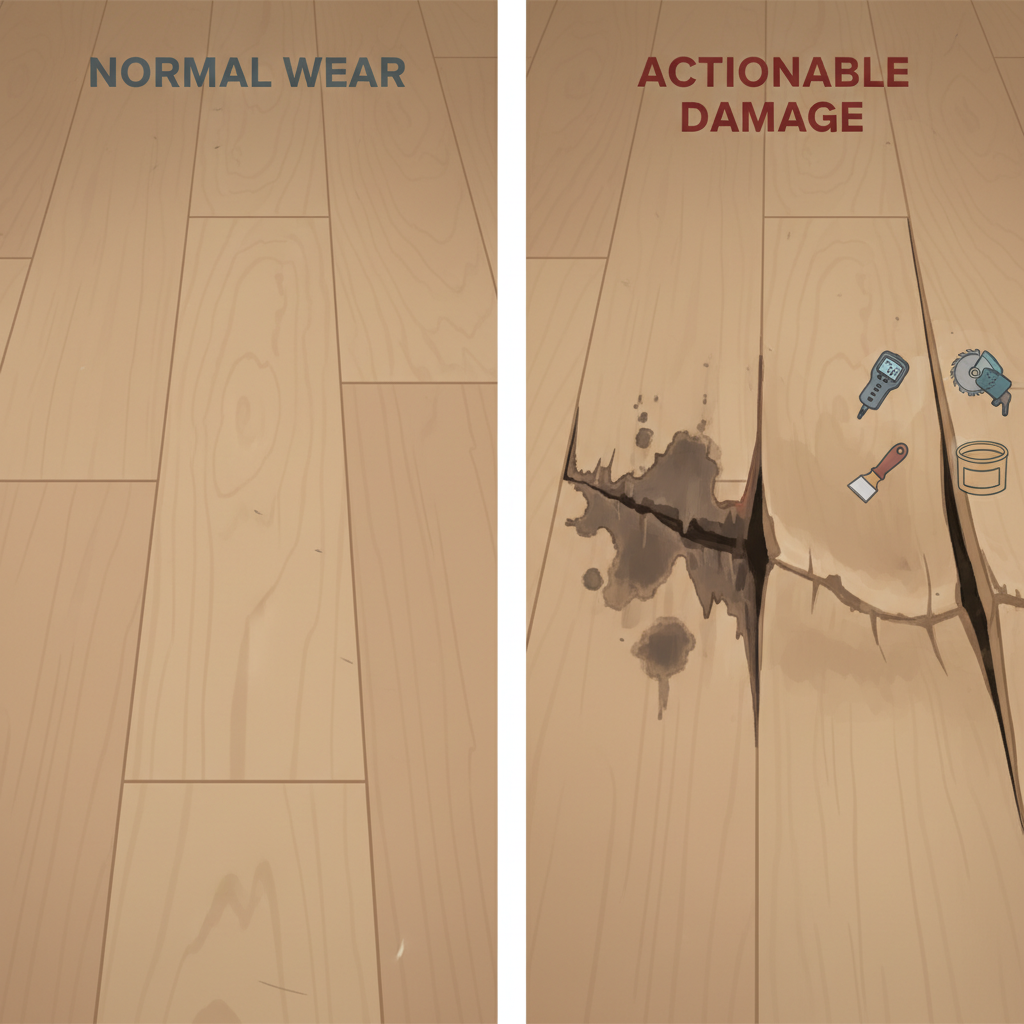
Creating a visual “Wear vs. Damage” matrix concept in your mind can help you assess your floors objectively. When issues do arise, having the right repair tools—such as moisture meters for diagnosing unseen leaks, or oscillating saws for precision board replacement—can save you thousands of dollars in professional fees.
Defining Normal Wear vs. Damage
Understanding the definition of normal wear versus structural damage is a critical distinction. Normal wear includes minor scuffs, slight finish fading in high-sunlight areas, and microscopic surface scratches. Damage, on the other hand, involves deep gouges that penetrate the wear layer, permanent pet stains, or warped boards from water exposure.
Real estate and property management guidelines regarding deposit deductions rely heavily on these strict definitions. According to experts at Maple Leaf Management, clearly defining wear and tear protects both the property’s structural integrity and the financial interests of the occupants [10]. Addressing wear early prevents it from degrading into costly, actionable damage.
The Triage Guide for Damaged Family Floors
When faced with damaged family floors, immediate triage is required before calling a professional. Categorize the damage by severity: is it a surface-level aesthetic scratch, or a structural water warp?
If you suspect water damage, the most critical step is diagnosing subfloor moisture with a moisture meter before attempting any surface fix; sealing moisture into a subfloor will lead to catastrophic mold and rot. If a board is physically broken or deeply gouged, replacement is necessary. This involves a complex process of matching grain patterns and utilizing an oscillating saw to carefully extract the damaged plank without harming the surrounding locking mechanisms. Manufacturer guidelines, such as those provided by Bruce Flooring, stress that following exact protocols for hardwood floor repair and board replacement is vital for preserving the floor’s warranty [11].
DIY Repair Hacks for Scratched and Stained Floors
For scratched and stained floors that don’t require full board replacement, DIY restoration is highly actionable. The financial incentive is clear: industry data shows that repairing hardwood floors typically costs $478 to $1,624, while full replacement can run $2,480 to $7,028 or more [12].
Before applying any store-bought restorers, you must identify your floor’s existing finish (wax, aluminum oxide, or polyurethane). Applying the wrong chemical can ruin the floor. Always use the “Test Block Method”—testing stain combinations on scrap wood or in a hidden closet—to prevent further aesthetic damage. For blending repairs seamlessly, master the “Feathering Technique,” which involves lightly sanding the edges of the scratch and gradually blending the new stain and polyurethane into the old finish. Professional refinishers, like those at SVB Wood Floors, utilize these exact finish identification protocols and blending techniques to achieve invisible repairs [12].
Conclusion
The journey to finding the ultimate “Forever Floor” does not have to be dictated by confusing marketing jargon. By understanding the material science behind the products—prioritizing appropriate wear layers, AC ratings, and Noise Reduction Coefficients—you can confidently select flooring that withstands the beautiful chaos of family life. Choosing a versatile, ultra-durable floor is not just a home improvement project; it is a long-term investment that saves significant money, time, and stress over your family’s lifetime.
Take a moment today to assess your home’s distinct “zones” and traffic levels using the criteria outlined in this guide. Whether you are prepping a nursery or renovating a high-traffic mudroom, consider consulting with a FloorScore-certified local installer to ensure your next flooring choice is truly built for life.
Disclaimer: This article provides general informational guidance on flooring durability, material science, and DIY repair. Always consult manufacturer warranties and professional contractors for structural issues, subfloor preparation, or severe water damage.
References
- ASTM International. (N.D.). Standard Test Method for Abrasion Resistance of Organic Coatings by the Taber Abraser.
- Concrete Construction Magazine. (N.D.). Industry standards for floor coatings and concrete prep.
- Consumer Reports. (N.D.). Independent flooring durability and scratch-resistance testing.
- Pacific Mat & Commercial Flooring. (N.D.). Data on Janka hardness for pet-friendly wood selection.
- Resilient Floor Covering Institute (RFCI). (N.D.). FloorScore certification data.
- American Academy of Pediatrics (AAP). (N.D.). Home safety and allergy/asthma guidelines.
- Carpet One. (N.D.). Authoritative insights on the acoustic and cushioning properties of family flooring.
- Patrick A. Finn. (N.D.). Design-build expertise on integrating durable flooring into home architecture and lifestyle.
- Spectra Contract Flooring. (N.D.). Commercial flooring standards and epoxy application data.
- Maple Leaf Management. (N.D.). Real estate and property management guidelines on wear and tear definitions.
- Bruce Flooring. (N.D.). Manufacturer guidelines on hardwood floor repair, board replacement, and warranty preservation.
- SVB Wood Floors. (N.D.). Professional floor refinishing techniques and finish identification protocols.
