If you live in an active household, you likely know the sinking feeling that accompanies the frantic “click-clack” of dog claws peeling out across the living room, or the gritty crunch of dirt being ground into your entryway. For families with pets, kids, and heavy foot traffic, rapidly degrading floors are a universal frustration. You don’t just need a floor that looks beautiful; you need a surface engineered to survive.
Enter the world of adamantine flooring and ultra-durable surfaces. But before you dive into a sea of marketing jargon, we need to separate fact from fiction. This is not a list of empty “scratch-proof” promises. This is a science-backed master guide. By translating objective durability metrics—like mil wear layers, AC ratings, and the Mohs hardness scale—into practical purchasing power, you will learn exactly how to choose, install, and maintain the perfect floor. Complete with a definitive DIY scratch triage matrix, this guide will help you transform your home’s foundation into an unyielding surface.
- What is Adamantine Flooring? Disambiguating the Myth from the Material
- Demystifying Durability: How to Read Flooring Specifications
- The ‘Scratch-Proof’ Myth vs. Scratch-Resistant Reality
- Best Flooring for Active Homes: A Room-by-Room Guide
- The Holistic Pet-Friendly Floor: Scratch Resistance Meets Traction
- High-Traffic Floor Wear: The Chemistry of Abrasion & Prevention
- The Ultimate Scratch Triage Guide: DIY Repair vs. Professional Refinishing
- Adamantine Floor Installation: A DIY Step-by-Step Guide
- Conclusion
- References & Authoritative Sources
What is Adamantine Flooring? Disambiguating the Myth from the Material
If you search for “adamantine flooring,” you will quickly realize the term straddles two entirely different worlds. For millions of gamers, the Adamantine Forge is a mythical, indestructible crafting location in the hit video game Baldur’s Gate 3. However, if you are a homeowner looking to renovate, you aren’t looking for a virtual blacksmith—you are looking for a highly durable, real-world flooring finish.
In the flooring industry, the “Adamantine Finish” refers to a proprietary, ultra-tough coating used on premium Luxury Vinyl Plank (LVP) and Stone Polymer Core (SPC) hybrid floors. Specifically, TAS Flooring utilizes this technology in their Ambiance Collection LSPC Hybrid flooring [1]. This real-world adamantine flooring features a robust 20-mil wear layer that is specifically branded for Adamantine Scratch, Stain, and Wear Resistance [1]. Unlike standard residential vinyl that can easily scuff under the weight of moving furniture or pet activity, this specialized finish utilizes advanced chemistry to create a protective shield over the high-definition decorative layer, ensuring your floors look newly installed for decades.
Demystifying Durability: How to Read Flooring Specifications
The term “durable flooring” is thrown around loosely by retailers, but true durability is objectively measured through rigorous industry specifications. To find the most durable flooring for your home, you must move beyond generic claims and learn to read the technical data. Independent testing organizations like Consumer Reports [2] and certification standards like FloorScore [3] rely on these metrics to evaluate flooring longevity.
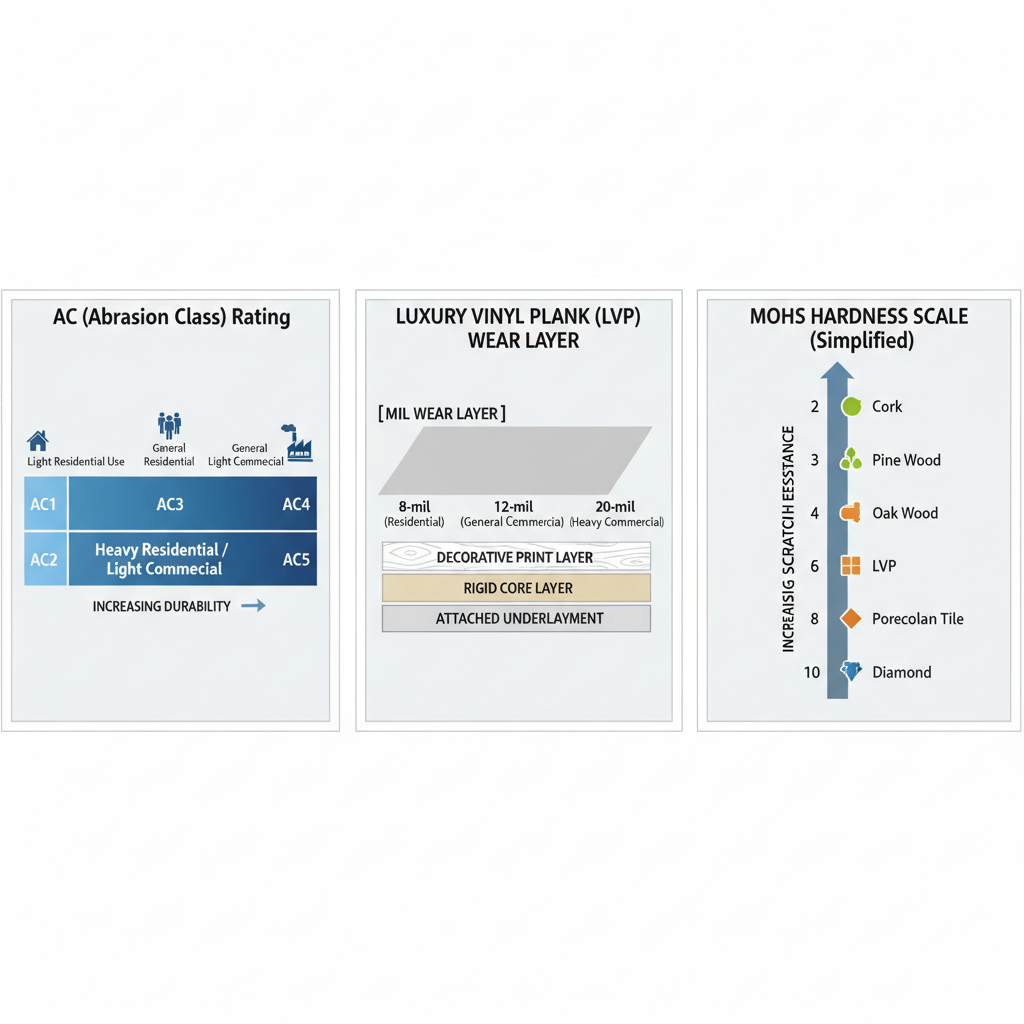
When shopping for laminate, durability is measured by an Abrasion Class (AC) rating. This rating scales from AC1 to AC5. For an active home, you should completely ignore anything below an AC3. An AC4 rating is ideal for heavy residential use and light commercial traffic, while AC5 is reserved for the heaviest commercial applications.
For Luxury Vinyl Plank (LVP), durability is dictated by the “mil wear layer” (a mil is one-thousandth of an inch, not a millimeter). Standard residential LVP typically features an 8 to 12-mil wear layer. However, if you want truly durable flooring, you need to look for commercial-grade wear layers ranging from 20 to 30+ mils.
Commercial vs. Residential High-Traffic Needs
Understanding the difference between commercial and residential high-traffic needs is crucial. Residential high-traffic areas—like hallways and living rooms—require materials like 20-mil LVP or porcelain tile, which balance extreme wear resistance with residential aesthetics. Commercial environments, however, face a different level of abuse. According to commercial flooring experts at Spectra Contract Flooring [4] and CFS Floors [5], the compressive strength of concrete and the grease and traffic resistance of quarry tile make them the undisputed champions for industrial spaces and commercial kitchens. While you might not want quarry tile in your living room, understanding these commercial benchmarks helps you set realistic expectations for residential materials.
The ‘Scratch-Proof’ Myth vs. Scratch-Resistant Reality
Let’s address the elephant in the room: 100% “scratch-proof” wood or vinyl flooring is a marketing myth. If you drag a heavy, sharp object across any resilient floor, it will eventually scratch. However, there are incredible scratch proof flooring solutions that come remarkably close, and highly scratch-resistant floors that can easily withstand daily family life.
To categorize materials by actual abrasion resistance, we look to the Mohs hardness scale, which measures a material’s resistance to being scratched by another material.
- The Closest to Scratch-Proof: Porcelain tile and interior concrete coatings sit at the top of the hierarchy. Porcelain is fired at extremely high temperatures, making it denser and harder than standard ceramic. For an industrial-chic look, polyaspartic concrete coatings are unparalleled. Technical data from Orange County Decorative Concrete shows that polyaspartic coatings offer four times the abrasion resistance of standard epoxy [7].
- Highly Scratch-Resistant: For those who want a wood look, premium LVP and Laminate are the answers. Manufacturers achieve this resistance through proprietary top-coat technologies. For example, finishes infused with Aluminum Oxide or Armstrong Flooring’s Diamond 10 Technology [6] use cultured diamonds to create an incredibly hard surface barrier against pet claws and dropped toys.
Best Flooring for Active Homes: A Room-by-Room Guide
Finding the best flooring for active homes requires balancing extreme durability and moisture resistance with comfort underfoot. A floor that is indestructible but feels like standing on a sidewalk is not ideal for a family kitchen. Standardized testing from organizations like the Good Housekeeping Institute [8] emphasizes the need for this balance.
- Mudrooms and Entryways: These are the highest abrasion zones in a home. Wood-look porcelain tile is the ultimate choice here, offering total water resistance and immunity to the grit tracked in from outside.
- Kitchens and Living Rooms: This is where the “comfort underfoot” versus “durability” matrix matters most. LSPC (Luxury Stone Polymer Core) or high-end engineered wood lines designed for active homes, such as Bruce Dogwood Pro [9], offer the warmth and slight yield of wood/vinyl while maintaining high scratch resistance.
- Basements: Basements require moisture immunity. LVP with an attached cork or foam acoustic pad provides warmth over cold concrete subfloors while remaining impervious to humidity and flooding.
Strategic Durable Floor Replacement
If your current floors are failing, a strategic durable floor replacement requires a careful buyer’s guide approach. You must calculate the ROI, the cost-per-square-foot of materials, and the labor involved. One of the most cost-effective strategies is floating new floors over existing hard surfaces. Modern rigid core LVP and laminates can often be floated directly over old tile or well-adhered linoleum. This is particularly valuable if your home contains older flooring; encapsulating old materials (like floating LVP over intact asbestos tile) can save thousands in hazardous demolition costs, while providing a modern, moisture-resistant surface with a decades-long lifespan [10].
The Holistic Pet-Friendly Floor: Scratch Resistance Meets Traction
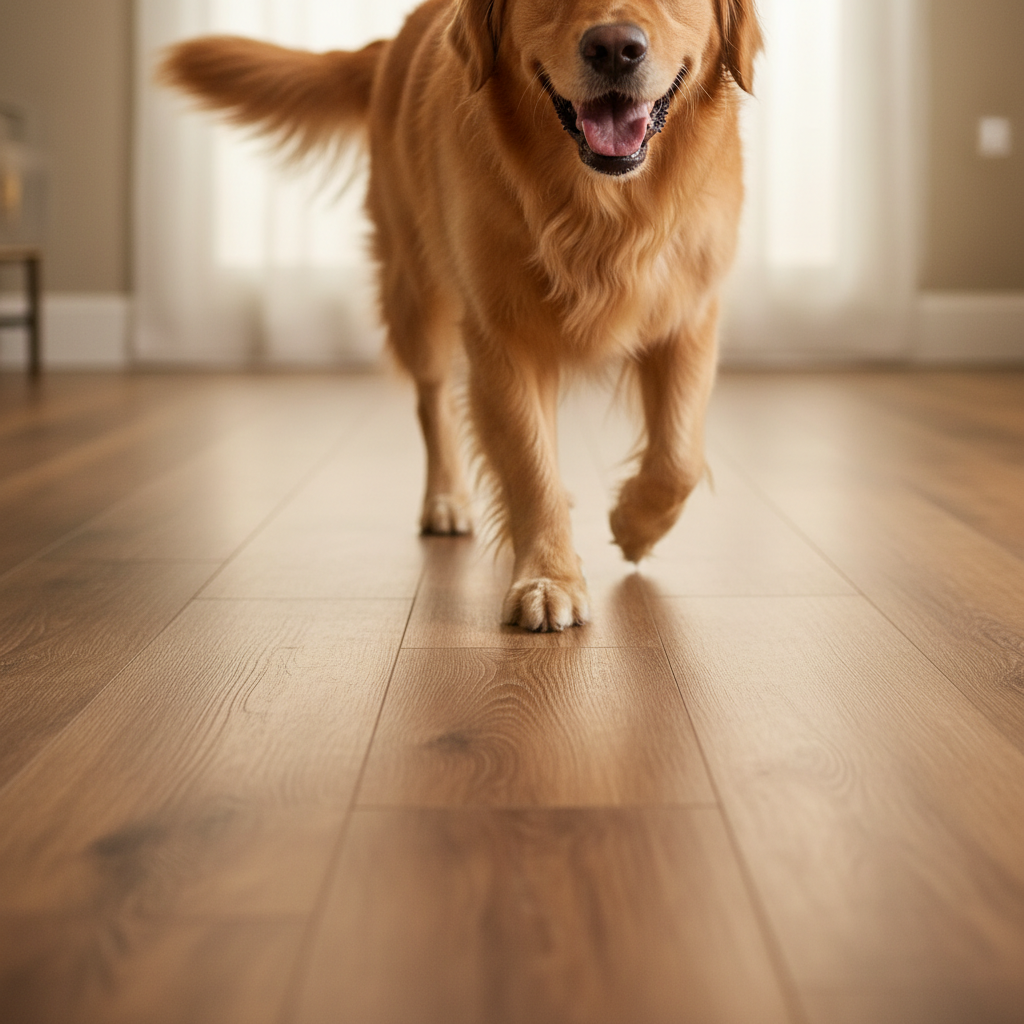
When searching for scratch resistant pet friendly flooring, homeowners often focus entirely on protecting the floor from the dog, forgetting to protect the dog from the floor. Highly scratch-resistant surfaces can be incredibly slick. When dogs lack traction, they slip, which can lead to severe joint issues, hip dysplasia aggravation, and torn ligaments.
A holistic pet-friendly floor addresses scratch resistance, moisture resistance (for inevitable accidents), acoustics, and traction. The secret to traction lies in Embossed-in-Register (EIR) textures. EIR technology perfectly aligns the physical texture of the floor with the printed visual wood grain, providing microscopic ridges that allow dog pads to grip the floor.
Furthermore, the “click-clack” of dog nails can create maddening ambient noise. Choosing a floor with a dense acoustic backing absorbs this sound. If you want the durability of stone without the cold, hard feel, engineered tiles made of 70% limestone (such as those utilizing Armstrong’s technologies) are significantly warmer and more comfortable for pets than traditional ceramic, while remaining impervious to pet accidents [6] [11].
High-Traffic Floor Wear: The Chemistry of Abrasion & Prevention
Even the most durable flooring for high traffic will eventually show wear patterns if not properly maintained. High traffic floor wear is fundamentally an issue of abrasion chemistry. Every time you walk into your home, your shoes carry microscopic particles of dirt and silica. When you walk across the floor, these particles act like fine-grit sandpaper, slowly grinding away the polyurethane or adamantine finish.
Prevention requires adopting commercial-grade maintenance routines for your residential home. First, upgrade your cleaning tools. Traditional cotton mops simply push dirty water and grit around, often over-wetting the floor and driving moisture into the seams. Instead, use flat microfiber mops. Microfiber carries a positive electrostatic charge that actively attracts and traps negatively charged dirt and bacteria.
For older floors that have already lost their luster, applying commercial-grade high-traffic floor polishes can restore the sacrificial wear layer. Experts at Zep Inc. [12] and Galaxy Concrete Coatings [13] note that applying these specialized chemical polishes in multiple thin coats can successfully fill micro-scratches and protect the core material from further degradation.
The Ultimate Scratch Triage Guide: DIY Repair vs. Professional Refinishing
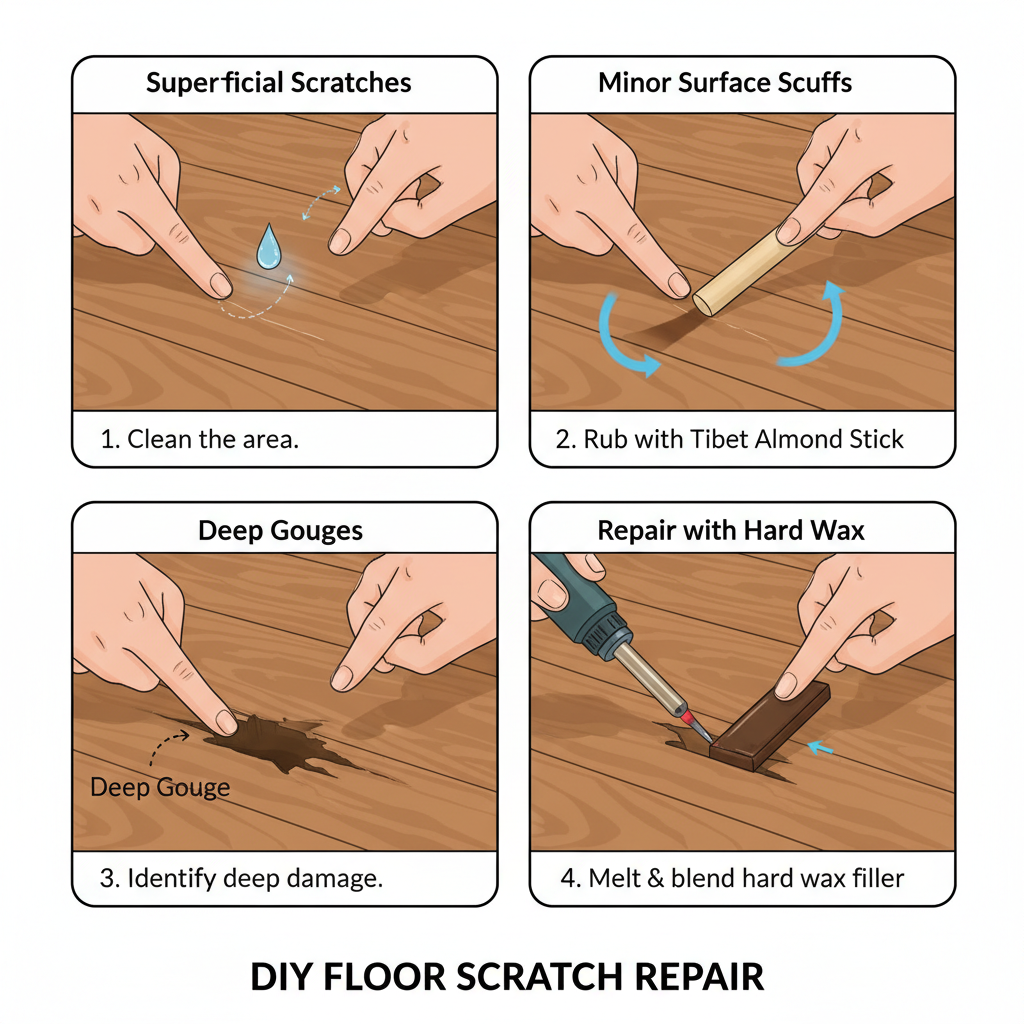
Despite your best efforts, accidents happen. When dealing with scratched hardwood floors or pet claw floor damage, distressed homeowners need a step-by-step triage guide to determine if a DIY repair will suffice or if professional refinishing is required.
Step 1: Assess the Depth
- Surface Finish Scratches: If the scratch is white or light-colored and disappears when you rub a drop of water over it, it has only damaged the clear topcoat (polyurethane).
- Deep Wood Gouges: If the scratch has exposed raw, splintered wood and feels deep to the touch, the actual flooring material is compromised.
Step 2: Execute the Repair
- For Minor Surface Scratches: Products like the Tibet Almond Stick are highly effective for masking superficial clear-coat scratches [15].
- For Medium Gouges: You can use hard wax repair kits. Elite-level DIYers use a battery-powered soldering iron to melt and blend different shades of hard wax into the gouge [14]. Pro Tip: If you have wire-brushed hardwood, wait for the melted wax to partially cool, then lightly drag a stiff wire brush over the wax to perfectly recreate the wood’s natural texture.
- For Deep Gouges/Widespread Damage: If the raw wood is exposed across large high-traffic areas, wax will not hold. This crosses the threshold into professional sanding and refinishing.
Preventing Pet Claw Floor Damage
Repairing the floor is only half the battle; you must also manage the source of the pet claw floor damage. Floor preservation and pet grooming are inextricably linked. Adopt the “tap tap tap” rule: if you can hear your dog’s nails clicking on the floor when they walk, their nails are too long and will inevitably cause damage. Maintain a strict nail trimming or grinding schedule. For highly active or anxious dogs, consider applying vinyl claw caps, which safely blunt the nail. Flooring professionals at Hudson Hardwood Floors [16] and UB Hardwoods [17] consistently cite strategic rug placement in high-pivot areas (like the bottom of stairs or near front doors) as the most effective preventative strategy for pet owners.
Adamantine Floor Installation: A DIY Step-by-Step Guide
If you have selected a premium LSPC rigid core product featuring an Adamantine finish, you can save significantly on labor by tackling the adamantine floor installation yourself. These modern floors utilize an Angle/Angle Float click-lock installation method, requiring no glue or nails.
- Subfloor Preparation (The Most Critical Step): Rigid core flooring is strong, but it will not conform to a wavy subfloor. Your subfloor must be flat to a tolerance of 3/16 of an inch over a 10-foot radius. Use a long level to identify low spots and fill them with a Portland cement-based self-leveling compound.
- Underlayment Considerations: Check your product specifications. TAS Flooring’s Ambiance Collection features a 10mm overall thickness that includes a 2mm attached acoustical pad [1]. This built-in layer eliminates the need for a separate underlayment, saving you time and money.
- Establishing the Expansion Gap: Floating floors expand and contract with temperature changes. You must leave a 1/4-inch expansion gap around the entire perimeter of the room, including cabinets and pipes. Failure to do so will cause the floor to buckle. Use plastic spacers against the drywall to maintain this gap during installation.
- The Angle/Angle Locking Mechanism: Starting in the left corner of the room, lay the first plank. To connect the next plank, insert the short end tongue into the groove of the first plank at a slight 20-degree angle, then fold it down until it clicks flat. When starting the second row, angle the long side of the new plank into the groove of the first row, slide it down to meet the short end of the previous plank, and fold it down. Use a tapping block and a rubber mallet to gently tap the seams tight, ensuring there are no micro-gaps.
Conclusion
Creating an indestructible foundation for an active home is not about finding a magical, mythical material; it is about the science of flooring. By understanding objective specifications like 20-mil wear layers and AC4 ratings, managing your expectations regarding the “scratch-proof” myth, and implementing commercial-grade preventative maintenance, you can dramatically extend the life of your floors. Balancing extreme durability with the lifestyle needs of pets and children is entirely possible with modern innovations like Adamantine LSPC and engineered tile. Take the time to assess your current floor’s wear patterns, order samples of high-mil LVP to test pet traction in your own home, and keep a DIY scratch triage kit on hand to protect your investment for decades to come.
DIY Repair Disclaimer: Always test repair methods on an inconspicuous area first. Asbestos Warning: Consult a professional before removing or floating over flooring installed prior to 1980 due to potential asbestos risks.
References & Authoritative Sources
- TAS Flooring. (N.D.). Ambiance Collection LSPC Hybrid Flooring Specifications. Retrieved from tasflooring.com
- Consumer Reports. (N.D.). Flooring Buying Guide and Durability Tests. Retrieved from consumerreports.org
- FloorScore. (N.D.). Indoor Air Quality and Flooring Certification Standards.
- Spectra Contract Flooring. (N.D.). Commercial Flooring Materials and High-Traffic Data. Retrieved from spectracf.com
- CFS Floors. (N.D.). Compressive Strength of Concrete and Porcelain in Commercial Settings. Retrieved from cfs-floors.com
- Armstrong Flooring. (N.D.). Diamond 10 Technology and Engineered Tile Specifications. Retrieved from armstrongflooring.com
- Orange County Decorative Concrete. (N.D.). Polyaspartic vs. Epoxy Floor Coatings. Retrieved from orangecountydecorativeconcrete.com
- Good Housekeeping Institute. (N.D.). Standardized Testing on Home Products and Flooring Durability. Retrieved from goodhousekeeping.com
- Bruce Flooring. (N.D.). Dogwood Pro Engineered Wood Specifications. Retrieved from bruce.com
- Yonan Carpet One. (N.D.). Lifespan and Moisture Sensitivity of Replacement Flooring Options. Retrieved from yonancarpetone.com
- Floor & Decor. (N.D.). Pet-Friendly Laminate and LVP Flooring Data. Retrieved from flooranddecor.com
- Zep Inc. (N.D.). Commercial-Grade High-Traffic Floor Polishes and Chemicals. Retrieved from zep.com
- Galaxy Concrete Coatings. (N.D.). Technical Data on Polyaspartic Floor Coatings. Retrieved from galaxyconcretecoatings.com
- Portercraft. (N.D.). Professional-Grade Repair Steps Using Wax and Soldering Irons. Retrieved from portercraft.com
- Room for Tuesday. (N.D.). DIY Hardwood Repair and Tibet Almond Stick Review. Retrieved from roomfortuesday.com
- Hudson Hardwood Floors. (N.D.). Categorizing Pet Damage to Wood Finishes. Retrieved from hudsonhardwood.com
- UB Hardwoods. (N.D.). Preventative Strategies for Pet Owners. Retrieved from ubhardwoods.com
