There is a distinct, universal frustration that comes with watching a supposedly “premium” floor succumb to the realities of daily life. For homeowners and facility managers alike, easily damaged floors represent more than just an aesthetic disappointment; they are a recurring financial burden. The cycle of installing, scratching, repairing, and ultimately replacing traditional flooring every seven to ten years is a costly loop driven by a persistent industry problem: marketing claims often do not align with real-world wear and tear.
We are moving beyond the superficial marketing brochures to provide the ultimate scientific guide to indestructible flooring. By exploring the physics of floor damage and the advanced material science behind Adamantine flooring’s nanoparticle technology, we will reveal what it truly takes to engineer a surface that lasts. This comprehensive guide will diagnose why traditional materials fail, break down the 30-year lifecycle costs of premium options, and demonstrate exactly how Adamantine compares to other high-performance alternatives.
- The Anatomy of Floor Failure: Why Traditional Materials Dent, Scratch, and Crack
- What is Adamantine Flooring? The Science of Extreme Durability
- Adamantine vs. The Competition: High-Performance Floors Compared
- 30-Year Lifecycle Cost Analysis: Is Adamantine Worth the Investment?
- Installation and Maintenance for Lifelong Performance
- Conclusion
- References & Authoritative Sources
The Anatomy of Floor Failure: Why Traditional Materials Dent, Scratch, and Crack
To understand what makes a floor truly durable, we must first examine the real-world stress factors that destroy traditional flooring. High wear and tear flooring environments expose materials to a relentless barrage of friction, moisture, and impact. Standard materials—like basic polyurethane-coated hardwoods and low-grade laminates—fail because their structural engineering cannot withstand the physics of daily pressure.
Moisture, Micro-Climates, and Surface Wear
Every room in a building possesses its own micro-climate. The humidity in a basement differs drastically from the dry heat of a sunroom or the frequent liquid spills in a kitchen. Traditional engineered wood often relies on a High-Density Fiberboard (HDF) core. While HDF provides a stable base in climate-controlled environments, it acts like a sponge when exposed to persistent moisture. As the HDF core absorbs water vapor, it expands, causing the wood veneer to cup, buckle, and eventually delaminate.
This micro-climate vulnerability makes standard wood and softer vinyl easily damaged floors. Surface wear accelerates when the structural integrity of the core is compromised. Once the planks begin to warp, the protective topcoat is stretched and weakened, making it highly susceptible to scuffs and premature degradation.
The Physics of Angled Point Loads and Heavy Impacts
Heavy impact floor damage is rarely the result of a flat, evenly distributed weight. Instead, the most catastrophic damage comes from “angled point loads.” When a heavy object—like a loaded dolly, a grand piano, or an industrial cart—is moved, the force is not just pushing straight down (compressive strength); it is often applied at an angle, testing the floor’s tensile and flexural strength.
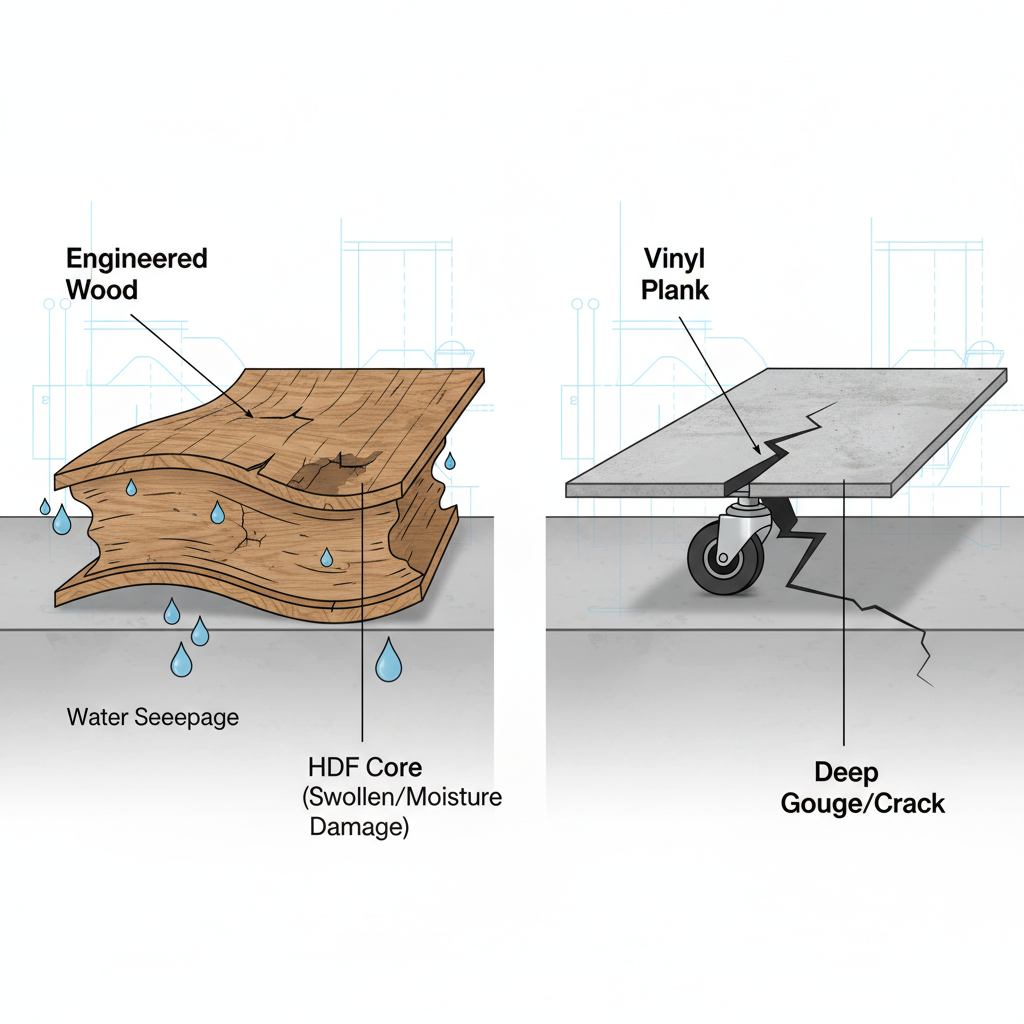
Imagine a visual model comparing two wheels: a wide, soft rubber wheel and a small, hard plastic caster. The hard plastic caster on a heavy piece of furniture might have as little as 0.32 square inches of contact area with the floor. When that wheel pivots or is dragged at an angle, the concentrated force per square inch skyrockets, easily exceeding the tensile strength of traditional wood fibers or standard vinyl wear layers. This localized, high-pressure friction shears the surface, resulting in deep gouges and structural cracking. According to experts at Fine Homebuilding, understanding these mechanics of wood fractures and ensuring meticulous subfloor preparation are critical, as any void beneath the flooring will amplify this point-load damage [1].
What is Adamantine Flooring? The Science of Extreme Durability
Adamantine flooring represents a paradigm shift in the industry, bridging the gap between industrial-grade toughness and luxury residential aesthetics. But what exactly is it? At its core, Adamantine flooring is an ultra-durable, hybrid flooring solution engineered to solve the exact structural failures discussed above. By leveraging advanced material science, it answers the demand for scratch resistant adamantine floors that can genuinely withstand decades of abuse.
Aluminum Oxide Nanoparticles and the Mohs Hardness Scale
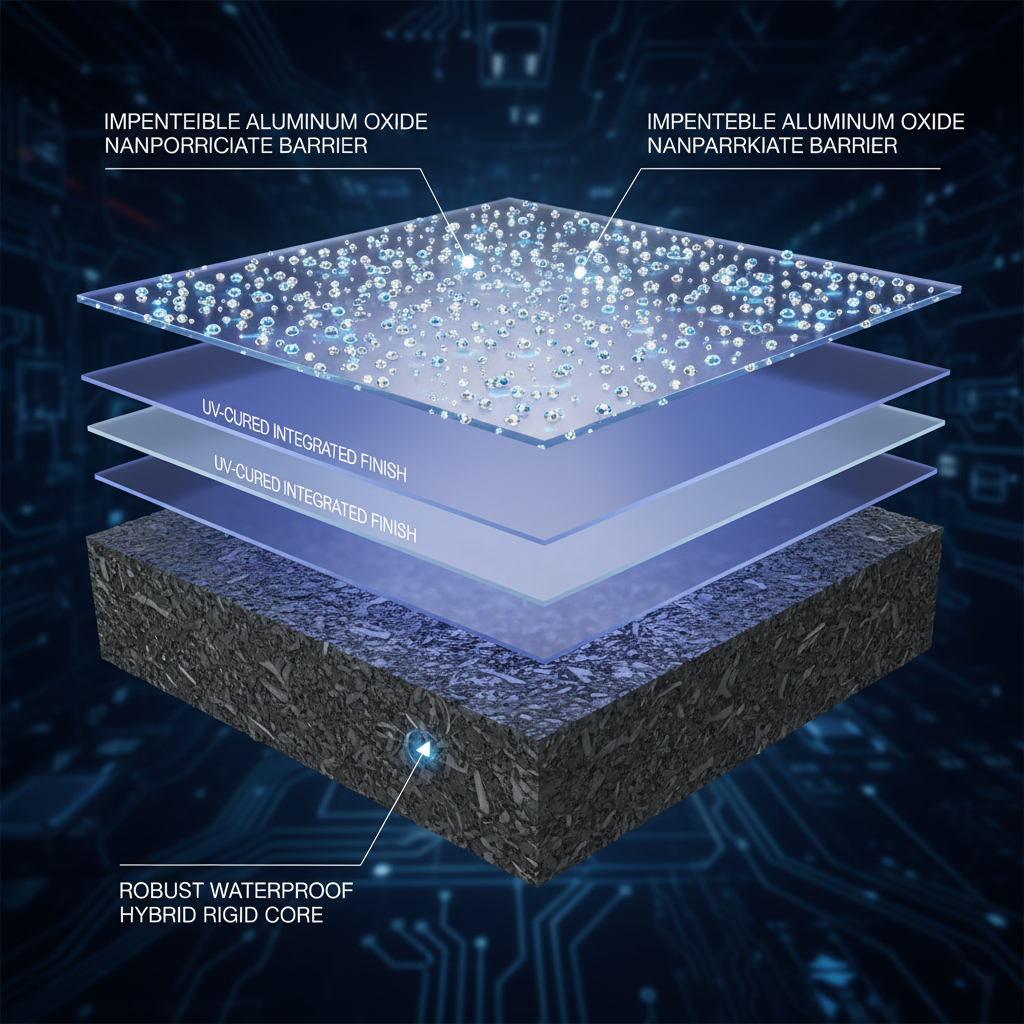
The secret to Adamantine’s surface resilience lies in aluminum oxide nanoparticles. To understand this, we look to the Mohs Hardness Scale, a scientific metric used to characterize the scratch resistance of various minerals. On this scale, talc is a 1, and diamond is a 10. According to data from the National Center for Biotechnology Information (NCBI), aluminum oxide—the same compound that forms rubies and sapphires—ranks at an incredibly tough 9 [4].
By infusing the wear layer with these microscopic, gemstone-grade particles, Adamantine flooring creates an impenetrable, crystal-clear barrier. This engineering behind adamantine flooring toughness ensures that the surface is virtually impervious to pet claws, dragged furniture, and abrasive dirt.
Multi-Layer UV-Curing vs. Traditional Polyurethane
Traditional hardwood floors are typically finished with surface-level polyurethane. If you were to look at a cross-section diagram of standard polyurethane, it sits on top of the wood like a sheet of plastic wrap. Once that thin layer is breached, the wood is exposed.
Adamantine utilizes a multi-layer penetration and advanced UV-curing process. Instead of just sitting on the surface, the liquid finish is driven deep into the pores of the material before being instantly hardened by high-intensity ultraviolet light. This creates a composite matrix that binds the finish to the core at a molecular level. Furthermore, peer-reviewed data from the Journal of Physics: Condensed Matter highlights the incredible structural stability of adamantane-like molecular structures, noting elastic constants of 7.52, 8.20, and 6.17 GPa [3]. This immense structural rigidity is why Adamantine boasts 3x greater scratch resistance than traditional polyurethane and maintains color stability for 25+ years without UV fading [2].
Hybrid Rigid Core: 100% Waterproof and Dent Resistant
Just how tough is adamantine flooring beneath the surface? The answer lies in its hybrid rigid core. Unlike the moisture-sensitive HDF cores of the past, Adamantine utilizes a proprietary, closed-cell hybrid construction. Certified flooring installers frequently highlight this hybrid construction as a game-changer for moisture-prone areas because it is 100% waterproof. It will not swell, cup, or buckle, even if fully submerged. Furthermore, this dense structural core absorbs and disperses kinetic energy, providing 50% more dent resistance than traditional hardwood [2].
Adamantine vs. The Competition: High-Performance Floors Compared
When searching for the most durable flooring for heavy traffic, it is essential to rely on objective metrics rather than subjective marketing. Durable flooring is a broad category, but high-performance floors can be broken down into a few top contenders.
Luxury Vinyl Tile (LVT) and Engineered Hardwood
Luxury Vinyl Tile (LVT) and engineered hardwood are popular engineered tough flooring solutions. Their longevity is largely dictated by their “wear layer,” measured in mils (thousandths of an inch). A standard residential LVT might have a 12-mil wear layer, while commercial grades push 20 to 30 mils. While high-mil LVT is resilient, it is still fundamentally a vinyl product that can be gouged by sharp, heavy impacts.
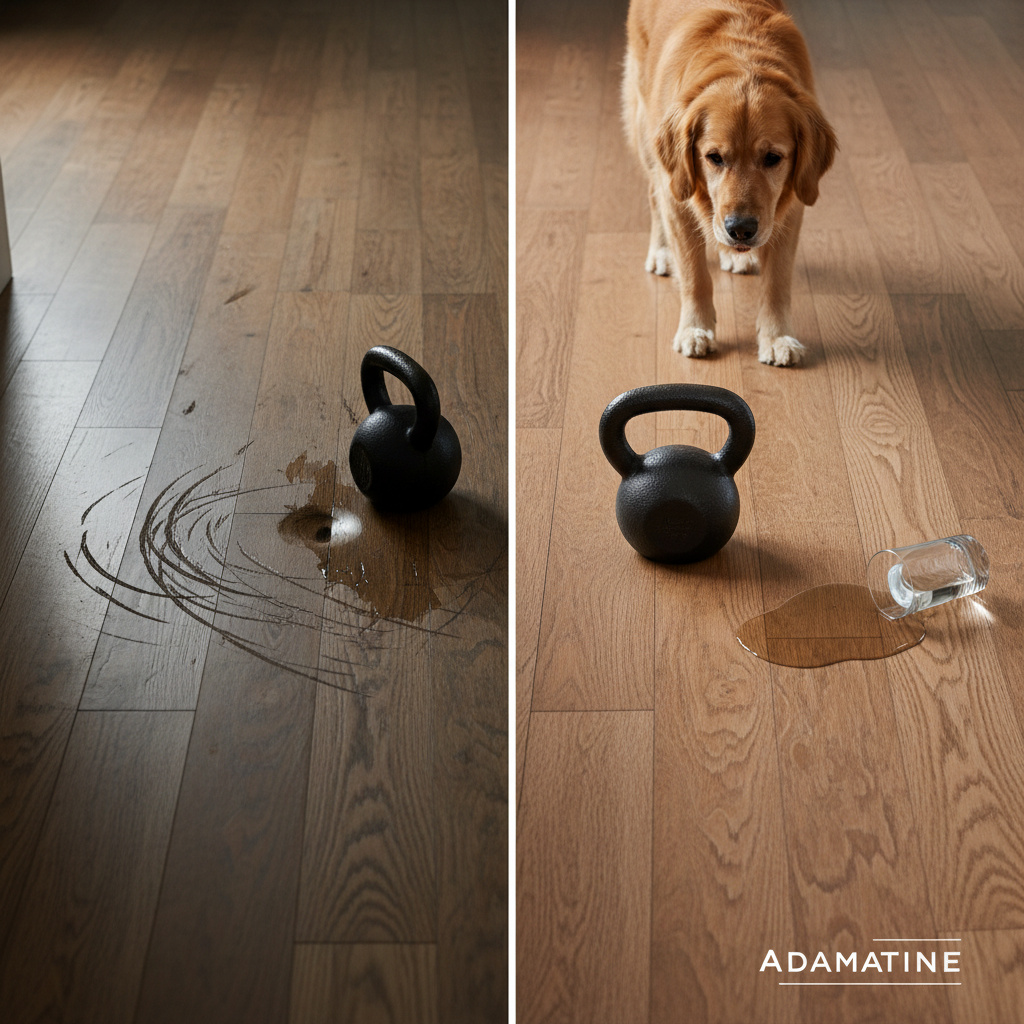
Engineered hardwood offers the beauty of real wood, but it consistently falls short in extreme durability tests. When evaluating domestic wood species using the standardized Janka hardness scale, even hard woods like Hickory (1820 lbf) can dent under the concentrated pressure of angled point loads. In standardized abrasion testing methodologies conducted by independent authorities like Consumer Reports, traditional wood products generally receive only satisfactory or less-than-satisfactory ratings when subjected to heavy, abrasive traffic [5].
Porcelain Tile: The Heavy Traffic Contender
For decades, porcelain tile has been a champion among long-lasting floor materials. Its durability is derived from a high-temperature firing process (often exceeding 2,200°F), which creates a remarkably dense, virtually non-porous material. Porcelain is impervious to water and highly resistant to dents and scratches. However, its ultimate rigidity is a double-edged sword. Porcelain offers zero underfoot comfort, is notoriously cold, and if a heavy object is dropped, the tile can crack or shatter, requiring a difficult and messy extraction process to repair.
Bridging the Gap: Industrial Seamless Systems (Epoxy & MMA)
In true commercial environments, High-performance floors often mean seamless industrial systems like thermosetting epoxy resins and Methyl Methacrylate (MMA). These liquid-applied systems bond directly onto moisture-treated concrete slabs. According to industrial flooring leaders like Stonhard, these systems are engineered to meet strict OSHA slip resistance guidelines and feature robust chemical resistance profiles capable of withstanding harsh solvents and acids [6].
While epoxy and MMA are virtually indestructible, they possess a clinical, industrial aesthetic that is undesirable for luxury residential or high-end retail spaces. Adamantine flooring bridges this exact gap: it harnesses the chemical resilience and impact resistance of industrial-grade engineering but delivers it in a format that mimics the warmth and beauty of natural wood or stone.
30-Year Lifecycle Cost Analysis: Is Adamantine Worth the Investment?
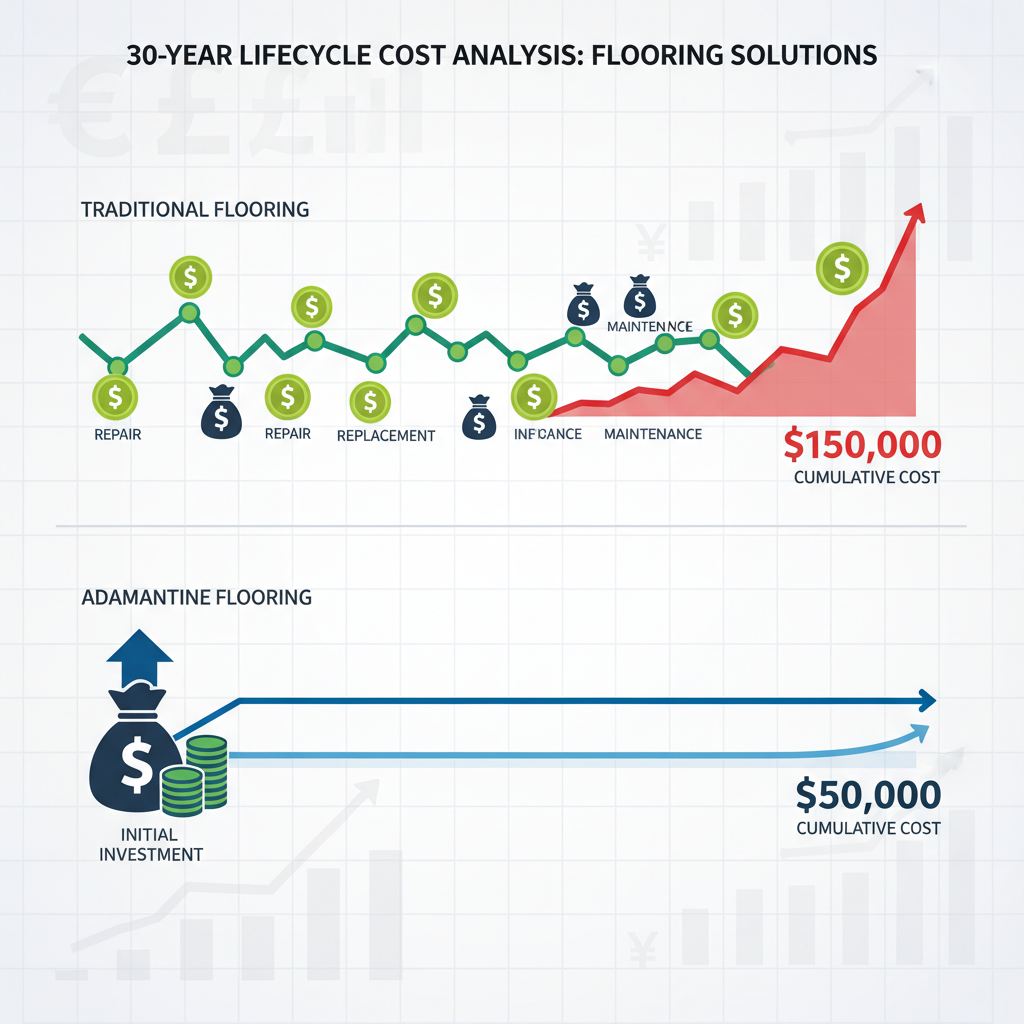
When evaluating engineered tough flooring solutions, sophisticated buyers must shift their focus from upfront price tags to long-term financial durability. The cheapest floor to buy is rarely the cheapest floor to own.
A 30-Year Lifecycle Cost Analysis reveals the true value of long-lasting floor materials:
- Standard LVT/LVP: May cost significantly less upfront. However, in a high-traffic environment, it typically requires full replacement every 7 to 10 years. Over 30 years, you are paying for the material, the labor, and the disruption of installation three to four separate times.
- Traditional Hardwood: Requires professional sanding, refinishing, and resealing every decade to maintain its protective barrier, adding thousands of dollars in maintenance costs over its lifespan.
- Adamantine Flooring: Requires a higher initial investment. However, it is backed by a 50-year residential warranty [2]. This warranty explicitly covers structural integrity, waterproofing, and wear-through of the aluminum oxide finish (excluding intentional abuse or improper installation). Over a 30-year period, Adamantine’s cost-per-year plummets, making it a vastly superior financial investment compared to replacing cheaper alternatives multiple times.
Installation and Maintenance for Lifelong Performance
Even the most advanced high wear and tear flooring can become easily damaged floors if installed improperly or maintained with the wrong chemicals. Protecting your investment requires adherence to strict protocols.
During installation, subfloor preparation is non-negotiable. The subfloor must be perfectly level; any dips or peaks will create hollow spots that amplify point-load stress. Master carpenters strongly advise using specific, manufacturer-approved nailer adapters (if mechanically fastening) or the correct trowel notch sizes (if gluing down) to prevent damaging the factory finish during installation.
Once installed, maintaining the aluminum oxide nanoparticle finish is remarkably simple, but it requires discipline. You must use exact pH-neutral cleaning protocols. Highly acidic cleaners (like vinegar solutions) or abrasive scouring pads can chemically etch or micro-scratch the finish over time, degrading its light-refracting properties and compromising its protective seal. Regular sweeping and damp-mopping with a pH-neutral, non-residue cleaner is all that is required to maintain its lifelong performance.
Conclusion
The frustration of easily damaged floors is a problem of the past for those willing to look beyond standard materials. By understanding the physics of floor failure—from moisture degradation to angled point loads—it becomes clear why traditional polyurethane and standard vinyl fall short. Adamantine flooring, with its aluminum oxide nanoparticle finish, multi-layer UV-curing, and 100% waterproof hybrid core, represents the pinnacle of material science applied to interior design.
While the upfront costs of true high-performance floors may be higher, the 30-year lifecycle value makes them the smartest investment for heavy traffic areas. Evaluate your space’s specific traffic needs using our diagnostic guide above, and request a physical sample of Adamantine flooring to test its scratch resistance for yourself.
Disclaimer: Pricing, warranty details, and lifecycle cost estimates are based on manufacturer data and industry averages; actual costs may vary. Always consult a certified flooring professional for specific subfloor and installation requirements.
References & Authoritative Sources
- Fine Homebuilding. (N.D.). Mechanics of wood fractures and subfloor preparation techniques. Retrieved from authoritative construction and carpentry guidelines.
- Adamantine.info. (N.D.). Adamantine Flooring Product Specifications and Warranty Details. Retrieved from primary manufacturer and patent holder data.
- Journal of Physics: Condensed Matter. (N.D.). Data on elastic constants of adamantane structures. Retrieved from peer-reviewed material science data.
- National Center for Biotechnology Information / PMC. (N.D.). Material properties and the Mohs Hardness Scale regarding Aluminum Oxide. Retrieved from scientific authority on material properties.
- Consumer Reports. (N.D.). Standardized Abrasion Testing Methodology and Flooring Durability Ratings. Retrieved from independent testing authority data.
- Stonhard. (N.D.). Industrial Safety Standards, OSHA Slip Resistance Guidelines, and Chemical Resistance Profiles. Retrieved from global leader in seamless industrial flooring data.
