There is an undeniable luxury to walking barefoot across a warm floor on a freezing winter morning. However, for many homeowners and renovators, the dream of underfloor heating is quickly overshadowed by the anxiety of catastrophic floor failure. The fear of waking up to expensive wood that is warping, cupping, or cracking under the stress of temperature spikes is a valid concern. Navigating the strict, often confusing manufacturer warranties and understanding the unforgiving physics of heat transfer can feel like a daunting task.
This article serves as your forensic-level guide to pairing premium flooring with radiant heat. We will move beyond generic advice to provide you with a deep dive into thermal science, introducing a proprietary “Radiant Compatibility Score” and actionable failure prevention protocols. Whether you are investing in ultra-durable adamantine finishes or premium engineered planks, this guide will ensure your floors remain structurally sound and aesthetically flawless for decades to come.
- The Science of Radiant Heat and Flooring Compatibility
- Why Engineered Wood is the Champion of Underfloor Heating
- Demystifying “Adamantine” Flooring for Radiant Heat
- Forensic Failure Prevention: Stopping Warping and Heat Damage
- Strict Installation and Acclimation Protocols
- Conclusion
- References & Authoritative Sources
The Science of Radiant Heat and Flooring Compatibility
To guarantee long-term success, you must first understand the foundational science of how underfloor heating interacts with the materials placed above it. Radiant heat flooring systems operate on the principle of thermal radiation, warming the objects and people in a room rather than just blowing heated air. According to the Department of Energy (DOE), radiant heating systems can reduce overall energy costs by 10% to 30% compared to traditional forced-air systems [1].
However, achieving these efficiencies while maintaining the indoor thermal comfort standards set by ASHRAE (The American Society of Heating, Refrigerating and Air-Conditioning Engineers) requires selecting radiant heat compatible flooring that balances thermal conductivity (how fast heat moves through a material) with thermal resistance (how much a material resists heat flow) [2].
Hydronic vs. Electric Systems: The Retrofit Decision Tree
Before selecting your flooring, it is crucial to identify which type of underfloor heating system fits your project.
- Hydronic (Water) Systems: These systems pump heated water through a network of tubing beneath the floor. They are typically 25% more efficient than traditional forced-air heating and are the gold standard for whole-home new builds. However, they require a thicker floor buildup and are complex to install.
- Electric Systems: These utilize electric cables or mats. They are significantly cheaper and easier to install upfront, making them ideal for single-room retrofits (like bathrooms). However, they generally cost more to run long-term.
As noted by licensed mechanical engineers and HVAC professionals, “While electric systems offer an accessible entry point for renovations, hydronic systems provide the superior long-term ROI and more consistent, gentle heat distribution critical for the preservation of wood flooring” [3].
The Thermal Efficiency Matrix: R-Values Explained
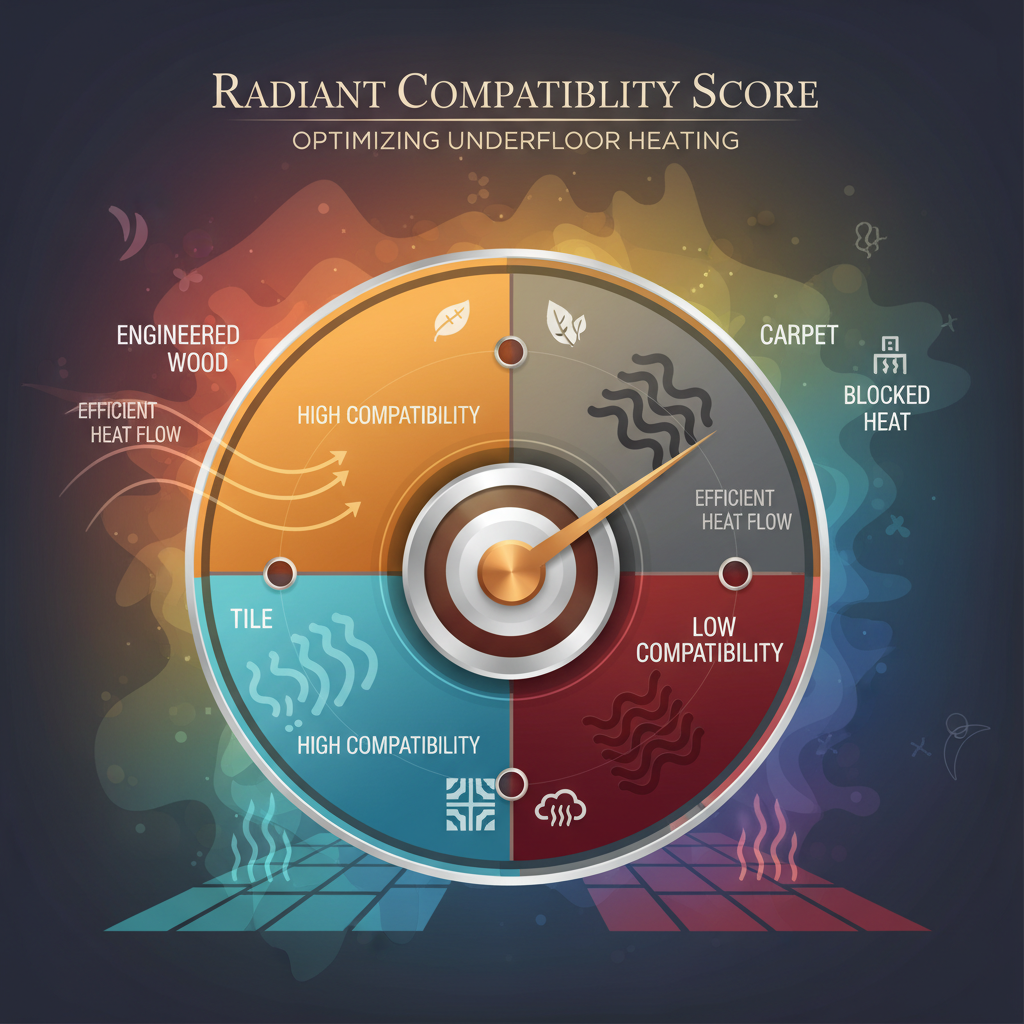
Not all materials transfer heat equally. To evaluate engineered flooring thermal stability, we must look at a material’s R-value (thermal resistance). The lower the R-value, the better the heat transfer.
Based on thermal resistance testing standards from organizations like Oak Ridge National Laboratory and ASTM International [4], we can rank flooring types by their efficiency:
- Tile and Natural Stone (R-Value ~0.02 to 0.05): With a thermal conductivity of roughly 1.5 W/mK, these are the most efficient choices, transferring heat almost instantly.
- Engineered Wood (R-Value ~0.4 to 0.6): Standard 1/2-inch engineered wood offers the perfect balance. It provides the highly sought-after aesthetic of natural hardwood while maintaining an acceptable R-value that allows for efficient, steady heat transfer without trapping the heat in the subfloor.
- Carpet and Pad (R-Value 1.5 to 2.5+): Highly resistant to heat. Most radiant systems cannot effectively push heat through thick carpeting without overworking the system.
Why Engineered Wood is the Champion of Underfloor Heating
When homeowners ask for hardwood flooring compatible with underfloor heating, solid hardwood is rarely the answer. Solid wood is highly reactive to temperature and moisture fluctuations, making it incredibly prone to warping over heat. Engineered wood flooring, however, is a technological marvel designed specifically to solve this problem.
The Anatomy of Warp Resistance: Core Construction
What makes warp resistant engineered flooring so effective is its internal anatomy. Instead of a single piece of wood, engineered planks consist of a top veneer of real hardwood bonded to a multi-layer core.
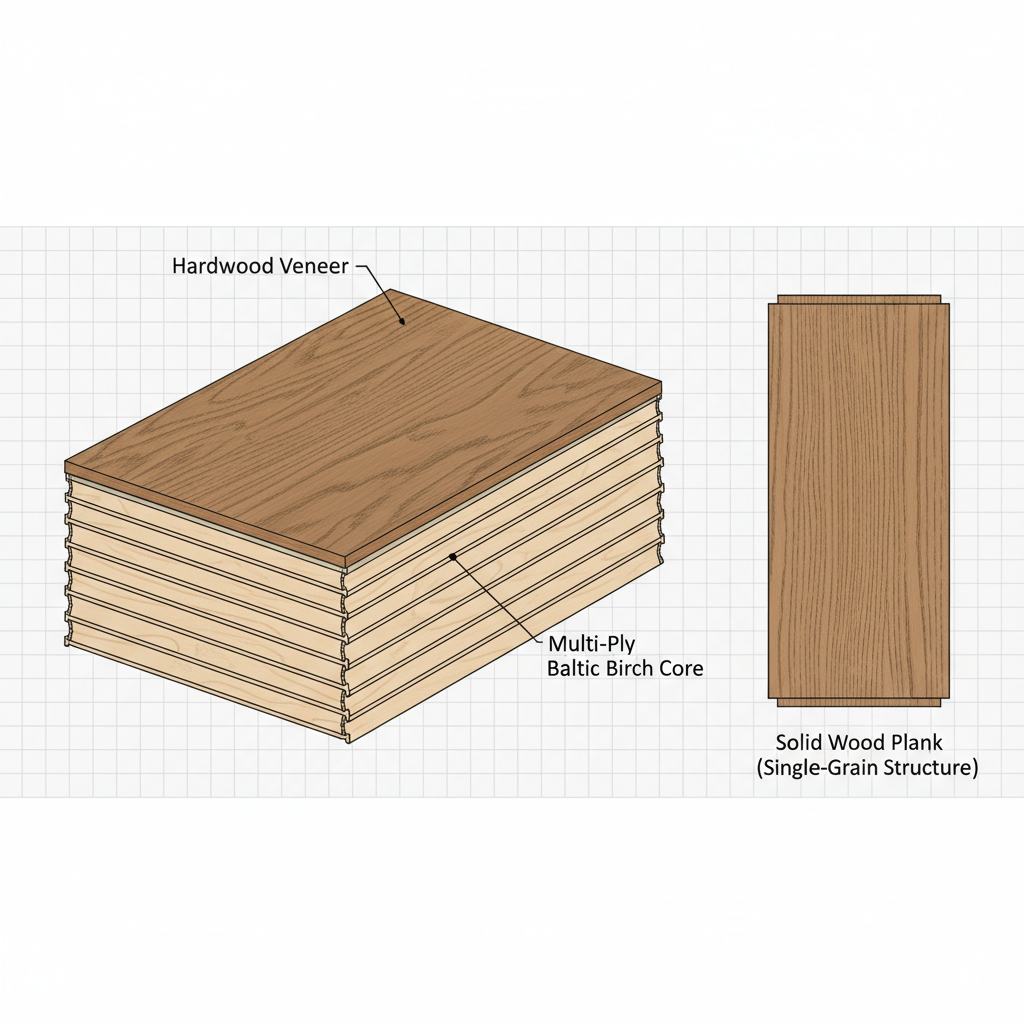
According to the APA – The Engineered Wood Association, the structural performance of cross-laminated plywood cores is vastly superior to solid wood in heated environments [5]. High-end engineered flooring often utilizes a multi-ply Baltic birch core, which is up to 70% more dimensionally stable than solid wood of the same species. The cross-directional layers physically counteract the wood’s natural tendency to expand and contract along the grain. Furthermore, premium manufacturers use specialized, low-VOC adhesives in these cores that maintain their structural integrity and resist breaking down under continuous thermal stress. Conversely, cheaper MDF (Medium-Density Fiberboard) or HDF cores are more susceptible to moisture changes and thermal degradation.
Wood Species and Cut: The Stability Index
Even with a stable core, the top veneer matters. Wood species and the way the wood is cut dictate how it will behave. Data from the Forest Products Laboratory (FPL) regarding wood shrinkage coefficients provides a clear “Stability Index” for heated floors [6]:
- The Cut: Quarter-sawn wood is up to 50% more dimensionally stable than plain-sawn wood. The vertical grain pattern of quarter-sawn planks allows them to expand vertically rather than horizontally, preventing gaps and buckling.
- The Species: American Cherry, Walnut, and White Oak are highly stable species, making them excellent choices. Conversely, Hickory, Maple, and Brazilian Cherry are highly reactive to temperature and moisture changes and should generally be avoided over radiant systems.
Demystifying “Adamantine” Flooring for Radiant Heat
A highly specific, yet frequently misunderstood query in the renovation space is the search for adamantine flooring for radiant heating systems. In mineralogy and mythology, “adamantine” implies an indestructible, diamond-like quality. In the modern flooring industry, it refers to ultra-hard, high-durability industrial finishes, most commonly aluminum oxide infused into the wear layer of engineered wood or rigid core vinyl.
While these ultra-hard finishes offer incredible scratch resistance, they introduce unique thermal dynamics. Materials science principles dictate that extremely rigid, ultra-hard coatings can sometimes be prone to micro-cracking if the substrate beneath them expands and contracts too rapidly under thermal stress. Therefore, if you are purchasing an “adamantine-finished” engineered floor, it is doubly important that the core construction is highly stable (like cross-ply Baltic birch) to prevent the expansion that could compromise the indestructible top coat.
Forensic Failure Prevention: Stopping Warping and Heat Damage
For those researching underfloor heating flooring problems, the horror stories are usually the result of user error, not a flaw in the heating technology itself. From the perspective of NWFA Certified Wood Flooring Inspectors, over 80% of radiant heat floor failures are attributed to improper acclimation or a lack of whole-home humidity control, rather than the heat itself [7]. Here is how to prevent hardwood floor heat damage before it starts.
The Universal 85°F (29°C) Rule and Thermal Blocking Hazards
The absolute golden rule of radiant heat is the 85°F limit. Industry standards and the fine print of virtually every major manufacturer warranty dictate that the floor surface temperature must never exceed 85°F (29°C). Prolonged exposure to temperatures above this threshold can cause irreversible lignin breakdown and finish degradation.
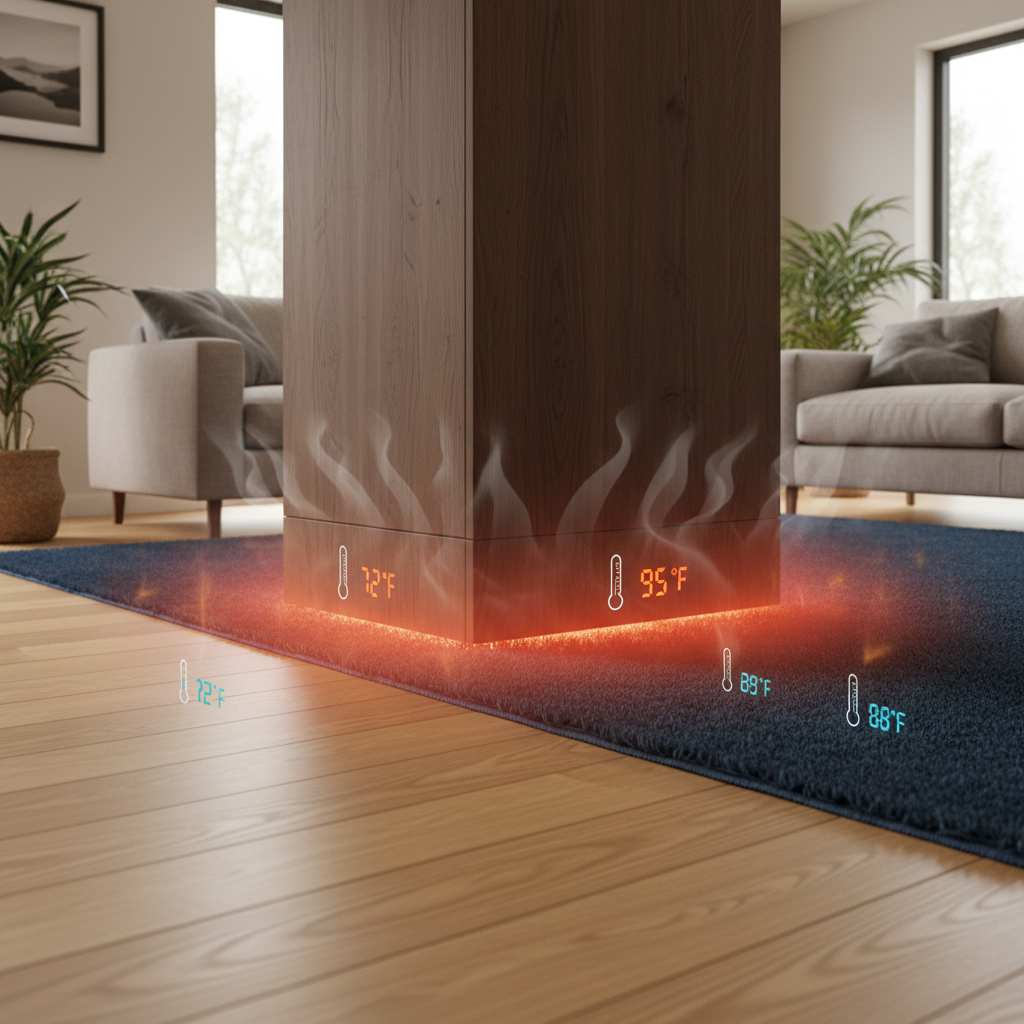
A hidden danger that frequently voids warranties is “thermal blocking.” This occurs when flat-bottomed furniture (like a solid-base bookcase or beanbag chair) or thick, rubber-backed rugs are placed over the heated floor. These items trap the heat, causing localized temperature spikes that easily push the floor surface past 85°F, leading to severe, localized flooring warping from radiant heat.
The 30-50% Relative Humidity Mandate
Radiant heat does not directly destroy wood; it dries it out. As the temperature rises, the relative humidity (RH) in the immediate micro-climate of the floor drops. The National Wood Flooring Association (NWFA) mandates that wood flooring must be maintained in an environment of 30% to 50% relative humidity year-round to prevent warping [8].
Integrating a whole-home humidifier with your HVAC system is non-negotiable when pairing wood with radiant heat. Without it, the winter heating season will strip the moisture from your planks, causing them to shrink, become brittle, and separate.
Diagnosing Damage: Cupping vs. Crowning vs. Gapping
If you suspect damage, you must identify the root cause quickly. The Institute of Inspection, Cleaning and Restoration Certification (IICRC) provides clear guidelines on damage identification [9]:
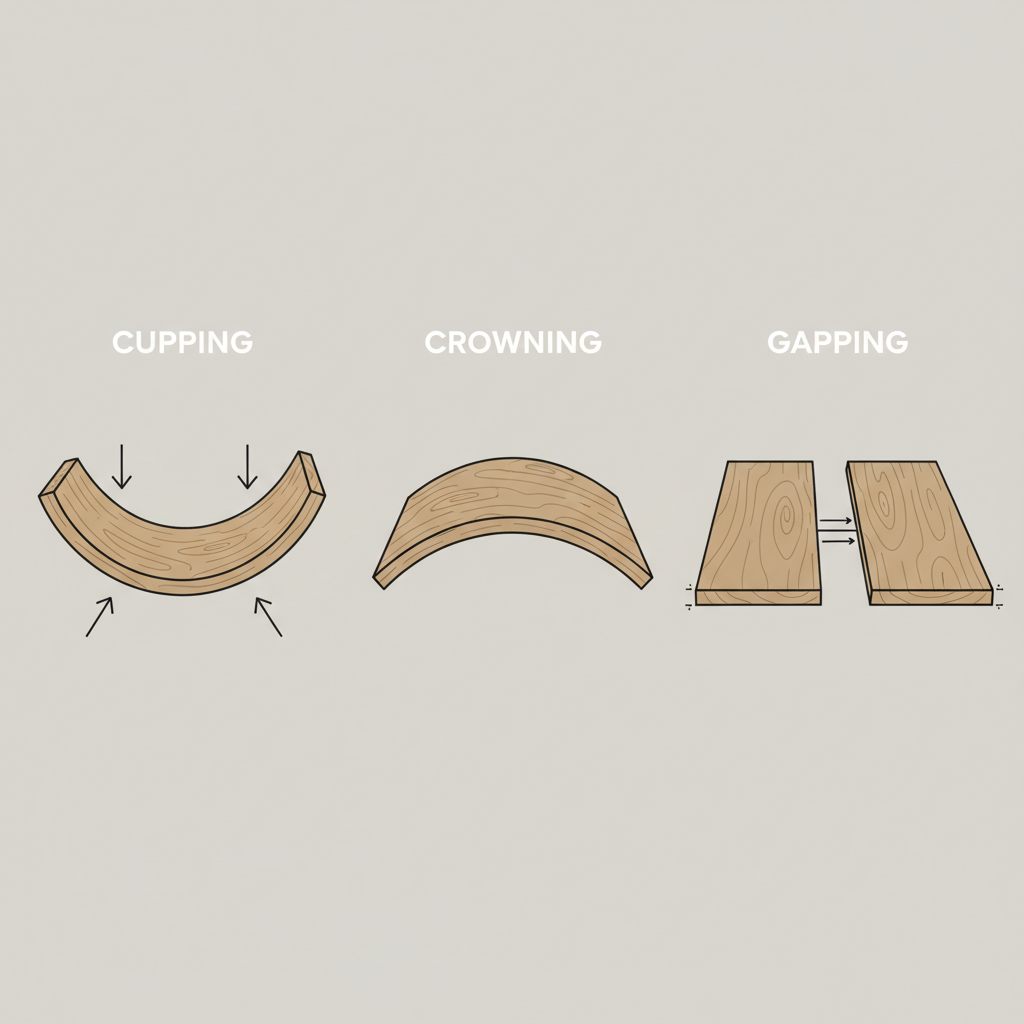
- Cupping: The edges of the board are higher than the center. Over radiant heat, this usually indicates a moisture issue coming from below the subfloor, not a heat issue.
- Gapping: Gaps between boards larger than the thickness of a dime during winter indicate severe moisture loss driven by the heating system.
- Crowning: The center of the board is higher than the edges. This often happens if cupped floors were sanded flat before they dried out, or if excessive moisture is introduced to the top of a floor that has been dried out by radiant heat.
Strict Installation and Acclimation Protocols
Finding the best engineered flooring for radiant heat is only half the battle; the installation dictates its survival. Rushing the installation process guarantees failure.
The Multi-Week Acclimation Process
Acclimation is not simply leaving closed boxes of flooring in a room for 48 hours. According to the NWFA Radiant Heat Guidelines [10], the acclimation process for wood over radiant heat is a multi-week, forensic procedure:
- The radiant heating system must be turned on and running at normal living conditions for at least 5 to 6 days before the flooring is delivered.
- The flooring must be unboxed and cross-stacked in the room.
- Using a high-quality pinless moisture meter, the installer must monitor the moisture content of the wood and the subfloor. Installation cannot begin until the moisture content of the wood is within 2% to 4% of the subfloor’s moisture content.
Underlayment and Floating Floor Requirements
To ensure proper heat transfer, the maximum recommended thickness for engineered wood over radiant heat is 5/8 inch. If you are installing a floating floor, the underlayment is critical.
You cannot use standard, thick foam underlayments, as these act as insulators and block the heat. Leading authorities like Schluter Systems and the Tile Council of North America (TCNA) emphasize the use of specific, thermally conductive uncoupling membranes and low-R-value underlayments designed explicitly for radiant systems [11]. These membranes protect the floor from subfloor shifts while allowing the heat to radiate efficiently upward.
Conclusion
Pairing the beauty of natural wood with the luxury of underfloor heating does carry inherent risks, but those risks are entirely manageable with the right knowledge. By choosing a warp-resistant engineered wood with a stable, cross-ply core, strictly adhering to the 85°F surface temperature limit, and maintaining a humidified environment of 30-50% RH, you can virtually eliminate the threat of heat damage. Before purchasing your premium engineered or adamantine flooring, we strongly encourage you to consult with an NWFA-certified installer and request a comprehensive home humidity assessment to ensure your environment is truly radiant-ready.
This article provides educational guidelines based on industry standards. Always consult your specific flooring manufacturer’s warranty and a licensed HVAC professional before installing flooring over radiant heating systems.
References & Authoritative Sources
- Department of Energy (DOE). (N.D.). Radiant Heating. Energy.gov. Retrieved from authoritative energy efficiency data regarding 10-30% efficiency gains.
- ASHRAE. (N.D.). Standard 55 – Thermal Environmental Conditions for Human Occupancy. American Society of Heating, Refrigerating and Air-Conditioning Engineers.
- Mechanical Engineering Consensus / ASHRAE HVAC Applications. (N.D.). Comparisons of Hydronic and Electric Radiant Heating Systems.
- ASTM International / Oak Ridge National Laboratory. (N.D.). Standard Test Method for Determining Dimensional Stability of Resilient Floor Tile after Exposure to Heat (ASTM F2199) and Building Materials Thermal Resistance Data.
- APA – The Engineered Wood Association. (N.D.). Performance and Dimensional Stability of Cross-Laminated Plywood Cores.
- Forest Products Laboratory (FPL). (N.D.). Wood Handbook: Wood as an Engineering Material. United States Department of Agriculture. Data on wood shrinkage coefficients and dimensional stability.
- NWFA Certified Wood Flooring Inspectors. (N.D.). Failure Analysis and Troubleshooting Wood Floors Over Radiant Heat. National Wood Flooring Association.
- National Wood Flooring Association (NWFA). (N.D.). Water and Wood: Environmental Controls and Humidity Guidelines.
- Institute of Inspection, Cleaning and Restoration Certification (IICRC). (N.D.). Standards for Water Damage Restoration and Heat Damage Identification.
- National Wood Flooring Association (NWFA). (N.D.). Radiant Heat Installation Guidelines and Acclimation Protocols.
- Schluter Systems & Tile Council of North America (TCNA). (N.D.). Underlayment, Uncoupling Membranes, and Heat Transfer Specifications.
