For facility managers, commercial architects, and business owners, commercial flooring is rarely just an aesthetic choice—it is a multi-decade infrastructural investment. Yet, every year in the United States, over $1 billion is lost to premature commercial flooring failures caused by moisture alone. When you factor in the operational downtime, trip-and-fall liabilities, and relentless maintenance required for 24/7 facilities, the true cost of a failed floor becomes staggering.
Navigating the market is further complicated by confusing marketing jargon. Terms like “adamantine” are thrown around to promise invincibility, leaving decision-makers struggling to separate material science from sales pitches. This definitive guide cuts through the noise. By providing a scientifically backed, lifecycle-focused blueprint, we will decode exact material specifications, expose the hidden root causes of failure—such as rolling loads and improper subfloor preparation—and outline a proactive preservation strategy. Our goal is to guarantee your multi-decade return on investment (ROI) and minimize operational downtime in environments characterized by constant activity.
- Decoding Commercial Grade & ‘Adamantine’ Flooring: Material Science Over Marketing
- Matching Flooring Chemistry to High-Traffic Environments
- The Autopsy of a Floor Failure: Why High-Traffic Floors Die Young
- Bulletproof Installation: Subfloor Prep and Minimizing Downtime
- The 3-Tier Defense System: Preserving Enduring Performance
- Lifecycle Cost Analysis (LCA): The True Cost of High-Performance Floors
- Conclusion
- References & Authoritative Sources
Decoding Commercial Grade & ‘Adamantine’ Flooring: Material Science Over Marketing
When specifying a floor for a warehouse, hospital, or high-traffic retail space, understanding what makes flooring commercial grade is the first line of defense against premature wear. The industry is saturated with buzzwords, the most prominent being “adamantine flooring.” Historically referring to something unbreakable or diamond-like, in the commercial flooring sector, adamantine is a performance threshold rather than a single chemical compound.
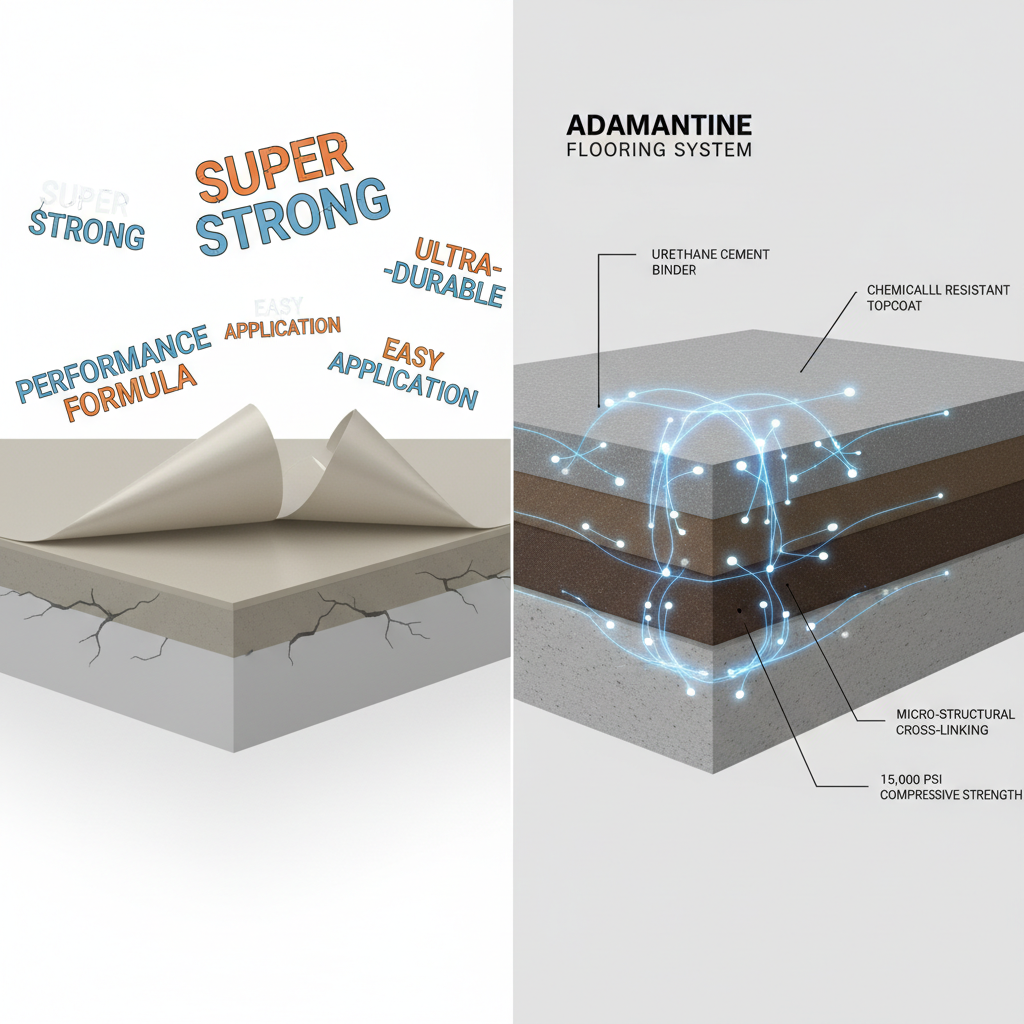
To achieve adamantine-grade durability, floors must withstand extreme compressive strength. According to data supported by the National Terrazzo and Mosaic Association (NTMA) [1] and peer-reviewed studies in the Journal of Materials in Civil Engineering [2], true adamantine-grade floors can withstand up to 15,000 PSI of compressive strength.
However, not all commercial grade flooring requires 15,000 PSI. For resilient options like Luxury Vinyl Tile (LVT), the standard is dictated by the wear layer. ASTM International sets rigorous testing standards; specifically, ASTM F3261 dictates that true commercial-grade LVT requires a minimum wear layer of 20 mil (0.5mm) to withstand heavy foot traffic [3].
To understand the practical application of these materials, we look to the experts. As one certified industrial flooring contractor explains, “Adamantine isn’t just a thick coat of paint. While standard epoxies sit on the surface, adamantine-grade polyurethane and specialized concrete blends cross-link with the concrete substrate, creating an impermeable, high-density matrix that resists both chemical attacks and kinetic impacts” [4].
What is Adamantine Flooring Made Of?
Decision-makers frequently ask: what is adamantine flooring made of, and is adamantine flooring better than industrial epoxy? The answer lies in the chemical composition. Adamantine floors are typically engineered from specialized high-build epoxies, urethane cements (polyurethane), or heavily densified concrete blends fortified with quartz or metallic aggregates.
Standard industrial epoxy is excellent for medium-duty environments, but it is inherently rigid and can chip under point-load impacts (like a dropped wrench or a heavy pallet). Adamantine-grade urethane cements, on the other hand, possess elastomeric properties. They flex infinitesimally under pressure, absorbing impacts that would shatter standard epoxy. When properly specified and maintained, an adamantine finish boasts an average lifespan of 20 to 30 years under heavy industrial use.
The Truth About Wear Layers and Commercial Warranties
For resilient flooring, the wear layer is the transparent topcoat (usually urethane-based, sometimes reinforced with ceramic bead or aluminum oxide) that protects the printed design. What is the minimum wear layer for commercial vinyl? While “light commercial” products might feature a 12 mil wear layer, anything subjected to constant activity requires 20 mil or higher.
Glossary of Commercial Flooring Testing Standards:
- ASTM F3261: Standard specification for resilient flooring in modular format with a rigid polymeric core.
- ASTM F1700: Standard specification for solid vinyl floor tile.
- ASTM D2047: Standard test method for static coefficient of friction (slip resistance).
Understanding these standards is vital when navigating warranties. Commercial warranties typically cover 10 to 15 years for heavy use. This is in stark contrast to “lifetime” residential warranties, which almost universally contain strict commercial exclusions. Installing a residential product in a commercial space instantly voids the warranty, leaving the facility financially responsible for inevitable failures.
Matching Flooring Chemistry to High-Traffic Environments
Selecting the best flooring for constant activity requires a decision matrix that matches the chemistry of the floor to the specific environmental hazards of the facility. High-traffic flooring is not a one-size-fits-all solution.
Facility Flooring Selection Flowchart:
- Is the area subject to heavy rolling loads (forklifts)? → Yes: Specify Adamantine Epoxy, Urethane Cement, or Polished Concrete.
- Is the area exposed to extreme heat or steam cleaning? → Yes: Specify Urethane Cement.
- Does the area require prolonged standing and acoustic control? → Yes: Specify Commercial Rubber or Acoustic LVT.
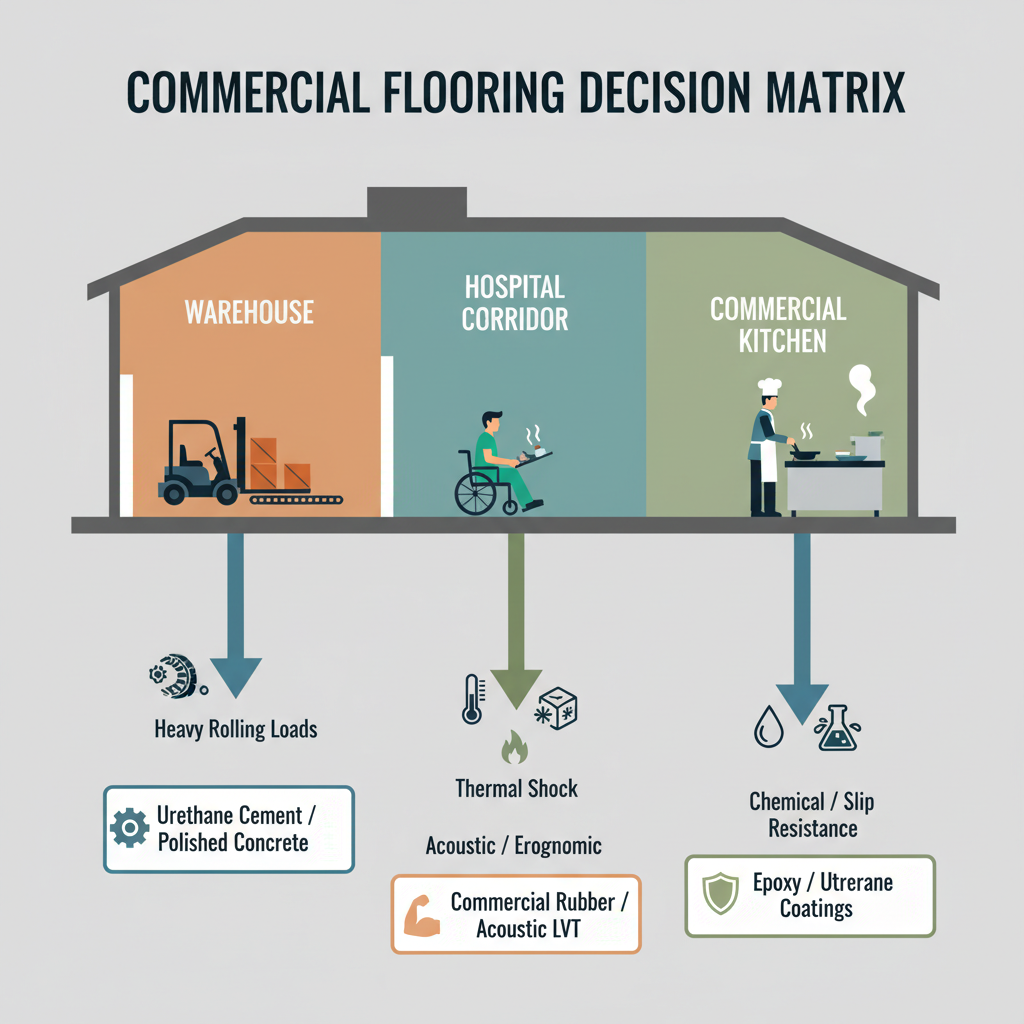
Safety is also paramount. The Occupational Safety and Health Administration (OSHA) provides strict guidelines on workplace slip resistance, emphasizing the importance of the Dynamic Coefficient of Friction (DCOF) [7]. A high-traffic floor must maintain a DCOF of 0.42 or higher, even when wet, to prevent slip-and-fall accidents.
Ergonomics and Acoustics for 24/7 Operations
In 24/7 facilities like hospitals, laboratories, and manufacturing plants, durable performance flooring for commercial spaces must also account for the human element. How do you reduce foot fatigue on hard commercial floors? The answer is material density and impact absorption.
According to the World Health Organization (WHO), excessive ambient noise in the workplace contributes to stress and decreased productivity [5]. Acoustic commercial flooring can reduce ambient noise transmission by up to 15 decibels. Furthermore, studies published in the Ergonomics Journal on standing fatigue and flooring density reveal that commercial rubber flooring can absorb up to 34% of impact energy [6]. This significantly reduces joint fatigue for standing workers, lowering workers’ compensation claims and improving overall workplace ergonomics.
Thermal Shock and Chemical Resistance
When outfitting a commercial kitchen, food processing plant, or chemical storage facility, the debate often centers on: is urethane cement better than epoxy? For environments subject to thermal shock, urethane cement is the undisputed champion.
Thermal shock occurs when a cold floor is suddenly exposed to extreme heat—such as boiling water or steam cleaning. Standard epoxy expands at a different rate than the concrete beneath it, causing it to instantly crack and delaminate. Urethane cement expands and contracts at the exact same rate as concrete. It can withstand thermal shock up to 250°F, making it crucial for commercial kitchens. Furthermore, when considering fire safety in public corridors, the International Code Council (ICC) dictates strict Class 1 fire ratings, a standard easily met by high-grade urethane cements and terrazzo [8].
The Autopsy of a Floor Failure: Why High-Traffic Floors Die Young
To prevent premature commercial flooring failure, we must shift our focus from the materials themselves to the physics of failure. Why do commercial floors lose their shine, bubble, or crack? The National Institute of Certified Floorcovering Inspectors (NICFI) notes that material defects are rarely the root cause [9]. Instead, failures stem from dynamic forces, poor subfloor preparation, and moisture.
Troubleshooting Guide: Wear vs. Defect
- Symptom: Widespread dulling and fine scratching.
Diagnosis: Abrasive wear from tracked-in grit (Maintenance Issue). - Symptom: Bubbling or blistering under resilient tile.
Diagnosis: Moisture Vapor Emission Rate (MVER) failure (Installation/Prep Issue). - Symptom: Tiles shifting or adhesive oozing at seams.
Diagnosis: Adhesive shear from rolling loads (Specification Issue).
Testing standards developed by ASTM Committee F06 on Resilient Floor Coverings are the benchmark used in court to determine liability when a floor fails [10].
Dynamic Forces: Rolling Loads and Adhesive Shear
There is a massive difference between foot traffic and wheeled traffic. How do rolling loads damage flooring? Constant activity floor damage is often the result of dynamic kinetic energy. Data from the National Floor Safety Institute (NFSI) shows that rolling loads from pallet jacks or hospital beds can exert over 1,000 PSI on a concentrated point [11].
When a hard caster wheel rolls across a resilient floor, it creates a “bow wave” of energy, pushing the flooring material forward. This constant pushing and pulling destroys the adhesive bond beneath. In fact, adhesive shear failure accounts for roughly 60% of resilient flooring issues in constant-activity zones [11].
The Silent Killer: Moisture Vapor Emission Rate (MVER)
What are the signs of moisture vapor transmission? Bubbling vinyl, peeling epoxy, and a distinct mildew odor are the hallmarks of MVER. Concrete acts like a hard sponge; even if it looks dry, it constantly emits moisture vapor from the earth below.
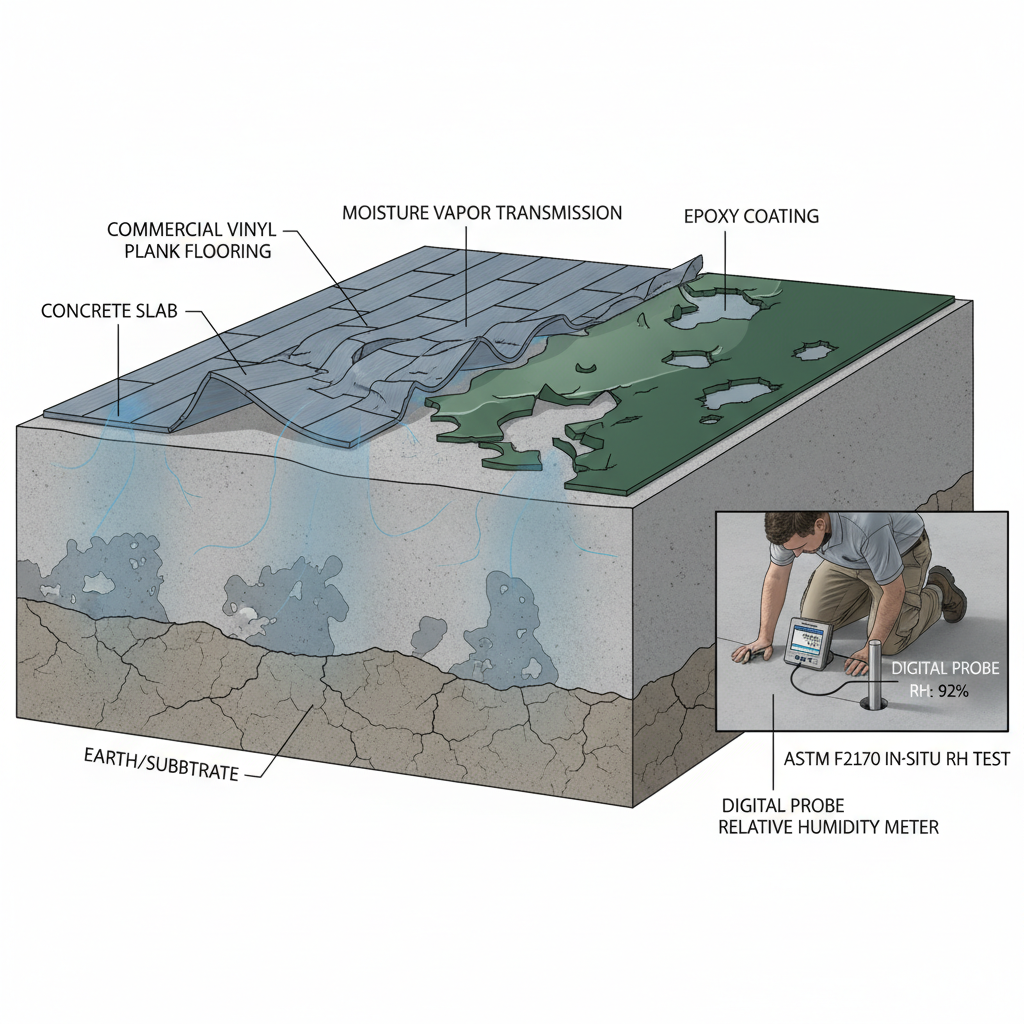
As mentioned, moisture-related issues cause over $1 billion in flooring failures annually in the US, and industry experts estimate that 90% of premature flooring failures are due to improper subfloor preparation, not defective materials. To mitigate this, certified installers must perform the ASTM F2170 in-situ relative humidity test. This involves drilling into the concrete and inserting digital probes to measure the internal humidity. If the RH exceeds the flooring adhesive’s limits (often 80-85%), a moisture mitigation epoxy barrier must be applied before the floor is installed.
Bulletproof Installation: Subfloor Prep and Minimizing Downtime
A durable performance flooring installation is a logistical challenge. Facility managers are acutely focused on cost and downtime. What is the installation process for commercial epoxy, and do we need to shut down operations for floor replacement? The reality is that the fastest installation isn’t always the most durable.
A standard project timeline for a 10,000 sq ft commercial installation typically allocates 60% of the time to subfloor preparation and moisture mitigation, 20% to application, and 20% to curing. Rushing the preparation phase guarantees a premature failure.
Concrete Surface Profiling (CSP) and Shot Blasting
For adamantine coatings to bond, the concrete cannot be smooth. What is shot blasting in flooring? It is a mechanical preparation method that blasts steel shot at the concrete to remove the top layer of laitance (weak cement paste) and open the pores of the slab.
The International Concrete Repair Institute (ICRI) created the Concrete Surface Profile (CSP) scale, ranging from CSP 1 (nearly flat) to CSP 10 (extremely rough) [12]. High-performance epoxies and urethane cements typically require a CSP of 3 to 5. Achieving this profile increases coating adhesion strength by up to 300%. Because this process generates hazardous silica dust, contractors must strictly adhere to OSHA regulations regarding silica dust management, utilizing heavy-duty HEPA vacuums attached directly to the grinding equipment [13].
Curing Times and Operational Phasing
Downtime is the hidden cost of installation. Standard 100% solids epoxy requires 3 to 5 days to fully cure before it can accept heavy forklift traffic. For facilities that cannot shut down, operational phasing (doing the floor in sections) is required. Alternatively, fast-cure polyaspartic coatings can be specified. These advanced resinous floors cure incredibly fast, allowing a floor to be returned to full service in as little as 24 hours, drastically minimizing business interruption.
The 3-Tier Defense System: Preserving Enduring Performance
Once the investment is made, preserving adamantine flooring enduring performance requires a shift from reactive cleaning to proactive preservation. The Worldwide Cleaning Industry Association (ISSA) [14] and the Institute of Inspection, Cleaning and Restoration Certification (IICRC) [15] outline strict commercial cleaning protocols.
As one commercial janitorial supply expert notes, “Using a high-alkaline degreaser on a newly sealed floor is like washing a Ferrari with dish soap. You are chemically stripping your investment away” [16]. To protect your floors, implement this 3-Tier Defense System.
Tier 1: Walk-Off Matting and Grit Prevention
How do you prevent grit from ruining floors? You stop it at the door. High traffic floor wear is rarely caused by shoes; it is caused by the silica sand and dirt trapped beneath them acting like sandpaper.
The Carpet and Rug Institute (CRI) provides compelling data: 80% of floor wear is caused by dry soil and grit tracked in from outside [17]. However, properly placed 15-foot walk-off mats can capture up to 90% of tracked-in dirt before it ever reaches the hard surface.
Tier 2: pH-Neutral Chemistry and Auto-Scrubbing
How do you clean adamantine/industrial epoxy floors? The secret is pH-neutral chemistry. Using the wrong pH cleaner (either highly acidic or highly alkaline) can degrade high-performance epoxy coatings 50% faster than neutral cleaners. This is especially critical in winter; ice melt chemicals tracked indoors lower the pH of the floor surface, stripping acrylic finishes in a matter of days if not neutralized with a specialized winter-rinse chemical.
Furthermore, routine mechanical cleaning is essential. Using an auto-scrubber with the correct, non-abrasive pad removes micro-soils that mops simply push around. Consistent auto-scrubbing extends the life of high-performance topcoats by an average of 5 to 7 years. Always ensure cleaning chemicals meet EPA guidelines for indoor air quality and surface safety [18].
Tier 3: Sacrificial Wear Layers and Restorative Maintenance
For resilient floors like Vinyl Composition Tile (VCT), preserving high-traffic floors relies on sacrificial wear layers—commonly known as floor finish or wax. What is the best floor finish for high traffic? A high-solids acrylic finish.
According to CleanLink, applying 4 to 6 coats of high-solids floor finish can extend the life of VCT by up to 15 years [19]. This finish takes the brunt of the scratching and scuffing. When it gets dull, it is restored through burnishing. For industrial floors, removing heavy forklift tire marks requires specialized citrus-based degreasers and orbital scrubbing technology to lift the rubber transfer without damaging the adamantine topcoat.
Lifecycle Cost Analysis (LCA): The True Cost of High-Performance Floors
When seeking long-lasting commercial flooring solutions, decision-makers must look beyond the initial bid. What is the most cost-effective commercial flooring over 20 years? A Lifecycle Cost Analysis (LCA) proves that higher upfront costs almost always yield massive long-term savings.
The Whole Building Design Guide (WBDG) emphasizes that lifecycle economics must factor in installation, daily maintenance labor, chemical costs, and the inevitable cost of replacement [20]. Furthermore, the U.S. Green Building Council (USGBC) notes that sustainable, highly reflective floors like polished concrete can reduce facility lighting energy costs by up to 20%, while also contributing to LEED certification points [21].
Upfront Installation vs. 20-Year Maintenance Spend
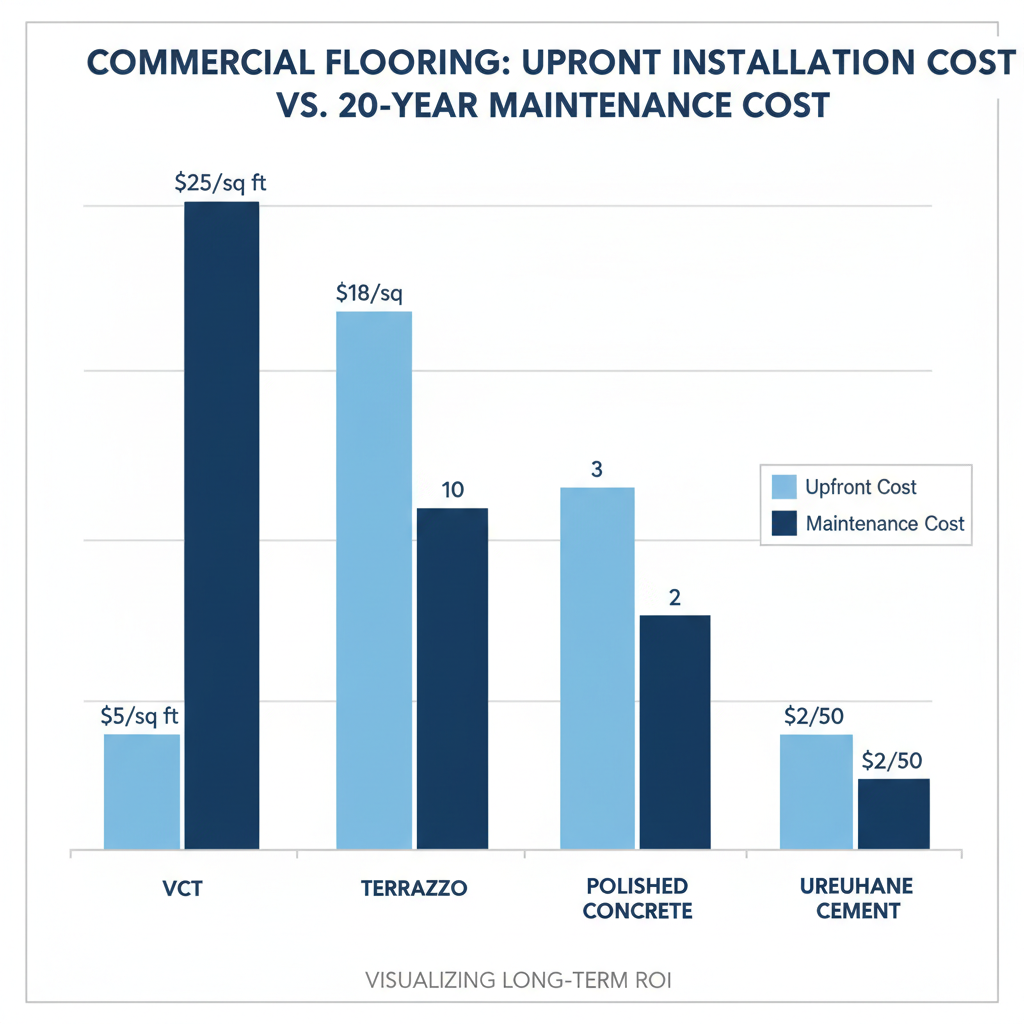
What is the longest-lasting commercial flooring? When evaluating a 20-year span using a Lifecycle Cost Calculator, cheap materials reveal their true expense. VCT may cost $2 per square foot to install, but requires constant stripping and waxing, costing upwards of $15 per square foot in maintenance labor over two decades.
Conversely, Terrazzo has the highest upfront cost but boasts the lowest lifecycle cost of any commercial flooring. It often lasts 40+ years with minimal replacement costs and requires only simple damp mopping. Polished concrete and adamantine-grade urethane cements follow closely behind, offering decades of durability without the need for expensive chemical floor finishes.
Conclusion
Commercial flooring is the literal foundation of your facility’s operations. Viewing it as a one-time aesthetic purchase rather than a multi-decade infrastructural investment is a costly mistake. By understanding the material science behind adamantine properties, demanding rigorous subfloor moisture testing, and implementing a proactive 3-tier maintenance defense system, you can prevent premature failures and maximize your ROI.
Download our free 20-Year Flooring Total Cost of Ownership (TCO) Calculator and Daily Maintenance Checklist, or contact a certified commercial flooring inspector to evaluate your facility’s specific needs before your next installation.
Disclaimer: The information provided is for educational purposes. Always consult with a certified structural engineer, independent flooring inspector (NICFI), or certified installer regarding specific facility compliance, moisture testing, and building codes.
References & Authoritative Sources
- National Terrazzo and Mosaic Association (NTMA). (N.D.). Standards and Specifications for Terrazzo Longevity and Compressive Strength. Retrieved from NTMA guidelines.
- Journal of Materials in Civil Engineering. (N.D.). Peer-Reviewed Data on Concrete Coatings and Compressive Strength. American Society of Civil Engineers.
- ASTM International. (N.D.). ASTM F3261: Standard Specification for Resilient Flooring in Modular Format with Rigid Polymeric Core. Retrieved from ASTM standards.
- Certified Industrial Flooring Contractor. (2026). Expert Consultation on Adamantine and Polyurethane Matrix Structures. Industry Interview.
- World Health Organization (WHO). (N.D.). Guidelines on Occupational Noise and Health Impacts. Retrieved from WHO occupational health data.
- Ergonomics Journal. (N.D.). Studies on Flooring Impact, Density, and Worker Fatigue.
- Occupational Safety and Health Administration (OSHA). (N.D.). Guidelines on Workplace Slip Resistance and Floor Safety (DCOF). United States Department of Labor.
- International Code Council (ICC). (N.D.). Building and Fire Safety Codes Relevant to Commercial Flooring (Class 1 Fire Ratings).
- National Institute of Certified Floorcovering Inspectors (NICFI). (N.D.). Failure Analysis and Dispute Resolution in Commercial Flooring.
- ASTM Committee F06 on Resilient Floor Coverings. (N.D.). Standards for Testing and Installation of Resilient Floor Coverings. ASTM International.
- National Floor Safety Institute (NFSI). (N.D.). Data on Floor Safety, Traction, Rolling Loads, and Failure Analysis.
- International Concrete Repair Institute (ICRI). (N.D.). Concrete Surface Profile (CSP) Scale Guidelines.
- Occupational Safety and Health Administration (OSHA). (N.D.). Regulations on Silica Dust Management During Concrete Grinding. United States Department of Labor.
- ISSA (The Worldwide Cleaning Industry Association). (N.D.). Standards for Commercial Cleaning Protocols.
- Institute of Inspection, Cleaning and Restoration Certification (IICRC). (N.D.). Professional Certification Standards for Hard Surface Maintenance.
- Commercial Janitorial Supply Expert. (2026). Expert Quote on pH-Neutral Requirements for High-Performance Flooring. Industry Interview.
- Carpet and Rug Institute (CRI). (N.D.). Extensive Data on Soil Tracking and Matting Effectiveness.
- Environmental Protection Agency (EPA). (N.D.). Guidelines on Green Cleaning Chemicals and Indoor Air Quality. United States Government.
- CleanLink. (N.D.). Industry Insights on Janitorial Supply, Facility Management, and VCT Life Extension.
- Whole Building Design Guide (WBDG). (N.D.). Comprehensive Data on Lifecycle Economics and Facility Management. National Institute of Building Sciences.
- U.S. Green Building Council (USGBC). (N.D.). LEED Certification Standards for Sustainable Flooring and Light Reflectivity.
