If you are a homeowner, real estate investor, or facility manager, you are likely intimately familiar with the financial bleed and logistical nightmare of easily damaged floors. Scratches from pets, dents from dropped furniture, and the creeping dread of water damage can turn what should be a permanent foundation into a recurring expense. You patch, you repair, and eventually, you face the disruption of yet another frequent floor replacement. But what if your floors could be virtually unbreakable?
Enter the concept of “adamantine” flooring. Derived from the mythological term for an indestructible material, adamantine flooring strips away the fluffy marketing jargon to focus on the hard materials science of extreme durability. This definitive guide will serve as your ultimate flooring survival roadmap. We will journey from understanding the advanced chemical makeup of high-performance resinous coatings to diagnosing hidden structural damage, calculating true long-term ROI, and executing flawless installations. It is time to redecorate with confidence on an unyielding foundation.

- Decoding ‘Adamantine’: The Materials Science of Extreme Durability
- Diagnosing Damage vs. Normal Wear and Tear
- Top High-Performance Flooring Upgrades for Home Renovation
- The Economics of Flooring: Repair vs. Replace ROI Calculator
- Flawless Execution: How to Install Adamantine Flooring
- Redecorate and Preserve: Maintenance for Resilient Floors
- Conclusion
- References & Authoritative Sources
Decoding ‘Adamantine’: The Materials Science of Extreme Durability
The term “adamantine” is not a single, magical product you can pull off a hardware store shelf. Rather, adamantine flooring refers to a category of ultra-durable, high-performance floors engineered to withstand extreme stress. To truly understand the best high performance flooring options, we must look at the structural and chemical differences that separate commercial-grade longevity from standard residential wear.
According to the American Society of Concrete Contractors (ASCC), the gold standard for evaluating these surfaces lies in strict concrete and resinous coating standards [1]. Furthermore, principles outlined in the Journal of Protective Coatings & Linings (JPCL) emphasize that industrial coating durability is a function of chemical resistance, abrasion tolerance, and adhesive strength [2].
What is Adamantine Flooring Made Of? Polyaspartic vs. Epoxy
When exploring high-performance flooring upgrades, particularly for garages, basements, or industrial lofts, the conversation inevitably turns to resinous coatings. But what is adamantine flooring made of in this context? The answer usually lies in advanced polymers like aliphatic polyurea and urethane, which offer significant advantages over traditional acrylics and standard epoxies.
While epoxy has long been the standard, next-generation polyaspartic coatings are redefining durability. The secret lies in how the material interacts with the substrate. Proprietary wicking technology in polyaspartic systems can forge a bond that surpasses ordinary epoxy by up to three times, penetrating deep into the concrete’s pores rather than just sitting on top. Additionally, industry leaders like Sherwin-Williams High Performance Flooring [3] and Versatile High-Performance Coatings [4] note that polyaspartic aliphatic urethanes offer vastly superior UV resistance—meaning they won’t yellow in sunlight—and boast significantly faster cure times, reducing installation downtime from days to mere hours.
Measuring Durability: Mohs, Janka, and AC Ratings Explained
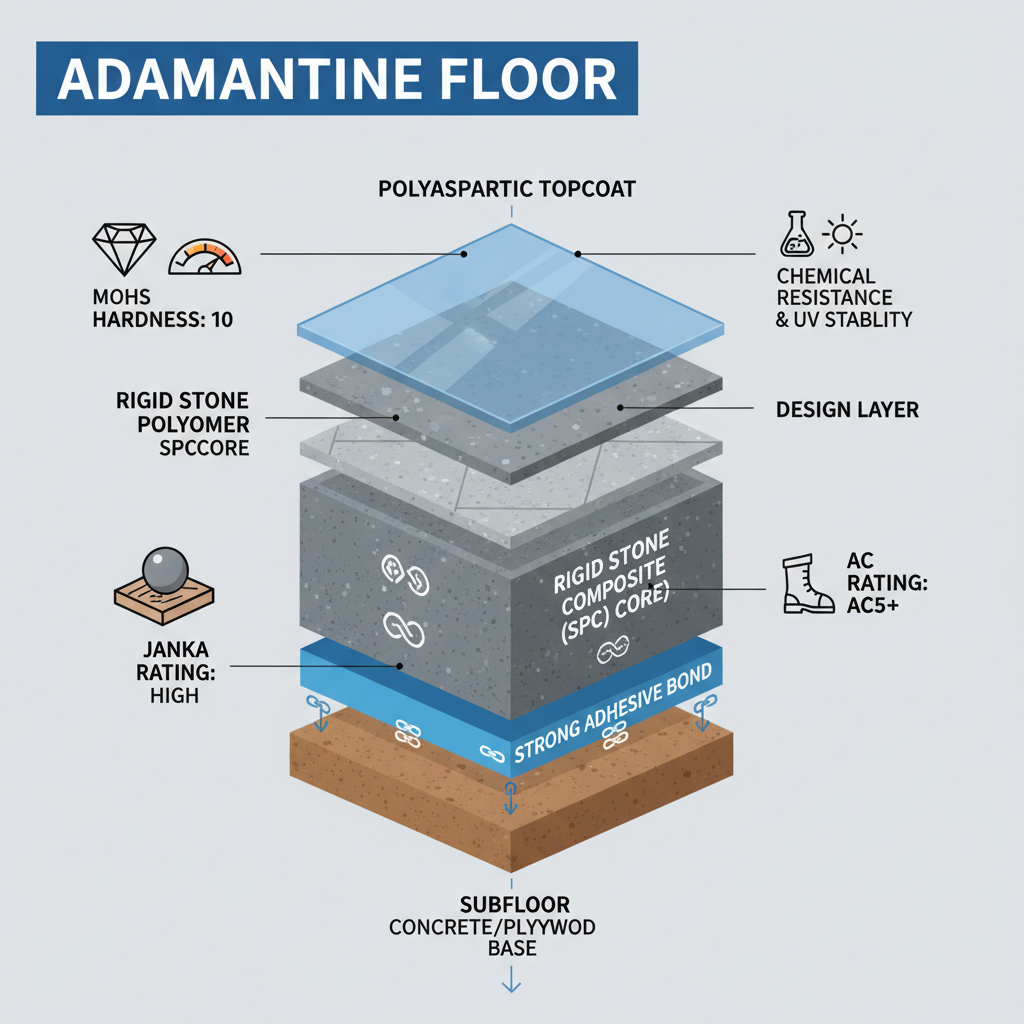
To separate true durable flooring from clever marketing, you must rely on objective criteria. Durability is measured using standardized industry scales. For natural stone and concrete, the Mohs hardness scale dictates scratch resistance. For laminate flooring, the AC (Abrasion Class) rating is paramount; an AC4 or AC5 rating indicates a floor capable of withstanding heavy commercial traffic.
When it comes to wood, the National Wood Flooring Association (NWFA) is the recognized authority on wood flooring standards and utilizes the Janka hardness scale [5]. The Janka test measures the force required to embed a 0.444-inch steel ball halfway into the wood. By consulting these ratings, you can objectively determine if a species like Brazilian Walnut (incredibly high Janka score) is a better investment for your high-traffic home than a softer wood like Pine.
Diagnosing Damage vs. Normal Wear and Tear
For property managers and homeowners alike, distinguishing between inevitable surface wear and preventable structural damage is a critical skill. This section acts as a triage guide for easily damaged floors, helping you understand when a floor is simply aging and when it is actively failing.
Adopting a property manager’s perspective is the best way to define the legal and practical boundaries of wear and tear. Experts at Maple Leaf Management provide excellent real-world guidelines on tenant wear and tear, noting that the lifespan of the material must be factored into any assessment [6].
The Wear vs. Damage Checklist for Property Owners
What is considered normal wear and tear on hardwood floors? Generally, minor scuffs, slight fading from sunlight, and small, superficial scratches from daily foot traffic fall into this category. These are expected degradations of the finish over time. BuildDirect offers a thorough technical breakdown of how floor finishes degrade, explaining that the protective topcoat naturally thins out with use [7].
Conversely, damage is preventable and often severe. Deep gouges that penetrate the wood grain, burns, and notably, pet stains, are not normal wear and tear. Pet urine contains uric acid that can chemically burn through the finish and permanently discolor the wood or vinyl beneath, requiring intensive repair or replacement.
Hidden Culprits: Subfloor Deflection and Installation Errors
Often, what appears to be a surface issue is actually a structural failure. If you are constantly asking, “Why are my floor tiles cracking?” or wondering what causes factory-finished wood floors to fracture, the answer rarely lies in the flooring material itself.
The most common hidden culprit is subfloor deflection—meaning the floor system is not stiff enough and bends under weight. When the subfloor flexes, rigid materials like ceramic tile or the tongues of factory-finished wood will crack or snap under the pressure. Fine Homebuilding [8] and InspectAPedia [9], both authorities on residential construction best practices and structural failures, emphasize that improper nailer use during installation or failing to reinforce joists are primary drivers of these easily damaged floors.
Top High-Performance Flooring Upgrades for Home Renovation
When planning a remodel, selecting highly durable flooring for home renovation requires mapping specific materials to specific stress zones—like prioritizing water resistance in basements or scratch resistance in living rooms with pets. Creating a “High-Performance Matrix” that scores materials on hardness, moisture resistance, and maintenance ease is the best way to evaluate the best high performance flooring options. For insights into how these materials perform under extreme conditions, Spectra Contract Flooring provides invaluable data on commercial and high-performance installations [10].
Resilient Home Flooring: Balancing Comfort and Indestructibility
Hard floors like tile and concrete are durable, but they lack ergonomic comfort. This is where resilient home flooring shines. Resilient flooring—which includes Luxury Vinyl Plank (LVP) and modern Linoleum—offers a slight “give” underfoot. This flexibility provides significant ergonomic benefits, which can be explained through basic biomechanics: softer surfaces reduce the impact force on joints during prolonged standing.
Furthermore, modern resilient options are highly eco-friendly and safe for indoor air quality. The Resilient Floor Covering Institute (RFCI) [11] and SCS Global Services [12] oversee FloorScore certifications, ensuring that these low-VOC emission floors contribute to a healthy, breathable home environment without sacrificing toughness.
Rigid Core Vinyl (SPC vs. WPC) and Bamboo
For those seeking the pinnacle of highly durable flooring for home renovation, understanding the nuances of rigid core vinyl is essential. While Wood Plastic Composite (WPC) offers great comfort, Stone Polymer Composite (SPC) is the undisputed champion of dent resistance. SPC features an ultra-tough rigid core made from a mixture of limestone and stabilizers, making it virtually impervious to impacts from heavy furniture or dropped items.
Bamboo is another excellent, eco-friendly option that, when strand-woven, boasts a Janka hardness rating that rivals the hardest tropical hardwoods. For material-specific durability insights and contractor matching to ensure these premium materials are handled correctly, platforms like GreatBuildz [13] and specialized retailers like Word of Mouth Floors [14] are excellent resources.
The Economics of Flooring: Repair vs. Replace ROI Calculator
The financial pain of frequent floor replacement is a major burden. At a certain point, cumulative patch repairs become more expensive than a full upgrade. To maximize your return on investment (ROI), you must know when to stop patching and invest in long-lasting flooring solutions. House Doctors Handyman, experts in home repair cost-benefit analysis, suggest that evaluating the “disruption cost”—the time, stress, and labor of constant fixes—is just as important as the material costs [15].
When is it Time to Completely Replace a Floor?
Is it cheaper to patch repair or replace flooring? If your floor looks worse after a deep clean, or if you are dealing with widespread structural damage, replacement is the most economical choice. For hardwood, you must consider the technical “sanding limit.” Wood floors can only be sanded and refinished a finite number of times before the wear layer becomes too thin, exposing the nails beneath. Wood and Beyond, specialists in hardwood flooring lifespans and technical limitations, note that once this limit is reached, replacement is mandatory [16].
Furthermore, installing new flooring typically takes 1 to 3 days, minimizing long-term disruption compared to the endless cycle of frequent patching. A full replacement not only cures the headache but instantly elevates property value.
Decade-by-Decade Lifecycle Projections
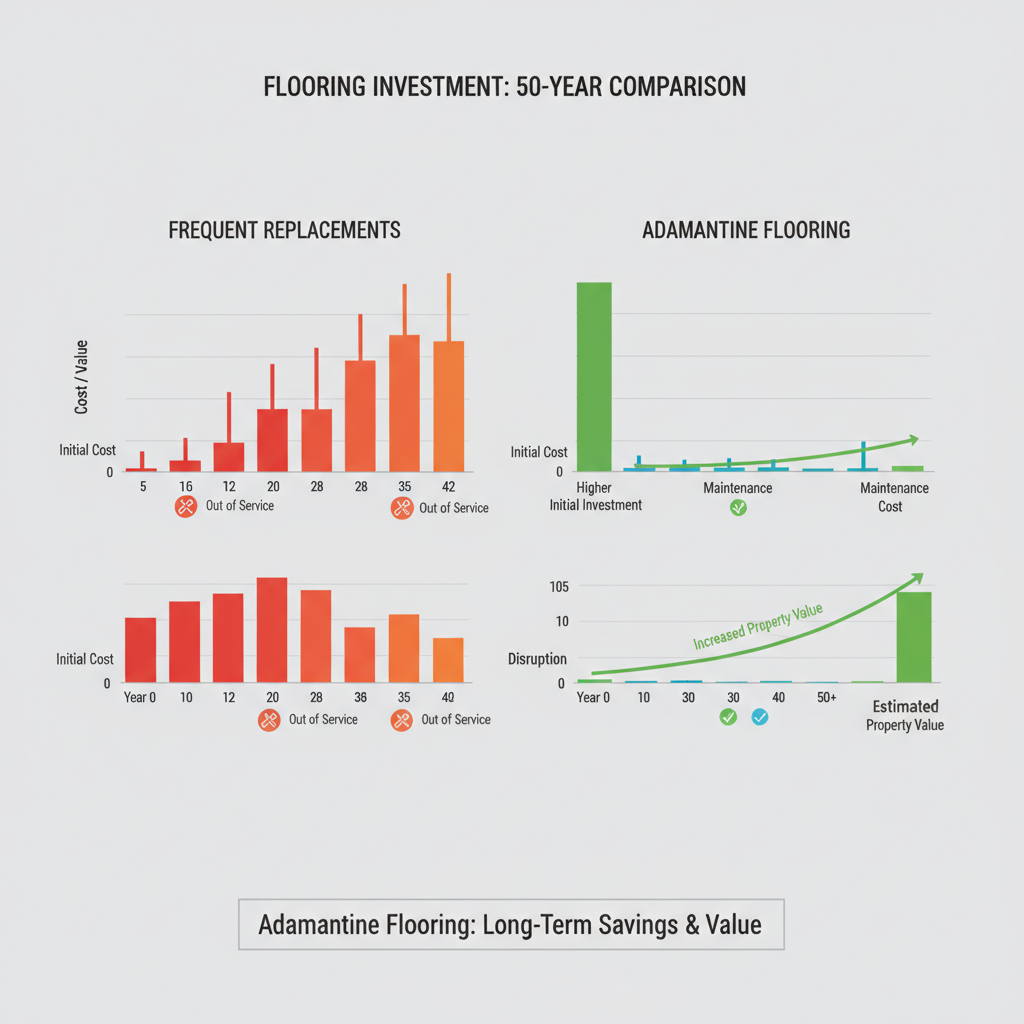
To understand the true value of long-lasting flooring solutions, look at decade-by-decade lifecycle projections. TAJ Flooring, experts in commercial resilient flooring performance metrics, highlights how different materials age [17].
- 10 to 20 Years: High-quality vinyl flooring generally has a lifespan of 10 to 20 years before the wear layer degrades in high-traffic areas.
- 30+ Years: Engineered wood flooring typically lasts 30+ years, offering excellent moisture adaptability due to its cross-ply construction.
- 50+ Years: Solid wood flooring can last 50+ years or more, serving as a multi-generational investment if properly maintained.
Flawless Execution: How to Install Adamantine Flooring
Even the most indestructible material will fail if installed poorly. A mistake-free installation masterclass focuses heavily on the preparation steps that prevent premature failure. To successfully install adamantine flooring, you must adhere to strict tolerances. Titan Surfaces, a commercial flooring manufacturer, provides exact technical installation tolerances that separate amateur jobs from permanent solutions [18].
The Expert Installer’s Prep Checklist: Acclimation and Leveling
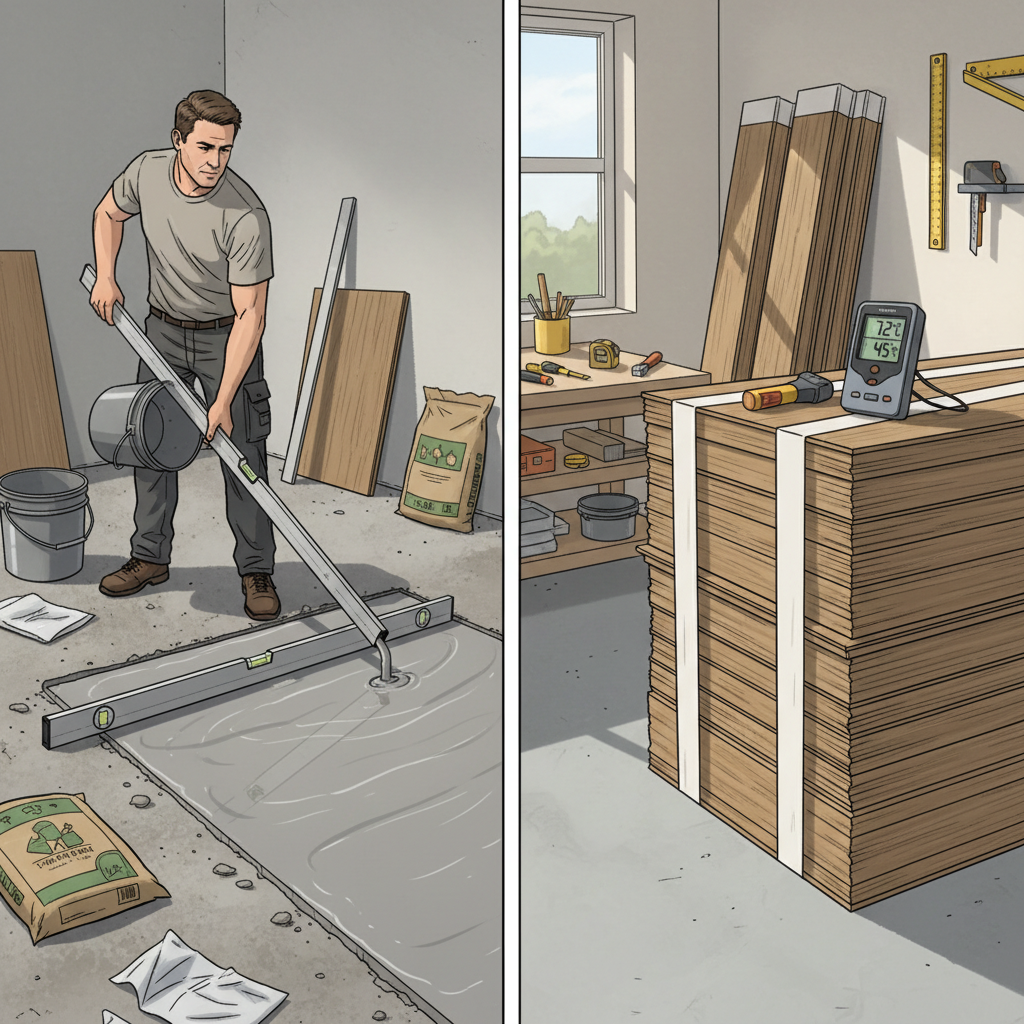
The two most critical steps to install adamantine flooring are environmental acclimation and subfloor leveling.
- Acclimation: Flooring materials expand and contract with temperature and humidity. Flooring should acclimate in conditions between 65-85 degrees F with 35-65% relative humidity for at least 48 hours prior to installation.
- Leveling: A wavy subfloor will cause rigid planks to unlock or snap. Subfloors must be level to within 3/16 inch over a 10-foot radius. Achieving this often requires grinding down high spots and using self-leveling underlayment compounds in low spots.
Professional Tools, Techniques, and Costs
Professional installation requires specialized tools. For resilient sheet vinyl and certain LVT products, a 100-pound sectional floor roller is mandatory to ensure the adhesive fully transfers to the backing and eliminates air bubbles. Proper expansion gaps (usually 1/4 inch around the perimeter) must be maintained using spacers to prevent buckling.
Because of the precision required, many choose to hire experts. According to Fixr, an authority on home improvement pricing and contractor cost data, professional laminate installation costs range from $1,500 to $3,500, with a national average of $2,207 [19]. Factoring this into your budget ensures your adamantine floor performs as engineered.
Redecorate and Preserve: Maintenance for Resilient Floors
Once your high-performance floor is installed, the focus shifts to “Preservation Design.” If you want to redecorate with resilient adamantine flooring, you must understand how to restore and maintain the finish rather than replacing the whole floor when it looks dull. Tarkett [20] and Hillyard [21], both global leaders in facility maintenance and floor care programs, emphasize that proper chemical and mechanical maintenance can extend a floor’s life indefinitely.
Scientific Cleaning: pH Levels and Pad Selection
Maintaining resilient floors is a science. Using the wrong cleaning agents will strip the protective wear layer and accelerate degradation. Cleaning solutions for resilient floors should ideally have a pH of 10-11 for heavy scrubbing, while daily neutral cleaners should hover around a pH of 7.
When it is time to deeply restore the floor to redecorate with resilient adamantine flooring, a step-by-step technical approach is required: Scrubbing, wet vacuuming, and dry buffing. A combined scrubber/dryer machine should use medium hard brushes or red pads for best results. Using a pad that is too aggressive (like a black stripping pad) on a standard maintenance run will permanently scratch the resilient surface.
Conclusion
Achieving an “adamantine” floor is rarely about finding a mythical, unbreakable material. Instead, it is about matching the right advanced chemistry—whether that is polyaspartic coatings, rigid core SPC, or commercial-grade resilient vinyl—to your specific environmental stressors. By understanding the materials science, demanding flawless subfloor preparation, and utilizing scientific maintenance protocols, you can permanently eliminate the cycle of frequent replacements. Evaluate your current flooring’s wear and tear using our checklist, and consult with a certified flooring professional to calculate the exact ROI of upgrading to a high-performance, adamantine solution for your next renovation.
Disclaimers: Standard DIY and home renovation disclaimers apply. Readers should consult manufacturer guidelines and local building codes before undertaking structural subfloor modifications or applying chemical resins.
References & Authoritative Sources
- American Society of Concrete Contractors (ASCC). (N.D.). Concrete and Resinous Coating Standards. Retrieved from authoritative industry guidelines.
- Journal of Protective Coatings & Linings (JPCL). (N.D.). Industrial Coating Durability and Materials Science. Retrieved from peer-reviewed data.
- Sherwin-Williams High Performance Flooring. (N.D.). Resinous Coatings and UV Resistance. Retrieved from industrial.sherwin-williams.com.
- Versatile High-Performance Coatings. (N.D.). Polyaspartic and Epoxy Proprietary Technologies. Retrieved from versatile.net.
- National Wood Flooring Association (NWFA). (N.D.). Wood Flooring Standards and Janka Ratings. Retrieved from authoritative industry guidelines.
- Maple Leaf Management. (N.D.). Tenant Wear and Tear Guidelines. Retrieved from mapleleafmgt.com.
- BuildDirect. (N.D.). Technical Breakdown of Floor Finishes. Retrieved from builddirect.com.
- Fine Homebuilding. (N.D.). Residential Construction Best Practices and Structural Failures. Retrieved from finehomebuilding.com.
- InspectAPedia. (N.D.). Encyclopedia of Building and Environmental Inspection. Retrieved from inspectapedia.com.
- Spectra Contract Flooring. (N.D.). Commercial and High-Performance Flooring Installations. Retrieved from spectracf.com.
- Resilient Floor Covering Institute (RFCI). (N.D.). Resilient Flooring Manufacturer Standards. Retrieved from authoritative industry guidelines.
- SCS Global Services. (N.D.). FloorScore Certification for Low VOC Emissions. Retrieved from authoritative industry guidelines.
- GreatBuildz. (N.D.). Home Renovation and Contractor Matching. Retrieved from greatbuildz.com.
- Word of Mouth Floors. (N.D.). Material-Specific Durability Insights. Retrieved from wordofmouthfloors.com.
- House Doctors Handyman. (N.D.). Home Repair and Renovation Cost-Benefit Analysis. Retrieved from housedoctorshandymanco.com.
- Wood and Beyond. (N.D.). Hardwood Flooring Lifespans and Technical Limitations. Retrieved from woodandbeyond.com.
- TAJ Flooring. (N.D.). Commercial Resilient Flooring and LVT Performance Metrics. Retrieved from tajflooring.com.
- Titan Surfaces. (N.D.). Technical Installation Tolerances for Commercial Flooring. Retrieved from titansurfaces.com.
- Fixr. (N.D.). Home Improvement Pricing and Contractor Cost Data. Retrieved from fixr.com.
- Tarkett. (N.D.). Technical Installation and Maintenance Guidelines. Retrieved from tarkett.com.
- Hillyard. (N.D.). Facility Maintenance and Floor Care Programs. Retrieved from hillyard.com.
