Did you know that the air inside your home can be two to five times more polluted than the air outside? For the average person, this is a surprising statistic; for the over 50 million Americans who suffer from allergies each year, it is a daily, exhausting reality [1], [2]. While many homeowners tirelessly dust surfaces and invest in expensive air purifiers, they often overlook the largest surface area in their entire house: the floor. Traditional flooring acts as a hidden reservoir, harboring microscopic dust mites, trapping pet dander, and silently off-gassing toxic Volatile Organic Compounds (VOCs) into the air you breathe.
If you are battling chronic respiratory distress or asthma flare-ups, simply “removing the carpet” is no longer enough. True relief requires a paradigm shift from treating symptoms to engineering a holistic, zero-VOC home ecosystem. This definitive, medically-informed guide will walk you through the science of hypoallergenic flooring. We will expose the hidden hazards of standard materials, establish a checklist for truly safe surfaces, and spotlight clinical-grade innovations like Adamantine flooring—a premium solution designed to permanently eradicate indoor triggers and transform your home into an allergy-proof sanctuary.

- The Hidden Health Hazards Lurking in Traditional Flooring
- The Science of Hypoallergenic Flooring: What Makes a Surface Truly Safe?
- Top Allergy-Friendly Flooring Options Compared
- Adamantine Flooring: The Clinical-Grade Standard for Healthy Homes
- Building Your Holistic Allergy-Proof Ecosystem
- Conclusion
- References & Authoritative Sources
The Hidden Health Hazards Lurking in Traditional Flooring
To understand how to build a healthy home, we must first expose the invisible threats lurking beneath our feet. The conversation around poor indoor air quality must shift from visible dirt to microscopic allergens and chemical off-gassing. When building materials actively degrade the air we breathe, it can lead to what the Occupational Safety and Health Administration (OSHA) defines as Sick Building Syndrome (SBS)—a condition where occupants experience acute health and comfort effects linked directly to time spent in a building [3].
Dust Mites and Trapped Allergens: The Anatomy of a Trigger
High-pile carpets, heavily textured floors, and unsealed grout lines are notorious for acting as physical traps for pet dander, pollen, and dust mites. Dust mites are microscopic arachnids that thrive in warm, humid environments, feeding on the dead skin cells shed by humans and pets. According to the Cleveland Clinic, these microscopic pests are one of the most common triggers for year-round allergies and asthma [4].
The danger of flooring that traps allergens lies in the constant re-suspension of particles. Every time you walk across a carpeted room, settled allergens are kicked back up into your breathing zone. When inhaled, these proteins trigger the immune system to overreact, producing immunoglobulin E (IgE) antibodies. This biological response leads to the painful inflammation of nasal passages, chronic sneezing, and severe asthma attacks. For those with indoor dust mite allergies, living with carpet is akin to sleeping in a bed of microscopic triggers.
The Invisible Threat: VOCs and Sick Building Syndrome

While dust mites are a biological threat, chemical irritants represent a massive, often ignored content gap in allergy management. Many homeowners rip out their carpets only to replace them with synthetic vinyls glued down with toxic adhesives. These materials release Volatile Organic Compounds (VOCs)—such as formaldehyde and benzene—into the home through a process called off-gassing.
Peer-reviewed literature highlights that prolonged exposure to VOCs induces oxidative stress in the respiratory tract, compounding the effects of physical allergens and leading to severe respiratory distress [5]. This chemical off-gassing is a primary driver of poor indoor air quality and Sick Building Syndrome. If you want to know how to choose hypoallergenic flooring, you must evaluate the chemical emissions of the product just as rigorously as its ability to repel dust.
The Science of Hypoallergenic Flooring: What Makes a Surface Truly Safe?
What does “hypoallergenic” actually mean in the context of building materials? A truly hypoallergenic floor does not simply mean it is easy to sweep; it means the material actively resists the accumulation of biological allergens while emitting zero chemical irritants. Navigating allergen resistant flooring options requires a comprehensive checklist that evaluates the entire flooring system—from the subfloor to the topcoat.
Hard, Non-Porous Surfaces vs. ‘Low-Pile’ Myths
A pervasive myth in the home improvement industry is that “low-pile” carpet is a safe compromise for allergy sufferers. Medically speaking, this is false. The Asthma and Allergy Foundation of America (AAFA) universally recommends hard surface flooring over any type of carpet for asthma patients [2].
The physics of allergen retention dictate that even the tightest carpet weaves will trap microscopic particles over a 5-to-10-year lifespan. Hypoallergenic flooring must be hard and non-porous. Materials like solid hardwood, porcelain tile, and premium engineered woods provide no fibrous hiding places for dust mites to breed, making them the undisputed best flooring for allergy sufferers.
Beyond the Surface: Adhesives, Underlayments, and Radiant Heating
A major oversight in flooring installation is ignoring the layers beneath the surface. You can purchase the most expensive, eco-friendly hardwood on the market, but if it is installed using a VOC-heavy glue-down method, you have instantly ruined your hypoallergenic floor.
To maintain pristine indoor air quality, opt for low-VOC installation methods, such as floating floors that click together without the need for chemical adhesives. Additionally, be mindful of under-floor radiant heating. While luxurious, radiant heating can alter the humidity and temperature dynamics of a room, potentially circulating allergens if paired with the wrong underlayment or a porous surface. Always select hypoallergenic, moisture-resistant underlayments that block mold growth.
Top Allergy-Friendly Flooring Options Compared
When evaluating the best flooring for allergy sufferers, we must maintain an objective, analytical approach, judging materials based on both their allergen-trapping potential and their VOC emissions. Here is how the top allergy-friendly flooring options stack up.
Solid Hardwood & Porcelain Tile
Solid hardwood and porcelain tile are the traditional gold standards for allergen resistant flooring options. Hardwood offers incredible longevity and a beautifully smooth surface that is easy to keep dust-free. However, homeowners must ensure that the hardwood is finished with low-VOC, water-based polyurethanes rather than traditional oil-based finishes that off-gas for months.
Porcelain tile is exceptionally safe because it is fired at extreme temperatures, making it entirely non-porous. Furthermore, dust mites cannot survive on unheated porcelain tile due to the lack of moisture and the naturally cold temperature of the material. However, there is a critical caveat: unsealed grout lines. If grout is left unsealed, it becomes porous, absorbing moisture and harboring mold and mildew. Always use a high-quality, low-VOC sealant on tile grout.
The Antimicrobial Advantage: Natural Linoleum & Cork
For those looking to actively fight allergens, natural linoleum and cork offer a unique antimicrobial advantage, making them excellent choices for reducing indoor allergies naturally.
It is vital to understand the scientific difference between true linoleum and synthetic vinyl. True linoleum (often sold under brand names like Marmoleum) is made from natural ingredients, primarily linseed oil, pine rosin, and wood flour. The continuous oxidation of linseed oil over the floor’s lifespan gives it natural bactericidal properties, actively inhibiting the growth of microorganisms. Similarly, cork flooring contains a naturally occurring waxy substance called suberin. Suberin repels moisture, making cork inherently resistant to mold, mildew, and rot, while providing a softer step than tile or wood.
Adamantine Flooring: The Clinical-Grade Standard for Healthy Homes
While traditional hard surfaces offer great benefits, recent innovations have birthed a new tier of flooring that represents the ultimate intersection of luxury aesthetics and clinical-grade indoor air quality. Enter Adamantine flooring. For homeowners researching Adamantine flooring for healthy homes, this material stands out as a revolutionary, zero-compromise solution.
The Anatomy of Adamantine: 1.2mm Wood Veneer & UV-Cured Finish
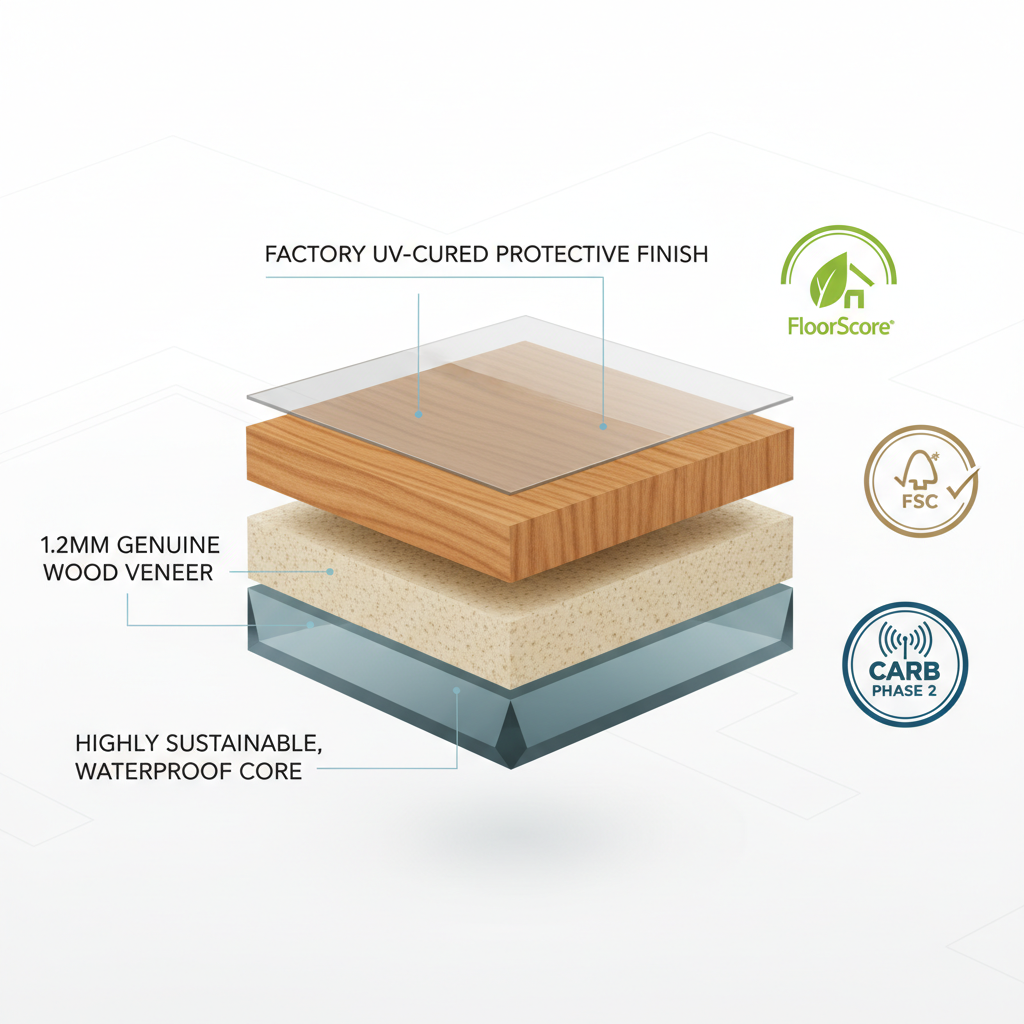
If you are wondering what Adamantine flooring is made of, its construction is a masterclass in eco-friendly engineering. Adamantine features a 1.2mm genuine wood veneer, providing the exact look, feel, and warmth of traditional hardwood. Beneath this veneer lies a highly sustainable, topically waterproof core that prevents moisture penetration—a crucial feature for starving out mold and dust mites.
What truly elevates Adamantine Flooring is its factory UV-cured finish. Indoor air quality experts consistently praise UV-curing because the finish is instantly and completely hardened by ultraviolet light in the factory. This means that by the time the flooring reaches your living room, the curing process is 100% complete, resulting in absolutely zero in-home off-gassing.
Decoding the Certifications: FloorScore, CARB Phase 2, and FSC
To separate genuine health claims from marketing fluff, you must look at third-party certifications. Adamantine flooring boasts a trifecta of rigorous environmental and health verifications:
- FloorScore: This is the most recognized indoor air quality certification standard for hard surface flooring materials. FloorScore certifies that Adamantine meets strict limits for low VOC emissions, ensuring it will not compromise your home’s air [6].
- CARB Phase 2: Set by the California Air Resources Board, this certification guarantees that the composite wood core of the flooring meets the world’s most stringent standards for formaldehyde emissions, keeping chemical irritants out of your breathing zone [7].
- FSC Certification: The Forest Stewardship Council certifies that the genuine wood veneers used in Adamantine are sustainably and ethically sourced, supporting global environmental health alongside your home’s indoor air quality [8].
Adamantine vs. Traditional LVP: A Health-First Comparison
When comparing Adamantine to standard Luxury Vinyl Plank (LVP), the health-first benefits become glaringly obvious. Standard LVP is entirely synthetic, often manufactured with plasticizers and PVC that can off-gas phthalates and VOCs over time. While LVP is waterproof and easy to clean, its chemical profile can be a risk for severe asthmatics.
Adamantine bridges this gap perfectly. It offers the topical waterproofing and durability of LVP, but replaces the synthetic plastic wear layer with a genuine wood veneer and a low-VOC, UV-cured finish. For the allergy sufferer, Adamantine provides the aesthetic luxury of real wood without the chemical risks of synthetic vinyl, making it a superior long-term investment.
Building Your Holistic Allergy-Proof Ecosystem
Selecting the right material is only the first step. Board-certified allergists emphasize that even the best flooring must be paired with rigorous environmental control to be truly effective [9]. To conquer poor indoor air quality, you must build a holistic allergy-proof ecosystem.
The 50% Rule: Controlling Humidity to Starve Dust Mites
The most actionable step you can take in reducing indoor allergies naturally is mastering the 50% rule. Dust mites absorb moisture directly from the air to survive. According to the Cleveland Clinic, maintaining your indoor humidity below 50% effectively starves dust mites, halting their reproduction and preventing mold growth [4].
Invest in a few digital hygrometers and place them around your home to monitor moisture levels, utilizing dehumidifiers in damp areas like basements. Furthermore, to kill any existing dust mites that make their way into your bedroom, ensure all bedding is washed weekly in water that is at least 130 degrees Fahrenheit.
The 5-Minute Allergy Sweep: Safe Cleaning Protocols
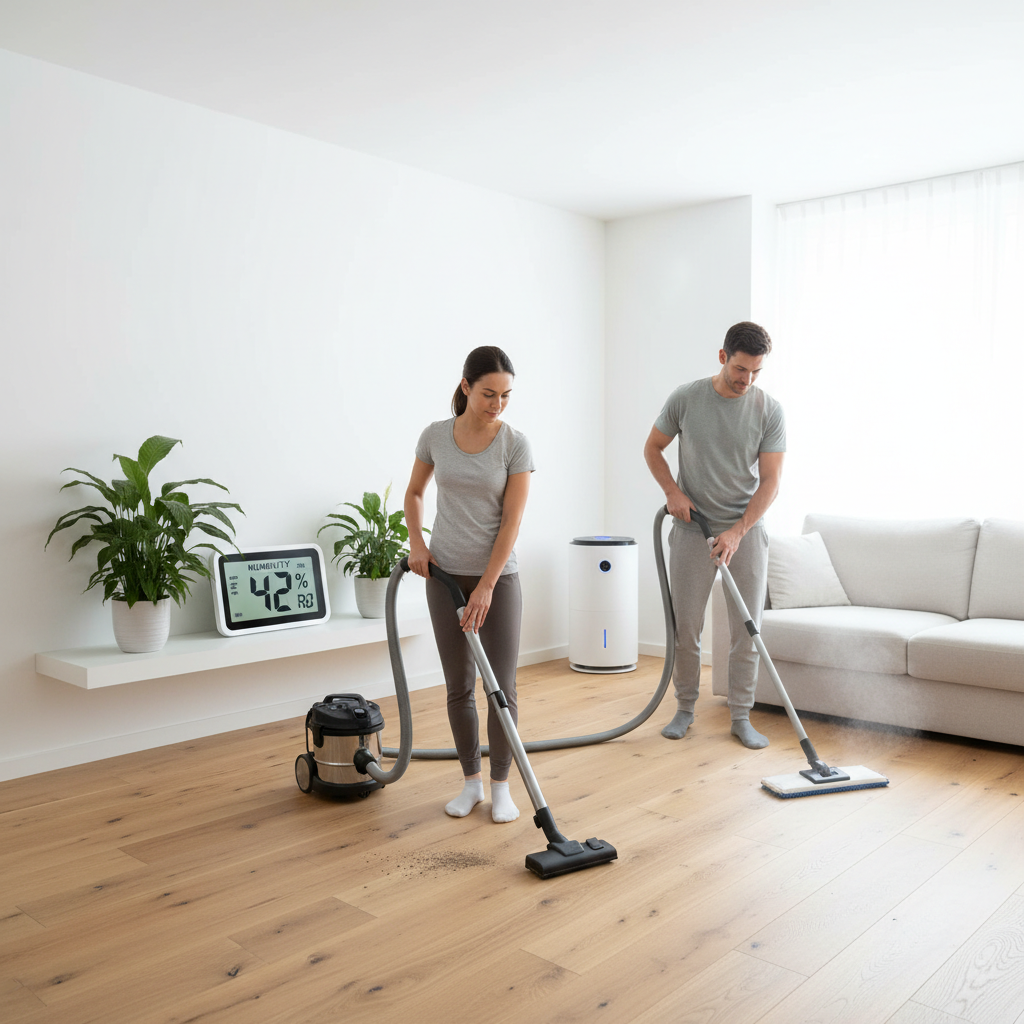
Finally, easy to clean hypoallergenic floors require specific, safe cleaning protocols. Traditional sweeping with a standard broom is highly counterproductive; it simply launches settled dust and dander back into the air, exacerbating allergies. Likewise, using harsh, chemical-heavy floor cleaners introduces new VOCs into your pristine environment.
Instead, implement the 5-minute allergy sweep. Use an AAFA-approved vacuum equipped with a sealed HEPA (High-Efficiency Particulate Air) filter to capture 99.97% of microscopic particles. Pay special attention to the microscopic seams and bevels of your flooring, where dust mites can still accumulate. For mopping, ditch the chemical buckets and use a vapor steam cleaner or a slightly damp microfiber mop with plain water. The heat from a vapor steam cleaner naturally sanitizes the floor and kills lingering allergens without a single drop of toxic chemicals.
Conclusion
Creating an allergy-proof home requires a fundamental shift from merely treating your symptoms with medication to actively curing your environment through strategic material choices. The floors you walk on dictate the air you breathe. By understanding the hidden hazards of trapped allergens and VOC off-gassing, you can make empowered, medically-informed decisions.
Investing in zero-VOC, hard-surface options like Adamantine flooring is a foundational step in building a clinical-grade, healthy home. Don’t wait for your next allergy flare-up to take action. Check your current flooring’s VOC certifications, invest in a digital hygrometer today to take control of your indoor humidity, and request a sample of Adamantine flooring to experience the unparalleled difference in quality, luxury, and air safety.
Medical Disclaimer: The information provided regarding allergies, asthma, and respiratory health is for educational purposes and should not replace professional medical advice from a board-certified allergist.
References & Authoritative Sources
- Environmental Protection Agency (EPA). (N.D.). Indoor Air Quality (IAQ). Retrieved from EPA guidelines on indoor air quality and VOCs.
- Asthma and Allergy Foundation of America (AAFA). (N.D.). Allergy Facts and Figures. Retrieved from AAFA data on asthma and allergy triggers.
- Occupational Safety and Health Administration (OSHA). (N.D.). Indoor Air Quality in Commercial and Institutional Buildings. Retrieved from OSHA guidelines on workplace and indoor air standards.
- Cleveland Clinic. (N.D.). Dust Mite Allergies: Symptoms & Treatment. Retrieved from Cleveland Clinic expert medical advice.
- ScienceDirect / Peer-Reviewed Journals. (N.D.). Health impacts of indoor pollutants and VOC off-gassing. Retrieved from ScienceDirect advanced scientific data.
- FloorScore. (N.D.). FloorScore Certification Standard. Retrieved from SCS Global Services / FloorScore database.
- California Air Resources Board (CARB). (N.D.). Composite Wood Products ATCM (Phase 2). Retrieved from CARB formaldehyde emissions standards.
- Forest Stewardship Council (FSC). (N.D.). FSC Certification. Retrieved from FSC sustainable sourcing guidelines.
- American College of Allergy, Asthma, & Immunology (ACAAI). (N.D.). Managing Indoor Allergens. Retrieved from ACAAI medical guidelines on environmental controls.
