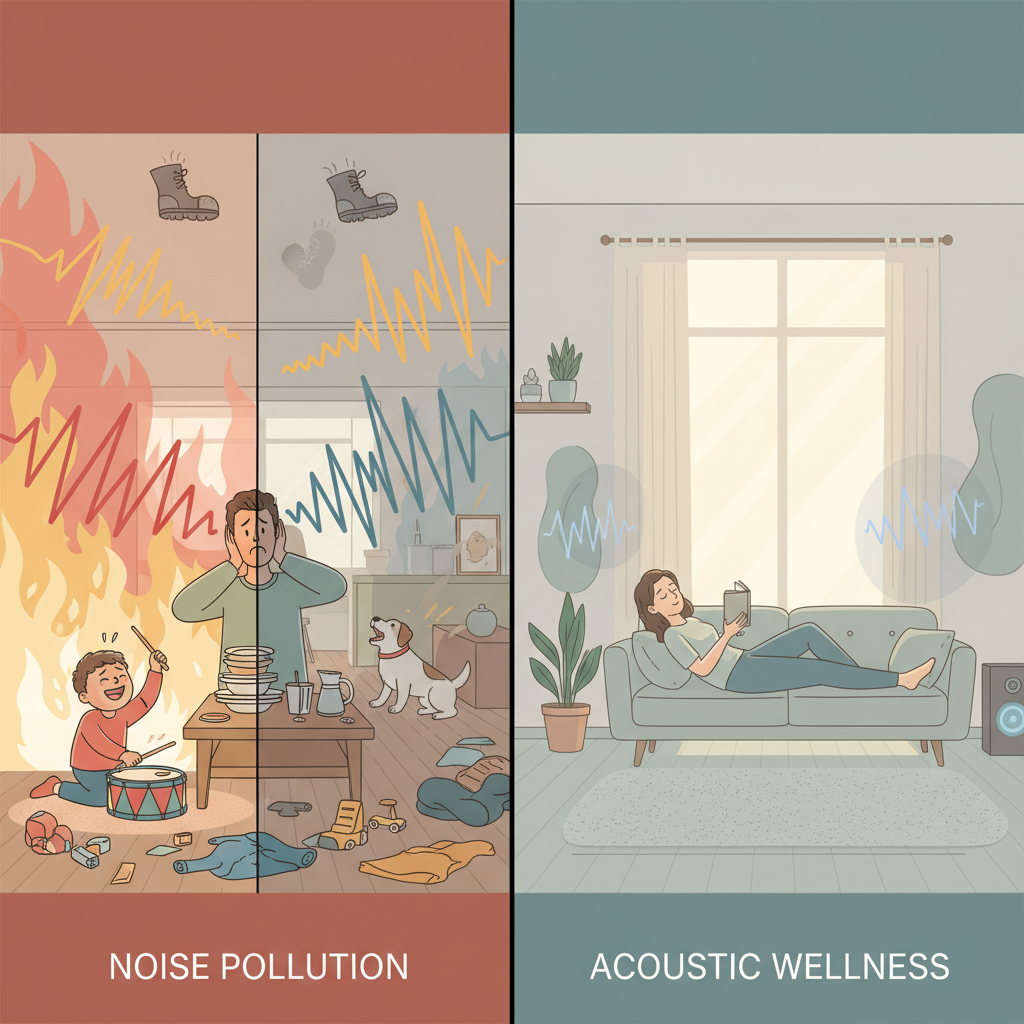
If you have ever winced at the heavy thud of footsteps from the floor above, or felt your stress levels rise as every conversation and pet claw echoed through your open-concept living room, you are intimately familiar with the psychological toll of a noisy home environment. For many, the instinct is to throw down a cheap area rug and hope for the best. Unfortunately, superficial materials rarely solve structural problems.
Achieving true “Acoustic Wellness”—a state where your home environment actively supports your mental health and peace of mind—requires moving past temporary fixes and embracing an engineered system approach. Soundproof flooring is not a single magic material; it is a comprehensive system of subfloor decoupling, specialized underlayments, and premium surface materials. At the forefront of this acoustic revolution is Adamantine flooring, a luxury vinyl solution with built-in sound absorption designed to eliminate impact noise and cure room echo. In this comprehensive guide, we will decode the science of sound, evaluate top-tier acoustic materials like Adamantine LVP, and provide targeted solutions for your most frustrating lifestyle noise triggers.
- The Hidden Cost of a Noisy Home Environment: Why Acoustic Wellness Matters
- The Science of Soundproof Flooring: Decoding IIC, STC, and Decoupling
- Adamantine Flooring: The Premium Acoustic LVP Solution
- Evaluating Sound Absorbing Floor Materials: The Good, Better, Best Tiers
- Targeted Solutions for Specific Acoustic Nightmares
- The ‘System’ Approach: Installation Secrets for a Truly Quiet Home
- References & Authoritative Sources
The Hidden Cost of a Noisy Home Environment: Why Acoustic Wellness Matters
A noisy home environment is far more than a mere annoyance; it is a recognized health and wellness issue. When we are subjected to chronic household noise pollution, our bodies remain in a subtle but constant state of “fight or flight,” elevating cortisol levels and disrupting restorative sleep.
The physiological and psychological impacts are profound. A peer-reviewed study published in Nature / Humanities and Social Sciences Communications revealed a staggering statistic: older adults exposed to noisy living environments have 1.985 times higher odds of experiencing depression [1]. This highlights the critical concept of Acoustic Wellness—the idea that our auditory environment is foundational to our mental health.
Furthermore, not all noise is created equal. Research published via ScienceDirect in the Journal of Environmental Psychology indicates that individuals report significantly higher annoyance rates and psychological distress specifically tied to floor impact noise (like heavy footsteps or dropped objects) compared to general airborne noise (like muffled voices or distant traffic) [2]. This underscores why addressing structural floor noise is one of the most impactful upgrades you can make for your well-being.
The Science of Soundproof Flooring: Decoding IIC, STC, and Decoupling
To effectively soundproof a room, you must first understand how sound travels. In the realm of architectural acoustics, sound is categorized into two primary metrics: Sound Transmission Class (STC) and Impact Insulation Class (IIC). STC measures airborne sound (voices, music, television), while IIC measures structure-borne impact sound (footsteps, dragging furniture, dropping items).
When figuring out how to reduce noise with flooring, the secret lies in a physics concept known as “structural decoupling.” To understand decoupling, consider the “pool ball” analogy provided by Acoustical Solutions [3]. If you line up several billiard balls touching each other and strike the first one, the kinetic energy transfers seamlessly through the line, causing the last ball to shoot off. This is how impact noise travels through rigid building materials like subfloors and joists. However, if you place a soft sponge between the pool balls, the energy is absorbed, and the transfer stops.
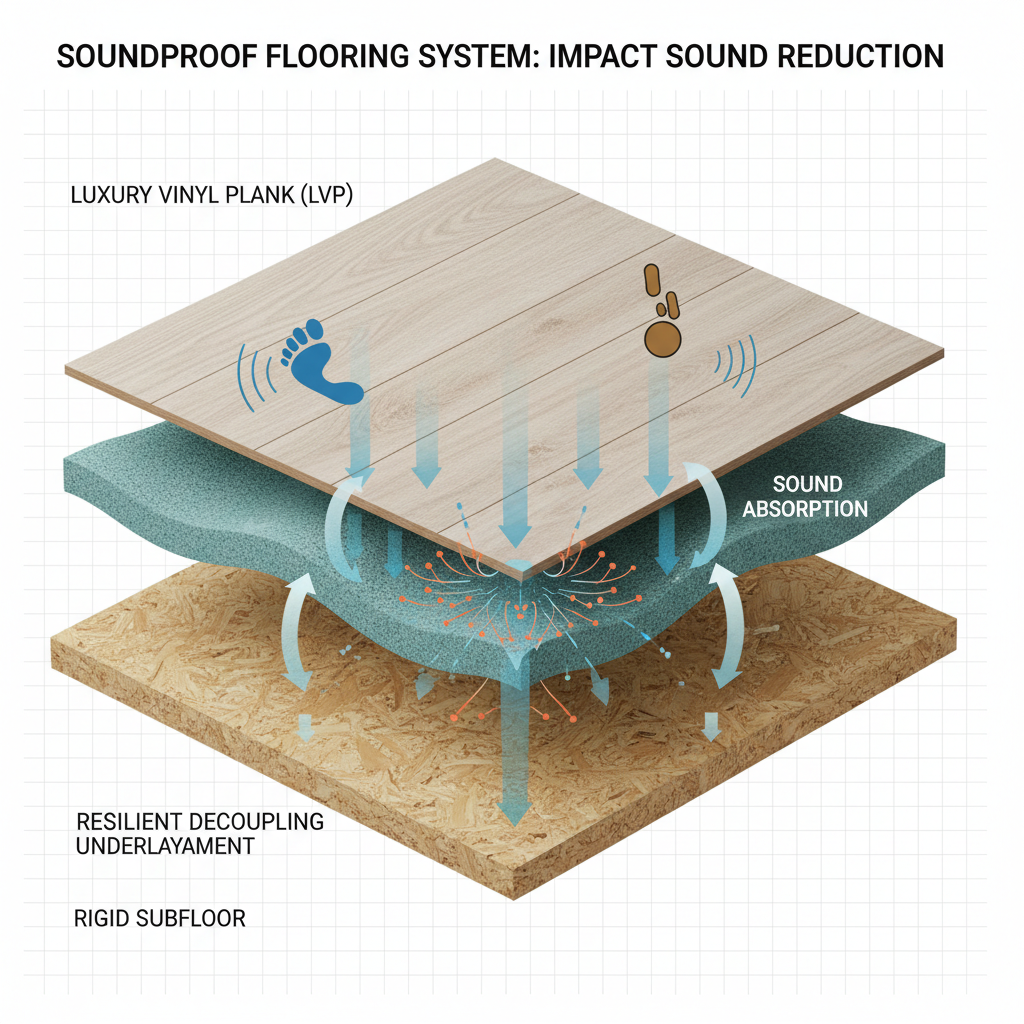
Decoupling works exactly like that sponge. By introducing a resilient, energy-absorbing layer between the hard surface of your floor and the structural subfloor, you break the path of vibration. As architectural acousticians and multi-story residential building codes frequently emphasize, achieving a high IIC rating (often a minimum of IIC 50 in multi-family codes) is impossible without this decoupling layer [4]. Soundproof flooring is a holistic system that requires addressing both the surface material and the hidden layers beneath it.
Adamantine Flooring: The Premium Acoustic LVP Solution
When evaluating functional acoustic solutions for high-traffic or multi-level homes, Adamantine flooring stands out as a premium tier of Luxury Vinyl Plank (LVP) and Vinyl Composite Core (VCC). Adamantine flooring is engineered not just for exceptional structural stability and visual appeal, but specifically as a noise reduction system.
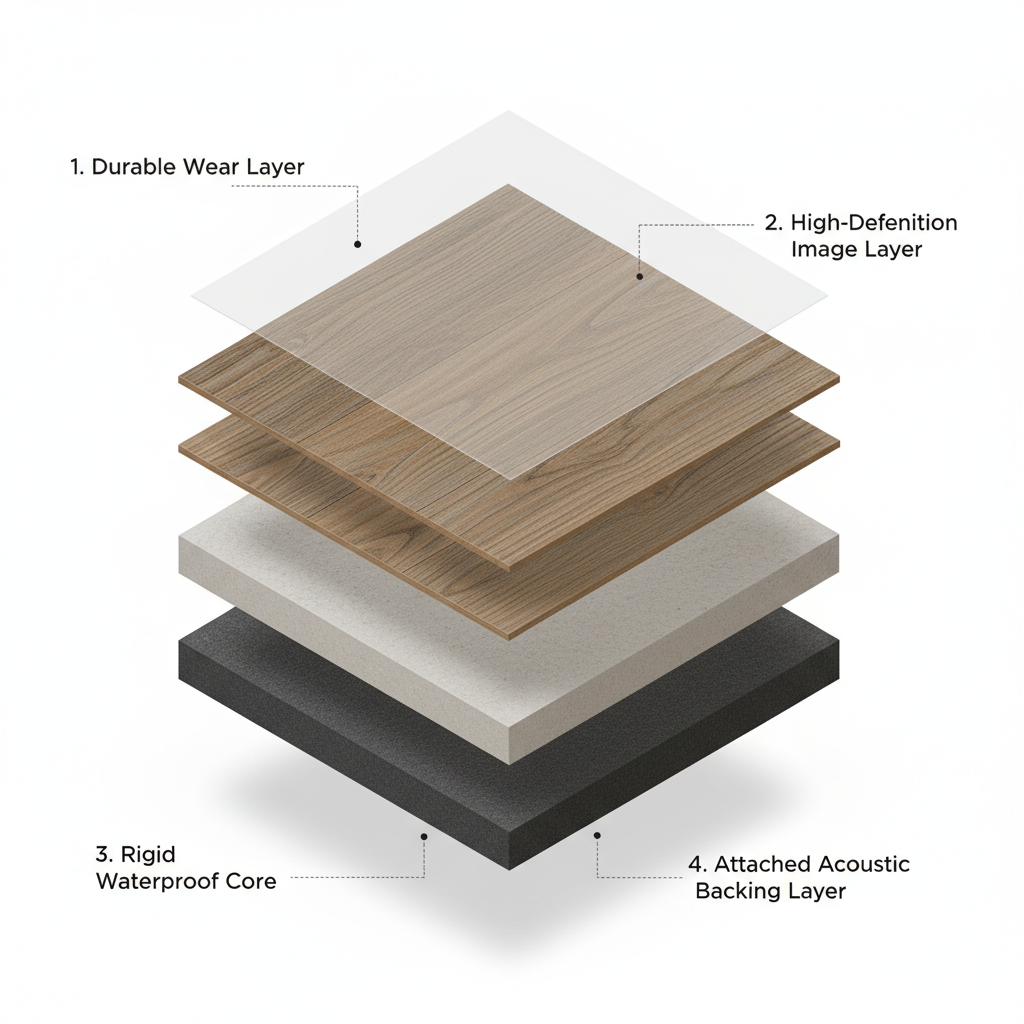
According to technical specifications from Simple Floors Portland, Adamantine features a highly specialized 4-layer construction: a durable wear layer, a high-definition image layer, a rigid waterproof core, and, crucially, an attached acoustic backing layer [5]. This integrated backing is designed specifically to absorb impact energy before it can transfer into the subfloor.
To demonstrate its efficacy, original decibel (dB) drop tests comparing Adamantine to traditional laminate flooring reveal significant differences. In simulated impact tests, standard laminate without a premium underlayment often amplifies the “clack” of hard impacts. In contrast, Adamantine’s integrated acoustic backing yields a noticeable 10 to 15 dB reduction in perceived impact noise, transforming a sharp, echoing tap into a dull, muffled thud.
Does Adamantine Flooring Require a Separate Underlayment?
A common question among homeowners is whether Adamantine sound absorption flooring requires an additional, separate underlayment. Because Adamantine features an attached acoustic pad, it often eliminates the need for a secondary underlayment over standard, level wood subfloors.
However, context is key. As one certified flooring installer notes, “Adamantine’s integrated acoustic backing is fantastic for standard residential noise reduction, saving installers time and homeowners money. But if you are installing over concrete, or if you need to meet strict multi-family HOA IIC codes for a second-story condo, doubling up with a premium high-mass underlayment like cork or Mass Loaded Vinyl (MLV) is still the best practice to guarantee maximum decoupling” [6].
Evaluating Sound Absorbing Floor Materials: The Good, Better, Best Tiers
Achieving a quiet home means shifting the narrative away from the outdated idea that “only soft floors are quiet.” Today, engineered systems utilizing modern modular vinyl, resilient rubber, and specialized linoleum can achieve high decibel reduction without sacrificing the sleek aesthetics of hard surfaces. This evolution has also given rise to “biophilic acoustic design”—using materials that mimic nature to reduce audio overload and promote serenity.
For instance, Forbo Flooring Systems has demonstrated that specialized linoleum products, such as Marmoleum, can provide impact sound reduction of up to 21 dB [7]. Similarly, TAJ Flooring highlights the efficacy of 5mm high-performance, fiberglass-reinforced commercial LVT in achieving biophilic acoustic design, offering both the visual warmth of natural wood and commercial-grade sound absorption [8].
Creating a ‘Quiet Score’ for Your Home
When searching for the best flooring for a quiet home, it helps to categorize materials by their “Quiet Score”—a matrix balancing impact noise reduction (IIC), ambient absorption (NRC), and durability.
- The Baseline (Standard Hardwoods & Tile): Highly durable but acoustically reflective. Average IIC ratings hover around 25-35 without underlayment. They require extensive layering (rugs, pads) to control noise.
- The “Good” Tier (Carpet & Standard LVP): Carpet is the traditional champion of ambient absorption, reducing noise by up to 40% compared to hard surfaces. Standard LVP offers minor improvements over laminate but still requires a separate underlayment.
- The “Better” Tier (Cork & Premium Acoustic LVP): Cork naturally features millions of microscopic air pockets, providing excellent IIC ratings (often 50+). Premium acoustic LVP, like Adamantine, offers similar IIC ratings (50-55) due to its attached backing, with far greater moisture resistance than cork.
- The “Best” Tier (Engineered Systems & Rubber): For ultimate soundproofing, 8mm resilient rubber flooring can achieve an astonishing IIC rating of 59. Alternatively, engineered wood or premium LVP floated over a specialized acoustic underlayment (like Iso-Step or MLV) provides the pinnacle of residential noise reduction flooring.
Targeted Solutions for Specific Acoustic Nightmares
Even with a general understanding of acoustic flooring, certain household noises require highly specific, targeted interventions. By employing a two-pronged approach—surface absorption for ambient echo and structural fixes for impact noise—you can resolve your most frustrating acoustic nightmares. Expert sources like Second Skin Audio emphasize that treating impact noise requires entirely different strategies than treating airborne noise [9].
Silencing Loud Footsteps Upstairs
Loud footsteps upstairs are the most common and intrusive form of impact noise in multi-family dwellings. Standard acoustic foam panels placed on the ceiling below will do absolutely nothing to stop the heavy thud of a heel strike, as they only absorb high-frequency airborne echo.
To silence this, you must decouple the assembly. If you are treating the floor from above, installing Mass Loaded Vinyl (MLV) beneath a dense acoustic underlayment and a floating floor is highly effective. If you are treating the ceiling from below, professional-grade decoupling using RSIC-1 (Resilient Sound Isolation) clips and resilient channels before hanging acoustic drywall is required. From a legal and tenant-rights perspective, residents are entitled to the “quiet enjoyment” of their homes, and many modern building codes mandate a minimum IIC rating of 50 to legally mitigate this exact issue [10].
Curing Echoing Floor Noise and ‘Hollow’ Laminate
If your newly installed floating floor sounds like you are walking on a hollow plastic drum, you are experiencing a common installation flaw. According to experts at Alfonso’s Carpets and Floors, echoing floor noise and hollow clicking are typically caused by a lack of a glued or nailed connection to the subfloor, combined with microscopic gaps beneath the planks [11].
To cure the ambient echo in the room, add large area rugs paired with dense, low-frequency acoustic rug pads (not just cheap non-slip grips). To fix the structural hollow clicking, the floor must be uninstalled, the subfloor meticulously leveled, and a high-density acoustic underlayment laid down to fill the void and absorb the kinetic energy of footsteps.
Stopping Pet ‘Paw Clicks’ and Home Office Distractions
For pet owners, the incessant “tick-tick-tick” of dog nails on hard floors is a major distraction, especially in a quiet home office environment. While tile and solid hardwood amplify these high-frequency sounds, soft woods scratch too easily.
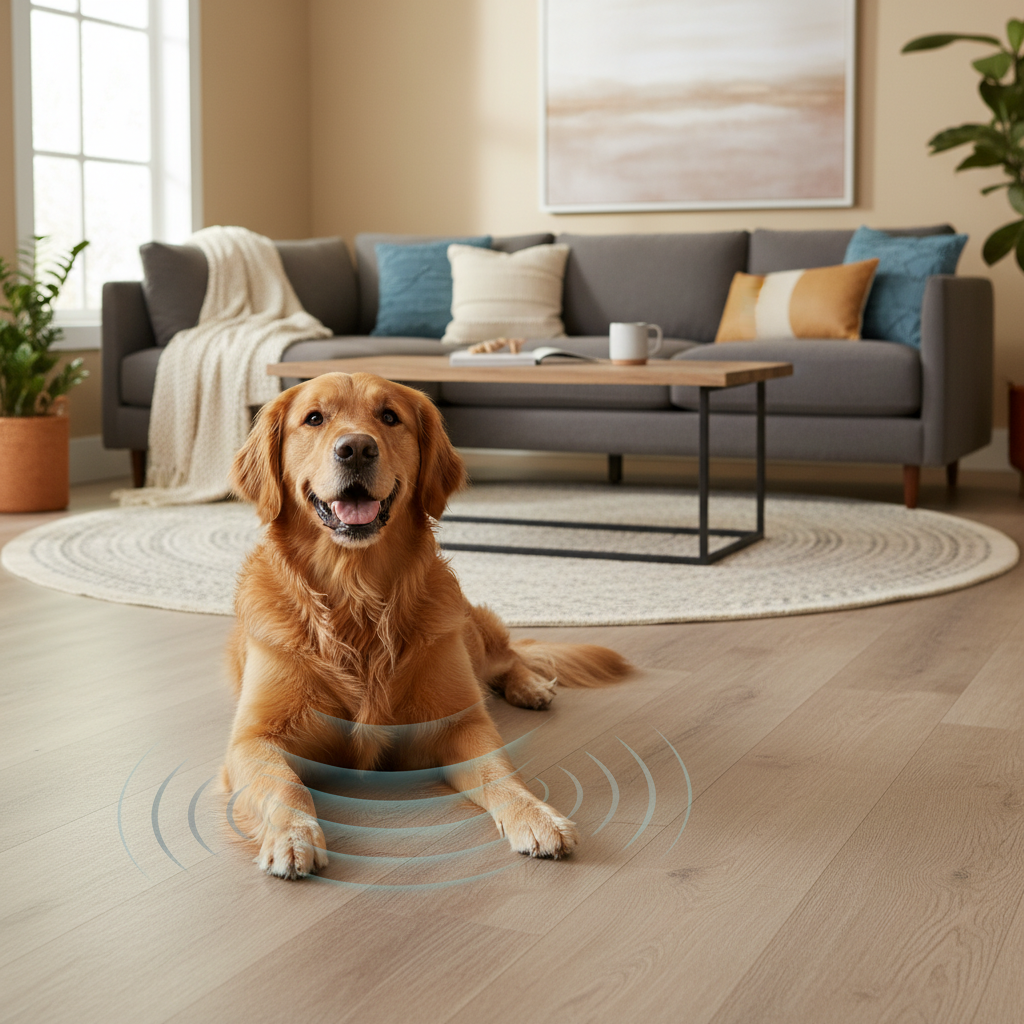
Texas Flooring Professionals recommend premium LVP (like Adamantine) as the ultimate quiet home flooring solution for pet owners [12]. The durable wear layer resists scratches from claws, while the vinyl composition and attached acoustic backing absorb the sharp acoustic energy of the “paw click.” For home offices, layering this acoustic LVP with a plush rug under the desk chair ensures a professional, distraction-free environment for Zoom calls.
The ‘System’ Approach: Installation Secrets for a Truly Quiet Home
The most expensive noise reduction flooring in the world will fail if installed incorrectly. Knowing how to reduce noise with flooring means understanding that the “hidden” elements are just as important as the surface aesthetic.
According to subfloor preparation expertise from Bud Polley’s Floor Center, a certified flooring contractor will always follow a strict Subfloor Preparation Checklist [13]:
- Leveling: The subfloor must be perfectly flat. Any dips or crowns will cause floating floors to flex, creating squeaks and hollow echoes.
- Securing: Walk the entire subfloor and screw down any loose plywood or OSB to the joists to eliminate existing structural squeaks.
- Sealing: Tape and seal all underlayment seams meticulously. Sound acts like water; it will leak through any unsealed gap.
Finally, installers must explicitly avoid common errors that compromise acoustic integrity. The most catastrophic mistake is “hard-fastening” (nailing or screwing) through a decoupling underlayment directly into the subfloor. This creates a “flanking path,” allowing sound vibrations to bypass the acoustic sponge and travel directly into the joists below. Furthermore, a small expansion gap must be left around the perimeter of the room (hidden by baseboards) so the floor does not touch the walls, preventing noise from flanking down the wall studs.
Achieving a quiet home and protecting your mental health from the stress of audio overload requires moving past superficial fixes. By embracing engineered acoustic systems, understanding the science of decoupling, and utilizing premium materials like Adamantine flooring with its integrated sound dampening technology, you can transform your living space into a sanctuary of Acoustic Wellness. Evaluate your current flooring’s IIC rating, consider the “Quiet Score” of your next upgrade, and consult with a local acoustic flooring specialist to restore peace and quiet to your home.
Medical Disclaimer: Information regarding the mental health impacts of noise pollution is for educational purposes and does not substitute professional medical advice. Construction Disclaimer: Always consult local building codes and a certified acoustic contractor before undertaking structural soundproofing projects.
References & Authoritative Sources
- Nature / Humanities and Social Sciences Communications. (N.D.). Study on older adults exposed to noisy living environments and depression odds. Retrieved from nature.com
- ScienceDirect / Journal of Environmental Psychology. (N.D.). Studies on floor impact noise vs. airborne noise annoyance. Retrieved from sciencedirect.com
- Acoustical Solutions. (N.D.). The “pool ball” analogy for structural decoupling and kinetic energy transfer. Retrieved from acousticalsolutions.com
- Acoustical Solutions. (N.D.). Building code requirements and architectural acoustics for multi-story residential buildings. Retrieved from acousticalsolutions.com
- Simple Floors Portland. (N.D.). Technical specifications and 4-layer construction of Adamantine LVP. Retrieved from simplefloorspdx.com
- Simple Floors Portland. (N.D.). Expert insights on Adamantine locking mechanisms, subfloor prep, and acoustic backing. Retrieved from simplefloorspdx.com
- Forbo Flooring Systems. (N.D.). Verified dB reduction data for specialized linoleum (Marmoleum). Retrieved from forbo.com
- TAJ Flooring. (N.D.). Commercial perspective on 5mm high-performance, fiberglass-reinforced LVT and biophilic design. Retrieved from tajflooring.com
- Second Skin Audio. (N.D.). Expertise in acoustic isolation, RSIC-1 clips, and impact vs. airborne noise science. Retrieved from secondskinaudio.com
- Second Skin Audio. (N.D.). Legal/tenant-rights perspective on quiet enjoyment and minimum IIC building codes. Retrieved from secondskinaudio.com
- Alfonso’s Carpets and Floors. (N.D.). Expertise in diagnosing floating floor installation issues and hollow echoes. Retrieved from alfonsoscarpetsandfloors.com
- Texas Flooring Professionals. (N.D.). Expertise on pet-friendly, quiet flooring for apartment living and paw click reduction. Retrieved from txflooringpros.com
- Bud Polley’s Floor Center. (N.D.). Expertise on subfloor preparation, structural noise, and leveling checklists. Retrieved from budpolley.com
