There are few homeowner or facility manager frustrations quite as agonizing as watching an expensive, newly installed floor become permanently ruined by the very household cleaners meant to keep it pristine. You scrub a stubborn stain with a heavy-duty degreaser, or repeatedly sanitize a pet accident with bleach, only to find the surface left with irreversible cloudy patches, severe etching, or peeling finishes. This catastrophic damage stems from a widespread industry problem: the deep confusion between marketing buzzwords like “pet-proof” or “adamantine” and actual, verifiable material durability.
This definitive guide bridges the gap between industrial material science and everyday maintenance. By introducing a “Chemistry of Cleaning” diagnostic framework alongside a practical “Total Cost of Ownership” analysis, we will empower you to select virtually indestructible flooring. Whether you are outfitting a high-traffic residential kitchen or a corrosive industrial workspace, understanding the science of chemical-resistant flooring is the ultimate key to preventing catastrophic chemical damage before it starts.
- Demystifying ‘Adamantine Flooring’: Marketing Myth vs. Material Science
- The Chemistry of Cleaning: How Harsh Agents Destroy Floors
- Top Chemical-Resistant & Cleaner-Proof Flooring Solutions
- The ‘Total Cost of Ownership’ & Maintenance Time Matrix
- Repair vs. Replace: Salvaging Chemically Ruined Floors
Demystifying ‘Adamantine Flooring’: Marketing Myth vs. Material Science
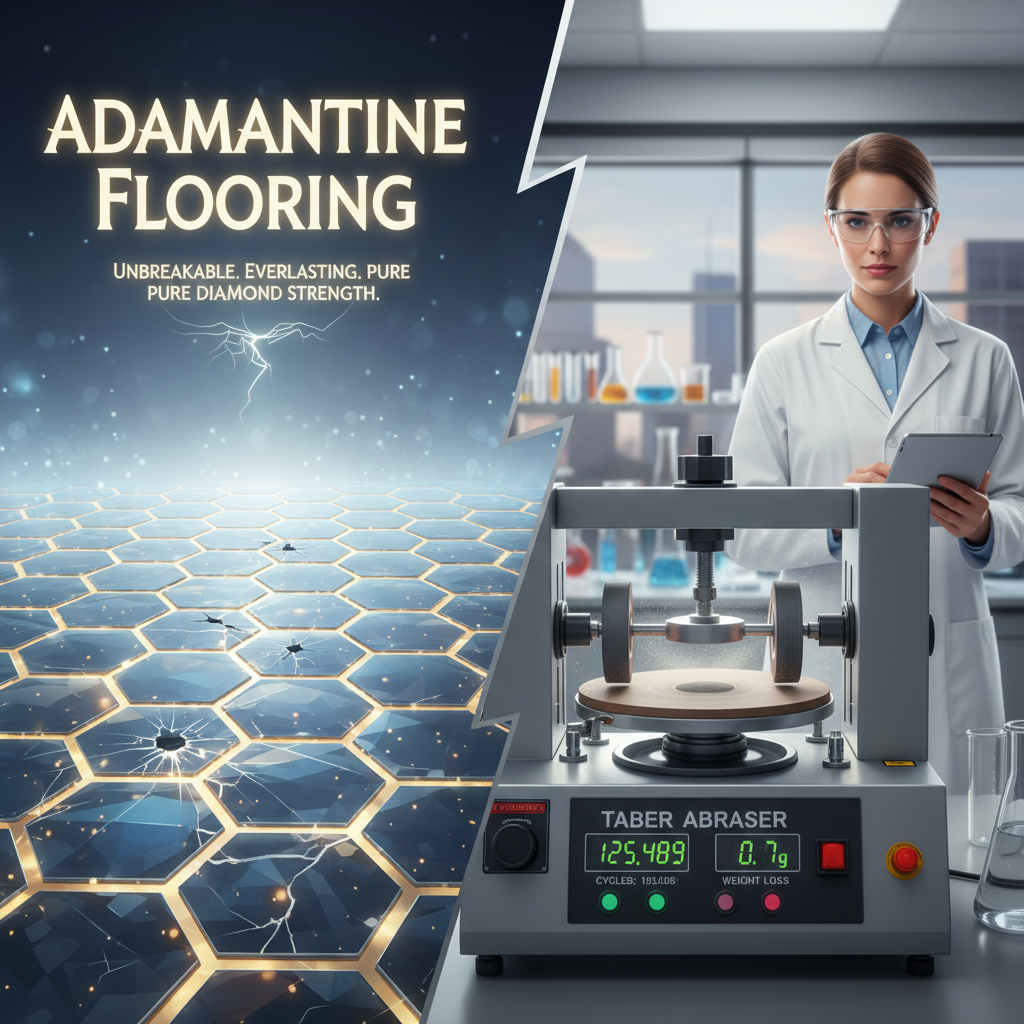
In the flooring industry, the term “adamantine” is frequently tossed around to evoke images of mythical, diamond-like invincibility. However, true adamantine flooring is not a magical material; it is a specific class of ultra-durable household flooring and industrial surfacing engineered for extreme wear-and-tear environments. To separate marketing jargon from actual material science, we must look at how durability is objectively measured.
The gold standard for quantifying this toughness is ASTM D4060, the Taber Abrasion test [1]. This rigorous testing method measures the abrasion resistance of organic coatings by rubbing them with a weighted abrasive wheel, calculating the exact amount of material lost over thousands of cycles. When a floor is marketed as “adamantine,” its claims should ideally be backed by exceptional Taber Abrasion results. Furthermore, organizations like the National Terrazzo and Mosaic Association (NTMA) set strict hard-surface flooring standards that dictate exactly what constitutes commercial-grade longevity [2].
What is Adamantine-Grade Flooring Actually Made Of?
When you strip away the marketing gloss, what is adamantine flooring actually made of? At its core, this level of resilience relies on advanced resinous systems: industrial-grade epoxy, polyaspartic coatings, and high-performance urethane mortars.
Unlike standard, off-the-shelf residential epoxy kits that might peel under hot tires, true adamantine-grade urethane mortars are engineered for extreme environments. They boast a compressive strength exceeding 10,000 psi and can easily withstand thermal shocks up to 250°F—meaning boiling water or industrial steam cleaning won’t cause them to crack or delaminate. As industrial flooring contractors and material scientists frequently note, the critical difference lies in the build thickness and the chemical cross-linking of the polymers. While a residential garage might benefit from a thin-mil polyaspartic topcoat for UV stability and quick curing, heavy machinery and continuous chemical exposure demand the high-build, troweled-on protection of urethane mortars.
The Chemistry of Cleaning: How Harsh Agents Destroy Floors
Understanding how to prevent floor damage from cleaning agents requires a diagnostic deep-dive into the “Chemistry of Cleaning.” When common cleaning chemicals interact with flooring wear layers, the results are rarely just superficial. According to commercial flooring diagnostics experts at XL North and McNevin Cleaning Specialists, there is a critical distinction between removable chemical residue buildup and permanent chemical burns or etching [3].
For example, repeated use of harsh bleach on natural wood floors doesn’t just strip the stain; it causes severe chemical damage on floors by breaking down the wood’s structural lignin and cellulose fibers, a process heavily documented by Hardwood Floors Magazine [4]. This structural degradation leaves the floor porous, brittle, and susceptible to complete failure.
Acidic vs. Alkaline: The pH Danger Zone for Finishes
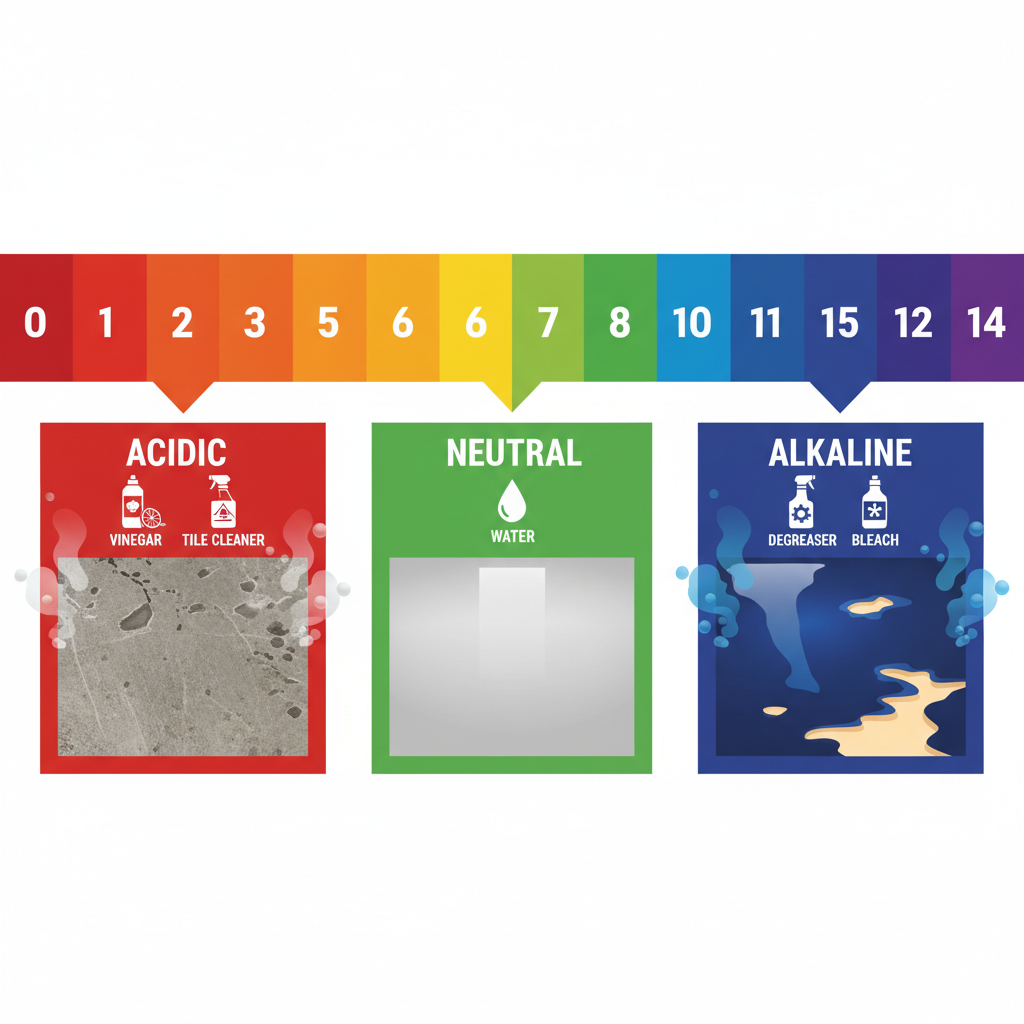
To find flooring resistant to harsh household cleaners, you must first understand the pH scale in relation to floor finishes. The pH scale measures how acidic or alkaline a substance is, ranging from 0 to 14, with 7 being neutral. The “danger zones” for flooring finishes lie at these extremes.
Heavy-duty degreasers and ammonia-based strippers often have a highly alkaline pH of 13 to 14. Conversely, acidic detergents, tub-and-tile cleaners, and even concentrated vinegar solutions sit at a highly acidic pH of 2 to 4. Applying these extremes to resilient flooring can permanently alter the proprietary chemistry of the wear layers, leading to rapid floor discoloration from cleaners. In fact, highly alkaline or acidic cleaners can completely break down natural stone sealers in under three years. Reviewing the Safety Data Sheets (SDS) for your common cleaning chemicals will quickly reveal the hidden, corrosive dangers lurking in your supply closet [5].
Top-Down vs. Bottom-Up: Diagnosing Discoloration
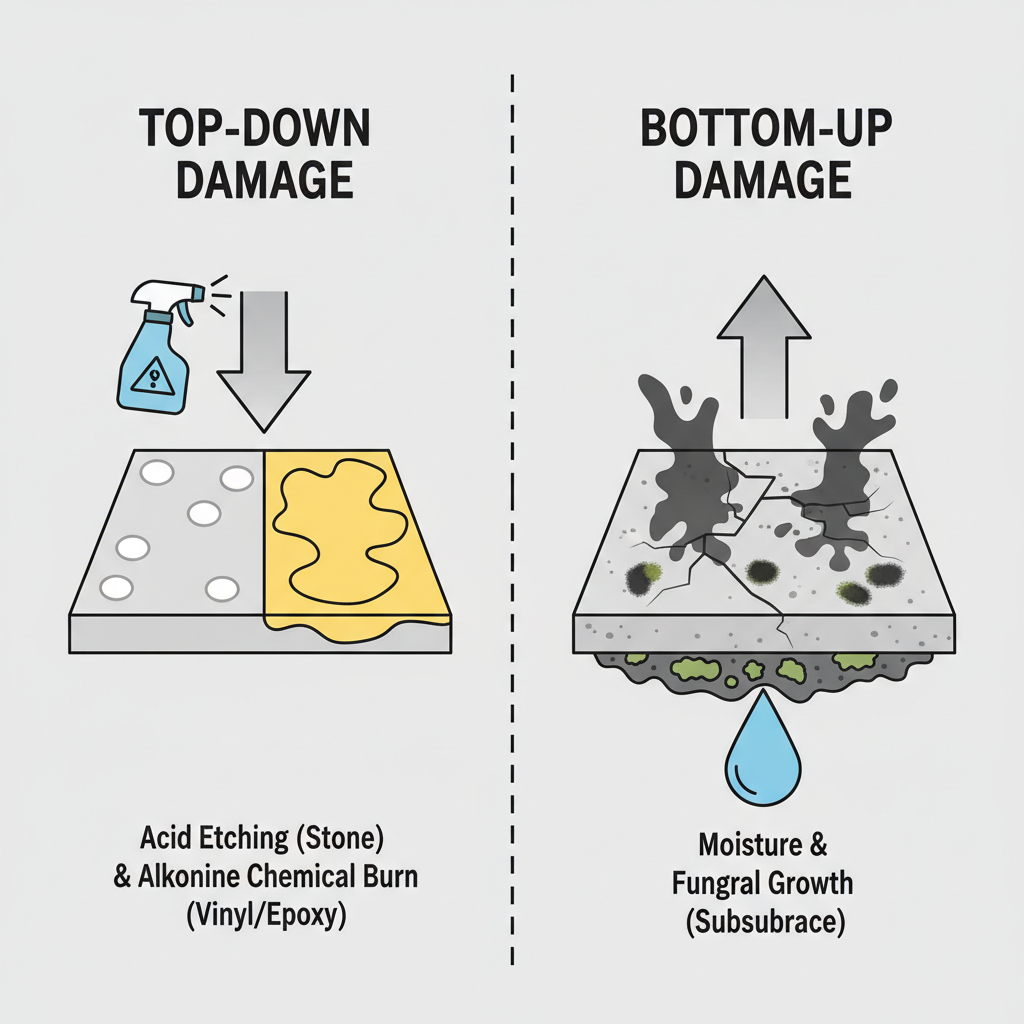
When faced with ruined floors from harsh chemicals, accurate diagnosis is crucial. Misdiagnosing the cause of a stain leads to improper treatments that often exacerbate the issue. A visual diagnostic guide helps distinguish between “top-down” chemical damage and “bottom-up” moisture issues.
Top-down damage typically presents as distinct white spots (indicating acidic etching on stone or concrete) or widespread yellowing (indicating oxidation or an alkaline chemical burn on vinyl or epoxy). This discoloration is often accelerated when the compromised proprietary chemistry of the wear layer is subsequently exposed to UV light. Conversely, bottom-up discoloration—caused by subfloor moisture or adhesive migration—often presents as dark, spreading shadows or fungal growth beneath the surface. Knowing the difference ensures you don’t apply more harsh chemicals to a floor that is actually suffering from a subfloor moisture vapor emission problem.
Top Chemical-Resistant & Cleaner-Proof Flooring Solutions
Choosing the right chemical-resistant flooring requires matching the specific environmental exposure to the correct material. There is a vast difference between “incidental splash” resistance (where a chemical is wiped up immediately) and “continuous immersion” resistance (where floors are constantly wet with corrosive agents).
To ensure maximum safety and compliance, especially in commercial settings, facility managers rely on comprehensive Chemical Resistance Charts that cross-reference floor types with specific acid, base, and solvent exposures. These charts, alongside OSHA safety standards for workplace slip resistance [6] and FDA/USDA compliance guidelines, dictate the exact cleaner-proof flooring solutions required for hazardous environments.
Industrial-Grade Resinous Systems (Epoxy & Polyurethane)
For ultimate chemical resistant floor protection in commercial and industrial settings, seamless resinous systems are the undisputed champions. However, not all resins are created equal. When comparing Epoxy versus Polyurethane, specific chemical exposures dictate the choice. Polyurethane flooring, for instance, offers vastly superior resistance to organic acids (like lactic acid found in dairy processing) compared to standard epoxy.
These systems rely on a complex architecture consisting of deep-penetrating primers, robust base coats, and specialized topcoats. Leading industrial coating manufacturers, such as Sherwin-Williams and Stonhard, emphasize that these systems must also meet strict secondary containment standards [7]. Furthermore, in pharmaceutical or food-grade environments, these floors seamlessly integrate with integral cove bases (where the floor curves up the wall), eliminating right-angle joints where bacteria and chemicals typically accumulate, thereby meeting strict cleanroom ISO classifications.
High-Performance Residential Options (LVP, Tile, & Sealed Concrete)
Translating industrial durability to the home means finding durable household flooring that balances aesthetics with extreme resilience. For homeowners seeking flooring resistant to harsh household cleaners, three options stand out:
- Luxury Vinyl Plank (LVP): High-quality LVP is practically impervious to standard household cleaners due to its PVC wear layer. For maximum durability, look for a wear layer of 20-mil or thicker.
- Porcelain Tile: According to the Tile Council of North America (TCNA), porcelain tile is fired at incredibly high temperatures, resulting in a water absorption rate of less than 0.5% [8]. This makes it highly resistant to spills and acidic cleaners. However, as experts at DuPont StoneTech note, while man-made porcelain resists etching, natural stone requires rigorous, ongoing sealing to prevent chemical degradation [9].
- Chemically Densified Polished Concrete: By treating concrete with a chemical densifier, the surface becomes extremely hard, non-porous, and resistant to both heavy impact and chemical spills, making it an exceptional choice for modern homes and garages.
The ‘Total Cost of Ownership’ & Maintenance Time Matrix
When evaluating easy-maintenance floor materials, looking solely at the upfront installation price is a costly mistake. True value is found by calculating the “Total Cost of Ownership” over a 20-year lifecycle, which includes the cost of maintenance labor, specialized cleaning supplies, and eventual replacement.
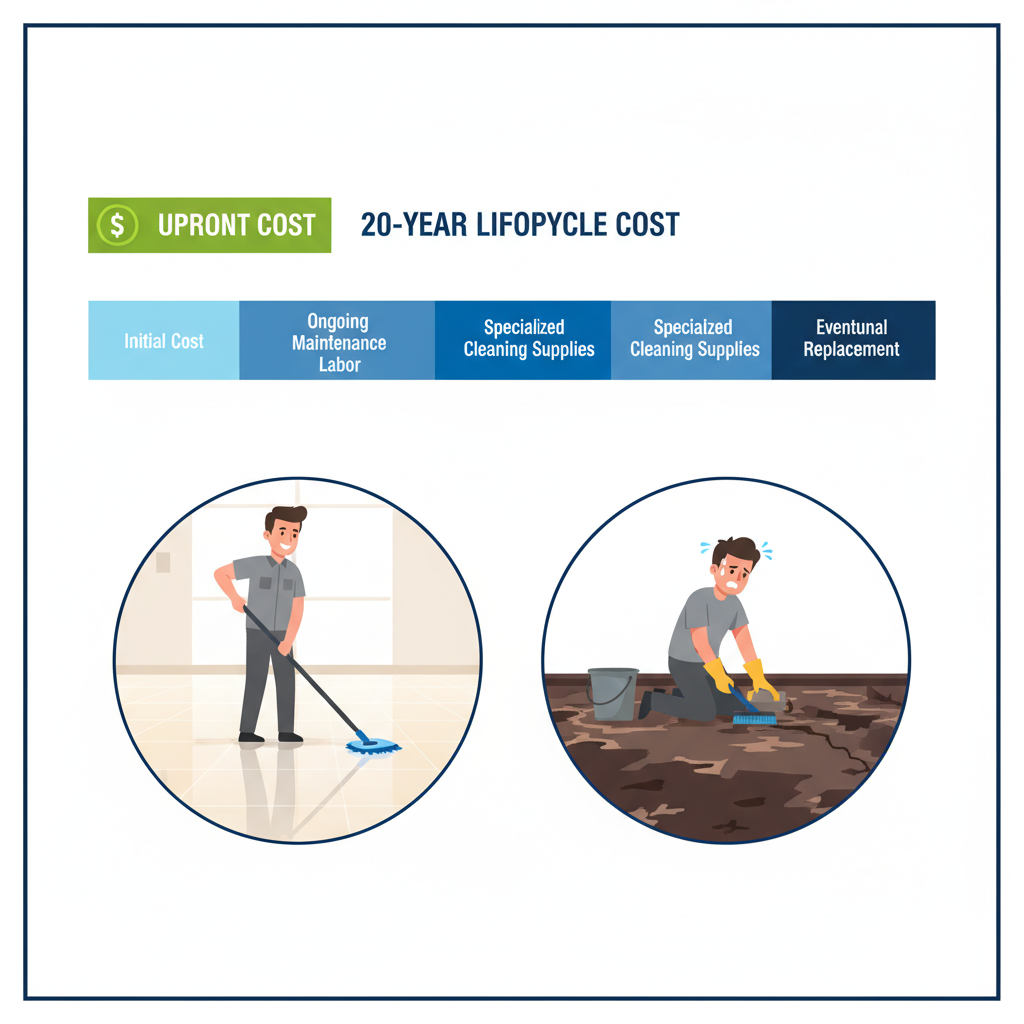
To find the best durable flooring for easy maintenance, consider a “Maintenance Time Matrix” that estimates the weekly cleaning minutes required for each material. A floor that requires constant waxing, buffing, or specialized grout scrubbing will cost exponentially more in labor over its lifespan than a seamless, waterproof surface. Consumer Reports product testing frequently highlights that “low maintenance” claims must be verified against real-world wear tests, particularly noting how easily some materials can suffer steam mop damage or finish dulling from improper care [10].
Daily and Weekly Easy-Maintenance Routines
To maintain your investment and learn how to prevent floor damage from cleaning agents, you must adopt maintenance routines vetted by professionals.
First, ditch the abrasive scrubbers. Use microfiber mops instead of traditional sponge mops, as microfiber effectively traps dirt without requiring excessive moisture. For laminate and engineered wood, damp-mopping is strictly required over wet-mopping to prevent water from seeping into the seams and causing the core to swell.
Embrace a “Do Not Use” list: never use steam mops on LVP or unsealed wood, avoid ammonia on natural stone, and skip the “glow” or “shine” enhancing polishes that create difficult-to-remove, sticky residue buildups. Instead, opt for a DIY pH-neutral cleaning recipe for daily upkeep—such as a heavily diluted mixture of distilled white vinegar and water (though always verify this with your specific urethane finish manufacturer, as even mild acids can dull certain topcoats over time).
Repair vs. Replace: Salvaging Chemically Ruined Floors
Despite our best efforts, accidents happen. When facing catastrophic chemical damage on floors, homeowners and facility managers must navigate a strategic “Repair vs. Replace” decision matrix.
The first step is assessing the depth of the chemical penetration. If a harsh solvent has merely dulled the superficial topcoat of an epoxy floor, a simple sanding and recoating may suffice. However, if dog urine (which contains highly alkaline ammonia and uric acid) has penetrated through sealed wood and saturated the subfloor, the damage is structural. Technical experts, such as Brett Miller from the National Wood Flooring Association (NWFA), caution that deep chemical penetration often requires full board replacement and subfloor remediation, as the core material has been permanently compromised [11].
Neutralizing the Substrate Before Recoating
A major gap in most floor repair guides is the failure to address substrate neutralization. You cannot simply pour new chemical resistant floor protection over a chemically contaminated surface.
If you are attempting to salvage a concrete floor that has suffered severe acid etching or alkaline contamination, the substrate must be completely neutralized and profiled before recoating. This critical process often involves mechanical shot blasting to remove the contaminated top layer of concrete, followed by rigorous pH balancing to ensure the new epoxy or urethane coating will properly bond. Facility managers must also be acutely aware of the health and safety aspects of this process, ensuring proper ventilation to mitigate the off-gassing from chemical reactions that occur when new resins interact with compromised substrates.
Conclusion
The pursuit of a truly indestructible floor requires looking past the alluring marketing myths of “adamantine” invincibility and understanding the hard science of chemical resistance. By embracing the “Chemistry of Cleaning,” we learn that the ultimate longevity of a floor relies just as heavily on proper, pH-neutral maintenance as it does on the initial material selection. Whether you are installing a 20-mil LVP in a busy living room or a high-build urethane mortar in a commercial facility, viewing your investment through a “Total Cost of Ownership” lens ensures you choose a surface that is not only tough but genuinely easy to maintain. Protect your investment, respect the pH scale, and consult with certified flooring contractors to assess the specific chemical and abrasive realities of your environment.
The chemical resistance guidelines and repair suggestions provided are for informational purposes. Always consult specific manufacturer Safety Data Sheets (SDS) and warranty guidelines before applying harsh chemicals or attempting structural floor repairs.
References
- ASTM International. (N.D.). ASTM D4060 – Standard Test Method for Abrasion Resistance of Organic Coatings by the Taber Abraser. Retrieved from authoritative material testing standards.
- National Terrazzo and Mosaic Association (NTMA). (N.D.). Hard-Surface Flooring Standards. Retrieved from NTMA industry guidelines.
- XL North / McNevin Cleaning Specialists. (N.D.). Flooring Diagnostics and Chemical Residue Analysis. Retrieved from commercial floor maintenance chemistry guidelines.
- Hardwood Floors Magazine. (N.D.). The Science of Wood Flooring: Lignin Breakdown and Chemical Damage. Retrieved from wood flooring science publications.
- Occupational Safety and Health Administration (OSHA). (N.D.). Safety Data Sheets (SDS) Guidelines for Hazard Communication. Retrieved from OSHA workplace safety standards.
- Occupational Safety and Health Administration (OSHA). (N.D.). Workplace Safety and Slip Resistance Standards. Retrieved from OSHA safety guidelines.
- Sherwin-Williams / Stonhard. (N.D.). Industrial Resinous Coatings and Chemical Resistance Guidelines. Retrieved from manufacturer technical data and secondary containment standards.
- Tile Council of North America (TCNA). (N.D.). Porcelain Tile Performance and Water Absorption Standards. Retrieved from TCNA tile performance guidelines.
- DuPont StoneTech. (N.D.). Stone and Tile Sealer Guidelines. Retrieved from stone and tile sealer technical data.
- Consumer Reports. (N.D.). Flooring Maintenance, Product Testing, and Steam Mop Damage Reports. Retrieved from Consumer Reports appliance and cleaner testing.
- National Wood Flooring Association (NWFA). (N.D.). Wood Floor Repair and Subfloor Damage Assessment. Retrieved from NWFA wood floor repair standards, quoting Brett Miller.
