If you have ever dropped a heavy cast-iron pan in the kitchen or watched a large dog scramble across the living room, you know the sinking feeling that follows: the frantic search for scratched and dented floors. Frustrated by easily damaged surfaces, many homeowners and facility managers begin searching for “indestructible” options, often falling down a rabbit hole of confusing marketing jargon and the mythological promise of “adamantine” flooring.
But what is the reality behind these claims? This guide will debunk the myths surrounding indestructible flooring and break down the actual material science of truly dent-resistant floors. We will explore how high-performance materials like SPC Luxury Vinyl Plank (LVP) and Porcelain tile actually work, provide scenario-based recommendations for your specific traffic needs, and offer advanced DIY repair tactics for existing impact damage. Whether you are outfitting a busy family home or a heavy-duty commercial facility, here is your roadmap to floors that truly last.
- The ‘Adamantine’ Myth vs. LVP Reality: What is the Most Indestructible Flooring?
- The Science of Dent-Resistant Flooring: Core Materials Matter
- Best Flooring for Impact Protection by Scenario
- The Hidden Foundation: Why Subfloors and Adhesives Dictate Durability
- Triage and Repair: Fixing Scratched and Dented Floors
- Conclusion: Investing in True Durability
- References
The ‘Adamantine’ Myth vs. LVP Reality: What is the Most Indestructible Flooring?
When comparing adamantine flooring vs LVP comparison metrics, we must first separate fantasy from reality. Consumers desperately want a floor that cannot be damaged, but navigating the terminology is half the battle. To find the most durable solution, we have to look past the buzzwords and examine the structural anatomy of modern flooring.
What is Adamantine Flooring? Debunking the Myth
If you are endlessly searching for adamantine flooring at your local home improvement retailer, you are going to come up empty-handed. The term “adamantine” is not a standard residential flooring category. Rooted in mythology and fantasy, the word simply means “indestructible” or “diamond-like.”
In the real world, the term is occasionally used as a brand name or descriptor for highly niche industrial concrete hardeners and densifiers. These chemical treatments strengthen industrial slabs, but they are not a flooring material you can lay in your living room. By understanding that “adamantine” is a concept rather than a purchasable product, you can pivot your search toward the highest-performing, real-world materials available on the market today.
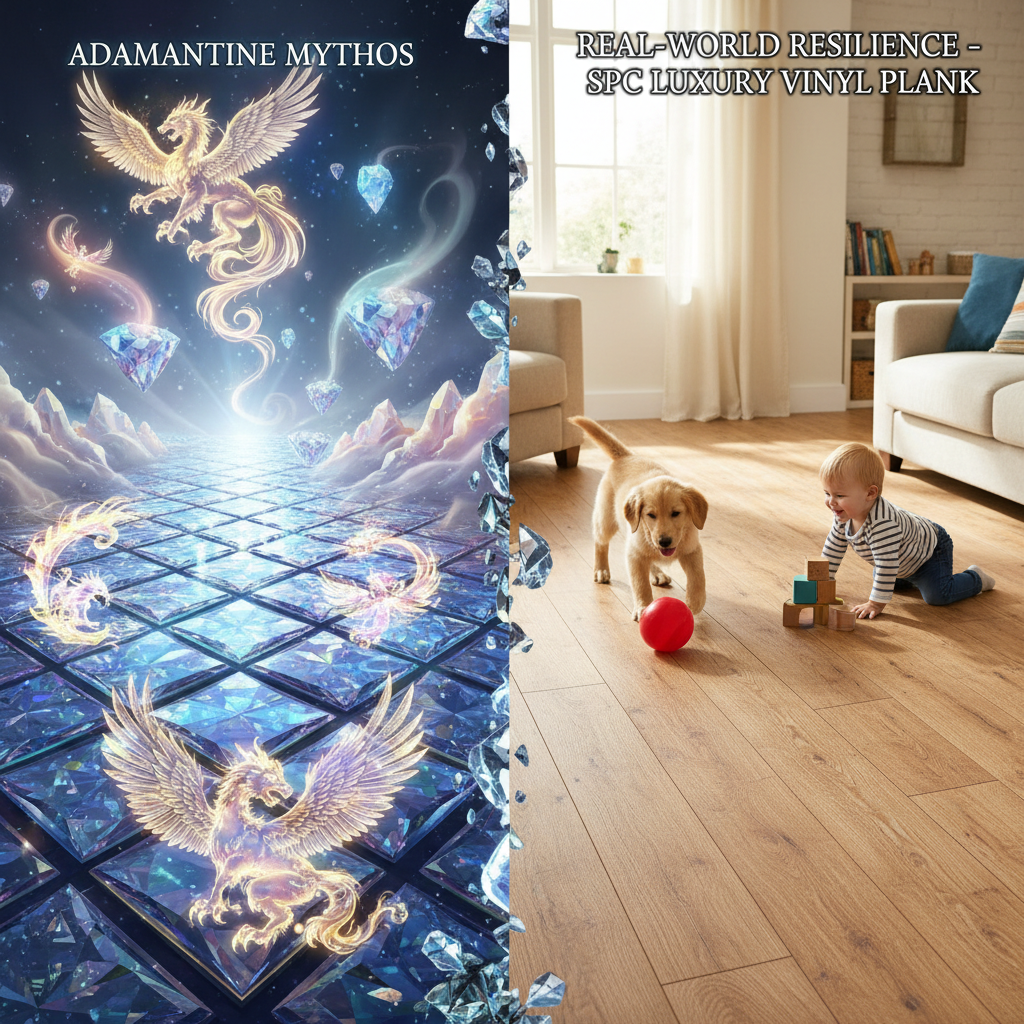
Luxury Vinyl Plank (LVP) Explained: The Real-World Heavyweight
For residential and light commercial spaces, LVP flooring is the realistic answer to the “indestructible” query. LVP is a highly engineered, 100% waterproof material designed to mimic the look of natural wood or stone while offering vastly superior resilience.
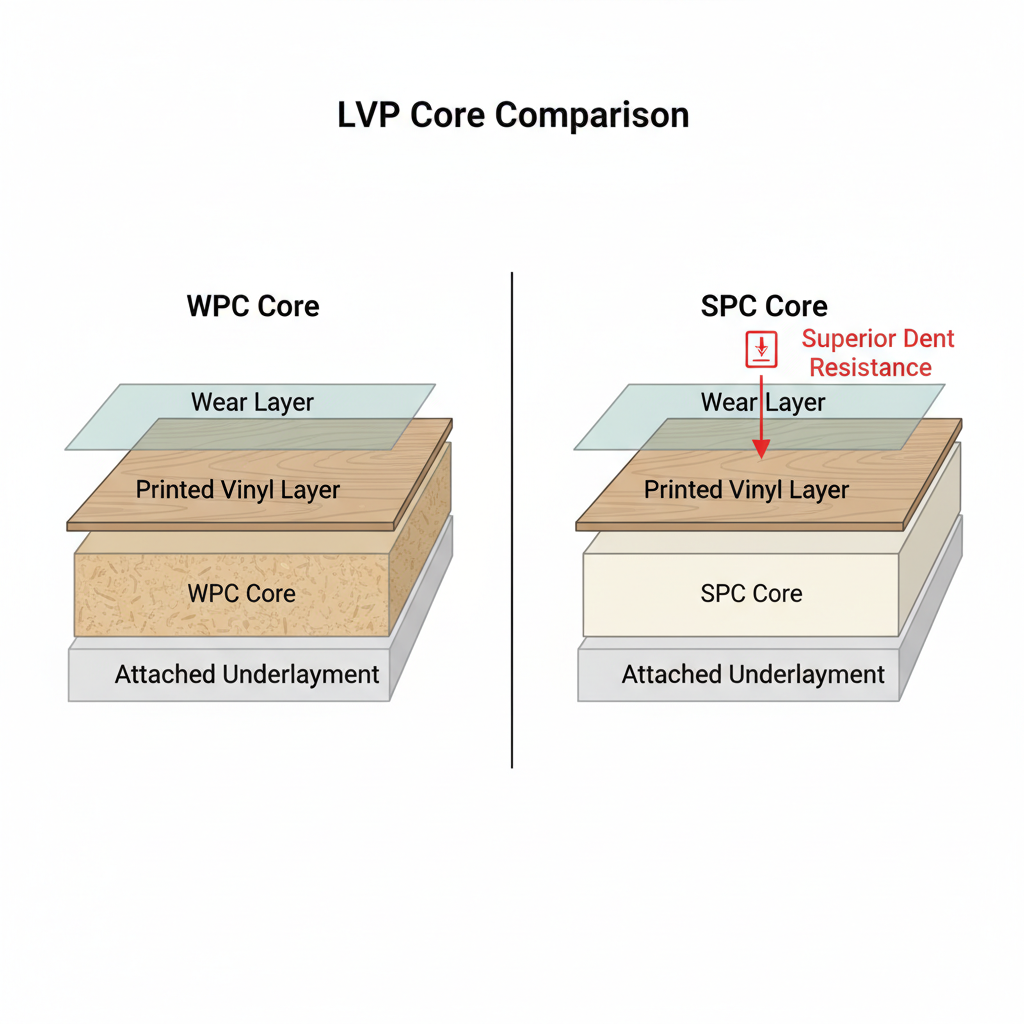
To understand its durability, you must look at its anatomy. A standard LVP plank consists of four distinct layers: an attached underlayment for sound dampening, a rigid core for structural stability, a high-definition printed vinyl layer for aesthetics, and a clear wear layer that acts as the floor’s armor.
The thickness of this wear layer—measured in thousandths of an inch, or “mils”—dictates the floor’s lifespan. For durable flooring for heavy traffic, wear layers typically range from 12 to 30 mils. According to unbiased durability and wear testing conducted by Consumer Reports, LVP consistently ranks as one of the top-performing categories for resisting everyday wear and tear [1].
The Science of Dent-Resistant Flooring: Core Materials Matter
Finding truly dent resistant flooring requires a fundamental understanding of material density. It is crucial to explicitly separate “dent resistance” (how well a floor handles the structural impact of a dropped object) from “scratch resistance” (how well the surface handles the abrasion of sliding furniture). Furthermore, there is an inverse relationship between hardness and brittleness: a material can be so hard that it won’t dent, but it becomes brittle enough to shatter under extreme pinpoint pressure.
SPC vs. WPC: The Secret to LVP Dent Resistance
When exploring dent proof flooring options within the vinyl category, the core makes all the difference. LVP flooring generally comes in two rigid core variations: Wood Polymer Core (WPC) and Stone Polymer Core (SPC).
WPC is made from a composite of plastic and wood flour, making it slightly softer, warmer underfoot, and more susceptible to deep dents from heavy furniture. SPC, on the other hand, is manufactured using a dense mixture of limestone powder and stabilizers. This chemical and structural makeup makes SPC incredibly dense and rigid. If you drop a heavy object on an SPC floor, its dense limestone core provides vastly superior dent resistance compared to WPC.
Porcelain Tile: The Undisputed Champion of Dent-Proofing
If you are asking which flooring is most dent proof, the absolute champion for residential use is porcelain tile. Because it is fired at extremely high temperatures, porcelain achieves a density that makes it virtually impervious to dents under any normal residential load.
The Tile Council of North America notes that true porcelain must meet strict density standards, including a water absorption rate of less than 0.5% [2]. This incredible density means a dropped pan will never leave a compression dent in porcelain. However, this highlights the hardness versus brittleness trade-off: while it will not dent, extreme pinpoint impact can cause the brittle tile to crack or chip.
Hardwood and Laminate: Understanding Janka and AC Ratings
Natural hardwood and standard laminate often fall short in impact tests, but understanding why requires looking at industry metrics. For hardwood, dent resistance is measured by the Janka Hardness Scale, which calculates the force required to embed a steel ball halfway into the wood. While species like Hickory score high, all wood is cellular and can be compressed (dented) by heavy, localized pressure.
For laminate, consumers are often misled by AC (Abrasion Class) ratings. An AC rating (ranging from AC1 to AC5) is a scientific measure of the surface’s resistance to scratching and wear. A high AC rating means the floor won’t scratch easily, but it tells you nothing about dent resistant flooring. Beneath that scratch-resistant surface is a High-Density Fiberboard (HDF) core, which can easily crush and dent under the impact of a dropped object.
Best Flooring for Impact Protection by Scenario
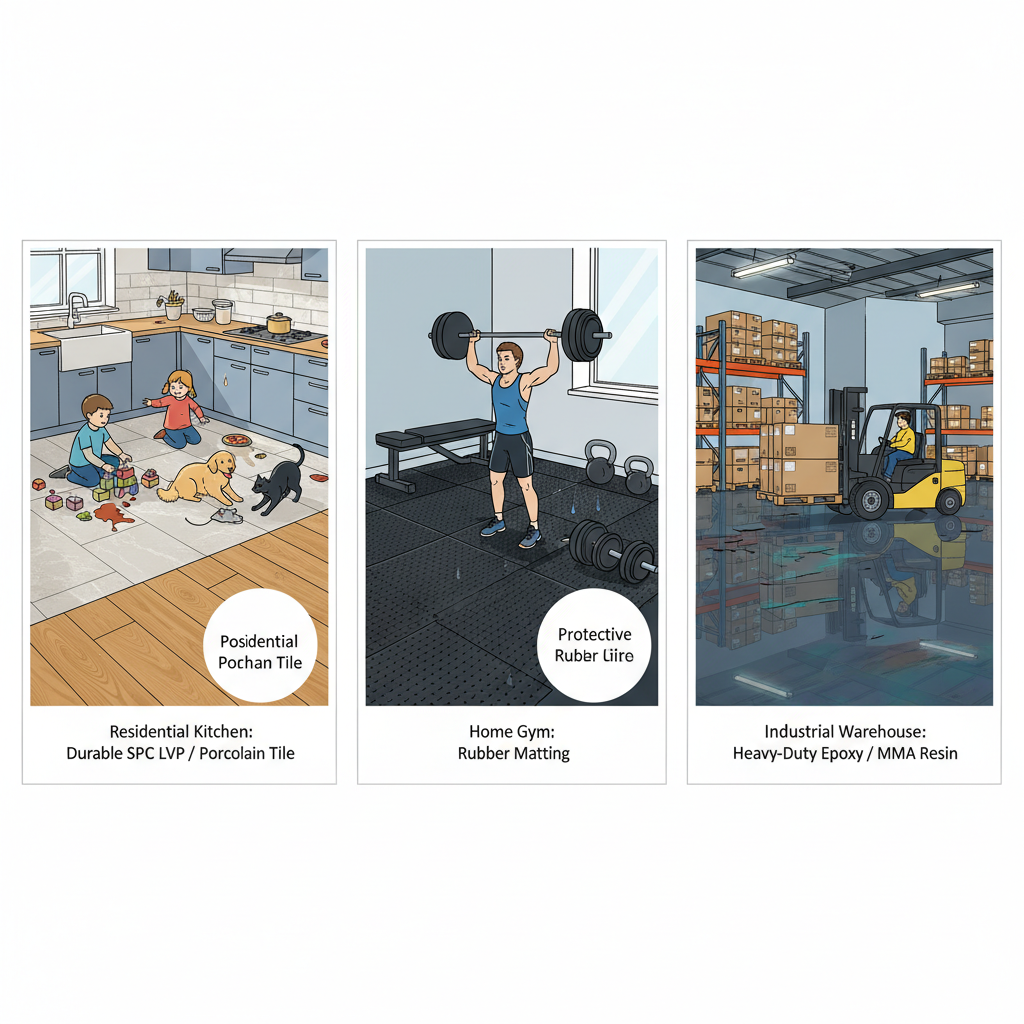
Because no single material is perfect for every environment, choosing the best flooring for impact protection requires segmenting your needs. The demands of a residential living room are vastly different from a commercial manufacturing floor.
Residential Heavy Traffic: Kitchens, Pets, and Kids
For residential heavy traffic—which typically involves large dogs, running children, and dropped kitchen utensils—the top dent proof flooring options are Porcelain tile and high-grade SPC LVP. If you choose SPC vinyl, ensure it features a 20+ mil wear layer. This specific thickness is required for optimal protection against the sharp impact of large dog claws and the heavy footfall of a busy household.
Home Gyms and Acoustic Impact Protection
Home gyms present a unique challenge: you need the best flooring for impact protection to prevent subfloor breakage from dropped free weights, but you also need acoustic impact protection to stop noise from transferring to the rooms below.
In this scenario, effectiveness is measured using technical acoustic metrics like IIC (Impact Insulation Class) ratings and ΔLw (Delta Lw). High-density vulcanized rubber matting, often layered over a rigid subfloor, provides the necessary shock absorption to protect the structural integrity of the room while significantly dampening the acoustic impact of heavy deadlifts.
Commercial & Industrial High-Impact Solutions
Commercial heavy traffic involves pallet jacks, forklift traffic, and chemical spills. For these B2B environments, high impact flooring solutions rely on seamless thermosetting resins.
The leading choices are Epoxy, Polyurethane, and MMA (Methyl Methacrylate). The deciding factor for facility managers is often installation downtime. MMA offers a remarkably rapid cure time, allowing facilities to return to full operation in hours, whereas traditional Epoxy requires a much longer curing process. Leading global manufacturers of high-impact seamless industrial floors, such as Stonhard, engineer these specific chemical compositions to withstand extreme thermal shock and heavy industrial loads [3].
The Hidden Foundation: Why Subfloors and Adhesives Dictate Durability
A major oversight in the quest for durable flooring for heavy traffic is ignoring what lies beneath. Even the most dent-proof porcelain or rigid SPC plank will fail prematurely if the subfloor is improperly prepared.
According to installation standards set by the World Floor Covering Association, a subfloor must be perfectly level and structurally sound [4]. If you install a rigid floating LVP floor over a subfloor with dips or voids, the planks will flex every time they are stepped on. Eventually, this flexing will snap the click-lock joints, destroying the floor regardless of its mil thickness.
Similarly, for high-traffic commercial tile, durability relies heavily on the installation materials. Using high-grade thermosetting resins, epoxy grout, and premium thin-set adhesives is absolutely critical. Cheap grout or improper adhesives will cause a heavy-traffic floor to crack and fail long before the tile itself gives out.
Triage and Repair: Fixing Scratched and Dented Floors
Even with the toughest materials, accidents happen. If you are dealing with scratched and dented floors, you need a precise, material-specific triage plan.
How to Fix Dropped Object Dents in Hardwood (The Steam Method)
If you have dropped object floor dents in natural hardwood, the most effective DIY repair is the steam method.
The Physics: Wood is made of cellulose fibers. When an object drops, it compresses these fibers without necessarily breaking them. By applying moisture and heat, you can force the compressed fibers to expand back to their original shape.
The Method: Place a damp (not soaking wet) cloth over the dent. Apply a hot iron to the cloth in short bursts of 5 to 10 seconds, checking the progress frequently.
The Warning: This method carries severe risks for modern polyurethane finishes. The steam can cause permanent clouding or blanching of the finish. Always test this method on an inconspicuous area first.
LVP Impact Damage: The Single Plank Replacement Guide
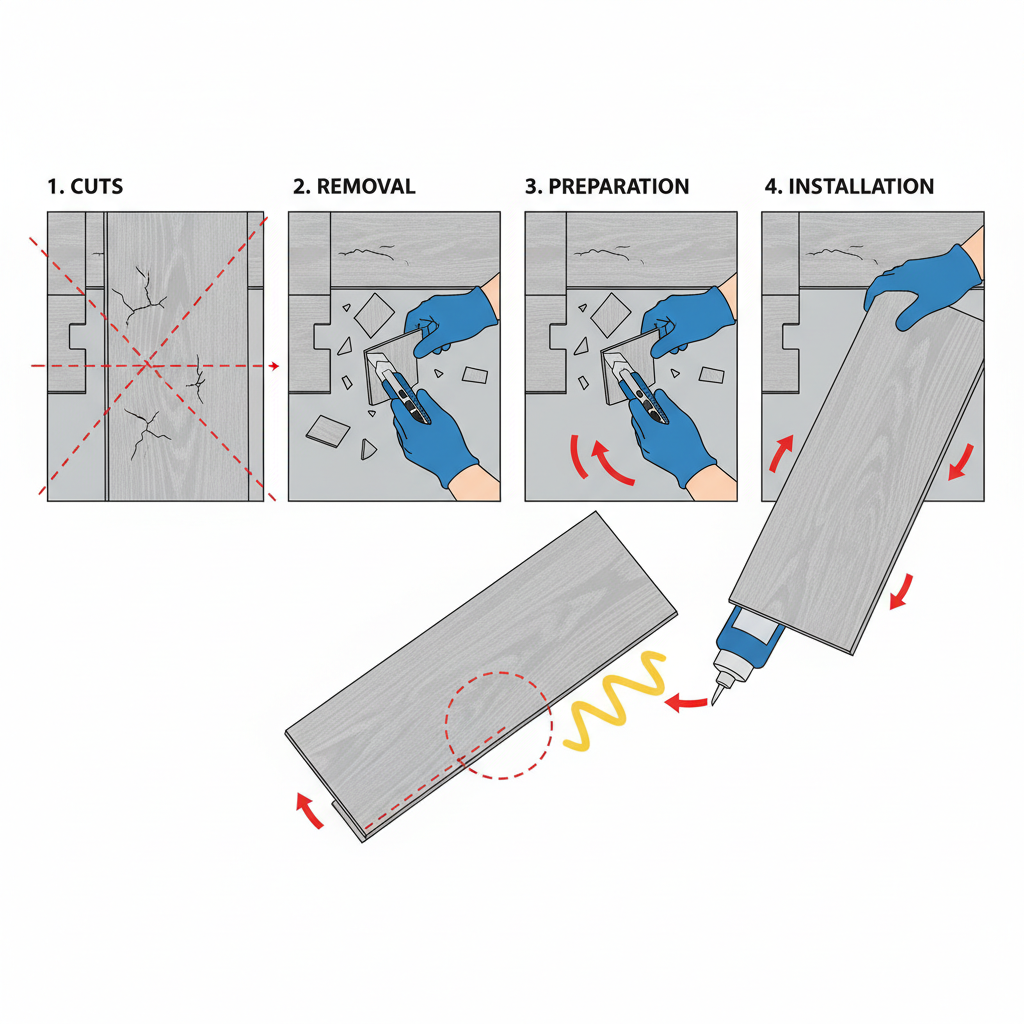
While LVP is tough, a sharp, heavy impact can cause deep gouges that penetrate the wear layer and expose the core. Because of its anatomy, you cannot simply fill LVP impact damage with putty; structural damage requires a single plank replacement.
The Technique:
- Use a utility knife to carefully cut down the center of the damaged plank, lengthwise.
- Make diagonal cuts from the center line to the four corners of the plank.
- Carefully pry out the cut pieces from the center outward, avoiding damage to the surrounding planks.
- Take your replacement plank and use a utility knife to shave off the bottom lip of the groove on both the short and long sides.
- Apply a high-quality flooring adhesive to the exposed subfloor.
- Slide the tongue of the new plank into the groove of the adjacent plank, and press the shaved edges down flat into the adhesive. Weight it down until the glue cures.
Laminate Repair: Utilizing Hard Wax Kits
If you have scratched and dented floors made of laminate, you must never use the steam method. Because laminate features an HDF core, introducing water or steam will cause the core to swell irreversibly, ruining the floor.
Instead, minor dents and deep scratches should be repaired using a color-matched hard wax floor repair kit. These kits use a heated melting tool to drip specific, color-matched wax putty into the dent. Once the wax cools and hardens, it is leveled off with a specialized scraper, sealing the breach and hiding the damage without introducing moisture.
Conclusion: Investing in True Durability
While the concept of “adamantine” floors belongs in the realm of mythology, modern material science offers incredibly resilient alternatives that can handle the toughest environments. When comparing adamantine flooring vs LVP comparison metrics, it is clear that high-mil SPC LVP and dense Porcelain tile are the true champions of dent proof flooring options for the home, while seamless resins like MMA dominate the industrial space.
Remember that true durability is a holistic system: it requires matching the right surface material to your specific environmental demands and ensuring a flawless, perfectly level subfloor installation. Assess your current subfloor and traffic needs before purchasing. If you’re dealing with severe impact damage, use our DIY triage guide or contact a certified flooring professional to ensure your next floor is truly built to last.
DIY Repair Disclaimer: The floor repair methods described, particularly the steam method for hardwood, carry a risk of damaging modern polyurethane finishes. Always test on an inconspicuous area first. Consult a professional for structural subfloor issues.
References
- Consumer Reports. (N.D.). Flooring Durability and Wear Testing. Retrieved from consumerreports.org
- Tile Council of North America. (N.D.). Porcelain Density and Water Absorption Standards. Retrieved from tcnatile.com
- Stonhard. (N.D.). High-Impact Seamless Industrial Flooring Solutions. Retrieved from stonhard.com
- World Floor Covering Association. (N.D.). Industry Installation and Subfloor Preparation Standards. Retrieved from wfca.org
