Few things induce buyer’s remorse quite like watching a newly installed, supposedly “highly durable” floor succumb to unsightly scratches and scuffs within months of installation. Homeowners and commercial facility managers alike are frequently frustrated by easily scratched floors, often feeling misled by aggressive marketing campaigns promising near-indestructible surfaces. The core problem lies in the confusion between industry marketing jargon and actual material science.
This comprehensive guide moves beyond the marketing hype to deliver a science-backed approach to bulletproofing your floors. We will demystify terms like “adamantine” flooring, clearly explain the critical chemical and physical differences between surface scuffs and deep abrasions, and provide expert-vetted solutions. Whether you are looking for holistic prevention strategies, safe repair methods, or the ultimate guide to selecting genuinely abrasion-proof floors, this roadmap will help you match the right material science to your high-impact lifestyle.
- Decoding ‘Adamantine Flooring’: Marketing Hype vs. Material Science
- The Anatomy of Floor Damage: Scuffs vs. Scratches vs. Abrasions
- The Best Abrasion-Proof and Scuff-Resistant Flooring Options
- How to Prevent Floor Scratches and Scuffs: A Holistic Protocol
- Repair vs. Replace: Fixing Flooring Abrasion Damage and Scuff Marks
- Conclusion
- References & Authoritative Sources
Decoding ‘Adamantine Flooring’: Marketing Hype vs. Material Science
When searching for the ultimate durable flooring, you may encounter the term “adamantine.” Often used to market industrial-grade or highly resilient commercial materials, the word itself implies a surface that is unbreakable or diamond-like. However, to make an informed investment, consumers must separate niche marketing claims from empirical mineral hardness.
What Does ‘Adamantine’ Actually Mean?
Linguistically, “adamantine” refers to something possessing the hardness or luster of a diamond. In the flooring industry, it is rarely a specific material category but rather a descriptive buzzword used by manufacturers to signal extreme durability. According to guidelines and material definitions from the Floor Covering Institute, true durability is measured not by marketing adjectives, but by standardized testing [1].
To understand what adamantine flooring actually means in a practical sense, we must look to the Mohs hardness scale, which characterizes the scratch resistance of various minerals through the ability of a harder material to scratch a softer material. As one material science engineer notes:
“When a flooring manufacturer claims an ‘adamantine’ finish, we look for the inclusion of materials like aluminum oxide or quartz in the wear layer, which rank a 9 and 7 on the Mohs scale, respectively.”
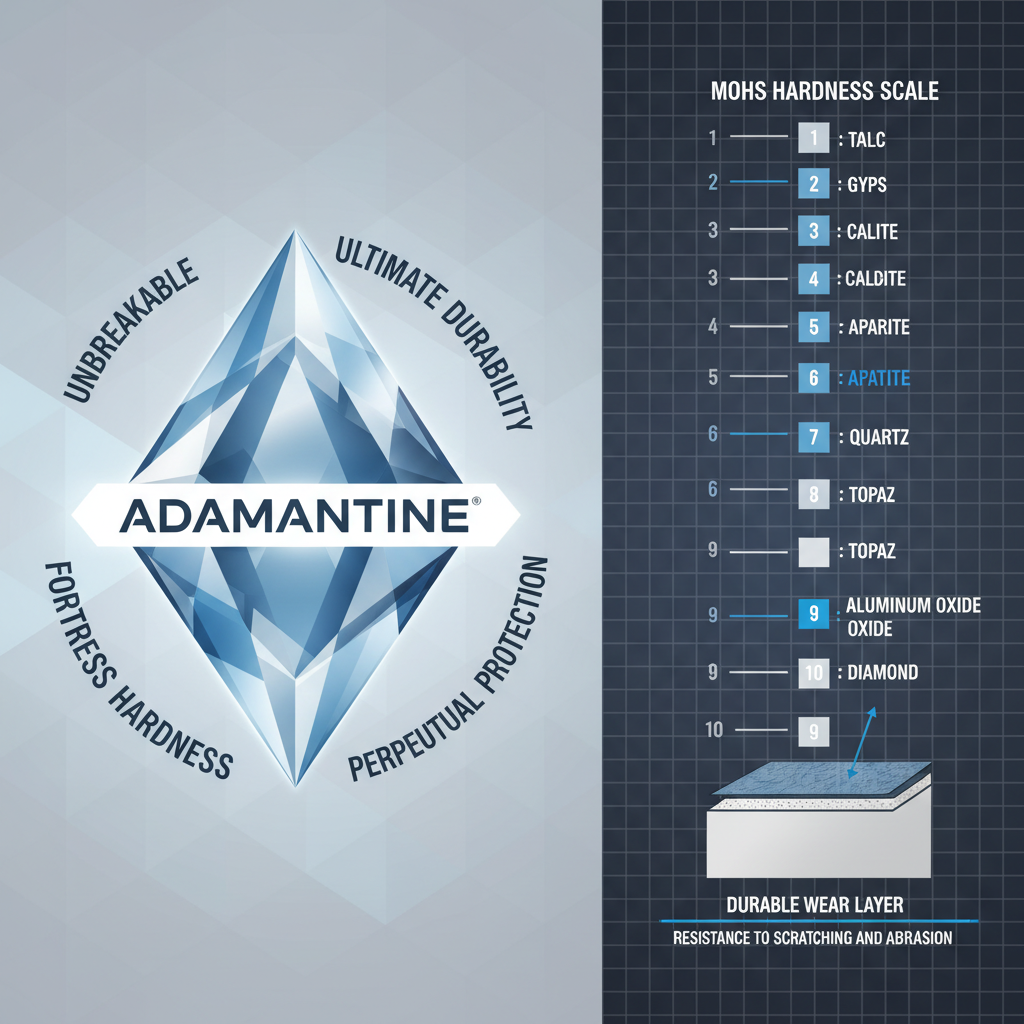
Peer-reviewed insights from the Journal of Materials Science confirm that incorporating these high-hardness minerals into synthetic wear layers is what provides extreme abrasion resistance, making these floors highly suitable for both heavy commercial use and active residential homes [2].
The Economics of Ultra-Durable Floors: Are They Worth It?
Investing in premium, ultra-durable flooring often comes with a higher upfront price tag, prompting the question: are the benefits of durable adamantine flooring worth the initial cost? To answer this, buyers must evaluate the investment through a 30-year Total Cost of Ownership (TCO) model.
While budget floors may need replacing every 7 to 10 years due to wear and tear, ultra-durable options drastically reduce long-term maintenance and replacement costs. Furthermore, high-quality flooring significantly impacts property value. The Appraisal Institute notes that premium, long-lasting flooring upgrades are among the most reliable ways to increase a home’s valuation and appeal to future buyers [3]. Additionally, the U.S. Green Building Council (USGBC) advocates for the use of sustainable, long-lasting building materials, as reducing the frequency of floor replacements drastically lowers a building’s overall environmental footprint [4]. For those planning renovations, utilizing a TCO calculator can clearly demonstrate how a higher initial investment in durable flooring pays dividends over decades.
The Anatomy of Floor Damage: Scuffs vs. Scratches vs. Abrasions
To properly protect or repair a floor, you must first accurately diagnose the damage. Many people use the terms “scuff,” “scratch,” and “abrasion” interchangeably, but they represent distinct physical and chemical events. Understanding these differences is the key to finding flooring that resists scuffs and abrasions effectively.
Surface Scuffs: The Chemistry of Rubber Transfer
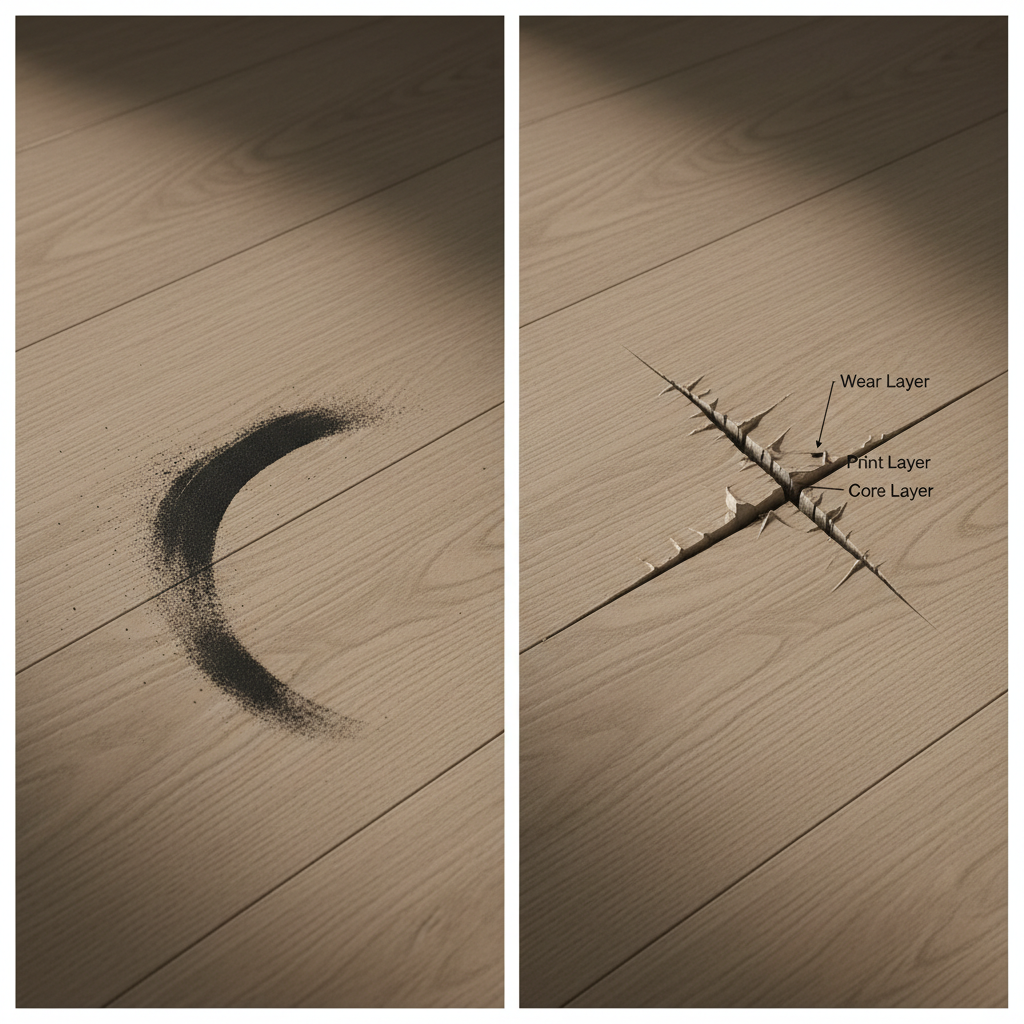
If you are battling floor scuff marks, you are usually dealing with a chemical transfer rather than physical damage to the floor itself. Scuffs occur due to friction. When a softer material—like the rubber sole of a sneaker or the hard plastic of a toy—drags across a harder floor surface, the friction generates heat. This causes a microscopic layer of the softer material to melt and transfer onto the floor’s wear layer.
The chemistry of modern wear layers, particularly those enhanced with aluminum oxide coatings, is designed to be incredibly hard and non-porous. Because the floor’s finish is harder than the shoe, the floor doesn’t break; instead, it “catches” the rubber. According to guidelines from the Resilient Floor Covering Institute (RFCI) on distinguishing wear types, a true scuff rests entirely on top of the finish and has not removed any of the floor’s protective coating [5].
Deep Abrasions: When the Wear Layer Fails
Unlike a scuff, flooring abrasion damage involves the physical gouging and permanent removal of the floor’s material. This happens when a material harder than the floor’s finish (like a sharp rock trapped under a shoe) is dragged across it with heavy pressure.
To determine a floor’s breaking point, the industry relies on the Taber Abrasion Test (ASTM D4060), a standard set by ASTM International [6]. In this test, a flooring sample is mounted on a rotating turntable while weighted abrasive wheels grind against it. The floor’s abrasion resistance is measured by how many cycles it takes to wear through the protective finish. Translating this industrial standard for residential consumers means looking for products with high Taber test cycle ratings, ensuring the wear layer won’t easily fail under the weight of heavy furniture or pet claws.
The Best Abrasion-Proof and Scuff-Resistant Flooring Options
Searching for the best abrasion proof flooring options requires moving past subjective opinions and relying on empirical data like PEI ratings, the Janka scale, and wear layer thickness. It is also vital to debunk the myth of the “100% scratch-proof” floor. No floor is entirely impervious to damage under extreme conditions, but the following materials offer maximum abrasion resistance. Independent flooring durability testing, such as those conducted by Consumer Reports, consistently highlights these categories for top-tier performance [7].
High-Fired Porcelain Tile: Mastering the PEI-5 Rating
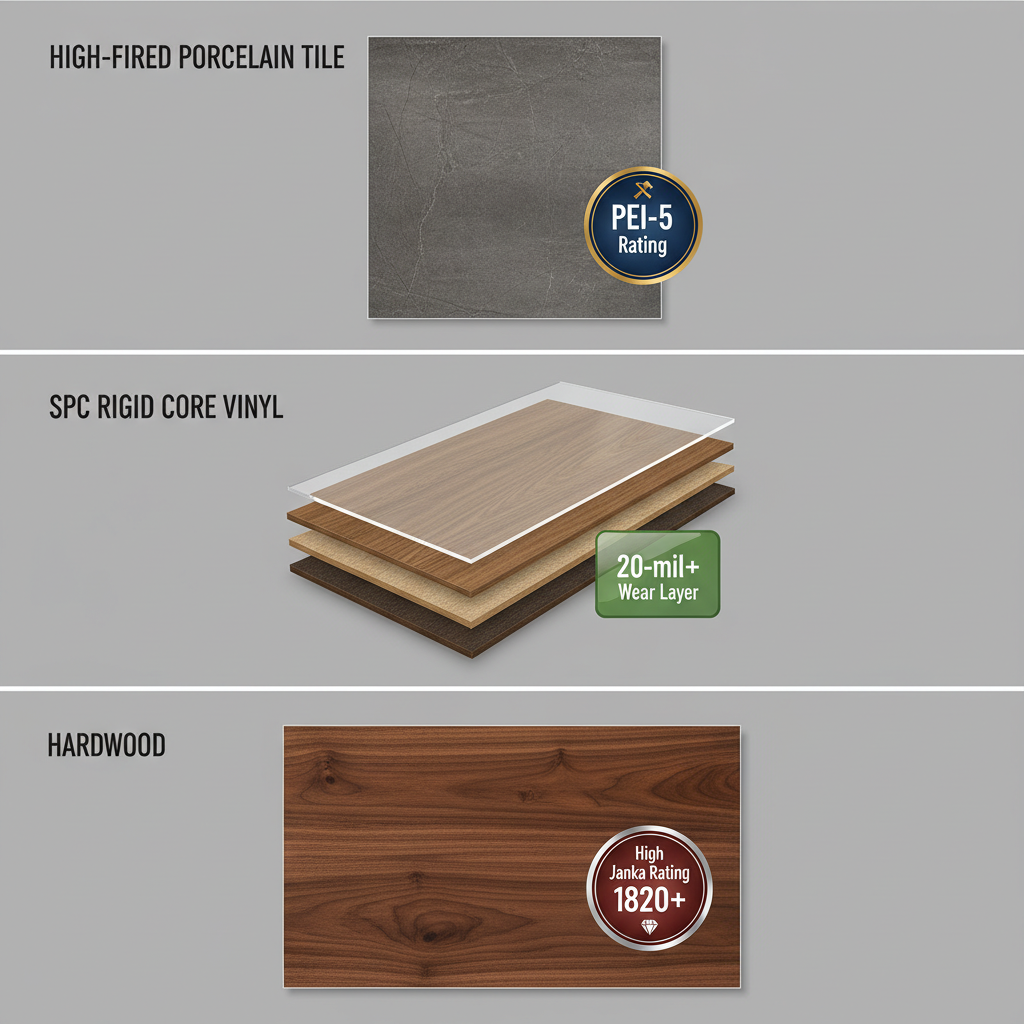
For those seeking near-adamantine solutions, high-fired porcelain tile is unmatched. Porcelain is manufactured from dense clay and fired at temperatures exceeding 2,000°F, creating a highly impervious, glass-like surface.
To gauge its durability, look to the Porcelain Enamel Institute (PEI) wear ratings [8]. A PEI-5 rating indicates the tile is suitable for heavy commercial abrasion, high foot traffic, and extreme moisture areas. The Tile Council of North America (TCNA) standards confirm that PEI-5 porcelain is one of the few truly abrasion proof floors available, making it a favorite among commercial facility managers and architects for high-stress environments [9].
SPC Rigid Core Vinyl: The Ultimate Dual-Threat Solution
If you need flooring that resists scuffs and abrasions while maintaining a warmer, wood-like aesthetic, Stone Plastic Composite (SPC) rigid core vinyl is the ultimate dual-threat solution. SPC features a core made of limestone powder and stabilizers, making it incredibly dense and dent-resistant.
The secret to its surface durability lies in its wear layer. For commercial-grade resistance in a residential setting, a 20-mil or higher wear layer is highly recommended. Furthermore, Floor Trends Magazine highlights that rigid core technology often utilizes factory-applied aluminum oxide finishes, which data shows can increase scuff resistance by up to 50% compared to standard polyurethane coatings [10].
Hardwood Realities: Understanding the Janka Hardness Scale
Homeowners with easily scratched floors are often dealing with softwoods. To understand hardwood durability, you must consult the Janka hardness scale, which measures the force required to embed a steel ball halfway into a plank of wood.
Data from the American Hardwood Information Center reveals that softwoods like Pine and Fir have Janka ratings below 1000, making them highly susceptible to scratches from dog nails and dropped objects [11]. In contrast, harder species like Hickory (1820) or Brazilian Walnut (3684) offer vastly superior dent and scratch resistance. The National Wood Flooring Association (NWFA) notes that while no wood is entirely scratch-proof, a properly maintained hardwood floor made from a high-Janka species can boast a lifespan of 100+ years, making it a highly durable flooring choice [12].
Commercial-Grade Epoxy and Polished Concrete
For industrial environments, garages, or ultra-modern lofts, commercial-grade epoxy and polished concrete represent the pinnacle of the best abrasion proof flooring options. The American Concrete Institute (ACI) and the Society for Protective Coatings (SSPC) provide stringent standards for these protective floor coatings, ensuring they can withstand forklift traffic and chemical spills [13, 14]. While their abrasion resistance is legendary, buyers must weigh the trade-offs: these floors offer poor acoustics, lack underfoot comfort, and can be cold, making them less ideal for cozy residential living spaces.
How to Prevent Floor Scratches and Scuffs: A Holistic Protocol
Even the most scuff resistant flooring requires proper care. To prevent floor scratches and protect your investment, you need a comprehensive approach that addresses the root causes of wear and tear.
The Floor Protection Protocol: Furniture, Footwear, and Pets
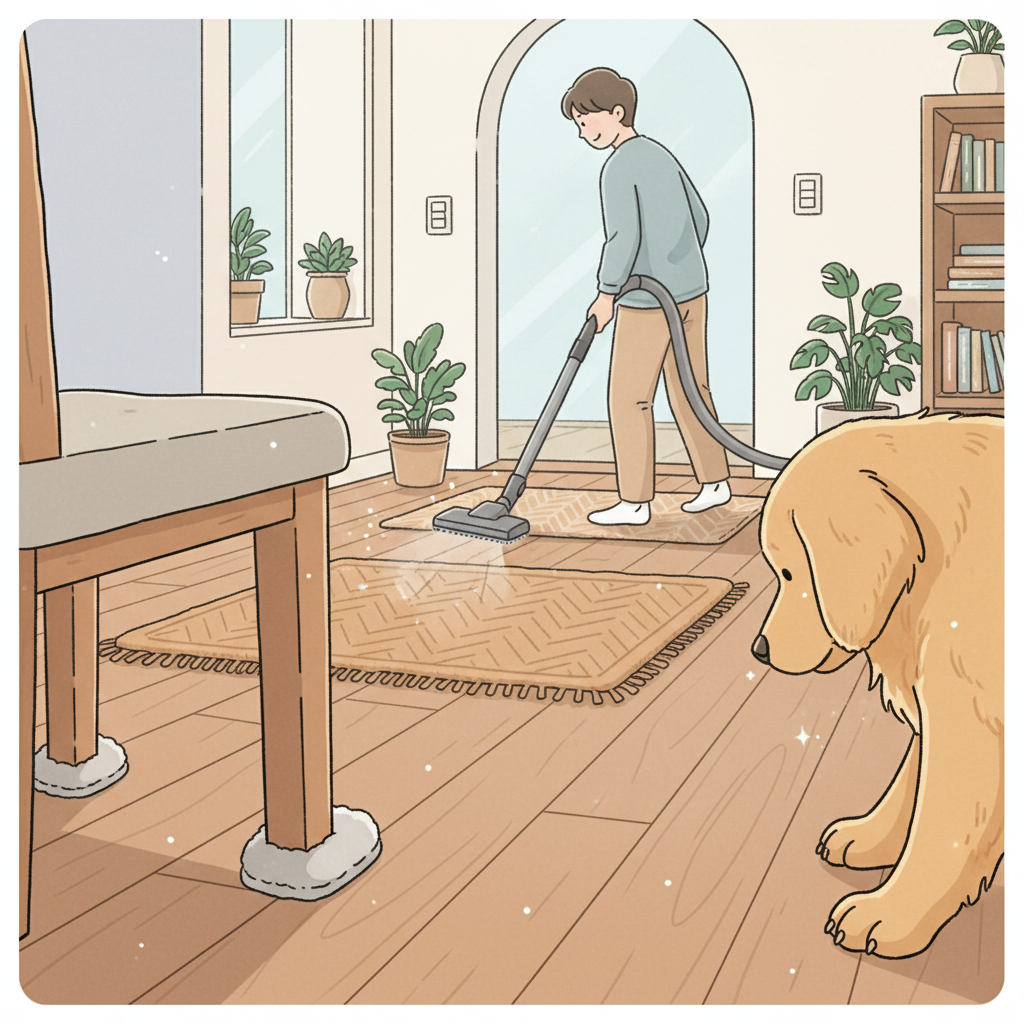
The World Floor Covering Association (WFCA) consumer guides emphasize that preventative maintenance is the most effective way to extend a floor’s life [15]. This begins with furniture. Replace hard plastic or metal furniture glides with high-quality, thick felt pads, and check them bi-annually for trapped dirt. For home offices, standard hard-plastic caster wheels on rolling chairs are notorious floor destroyers; upgrading to soft polyurethane, rollerblade-style caster wheels is a mandatory preventative step.
Pets are another major factor. Advice from Veterinary Partner and professional dog trainers highlights the importance of regular pet nail maintenance [16]. Trimming and grinding a dog’s nails every two to three weeks significantly reduces the clicking and subsequent scratching on hard surfaces. Finally, implementing a “no-shoes” policy indoors prevents the tracking of damaging debris. Creating a simple ‘Floor Protection Checklist’ for your household can ensure these habits stick.
Micro-Grit: The Invisible Sandpaper Destroying Your Floors
Perhaps the most insidious cause of easily scratched floors is micro-grit. Microscopic dirt, sand, and silica particles tracked in from outside act as invisible sandpaper. When trapped under rugs, shoes, or bare feet, this grit grinds into the floor’s finish with every step.
The Cleaning Management Institute (CMI) outlines best practices for hard floor care, stressing the importance of grit removal [17]. This involves placing high-quality, abrasive doormats at all exterior entrances to capture dirt before it enters the home, combined with frequent dry-dusting or vacuuming (using a hard-floor setting without a beater bar) to remove particulate abrasion from the surface.
Repair vs. Replace: Fixing Flooring Abrasion Damage and Scuff Marks
When damage does occur, knowing the threshold between a simple DIY fix and a total replacement will save you time and money. The Institute of Inspection, Cleaning and Restoration Certification (IICRC) provides excellent standards for hard surface floor cleaning and restoration, helping users build a clear “Repair vs. Replace” framework based on the depth of the gouge and the percentage of the floor affected [18].
Triage Guide: Safe DIY Scuff Removal
If you are looking to get floor scuff marks off safely, step away from harsh chemicals. Major flooring manufacturers, including Armstrong and Mohawk, explicitly warn in their official care guides against using abrasive chemicals, ammonia, or solvents like WD-40, as these will strip the factory finish, dull the floor, and void your warranty [19].
Instead, rely on the “tennis ball friction technique.” Testing methodology shows that taking a clean, standard tennis ball (often cut a small “X” into it and placed over the end of a broomstick for leverage) and rubbing it firmly over the scuff is effective on 80% of rubber transfer scuffs. The felt of the tennis ball creates just enough safe friction to heat and lift the rubber transfer without scratching the floor’s wear layer.
Aftermarket Solutions: Polyurethane Recoating and Wear Layer Restoration
For floors that have lost their luster and are becoming easily scuffed, aftermarket scuff resistant floor solutions can breathe new life into the material. Applying a high-quality, water-based polyurethane topcoat can extend the scuff-free life of a hardwood floor by 3 to 5 years.
However, chemical compatibility is paramount. According to Coatings World and the NWFA guidelines on sanding and finishing, you cannot simply paint a new finish over an old one without proper preparation [20]. Consulting with a flooring refinishing expert is highly recommended to ensure the new topcoat adheres correctly to the existing factory finish, preventing peeling and flaking.
When to Call a Certified Floor Inspector or Insurance
There is a distinct threshold where DIY repairs fail. If flooring abrasion damage is deep enough to expose the raw wood of a plank, or if the wear layer of a laminate floor is breached allowing water to seep into the structural core, replacement of the affected planks is necessary.
If the damage is extensive—perhaps caused by moving a heavy piano or a sudden appliance failure—it may be time to consult the National Institute of Certified Floor Covering Inspectors (NICFI) to assess the structural integrity of the floor [21]. Furthermore, the Insurance Information Institute (III) notes that while standard homeowners insurance rarely covers gradual wear and tear or easily scratched floors due to pets, they may cover sudden, accidental abrasion damage [22]. Documenting the damage and consulting your policy is the best course of action.
Conclusion
Ultimately, true durability does not come from chasing “adamantine” marketing buzzwords; it comes from matching the right material science to your specific lifestyle. By understanding empirical data like PEI ratings, the Janka hardness scale, and wear layer mil thickness, you can confidently select the best abrasion-proof and scuff-resistant flooring for your home or business. Remember that even the toughest materials require a holistic approach to care. Prevention, proper maintenance, and mitigating micro-grit are just as critical as the flooring material itself. We encourage you to utilize a Total Cost of Ownership (TCO) calculator and implement a strict Floor Protection Checklist to ensure your next flooring upgrade provides enduring beauty for decades to come.
*Disclaimer: Always consult your flooring manufacturer’s warranty and care guidelines before applying aftermarket topcoats, chemical cleaners, or attempting DIY repairs, as unauthorized methods may void your warranty.
References & Authoritative Sources
- Floor Covering Institute. (N.D.). Industry standards and material definitions.
- Journal of Materials Science. (N.D.). Peer-reviewed studies on abrasion resistance.
- Appraisal Institute. (N.D.). Insights on home valuation and improvements.
- U.S. Green Building Council (USGBC). (N.D.). Data on sustainable, long-lasting building materials.
- Resilient Floor Covering Institute (RFCI). (N.D.). Industry standards for vinyl and resilient flooring.
- ASTM International. (N.D.). Standards for testing abrasion resistance of organic coatings (ASTM D4060).
- Consumer Reports. (N.D.). Independent flooring durability testing.
- Porcelain Enamel Institute (PEI). (N.D.). Standardized wear ratings for tile.
- Tile Council of North America (TCNA). (N.D.). Standards for ceramic and porcelain tile.
- Floor Trends Magazine. (N.D.). Industry publications on flooring technology and rigid core.
- American Hardwood Information Center. (N.D.). Data on wood species characteristics and Janka hardness.
- National Wood Flooring Association (NWFA). (N.D.). Authoritative guidelines on wood durability, sanding, and finishing.
- American Concrete Institute (ACI). (N.D.). Standards for concrete durability.
- Society for Protective Coatings (SSPC). (N.D.). Guidelines on protective floor coatings.
- World Floor Covering Association (WFCA). (N.D.). Consumer guides on floor maintenance.
- Veterinary Partner. (N.D.). Insights on pet nail care and its impact on home environments.
- Cleaning Management Institute (CMI). (N.D.). Best practices for hard floor care.
- Institute of Inspection, Cleaning and Restoration Certification (IICRC). (N.D.). Standards for hard surface floor cleaning.
- Armstrong Flooring & Mohawk Industries. (N.D.). Official flooring care and maintenance guides.
- Coatings World. (N.D.). Industry news and research on paints and coatings.
- National Institute of Certified Floor Covering Inspectors (NICFI). (N.D.). Expertise on assessing floor damage.
- Insurance Information Institute (III). (N.D.). Guidelines on what homeowners insurance typically covers.
