Have you ever moved a rug after years in the same spot, only to find a glaringly bright, unfaded rectangle on your floor? It’s a frustrating moment that reveals the silent damage the sun inflicts on our homes. That beautiful flooring, once a significant investment and a source of pride, has been slowly bleached by the very sunlight that makes a room feel so inviting. You’re not alone in this struggle, and the fear of making another costly mistake on a new floor is real.
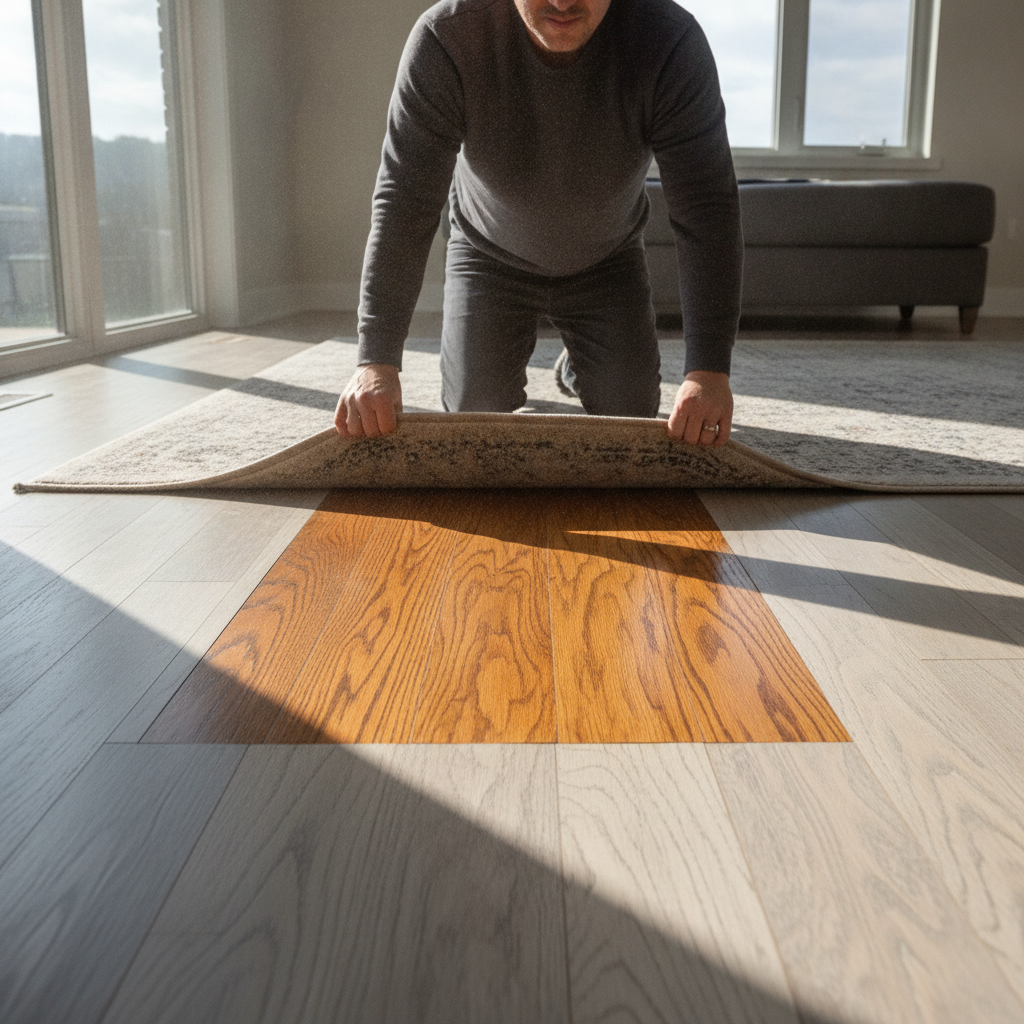
This isn’t just another list of “good flooring.” This is your definitive, science-backed guide to understanding, choosing, and protecting your floors from the sun. We go beyond vague marketing claims to decode the technology behind UV resistance, provide a clear ‘Best to Worst’ ranking of materials based on objective data, and deliver a complete action plan. By the end of this article, you will understand the science of sun damage, know which materials will stand the test of time in your sunniest rooms, and have the tools to protect your investment for years to come.
- Why Do Floors Fade? The Science of Sun Damage Explained
- The Ultimate Buyer’s Guide: Flooring Ranked by Fade Resistance (Best to Worst)
- Decoding the Technology: What Makes a Floor UV-Resistant?
- The Complete Protection Playbook: How to Prevent Floor Fading
- Restoration Guide: Can Sun-Damaged Flooring Be Repaired?
- FAQ: Your Top Questions About Sun-Resistant Flooring Answered
- Conclusion: Invest in a Floor That Lasts
- References & Authoritative Sources
Why Do Floors Fade? The Science of Sun Damage Explained
To defeat the enemy, you must first understand it. The fading, yellowing, or darkening of your floors isn’t just a random occurrence; it’s a chemical reaction caused by sunlight. By understanding the science behind this process, you can make smarter decisions about choosing and protecting your flooring.
Understanding UV Radiation and Photodegradation
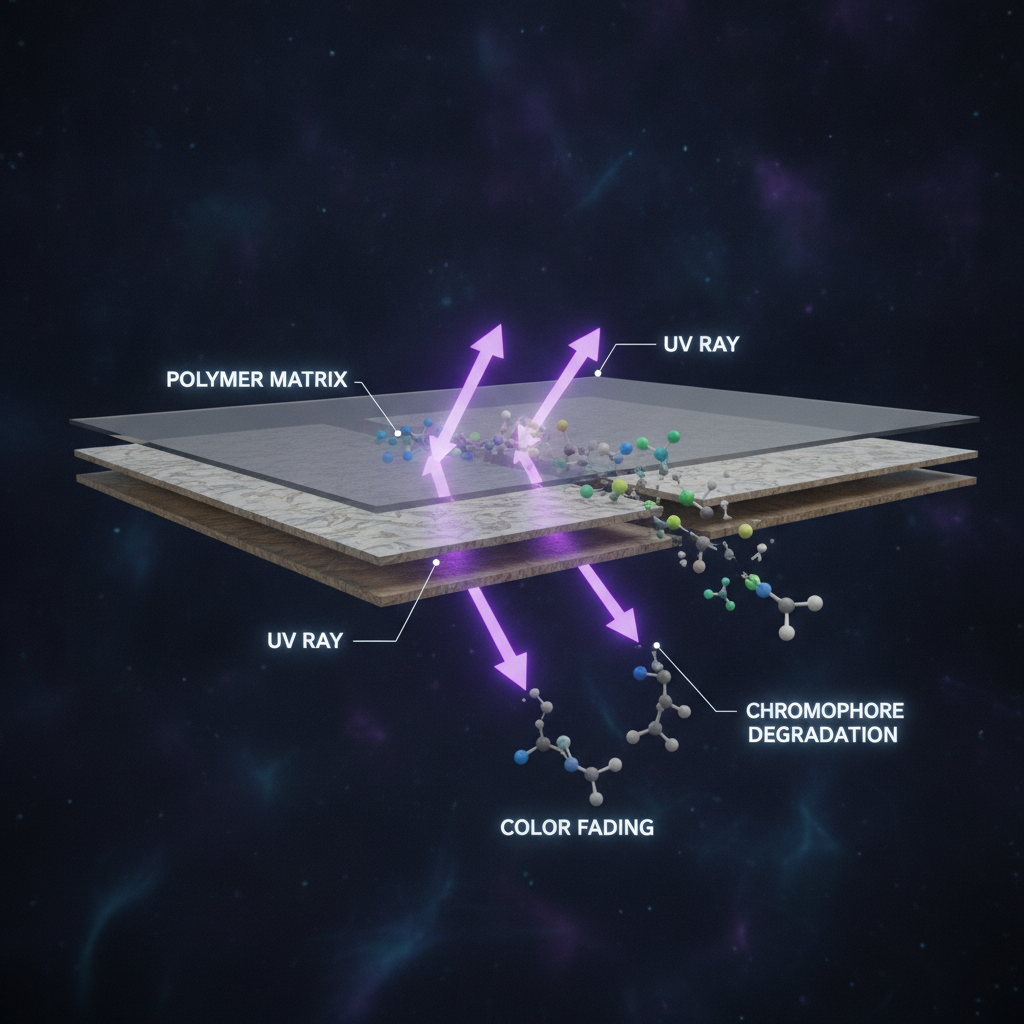
The culprit behind sun-damaged flooring is ultraviolet (UV) radiation, an invisible component of sunlight. This high-energy light acts like a microscopic wrecking ball, breaking down the chemical bonds in the materials and dyes that give your floor its color. This process is called photodegradation.
Essentially, the molecules responsible for color (called chromophores) absorb the energy from UV rays. This energy causes them to become unstable and break apart, leading to a loss of color that we perceive as fading or bleaching. Different materials react in different ways. For example, the U.S. Forest Service’s Forest Products Laboratory explains that in wood, UV light primarily degrades lignin, a natural polymer in wood cells. This breakdown is what causes many wood species to yellow or bleach over time.[1] In carpets or vinyl, the UV rays attack the synthetic dyes and polymers themselves, causing them to fade.
Visual Guide: How Sun Damage Appears on Different Floors
Sun damage isn’t a one-size-fits-all problem. It manifests differently depending on the material, making it crucial to identify the specific issue you’re facing. Here’s a visual dictionary of common symptoms, a resource often missing in other guides. According to flooring inspectors certified by organizations like the Institute of Inspection Cleaning and Restoration Certification (IICRC), accurately identifying the type of discoloration is the first step toward finding a solution.[2]
| Symptom | Common Cause | Affected Materials | Potential Solution |
|---|---|---|---|
| Fading/Bleaching | Photodegradation of dyes and pigments. | Hardwood (especially Oak), Carpet, Cork, Laminate. | Prevention is key. Repair may involve refinishing (wood) or replacement. |
| Yellowing | Lignin breakdown in wood; chemical changes in older vinyl or oil-based finishes. | Hardwood (especially Maple), older Vinyl Flooring, floors with oil-based polyurethane finishes. | Refinishing wood with a modern water-based, UV-inhibiting finish. Yellowed vinyl is often irreversible. |
| Darkening | A natural photo-chemical reaction in certain exotic woods. | Exotic Hardwoods like Cherry, Brazilian Cherry, and Mahogany. | This is a natural aging process. It can be evened out by exposing the entire floor to light. |
The Ultimate Buyer’s Guide: Flooring Ranked by Fade Resistance (Best to Worst)
When choosing a new floor for a sun-drenched room, you need clear, unbiased information. We’ve created a definitive ranking based on material science and industry standards, moving from the most resilient to the most vulnerable. This framework will help you select the best flooring for rooms with lots of sun and avoid costly mistakes.
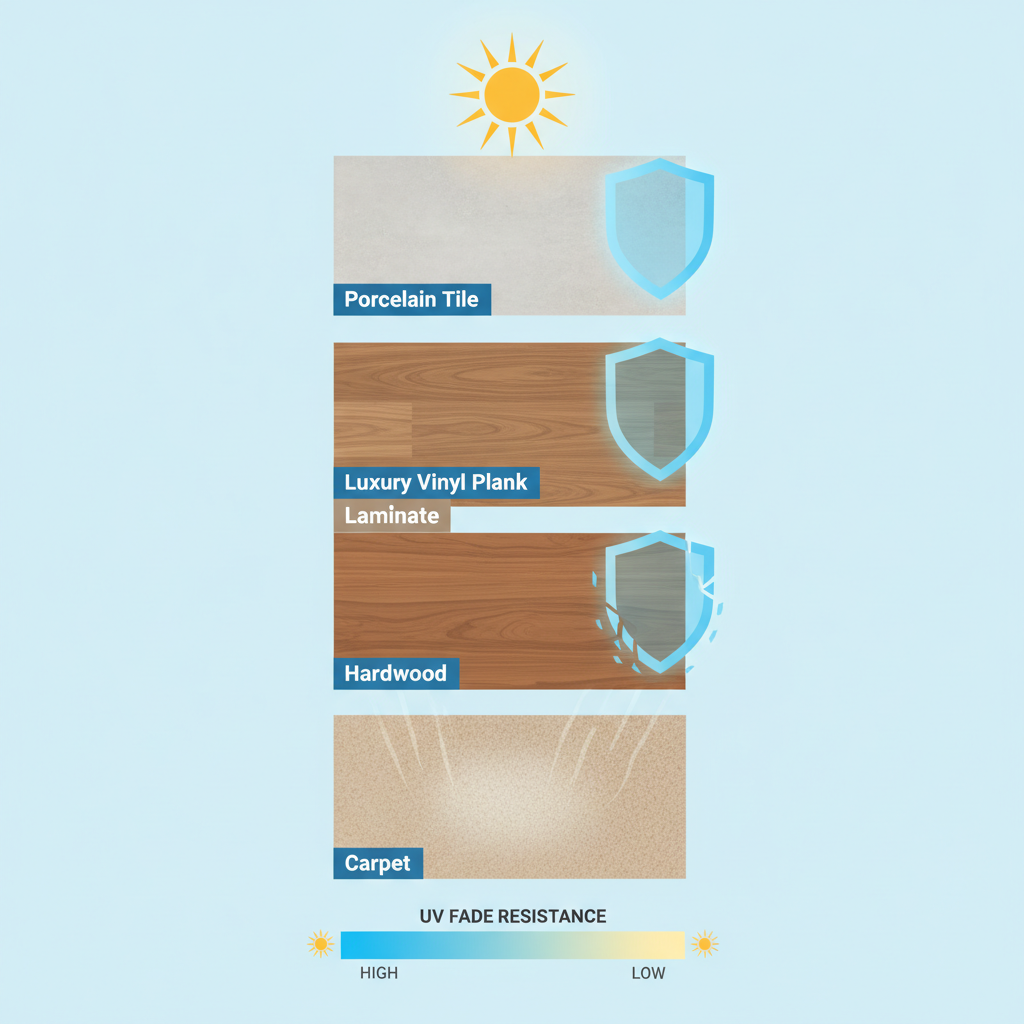
Tier S (Virtually Sun-Proof): Porcelain & Ceramic Tile
Fade Resistance: 10/10 | Durability: 10/10 | Cost: 6/10 | Maintenance: 9/10
Hands down, porcelain and ceramic tile are the champions of fade resistance. The reason is simple: their color is not a surface-level dye but an integral part of the material itself. During manufacturing, pigments are mixed into the clay or applied as a glaze that is fired at extreme temperatures. This process, as outlined by industry authorities like the Tile Council of North America (TCNA), creates a permanent, UV-impermeable barrier.[3] The color is baked in, making it virtually impossible for sunlight to alter. This makes tile the number one choice for sunrooms, entryways, and any space with large windows.
Tier A (Excellent Resistance): Luxury Vinyl Plank (LVP/LVT)
Fade Resistance: 9/10 | Durability: 9/10 | Cost: 7/10 | Maintenance: 10/10
Modern Luxury Vinyl Plank (LVP) and Luxury Vinyl Tile (LVT) are engineered specifically to combat sun damage. Their remarkable fade resistance comes from a high-tech, transparent wear layer applied over the printed design layer. This topcoat is typically a UV-cured urethane finish that acts like a powerful sunscreen, blocking harmful rays from reaching the pigments below. According to the Resilient Floor Covering Institute (RFCI), this protective technology is a key performance feature of quality vinyl flooring.[4] Many top-tier LVP products also infuse this wear layer with ceramic bead or aluminum oxide for enhanced scratch resistance, making it an incredibly durable and color-stable flooring option.
Tier B (Good Resistance): Modern Laminate Flooring
Fade Resistance: 7/10 | Durability: 8/10 | Cost: 8/10 | Maintenance: 9/10
Laminate flooring has come a long way in fade resistance. Like LVP, its durability depends on a robust top wear layer protecting a high-resolution photographic image of wood or stone. High-quality modern laminates offer good protection against fading, but their performance is directly tied to the quality of the wear layer and the stability of the inks used. Cheaper products may use lower-quality components that are more susceptible to fading over the long term. When considering laminate, it is crucial to check the manufacturer’s warranty for specific clauses related to fade resistance, as this is often a key indicator of product quality.
Tier C (Vulnerable): Hardwood (Solid & Engineered)
Fade Resistance: 5/10 | Durability: 7/10 | Cost: 4/10 | Maintenance: 6/10
There is no such thing as a fade-proof hardwood floor. As the National Wood Flooring Association (NWFA) advises, all wood is photosensitive and will change color over time with exposure to light.[5] This is a natural process. The key is understanding how different species react.
- Species that Lighten: Oak, Ash, Maple, Hickory
- Species that Darken: American Cherry, Brazilian Cherry (Jatoba), Mahogany, Walnut
Modern polyurethane finishes contain UV inhibitors that can significantly slow this process, but they cannot stop it entirely. While the character change can be beautiful, it’s a critical factor to consider if you expect your floor’s color to remain static.
Tier D (Highly Vulnerable): Carpet, Cork, and Natural Fibers
Fade Resistance: 3/10 | Durability: 5/10 | Cost: 9/10 | Maintenance: 5/10
Carpet and other natural fibers like cork, sisal, and jute are the most susceptible to sun fading. The dyes used to color these fibers are often the first thing to break down under persistent UV assault. According to color science authorities like the American Association of Textile Chemists and Colorists (AATCC), the stability of these dyes varies widely.[6] One exception is solution-dyed carpet fiber (common in commercial applications), where the pigment is added to the fiber’s polymer liquid before it’s formed. This makes the color integral to the fiber and far more resistant to fading than traditional post-production dyeing. For most residential carpets and natural floors, however, direct sunlight is a significant threat.
Decoding the Technology: What Makes a Floor UV-Resistant?
Understanding the marketing terms is key to becoming a savvy shopper. “UV-resistant” isn’t just a buzzword; it refers to specific technologies engineered to protect your investment. By learning to decode these features, you can distinguish between true performance and empty promises.
The Critical Role of the Wear Layer: Urethane, Aluminum Oxide, and UV Inhibitors
For resilient floors like LVP and laminate, the magic happens in the transparent top layer, known as the wear layer. This isn’t just a simple sheet of plastic; it’s a sophisticated coating designed for extreme durability.
- Urethane: This forms the base of the wear layer, providing a tough, flexible, and clear surface that resists scuffs and stains.
- UV Inhibitors: These are chemical compounds mixed into the urethane that act like sunscreen for your floor. They absorb or reflect harmful UV radiation before it can penetrate to the printed design layer and degrade the pigments.
- Aluminum Oxide: Often added to high-quality urethane finishes, this is a microscopic mineral additive that dramatically increases the wear layer’s resistance to scratches and abrasion, indirectly helping to keep the UV-protective layer intact and effective.
How to Be a Savvy Shopper: Reading Technical Specs for Lightfastness
To truly verify a floor’s fade resistance, you need to look at its technical data sheet. Manufacturers test their products using standardized methods to determine how well they hold up to light. One of the most common standards is the Blue Wool Scale test, often guided by protocols from the International Organization for Standardization (ISO) or ASTM International.[7], [8]
This test exposes the flooring sample and a set of eight standardized blue wool strips to a powerful, controlled light source. The flooring is then given a rating from 1 (very poor) to 8 (excellent) based on which wool strip faded at the same rate. When shopping, look for a lightfastness rating of 6 or higher on the Blue Wool Scale for rooms with significant sun exposure. This information, while sometimes hard to find, is the ultimate proof of a color-stable flooring product.
The Complete Protection Playbook: How to Prevent Floor Fading
Whether you’re installing a new floor or preserving an existing one, a multi-layered defense strategy is the most effective way to combat sun damage.
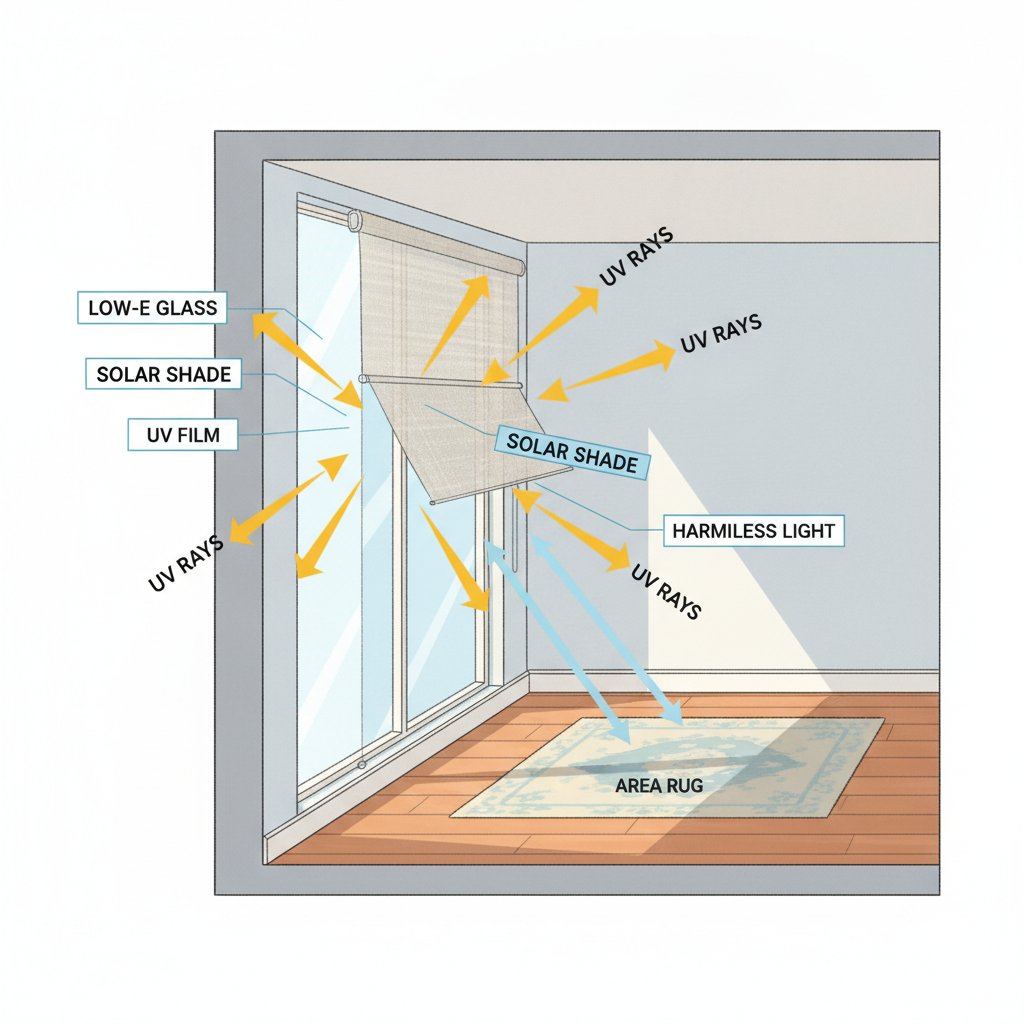
Layer 1: High-Tech Window Solutions (Films & Low-E Glass)
The most effective solution is to stop UV radiation before it even enters the room. Modern window technology offers powerful tools to do just that.
- UV-Blocking Window Films: These transparent films can be professionally applied to existing windows and are incredibly effective. According to the International Window Film Association (IWFA), high-quality films can block up to 99% of UV radiation without significantly darkening your room.[9]
- Low-E (Low-Emissivity) Glass: If you’re replacing windows, opting for Low-E glass is a wise investment. These windows have an invisible metallic coating that reflects UV and infrared light while allowing visible light to pass through. The U.S. Department of Energy highlights these windows as a key component of an energy-efficient home.[10] You can check a window’s performance by looking for its NFRC label, which provides data on UV transmittance.
Layer 2: Everyday Protection with Window Treatments
Your choice of window coverings plays a huge role in protecting your floors. Here’s a quick comparison:
| Treatment Type | UV Protection Level | Pros | Cons |
|---|---|---|---|
| Sheer Curtains | Low | Diffuses light, preserves view | Blocks minimal UV |
| Lined Drapes | High-Excellent | Excellent protection when closed | Blocks light and view |
| Solar Shades | Medium-High | Blocks UV while preserving view | Can feel commercial |
| Cellular Shades | High-Excellent | Excellent insulation and UV blocking | Obscures view when down |
| Blinds/Shutters | Medium-High | Adjustable light control | UV can leak between slats |
A window treatment specialist can help you choose the best option that balances light, privacy, and protection for your specific needs.
Layer 3: Smart Interior Design Strategies
Don’t underestimate the power of simple, strategic design choices. As recommended by interior designers from organizations like the American Society of Interior Designers (ASID), smart layout planning can make a big difference.[11]
- Use Area Rugs: Place large area rugs in the sunniest parts of a room. They not only define the space but also act as a sacrificial layer, taking the brunt of the sun’s rays.
- Rotate, Rotate, Rotate: At least once or twice a year, rotate your rugs and rearrange your furniture. This simple habit ensures that any light-induced color change happens evenly across the entire floor, making it far less noticeable than a stark, faded patch.
Restoration Guide: Can Sun-Damaged Flooring Be Repaired?
If your floors are already showing signs of sun damage, don’t despair. In many cases, especially with hardwood, repair is possible. The key is to correctly assess the damage and choose the right approach.
Assessing the Damage: When to DIY vs. When to Call a Pro
First, determine the severity of the problem. Is it minor cosmetic fading, or is it deeper? If you have hardwood floors, is the discoloration just in the top finish, or has the wood itself changed color? For vinyl or laminate, has the material become brittle or cracked in addition to fading?
Generally, minor, even fading can often be lived with and managed through the strategic placement of rugs and furniture. However, for significant discoloration, deep scratches, or any signs of structural damage like cracking or warping, it’s time to call a certified professional. Also, it’s wise to check your flooring warranty. While many exclude environmental factors, some high-end products offer limited fade resistance coverage. Always read the fine print.
Repair Options for Hardwood: Screening vs. Full Refinishing
For sun-damaged hardwood, you have two primary professional restoration options. Expert refinishers, such as those certified by Bona, can recommend the best course of action.[12]
- Screen and Recoat: This is a less invasive and more affordable option suitable for floors with only light fading or surface-level scratches confined to the top polyurethane layer. The process involves lightly abrading (screening) the existing finish and applying a fresh coat of polyurethane. This can restore the sheen and add a new layer of UV protection.
- Full Sand and Refinish: This is the solution for deeper discoloration where the wood itself has changed color. The entire finish and a very thin layer of wood are sanded off, removing the damaged surface. You can then re-stain the floor (even choosing a new color) and apply multiple coats of a modern, durable, UV-resistant finish. While more expensive, this process can make your floors look brand new.
FAQ: Your Top Questions About Sun-Resistant Flooring Answered
What is the absolute best flooring for a sunroom or a room with walls of windows?
Porcelain or ceramic tile is the undisputed champion for its near-total immunity to UV degradation. For a warmer or softer feel, high-quality Luxury Vinyl Plank (LVP) with a robust UV-cured urethane wear layer is the best non-tile alternative. Home builders in sunny climates, as noted by the National Association of Home Builders (NAHB), frequently rely on these two materials for long-term durability.[13]
Will dark-colored floors fade faster than light-colored floors?
Not necessarily faster, but the fading is often far more noticeable on dark or vibrantly colored floors. The chemical process of fading happens at the same rate, but the visual contrast between a faded area and the original deep color is much starker. The material’s inherent UV resistance is a more important factor than its color.
Is sun damage covered by flooring warranties?
It varies significantly by manufacturer and product line. Most standard warranties cover manufacturing defects but explicitly exclude damage from environmental factors, including fading from sunlight. However, premium flooring lines often include specific fade-resistance warranties. Always read the warranty document carefully before you buy to understand what is and isn’t covered.
What was Adamantine Flooring?
Adamantine Flooring was a durable, water-resistant flooring popular in the late 19th and early 20th centuries. Citing historical records from sources like the U.S. Patent and Trademark Office, it was made from a mixture of linseed oil, cork dust, and other materials pressed onto a canvas backing—a precursor to modern linoleum.[14] It is no longer manufactured, but its legacy of durability lives on in modern resilient products like LVP and true linoleum (such as the brand Marmoleum).
Conclusion: Invest in a Floor That Lasts
Choosing a floor for a sun-filled room is about more than just aesthetics; it’s about making a smart, lasting investment. By understanding the science of sun damage, you can move past the marketing hype and focus on what truly matters: the material’s inherent resistance and the technology protecting it.
Remember the key takeaways: Porcelain tile and high-quality LVP are the top-tier choices for battling the sun. For any floor, a multi-layered protection strategy—combining modern window technology, smart window treatments, and strategic interior design—is the most effective way to preserve its color and vibrancy. With this knowledge, you are now empowered to confidently choose a beautiful floor that you’ll love not just on day one, but for many sunny years to come.
References & Authoritative Sources
- Forest Products Laboratory (U.S. Forest Service). (n.d.). Research and information on wood products and their reaction to environmental factors like UV light.
- Institute of Inspection Cleaning and Restoration Certification (IICRC). (n.d.). Standards for flooring inspection, damage assessment, and restoration.
- Tile Council of North America (TCNA). (n.d.). Authoritative standards and information on ceramic tile durability and performance.
- Resilient Floor Covering Institute (RFCI). (n.d.). Industry association providing information on the performance of resilient flooring, including LVP/LVT.
- National Wood Flooring Association (NWFA). (n.d.). Guidelines and educational resources on hardwood flooring properties, including photosensitivity.
- American Association of Textile Chemists and Colorists (AATCC). (n.d.). Authority on color science, dye stability, and testing methods for textiles.
- ASTM International. (n.d.). Organization that develops and publishes voluntary consensus technical standards for a wide range of materials, including lightfastness testing.
- International Organization for Standardization (ISO). (n.d.). Develops and publishes international standards, including ISO 105-B02 for color fastness to light (Blue Wool Scale).
- International Window Film Association (IWFA). (n.d.). Trade association providing data and consumer information on the efficacy of window films.
- U.S. Department of Energy. (n.d.). Authoritative resource on energy-efficient building technologies, including Low-E windows and solar radiation.
- American Society of Interior Designers (ASID). (n.d.). Professional association for interior designers, providing expertise in material selection and space planning.
- Bona. (n.d.). Leading manufacturer of floor finishing products and authority on hardwood floor restoration best practices.
- National Association of Home Builders (NAHB). (n.d.). Trade association representing home builders and providing expertise on durable construction materials.
- U.S. Patent and Trademark Office. (n.d.). Historical archives containing patents and information on historical products like Adamantine flooring.
