For decades, the home improvement industry has heavily marketed “waterproof” flooring, leading homeowners to believe that a simple layer of luxury vinyl or porcelain tile is enough to safeguard their homes from moisture. This is the “Waterproof Myth.” The harsh reality is that while the surface planks themselves may not swell or warp when exposed to water, they do absolutely nothing to protect the vulnerable structural layers beneath them. When everyday spills, perimeter leaks, or plumbing failures occur, water inevitably finds its way through expansion gaps and unsealed edges, bypassing the surface and settling directly into the subfloor. The result? Hidden rot, structural degradation, and toxic mold growth that can cost thousands of dollars to remediate.
Moving beyond surface promises requires a paradigm shift in how we approach flooring installations. To achieve true peace of mind, homeowners and dedicated DIYers must engineer a holistic waterproof ecosystem. This definitive guide provides a comprehensive roadmap to lifetime protection against spills and leaks by combining the surface supremacy of Adamantine flooring’s nanotechnology with impenetrable structural subfloor armor, such as Magnesium Oxide (MGO) panels and advanced engineered OSB.
- The ‘Waterproof’ Myth: Why Surface Flooring Fails Without Subfloor Protection
- Adamantine Flooring: The Science of Surface Supremacy
- Fortifying the Foundation: Best Waterproof Subfloor Protection Methods
- Proactive Mitigation: Managing Everyday Floor Spills and Appliance Leaks
- Conclusion: Investing in a Lifetime Waterproof Ecosystem
- References & Authoritative Sources
The ‘Waterproof’ Myth: Why Surface Flooring Fails Without Subfloor Protection
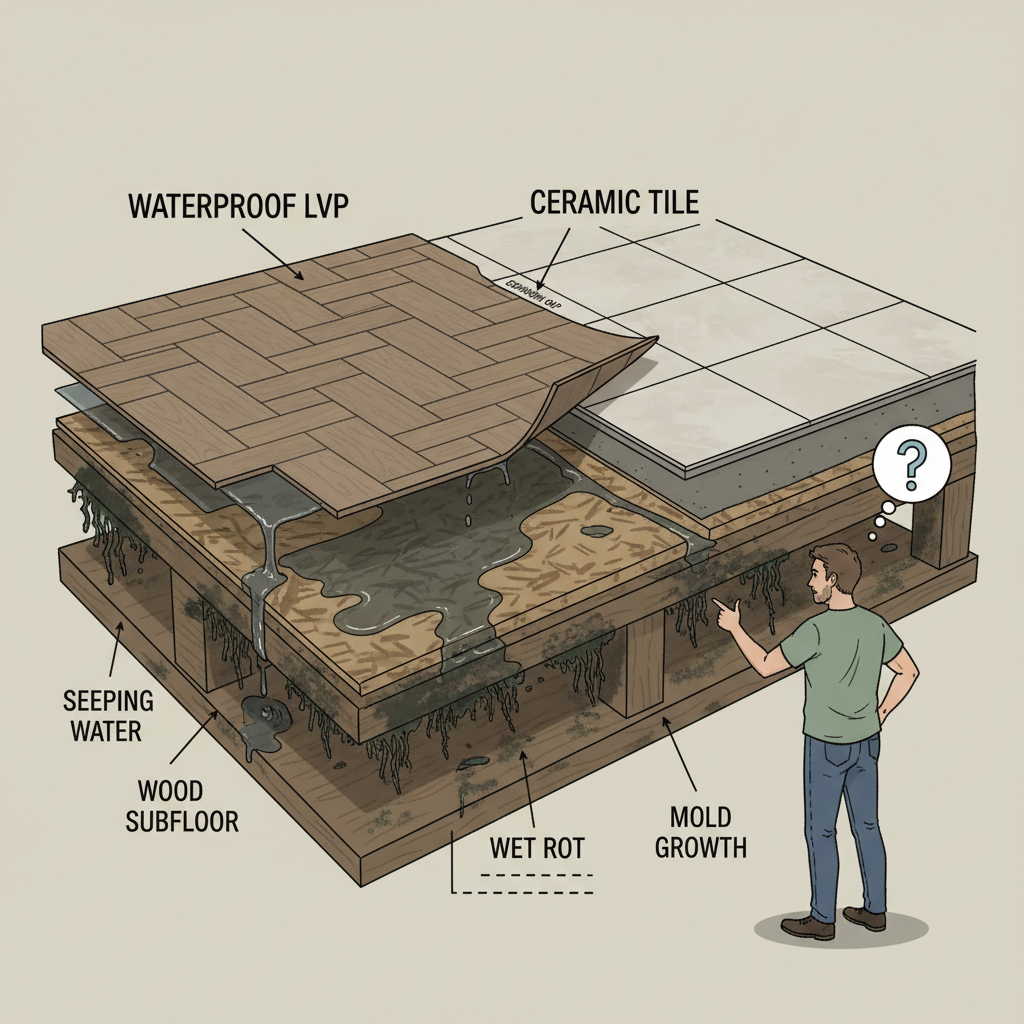
The most common misconception in modern renovations is that installing waterproof flooring solutions—like Luxury Vinyl Plank (LVP) or ceramic tile—creates a watertight seal across the entire room. In reality, floating floors and even grouted tiles have vulnerabilities at their perimeters, seams, and transitions. When a dishwasher leaks or a heavy spill occurs, water travels via capillary action through these microscopic expansion gaps, becoming trapped between the impermeable surface floor and the porous wood subfloor.
Once moisture is trapped in this dark, unventilated space, the clock starts ticking. According to indoor air quality and restoration experts at BioSweepSE, “Mold from trapped moisture on floors can start forming in as little as 24 to 48 hours” [1]. This trapped moisture quickly leads to severe subfloor water damage, compromising the structural integrity of the home.
Understanding the severity of leaking floor damage also requires categorizing the water source. Restoration standards outlined by Rainbow Restoration classify water damage into three categories: Category 1 (clean water, like a spilled glass), Category 2 (gray water, like washing machine overflow), and Category 3 (black water, containing raw sewage or heavy pathogens) [2]. While a clean water leak might allow for the subfloor to be salvaged if dried immediately, contaminated water often mandates complete subfloor replacement due to health hazards.
Furthermore, moisture doesn’t always come from above. Understanding the physics of moisture migration is critical, especially for homes built on concrete slabs. Plumbing experts at Jim’s Plumbing note that slab leaks—where pipes embedded in the foundation rupture—force hydrostatic pressure upward [3]. This moisture travels up through the concrete, completely bypassing the surface flooring and rotting the subfloor from the bottom up.
Identifying Hidden Subfloor Water Damage Before It Spreads
Because the surface floor often masks the destruction below, homeowners must learn how to diagnose hidden rot early. The key is differentiating between surface damage and structural failure. Surface damage typically manifests as cupping (edges of planks raised) or crowning (center of planks raised). However, structural subfloor water damage presents as soft, spongy spots when walked upon, persistent squeaks, or a visible sinking of the floor level.
If you suspect moisture intrusion, visual inspection is not enough. Professional restoration specialists at RW Supply + Design emphasize the necessity of using specialized moisture meters to accurately diagnose subfloor viability [4]. Pin-type moisture meters can penetrate the subfloor to give an exact moisture content percentage, while pinless meters can scan larger areas for hidden pockets of water.
A major gap in homeowner knowledge is knowing when a subfloor can be dried in place versus when it must be torn out. The objective criteria come down to structural adhesion. If the subfloor (such as plywood or OSB) has swelled but remains structurally sound with no delamination (layers peeling apart) and the fasteners (screws/nails) are still holding tight, rapid industrial drying can save it. However, if the moisture has caused the glues in the OSB to break down, resulting in delamination, crumbling, or fastener failure, the subfloor has lost its load-bearing capacity and must be replaced.
Adamantine Flooring: The Science of Surface Supremacy
To build a truly waterproof ecosystem, your first line of defense must be flawless. Enter Adamantine flooring. Representing a massive breakthrough in hybrid hardwood technology, Adamantine flooring merges the authentic, natural aesthetics of real wood with industrial-grade durability. But what is Adamantine flooring, and is it truly waterproof?
Unlike traditional engineered hardwoods that rely on topical sealants, Adamantine utilizes proprietary nanotechnology. According to the Adamantine Official Technical Specs, the finish is engineered using aluminum oxide nanoparticles [5]. These microscopic particles are small enough to penetrate deeply into the wood’s cellular structure rather than just sitting on the surface. Through a rigorous multi-layer penetration and UV-curing process, these nanoparticles cross-link with the wood fibers, creating an impenetrable, waterproof bond that achieves gemstone-level hardness.
This advanced chemical and physical engineering yields staggering performance metrics. Adamantine flooring provides 3x greater scratch resistance than traditional polyurethane finishes and offers an incredible 25+ year durability lifespan, compared to the mere 7-10 years expected from standard finishes [5].
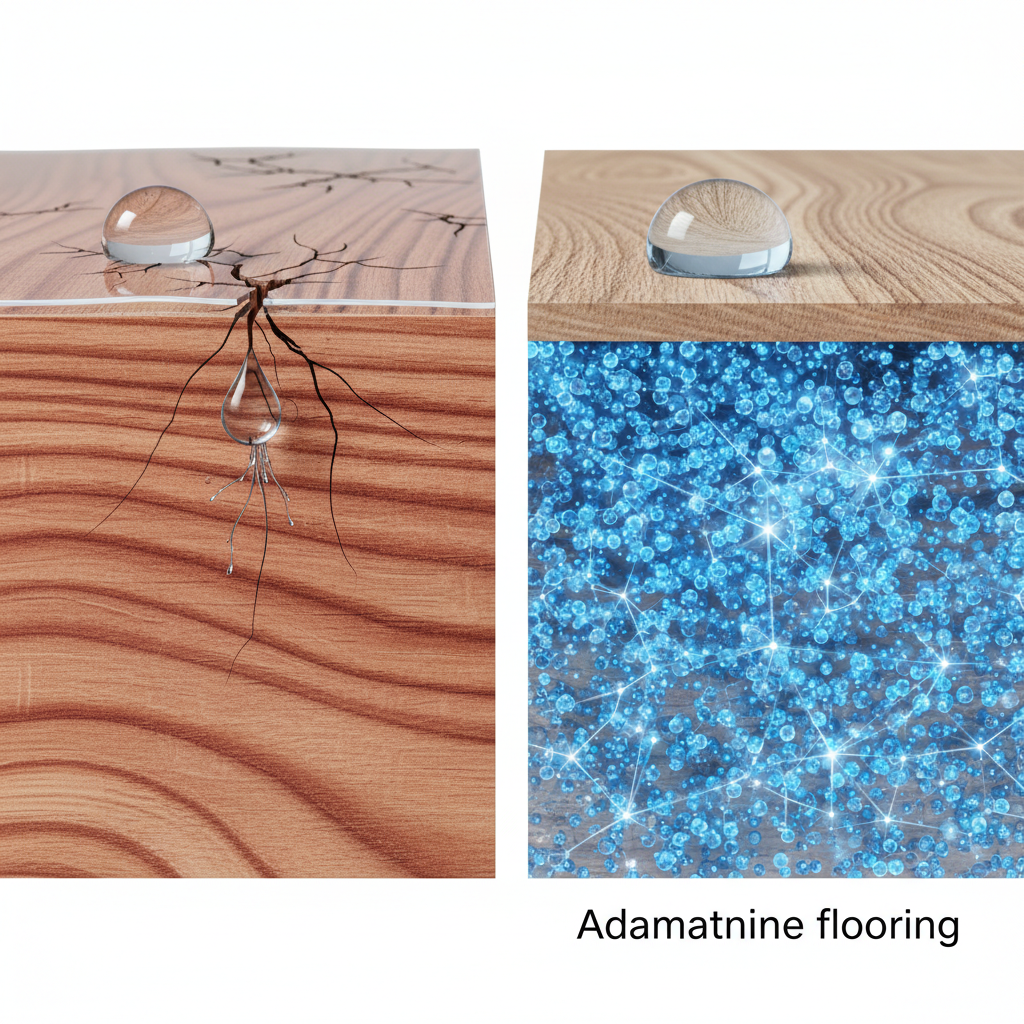
Adamantine vs. Traditional Polyurethane Finishes
When evaluating Adamantine flooring spill and leak protection, it is vital to understand how it physically differs from standard aluminum oxide or polyurethane coatings. Traditional polyurethane is a topical finish; it creates a plastic-like film over the top of the wood. While it offers temporary water resistance, any deep scratch or dent can pierce this film, allowing moisture to seep into the unprotected raw wood beneath, causing swelling and finish peeling.
The Adamantine Technical Support Center explains that their penetrating nanoparticle finish works entirely differently [6]. Because the aluminum oxide nanoparticles bond internally with multiple layers of the wood veneer during the UV-curing process, the protection is structural, not just superficial. Even if the absolute top layer is subjected to heavy impact, the layers beneath remain fully sealed and waterproof. This means Adamantine protects the core from liquid intrusion, making it a genuinely safe and superior choice for full bathrooms, kitchens, and high-traffic commercial spaces.
Fortifying the Foundation: Best Waterproof Subfloor Protection Methods
While Adamantine flooring provides ultimate surface protection, the ecosystem is only as strong as its foundation. Subfloor protection requires a tiered, multi-layered approach tailored to the specific moisture risks of the room. The best waterproof subfloor protection methods shift the focus from merely trying to waterproof existing, vulnerable wood to installing inherently moisture-resistant substrates and engineered drainage systems.
When designing a waterproof subfloor, structural engineers emphasize the importance of balancing load-bearing requirements with moisture dynamics. It is also crucial to differentiate between moisture control layers: a vapor retarder slows moisture transmission, a vapor barrier completely stops it, and a full waterproofing membrane prevents bulk liquid water from passing through.
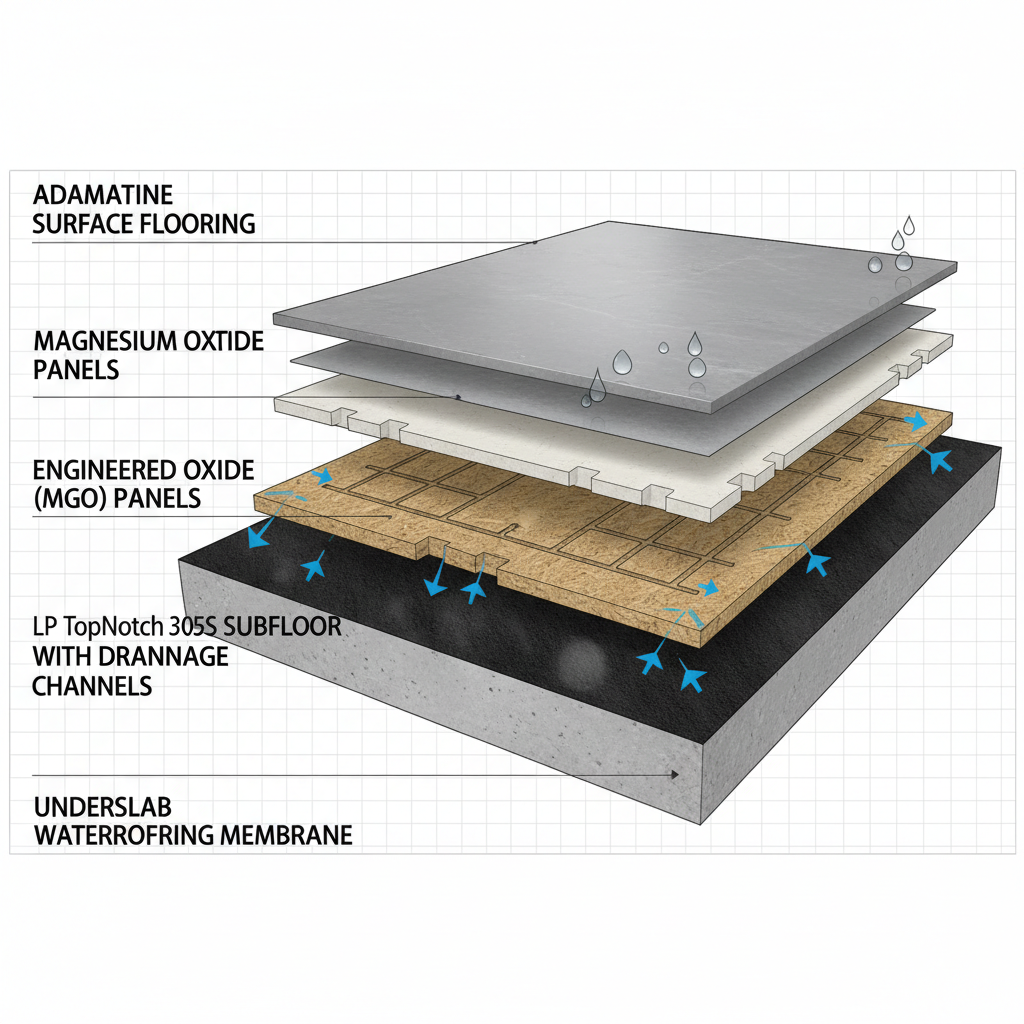
Advanced Moisture-Resistant Substrates: MGO Panels and Cement Board
For areas highly prone to advanced subfloor protection from spills—such as laundry rooms, bathrooms, and kitchens—standard OSB or plywood is a liability. Upgrading to advanced moisture-resistant substrates like cement board or Magnesium Oxide (MGO) panels is the ultimate preventative measure.
MGO panels are revolutionizing subfloor construction. According to MagMatrix Boards, a leading authority on MGO technology, the chemical makeup of Magnesium Oxide creates a board that is fundamentally impervious to water degradation, mold, and mildew [7]. Unlike wood-based products that rely on glues that break down when wet, MGO maintains its structural integrity and load-bearing capacity even if completely submerged.
While upgrading from standard OSB to MGO panels involves a higher upfront material cost (often 20-30% more per square foot), the cost-benefit analysis heavily favors MGO for wet rooms. The initial investment is negligible compared to the $5,000 to $10,000+ cost of tearing out ruined surface flooring, mitigating mold, and replacing a rotted OSB subfloor after a single appliance leak.
Engineered Drainage: How LP TopNotch 350 and DryBarrier Work
For basements and flood-prone ground floors, active moisture management is required. This is where engineered drainage subfloors excel.
For wood-framed construction, LP Building Solutions has engineered LP TopNotch 350, a specialized moisture-resistant OSB. Its defining feature is its proprietary RainChannel technology—a self-draining notch system cut into the panel edges that actively channels bulk water away from the seams during construction and in the event of severe interior leaks. This engineering is so robust that LP offers a 200-day “no-sand” warranty, guaranteeing the panels will not swell at the edges even under prolonged moisture exposure [8].
For concrete basement floors, modular synthetic subfloors like DryBarrier are the gold standard. DryBarrier utilizes low-profile thermoplastic elastomer tiles that snap together over the concrete. The genius of this system is its physical structure: it provides a 1/4 inch air gap between the concrete and the finished floor [9]. This air gap promotes continuous airflow, allowing any concrete moisture vapor to evaporate harmlessly while simultaneously providing a thermal break that makes the floor noticeably warmer underfoot.
Underslab Membranes and Concrete Moisture Management
Concrete is highly porous and acts like a sponge, constantly wicking moisture from the earth into your home. Therefore, the best waterproof subfloor protection methods for concrete must address negative-side versus positive-side waterproofing. Negative-side waterproofing (applying sealants to the top of the basement floor) is often prone to failure due to hydrostatic pressure pushing up. Positive-side waterproofing—stopping the water before it enters the concrete—is the structural ideal.
This is achieved using heavy-duty underslab membranes. Polyguard, an authority on underslab waterproofing, highlights the necessity of using tough 85-mil pre-concrete pour roll-on barriers [10]. These thick, puncture-resistant membranes are laid down before the concrete foundation is even poured, completely severing the capillary draw of moisture from the soil.
For existing concrete subfloors where underslab membranes weren’t installed, professional moisture assessment is mandatory before laying any flooring. General contractors and moisture specialists at Heide Contracting strictly advise following protocols for in-situ relative humidity (RH) testing [11]. This involves drilling small holes into the concrete and inserting probes to measure the internal moisture of the slab, ensuring it meets the strict dryness tolerances required before installing vapor barriers and surface flooring.
Proactive Mitigation: Managing Everyday Floor Spills and Appliance Leaks
Even with a fully engineered waterproof ecosystem, proactive mitigation is essential. Preventing minor, everyday floor spills from escalating into major subfloor water damage requires homeowners to adapt commercial spill response principles for residential use.
Organizations like the NY DEC and Safety Matters Weekly outline strict industrial spill protocols focusing on rapid containment and immediate source control [12][13]. Translated to the home, this means stopping the leak at its origin before attempting to dry the floor. Homeowners should invest in smart leak detectors placed under dishwashers, refrigerators, and washing machines. When paired with automatic shutoff valves, these devices can instantly cut the water supply the moment a leak is detected, providing ultimate spill and leak protection.
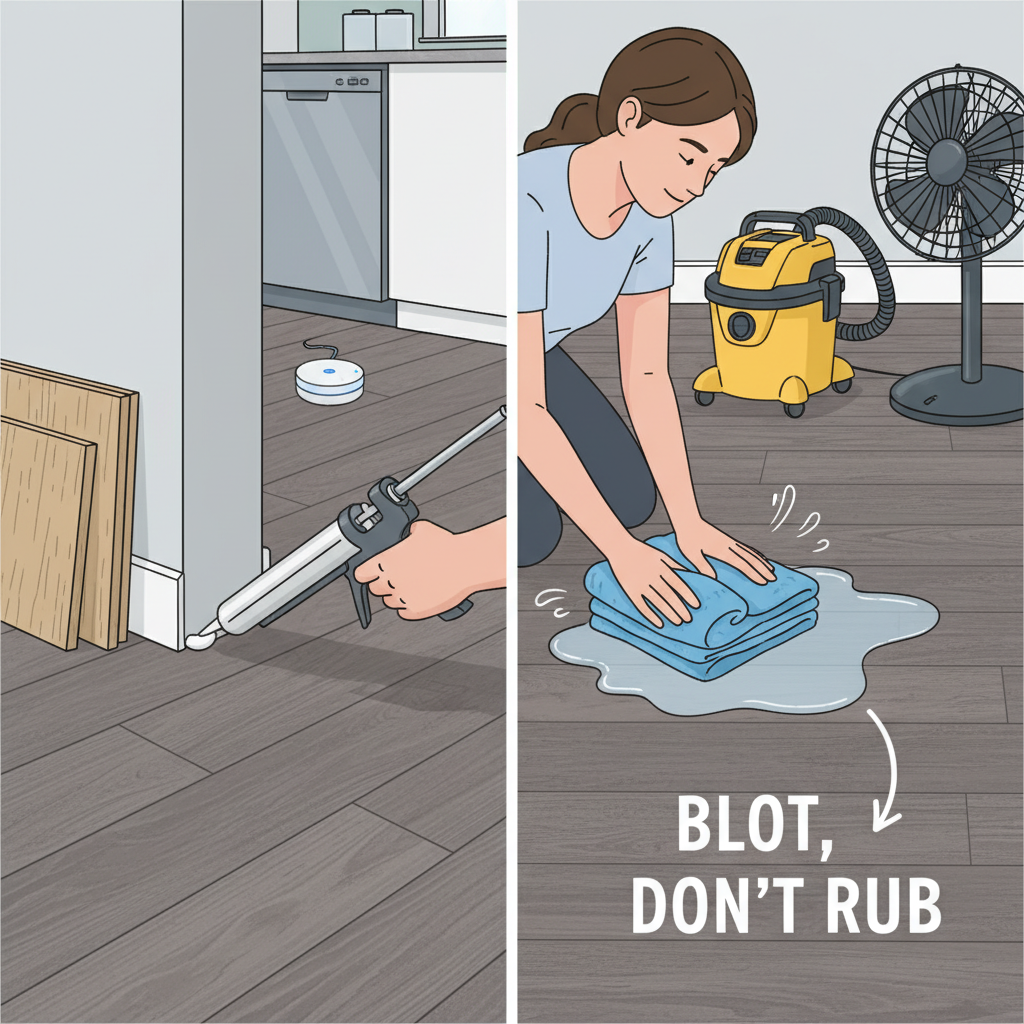
The ‘Blot, Don’t Rub’ Protocol and Rapid Moisture Extraction
When everyday floor spills occur, time is of the essence. Professional water mitigation experts at Roto-Rooter and commercial cleaning authorities at M Conley emphasize a strict rapid-response protocol: source control, moisture extraction, and air drying [14][15].
First, never wipe or rub a large spill, as this forces the liquid outward and down into the seams of the flooring. Instead, utilize the “Blot, Don’t Rub” technique using highly absorbent microfiber towels to pull the moisture straight up. For larger volumes of water, utilize a wet/dry vacuum for rapid moisture extraction. Once the standing water is removed, set up oscillating fans to promote aggressive air drying across the surface and along the baseboards. Furthermore, always use pH-neutral cleaners when dealing with sticky spills to ensure you do not chemically strip or dull your Adamantine or waterproof finishes during cleanup.
Perimeter Sealing: Protecting the Vulnerable Edges
The most significant vulnerability in any flooring installation—and the primary way to prevent subfloor water damage—is the perimeter. Water easily travels to the subfloor through the required expansion gaps left around the edges of floating floors.
To bridge this gap, structural repair and home improvement experts at Networx advocate for stringent perimeter sealing best practices [16]. In wet rooms (kitchens, bathrooms, laundry rooms), the expansion gap between the flooring and the wall should be filled with a 100% silicone sealant before the baseboards are installed. Additionally, applying a bead of silicone under the bottom edge of the baseboard creates a watertight gasket. This ensures that if a catastrophic appliance leak occurs, the water is contained on top of the Adamantine flooring like a swimming pool, rather than draining down the walls and into the subfloor.
Conclusion: Investing in a Lifetime Waterproof Ecosystem
The era of relying solely on “waterproof” surface planks to protect your home is over. True peace of mind comes from understanding that a floor is a system, and every layer must be engineered to resist moisture. By combining the unrivaled surface supremacy and nanoparticle technology of Adamantine flooring with robust, advanced subfloor protection like MGO panels, DryBarrier systems, or LP TopNotch 350, you create an impenetrable fortress against water.
While engineering a 100% waterproof ecosystem requires a higher initial investment of time and premium materials, the long-term ROI is undeniable. You are not just buying a floor; you are buying permanent insurance against the devastating costs of hidden subfloor rot, structural failure, and mold remediation. Evaluate your current subfloor before your next flooring installation. Consult with a certified flooring professional to choose the right combination of Adamantine flooring and advanced subfloor protection for your home’s specific moisture profile.
Disclaimer: Information is for educational purposes. Always consult a certified structural engineer or professional flooring installer before undertaking major subfloor modifications or addressing severe water damage.
References & Authoritative Sources
- BioSweepSE. (N.D.). Water Damage Restoration and Mold Prevention Standards. Retrieved from biosweepse.com
- Rainbow Restoration. (N.D.). Categorization of Water Damage and Mitigation Protocols. Retrieved from rainbowrestores.com
- Jim’s Plumbing. (N.D.). Understanding Slab Leaks and Upward Moisture Migration. Retrieved from jimsplumbingnow.com
- RW Supply + Design. (N.D.). Diagnosing Subfloor Viability with Moisture Meters. Retrieved from resources.rwsupply.com
- Adamantine. (N.D.). Adamantine Official Technical Specs: Nanoparticle Technology and Durability. Retrieved from adamantine.info
- Adamantine Technical Support Center. (N.D.). Topical Polyurethane vs. Penetrating Nanoparticle Finishes. Retrieved from adamantine.info
- MagMatrix Boards. (N.D.). Structural Benefits and Water Resistance of MGO Subflooring. Retrieved from magmatrixboards.com
- LP Building Solutions. (N.D.). LP TopNotch 350 Subflooring and RainChannel Technology. Retrieved from lpcorp.com
- DryBarrier. (N.D.). Low-Profile Modular Subfloor Systems and Air Gap Technology. Retrieved from drybarrier.com
- Polyguard. (N.D.). Underslab Waterproofing Membranes and 85-mil Barriers. Retrieved from polyguard.com
- Heide Contracting. (N.D.). In-Situ Relative Humidity Testing for Concrete Subfloors. Retrieved from heidecontracting.com
- NY DEC. (N.D.). Leak and Spill Best Management Practices. Retrieved from dec.ny.gov
- Safety Matters Weekly. (N.D.). Spill Response Protocols and Hazard Mitigation. Retrieved from safetymattersweekly.com
- Roto-Rooter. (N.D.). Professional Water Mitigation and Rapid Moisture Extraction. Retrieved from rotorooter.com
- M Conley. (N.D.). Commercial Spill Response and Janitorial Best Practices. Retrieved from mconley.com
- Networx. (N.D.). Home Improvement Best Practices: Perimeter Sealing and Moisture Management. Retrieved from networx.com
