Nothing is quite as frustrating as investing thousands of dollars into a home renovation, only to watch your brand-new floors succumb to scratches, dents, and dullness within a few short years. In the quest for indestructible surfaces, many homeowners are drawn to the buzzword “adamantine”—a term denoting extreme hardness and unbreakability. But while the promise of adamantine flooring is alluring, the reality is that many homeowners waste money on supposedly “durable” floors that fail prematurely due to poor subfloor preparation, misunderstood material science, or improper daily care.
This comprehensive guide will demystify the science behind extreme flooring durability and reveal the true lifecycle return on investment (ROI) of top materials. By mapping marketing jargon to objective material science and providing actionable triage and maintenance strategies, we will equip you with the knowledge to ensure your flooring investment lasts for decades. Here is your roadmap to choosing, installing, and maintaining floors that truly stand the test of time.
- Demystifying “Adamantine Flooring”: The Material Science of Extreme Durability
- The Economics of Longevity: Long-Term Flooring Solutions and ROI
- The Hidden Foundation: Why Subfloor Prep Dictates Floor Survival
- Aesthetic Longevity: Choosing Flooring That Looks New Longer
- Preventative Maintenance: How to Keep Floors Looking New
- The Damage Triage Guide: Fixing Scratched and Worn Out Floorboards
- Conclusion
- References & Authoritative Sources
Demystifying “Adamantine Flooring”: The Material Science of Extreme Durability
In the flooring industry, “adamantine” is a high-intent marketing descriptor rather than a specific class of material. It targets a very real consumer desire: finding the absolute toughest, most indestructible surface for extreme wear scenarios. However, to find the best durable flooring for homes, we must look past the marketing terminology and evaluate actual material compositions using objective scientific measurements.
When determining how hard a surface truly is, industry professionals rely on standardized scales. For stone, concrete, and porcelain tile options, the Mohs scale of mineral hardness is the gold standard, measuring a material’s resistance to scratching. For those interested in wood, the Janka Hardness Scale is utilized to objectively compare the density and dent resistance of various solid wood flooring options [1]. By relying on these scientific benchmarks rather than flashy product names, you can accurately gauge how a material will hold up to the daily abuse of heavy foot traffic, dropped items, and large pets.
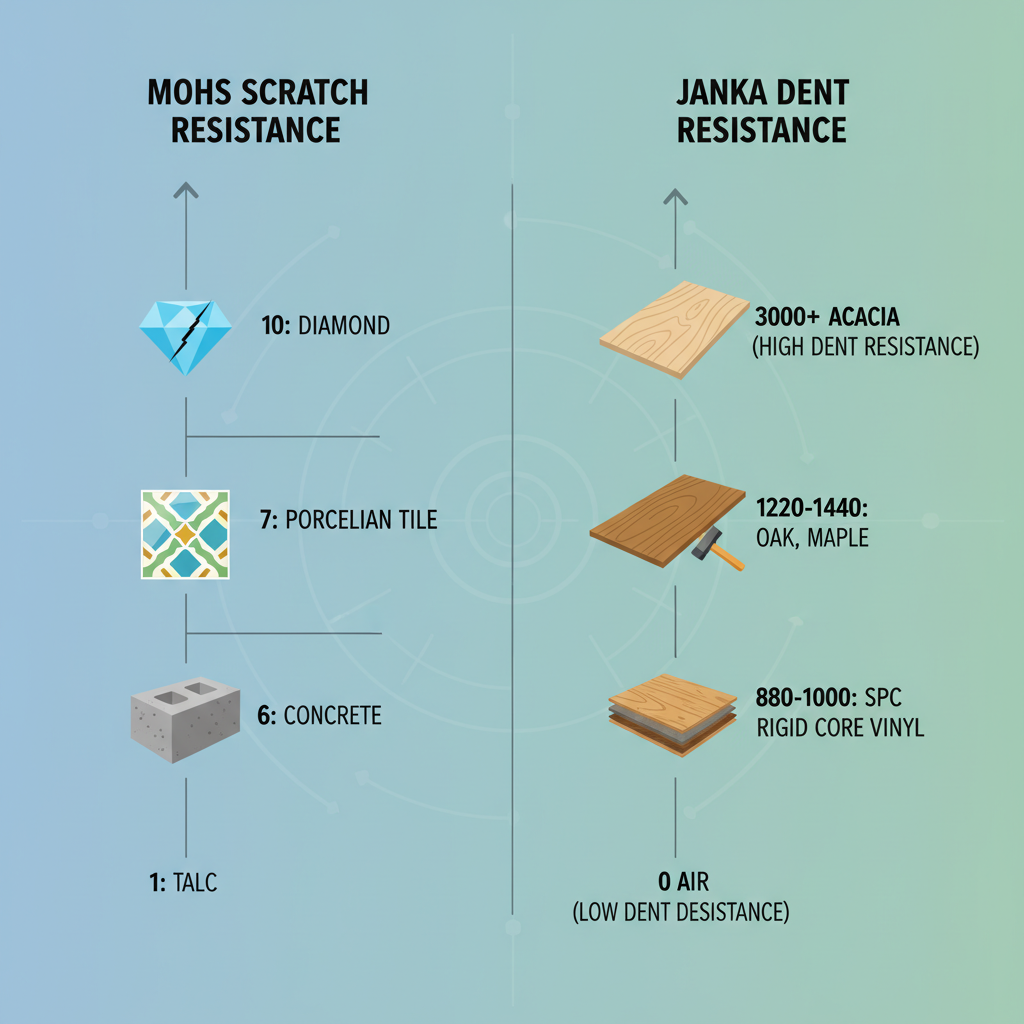
Top Contenders for Scratch-Resistant Adamantine Floors
If you are hunting for scratch resistant adamantine floors, four materials consistently rise to the top of the durability hierarchy: epoxy resins, polished concrete, Stone Plastic Composite (SPC) rigid core vinyl, and porcelain tile.
For residential applications, SPC luxury vinyl has become a dominant force in durable home flooring. It is crucial to understand the structural and chemical differences between SPC and traditional WPC (Wood Plastic Composite) cores. While WPC is softer and more comfortable underfoot, SPC is engineered with a limestone core, giving it vastly superior dent resistance against heavy furniture and high-impact drops.
On the extreme end of the spectrum are epoxy and polished concrete. The chemical resilience of epoxy resins makes them virtually impervious to chemical spills and surface abrasions, while porcelain tile boasts an incredibly high structural density that resists both moisture and deep gouging [2]. However, installing these ultra-hard materials in living spaces comes with ergonomic and temperature trade-offs. Materials boasting true “adamantine” scratch resistance are often cold, hard underfoot, and unforgiving to dropped glassware or joints during prolonged standing.
The Economics of Longevity: Long-Term Flooring Solutions and ROI
When shopping for long-lasting flooring, it is easy to suffer from sticker shock. However, the secret to making a sound financial decision is shifting your perspective from the upfront installation cost to the Annualized Cost of Ownership. When viewed through the lens of a 50-year lifecycle, cheaper materials often end up costing significantly more.
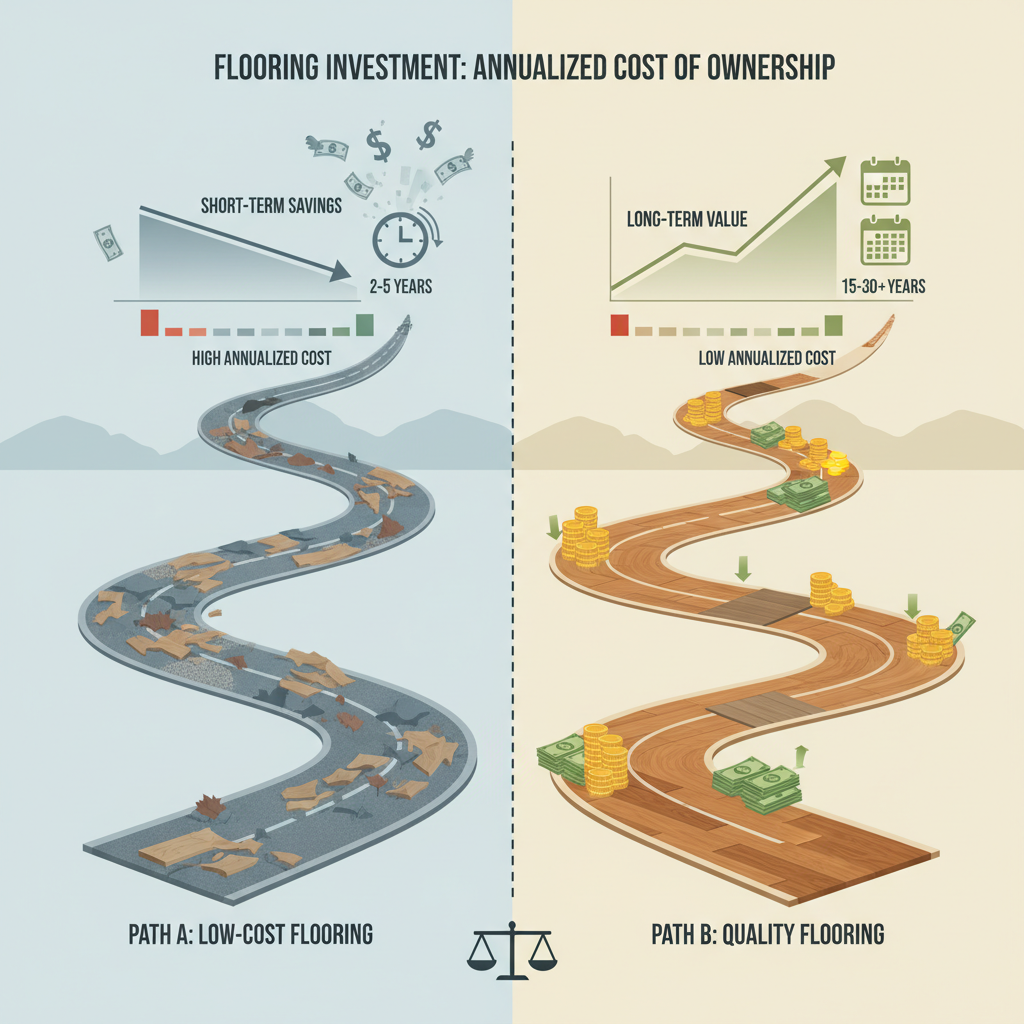
Consider this financial breakdown based on expected lifespans of home building materials [3]: A high-quality solid hardwood floor might have a steep initial price tag, but because it can last 70 years or more with occasional refinishing, its annualized cost is merely $0.11 to $0.17 per square foot. In contrast, builder-grade carpet, which typically requires replacement every 12 years, carries an annualized cost of $0.33 to $0.50 per square foot. Hardwood is mathematically the cheaper long-term flooring solution.
If you are opting for modern alternatives like premium luxury vinyl plank, achieving maximum lifespan requires strict adherence to technical specifications. To ensure the floor lasts its projected 20 to 30 years, it must feature a 20-mil or thicker commercial-grade wear layer. Anything less will inevitably wear through in high-traffic residential corridors.
The Hidden Foundation: Why Subfloor Prep Dictates Floor Survival
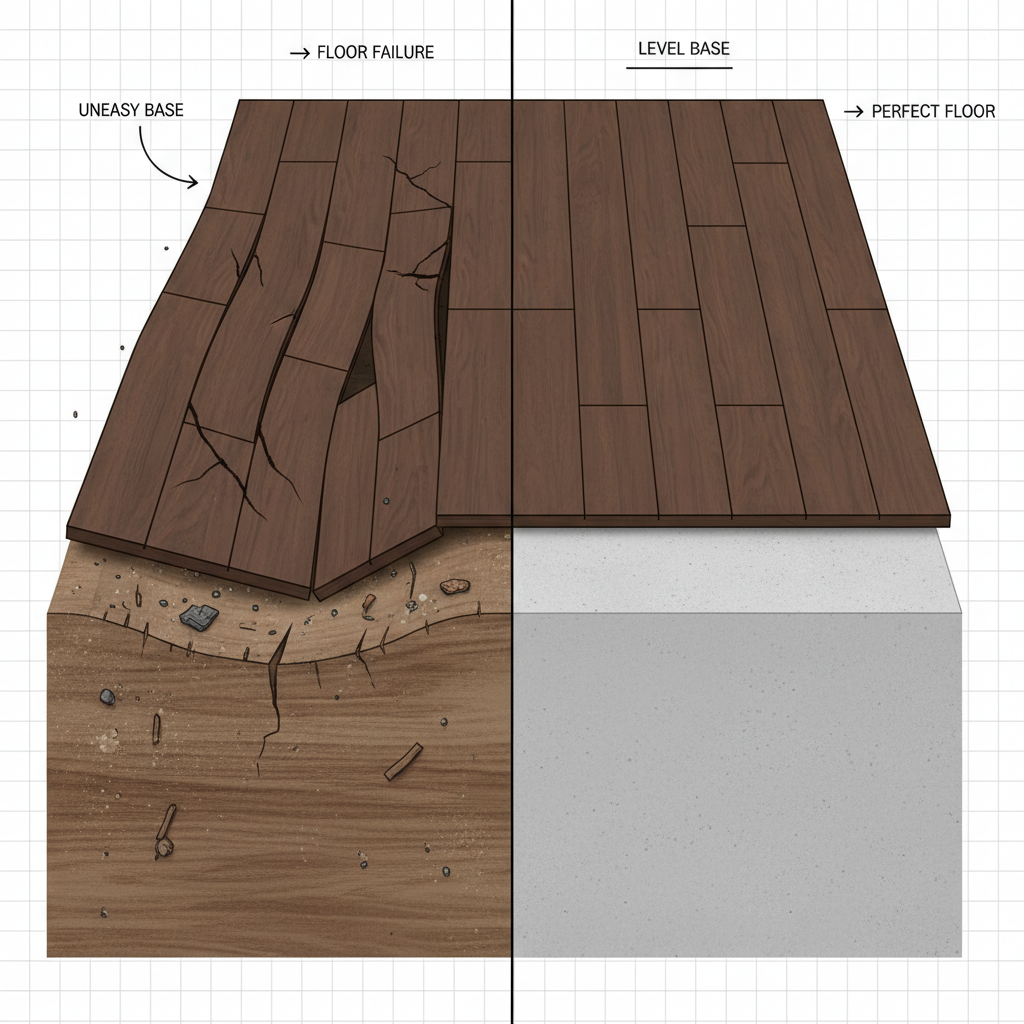
One of the most critical gaps in flooring knowledge is the assumption that a tough material guarantees a tough floor. In reality, the durability of your floor is entirely dependent on the quality of the foundation beneath it. If you want to successfully install durable home flooring, you must start with a flawless subfloor.
Even the most rigid, indestructible SPC plank will fail if installed over an uneven surface. Minor subfloor imperfections—such as a dip as small as 3/16 of an inch—create hollow spots. When heavy foot traffic compresses the plank into that dip, the rigid core locking mechanisms snap, leading to separated seams and structural failure [4].
Furthermore, technical requirements for material acclimation must be strictly followed to prevent expansion and buckling after installation. The type of subfloor also dictates the installation methodology; for example, glue-down methods are often mandatory over concrete slabs to prevent moisture migration and shifting, whereas nail-down methods are standard for solid wood over plywood subfloors.
Aesthetic Longevity: Choosing Flooring That Looks New Longer
A floor doesn’t have to break to look old. For many homeowners, aesthetic longevity—preventing fading, seam separation, and surface dullness—is just as important as structural integrity. If your goal is flooring that looks new longer, visual continuity is your greatest ally.
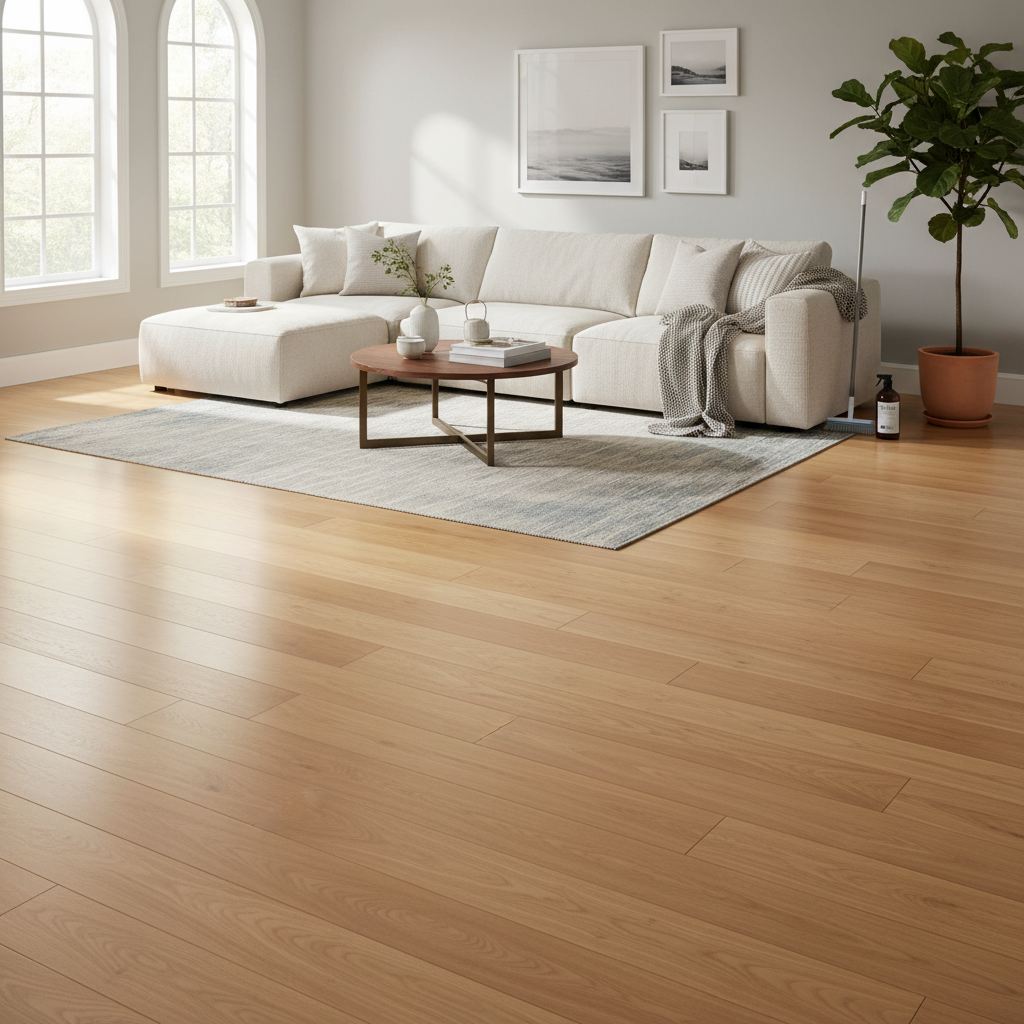
One of the most effective, yet rarely discussed, strategies for maintaining a seamless, high-end look over time is utilizing extra-long planks. Standard vinyl or laminate planks are typically 36 to 48 inches long. By upgrading to extra-long planks measuring 60 to 72 inches, you can reduce end-to-end seams by approximately 30% to 40% in a typical 20-foot room. Fewer seams mean fewer places for dirt to collect and fewer edges to catch and peel, drastically reducing the visual aging of the floor.
Additionally, understanding the science of UV degradation is vital. Direct sunlight acts as a bleaching agent on flooring finishes. To mitigate fading, look for products with high UV resistance ratings, a metric frequently evaluated in independent, rigorous product testing for high-traffic visual durability [5]. Combining UV-resistant finishes with strategic window treatments ensures your floor retains its day-one color for years.
Preventative Maintenance: How to Keep Floors Looking New
Post-purchase care is often where well-intentioned homeowners do the most damage. When learning how to keep floors looking new, the focus should heavily weigh on what not to do, as incorrect cleaning methods frequently cause more aging than actual foot traffic.
A prime example is the popular DIY cleaning hack of using vinegar and water on hardwood. Vinegar is highly acidic; over time, it will strip, dull, and etch modern polyurethane finishes. Another common mistake is using rubber-backed rugs on hard surfaces. The chemicals in the rubber backing interact with polyurethane floor finishes, causing permanent yellowing and discoloration.
Instead, adhere to specific daily floor maintenance guidelines from authoritative industry bodies [6]. Use pH-neutral cleaners specifically formulated for your material, sweep regularly with a soft-bristle broom to remove abrasive grit, and never use a vacuum with an engaged beater bar on hard surfaces. Even softer materials benefit greatly from proper care; for instance, well-cared-for carpet can last an average of 10 years before requiring replacement [7].
Normal Wear and Tear vs. Property Damage
For landlords and tenants, understanding flooring wear and tear is a matter of legal and financial importance. It is essential to delineate the boundaries between normal aging and actual property damage.
According to standard property management guidelines and legal definitions, “normal wear and tear” encompasses minor, unavoidable degradation that occurs through everyday use—such as slight fading from sunlight, gentle dulling of the finish in high-traffic walkways, or light surface scuffs [8]. Conversely, “damage” refers to negligence or abuse that breaches the material’s integrity, such as deep gouges from dragging heavy furniture, chipped porcelain tiles from dropped tools, or permanent stains and warping caused by pet urine.
The Damage Triage Guide: Fixing Scratched and Worn Out Floorboards
Despite your best efforts, accidents happen. When dealing with scratched home flooring, the first step is diagnosing the severity of the damage to determine if it’s a simple DIY fix or requires professional intervention.
Start with a step-by-step diagnostic framework to determine scratch depth. If the scratch is only visible at certain angles and feels smooth to the touch, it has likely only scuffed the clear finish. If your fingernail catches in the groove, it has breached the wear layer. For minor finish scratches on wood, DIY remedies like rubbing the meat of a raw walnut over the scratch can be surprisingly effective; the natural oils in the walnut hydrate and swell the exposed wood fibers, while the nut meat acts as a mild abrasive to blend the finish. For deeper gouges in vinyl or laminate, color-matched wax filler sticks physically fill the void and seal out moisture.
However, when dealing with severely worn out floorboards, homeowners need a stark reality check regarding DIY restoration. While sanding and refinishing sound straightforward, restoring historic or Victorian floorboards in a multi-room space is a monumental task. It can easily take up to 3 full days of grueling labor and require the rental and mastery of 5 different types of specialized sanders (drum sanders, edge sanders, orbital sanders, etc.). If a board is structurally compromised and needs extraction, cutting it out without destroying the adjacent tongue-and-groove joints requires surgical precision. In these cases, hiring a professional is not just a convenience; it is an investment in saving the floor.
Conclusion
True “adamantine” durability is rarely found in a single magic material. Instead, it is the result of a calculated combination: selecting materials based on objective scientific scales, ensuring flawless subfloor preparation and installation, and committing to rigorous, manufacturer-approved preventative maintenance. By shifting your focus from the initial price tag to the annualized cost of ownership, you can make informed decisions that protect your home’s value. Evaluate your current home’s traffic needs using our material breakdown, and consult with a certified flooring installer to assess your subfloor before making your next long-term flooring investment.
The lifecycle cost calculations and DIY repair advice are for informational purposes. Always consult a certified flooring installer and refer to manufacturer warranties before undertaking structural repairs or installations.
References & Authoritative Sources
- National Wood Flooring Association (NWFA). (N.D.). Janka Hardness Scale.
- Tile Council of North America (TCNA). (N.D.). Porcelain Tile Durability Standards.
- National Association of Home Builders (NAHB). (N.D.). Expected Lifespans of Home Building Materials.
- Certified Floorcovering Installers (CFI). (N.D.). Subfloor Preparation and Installation Guidelines.
- Consumer Reports. (N.D.). Flooring Durability Testing.
- National Wood Flooring Association (NWFA). (N.D.). Hardwood Floor Care and Maintenance Guidelines.
- Forbes. (N.D.). Carpet Lifespan and Maintenance.
- PURE Property Management of California. (N.D.). Normal Wear and Tear vs. Property Damage.
