If you have ever spent thousands of dollars on a “life-proof” or “indestructible” floor only to watch it succumb to pet claws, dropped pans, and daily foot traffic within a year, you are not alone. Active households and large pets destroy standard floors through a combination of slow, invisible degradation and acute, high-impact stress. The flooring industry is notorious for leaning on hyperbolic marketing buzzwords that promise the world but fail to deliver under the reality of household chaos.
This article is your engineer-level, science-backed guide to bulletproofing your home. By translating industrial-grade resilience into residential aesthetics, we will help you move past the marketing fluff to find the true “adamantine” solution tailored to your specific needs. It is time to stop replacing easily damaged home flooring and start investing in materials engineered to withstand every stressor your life throws at them.
- Demystifying ‘Adamantine’: Material Science vs. Marketing Buzzwords
- The Anatomy of Floor Failure: Why Easily Damaged Home Flooring Happens
- Matching Material to Stressor: Top Durable Home Flooring Options
- Heavy-Duty Floors & High Performance Floor Upgrades
- The Floor Protection Matrix: Flooring Dent Prevention
- Contractor’s Truth: Stress Resistant Flooring Installation
- Conclusion
- References & Authoritative Sources
Demystifying ‘Adamantine’: Material Science vs. Marketing Buzzwords
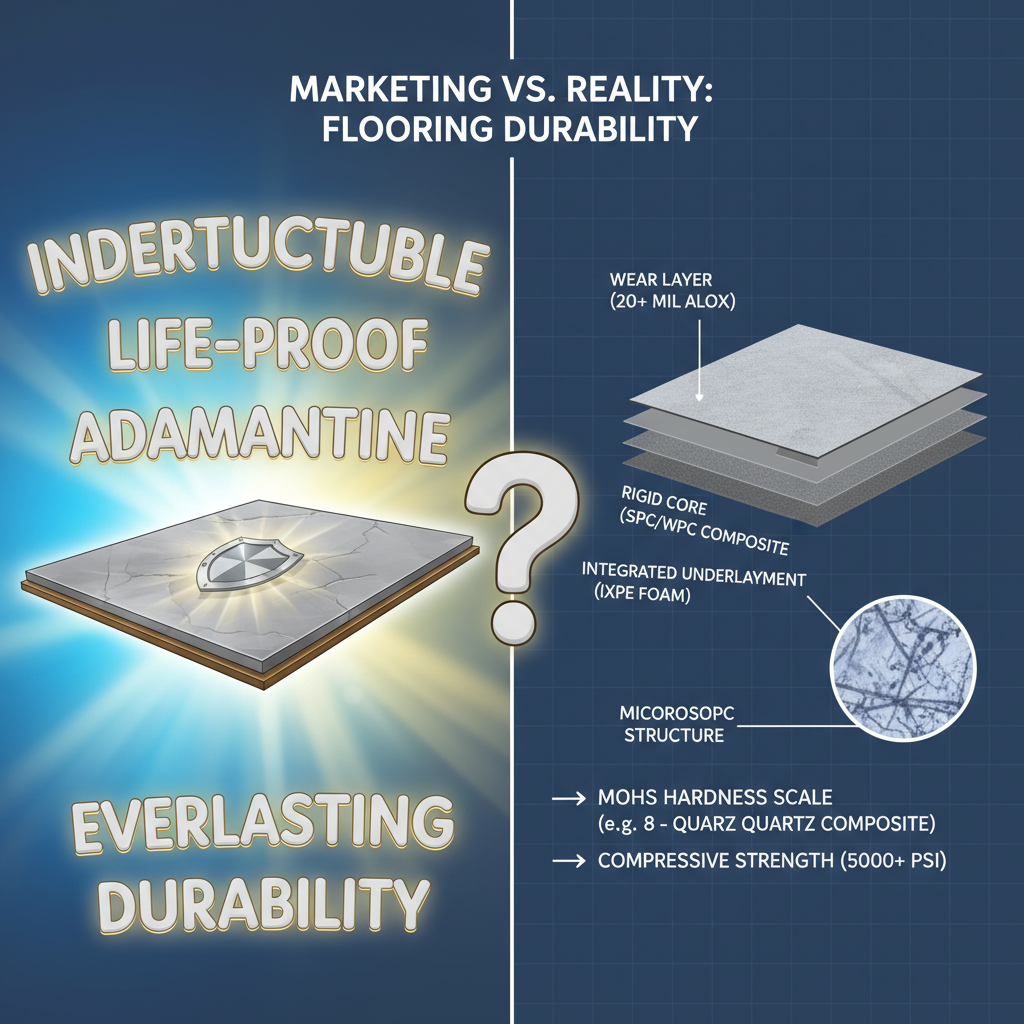
When searching for the hardest flooring for a house, you may encounter the term “adamantine flooring.” Derived from the Greek word adamantinos—meaning untameable or unbreakable, and historically used to describe diamonds or legendary impenetrable stones—the word carries serious weight. However, in the modern flooring industry, “adamantine” is strictly a descriptive marketing term denoting extreme hardness, rather than a specific, standardized class of material.
To truly evaluate durability, we must abandon marketing adjectives and look to material science. The Mohs hardness scale, a scientific metric used to measure the scratch resistance of various minerals, provides a reliable baseline. According to principles outlined in leading Materials Science and Engineering journals, true scratch resistance is determined by a material’s ability to withstand abrasion from substances with a lower or equal Mohs rating [1]. For example, while standard hardwood sits relatively low on the scale, porcelain tile fired at extreme temperatures ranks much higher, making it vastly superior at resisting grit and claws.
Industry watchdogs, such as Floor Covering Weekly, frequently debunk marketing myths by contrasting these “adamantine” claims with actual material science [2]. A manufacturer may call their ultra-hardened industrial epoxy or densified wood “adamantine,” but without looking at the underlying technical specifications—like Mohs hardness, wear-layer thickness, or compressive strength—you are simply buying a buzzword.
The Anatomy of Floor Failure: Why Easily Damaged Home Flooring Happens
Floor damage is rarely a sudden, catastrophic event; it is usually the result of slow, invisible habits. Understanding the mechanics of floor wear is the first step in prevention. Easily damaged home flooring is often the victim of micro-grit friction (acting like sandpaper underfoot), improper maintenance, and chemical incompatibilities like plasticizer migration.
One of the most common culprits of premature wear is the chemical breakdown of floor finishes when exposed to non-pH-neutral cleaners. Highly acidic or alkaline cleaners strip away the protective wear layers of vinyl and the polyurethane clear coats of hardwood, leaving the vulnerable core exposed to the elements. Furthermore, structural failures often begin on day one. Authoritative building science publications like Fine Homebuilding note that the cumulative effect of micro-abrasions is frequently compounded by installation errors, such as flooring nailer damage on factory-finished boards, which creates microscopic fractures that expand over time [3].
To stop the cycle of damage, you must first understand what you are looking at. A step-by-step diagnostic approach is required to distinguish between superficial damage and structural failure:
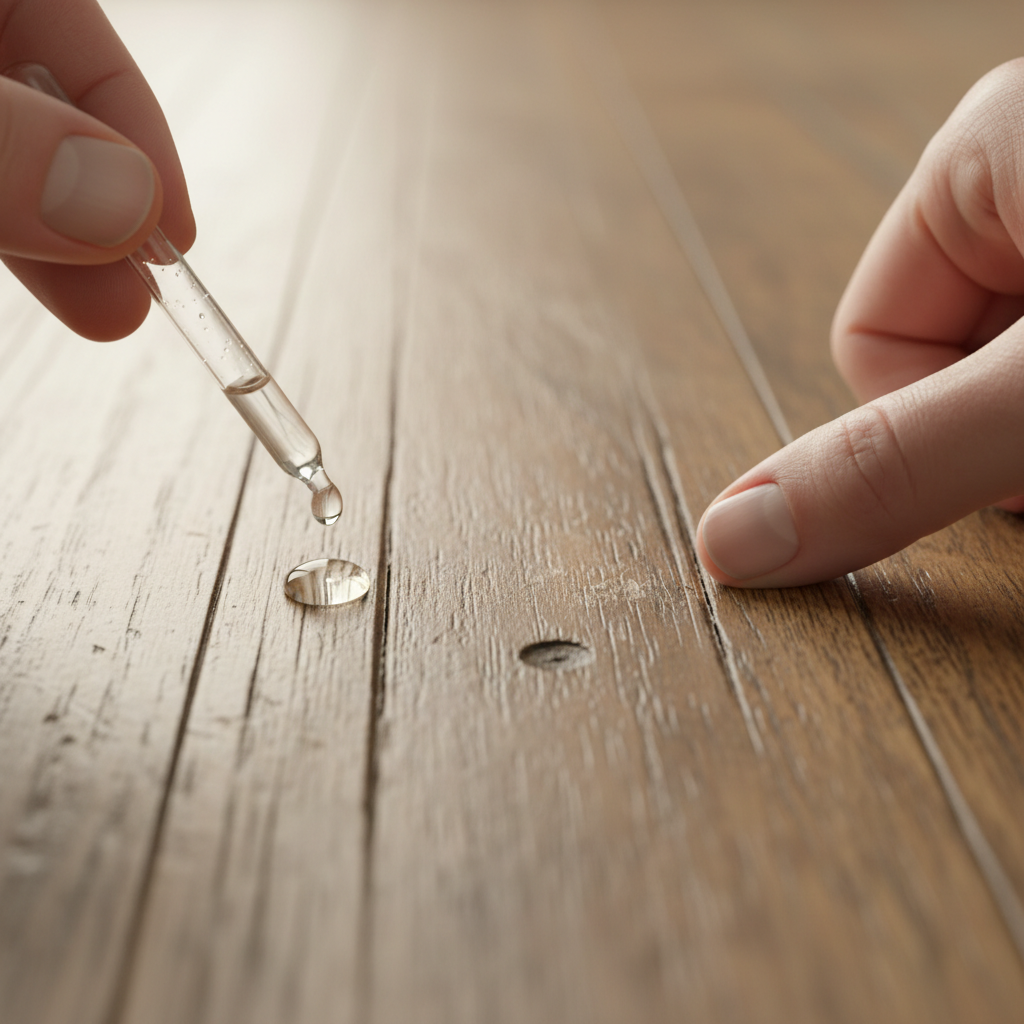
- The Water Test: Place a drop of water on a scratched hardwood floor. If it beads up, the scratch is likely superficial (only in the polyurethane clear coat). If it soaks in and darkens the wood, the structural wood grain is damaged.
- The Fingernail Catch: Run your fingernail across the scratch. If it glides over with minimal interruption, it is a clear-coat scuff. If your nail catches deeply, the core material is compromised.
Diagnosing and Repairing Scratched Hardwood Floors
If you have diagnosed your scratched hardwood floors as having superficial clear-coat damage, do not immediately resort to heavy sanding. Minor scuffs can often be masked or repaired with a simple 10% cleaner to 90% water spray solution (which dries in about 10 minutes) or specialized blending tools like Tibet Almond Sticks.
However, deep gouges require a more technical approach to repair scratches and dents. According to maintenance guidelines and finish chemistry experts at Ted Todd Fine Wood Floors, treating the specific finish correctly is paramount to avoiding further damage [4]. For actual dents where the wood fibers have been crushed but not severed, professionals often use a steam expansion technique. By placing a damp, clean cloth over the dent and applying a hot iron for brief intervals, the steam forces the crushed wood fibers to expand and swell back to their original shape without causing water damage to the surrounding planks.
Matching Material to Stressor: Top Durable Home Flooring Options
Because no single material is impervious to everything, finding durable home flooring requires categorizing durability by your specific household needs—namely dent resistance, scratch resistance, and water resistance.
When evaluating the best flooring for high traffic areas, Porcelain Tile, Luxury Vinyl Plank (LVP), and Engineered Hardwood are the top contenders. Porcelain offers unmatched sheer durability; the Tile Council of North America (TCNA) notes that high-quality porcelain tile can last 50+ years with proper maintenance, owing to its high-temperature kiln-firing process [5].
For those seeking a warmer, softer alternative, LVP is highly resilient, provided you check the specifications. A wear-layer thickness chart is critical here: for active residential use, you must demand a wear layer between 12 mil and 20+ mil. Anything less will quickly show traffic patterns. It is also vital to understand the technical limitations of rigid core floors. While Stone Polymer Core (SPC) and Wood Polymer Core (WPC) vinyls are incredibly dent-resistant, they have expansion limitations in massive, continuous commercial-style spaces compared to traditional Luxury Vinyl Tile (LVT), making strategic installation crucial.
Scratch Resistant Flooring for Dogs: Balancing Durability and Traction
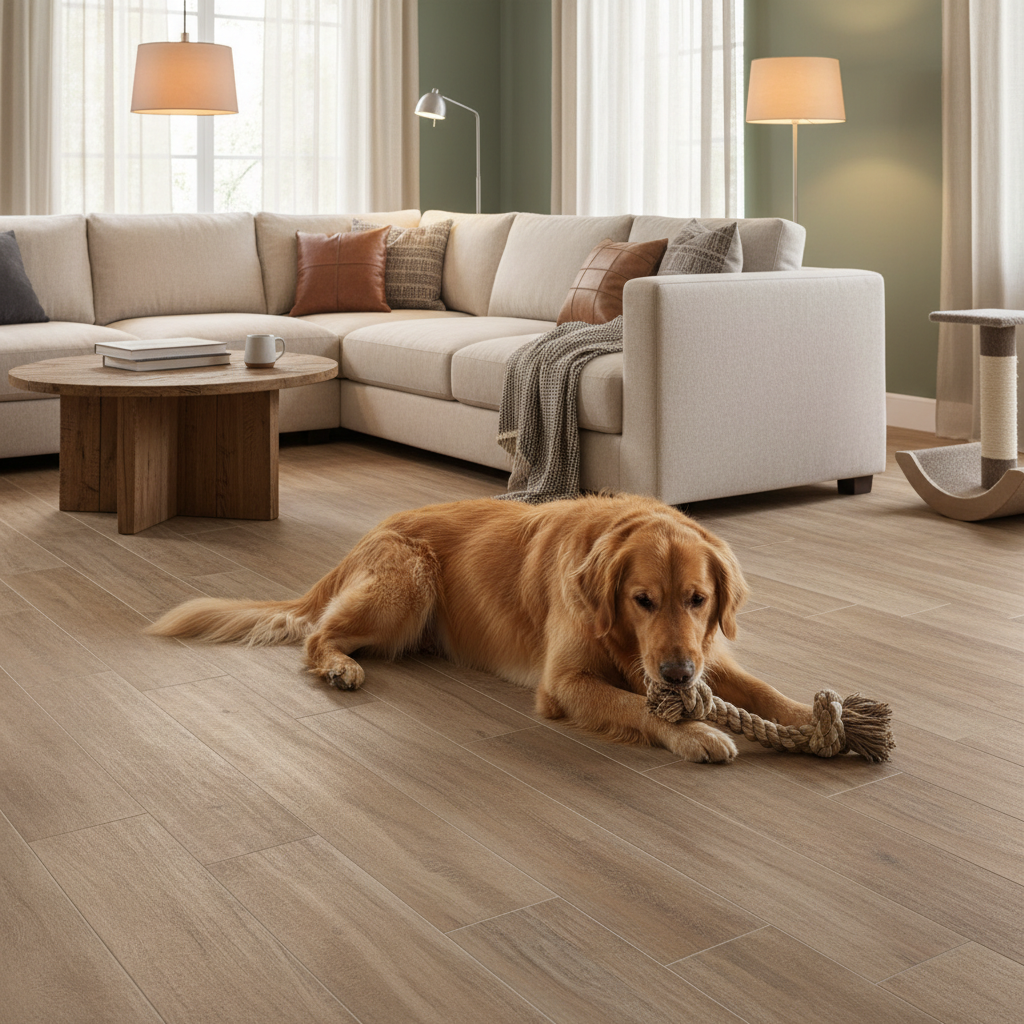
Pet owners face a unique challenge: balancing scratch resistance with the traction necessary to protect canine joint health. When searching for scratch resistant flooring for dogs, it is crucial to differentiate between scratch-proof and scratch-resistant. No wood or plastic is entirely scratch-proof against a determined 80-pound dog, but premium LVP and textured tile come close.
Insights from flooring retailers like Floor & Decor highlight that specific pet-friendly product lines rely on two factors: a thick wear layer (20+ mil is non-negotiable for large dogs) and a textured finish [6]. A highly smooth, glossy floor may resist scratches, but it forces dogs to splay their legs, leading to severe hip and joint injuries over time. Textured LVP or matte-finished porcelain provides the necessary grip for the dog while maintaining an impenetrable barrier against claws.
Engineered Flooring for Active Households: The Next-Gen Solutions
For homeowners who refuse to compromise on the authentic feel of real wood but need durable engineered flooring solutions, the industry has evolved. Engineered flooring for active households now bridges the gap between the cross-ply core stability of engineered wood and the bulletproof nature of premium waterproof laminate.
The most exciting next-gen solution is “densified hardwood.” Unlike traditional wood, densified hardwood undergoes a manufacturing process utilizing extreme heat and pressure (and sometimes specialized chemical resins) to compress the wood fibers, doubling or tripling its natural density and making it highly dent-resistant and waterproof. Furthermore, the Good Housekeeping Institute reports that premium engineered wood now features wear veneers up to 6mm thick [7]. This immense thickness allows the floor to be sanded and refinished 2 to 3 times, giving it a potential lifespan of up to 50 years while maintaining the structural stability that prevents warping in active, spill-prone homes.
Heavy-Duty Floors & High Performance Floor Upgrades
Sometimes, residential-grade materials simply aren’t enough. For garages, heavy workshops, and serious home gyms, you need heavy-duty floors that bridge the gap between industrial environments and residential applications.
When evaluating a high performance floor upgrade, resinous coatings are the gold standard. However, you must look at the PSI (pounds per square inch) ratings. The American Concrete Institute (ACI) sets rigorous standards for concrete strength, and a high-performance coating must be able to withstand both static loads (heavy machinery sitting in one place) and dynamic loads (vehicles moving) [8].
The two primary contenders are Epoxy and Polyaspartic coatings. While epoxy is the traditional choice, polyaspartic coatings offer superior UV stability (they won’t yellow in sunlight) and incredible resistance to hot-tire pickup (where hot car tires melt and peel the coating). Most importantly, advanced polyaspartic systems utilize proprietary wicking technology that penetrates deep into the concrete’s pores, surpassing ordinary epoxy adhesion by up to three times. Additionally, for the eco-conscious homeowner, the experts at Sherwin-Williams Protective & Marine note that certain low-VOC sustainable resin flooring solutions can even earn points toward LEED certification [9].
The Floor Protection Matrix: Flooring Dent Prevention
Even the most robust flooring will fail if subjected to concentrated point-loads. Flooring dent prevention relies entirely on the physics of weight distribution. A 100-pound sofa resting on four tiny, unprotected wooden legs exerts massive PSI on a floor. By using furniture sliders or wide pads, you distribute that weight across a larger surface area, neutralizing the threat.
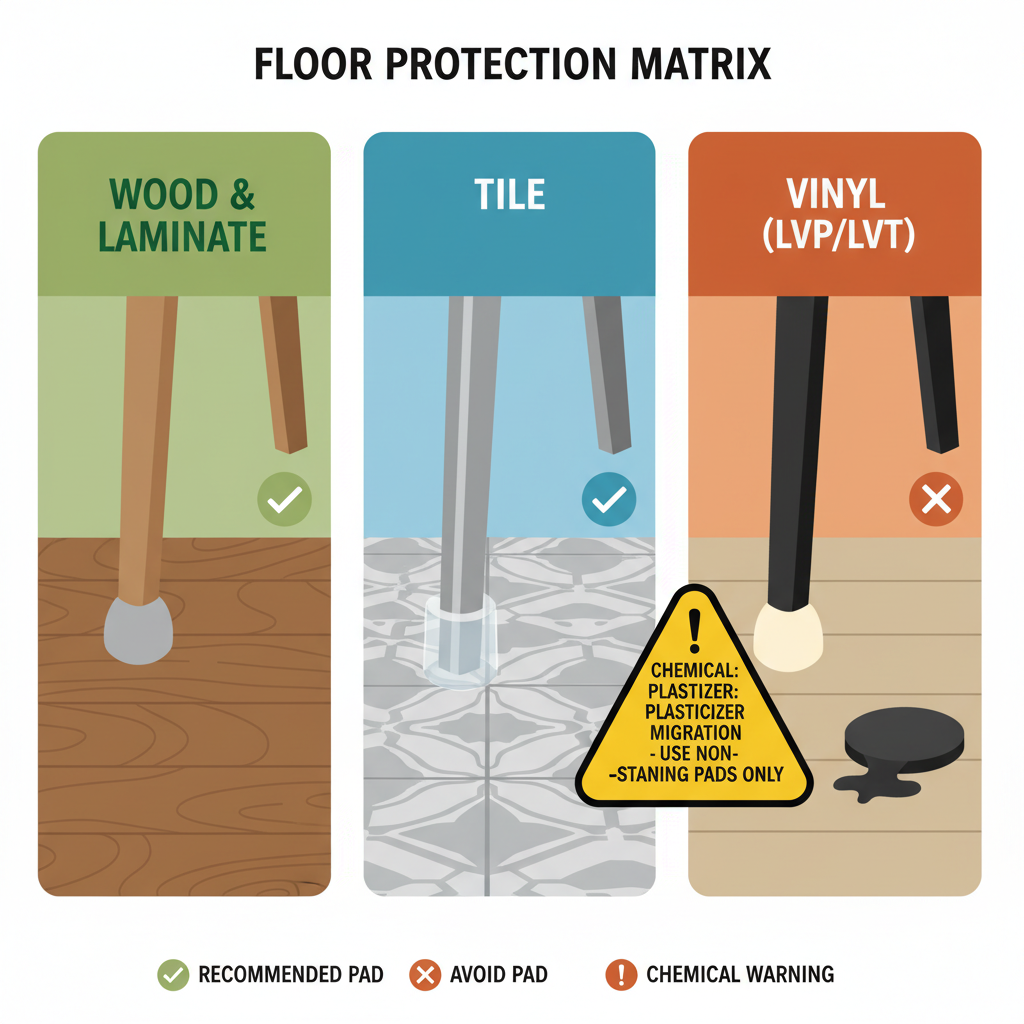
However, you must use the correct protection for the correct material. Implementing a “Floor Protection Matrix” is essential to avoid chemical damage:
- For Wood and Laminate: Use high-density felt pads. They allow heavy items to slide without scratching the clear coat and will not trap moisture.
- For Tile: Use silicone or approved heavy-duty rubber glides. Tile will shred felt pads quickly, but rubber provides excellent grip and shock absorption.
- For Vinyl (LVP/LVT): Critical Chemical Warning. You must avoid standard rubber mats or cheap rubber furniture pads on vinyl flooring. This causes “plasticizer migration,” a chemical reaction between the rubber and the vinyl’s wear layer that results in permanent, irreversible yellowing and localized denting. Use only vinyl-approved felt or specialized non-staining composite pads.
Contractor’s Truth: Stress Resistant Flooring Installation
The ultimate contractor’s truth is this: even the most expensive, “life-proof” material will suffer catastrophic failure if the installation is flawed. Stress resistant flooring installation is entirely dependent on subfloor preparation.
First, explicitly understand that underlayment cannot correct structural deficiencies. If your subfloor is spongy, unlevel, or dipping, laying a premium pad over it will not save the locking mechanisms of your rigid core planks from snapping under foot traffic. Underlayment panels must be dimensionally stable and have a minimum thickness of 1/4” (6mm) to provide adequate support.
Second, expansion gaps are non-negotiable. Mannington Commercial installation guidelines strictly mandate an expansion space of 5/16” to 3/8” between the wall and the flooring [10]. Without this gap, seasonal humidity and temperature changes will cause the floor to expand, hit the drywall, and buckle violently upward.
Finally, for high-performance resinous upgrades (like epoxy or polyaspartic garage floors), mechanical concrete profiling is an absolute necessity. DIYers often skip grinding or shot-blasting the concrete, opting for a simple acid wash. Without mechanical profiling to open the concrete’s pores, the coating cannot achieve a mechanical bond, guaranteeing that your expensive heavy-duty floor will peel within months.
Conclusion
True “adamantine” flooring isn’t a single, magical material found in a catalog. It is the strategic result of matching the right high-performance material—whether that is a 20-mil LVP for your golden retriever, densified wood for your active living room, or a polyaspartic coating for your workshop—to your specific household stressors. When backed by flawless, structurally sound installation and smart, chemically compatible maintenance, your floors can truly become unbreakable. Evaluate your home’s highest stress zones using our Floor Protection Matrix, and consult with a certified installer to thoroughly test your subfloor before investing in your next high-performance floor upgrade.
DIY Installation & Chemical Safety Disclaimer: Information regarding subfloor preparation and high-performance epoxy/polyaspartic coatings involves mechanical tools and chemicals. Always follow manufacturer safety guidelines and consult certified professionals for structural subfloor issues.
References & Authoritative Sources
- Materials Science and Engineering journals. (N.D.). Mohs Hardness Scale and Material Properties in Residential Applications.
- Floor Covering Weekly. (N.D.). Industry Terminology and Marketing Trends: Debunking Flooring Myths.
- Fine Homebuilding. (N.D.). Installation Failures and the Cumulative Effect of Micro-Abrasions on Flooring.
- Ted Todd Fine Wood Floors. (N.D.). Manufacturer Maintenance Guidelines and Finish Chemistry.
- Tile Council of North America (TCNA). (N.D.). Porcelain Tile Lifespan and Durability Standards.
- Floor & Decor. (N.D.). Pet-Friendly Product Lines, Wear-Layer Data, and Traction Requirements.
- Good Housekeeping Institute. (N.D.). Rigorous Product Testing: Longevity Analysis of Premium Engineered Wood.
- American Concrete Institute (ACI). (N.D.). Concrete Strength Standards and PSI Ratings.
- Sherwin-Williams Protective & Marine. (N.D.). Industrial Coatings Specifications and LEED Certification Standards.
- Mannington Commercial. (N.D.). Manufacturer Installation Guidelines and Subfloor Specifications.
