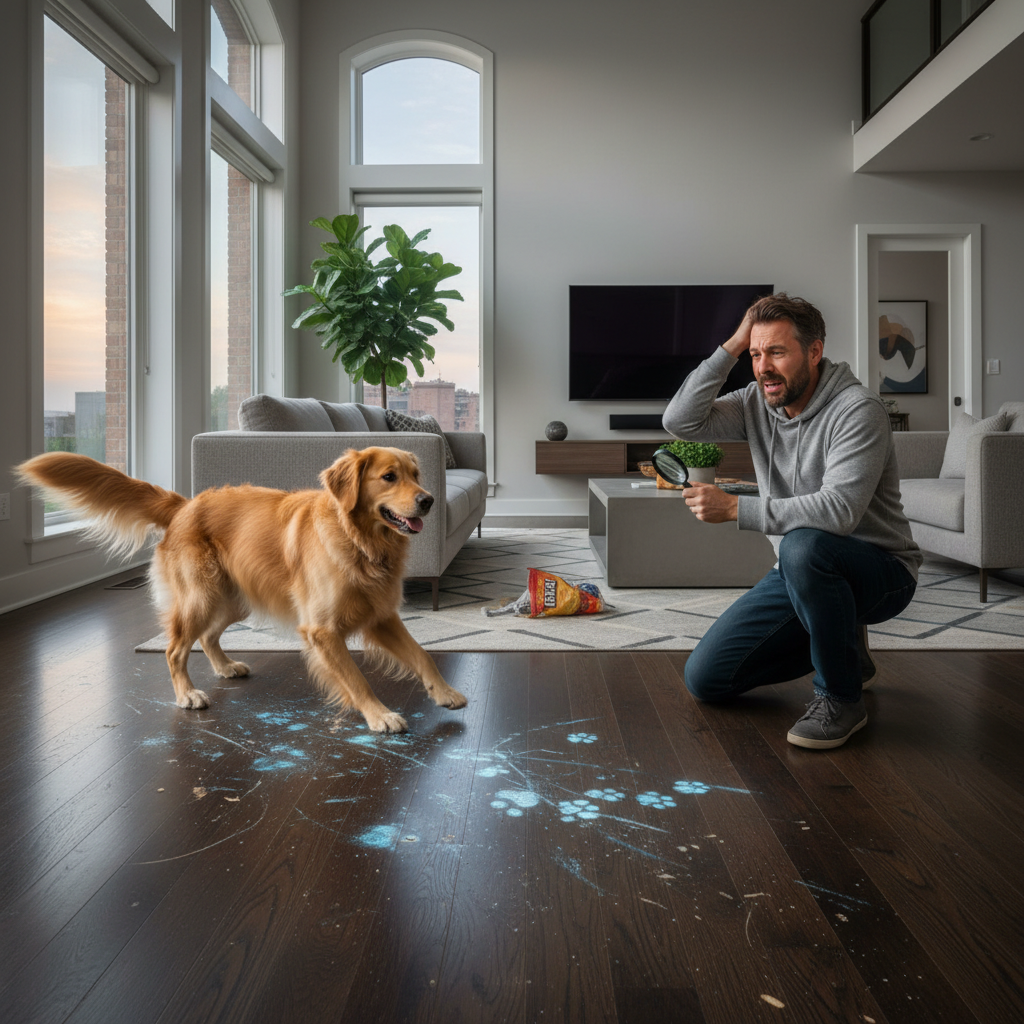
Every active dog owner knows the sound: the frantic, rhythmic clicking of nails against the floor as their pet rounds a corner, followed by the inevitable heart-sinking realization that another permanent scratch has just been etched into the wood. The frustration of dealing with ruined floors from pets is a universal pain point, often leading to significant financial distress and endless cycles of refinishing. In a desperate bid for a solution, many homeowners fall victim to misleading “scratch-proof” marketing that pushes ultra-hard materials without considering the holistic impact on the home or the animal.
Welcome to the definitive solution: The Pet-Proof Flooring Matrix. This comprehensive guide bridges the gap between complex material science (like Mohs hardness scales and AC ratings) and veterinary science (canine joint health and traction). Whether you are actively researching the legendary durability of adamantine flooring or simply looking for ways to protect your existing hardwood, this guide will help you navigate the delicate balance between extreme surface durability, acoustic comfort, and your dog’s long-term well-being.
- The Anatomy of Pet Floor Damage: Why Standard Floors Fail
- What is Adamantine Flooring? The Ultimate Shield Explained
- The Pet-Proof Flooring Matrix: Finding the Perfect Balance
- Proactive Defense: How to Prevent Pet Scratches on Existing Floors
- Triage and Repair: Fixing Floors Scratched or Ruined by Dogs
- Conclusion
- References & Authoritative Sources
The Anatomy of Pet Floor Damage: Why Standard Floors Fail
To truly understand how to protect your home, we first need to break down the mechanical and chemical ways dogs destroy flooring. Standard residential floors simply aren’t engineered for the unique biological and kinetic forces a dog brings into the house. Pet paw floor damage is rarely just about a single scratch; it is a compounding combination of pressure, friction, and chemical degradation.
According to the American Kennel Club (AKC), large breed dogs exert up to three times more pounds per square inch (PSI) of force on flooring than smaller breeds, turning every step into a localized pressure event [1]. But the damage isn’t just from the nails themselves. Insights from Veterinary Partner highlight a lesser-known culprit: paw anatomy. Microscopic sand, dirt, and silica get trapped deep within a dog’s paw pads, acting like coarse sandpaper grinding against your floor’s finish with every step [2]. Furthermore, the Institute of Inspection, Cleaning and Restoration Certification (IICRC) notes that chemical damage is a major factor; pet saliva, sweat from paw pads, and highly corrosive winter de-icing salts tracked indoors actively eat away at protective polyurethane coatings [3].
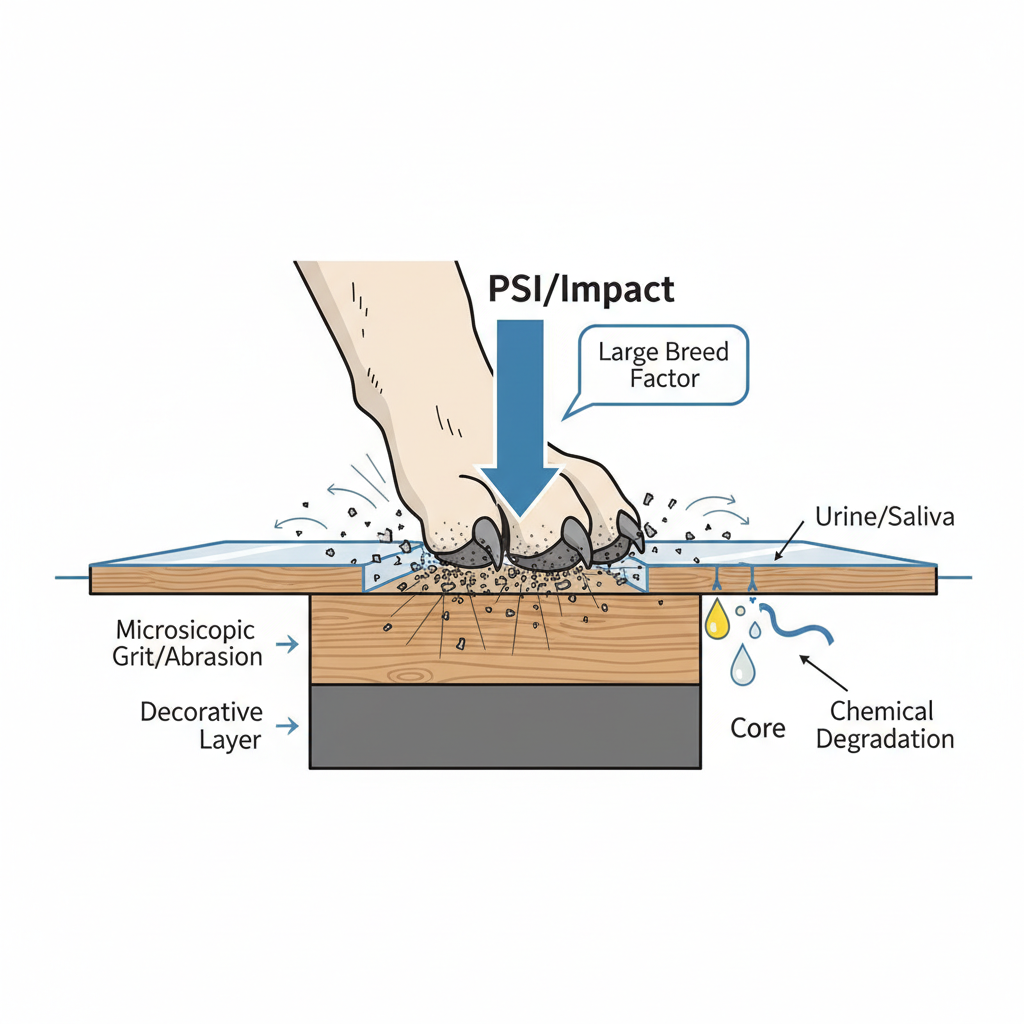
Surface Scratches vs. Structural Dents (The Large Breed Factor)
When evaluating scratch resistant flooring for large pets, you must understand the critical difference between scratching the wear layer (the clear protective topcoat) and physically denting the core material beneath it. A floor can be highly resistant to surface scratches but still succumb to deep structural gouges if a 100-pound Mastiff jumps off the sofa.
This is where the Janka hardness scale becomes vital. The National Wood Flooring Association (NWFA) utilizes the Janka scale to measure the resistance of wood to denting and wear. For homes with large, heavy dogs, the NWFA recommends wood floors with a Janka rating above 1500 (such as Hickory or Brazilian Cherry) to adequately resist the impact denting caused by heavy pets [4]. If the core material is too soft, no amount of surface finish will prevent the floor from looking like a golf ball over time.
The Sheer Force of ‘Zoomies’ and Chemical Degradation
Finding the most durable flooring for active dogs requires accounting for horizontal sheer force. When a high-energy dog gets the “zoomies,” their sudden acceleration and sharp directional changes apply immense lateral pressure to the floor. The Association of Professional Dog Trainers (APDT) explains that the mechanics of indoor active dog behavior—specifically the frantic scrambling for grip—can actually pull apart the locking mechanisms of poorly installed floating floors [5].
Beyond the physical force, chemical degradation remains a silent floor killer. Urine seepage into the seams of laminate or hardwood doesn’t just stain; it causes the core fibers to swell, warp, and delaminate, turning a minor accident into a structural failure.
What is Adamantine Flooring? The Ultimate Shield Explained
In the quest for an indestructible home, “adamantine flooring” has emerged as a buzzword for the ultimate shield. But what exactly is it? Adamantine flooring represents the absolute pinnacle of ultra-durable, scratch-proof surfaces. It is not a specific species of wood, but rather a category of advanced composite materials or specialized ceramic-infused coatings engineered for extreme commercial-grade wear.
If you are looking to install adamantine pet flooring, you are looking at materials engineered to survive almost anything. According to the Journal of Materials Science, adamantine-grade composites utilize highly dense, cross-linked polymer structures often reinforced with aluminum oxide or quartz [6]. The data is staggering: true adamantine-grade composites typically score an 8 or higher on the Mohs hardness scale (where a diamond is a 10) and are engineered to withstand up to 10,000 Taber abrasion cycles without showing visible wear. In an unedited video scratch test, a steel key or a specialized dog nail simulator will glide right off an adamantine sample without leaving a microscopic trace.
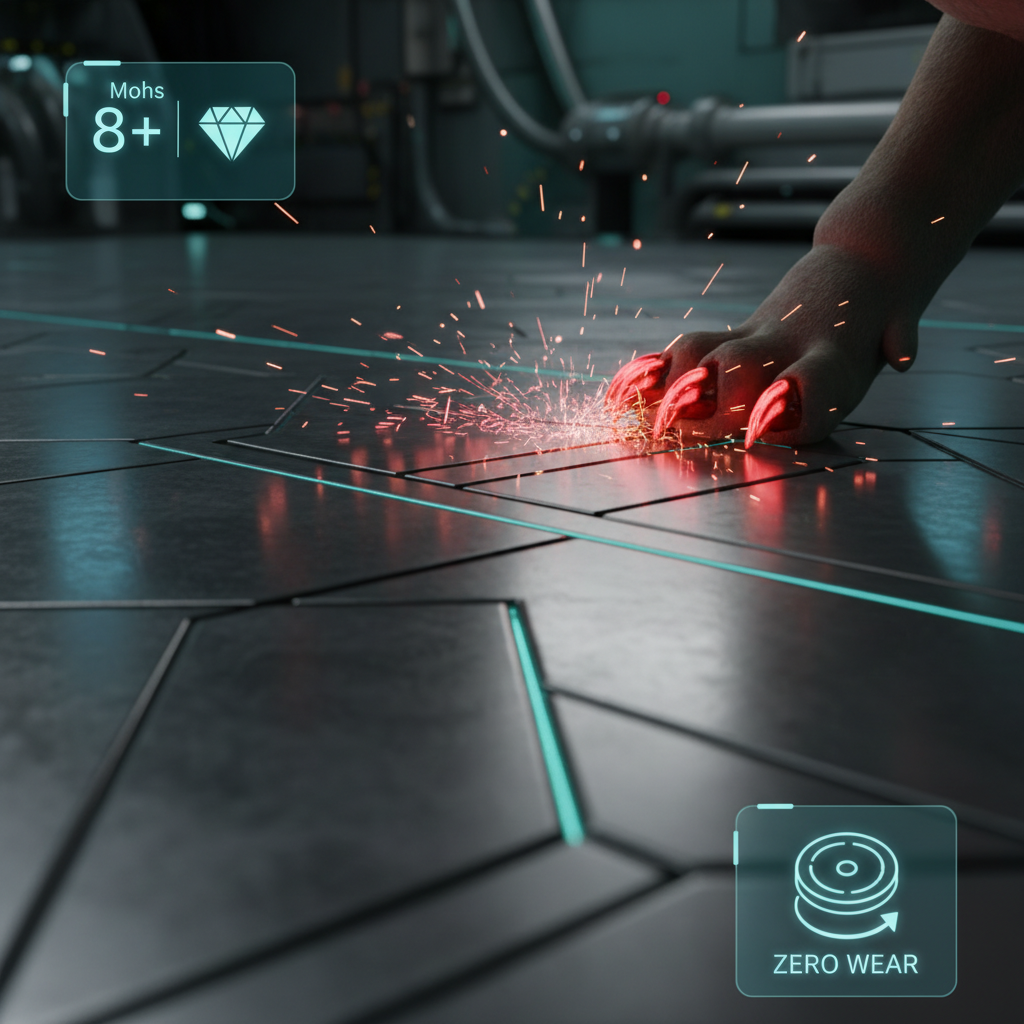
Material Science: Mohs Scale and Taber Abrasion Tests
To cut through marketing fluff, you need to know how scratch resistant flooring is actually tested. The Mohs scale measures a material’s resistance to being scratched by another material. However, the flooring industry relies heavily on the Taber Abrasion Test.
The North American Laminate Flooring Association (NALFA) sets the standard for this test, which involves mounting a flooring sample on a turntable and subjecting it to rotating, weighted abrasive wheels [7]. The number of revolutions (cycles) the floor can endure before the decorative layer is breached determines its durability rating. Adamantine floors excel here, offering cycle counts that dwarf traditional residential materials.
Cost Analysis and Installation Realities
The extreme durability of adamantine materials comes with significant cost and installation complexities. Professional installation for ultra-hard composite flooring averages $3 to $8 per square foot, largely due to the labor involved.
If you plan to install adamantine pet flooring yourself, be prepared. Because these composites are incredibly dense, they require specialized diamond-tipped or carbide saw blades to cut without chipping. Furthermore, the Occupational Safety and Health Administration (OSHA) issues strict safety guidelines regarding the cutting of silica and advanced composite materials, as the fine dust produced is a severe respiratory hazard [8]. Proper ventilation, respirators, and wet-cutting techniques are often mandatory.
The Pet-Proof Flooring Matrix: Finding the Perfect Balance
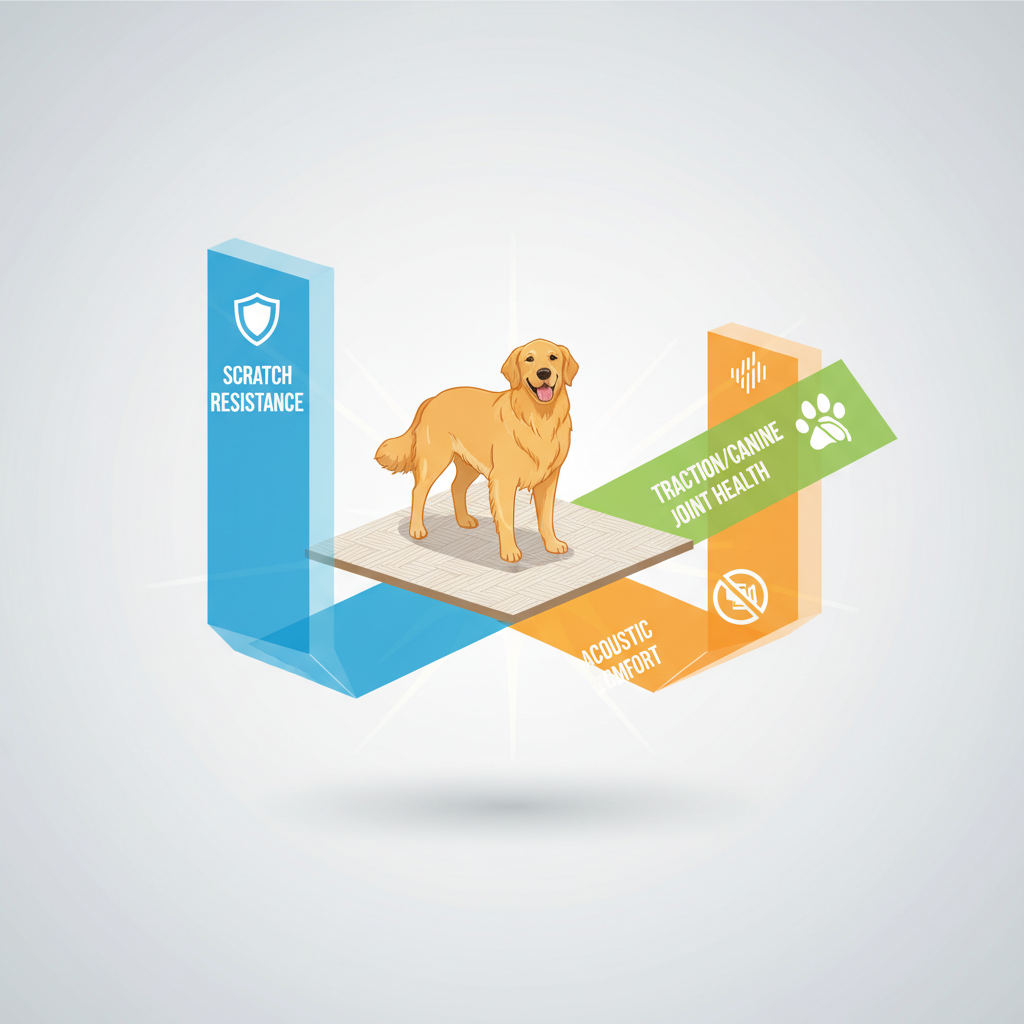
While adamantine materials offer unmatched surface protection, are they actually the best choice for your home and your dog? This brings us to the proprietary “Pet-Proof Matrix,” which scores floors on three vital pillars: scratch resistance, water/urine resistance, and traction.
It turns out that 100% pet proof flooring isn’t just about hardness. In fact, Luxury Vinyl Plank (LVP) makes up over 60% of professional pet-proof flooring recommendations today. High-resolution photos of pets on premium LVP often reveal a textured surface that provides crucial grip, something ultra-hard, glossy floors lack.
LVP vs. Laminate vs. Engineered Hardwood
When comparing standard scratch resistant flooring, technical specifications are your best friend.
- Luxury Vinyl Plank (LVP): The durability of LVP is dictated by its “wear layer,” measured in mils (thousandths of an inch). The World Floor Covering Association (WFCA) states that a minimum wear layer of 20 mil is recommended to withstand commercial or heavy pet traffic [9].
- Laminate: Laminate durability is measured by an AC (Abrasion Class) rating. To withstand the sheer force of running dogs, an AC4 or AC5 rated laminate is highly recommended.
- Engineered Hardwood: While beautiful, it features a thin veneer of real wood. Once a dog scratches through the polyurethane and the thin veneer, the floor cannot be sanded down and refinished like solid hardwood.
The ‘Adamantine Trade-off’: Hardness vs. Canine Joint Health & Acoustics
Here is the critical gap most flooring guides ignore: the hardest floor is rarely the best adamantine flooring for dogs. There is a severe trade-off between extreme surface hardness, acoustic comfort, and canine joint health.
Ultra-hard adamantine floors are highly reflective of sound. The acoustic nightmare of loud nail clicking echoing through the house drives many homeowners crazy. More importantly, ultra-hard, scratch-proof floors are notoriously slippery. Experts at the Canine Rehabilitation Institute warn that smooth, ultra-hard surfaces are a leading environmental contributor to canine hip dysplasia exacerbation and cranial cruciate ligament (CCL) tears, as the dog’s muscles constantly strain to maintain stability [10].
To find the most durable flooring for active dogs, you must factor in slip resistance. The Tile Council of North America (TCNA) utilizes Dynamic Coefficient of Friction (DCOF) ratings to measure slip resistance. Their data shows that opting for a textured LVP or a wire-brushed finish reduces slip incidents by up to 40% compared to smooth, adamantine-level laminates or polished tiles [11].
Proactive Defense: How to Prevent Pet Scratches on Existing Floors
If you aren’t ready for a full renovation, you can still protect floors from dog claws using a multi-layered defense strategy. The goal is to prevent pet floor scratches before they happen by addressing the dog, the environment, and the floor itself. The American Animal Hospital Association (AAHA) emphasizes that safe grooming and claw management practices are the first and most effective line of defense for your home [12].
Dog-Focused Solutions: Dremel Grinding and Nail Caps
Simply clipping a dog’s nails leaves sharp, sheer edges that act like chisels on your floor. To truly prevent pet floor scratches, you must change how you groom. Data shows that regular Dremel nail grinding—which smoothly rounds the edges of the nail—reduces floor scratch incidents by up to 80%. The National Dog Groomers Association of America (NDGAA) recommends weekly grinding to push the quick back safely, ensuring the nails never touch the floor when the dog is standing naturally [13].
For persistent scratchers, vinyl nail caps (like Soft Paws) are highly effective physical barriers, though they require maintenance, typically needing replacement every 4 to 6 weeks as the nail grows.
Floor-Focused Solutions: Aluminum Oxide and Safe Rug Pads
If you are refinishing existing wood to protect floors from dog claws, skip the standard polyurethane. Wood Floor Business, an authoritative industry source, notes that commercial-grade aluminum oxide finishes provide up to 50% more scratch resistance than standard water-based polyurethanes [14].
Environmentally, area rugs and runners are essential in high-traffic zones. However, the Hardwood Manufacturers Association warns against using cheap rubber or PVC rug pads, which can cause severe chemical discoloration to wood finishes over time. Always invest in felt or natural rubber pads specifically rated as safe for hardwood [15].
Triage and Repair: Fixing Floors Scratched or Ruined by Dogs
Sometimes, the damage is already done. Over 50% of hardwood floor refinishing jobs are prompted by pet-related damage. If you are staring at a floor scratched by dogs, your first step is triage: determining if the damage is a superficial clear-coat scratch or a deep structural gouge.
DIY Surface Repair for Minor Scratches
If the scratch disappears when you wipe a damp cloth over it, only the polyurethane topcoat is damaged, not the wood itself. You can often camouflage these surface scratches for under $20. Trusted restoration authorities like Bona [16] and verified DIY methodologies from This Old House [17] recommend using specialized stain-blending markers or tinted floor waxes. By carefully filling the microscopic valley of the scratch with a matching wax, you restore the optical clarity of the floor. Authentic before-and-after photos of these DIY repairs often show a near-invisible mend without the need for heavy sanding.
When to Replace: Assessing Subfloor Urine Damage and Biohazards
There comes a point when a floor is unsalvageable. Ruined floors from pets—specifically those saturated by repeated urine accidents—present serious financial and health hazards.
If urine has seeped through the floorboards and saturated the wooden subfloor, surface cleaners will not work. The National Association of Realtors (NAR) reports that pet urine odors penetrating the subfloor can reduce a home’s resale value by up to 5% [18]. Furthermore, the Environmental Protection Agency (EPA) warns that trapped moisture and urine in subfloors severely degrade indoor air quality and promote toxic mold growth [19]. In these severe cases, professional subfloor remediation, biohazard enzyme treatments, and sealing (which can cost $2 to $4 per square foot) are required before any new flooring can be installed.
Conclusion
Achieving a truly pet-proof home isn’t about blindly purchasing the hardest, most impenetrable “adamantine” material on the market. It is about applying the Pet-Proof Matrix: balancing the technical durability of wear layers and Mohs ratings with the acoustic comfort of your home and the vital joint health of your dog.
Before you visit a flooring showroom, assess your current floor’s damage using the triage steps above. Consult your veterinarian about your specific dog’s traction needs, especially if they are a large or senior breed. By combining proactive grooming, smart material selection, and an understanding of canine biomechanics, you can create a beautiful home that stands up to paws, play, and everything in between.
Disclaimer: DIY installation of ultra-hard adamantine composites requires specialized tools; adhere to OSHA safety guidelines for cutting silica/composite materials. Always consult a veterinarian regarding your specific dog’s mobility and joint health needs.
References & Authoritative Sources
- American Kennel Club (AKC). (N.D.). Canine Physical Characteristics and Force Exertion. AKC.org.
- Veterinary Partner. (N.D.). Paw Anatomy and Environmental Hazards. VeterinaryPartner.com.
- Institute of Inspection, Cleaning and Restoration Certification (IICRC). (N.D.). Standards for Cleaning Abrasive Soils and Chemical Damage. IICRC.org.
- National Wood Flooring Association (NWFA). (N.D.). Janka Hardness Scale and Wood Durability. NWFA.org.
- Association of Professional Dog Trainers (APDT). (N.D.). Indoor Active Dog Behavior and Locomotion. APDT.com.
- Journal of Materials Science. (N.D.). Durability and Wear Resistance of Advanced Composite Materials.
- North American Laminate Flooring Association (NALFA). (N.D.). Taber Abrasion Test Standards and AC Ratings. NALFA.com.
- Occupational Safety and Health Administration (OSHA). (N.D.). Safety Guidelines for Cutting Silica and Composite Materials. OSHA.gov.
- World Floor Covering Association (WFCA). (N.D.). Industry Standards for Wear Layers in Resilient Flooring. WFCA.org.
- Canine Rehabilitation Institute. (N.D.). The Impact of Hard Floors on Dog Joints and Mobility.
- Tile Council of North America (TCNA). (N.D.). Dynamic Coefficient of Friction (DCOF) Ratings. TCNA.com.
- American Animal Hospital Association (AAHA). (N.D.). Safe Grooming and Claw Management Practices. AAHA.org.
- National Dog Groomers Association of America (NDGAA). (N.D.). Best Practices for Canine Nail Care and Grinding.
- Wood Floor Business. (N.D.). Finishing Techniques and Chemical Coatings for Hardwood.
- Hardwood Manufacturers Association. (N.D.). Guidelines on Safe Rug Pads for Wood Finishes.
- Bona. (N.D.). Floor Care, Finishes, and Restoration Methodologies. Bona.com.
- This Old House. (N.D.). Verified DIY Repair Methodologies for Hardwood Scratches. ThisOldHouse.com.
- National Association of Realtors (NAR). (N.D.). Data on Home Value Impact from Flooring Damage and Odors. NAR.realtor.
- Environmental Protection Agency (EPA). (N.D.). Guidelines on Indoor Air Quality and Mold from Moisture/Urine. EPA.gov.
