The quest for the perfect floor often feels like a search for something mythical. We dream of a surface that can withstand the daily chaos of life—dropped toys, skittering pet claws, relentless foot traffic, and blazing afternoon sun—without showing a single sign of surrender. This dream floor has a name whispered in design forums and historical texts: “Adamantine flooring,” a term that evokes images of an unbreakable, diamond-hard surface. But what if this myth could become your reality?
For too many homeowners and business owners, the reality is far from mythical. It’s the frustrating sight of a dull, worn path carved into a once-beautiful hallway. It’s the shock of moving a rug to find a bright, unfaded rectangle surrounded by a sun-bleached landscape. It’s the constant worry over scratches, dents, and damage from kids and pets.
This guide is here to bridge the gap between myth and material science. We will move beyond vague marketing claims and arm you with a data-driven framework for choosing a truly long-lasting, wear-resistant, and fade-resistant floor. We will demystify the technical jargon, explore the science behind why floors fail, and reveal the modern champions of durability that live up to the adamantine ideal. By the end, you’ll be empowered to select a floor that isn’t just beautiful on day one, but remains so for decades to come.
- What is Adamantine Flooring? The Myth vs. Modern Reality
- The Science of Floor Failure: Why Floors Fade and Wear Out
- Decoding Durability: How to Measure a Floor’s True Strength
- The Champions of Durability: Top Wear & Fade Resistant Flooring
- Scenario-Based Buying Guide: The Perfect Floor for Your Needs
- Beyond the Material: Protecting Your Investment for Decades
- Conclusion
- References
What is Adamantine Flooring? The Myth vs. Modern Reality
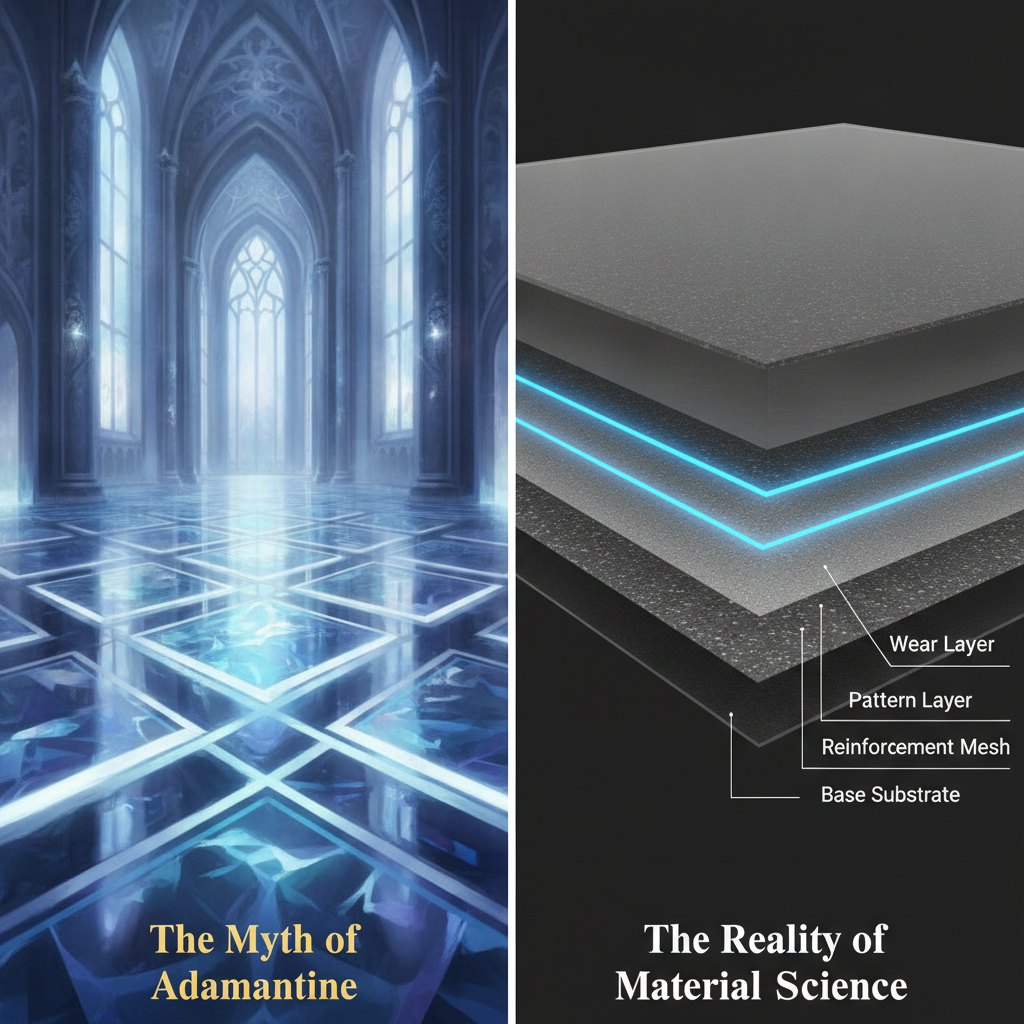
If you’ve searched for “Adamantine flooring,” you’ve likely found a mix of fantasy references and historical curiosities. So, is it a real product you can buy today? The short answer is no, but the concept it represents is very real.
Historically, the term refers to “adamantine clinkers,” a type of vitrified ceramic tile popular in the late 19th and early 20th centuries. These were incredibly dense, tough, and water-resistant pavers, often used in high-traffic industrial and commercial settings. While you can’t walk into a store and buy new adamantine clinkers, the spirit of these tiles—their near-indestructibility—lives on in a new generation of high-performance materials.
Today, the search for “adamantine flooring” is the search for the pinnacle of durability. The modern equivalents are not single products but rather systems engineered for extreme resilience. Two of the truest successors to this legacy are:
- High-Performance Epoxy Coatings: These are not your DIY garage floor kits. Professional-grade, multi-layer epoxy systems create a seamless, non-porous surface that is chemically bonded to the concrete below. Modern epoxy coatings can achieve compressive strengths exceeding 10,000 psi, making them incredibly resistant to abrasion, impact, and chemical spills.
- Polished Concrete: By grinding the concrete subfloor with progressively finer diamond-impregnated pads and treating it with a chemical densifier, you create a floor surface with a marble-like sheen and immense durability. According to standards set by bodies like the American Concrete Institute (ACI), properly finished concrete is a long-lasting and robust flooring solution.[1]
So, while the original product is a piece of history, the ideal it represents—a floor that resists almost anything you can throw at it—is more achievable today than ever before.
The Science of Floor Failure: Why Floors Fade and Wear Out
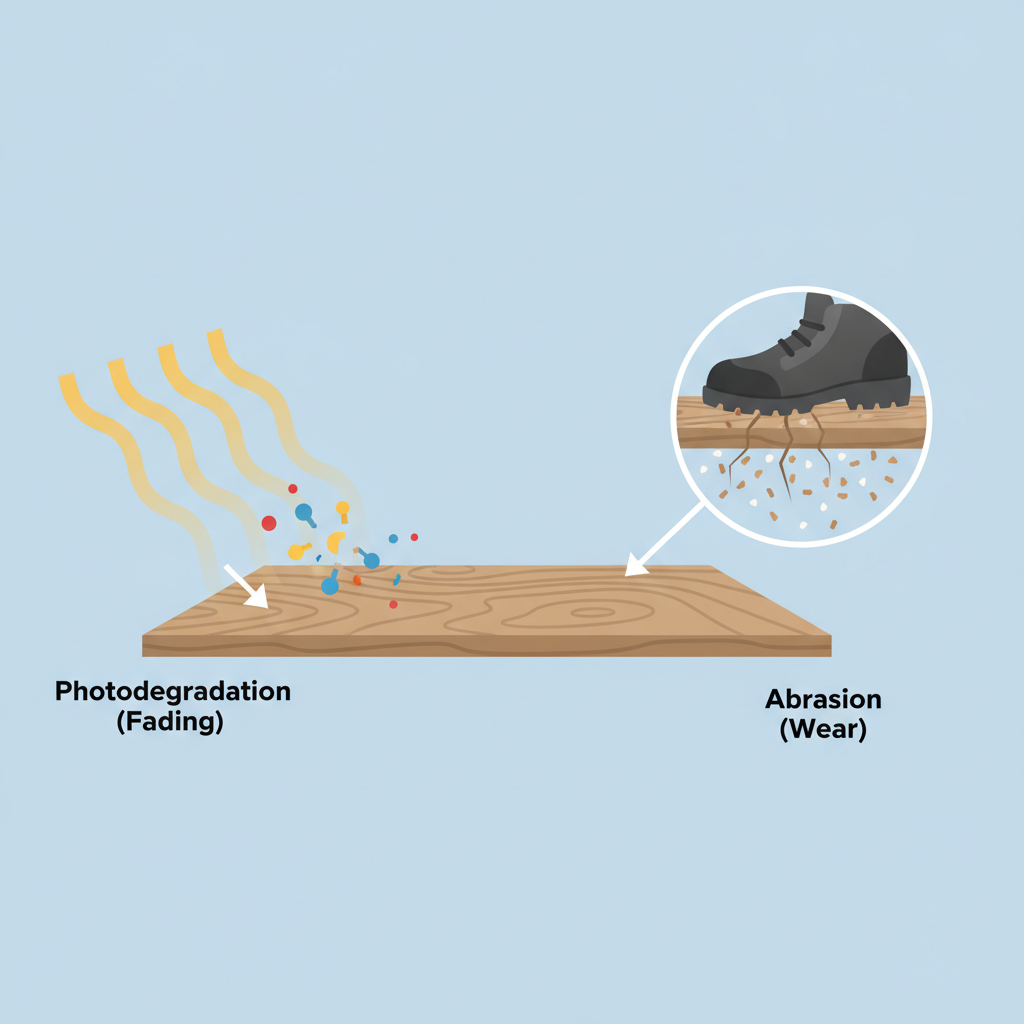
To choose a floor that lasts, you must first understand the forces working to destroy it. Every day, your floors are under a two-pronged attack: the mechanical assault of foot traffic and the chemical assault of sunlight.
Pro Panel Insight
“Think of a floor’s finish like the clear coat on a car,” explains a leading flooring finish chemist. “It’s a microscopic layer designed to take the abuse. Every gritty shoe sole acts like sandpaper, slowly abrading that protective layer. Once it’s compromised, you’re damaging the actual flooring material, leading to irreversible wear.”
Understanding Wear Patterns: The Impact of Abrasion and Traffic
Have you ever noticed a dull, discolored path in your carpet or a worn-down area in your hardwood floor’s finish? This is a classic wear pattern, often called “traffic lane graying” in the carpet industry.[2] It’s not just dirt; it’s physical damage caused by two key factors:
- Concentrated Traffic: Pedestrian studies show that people are creatures of habit. In many layouts, a staggering 80% of movement is concentrated over less than 20% of the floor area. This creates superhighways of foot traffic from the door to the sofa or down a central hallway.
- Abrasion: The primary culprit is silica—tiny, sharp particles of sand and grit tracked in on shoes. As you walk, these particles are ground against the floor, acting like low-grade sandpaper that slowly erodes the protective finish. Technical documents from finish manufacturers like Bona detail how this constant friction is the number one enemy of a floor’s surface.[4]
Decoding Sun Damage: How UV Rays Degrade Your Flooring
The sun’s rays feel wonderful, but they are a relentless enemy to your floor’s color and integrity. This damage, known as photodegradation, is a chemical process driven by ultraviolet (UV) and infrared (IR) radiation. Research from sources like the U.S. Department of Energy shows that UV radiation is responsible for about 40% of the fading process, with solar heat and visible light contributing the rest.[5]
This light energy breaks down the chemical bonds in your flooring. In wood, it degrades lignin, a natural polymer that gives wood its rigidity, causing it to change color. According to research from institutions like the Forest Products Laboratory, this is why some woods lighten while others darken.[3] In carpets, vinyl, and other dyed materials, it breaks down the chemical chromophores in the dyes, causing them to lose their color and fade.
Wood Species Photosensitivity Chart
| Wood Species | Tendency with Light Exposure |
|---|---|
| American Cherry | Darkens significantly to a rich reddish-brown |
| Brazilian Cherry | Darkens from salmon-pink to a deep, rich red |
| Oak (Red & White) | Tends to amber or yellow slightly over time |
| Maple | Tends to yellow slightly over time |
| Walnut | Lightens slightly, developing rich honey tones |
Decoding Durability: How to Measure a Floor’s True Strength
Marketing terms like “durable” and “long-lasting” are meaningless without data. To make an informed choice, you need to understand the industry-standard metrics that quantify a floor’s ability to resist wear, dents, and abrasion. These ratings, established by authoritative bodies like ASTM International,[8] are the language of true durability.
For Wood: The Janka Hardness Scale
The Janka Hardness Test measures the resistance of a species of wood to denting and wear. As defined by the National Wood Flooring Association (NWFA), the test measures the force required to embed a 0.444-inch steel ball halfway into a sample of wood.[6] The higher the Janka rating, the harder and more resistant the wood is to denting.
Installer’s Take
“I always tell my clients, Janka isn’t everything, but it’s a great starting point,” says a CFI-certified installer. “A high rating like Brazilian Walnut (3680) means it will resist dents from dropped pans or high heels far better than a softer wood like Douglas Fir (660). It’s a real-world measure of impact resistance.”
For Tile: The PEI Wear Rating
The Porcelain Enamel Institute (PEI) rating, standardized by the Tile Council of North America (TCNA), classifies ceramic and porcelain tile based on the hardness of its glaze and its suitability for different levels of foot traffic.[7] This is the single most important rating to check when choosing tile for a floor.
- PEI 1: Wall use only.
- PEI 2: Light traffic (e.g., residential bathrooms).
- PEI 3: Light to moderate traffic (most residential uses).
- PEI 4: Moderate to heavy traffic (all residential and light commercial).
- PEI 5: Heavy to extra-heavy traffic (all residential and heavy commercial).
For a truly durable floor, look for a PEI rating of 4 or 5. This is especially true for porcelain, which also boasts a water absorption rate of less than 0.5%, making it virtually waterproof.
For Laminate: The Abrasion Class (AC) Rating
Laminate flooring uses an Abrasion Class (AC) rating to indicate its durability. This rating reflects how well the floor resists abrasion, impact, stains, and burns.
- AC1: Light residential (e.g., bedrooms).
- AC2: General residential (e.g., living rooms).
- AC3: Heavy residential / Light commercial.
- AC4: General commercial.
- AC5: Heavy commercial (e.g., department stores, public buildings).
Pro Panel Insight
“In our facilities, we don’t even consider anything less than AC4,” notes a commercial facilities manager. “For main corridors and entryways, we specify AC5. It’s the only way to ensure the printed design layer is protected from wearing away under thousands of footsteps a day.”
For Vinyl: The Wear Layer Thickness (Mils)
For Luxury Vinyl Tile/Plank (LVT/LVP), the most critical durability factor is the thickness of its wear layer. This is a clear top coat that protects the printed design layer from scratches and wear. It is measured in mils (one-thousandth of an inch). Do not confuse a mil with a millimeter (1 mil = 0.0254 mm). According to the Resilient Floor Covering Institute (RFCI), a thicker wear layer provides greater protection.[9]
- 6-10 mil: Basic residential use.
- 12-20 mil: High-traffic residential and light commercial.
- 20+ mil: The gold standard for commercial applications and the best choice for busy homes with pets and kids.
Visually, the wear layer is the topmost transparent surface that sits above the printed design and the rigid core of the vinyl plank.
The Champions of Durability: Top Wear & Fade Resistant Flooring
Now that you understand the science of failure and the metrics of strength, let’s look at the materials that excel. The key to resisting wear patterns and fading lies in the floor’s composition—whether its protection is just on the surface or runs through its entire body.
From the Lab
“The holy grail of wear resistance is ‘depth of wear,'” says a flooring product developer. “A surface-level finish can always be worn away. But if the color and pattern are integral to the entire product, a scratch or chip reveals more of the same material. It becomes functionally invisible.”
Ultimate Wear Resistance: ‘Through-Body’ and Integral Color Floors
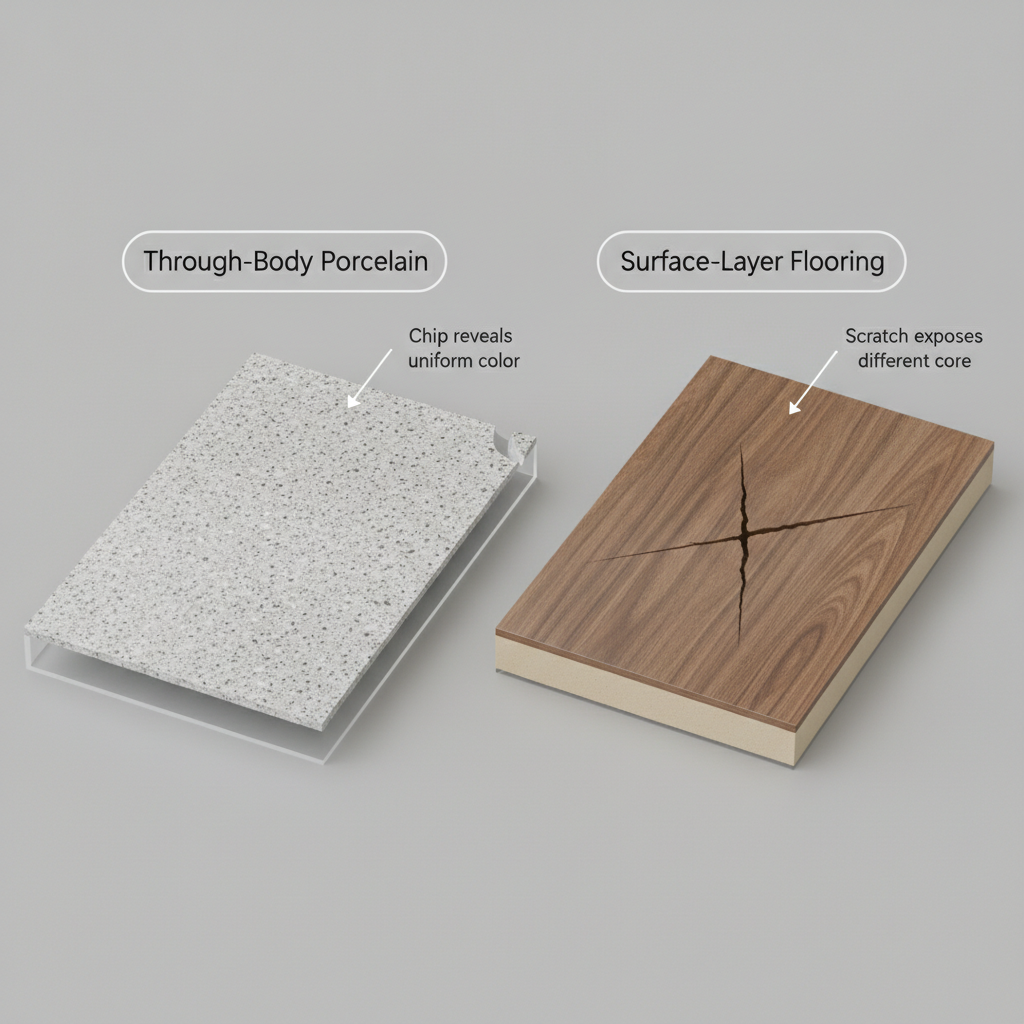
These materials are the gold standard for preventing visible wear patterns because they have no separate surface layer to wear through.
- Through-Body Porcelain: As defined in the TCNA Handbook, the color and pattern in a through-body tile extend through the entire thickness of the tile.[7] If it chips, the color underneath is the same as the color on top, making damage incredibly difficult to spot. This is the ultimate “depth of wear” solution.
- Vinyl Composition Tile (VCT): A workhorse in commercial spaces like schools and grocery stores, VCT is made of colored vinyl chips, fillers, and binders that are fused into solid sheets. Its color is integral throughout the tile, so scratches and scuffs don’t remove the color.
- Terrazzo: This classic material, consisting of marble, quartz, or granite chips set in a binder, is known for its incredible longevity. As outlined by organizations like the Terrazzo, Tile and Marble Association of Canada (TTMAC), its pattern is its entire composition, making it a lifetime floor that can be re-polished and restored indefinitely.[10]
High-Tech Surfaces: LVT, Laminate, and Epoxy
These modern marvels rely on advanced surface technology to achieve their adamantine-level durability.
- High-Performance LVT & Laminate: The best products in these categories (20+ mil wear layer LVT, AC5 laminate) feature a top coating infused with microscopic particles of aluminum oxide. This compound is one of the hardest minerals on earth, providing exceptional resistance to scratches and scuffs. This protective layer is often cured with UV light in the factory, a process detailed by coatings experts like Bona and PPG Industries, creating a harder, more durable finish than can be applied on-site.[4], [11]
- Epoxy Mortar Systems: Going beyond simple coatings, these systems mix epoxy resin with sand or quartz aggregates to create a floor that is 1/8th to 1/4th inch thick. According to data from the Floor Covering Institute, these systems can have a compressive strength of up to 15,000 psi—four to five times stronger than standard concrete—making them suitable for the most demanding industrial environments.[12]
Soft Surface Solutions: Solution-Dyed Carpet Fibers
For those who want a soft surface, the problem of traffic lanes and fading has a high-tech solution: solution-dyed fibers. The Carpet and Rug Institute (CRI) explains that in this process, the color pigment is added to the nylon or polyester polymer while it is still in a liquid state.[13] The color becomes an integral part of the fiber itself, like the color of a carrot. This is in contrast to traditional methods where the finished fiber is dipped in dye, coloring only the outside, like a radish.
Designer’s Choice
“For any commercial project—offices, hotels, you name it—I only specify solution-dyed nylon,” states a commercial interior designer. “It’s virtually stain-proof, it doesn’t fade from sunlight in lobbies, and it resists traffic lane graying. The long-term appearance retention is simply unmatched.”
Scenario-Based Buying Guide: The Perfect Floor for Your Needs
The “best” floor is not a one-size-fits-all answer. It’s the material that best solves your specific challenges. Here’s how to apply this knowledge to common high-demand scenarios.
Best Flooring for High-Traffic Areas (Entryways, Hallways, Commercial Spaces)
These areas demand the highest level of abrasion resistance. When specifying flooring for these applications, professionals often refer to construction standards like the CSI MasterFormat, which places flooring under Division 09 Finishes.[14]
- Good: AC4 or AC5 Rated Laminate. Offers excellent scratch resistance and a durable finish at a good price point.
- Better: 20+ Mil Wear Layer LVT. Provides superior water resistance, good sound absorption, and a resilient, comfortable feel underfoot while still being highly durable.
- Best: Through-Body Porcelain Tile or Epoxy Coating. These offer the ultimate in wear resistance. Porcelain is nearly indestructible, while epoxy provides a seamless, industrial-grade surface that can handle rolling loads and constant traffic.
Best Flooring for Homes with Pets
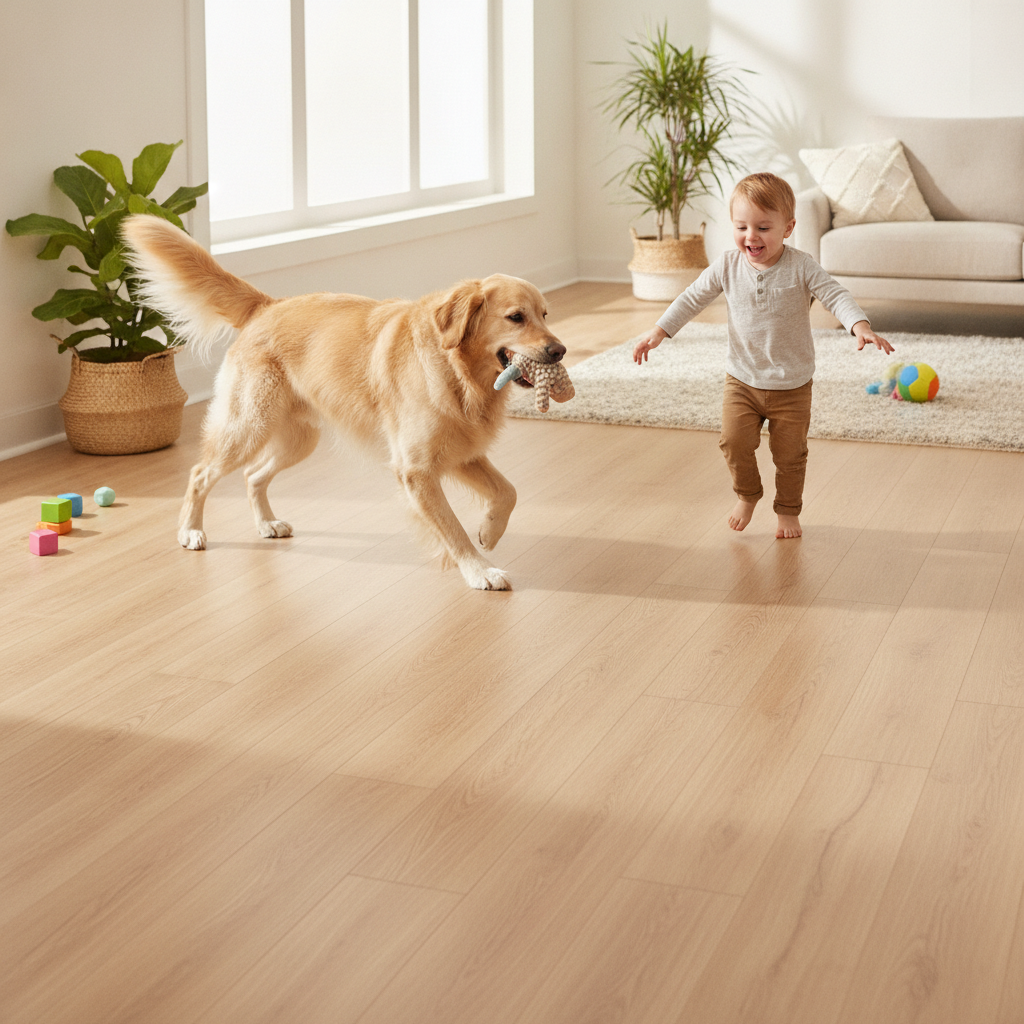
Pet owners need a trifecta of features: scratch resistance, impermeability to accidents, and good traction for their furry friends’ safety.
Pet-Proof Flooring Scorecard
| Flooring Type | Scratch Resistance | Waterproofing | Pet Traction |
|---|---|---|---|
| LVT (20+ mil) | Excellent | Excellent | Good |
| Laminate (AC4+) | Excellent | Good (with top-down protection) | Fair to Good |
| Porcelain Tile | Excellent | Excellent | Fair (choose textured) |
The American Kennel Club (AKC) highlights the importance of traction, especially for senior dogs or those with joint issues, as slippery surfaces can cause injury.[15] While tile is incredibly durable, its slick surface can be a problem; look for textured tiles or use area rugs. For this reason, high-quality LVT is often the top recommendation, balancing durability with pet safety and comfort.
Best Flooring for Sun-Drenched Rooms
For rooms with large windows, your primary concern is UV resistance. Your first line of defense should always be mitigation. According to the National Fenestration Rating Council (NFRC), modern Low-E (low-emissivity) window films can block up to 99% of harmful UV rays without significantly darkening the room.[16]
Expert Advice
“I always tell clients that window film is the cheapest insurance for their expensive floors and furniture,” says a window treatment specialist. “It’s a one-time investment that protects everything in the room from UV degradation, 24/7.”
- Inherent Resistance: Porcelain tile and natural stone are inorganic and will not fade. They are the most worry-free options.
- Applied Resistance: Look for LVT and factory-finished hardwoods that explicitly advertise UV-inhibiting finishes. Solution-dyed carpet is also an excellent choice.
Beyond the Material: Protecting Your Investment for Decades
Even the most “adamantine” material can fail if not installed or maintained correctly. True longevity comes from a holistic approach.
Studies from the National Association of Home Builders (NAHB) on the life expectancy of home components show that durable materials like slate and hardwood can last for over 100 years, but only with proper care.[17] The total cost of ownership is a critical factor. A cheaper floor that needs replacing every 10 years is a far worse investment than a more expensive one that lasts a lifetime.
Consider a homeowner with original 75-year-old oak floors. They’ve been sanded and refinished three times over the decades, each time looking brand new. This repairability is a key component of longevity that non-refinishable floors like LVT or laminate lack.
Total Cost of Ownership Comparison (Conceptual)
| Flooring | Initial Cost | Est. Lifespan | Refinishable? |
|---|---|---|---|
| Builder-Grade Carpet | Low | 5-10 Years | No |
| High-Quality LVT | Medium | 20-30 Years | No |
| Solid Hardwood | High | 100+ Years | Yes (5-7 times) |
| Through-Body Porcelain | High | Lifetime | No (but restorable) |
Conclusion
The legend of “Adamantine flooring” speaks to a universal desire for permanence, beauty, and value. While the mythical material itself is a relic of the past, the ideal it represents is now a reality, accessible through the marvels of modern material science.
The key to finding your perfect floor is to move from myth to measurement. By understanding the forces of wear and fading and by learning to speak the language of durability—Janka, PEI, AC, and mils—you are no longer at the mercy of marketing hype. You can now see the science behind the surface.
The strongest floor isn’t always the best floor. The best floor is the one perfectly engineered for your life’s unique challenges—be it the pitter-patter of paws, the constant footfalls in a busy hallway, or the bright glare of the afternoon sun. Armed with this guide, you are now empowered to evaluate your options with confidence, ensuring the floor you choose is a sound investment that will deliver lasting beauty and indestructible performance for years to come.
References
- American Concrete Institute (ACI). (n.d.). ACI Standards and Publications. Retrieved from the American Concrete Institute website.
- Institute of Inspection, Cleaning and Restoration Certification (IICRC). (n.d.). IICRC Standards. Retrieved from the IICRC website.
- Forest Products Laboratory (U.S. Forest Service). (n.d.). Research Publications on Wood Photodegradation. Retrieved from the Forest Products Laboratory website.
- Bona. (n.d.). Technical Data Sheets on Floor Finishes. Retrieved from the Bona US website.
- U.S. Department of Energy. (n.d.). Energy Saver: Windows. Retrieved from Energy.gov.
- National Wood Flooring Association (NWFA). (n.d.). Official Flooring School & Technical Publications. Retrieved from the NWFA website.
- Tile Council of North America (TCNA). (n.d.). TCNA Handbook for Ceramic, Glass, and Stone Tile Installation. Retrieved from the TCNA website.
- ASTM International. (n.d.). ASTM Standards for Resilient Floor Coverings. Retrieved from ASTM International.
- Resilient Floor Covering Institute (RFCI). (n.d.). Technical Resources. Retrieved from the RFCI website.
- Terrazzo, Tile and Marble Association of Canada (TTMAC). (n.d.). TTMAC Specification Guides. Retrieved from the TTMAC website.
- PPG Industries. (n.d.). Technical Bulletins for Industrial Coatings. Retrieved from the PPG Industrial Coatings website.
- Floor Covering Institute. (n.d.). Technical Bulletins and Reports. Retrieved from the Floor Covering Institute.
- Carpet and Rug Institute (CRI). (n.d.). Carpet Fiber Types. Retrieved from the Carpet and Rug Institute website.
- Construction Specifications Institute (CSI). (n.d.). MasterFormat (Division 09 – Finishes). Retrieved from the CSI website.
- American Kennel Club (AKC). (n.d.). Choosing the Best Flooring for Dogs. Retrieved from the AKC website.
- National Fenestration Rating Council (NFRC). (n.d.). NFRC Ratings for Windows, Doors, and Skylights. Retrieved from the NFRC website.
- National Association of Home Builders (NAHB). (n.d.). Study of Life Expectancy of Home Components. Retrieved from the NAHB website.
