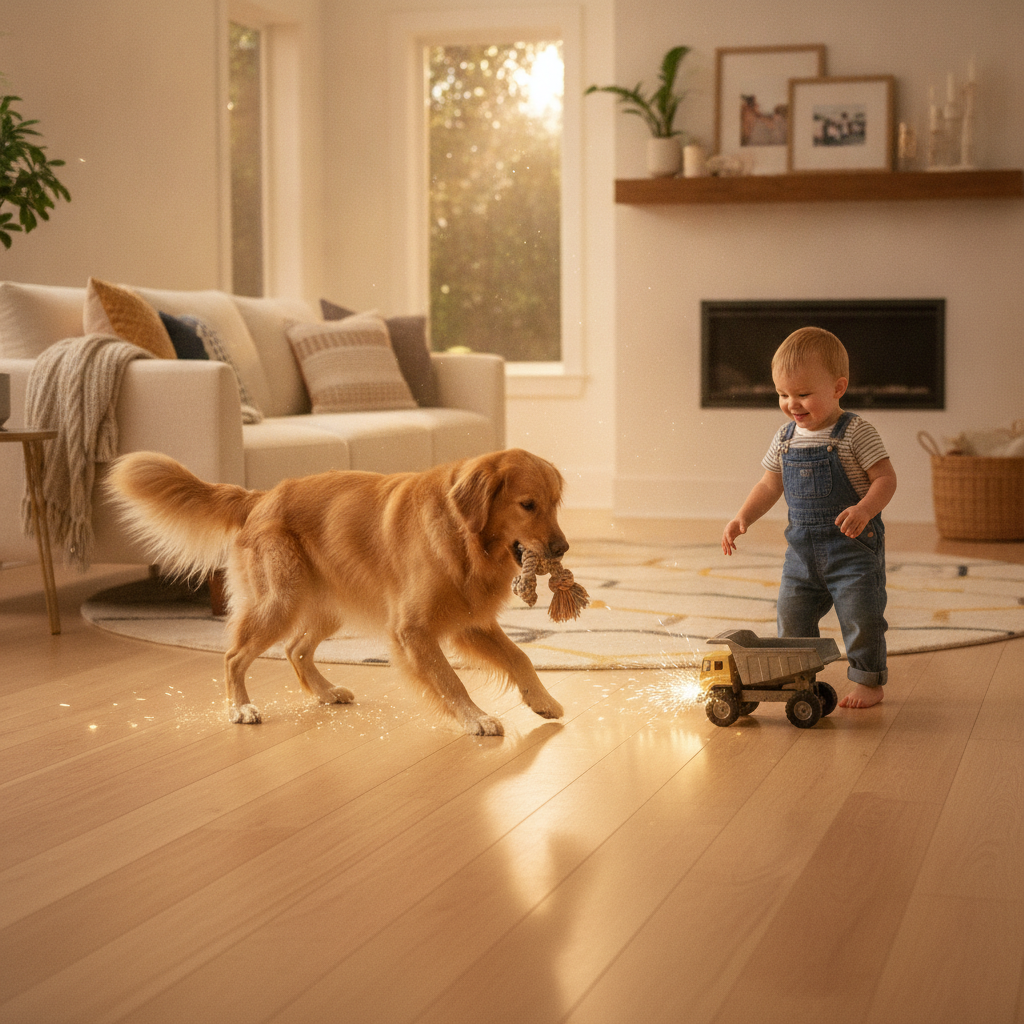
You’ve seen the search results, whispered the term, and wondered: is “Adamantine flooring” real? You’re picturing a floor forged in fantasy, a surface so impossibly tough it could withstand a dragon’s fire, let alone the daily chaos of dropped toys, skittering pet claws, and the endless parade of muddy shoes. You’re on a quest for something truly indestructible.
While you can’t install a mythical metal in your hallway, your search for an invincible, life-proof floor is completely valid. For homes bustling with the joyous pandemonium of kids and pets, standard flooring just doesn’t cut it. You need a solution that ends the constant worry about scratches, stains, and dents.
This is where fantasy meets reality. This guide bridges that gap. We won’t just list a few “durable” options. We will arm you with the knowledge to see past marketing hype and understand the science of a tough floor. We’re introducing our data-driven Family-Proof Scorecard, a unique framework that rates real-world flooring on its proven resistance to the challenges your family throws at it every single day. Get ready to find your home’s forever floor.
- What is Adamantine Flooring? From Fantasy to Your Family Room
- Decoding Durability: The Science Behind a Truly Tough Floor
- The Ultimate Flooring Showdown: The Family-Proof Scorecard
- Beyond Toughness: Health, Safety, and Maintenance for Your Family
- Frequently Asked Questions (FAQ)
- Your Quest for the Perfect Floor Ends Here
- References
What is Adamantine Flooring? From Fantasy to Your Family Room
Let’s address the core question first: “Adamantine flooring” is not a product you can buy at a showroom. The term “adamantine” or “adamant” refers to a mythical, diamond-like substance of legendary hardness and indestructibility. Its modern popularity has been supercharged by video games like Final Fantasy XIV, where players craft powerful “Adamantite” gear, and other fantasy worlds where it represents the ultimate in resilience.1
So, why are so many people searching for it? Because it perfectly captures a deep-seated need for homeowners. When you type “Adamantine flooring” into a search bar, you’re not really looking for a magical material. You’re looking for a promise: a floor that won’t scratch, won’t stain, won’t dent, and won’t make you cringe every time your toddler drops a toy or the dog gets the zoomies.
This article embraces that quest. We’ll use the concept of adamantine as our benchmark to identify and analyze the real-world flooring materials that come closest to achieving that legendary level of durability in a busy, modern home.
Decoding Durability: The Science Behind a Truly Tough Floor
To find a floor that can truly withstand family life, you have to speak the language of durability. Manufacturers use standardized rating systems to measure a floor’s toughness against specific types of wear and tear. Understanding these metrics is your secret weapon—it allows you to compare products based on hard data, not just vague promises.
Scratch & Scuff Resistance: The AC Rating and PEI Scale
This is the frontline defense against pet nails, dragged chairs, and abrasive dirt. Two key ratings tell you how well a floor will resist surface scratches.
The PEI (Porcelain Enamel Institute) Rating applies to ceramic and porcelain tile. It measures the wear resistance of the glaze on a scale from 1 to 5. According to the Tile Council of North America (TCNA), the authority on tile standards, a higher PEI rating means better abrasion resistance.2
- PEI 1-2: Suitable for wall use or very light foot traffic (e.g., a guest bathroom).
- PEI 3: Good for most residential floors.
- PEI 4-5: Designed for heavy residential and even commercial traffic. This is your target for an “adamantine-like” scratch-proof floor.
The AC (Abrasion Class) Rating is used for laminate flooring. The North American Laminate Flooring Association (NALFA) oversees these standards, which rate a floor’s resistance to abrasion, impact, stains, and burns.3
- AC1-AC2: For light residential use (e.g., bedrooms).
- AC3: Suitable for all general residential areas.
- AC4-AC5: Built for heavy residential and commercial use. These are the true workhorses that stand up to high traffic and abuse.
Expert Tip: For high-traffic family homes, flooring professionals recommend an AC rating of AC4 or higher for laminate and a PEI rating of Class 4 or 5 for tile.
Impact & Dent Resistance: The Janka Hardness Scale and Core Construction
What happens when your child drops a heavy toy or you move a bookcase? Resistance to denting is crucial.
For hardwood and bamboo, the Janka Hardness Scale is the standard. As the National Wood Flooring Association (NWFA) explains, this test measures the force required to embed a steel ball into the wood.4 A higher number means the wood is harder and more resistant to denting.
| Wood Species | Janka Hardness Rating |
|---|---|
| Red Oak (Common) | 1290 |
| Hickory | 1820 |
| Strand-Woven Bamboo | 3000+ |
| Brazilian Walnut | 3680 |
For Luxury Vinyl Plank (LVP), dent resistance comes from its core. Modern LVP often features a Solid Polymer Core (SPC), which is a dense, rigid composite of limestone and stabilizers. According to experts at the Floor Covering Institute, this SPC construction makes the plank far more resistant to dents from dropped objects and heavy furniture compared to older, more flexible vinyl or wood-plastic composite (WPC) cores.5
Water & Stain Proofing: Wear Layers and Water Absorption Rates
From spilled juice to pet accidents, your floor’s ability to repel liquid is non-negotiable.
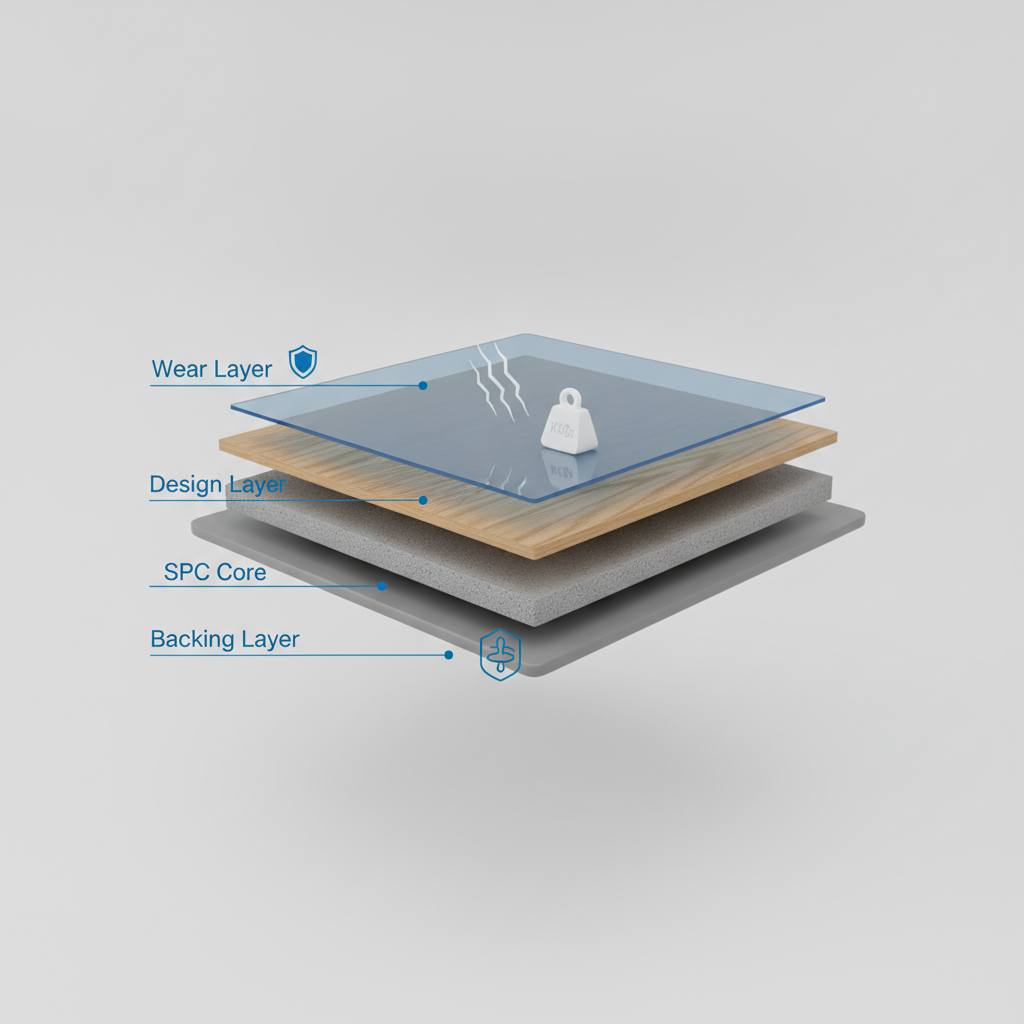
For vinyl flooring (LVP/LVT), the key is the wear layer. This is a clear, protective top coating, and its thickness is measured in mils (one-thousandth of an inch). The Resilient Floor Covering Institute (RFCI) notes that a thicker wear layer provides greater protection against scratches and scuffs, preserving the printed design below.6
- 6-10 mil: Entry-level, suitable for low-traffic areas.
- 12-20 mil: The sweet spot for most active residential homes.
- 20+ mil: Commercial-grade durability, ideal for homes with large pets or extreme traffic.
For tile, the magic is in its density. Glazed porcelain tile has a water absorption rate of less than 0.5%, a standard verified by the TCNA, making it functionally waterproof and impervious to stains soaking in.2
The Ultimate Flooring Showdown: The Family-Proof Scorecard
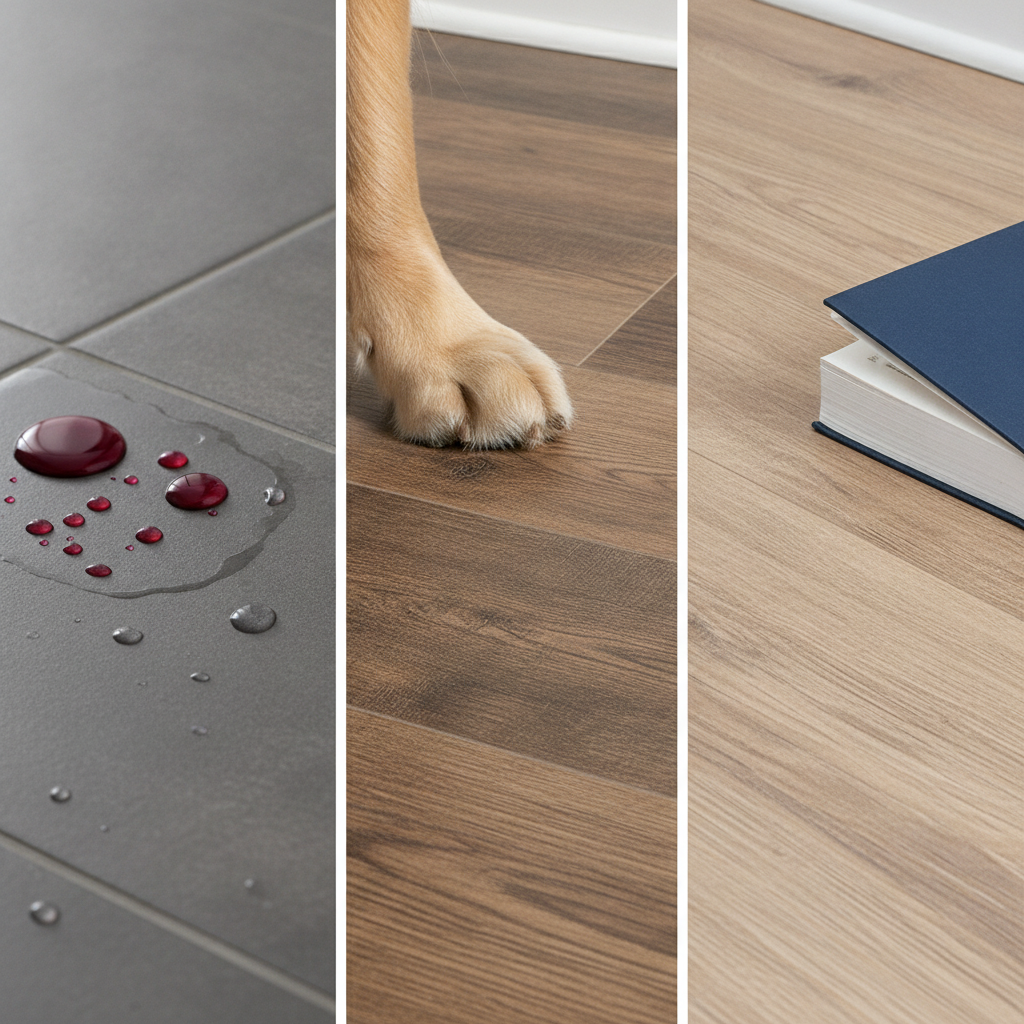
Now that you understand the science, let’s see how the top contenders stack up. We’ve created the Family-Proof Scorecard to rate each flooring type on the criteria that matter most to families. The ratings (1-5, with 5 being the best) are based on products that meet the high-performance standards discussed above (e.g., AC4+ Laminate, PEI 4+ Tile, 20 mil LVP).
| Flooring Type | Scratch Resistance | Stain/Water Resistance | Impact Resistance | Ease of Cleaning | Pet/Kid Comfort | Overall Score |
|---|---|---|---|---|---|---|
| Luxury Vinyl Plank (SPC) | 4 | 5 | 4 | 5 | 4 | 4.4 |
| Porcelain Tile | 5 | 5 | 5 | 4 | 2 | 4.2 |
| High-Performance Laminate | 5 | 3 | 4 | 5 | 3 | 4.0 |
| Strand-Woven Bamboo | 4 | 3 | 5 | 4 | 3 | 3.8 |
| Cork | 2 | 4 | 4 | 4 | 5 | 3.8 |
Champion Contender: Luxury Vinyl Plank (LVP)
LVP consistently ranks as a top choice for families, and for good reason. It’s the ultimate all-rounder. Its multi-layer construction, when equipped with a thick wear layer (20 mil or more) and a rigid SPC core, creates a floor that is highly durable, 100% waterproof, and comfortable underfoot. It masterfully balances toughness with a softer, warmer feel than tile, making it a true champion on the scorecard.
The secret to LVP’s success lies in its layers. A strong backing layer provides stability, the SPC core resists dents, the high-definition print layer offers realistic wood or stone visuals, and the transparent wear layer acts as the invisible shield against scratches and stains. As noted by the RFCI, this engineered approach delivers exceptional performance.6
The Fortress: Porcelain & Ceramic Tile
When it comes to sheer, unadulterated durability, nothing beats high-quality porcelain tile. With a PEI rating of 4 or 5, its surface is virtually scratch-proof against dog nails, furniture, and anything else your family can throw at it. Its near-zero water absorption rate makes it completely waterproof and stain-proof.2 It is, in essence, a fortress for your floor.
However, tile has a historical weakness: the grout. Traditional cement-based grout is porous and prone to staining and mildew. But modern solutions have solved this problem.
A Mini-Guide to Pet-Proof Grout:
- Epoxy Grout: This is the gold standard. It’s non-porous, chemically resistant, and will not stain. It’s more difficult to install but provides a truly indestructible, low-maintenance surface.
- High-Performance Sealers: If using cement-based grout, applying a high-quality penetrating sealer is crucial. It soaks into the grout to block moisture and prevent stains from setting in. Reapplication is needed every few years.
By choosing the right grout, you eliminate tile’s only real vulnerability, making it a top contender for the “adamantine” crown.
The High-Tech Challenger: Modern Laminate Flooring
Forget the laminate of the 1990s. Today’s high-performance laminate is a technological marvel. Its strength comes from an incredibly tough, clear topcoat, often infused with aluminum oxide—one of the hardest materials known. This gives laminates with a high AC rating (AC4 or AC5) exceptional scratch resistance, often even better than LVP.
Expert Tip from a Flooring Installer: “While LVP excels in waterproofing, a high-quality AC4 or AC5 laminate is one of the best choices for pure scratch resistance from pet claws. The aluminum oxide finish is incredibly tough.”
While most laminate is not fully waterproof, many modern product lines now feature enhanced water-resistant cores and edge sealants, making them suitable for kitchens and half-baths. Always check the manufacturer’s warranty regarding water exposure. For pure scratch and dent defense in living rooms, hallways, and bedrooms, high-tech laminate is a formidable challenger, backed by standards from NALFA.3
Other Resilient Options: Cork, Linoleum, and More
Beyond the top three, other resilient flooring options offer unique benefits for families. The RFCI defines this category as flooring that has some “give” or elasticity.6
- Cork: The ultimate comfort floor. Cork is naturally cushioned, making it softer on joints and safer for toddler tumbles. Its cellular structure allows it to “rebound” from impacts, resisting dents from dropped objects. It’s also naturally antimicrobial and a great insulator.
- Linoleum: Not to be confused with sheet vinyl, true linoleum is an eco-friendly champion made from natural, renewable materials like linseed oil and cork dust. It’s incredibly durable and its color goes all the way through the material, so scratches are less visible.
Beyond Toughness: Health, Safety, and Maintenance for Your Family
A truly family-proof floor isn’t just tough—it’s also safe, healthy, and easy to live with. This holistic approach ensures your flooring investment contributes positively to your home environment.
Creating a Healthy Home: Low-VOCs and Air Quality
Many home products, including some flooring, can release Volatile Organic Compounds (VOCs), which are chemicals that can impact indoor air quality. For families with children, choosing low-VOC materials is a top priority.
Look for floors with third-party certifications that test for chemical emissions. The most respected is GREENGUARD Gold. According to UL, the organization behind the certification, GREENGUARD Gold certified products are tested for over 10,000 chemicals and meet the strictest standards for low VOC emissions, making them suitable for sensitive environments like schools and healthcare facilities.7
Expert Insight: The Asthma and Allergy Foundation of America (AAFA) emphasizes that improving indoor air quality is a critical step in managing asthma and allergies, and choosing low-emitting building materials is a key part of that strategy.10
Comfort & Safety: Traction for Paws and Little Feet
Durability shouldn’t come at the expense of safety. Extremely smooth, glossy floors can be hazardous for pets and toddlers.
Veterinarian Expert Tip: The American Kennel Club (AKC) warns that slippery floors can be difficult for dogs to navigate, potentially leading to slips, falls, and stress on their joints, especially in senior dogs or breeds prone to hip dysplasia.8
Look for flooring with a bit of texture. Many modern LVP and laminate products feature “embossed-in-register” (EIR) texturing, where the surface texture perfectly matches the visual grain of the wood pattern, enhancing both realism and grip. The grout lines in tile also naturally provide traction.
The Easiest-to-Clean Floors: A Maintenance Guide
A low-maintenance floor is a gift to any busy parent. LVP, tile, and modern laminate are all incredibly easy to clean, but they do have slightly different needs.
Cleaning Supplies Checklist:
- LVP & Laminate: Microfiber mop, pH-neutral floor cleaner, soft-bristle broom or vacuum (beater bar off).
- Porcelain Tile: Microfiber mop, pH-neutral cleaner (or a steam mop), grout brush for occasional deep cleaning.
Do’s and Don’ts for Family-Proof Floors:
| Floor Type | Do | Don’t |
|---|---|---|
| LVP | Use a pH-neutral cleaner. Wipe up spills promptly. | Use steam mops, abrasive scrubbers, or wax-based polishes. |
| Porcelain Tile | Use a steam mop for a chemical-free deep clean. | Use oil-based cleaners or harsh acids that can damage grout. |
| Laminate | Use a damp (not soaking wet) mop. Vacuum regularly. | Let water stand on the seams. Use “mop and shine” products. |
Experts from the Good Housekeeping Institute recommend tackling tough stains immediately with the mildest cleaner possible before moving to stronger solutions, always testing in an inconspicuous area first.11
Frequently Asked Questions (FAQ)
What is the single most scratch-resistant flooring?
Porcelain tile with a PEI rating of 4 or 5 is the most scratch-resistant flooring available. Its hardness, often compared to the scientific Mohs Hardness Scale used for minerals, makes it virtually immune to scratches from pet nails and daily wear.9
Is LVP really the best choice for a busy family?
For most families, LVP offers the best all-around balance. It earns top marks on our Family-Proof Scorecard for being 100% waterproof, highly durable, easy to clean, comfortable, and quiet underfoot. It combines the toughness of harder materials with a comfort that is perfect for a busy home.
How can I protect my existing hardwood floors from my dog?
Protecting hardwood requires a multi-pronged approach. The American Kennel Club recommends keeping your dog’s nails trimmed short and smooth, ideally using a grinder to round the edges.8 Use runner rugs in high-traffic hallways and place durable mats under food and water bowls. Ensure your floor’s finish is in good condition; a fresh coat of a durable polyurethane can add a significant layer of protection.
Your Quest for the Perfect Floor Ends Here
The search for “Adamantine flooring” is a search for peace of mind. It’s about investing in a home that supports your family’s lifestyle, rather than being a source of constant stress. While the mythical material remains in the realm of fantasy, you can achieve its real-world equivalent by making an informed choice.
By moving beyond marketing claims and using data-driven metrics like PEI ratings, AC classifications, and wear layer thickness, you can confidently select a floor that is truly built to endure. For most families, the balanced performance of high-quality Luxury Vinyl Plank (LVP) or the sheer fortitude of properly installed Porcelain Tile will come closest to that “indestructible” ideal. Use the Family-Proof Scorecard as your guide, and you can finally install a floor that lets you stop worrying and start living.
References
- Square Enix / Final Fantasy XIV Wiki. (N.D.). Adamantite. Retrieved from ffxiv.consolegameswiki.com.
- Tile Council of North America (TCNA). (N.D.). PEI Rating.
- North American Laminate Flooring Association (NALFA). (N.D.). Performance Standards.
- National Wood Flooring Association (NWFA). (N.D.). Janka Hardness Scale.
- Floor Covering Institute. (N.D.). Expert Flooring Information and Standards.
- Resilient Floor Covering Institute (RFCI). (N.D.). Resilient Flooring Information.
- GREENGUARD Certification (UL). (N.D.). GREENGUARD Certification Program.
- American Kennel Club (AKC). (N.D.). Dog Ownership Resources and Advice.
- Mohs Hardness Scale. (N.D.). Scientific standard for mineral hardness.
- Asthma and Allergy Foundation of America (AAFA). (N.D.). Healthy Home Resources.
- Good Housekeeping Institute. (N.D.). Product Testing and Cleaning Methods.
