A cracked concrete floor under a multi-ton press. Spalled joints that rattle forklifts and their operators, driving up maintenance costs. A chemical spill that eats through a coating, causing an unscheduled shutdown. These aren’t just maintenance headaches; they are significant threats to your facility’s safety, operational efficiency, and bottom line. The true cost of flooring failure is measured in downtime, damaged equipment, and compromised safety—expenses that far outweigh the initial investment in the right surface.
This guide moves beyond a simple list of products. It is a strategic framework designed for facility managers, operations directors, and engineers who need to make a proactive, long-term asset investment in their industrial flooring. We will provide the data-driven insights necessary to stop reacting to failures and start specifying a system that enhances productivity and profitability.
Together, we will explore the core engineering metrics that define a high-performance floor, conduct a detailed comparison of the leading industrial systems, provide application-specific solutions for your unique environment, and delve into the critical science of failure analysis and prevention. It’s time to build your facility on a foundation of strength and certainty.
- What Makes Flooring ‘Heavy-Duty’? Understanding the Core Metrics
- The Ultimate Comparison of High-Strength Flooring Systems
- Application-Specific Flooring Recommendations: Matching the Floor to the Facility
- Diagnosing & Preventing Flooring Failures: A Facility Manager’s Guide
- From Foundation to Finish: A Strategic Investment
- References & Authoritative Sources
What Makes Flooring ‘Heavy-Duty’? Understanding the Core Metrics
Before you can choose the right industrial grade flooring, you must speak the language of performance. Marketing terms can be misleading; true durability is defined by verifiable, scientific metrics. Understanding these core concepts is the first step in moving from guesswork to a precise engineering decision.
A common misconception is that “heavy-duty” simply means thick. In reality, it’s a complex interplay of material science and load distribution. Let’s break down the critical terms you’ll encounter.
Key Performance Indicators: A Glossary
- Compressive Strength: This is arguably the most critical metric for high load capacity flooring. Measured in Pounds per Square Inch (PSI), it indicates how much crushing force a material can withstand before it breaks. A floor under a heavy machine’s leg is under compression. High compressive strength prevents cracking and deformation under concentrated weight. The standard test for this in resinous flooring is ASTM C579.[1]
- Tensile Strength: This measures a material’s ability to resist being pulled apart. While less critical than compressive strength for most floor loads, it’s important for floors that may experience flexing or movement.
- Abrasion Resistance: This defines a floor’s ability to withstand friction and wear from traffic, such as forklift wheels turning or pallets being dragged. A floor with poor abrasion resistance will quickly lose its finish, become difficult to clean, and generate dust.
- Thermal Shock: This refers to a material’s ability to withstand rapid and extreme temperature changes without cracking, delaminating, or failing. It is a vital consideration in food and beverage facilities that use hot water wash-downs or areas near ovens and freezers.
Understanding Your Loads: Static vs. Dynamic
The forces acting on your floor are not uniform. They fall into two primary categories:
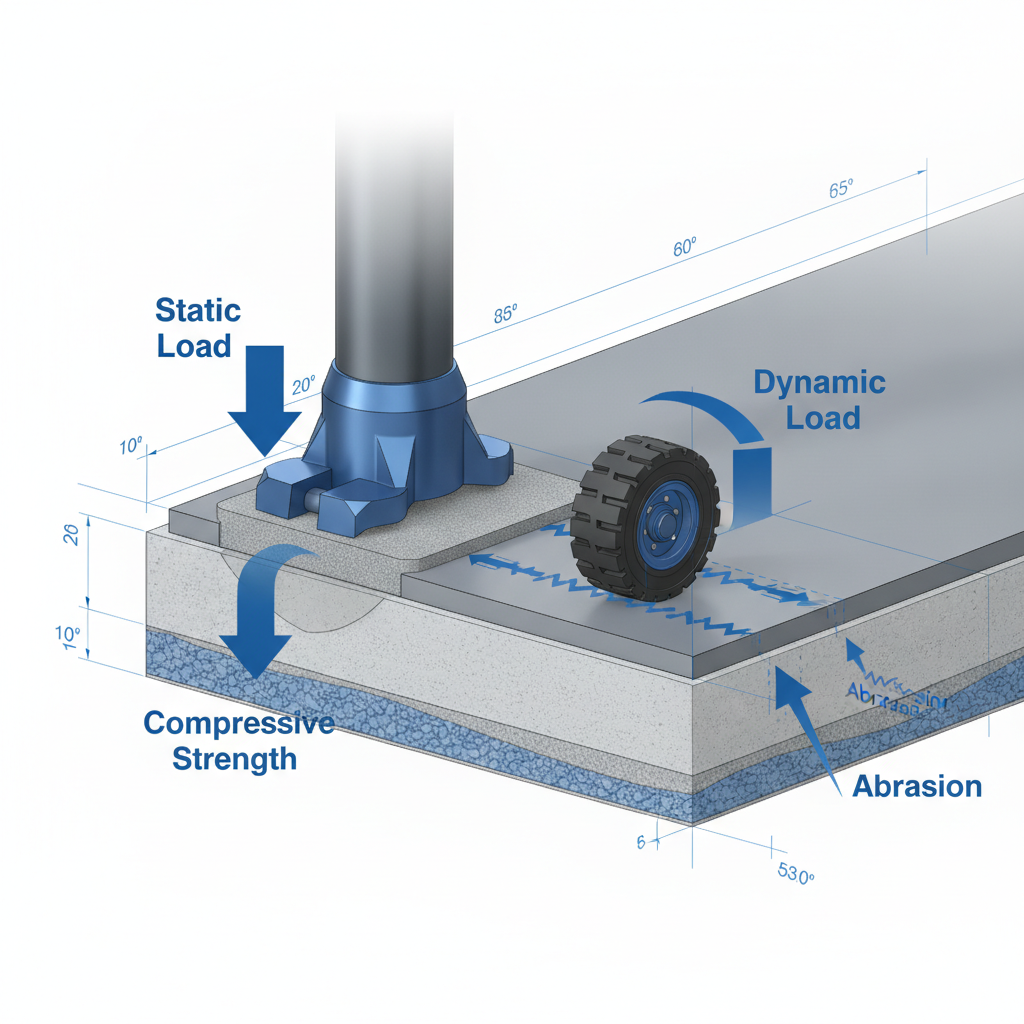
- Static Loads: These are long-term, constant forces exerted by stationary objects. Think of heavy pallet racking, large machinery, or stored materials. The weight is concentrated on small footprints (the rack legs or machine feet), requiring immense compressive strength to prevent the floor from sinking or cracking over time.
- Dynamic Loads: These are moving forces, primarily from vehicles like forklifts, pallet jacks, and automated guided vehicles (AGVs). Dynamic loads introduce additional stresses, including impact (from dropped items or hard wheels), vibration, and abrasion.
As one structural engineer might put it, “A facility manager must account for both the weight of the machine bolted to the floor and the forklift driving past it. Ignoring either static or dynamic loads is a recipe for premature failure. The metrics tell you if a system can handle the reality of your operations.”
The Ultimate Comparison of High-Strength Flooring Systems
With a grasp of the core metrics, we can now compare the leading high-strength flooring systems. It’s crucial to understand the difference between a simple, single-layer “coating” and a multi-layer “system.” A system is engineered with multiple layers—primer, body coat, and topcoat—that work together to provide superior adhesion, impact resistance, and longevity. A coating is often just a single layer of protection. For true heavy-duty applications, a system is almost always the required solution.
The following table provides a high-level comparison to guide your selection process.
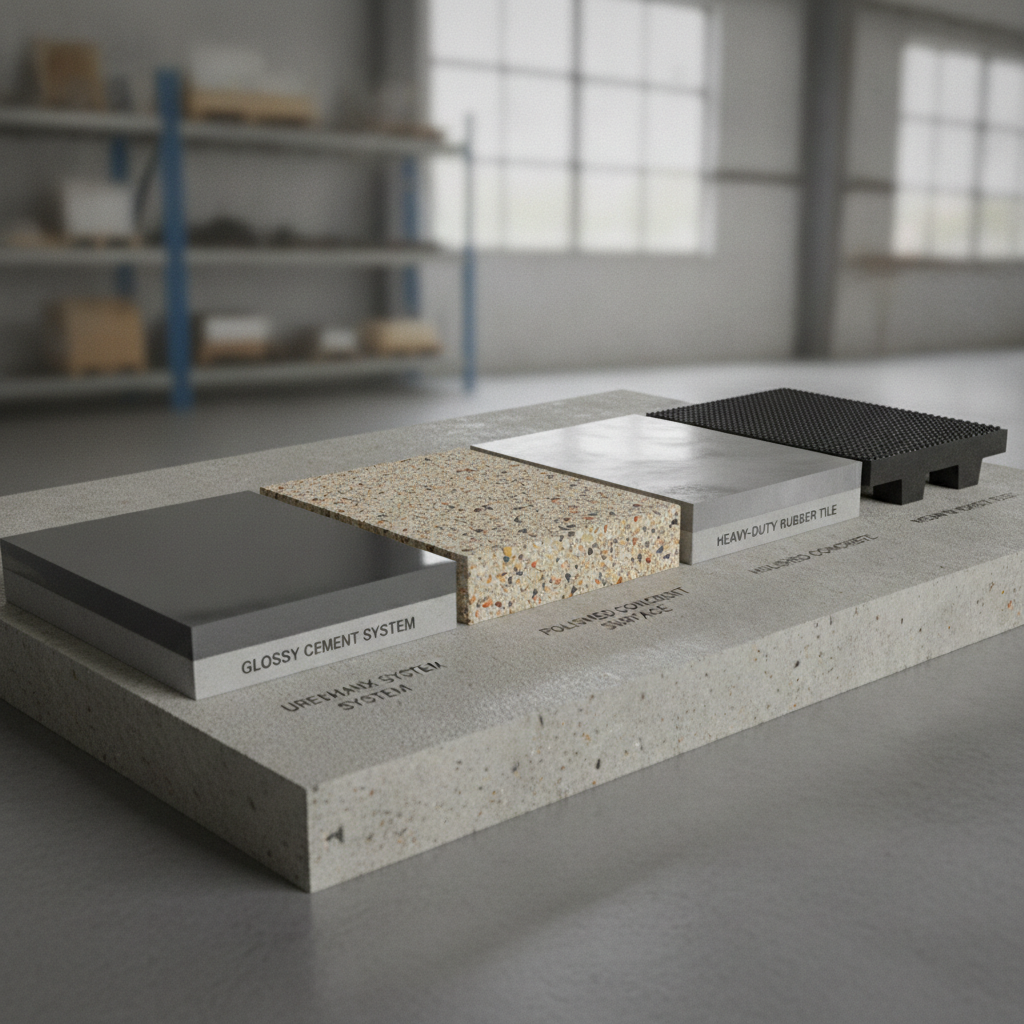
Heavy-Duty Flooring Selection Matrix
| Flooring Type | Compressive Strength (PSI) | Chemical Resistance | Curing Time / Downtime | Estimated Lifecycle Cost |
|---|---|---|---|---|
| Epoxy Resin System | 10,000 – 15,000+ | Good to Excellent | 24-72 hours | Moderate |
| Urethane Cement | 12,000 – 17,000+ | Excellent | 12-48 hours | High |
| Polished Concrete | 4,000 – 8,000+ (Slab Dependent) | Fair (Sealant Dependent) | Low (If slab is ready) | Low to Moderate |
| Heavy-Duty Rubber Tiles | N/A (Impact Absorbing) | Good | Minimal | Moderate to High |
Epoxy Resin Flooring: The Versatile Workhorse
Epoxy flooring systems are one of the most common solutions for industrial environments, and for good reason. They consist of a two-part system—a resin and a hardener—that chemically react to form a rigid, durable, and often high-gloss surface. While a basic epoxy paint from a hardware store is not an industrial solution, a professionally installed, 100% solids epoxy system is a formidable choice.
Technical data from leading manufacturers like Sherwin-Williams detail various formulations designed for specific needs, from chemical resistance to fast curing.[2] With proper installation and maintenance, a high-quality epoxy floor can last 10-20 years or more.[3] However, standard epoxies can be brittle, making them susceptible to cracking from heavy impacts, and many formulations are not UV-stable, meaning they can yellow over time when exposed to sunlight.
- Best For: Light-to-medium manufacturing, automotive service bays, warehouses, showrooms, and food processing areas (using specific USDA-approved grades).
Urethane Cement: The Unbeatable Champion of Durability
When the environment is at its most extreme, urethane cement is the undisputed champion. This three-part system combines a polyurethane resin, cementitious powders, and aggregates to create a surface with unparalleled durability. Its key advantage, as noted by experts at manufacturers like Stonhard, is its coefficient of thermal expansion, which is very similar to concrete.[4] This allows it to expand and contract with the concrete slab during extreme temperature changes, giving it superior resistance to thermal shock.
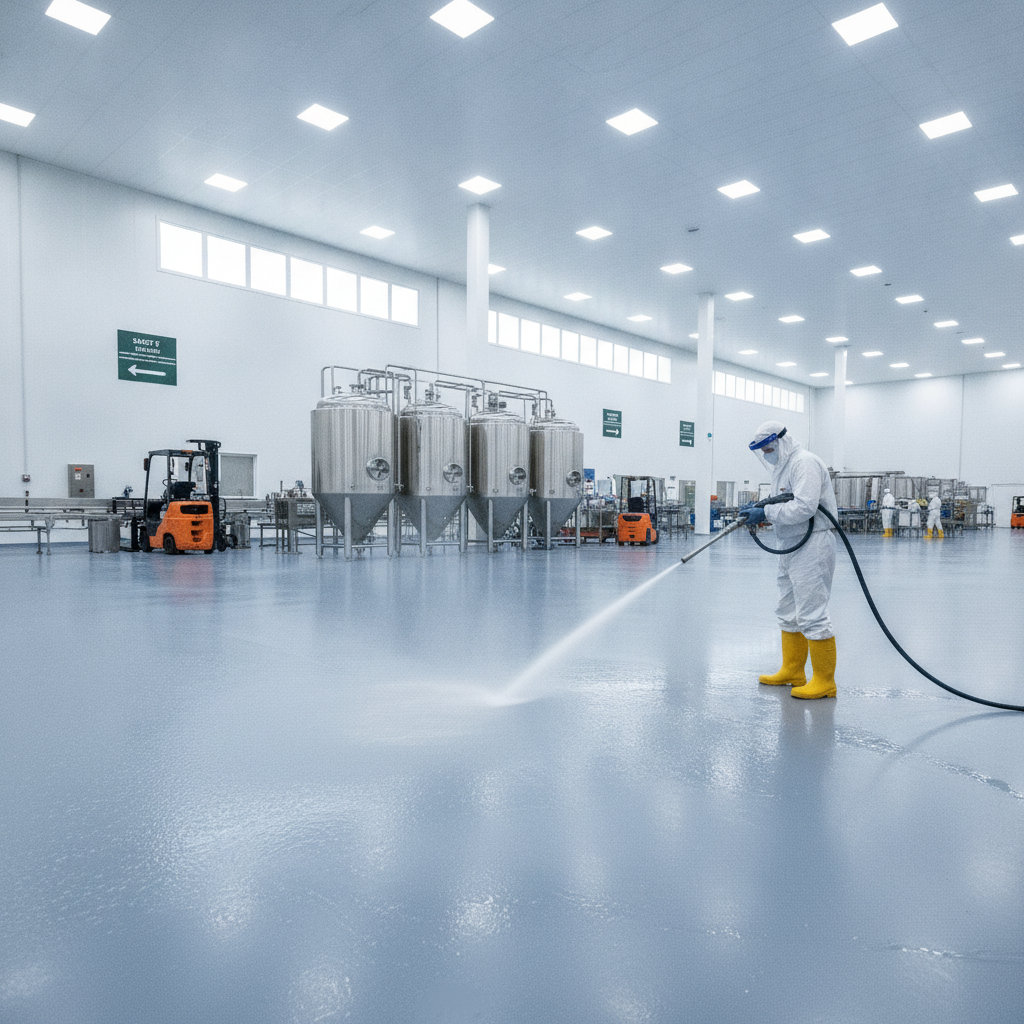
This makes it the go-to solution for facilities with hot pressure washing, steam cleaning, or proximity to ovens and freezers. Furthermore, urethane cement can often be applied to “greener” concrete (concrete that hasn’t fully cured and still has a higher moisture content), which can significantly shorten project timelines. It offers the highest level of impact, abrasion, and chemical resistance.
- Best For: Food and beverage processing, commercial kitchens, chemical plants, pharmaceutical labs, and any area subject to heavy wash-downs or extreme temperatures.
Polished & Sealed Concrete: The Economical Powerhouse
For many facilities, the most economical solution lies directly underfoot. Polished and sealed concrete utilizes the existing concrete slab as the final wear surface. The process involves mechanically grinding the surface with progressively finer diamond grits to achieve the desired level of sheen, followed by the application of a chemical densifier and a sealer. The densifier penetrates the concrete and creates a chemical reaction that hardens and dust-proofs the surface.
The success of this method is entirely dependent on the quality of the initial concrete pour. If the slab has a low PSI rating, is highly porous, or is extensively damaged, polished concrete may not be a viable option. For new construction, specifying a high-strength mix is crucial. A critical factor for warehouse safety, especially with high-reach forklifts, is the floor’s flatness (FF) and levelness (FL). These numbers, defined by standards from organizations like the American Concrete Institute (ACI), dictate how smoothly equipment can operate.[5] Poor FF/FL numbers can lead to dangerous instability in tall machinery.
- Best For: Large warehouses, distribution centers, retail spaces, and manufacturing facilities where the existing concrete is in good condition and chemical exposure is minimal.
Heavy-Duty Tiles (PVC & Rubber): The Modular Solution
Modular flooring, typically in the form of thick, interlocking PVC or rubber tiles, offers a unique set of advantages. Instead of a seamless, monolithic surface, these tiles provide exceptional point-of-use protection. Their primary benefits are impact and shock absorption. Dropping a heavy part or weight on a rubber tile is far less likely to damage the subfloor (or the part itself) than on bare concrete.
Authoritative suppliers like Greatmats recommend specific thicknesses based on the application; for areas with heavy industrial equipment and free weights, a thickness of one inch or more is often suggested.[6] Many tiles also feature a non-slip diamond shield tread for enhanced safety and offer excellent anti-fatigue properties for standing workers. If a tile is severely damaged, it can be easily popped out and replaced without re-coating the entire floor, making repairs fast and cost-effective.
- Best For: Weight rooms and gyms, manufacturing assembly lines, workshops, and specific zones around heavy machinery to absorb vibration and impact.
Application-Specific Flooring Recommendations: Matching the Floor to the Facility
A flooring system that excels in a food processing plant may fail in a heavy manufacturing facility. True expertise lies in matching the material science to the specific stresses of the environment. Here, we provide tailored recommendations for common industrial applications.
For Warehouses: Maximizing Load Capacity and Forklift Efficiency
The two greatest enemies of a warehouse floor are the immense point loads from racking and the relentless, abrasive traffic from forklifts. A floor must be specified to handle both. According to industry experts like Interlake Mecalux, a global leader in storage systems, heavy-duty warehouse floors must be rated for a minimum of 4,000 PSI and be capable of withstanding 6 to 8 tons concentrated under a single racking pillar.[7]
For the safe and efficient operation of modern equipment, especially high-reach forklifts and AGVs, FF/FL numbers are non-negotiable. A flat, level floor prevents dangerous swaying and ensures automated systems can navigate accurately.
- Top Choice: Polished and sealed concrete (on a high-quality, high-PSI slab) with armored, polyurea-filled joints to prevent spalling from forklift traffic.
- Budget-Friendly Alternative: A high-solids epoxy coating system to protect the concrete from abrasion and light chemical spills, provided the slab is structurally sound.
For Heavy Machinery Zones: Combating Impact, Vibration, and Point Loads
Areas with stamping presses, CNC machines, and other heavy industrial equipment face a trifecta of challenges: extreme concentrated weight, constant vibration, and the risk of severe impact from dropped tools or parts. The flooring system here must be robust and often requires extra thickness.
A key challenge often overlooked is vibration mitigation. Chronic vibration can not only damage the floor and the machine itself but can also be transmitted through the slab to affect other sensitive equipment in the building. Specialized rubber isolation pads placed under machinery or thick, shock-absorbing flooring systems can help dampen these forces.
- Top Choice: A thick-troweled (1/4 inch or greater) urethane cement system offers the ultimate combination of compressive strength and impact resistance.
- Budget-Friendly Alternative: A high-build, aggregate-filled epoxy mortar system can provide excellent compressive strength and durability, with heavy-duty rubber matting placed directly around machinery for added impact protection.
For Manufacturing & Factories: Resisting Chemicals and Abrasion
General manufacturing environments require a floor that is a jack-of-all-trades: durable enough for constant traffic, easy to clean, and resistant to a range of potential chemical spills (oils, coolants, cleaning agents).
For specialized industries, such as electronics manufacturing, standard flooring is insufficient. These environments require Electrostatic Dissipative (ESD) flooring. ESD systems are specifically designed to safely dissipate static charges away from sensitive electronic components, preventing catastrophic product failure.
- Top Choice: A chemical-resistant epoxy or polyaspartic top-coated system provides a durable, seamless, and easy-to-clean surface. Case studies from installers like Everlast Industrial Flooring often highlight successful applications in these environments.[3]
- Budget-Friendly Alternative: A two-coat system of a high-quality epoxy sealer and a durable urethane topcoat can offer good protection against abrasion and incidental chemical exposure.
Diagnosing & Preventing Flooring Failures: A Facility Manager’s Guide
Even the best flooring system can fail if the underlying issues aren’t addressed. A proactive approach to floor management involves understanding the warning signs, diagnosing the root cause of problems, and implementing preventative measures. This section is designed to help you shift from a reactive repair cycle to a proactive asset management strategy.
Why Floors Crack: Identifying the Root Cause of Concrete Failures
Seeing a crack in your concrete floor can be alarming. The critical first step is to determine if it’s a minor surface issue or a sign of a serious structural problem.
- Shrinkage Cracks: These are very common, hairline cracks that occur as the concrete cures and water evaporates. They are typically not a structural concern and can be filled and coated over.
- Settlement or Structural Cracks: These are more serious. Warning signs include cracks that are wider than a credit card, are vertically displaced (one side is higher than the other), or are actively growing. These can indicate an issue with the subgrade soil or an overloaded slab.
According to concrete experts at sources like the American Concrete Institute, if you see any of the warning signs of structural failure, it is imperative to contact a qualified structural engineer immediately for a professional assessment.[5] For non-structural cracks, preventative measures like honoring control joints with a flexible filler and using steel plates to distribute concentrated loads from machine feet can prevent future issues.
The Hidden Costs of Forklift Damage (And How to Stop It)
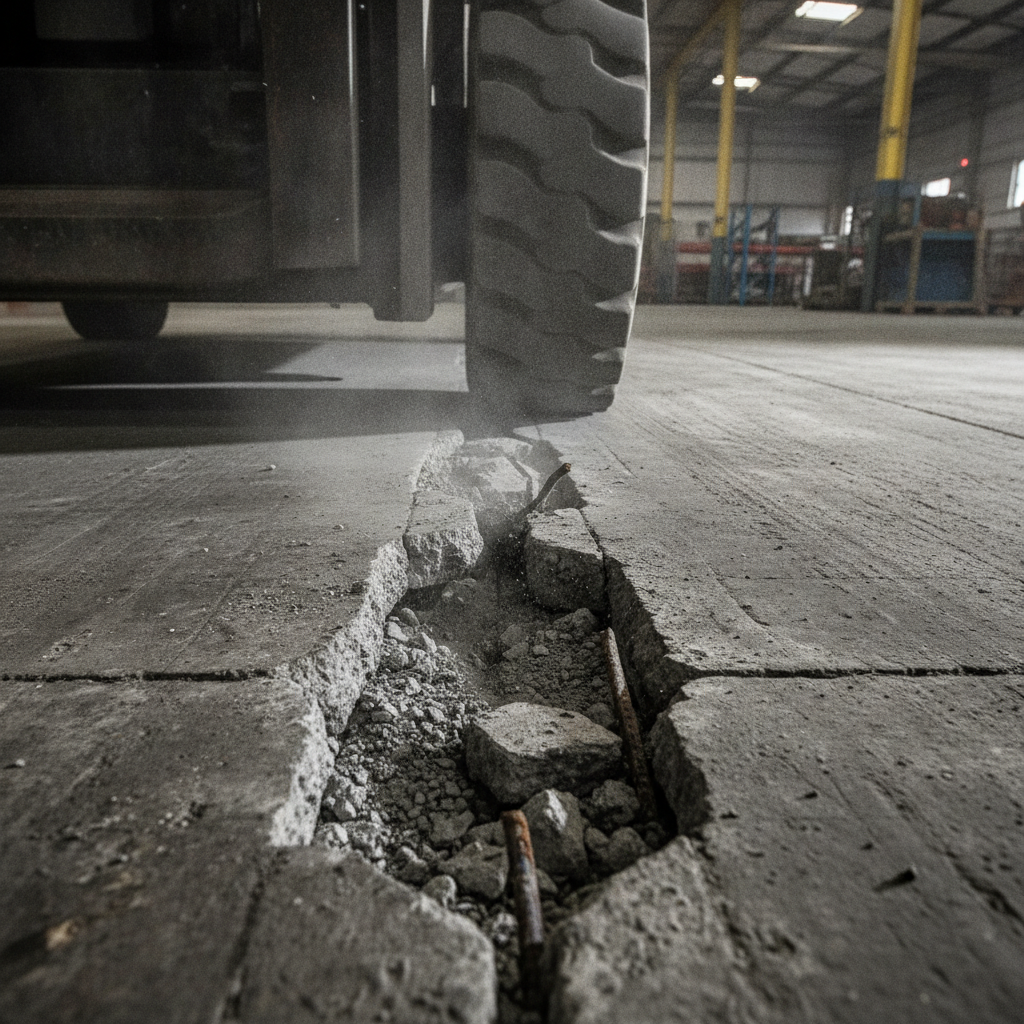
The connection between floor quality and forklift maintenance is one of the most significant hidden costs in any facility. Damaged, uneven floors and spalled joints don’t just slow down operations; they actively destroy your equipment.
The data is staggering. According to a report highlighted by Toyota Forklifts, a leading equipment manufacturer, a full 20% of all forklift maintenance is directly caused by poor flooring conditions.[9] They further note that 50% of all tire repairs and replacements are a result of driving over bad concrete and expansion joints.[9]
ROI Calculation: Floor Repair vs. Forklift Maintenance
Consider a simple calculation:
- Cost of professional joint repair: $X
- Cost of one set of forklift tires: $Y
- Number of excess tire replacements per year due to bad floors: Z
The annual excess maintenance cost is (Y * Z). In many cases, the one-time cost of repairing the floor (X) is less than just one or two years of these inflated maintenance expenses.
To stop this cycle, invest in repairing damaged control joints with flexible polyurea fillers and consider armoring the edges of joints in high-traffic areas with embedded steel angles. Furthermore, ensure operators are using the correct type of forklift wheels (e.g., softer cushion tires vs. hard pneumatic tires) for your specific floor surface.
Subfloor Integrity: The Unseen Foundation of Success
No flooring system, no matter how advanced, can outperform a failing subfloor. The substrate—be it concrete, wood, or metal—is the true foundation. Proper subfloor preparation is the most critical step in any flooring installation. This includes mechanical grinding to create a surface profile for adhesion, moisture testing and mitigation, and repairing all existing damage.
Signs of a failing subfloor, as noted by professional inspectors,[10] can include spongy or bouncy areas, unexplained floor sagging, and popping or creaking sounds under load. These are serious safety warnings that require immediate attention. Whether your subfloor is plywood, Oriented Strand Board (OSB), or a concrete slab, each has specific failure modes. Water damage is a common culprit for wood-based subfloors, while an improperly prepared subgrade can lead to concrete slab failure.
Ultimately, the load-bearing capacity of your entire flooring system is limited by the strength of its weakest link—the subfloor.
From Foundation to Finish: A Strategic Investment
Choosing a heavy-duty industrial floor is far more than a maintenance decision; it is a strategic investment in your facility’s core operational health. By moving beyond product names and focusing on the core metrics of compressive strength, load types, and environmental resistance, you empower yourself to specify a solution engineered for success.
The key takeaway is to match the system to the specific application—the thermal shock resistance of urethane cement for a food processing plant, the load capacity and FF/FL numbers of polished concrete for a modern warehouse, and the impact absorption of rubber tiles for a heavy machinery zone. By understanding the root causes of failure, from forklift damage at the joints to the critical importance of subfloor integrity, you can shift from a costly, reactive repair cycle to a proactive management strategy. A durable, well-chosen floor is an asset that pays dividends every day through enhanced safety, increased efficiency, and reduced operational costs.
Ready to make a confident flooring decision? Download our free ‘Industrial Flooring Project Checklist’ to ensure you ask the right questions and specify the perfect system for your facility.
Disclaimer: The information provided is for educational purposes. Always consult with a qualified structural engineer and professional flooring contractor for your specific facility’s needs and to ensure compliance with local building codes.
References & Authoritative Sources
- ASTM International. (n.d.). ASTM C579 – 18 Standard Test Methods for Compressive Strength of Chemical-Resistant Mortars, Grouts, Monolithic Surfacings, and Polymer Concretes. Retrieved from ASTM International.
- Sherwin-Williams. (n.d.). Industrial Flooring. Retrieved from the official Sherwin-Williams Industrial website.
- Everlast Industrial Flooring. (n.d.). Best Flooring Options for a Manufacturing Facility. Retrieved from the Everlast Flooring CT website.
- Stonhard. (n.d.). Industrial & Commercial Flooring. Retrieved from the official Stonhard website.
- American Concrete Institute. (n.d.). Resources & Publications. Retrieved from the American Concrete Institute (ACI) official website.
- Greatmats. (n.d.). Industrial Flooring. Retrieved from the official Greatmats website.
- Interlake Mecalux. (n.d.). Warehouse flooring: characteristics and types. Retrieved from the official Interlake Mecalux website.
- UVM Extension. (2021). Repairing Cracks and Pitting in Concrete Floors. Retrieved from The University of Vermont blog.
- Toyota Forklifts. (n.d.). Concrete Floors and Forklifts: From Damage Impacts to Friction. Retrieved from the official Toyota Forklift blog.
- OC Flooring Inspection. (n.d.). Subfloor Issues Causes & Solutions. Retrieved from the official OC Flooring Inspection website.
