If you are a homeowner or real estate investor, you are likely intimately familiar with the frustrating cycle of frequent floor replacement. You invest in what appears to be a high-quality surface, only to watch it succumb to scratches, delamination, and premature wear within a few short years. Worse still is the flimsy underfoot feel—that hollow, bouncy sensation that instantly undermines the perceived quality and structural integrity of a home.
In the quest for a permanent solution, the flooring industry frequently throws around mythological marketing terms like “adamantine flooring” to sell the promise of an indestructible surface. But what does “adamantine” actually mean when removed from the realm of fantasy and placed under the microscope of material science?
Achieving a true “forever floor” requires moving past superficial marketing hype. It demands a comprehensive blueprint that diagnoses structural issues from the joists up, compares real-world durability metrics, and provides a lifecycle roadmap for your home. This guide breaks down the hard material science and structural engineering required to permanently cure flimsy acoustics and invest in ultra-durable, premium quality flooring that lasts for generations.
- Demystifying ‘Adamantine Flooring’: Marketing Hype vs. Material Science
- The Subfloor Autopsy: Diagnosing a Flimsy Underfoot Feel
- Breaking the Cycle of Frequent Floor Replacement
- Executing a Durable Flooring Upgrade: Long-Term Solutions
- Conclusion
- References & Authority Sources
Demystifying ‘Adamantine Flooring’: Marketing Hype vs. Material Science
In modern marketing, “adamantine flooring” represents a niche, ultra-premium segment promising extreme durability. However, true adamantine quality is not a magic material; it is the result of specific chemical compositions and manufacturing processes. To separate premium quality flooring from exaggerated claims, we must look to objective material science.

ASTM International, the globally recognized authority on material testing standards, provides rigorous standardized testing protocols for hardness, abrasion resistance, and impact resistance [1]. When flooring materials are subjected to these tests, the results often separate commercial-grade titans from residential-grade pretenders. For instance, while standard residential epoxies may scratch under heavy loads, peer-reviewed data from the Journal of Materials Science demonstrates that high-end industrial epoxy coatings and advanced composites can achieve a Shore D hardness rating of 85 or higher—making them nearly impervious to standard household damage [2].
To truly understand how these materials stack up against everyday threats, we can compare them using the Mohs Hardness Scale, a scientific standard measuring scratch resistance:
- Mohs 1-2 (Very Soft): Standard vinyl, linoleum. (Easily scratched by debris).
- Mohs 3-4 (Medium Soft): Most solid hardwoods, standard marble. (Susceptible to pet claws and dropped items).
- Mohs 5-6 (Hard): Premium engineered wear layers, standard ceramic tile. (Resists daily wear, vulnerable to heavy impact).
- Mohs 7-8 (Ultra-Hard / “Adamantine”): High-end porcelain tile, quartz composites, diamond-polished concrete. (Requires specialized diamond-tipped tools to cut; virtually scratch-proof in residential settings).
The Metrics of Extreme Durability: Mohs, Janka, and AC Ratings
Understanding durable flooring requires knowing which metric applies to which material. You cannot measure wood the same way you measure laminate or stone.
For solid and engineered woods, the National Wood Flooring Association (NWFA) relies on the Janka Hardness Scale, which measures the force required to embed a 0.444-inch steel ball halfway into the wood [3]. A standard Red Oak floor sits at a Janka rating of 1290, while ultra-durable exotic woods like Brazilian Walnut (Ipe) soar past 3600.
For synthetic options like laminate and Luxury Vinyl Plank (LVP), durability is dictated by the wear layer—a clear urethane coating measured in “mils” (thousandths of an inch), and the Abrasion Class (AC) rating. While a 12-mil wear layer is standard for residential LVP, premium floors utilize a 20-mil or even 30-mil wear layer. For laminates, AC4 and AC5 ratings indicate commercial-grade durability that is highly suitable for heavy residential use, capable of withstanding heavy foot traffic, large pets, and dropped objects without compromising the photographic layer beneath.
The Most Durable Long-Lasting Floors on the Market
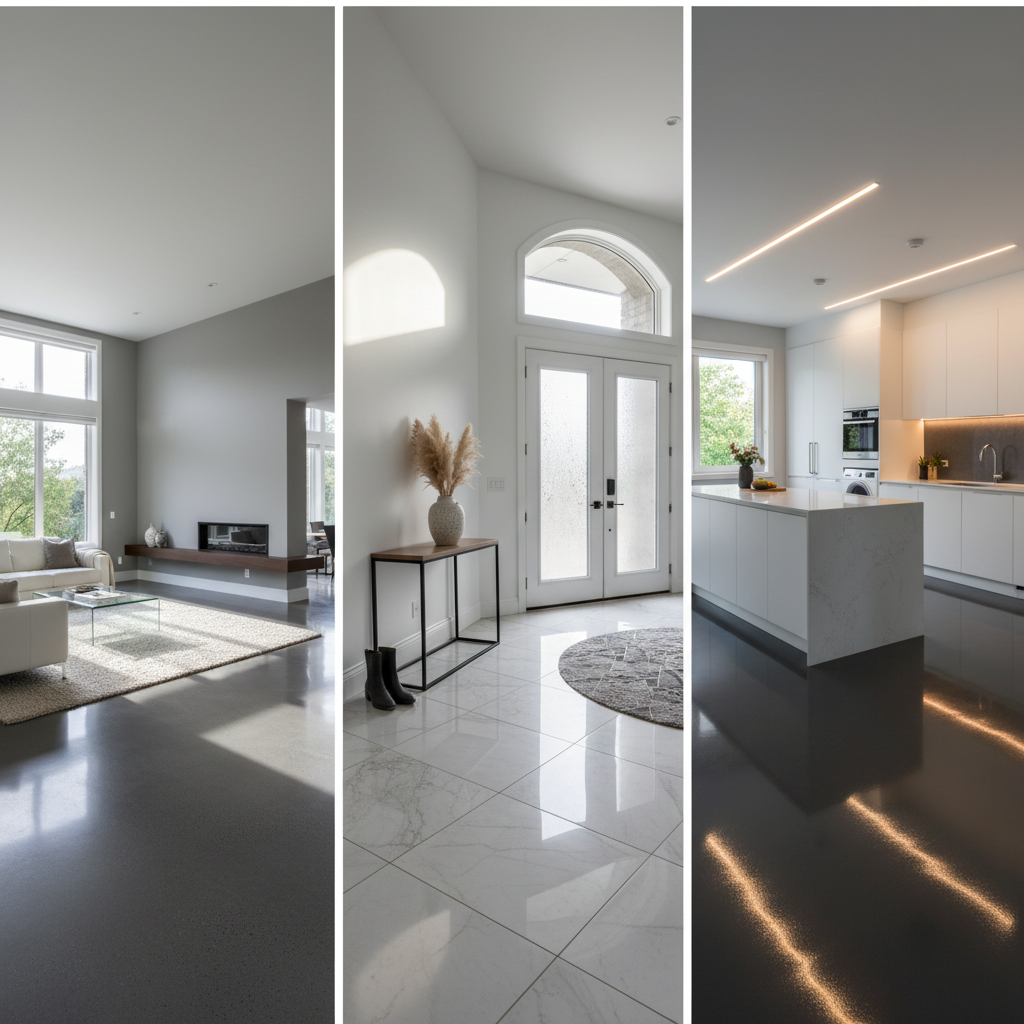
When seeking the most durable long lasting floors that fit the “adamantine” profile, three categories stand above the rest: high-end porcelain, industrial epoxies, and polished concrete.
- Polished Concrete: Often considered the ultimate forever floor, polished concrete is not just a slab; it is a mechanically ground and chemically densified surface. According to the Concrete Network, a properly maintained polished concrete floor has an expected lifespan exceeding 100 years [4]. (Estimated Cost: $8 – $15 per square foot, depending on the level of diamond polishing and staining).
- High-End Porcelain Tile: Fired at extreme temperatures, premium porcelain is incredibly dense and virtually waterproof. The Marble Institute of America notes that natural stone and high-grade porcelain boast a nearly infinite lifespan indoors if properly installed and sealed [5]. (Estimated Cost: $10 – $25+ per square foot installed).
- Industrial Epoxies and Polyaspartics: Moving beyond garage floors, these advanced chemical coatings are being adapted for modern residential interiors, offering seamless, waterproof, and highly impact-resistant surfaces. (Estimated Cost: $7 – $12 per square foot).
The Subfloor Autopsy: Diagnosing a Flimsy Underfoot Feel
You can purchase the most expensive, adamantine-grade porcelain in the world, but if the structural foundation beneath it is compromised, the floor will fail. A flimsy underfoot feel is rarely the fault of the surface material; it is a symptom of inadequate subfloor engineering.
The American Society of Civil Engineers (ASCE) dictates strict structural deflection standards to ensure floors feel solid and safely bear weight [6]. Furthermore, the International Residential Code (IRC) establishes legal floor span and deflection guidelines, commonly referred to as the L/360 rule [7]. This means a floor joist should not deflect (bend) more than its span divided by 360 when placed under a live load. If your floor exceeds this deflection, it will feel bouncy, spongy, and cheap.
Why Your Floor Bounces, Squeaks, or Sounds Hollow
A flimsy underfoot feel is typically caused by one of three structural culprits:
- Over-Spanned Joists: If the wooden joists supporting your floor are spaced too far apart (e.g., 24 inches instead of 16 inches) or span too great a distance without mid-span support, the floor will act like a trampoline. The Wood I-Joist Manufacturers Association provides strict joist span guidelines that must be adhered to during construction or remodeling to prevent this [8].
- Inadequate Subfloor Thickness: A standard 5/8-inch OSB subfloor may meet minimum code for carpet, but it is entirely inadequate for heavy natural stone or premium hardwood, leading to flex and eventual material cracking.
- Improper Underlayment: Floating floors (like laminate or LVP) often sound hollow if installed directly over an uneven subfloor without a high-quality acoustic underlayment to absorb the ambient vibration.
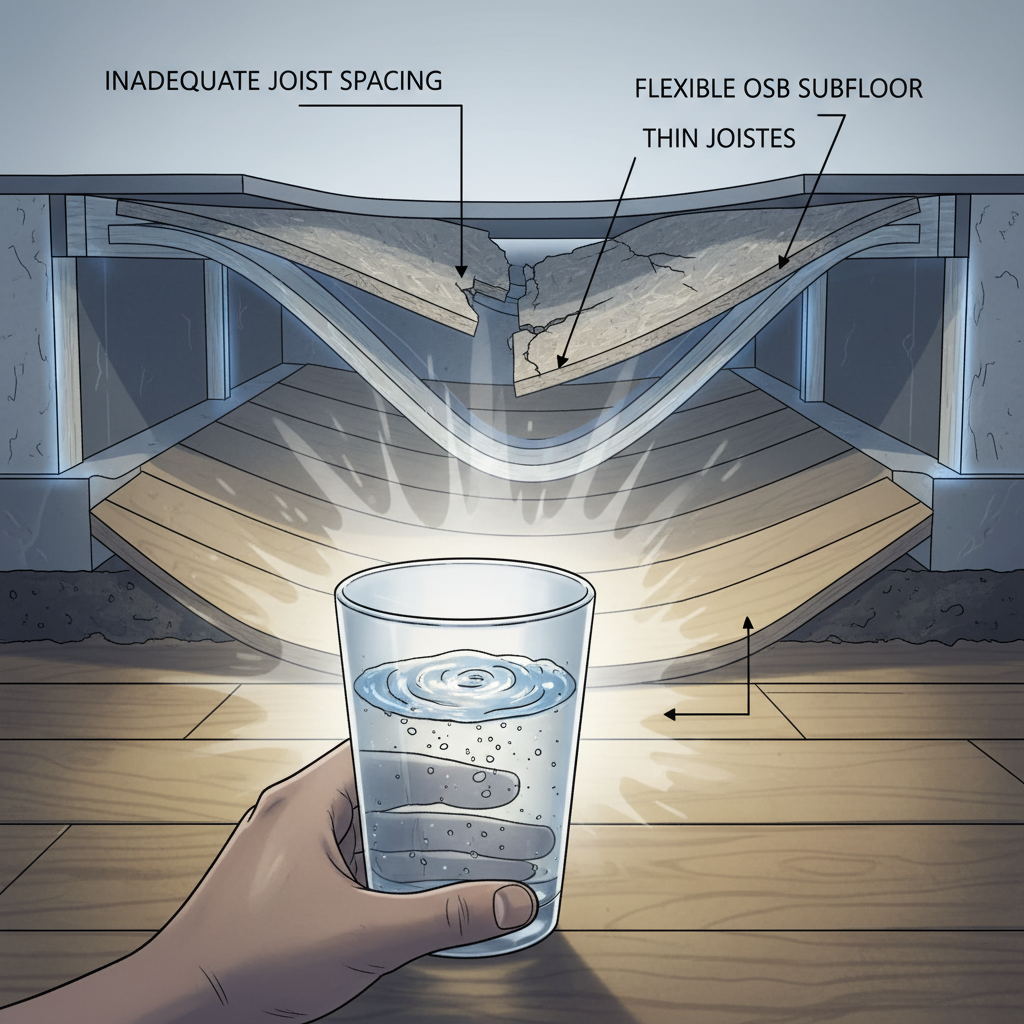
The Water Glass Test: To diagnose floor deflection yourself, place a full glass of water in the center of the room. Walk heavily (or jump lightly) about three feet away. If the water ripples violently or spills, your floor has excessive deflection.
If your floor sounds hollow but feels physically rigid, call a flooring contractor to address the underlayment. If your floor physically bounces, sags, or causes the water glass to spill, you must consult a structural engineer to assess your joists before installing any premium hard-surface flooring.
Engineering Acoustics: Underlayments and Impact Insulation
Learning how to maintain a solid underfoot feel involves mastering acoustic engineering. Sound travels through floors in two ways: airborne noise (voices, music) measured by Sound Transmission Class (STC), and impact noise (footsteps, dropped items) measured by Impact Insulation Class (IIC).
A premium acoustic underlayment made from dense cross-linked foam, cork, or recycled rubber can drastically alter the sensory experience of a room. High-quality underlayments can reduce impact noise by up to 73 IIC, transforming the cheap, plastic “click-clack” of a floating floor into a deep, solid thud reminiscent of nailed-down hardwood.
As one master structural carpenter notes:
“You cannot fix a trampoline with a heavy blanket. If the joists are sound, a dense acoustic underlayment is your best friend. But if the subfloor is thin, we have to pull it up, glue and screw a secondary layer of 3/4-inch plywood, and block the joists. That is the only way to engineer a truly solid feel.”
Breaking the Cycle of Frequent Floor Replacement
Homeowners often find themselves trapped in a cycle of frequent floor replacement, blaming the flooring material when the real culprit is an environmental failure. Over 40% of premature hard-surface flooring failures are due to improper installation, inadequate subfloor preparation, or unmitigated moisture—not standard wear and tear [9].
To break this cycle, you must be able to visually diagnose what is actually happening to your floors:
- Scratches & Scuffs: Superficial marks on the wear layer. (Normal wear).
- Gouges: Deep physical indentations penetrating the wear layer into the core. (Impact damage).
- Delamination: The top layer peeling away from the core. (Manufacturer defect or severe heat/moisture exposure).
- Cupping/Crowning: Wood or laminate planks curling at the edges or bulging in the center. (Severe moisture imbalance or hydrostatic pressure).
Normal Wear and Tear vs. Environmental Failure
Understanding flooring wear and tear is critical, especially for rental properties and insurance claims. The Department of Housing and Urban Development (HUD) defines the lifespan of standard builder-grade carpet at roughly 5 to 7 years for wear and tear purposes [10]. Fading from sunlight or minor traffic patterns constitutes normal wear.
However, cupping hardwood or peeling LVP is an environmental failure. The silent killer of ground-floor and basement flooring is hydrostatic pressure—moisture vapor rising through a concrete slab. If a floor is not properly acclimated to the home’s humidity prior to installation, or if a proper vapor barrier is omitted, the floor will fail regardless of its adamantine qualities. The Institute of Inspection, Cleaning and Restoration Certification (IICRC) sets strict standards for moisture testing concrete slabs before any hard surface is laid down [11]. Skipping this step guarantees a voided warranty and a ruined floor.
The Economics of Premium Quality Flooring That Lasts Decades
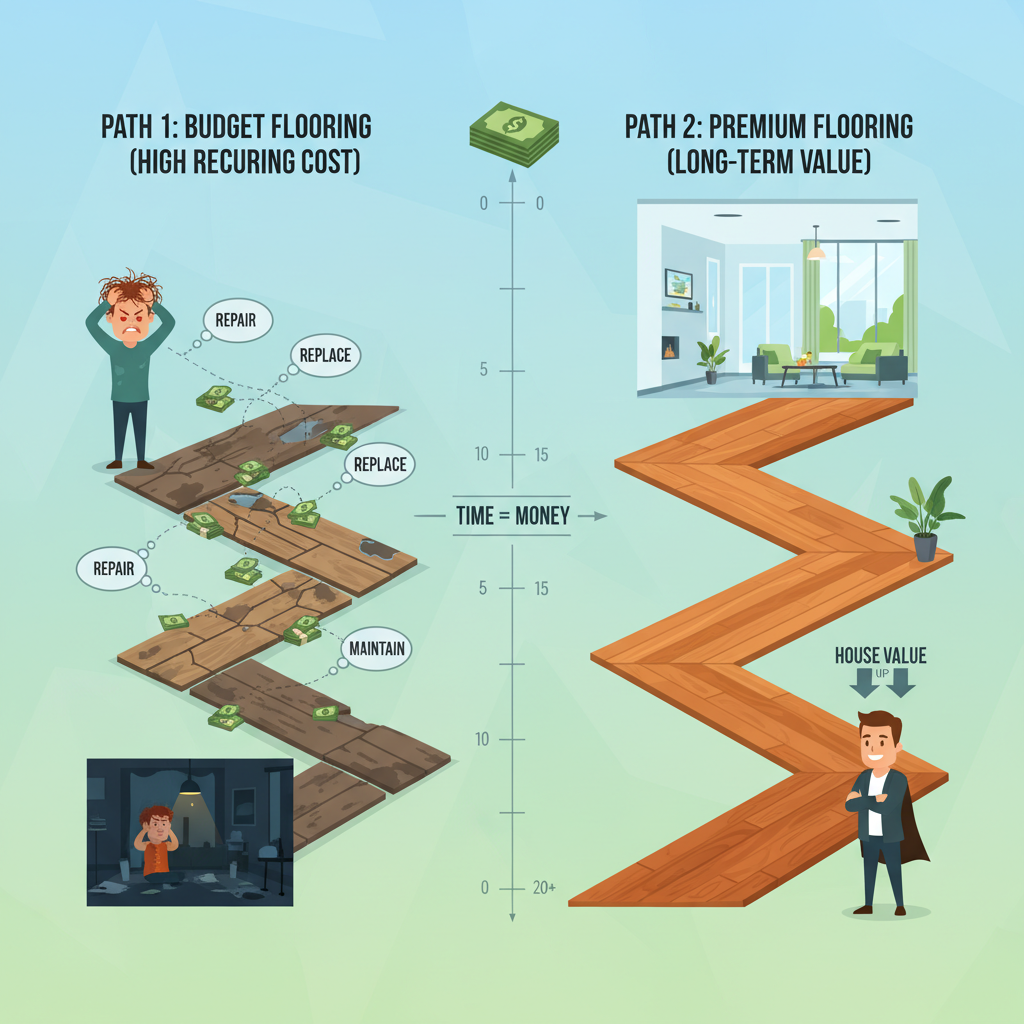
Is premium quality flooring that lasts decades actually worth the upfront cost? A lifecycle cost analysis proves mathematically that buying a premium floor once is significantly cheaper than replacing a budget floor multiple times.
Consider standard laminate flooring, which may cost $4 per square foot installed but requires replacement every 7 to 10 years due to moisture damage or wear. Over 30 years, you will pay for that floor three times, plus the cost of demolition and baseboard replacement.
Conversely, the Cost vs. Value Report by Remodeling Magazine highlights that upgrading to premium hard-surface flooring can yield an ROI of 70% to 80% at resale [12]. Furthermore, historical data from The National Trust for Historic Preservation shows that solid oak floors can be sanded and refinished up to 6 times over a century [13]. You pay a premium upfront, but the annualized cost of a 50-year floor is a fraction of the cost of a 10-year floor. “Buy once, cry once” is the golden rule of flooring economics.
Executing a Durable Flooring Upgrade: Long-Term Solutions
When you are ready to execute a durable flooring upgrade, the goal is to transition from builder-grade materials to a permanent architectural feature. According to the National Association of Home Builders (NAHB), high-quality hard surfaces are among the most requested features by homebuyers, directly impacting property valuation [14]. To achieve this, residential buyers are increasingly looking to The Construction Specifications Institute (CSI) standards, adapting commercial-grade materials for residential use [15].
Commercial-Grade Solutions for Residential Homes
If you want true long term flooring solutions, look at what is installed in airports, hospitals, and luxury hotel lobbies.
- Commercial LVT (Luxury Vinyl Tile): Featuring a 20-mil to 30-mil wear layer, commercial LVT often carries a 15-year commercial warranty, which translates to a lifetime residential warranty.
- Terrazzo: A composite material poured in place or precast, consisting of marble, quartz, or glass chips bound in epoxy or cement. The National Terrazzo and Mosaic Association (NTMA) provides lifecycle cost data proving that terrazzo has the lowest replacement cost of any hard surface flooring because it routinely outlasts the building itself [16].
- Commercial Warranties vs. Residential Warranties: Always read the fine print. Residential “lifetime” warranties often only cover manufacturer defects, not wear. Commercial warranties explicitly cover wear and tear under heavy foot traffic, making them the superior metric for true longevity.
Adamantine Floor Installation: Precision, Tools, and Safety
The final hurdle in achieving a forever floor is the adamantine floor installation process. Ultra-hard, premium materials are notoriously unforgiving and are rarely suitable for DIY projects.
Installing high-end porcelain, large-format tile, or advanced composites requires extreme precision. The Tile Contractors Association of America (TCAA) outlines advanced installation techniques, noting that ultra-dense materials require specialized, slow-curing modified epoxies and mortars to bond correctly to the subfloor [17].
Furthermore, cutting materials that rank 7 or 8 on the Mohs hardness scale requires professional-grade wet saws with continuous-rim diamond blades. Cutting these materials dry generates hazardous crystalline silica dust. The Occupational Safety and Health Administration (OSHA) mandates strict silica dust safety standards during construction, requiring wet-cutting methods and HEPA vacuums to prevent severe respiratory damage [18]. Hiring a certified master installer protects not only your investment but your health.
Conclusion
Achieving a true “forever floor” requires looking past the marketing allure of terms like “adamantine.” It demands an uncompromising approach to material science, a rigorous assessment of your home’s structural subfloor engineering, and an investment in expert installation. By understanding the metrics of durability—from Mohs hardness to IIC acoustic ratings—you can break the costly cycle of frequent floor replacement and permanently cure flimsy underfoot acoustics.
Before purchasing any new materials, perform the water glass test to evaluate your current subfloor deflection. If you detect structural bounce, consult with a certified structural engineer. When you are ready to upgrade, hire an NWFA or TCAA-certified installer to ensure your premium flooring investment truly lasts for decades.
Disclaimer: Structural engineering and installation advice is for informational purposes. Always consult a certified structural engineer or licensed contractor before altering floor joists or subfloors.
References & Authority Sources
- ASTM International. (N.D.). Standard Test Methods for Hardness and Impact Resistance of Flooring Materials. Retrieved from ASTM Standards database.
- Journal of Materials Science. (2021). Comparative Analysis of Shore D Hardness in Industrial Epoxies and Advanced Composites.
- National Wood Flooring Association (NWFA). (N.D.). The Janka Hardness Scale for Wood Flooring. Retrieved from NWFA Technical Guidelines.
- Concrete Network. (N.D.). Polished Concrete Lifespan and Maintenance Guide.
- Marble Institute of America. (N.D.). Natural Stone Durability and Interior Lifespan Standards.
- American Society of Civil Engineers (ASCE). (N.D.). Minimum Design Loads and Associated Criteria for Buildings and Other Structures (Deflection Standards).
- International Code Council. (N.D.). International Residential Code (IRC): Floor Cantilevers and Deflection Limits (L/360).
- The Wood I-Joist Manufacturers Association. (N.D.). Proper Joist Span and Installation Guidelines for Residential Flooring.
- World Floor Covering Association (WFCA). (N.D.). Industry Statistics on Hard Surface Flooring Failures and Moisture Mitigation.
- Department of Housing and Urban Development (HUD). (N.D.). Appendix 5D: Normal Wear and Tear Guidelines for Residential Properties.
- Institute of Inspection, Cleaning and Restoration Certification (IICRC). (N.D.). Standards for Professional Water Damage Restoration and Moisture Testing.
- Remodeling Magazine. (2023). Cost vs. Value Report: ROI of Residential Flooring Upgrades.
- The National Trust for Historic Preservation. (N.D.). Preservation and Longevity of Historic Solid Wood Flooring.
- National Association of Home Builders (NAHB). (N.D.). Residential Remodeling Trends and Homebuyer Preferences.
- The Construction Specifications Institute (CSI). (N.D.). MasterFormat Standards for Commercial Flooring Materials.
- National Terrazzo and Mosaic Association (NTMA). (N.D.). Lifecycle Cost Analysis of Terrazzo vs. Standard Hard Surface Flooring.
- Tile Contractors Association of America (TCAA). (N.D.). Advanced Installation Techniques and Curing Times for High-Density Materials.
- Occupational Safety and Health Administration (OSHA). (N.D.). Crystalline Silica Exposure Safety Standards in Construction and Cutting.
