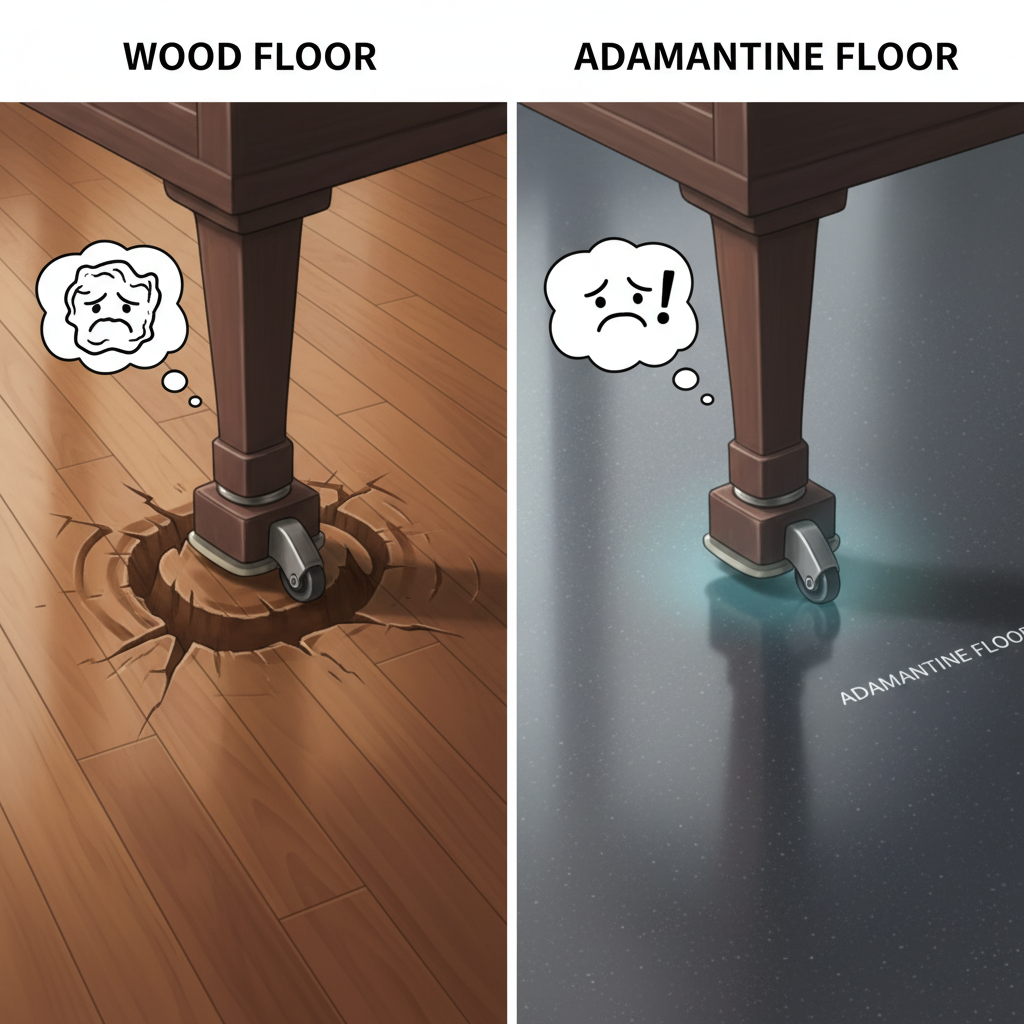
There are few homeowner frustrations quite as visceral as carefully moving a heavy sofa, a treasured grand piano, or a large area rug, only to uncover permanent, unsightly dents crushed into your expensive flooring. In an instant, the illusion of a pristine home is shattered by the reality of material failure. If you are tired of replacing floors that succumb to the pressures of daily life, it is time to move beyond vague marketing fluff and explore the realm of “adamantine flooring.”
Derived from the Greek word adamastos—meaning untameable or indestructible—adamantine flooring is not a specific brand, but rather the ultimate standard in material science. It represents the pinnacle of ultra-durable, heavy-duty flooring designed to withstand extreme point loads without yielding. This definitive guide will empower you to decode the actual physics of floor damage, choose genuinely dent-resistant materials, future-proof your home against heavy furniture, and execute professional-grade repairs when the unthinkable happens.
- Decoding ‘Adamantine Flooring’: What Does Indestructible Really Mean?
- The Physics of Floor Damage: Why Heavy Furniture Causes Dents
- The Most Dent-Resistant Flooring Options Ranked
- Understanding Durability Metrics: How to Shop Like a Pro
- Bulletproofing Your Home: Preventing Floor Dents from Heavy Furniture
- The Damage Triage Guide: How to Fix Scratched and Dented Flooring
- Conclusion
- References & Authoritative Sources
Decoding ‘Adamantine Flooring’: What Does Indestructible Really Mean?
In a modern construction context, the term “adamantine” is reserved for materials that offer uncompromising structural integrity. While no floor is truly, scientifically indestructible, adamantine flooring represents the absolute highest echelon of durability—encompassing industrial-grade resins, polished concrete, and highly resilient composite materials.
For years, there has been a significant gap between residential marketing claims (where terms like “dent-proof” are often used loosely) and actual commercial-grade specifications. However, the industry is shifting. According to experts at Floor Covering Weekly, there is a massive, growing trend of bringing industrial-grade durability and adamantine-like resilience directly into residential spaces, driven by consumers demanding floors that can survive active households and heavy static loads [1].
Residential vs. Commercial Grade: Bridging the Gap
To understand what truly qualifies as heavy-duty flooring, you must look past the aesthetic finish and examine the technical specifications. The difference between a floor that dents under a dining chair and one that can park a forklift comes down to core density and wear layer thickness.
When evaluating vinyl or composite options, the wear layer—the clear, protective top coating—is a critical metric. Commercial-grade heavy-duty vinyl typically requires a wear layer of 20 mil (0.5 mm) or higher to resist significant wear and tear [2]. The World Floor Covering Association (WFCA) notes that while residential products often feature 6 mil to 12 mil wear layers, stepping up to commercial specifications is the only way to guarantee long-term performance in high-stress residential environments [2].
The Physics of Floor Damage: Why Heavy Furniture Causes Dents
To prevent heavy furniture floor damage, you must first understand the science of why floors fail. Floor damage generally falls into two distinct categories: surface scratches and compression dents. Scratches occur when abrasive forces compromise the protective wear layer. Dents, however, are a failure of the floor’s core.
When heavy furniture rests on a floor, it exerts downward kinetic and static energy. If the floor’s core lacks the density to support this weight, the material compresses. The physics of this material memory dictate the permanence of the damage. For instance, crushed natural wood fibers can sometimes be coaxed back into their original shape because cellulose retains a degree of elasticity and reacts to moisture. In contrast, when the synthetic vinyl foam core of a standard Luxury Vinyl Plank (LVP) is compressed, the cellular structure is permanently crushed, making the dent irreversible.
Point Loads and PSI: The Grand Piano Problem
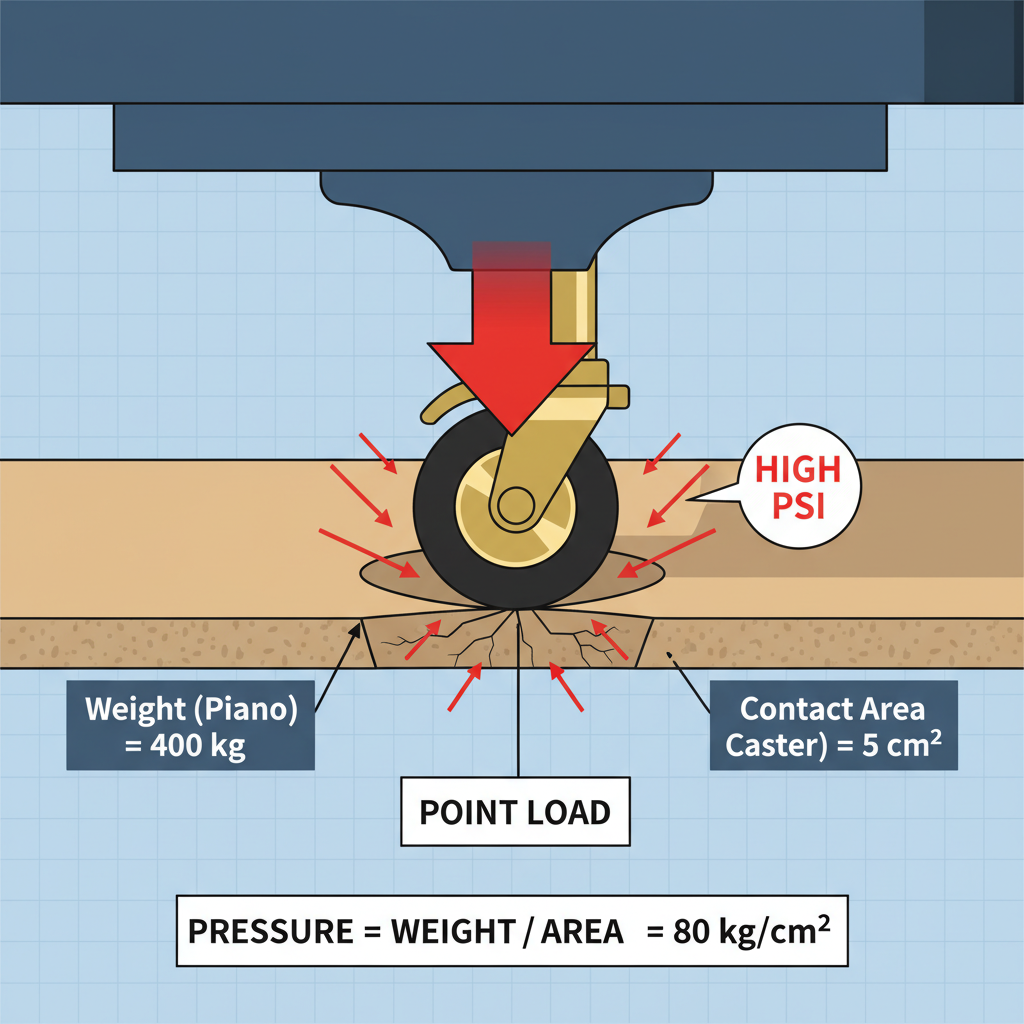
The true enemy of any floor is not necessarily the total weight of an object, but its “point load”—the weight distributed over a specific area of contact, measured in Pounds per Square Inch (PSI). This is best illustrated by the grand piano problem.
You might wonder what flooring won’t dent under a grand piano or a 500-pound gun safe. A standard grand piano exerts over 300 lbs of pressure per caster [3]. Because a caster wheel has a remarkably small surface area touching the floor, the resulting PSI is astronomical, easily exceeding the static load limits of standard wood or foam-core vinyl. The Piano Technicians Guild emphasizes that without proper weight distribution and exceptionally high point-load resistance from the flooring itself, structural subfloor deflection and permanent surface cratering are inevitable [3]. Finding the best flooring for heavy furniture requires prioritizing materials engineered to withstand massive PSI.
The Most Dent-Resistant Flooring Options Ranked
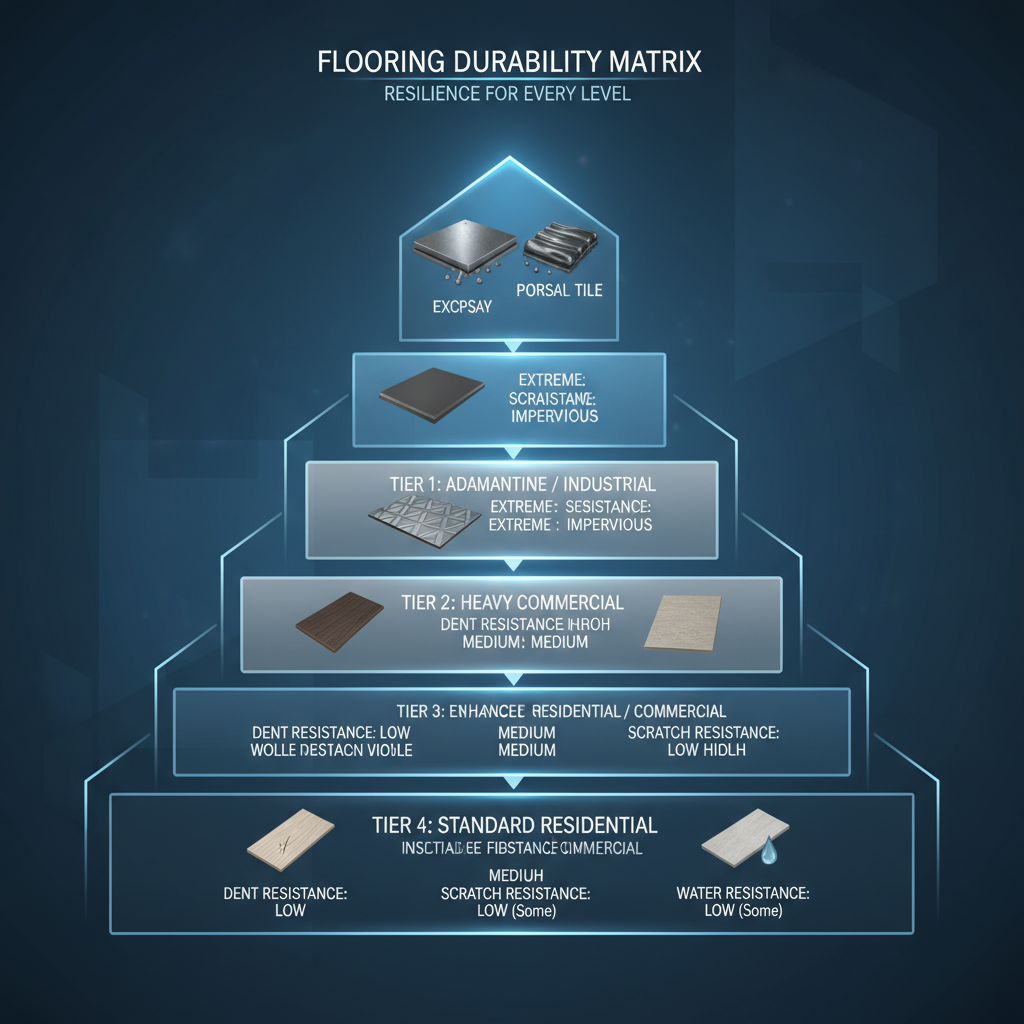
Not all durable flooring options are created equal. To help you navigate the market, we have categorized the most popular materials into a definitive, tiered ranking based specifically on their dent-resistance and ability to approach the adamantine standard.
The Durability Matrix:
- Tier 1 (Adamantine / Industrial): Polished Concrete, Porcelain Tile, Metallic Epoxy. (Extreme dent/scratch/water resistance; low comfort).
- Tier 2 (Ultra-Resilient Rigid Core): SPC Vinyl. (High dent/water resistance; moderate scratch resistance).
- Tier 3 (Natural Hardness): Ultra-Hardwoods, Strand-Woven Bamboo. (Moderate-to-high dent resistance; vulnerable to water and deep scratches).
- Tier 4 (Standard Residential): WPC Vinyl, Standard Laminate, Softwoods. (Low dent resistance; high comfort).
Stone Plastic Composite (SPC) Rigid Core Vinyl
If you are seeking flooring that resists furniture dents while maintaining the warmth and ease of installation of a floating floor, Stone Plastic Composite (SPC) is the undisputed champion. The secret lies in its material science. Unlike Wood Plastic Composite (WPC), which uses a core made of wood dust and foaming agents (making it softer and more comfortable, but highly prone to dents), SPC utilizes a core composed of natural limestone powder, polyvinyl chloride, and stabilizers.
This limestone core gives SPC an incredibly dense, rigid structure. Technical data from Floor Trends Magazine confirms that high-quality SPC flooring can typically withstand up to 2,000 PSI of static load without permanent indentation [4]. This makes it vastly superior to traditional LVP for rooms housing heavy cabinetry, pool tables, or massive sectionals.
Porcelain Tile and Industrial Resins
For those who want true durable adamantine flooring for homes, you must look to the ultimate hard surfaces: porcelain tile, metallic epoxy, and polished concrete. These materials are virtually impervious to compression dents from household furniture.
Porcelain tile, baked at extreme temperatures, achieves a density that mocks heavy point loads. Furthermore, the Tile Council of North America (TCNA) highlights that porcelain tile has a water absorption rate of less than 0.5%, making it one of the most durable options against moisture, stains, and structural degradation [5]. The trade-off for this adamantine durability is underfoot comfort; these floors are cold, unforgiving, and require rugs to soften the living space.
Ultra-Hardwoods and Bamboo
If synthetic materials or cold tiles don’t suit your aesthetic, natural wood can still hold up to heavy furniture—provided you choose the right species. The dent resistance of wood is measured by the Janka hardness scale, which tests the force required to embed a 0.444-inch steel ball halfway into the wood.
While popular woods like Red Oak sit around 1,290 on the Janka scale, they can still dent under heavy point loads. For true dent-resistant flooring, the National Wood Flooring Association (NWFA) guidelines point toward ultra-hardwoods [6]. Hickory (Janka 1,820), Brazilian Cherry (Janka 2,350), or true Mahogany offer vastly superior resistance to crushing. Strand-woven bamboo, engineered by compressing bamboo fibers under extreme heat and pressure, can even exceed a 3,000 Janka rating, making it a formidable, eco-friendly alternative.
Understanding Durability Metrics: How to Shop Like a Pro
To confidently invest in impact-resistant flooring solutions, you must be able to independently verify manufacturer claims. Familiarize yourself with this brief technical glossary:
- Wear Layer: The clear urethane coating protecting the floor’s design layer from scratches.
- Rigid Core: The dense, central layer of a composite plank (like SPC) that prevents compression.
- Attached Pad: The acoustic underlayment on the bottom of a plank; if too thick or soft, it can allow the plank to flex and snap under heavy loads.
- Static Load Limit: The maximum amount of resting weight a floor can bear before permanent indentation occurs.
AC and IC Ratings for Laminate
When shopping for laminate or engineered wood, durability is officially measured by Abrasion Class (AC) and Impact Class (IC) ratings. While AC ratings measure wear and scratch resistance, IC ratings specifically measure how well the floor absorbs kinetic energy from dropped objects without fracturing.
According to the North American Laminate Flooring Association (NALFA), high-quality laminate flooring often features an AC4 or AC5 rating, indicating high resistance to impact and heavy commercial traffic [7]. If you are installing flooring in a home gym or a kitchen where heavy pots might be dropped, insisting on an AC4/IC3 rating or higher is non-negotiable.
Bulletproofing Your Home: Preventing Floor Dents from Heavy Furniture
Even with adamantine-grade materials, proactive prevention is the best defense. Preventing floor dents requires a strategic approach to moving and placing heavy items. According to flooring repair specialists and data from Moving.com, over 60% of localized floor damage is caused by moving heavy furniture without proper protection or lifting equipment [8].
The Ultimate Heavy Furniture Checklist:
- Never Drag: Always lift furniture entirely off the floor. If it’s too heavy, use specialized appliance air sleds or glide tracks over hardboard.
- Distribute the Weight: For stationary items with narrow legs (like pianos or antique armoires), place wide, weight-distributing caster cups beneath the feet to lower the overall PSI.
- Check Your Wheels: Replace hard plastic or metal rolling casters on office chairs with soft polyurethane wheels designed specifically for hard floors.
Choosing the Best Furniture Pads and Coasters
Not all floor protectors are created equal. Thin, adhesive plastic sliders often trap grit and cause severe scratching, while cheap foam pads compress to nothing within weeks.
Tests conducted by the Good Housekeeping Institute reveal that using dense felt pads with a minimum thickness of 1/5 inch can reduce point-load pressure on hardwood floors by up to 80% [9]. For heavy, stationary furniture, tap-in heavy-duty felt pads or thick rubber coasters offer the best long-term defense against compression.
The Damage Triage Guide: How to Fix Scratched and Dented Flooring
If you are currently staring at a damaged floor, do not panic. The first step is triage. The Institute of Inspection, Cleaning and Restoration Certification (IICRC) sets strict standards for floor repair, and the methodology depends entirely on the material and the depth of the damage [10].
Diagnostic Triage Flowchart:
- Is it a surface scratch? Use color-matched wax fillers, stain markers, or spot-sanding (for wood).
- Is it a shallow dent in natural wood? Attempt the steam expansion method.
- Is it a deep gouge or crushed synthetic core? Spot repair is likely impossible; plank replacement is required.
Repairing Natural Wood: The Iron and Wet Towel Trick
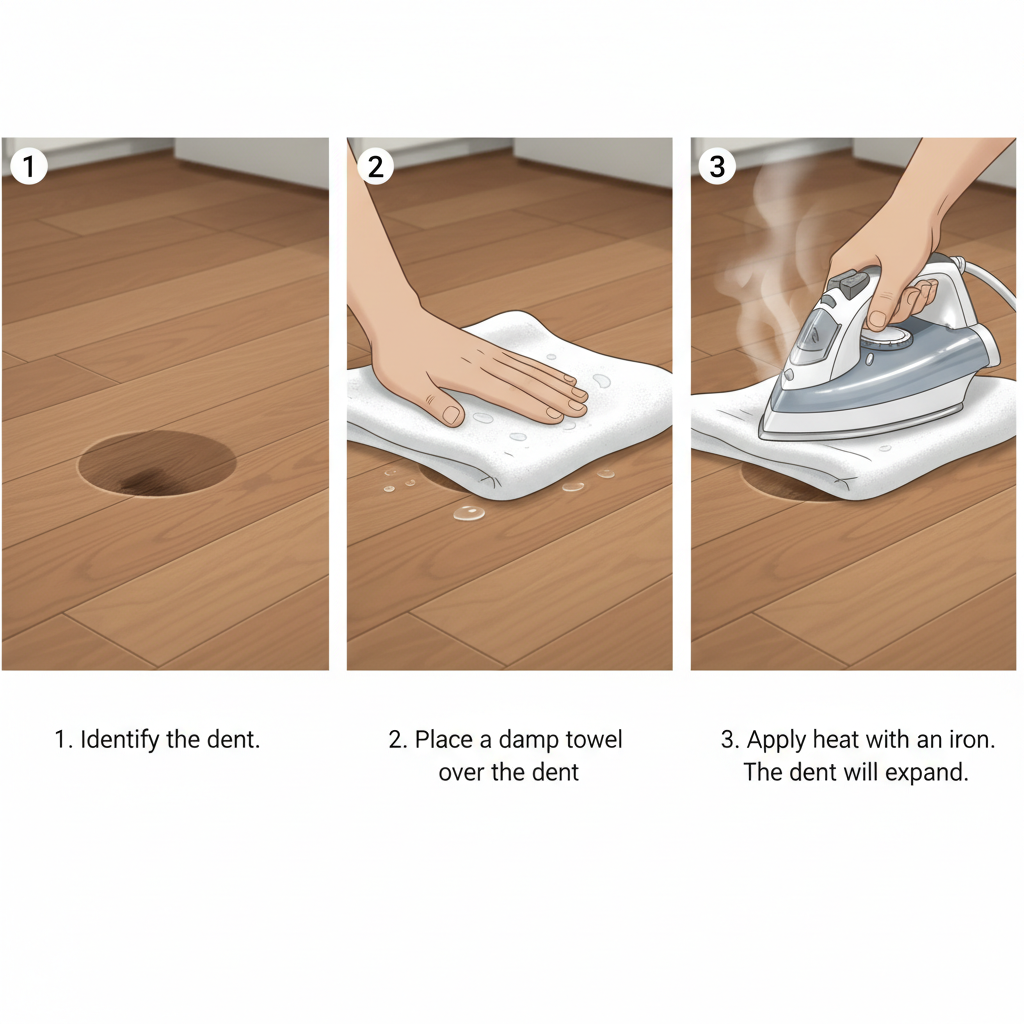
If you have floor dents from furniture on natural hardwood, you can often utilize the physics of cellulose to your advantage. Because wood fibers are naturally porous, they can be expanded using heat and moisture.
Technical techniques outlined by Wood Floor Business Magazine recommend the “iron and wet towel” trick [11]. Place a damp (not soaking) cotton towel or microfiber cloth directly over the dent. Take a standard clothing iron, set it to its highest setting, and press it onto the damp towel over the dent, moving it in small circles for 3 to 5 minutes. The steam penetrates the crushed wood fibers, causing them to swell and pop back into their original shape. Once dry, a light buffing and finish touch-up will make the dent virtually invisible.
Fixing Synthetic Floors: When to Fill and When to Replace
Unlike natural wood, scratched and dented flooring made of synthetic materials (like LVP, laminate, or linoleum) cannot be steamed. Once a synthetic foam core is crushed, the damage is permanent.
For minor surface scratches on the wear layer, specialized synthetic wax filler kits and stain markers can camouflage the damage. You can use ultra-fine grit sandpapers (3000+ grit) to carefully smooth the edges of a scratch before applying a specialized polyurethane finish restorer.
However, for deep compression dents or severe gouges in synthetic floors, attempting to fill the hole with wood putty will look amateurish and eventually flake out. In these cases, the only professional-grade solution is plank replacement. Most floating floors allow you to carefully uninstall the floor from the nearest wall to replace the damaged plank, or a professional can cut out the damaged section and glue down a replacement piece. Knowing when to attempt a DIY repair and when to call a professional flooring restorer will save you time, money, and frustration.
Conclusion
Achieving true “adamantine” durability in your home does not mean you have to live in a concrete bunker. It comes down to understanding the material science of your flooring, respecting the physics of PSI and point loads, and implementing proper preventative care. By looking past the marketing hype and focusing on core density, wear layers, and Janka ratings, you can choose floors that genuinely resist the pressures of daily life. Evaluate your current flooring’s vulnerability today, invest in high-density 1/5-inch felt pads for your heaviest furniture, and rest easy knowing your home is bulletproofed against damage.
Standard DIY Repair Disclaimer: Always consult manufacturer warranties before attempting heat/steam repairs or applying fillers, as unauthorized repair methods may void your warranty.
References & Authoritative Sources
- Floor Covering Weekly. (N.D.). Industry Trends: Bringing Commercial Durability to Residential Spaces.
- World Floor Covering Association (WFCA). (N.D.). Commercial vs. Residential Flooring Specifications and Wear Layers.
- Piano Technicians Guild. (N.D.). Piano Weight Distribution and Floor Protection Guidelines.
- Floor Trends Magazine. (N.D.). Technical Specifications of Stone Plastic Composite (SPC) Cores and Static Load Limits.
- Tile Council of North America (TCNA). (N.D.). Porcelain Tile Durability and Water Absorption Standards.
- National Wood Flooring Association (NWFA). (N.D.). Janka Hardness Scale and Wood Species Guidelines.
- North American Laminate Flooring Association (NALFA). (N.D.). Understanding AC and IC Ratings for Laminate Flooring.
- Moving.com. (N.D.). Safe Furniture Transport and Property Protection Statistics.
- Good Housekeeping Institute. (N.D.). Consumer Product Testing: The Effectiveness of Floor Protectors and Felt Pads.
- Institute of Inspection, Cleaning and Restoration Certification (IICRC). (N.D.). Standards for Hard Surface Floor Repair and Restoration.
- Wood Floor Business Magazine. (N.D.). Technical Repair Techniques: Using Steam for Wood Fiber Expansion.
