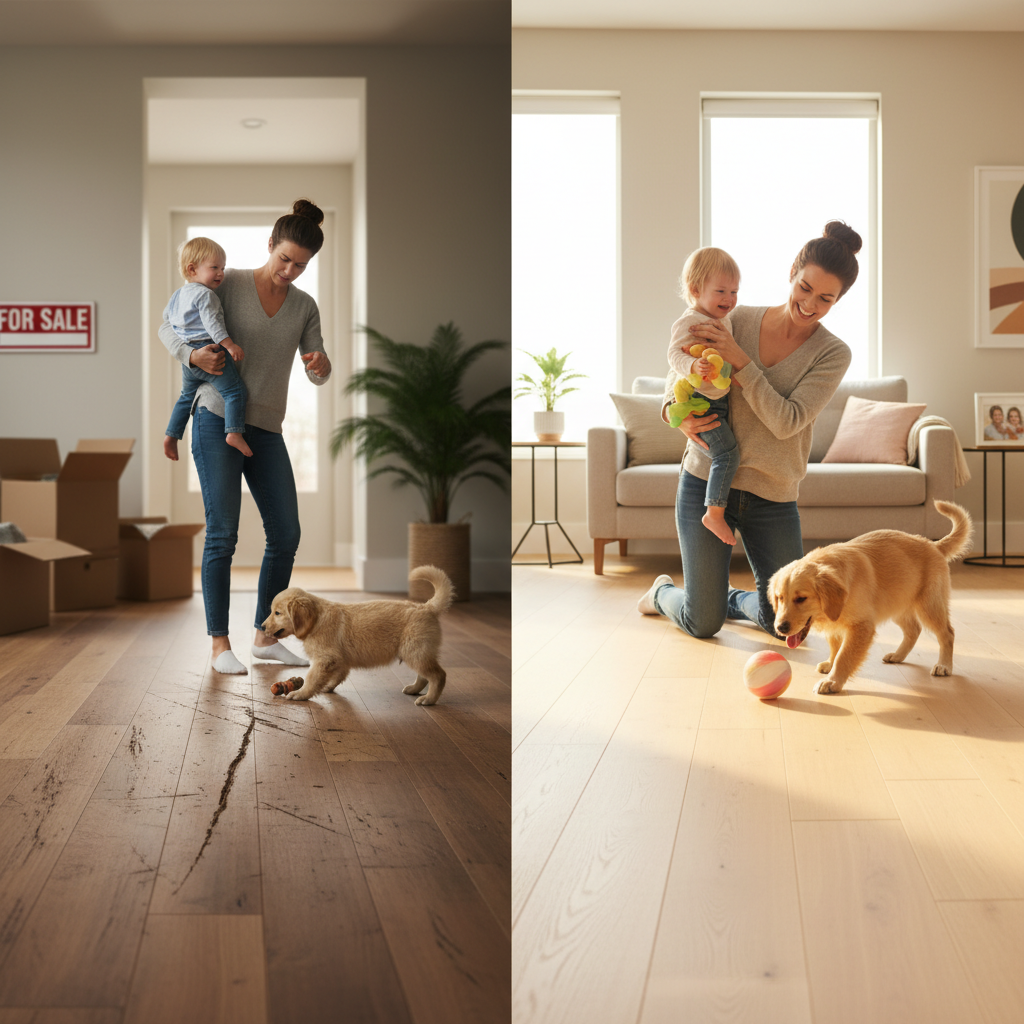
If you are a homeowner, active family, or pet parent, you likely know the sinking feeling of watching a beautiful new floor succumb to daily life. In fact, over 60% of pet owners report that easily scratched floors and surface damage are their primary home maintenance complaints. This frustration often leads to a vicious cycle of frequent floor replacement, where cheap materials are swapped out every few years, draining your wallet and disrupting your life.
But what if you could break that cycle? Enter the world of ultra-durable, high-performance flooring. You may have heard industry jargon like “adamantine” thrown around to describe indestructible surfaces, but separating marketing hype from actual material science is crucial. This definitive guide will demystify these terms, expose the true Total Cost of Ownership (TCO) of budget materials, and provide a contractor-verified roadmap to finding, installing, and maintaining a “forever” floor that perfectly balances industrial resilience with residential beauty.
- Decoding Flooring Durability: What is Adamantine Flooring?
- The Anatomy of Wear: Solving the ‘Easily Scratched Floors’ Dilemma
- Breaking the Cycle: The Financial Reality of Frequent Floor Replacement
- Top Contenders: The Best Adamantine and High-Performance Flooring
- Installation & Lifecycle: How Long Does Adamantine Flooring Last?
- Conclusion
- References
Decoding Flooring Durability: What is Adamantine Flooring?
When searching for the ultimate durable home flooring, you will inevitably encounter the word “adamantine.” Historically, the term is a metaphor for extreme hardness, akin to a diamond. In the modern home improvement space, however, its usage can be confusing. Is it a specific material, a brand, or just a clever marketing buzzword?
According to industry analysts at Floor Covering Weekly, “adamantine” is frequently utilized both as a trademarked brand name for specific ultra-durable engineered stone or epoxy lines, and as a generic marketing descriptor for high-pressure laminates and rigid core vinyls [1]. To make an informed decision, consumers must look past the buzzword and evaluate the actual material science.
This requires understanding the difference between ultra-hard surfaces (like porcelain tile or engineered stone) and resilient floor solutions. The Resilient Floor Covering Institute (RFCI) defines resilient flooring—such as luxury vinyl, linoleum, and cork—as materials that possess a degree of “give” or elasticity underfoot [2]. While adamantine-marketed floors prioritize absolute surface hardness, resilient options balance durability with flexibility.
Marketing Buzzword vs. Material Science: The Mohs Scale Explained
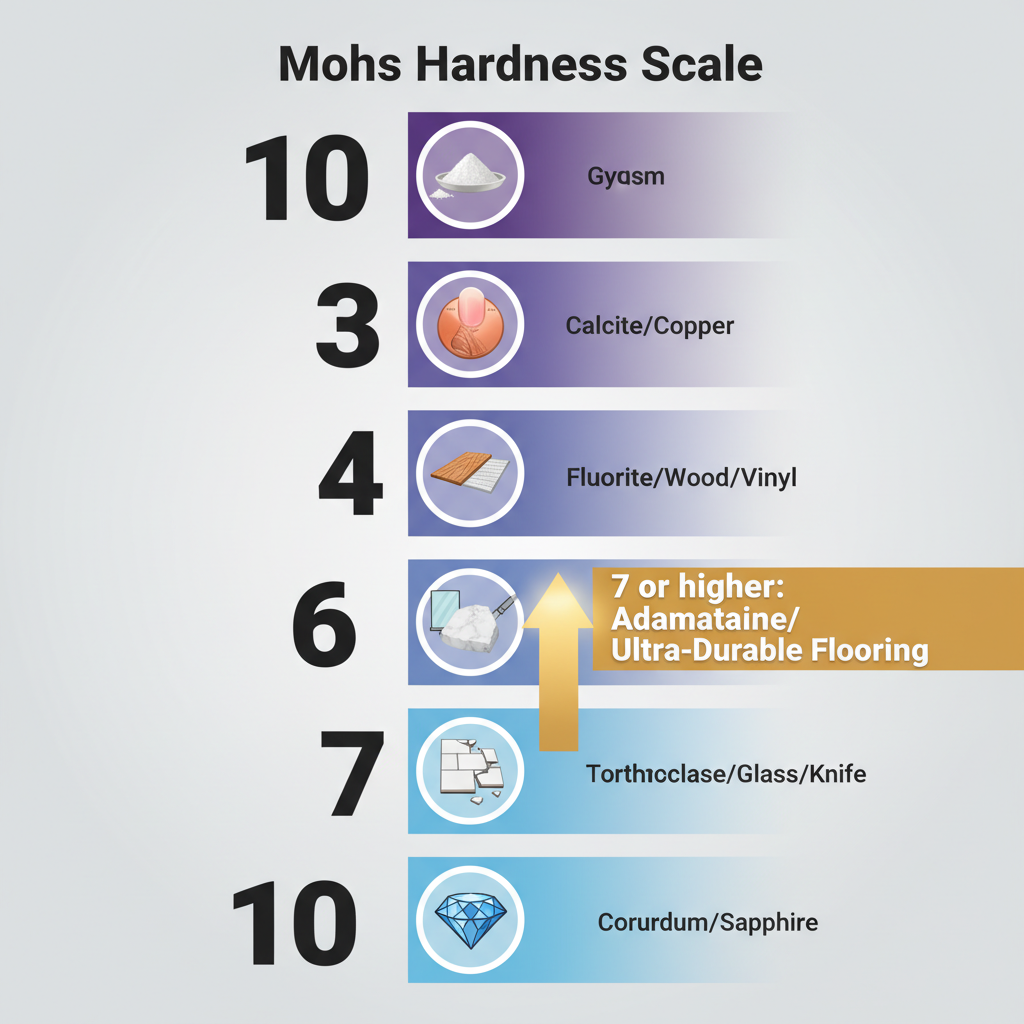
To truly gauge how adamantine flooring stacks up against traditional hard surfaces, we must look to the Mohs hardness scale. Developed to measure the scratch resistance of various minerals, the Mohs scale is the ultimate lie-detector for flooring durability claims.
“When we evaluate flooring materials, the Mohs scale allows us to predict how a surface will react to the microscopic grit tracked in on shoes, which is essentially quartz dust,” explains a leading materials scientist featured in the Materials Science and Engineering Journal [3]. “A floor marketed as ‘adamantine’ or ultra-durable should ideally feature a topcoat or core material that registers a 7 or higher on the Mohs scale, putting it on par with high-grade porcelain and above natural marble or basic polyurethane-coated wood.”
Hard vs. Resilient Flooring: Understanding the Ergonomic Trade-offs
While a floor that mimics the hardness of a diamond sounds ideal for preventing scratches, it introduces a significant comfort vs. hardness tradeoff. What exactly does resilient flooring mean for your daily life?
“Ultra-hard floors, while incredibly durable, offer zero shock absorption,” notes a licensed physical therapist specializing in home ergonomics. “For homeowners who spend hours standing in the kitchen or have aging joints, high-quality resilient floor solutions are often the better choice. They reduce the kinetic impact on the knees and lower back, offering health and acoustic benefits that a rigid, adamantine-style stone or epoxy simply cannot provide.”
The Anatomy of Wear: Solving the ‘Easily Scratched Floors’ Dilemma
Nothing accelerates the desire for a home renovation faster than worn out home flooring. To stop the damage, you must first diagnose the root cause. Scratches rarely happen in a vacuum; they are the result of specific environmental stressors.
Veterinary orthopedists and experts at the American Kennel Club (AKC) point out that unclipped pet nails act like concentrated pressure points, easily gouging soft woods and cheap vinyl [4]. Furthermore, according to floor care authority Bona, the most insidious culprit is microscopic dirt and grit. When trapped under shoes or sliding furniture, this grit acts as sandpaper, slowly degrading the factory finish over time [5].
Scratch Resistance vs. Dent Resistance: What’s the Difference?
When shopping for scratch resistant floor solutions, consumers frequently confuse scratch resistance with dent resistance. They are two entirely different mechanical properties.
Scratch resistance refers strictly to the floor’s surface wear layer—how well the topcoat repels abrasions from pet claws or sliding chairs. Dent resistance refers to the core density of the material—how well it withstands the blunt impact of a dropped cast-iron pan or the weight of a heavy piano.
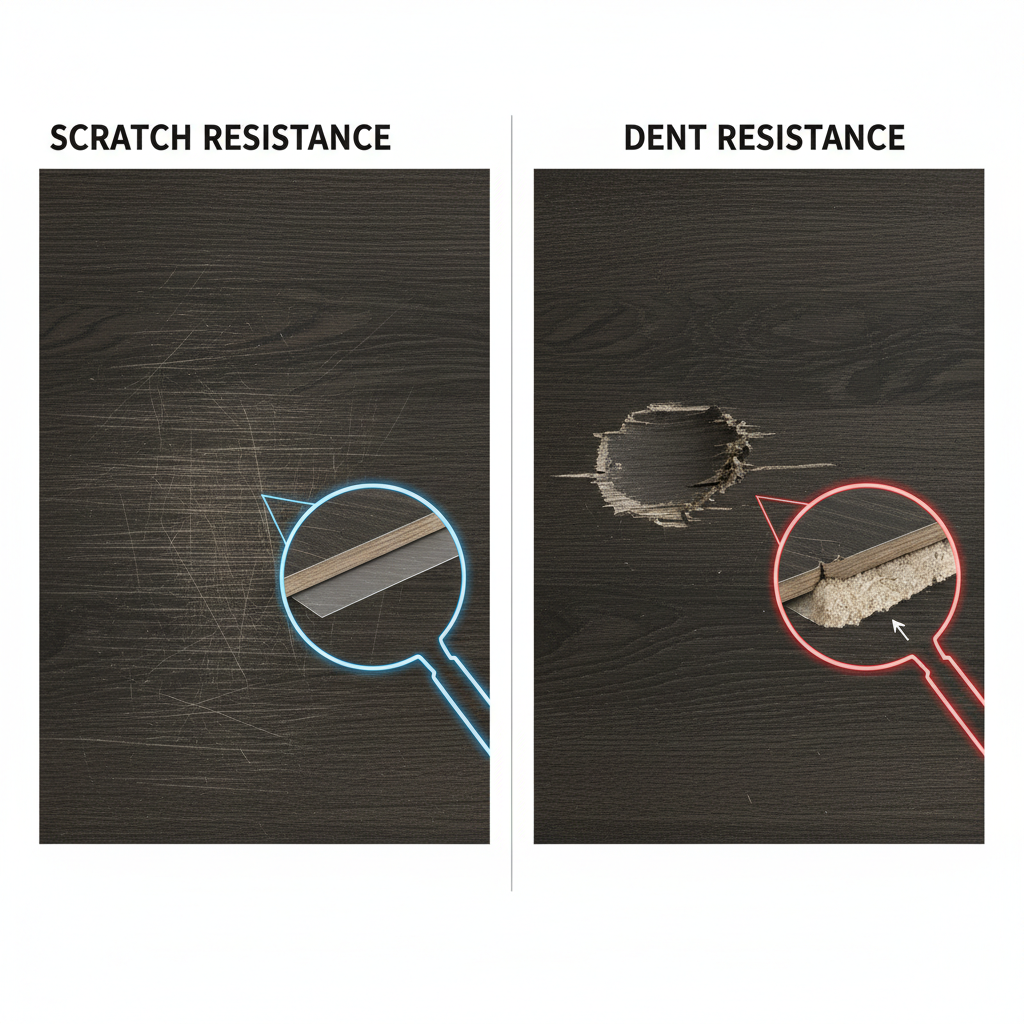
To achieve maximum scratch resistance, manufacturers turn to advanced chemistry. “Factory finishes infused with aluminum oxide or ceramic bead technology can increase a floor’s scratch resistance by up to 10 times compared to standard, site-applied polyurethane,” explains a leading flooring manufacturer’s R&D representative. This is scientifically verified using the Taber Abrasion Test, a standardized method established by ASTM International where a machine spins abrasive wheels against the flooring sample to measure exactly how many cycles it takes to wear through the finish [6].
Diagnosing the Damage: The Repair vs. Replace Calculator
Before you tear up your house, you need to determine if your worn out home flooring is structurally compromised or just aesthetically dull.
Normal wear and tear—characterized by superficial surface micro-scratches that do not penetrate the wear layer—can often be remedied. A deep professional clean, or a “screen-and-recoat” for solid hardwoods, can restore the luster for a fraction of the cost of replacement. However, structural failure mandates a full replacement. If you observe deep gouges exposing the raw core of your laminate, peeling wear layers on your vinyl, or water-damaged, cupping floorboards, the material has failed. At this stage, superficial topcoats will not stop your floors from scratching or degrading further.
Breaking the Cycle: The Financial Reality of Frequent Floor Replacement
Homeowners often default to the cheapest available option at the big-box store, only to find themselves facing another costly renovation a few years later. This cycle of frequent floor replacement is a massive drain on personal finances.
To understand why a long-lasting floor upgrade is a superior financial decision, we must look at the Total Cost of Ownership (TCO). Financial experts at Kiplinger emphasize that true home ROI isn’t just about the purchase price of the material; it includes the cost of labor, baseboard replacement, underlayment, and disposal fees every time the floor fails [7].
Furthermore, premium flooring is a recognized equity booster. According to data from the National Association of Realtors (NAR), replacing worn-out flooring before a home sale can yield a return on investment (ROI) of 70% to 80%, making it one of the most profitable cosmetic upgrades a homeowner can undertake [8].
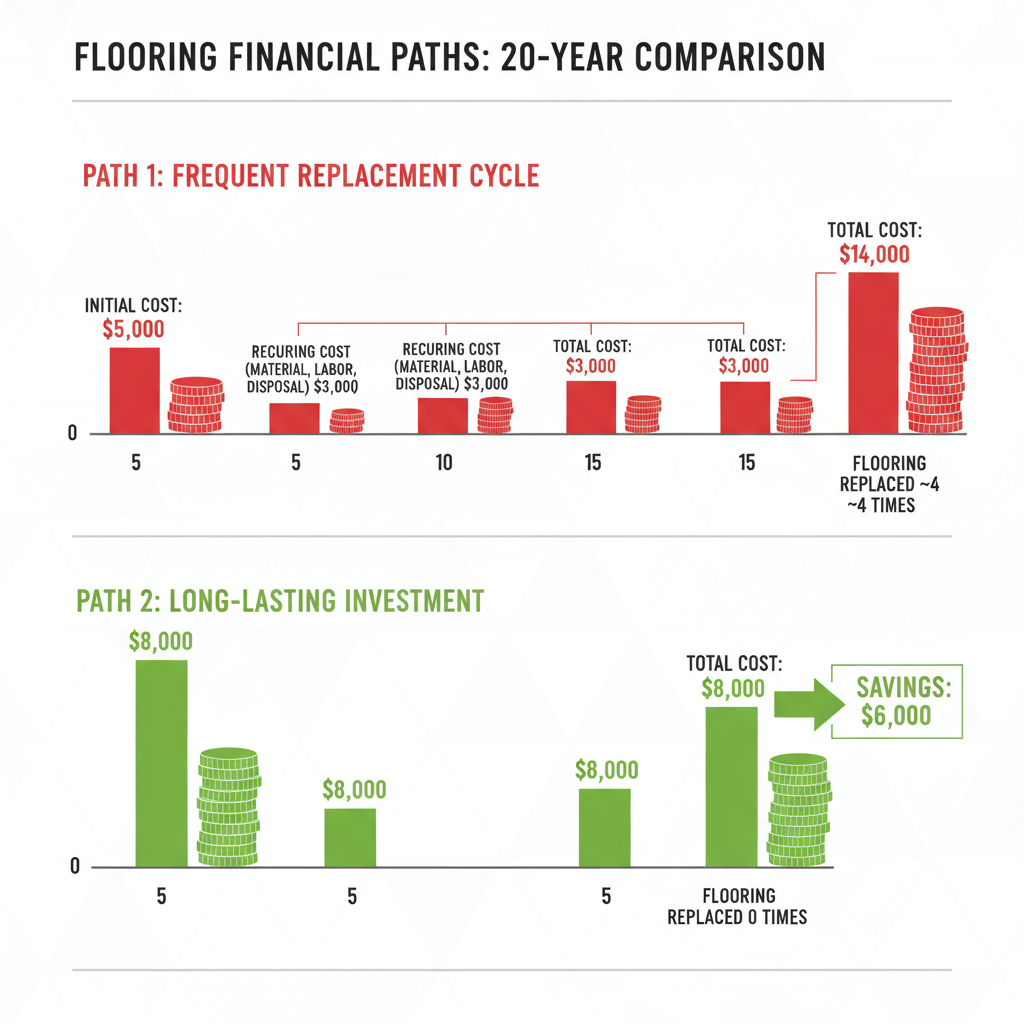
The 20-Year Total Cost of Ownership (TCO) Breakdown
Let’s look at a 20-year TCO comparison. Cheap laminate or thin peel-and-stick vinyl may look like a bargain, but in an active household, it typically requires replacement every 5 to 7 years.
“In our rental properties, we used to install budget laminate to save money upfront,” shares a veteran property manager who specializes in durable upgrades. “But factoring in the labor to rip it out and reinstall it three times over twenty years, plus the lost rent during renovations, it was a financial disaster. Upgrading to a premium, commercial-grade rigid core or engineered hardwood costs more on day one, but it effectively ends the replacement cycle, saving thousands over the property’s lifespan.”
Top Contenders: The Best Adamantine and High-Performance Flooring
If you are ready for a permanent solution, finding the best adamantine flooring for homes requires balancing industrial-level durability with residential warmth. Our transparent review methodology focuses on three pillars: footfall capacity, core density, and aesthetic longevity.
When evaluating durable home flooring, you must look at the technical specifications. The World Floor Covering Association (WFCA) advises consumers to check the AC (Abrasion Class) rating for laminates—where AC4 or AC5 indicates commercial-grade durability—and the “mil” wear layer thickness for luxury vinyl [9].
“The biggest mistake homeowners make with high-performance flooring is choosing a trendy, hyper-rustic pattern that looks dated in five years,” warns an ASID-certified interior designer [10]. “A true ‘forever’ floor must be timeless in its aesthetic as well as physical resilience.”
The Traffic Test: Surviving 10,000 Footfalls a Day
For hallways, kitchens, and entryways, you need high-performance flooring for high traffic areas. To pass the “Traffic Test,” a floor must offer superior slip resistance (measured by its Coefficient of Friction, or COF) and be exceptionally easy to clean.
“In commercial spaces, we rely on high-performance vinyl with a 20+ mil wear layer, which can easily withstand upwards of 10,000 footfalls per day without significant degradation,” states a facility management professional featured in FacilitiesNet [11]. Translating this to the residential sector means that a 20-mil or higher wear layer will render your home virtually immune to the daily chaos of kids, pets, and heavy foot traffic.
Designing with Adamantine: Comfort, Acoustics, and Radiant Heat
The challenge with ultra-hard, adamantine-style flooring (like engineered stone or high-grade epoxy) is that it can feel cold and sound hollow. To successfully integrate these materials into living rooms and bedrooms, you must design with acoustics and temperature in mind.
Architectural Digest highlights that the secret to integrating durable, industrial materials into high-end residential design lies in layering [12]. Utilizing high-quality acoustic underlayments beneath the rigid flooring will dampen the sound transmission. Additionally, pairing these hard surfaces with plush area rugs and subfloor radiant heating systems ensures that the space remains inviting, comfortable, and warm underfoot.
Installation & Lifecycle: How Long Does Adamantine Flooring Last?
You have selected your premium material, but the journey isn’t over. The ultimate lifespan of your floor is dictated entirely by how it is installed. So, how long does adamantine flooring last? Under normal residential use, ultra-durable engineered stone or high-grade epoxy floors can boast a functional lifespan of 25 to 50 years—but only if the structural foundation is flawless.
“The most critical phase of installing rigid, ultra-hard flooring is the subfloor preparation,” writes a licensed general contractor in the Journal of Light Construction (JLC)‘s Contractor’s Corner [13]. “Flexible vinyl can hide minor imperfections, but adamantine-level rigid flooring requires strict leveling tolerances. If your subfloor isn’t perfectly flat, the locking mechanisms will snap, or the rigid boards will crack under pressure.”
DIY vs. Pro: Tools, Costs, and Silica Dust Safety
Many homeowners wonder if they can install adamantine flooring themselves. While possible for highly experienced DIYers, the extreme hardness of these materials requires specialized diamond-tipped tools for scoring, snapping, or wet-sawing. Because of the labor intensity and tool wear, professional installation typically adds $3 to $8 per square foot to your project cost.
More importantly, DIYers must heed severe safety warnings. Cutting ultra-hard stone, tile, or engineered core materials releases hazardous silica dust. The Occupational Safety and Health Administration (OSHA) mandates strict silica dust mitigation protocols, as inhalation can lead to severe respiratory diseases [14]. Always use OSHA-compliant wet saws and N95 respirators if you attempt this work yourself.
The Warranty Fine Print: Structural Lifespan vs. Aesthetic Lifespan
Finally, it is vital to read the fine print of “lifetime warranties.” A consumer protection expert reviewing flooring warranties will quickly point out the difference between a structural lifespan and an aesthetic lifespan.
While the adamantine material itself may be guaranteed not to wear through for 50 years, warranties are voided by improper installation, lack of climate control, or moisture damage from below. “Even the hardest flooring materials on earth are at the mercy of the home’s foundation,” explains a structural engineer affiliated with the American Society of Civil Engineers (ASCE) [15]. “If your subfloor shifts, settles, or emits excessive moisture vapor, it will crack the flooring above it, rendering its surface durability completely moot.”
Conclusion
True flooring resilience is not found in a single marketing buzzword. It is achieved through a calculated combination of material science—specifically high Mohs ratings and thick aluminum oxide wear layers—meticulous subfloor preparation, and a clear understanding of the Total Cost of Ownership. By looking past the initial price tag and investing in the right high-performance, scratch-resistant materials, you can permanently break the cycle of frequent floor replacements. Before making your next major purchase, we highly encourage you to consult with a certified NWFA flooring inspector or download a Repair vs. Replace Diagnostic Worksheet to ensure your investment truly lasts a lifetime.
Disclaimer
Always prioritize safety when undertaking DIY home improvement projects. Cutting ultra-hard flooring materials can release hazardous silica dust. It is highly recommended to use OSHA-compliant wet saws and N95 respirators to prevent inhalation. For structural subfloor assessments, please consult with a certified and licensed contractor before beginning installation.
References
- Floor Covering Weekly. (N.D.). Industry authority on flooring trends and brand terminology.
- Resilient Floor Covering Institute (RFCI). (N.D.). Primary industry association and standards body.
- Materials Science and Engineering Journal. (N.D.). Authority on material hardness and durability metrics.
- American Kennel Club (AKC). (N.D.). Authority on pet-related home issues and nail maintenance.
- Bona. (N.D.). Industry authority on floor finishes, cleaning, and care.
- ASTM International. (N.D.). Authority on material testing standards, including abrasion.
- Kiplinger. (N.D.). Authority on personal finance, home investments, and ROI.
- National Association of Realtors (NAR). (N.D.). Authority on home value ROI and buyer preferences.
- World Floor Covering Association (WFCA). (N.D.). Industry standards and AC rating definitions.
- American Society of Interior Designers (ASID). (N.D.). Authority on design longevity and space planning.
- FacilitiesNet. (N.D.). Authority on commercial building management and high-traffic maintenance.
- Architectural Digest. (N.D.). Authority on integrating durable materials into high-end residential design.
- Journal of Light Construction (JLC). (N.D.). Authority on professional installation techniques and tolerances.
- Occupational Safety and Health Administration (OSHA). (N.D.). Authority on construction safety and silica dust mitigation.
- American Society of Civil Engineers (ASCE). (N.D.). Authority on structural integrity and settling.
