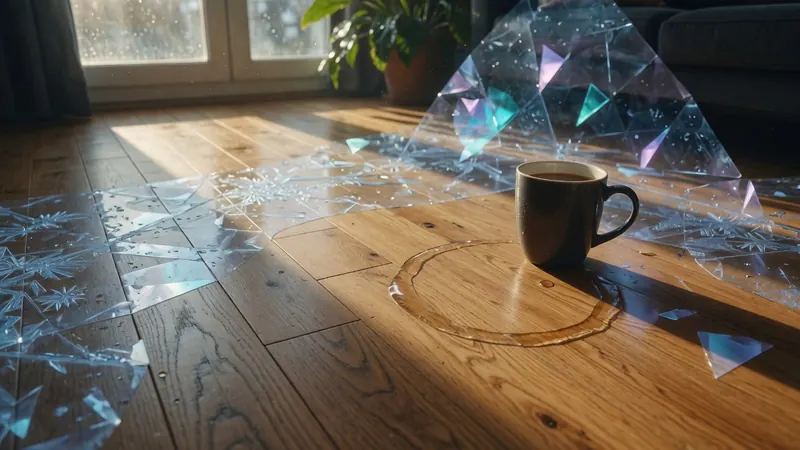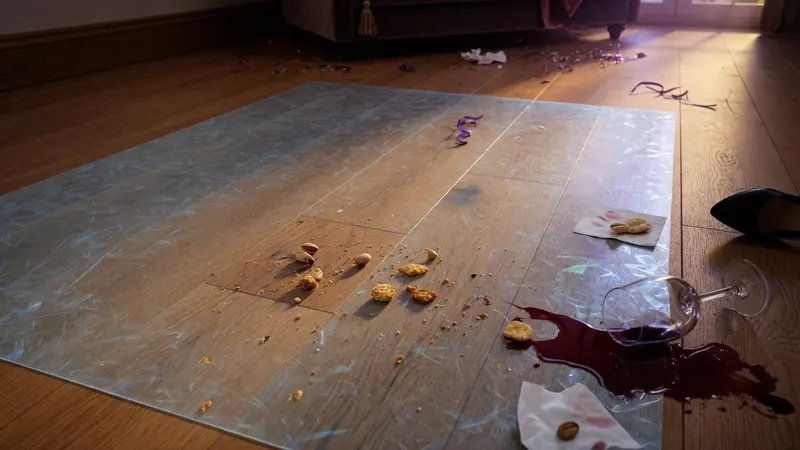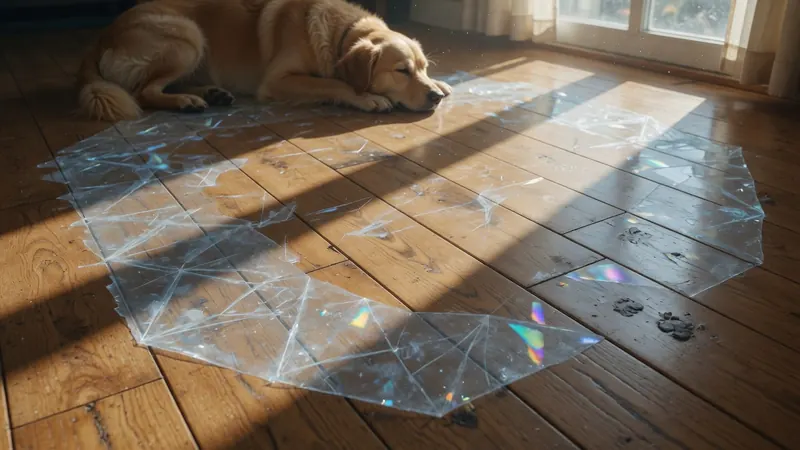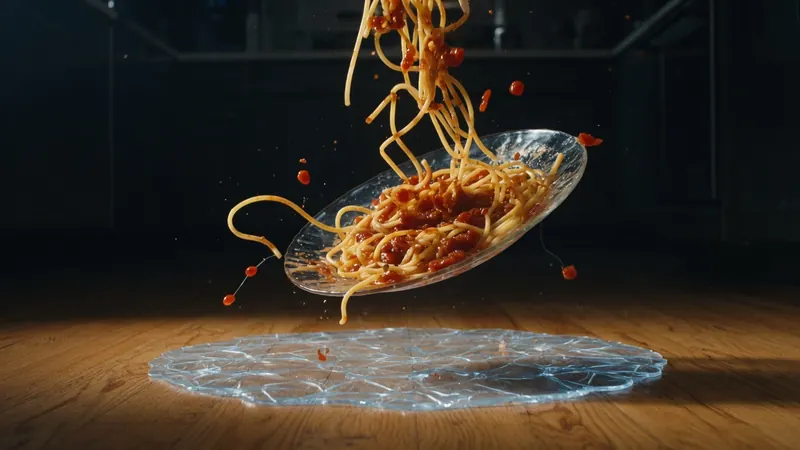
The plate slipped at 6:40 on a Tuesday evening. A full glass plate of spaghetti — sauce, meatballs, and a whole day of simmered patience — off the counter and falling toward five-year-old white oak. There was no time to catch it; there never is. There was only time to think: tomato acid, hot grease, and broken glass. On the good floor.
What happened next is the whole point of this article, so I'll come back to it. Because first you need to understand what was standing between that plate and the floor. It wasn't luck. It was a layer of chemistry about the thickness of a human hair that nobody in that kitchen had thought about once in five years.
That's the job of a finish. And it's why the question isn't really "how do I protect hardwood floors from scratches" — it's "what do I want standing guard when I'm not looking?"
The scratches you see, and the war you don't
Every scratch on a wood floor tells the same two-part story. Part one is the visible event: the dog scrambling for the doorbell, the dining chair dragged instead of lifted, the piece of grit under a sneaker that acts like a ball bearing between a boot and a board. Part two is invisible, and it happened years earlier — the moment the finish on that floor was chosen, applied, and cured. By the time the plate leaves the counter, the outcome is already decided.
Most people shop for flooring by color and plank width. Contractors shop by what we call the wear layer — the clear coat that takes the abuse so the wood doesn't have to. A standard site-applied polyurethane is a decent guard. A factory-cured cross-linked aluminum-oxide wear layer (aluminum oxide particles — the same mineral family as sapphire — locked into a hardened resin matrix) is a different weight class entirely.
How different? The industry measures abrasion resistance with the Taber test (ASTM D4060 — a weighted abrasive wheel grinding away at a sample, cycle after cycle). Aluminum-oxide finishes routinely outlast standard polyurethane several times over in that rig. The National Wood Flooring Association has pointed to factory-applied aluminum oxide as the benchmark for prefinished durability for years. This isn't marketing math. It's the difference between a guard who walks the perimeter and one who's already standing at the door.
That's the wear layer doing its job. Quietly.
A Guardian's Test: what cross-linking actually means
Quick tangent, because this term gets thrown around without explanation. When a finish cures, its resin molecules form bonds with each other. In cheap finishes those bonds are sparse — the molecules are like guests at a party, loosely mingling, easy to separate. In a UV-cured cross-linked aluminum-oxide wear layer, ultraviolet light forces the resin into a dense three-dimensional net where nearly every molecule is bonded to its neighbors.
It matters because a scratch is literally the act of tearing those bonds apart. Denser net, harder tear. While you're just living your life — dragging a laundry basket, rolling an office chair — the net is absorbing thousands of tiny insults and distributing the force across itself instead of handing it to the wood. You will never see it happen. That's the entire design.
Real-world stress tests
Lab numbers are nice. Houses are messier. Here's what I've actually watched floors go through.
The rental between tenants
A property manager I work with turns over a two-bedroom unit every eighteen months or so. Between tenants there's the move-out gauntlet: furniture sliders nobody bothered to use, a bed frame dragged across the hallway, weeks of unknown dog history. With the old oil-modified polyurethane, she budgeted a screen-and-recoat (a light sanding and fresh topcoat) every other turnover — about $1,400 and three days of vacancy each time. After switching the unit to a floor with a factory cross-linked aluminum-oxide wear layer, she's had exactly one recoat conversation in four years, and it turned out to be a cleaning issue, not a wear issue. The floor under the sofa legs looked like the floor inside the closet. That's the comparison that matters.
One more detail from that job, because it stuck with me. On the last walkthrough I watched her cleaning crew mop the place top to bottom, then drag their own vacuum across the bedroom threshold — the one unprotected metal edge in the unit. Even the best guardian only covers the surface it's applied to. Edges, thresholds, and stair noses are where I still see the first honest wear on any floor, and it's why I now spec transitions and nosings with the same finish system instead of whatever the installer has on the truck.
The kitchen with a dog and a toddler
If you've got a 70-pound dog and a kid under five, here's what actually matters: not whether the floor can survive one dramatic event, but whether it can survive ten thousand boring ones. Water bowl splashes. Dropped spoons. The daily 6 p.m. zoomies. In homes like this, the failure mode I see first on ordinary finishes is micro-scratching in the traffic lane — that dull, grayish haze between the island and the fridge where the finish has been sanded by life. It shows up around year two on standard polyurethane. On a well-made UV-stable topcoat over an aluminum-oxide layer, year five is when I start looking for it, and usually I'm still looking.
This matters more now than it used to. The pandemic years permanently rewired how floors get used: millions of households added a dog, then added a home office, and suddenly the kitchen floor went from weekend duty to sixteen-hour shifts, seven days a week. Floors installed in the last five years are carrying a wear load their predecessors never saw — and a lot of them are showing it early, because they were sold on looks, not on what was guarding the surface. Pet-friendly isn't a marketing segment. It's the default American household now, and floors should be spec'd like it.
The sunroom
Sunlight is the slow knife. UV radiation breaks down finish resins and bleaches the wood pigments beneath — ambering, fading, that telltale rectangle where the rug used to be. This is where I have to practice some professional humility: fifteen years ago I confidently recommended a standard waterborne finish for a south-facing sunroom, and it visibly yellowed inside three summers. I was wrong about what "durable" meant in a room that's basically a light reactor. Now, for sun-drenched spaces, I won't spec anything without a UV-stable topcoat — stabilizers in the finish that absorb ultraviolet energy before it can break bonds in the resin or reach the wood. (That's the same principle as sunscreen, if sunscreen were engineered to last a quarter-century.)
The part nobody tells you: even a guardian has limits
Here's the honesty a good finish deserves. No coating makes a floor invincible, and any brand that says otherwise is selling you a refund claim. A dragged refrigerator will beat almost anything. A deep gouge from a dropped tool on a job site can reach past the finish into the wood. What a superior finish actually buys you is performance under real conditions: dramatically better resistance to the scratches, scuffs, fading, and dulling that account for 95% of what actually kills floors. The other 5% is physics, and physics wins.
And even the best guardian appreciates decent backup. This is the short list I give every client:
- Felt pads on every chair and table leg — replace them yearly; they compress into plastic discs.
- Walk-off mats at exterior doors — most floor scratches are just tracked grit doing its slow work.
- Keep dog nails trimmed — your groomer is cheaper than a recoat.
- Damp-mop, don't flood-mop — finishes hate standing water more than they hate claws.
- Lift, don't drag — the four words that would put half the refinishers I know out of business.
The invisible week your floor just survived
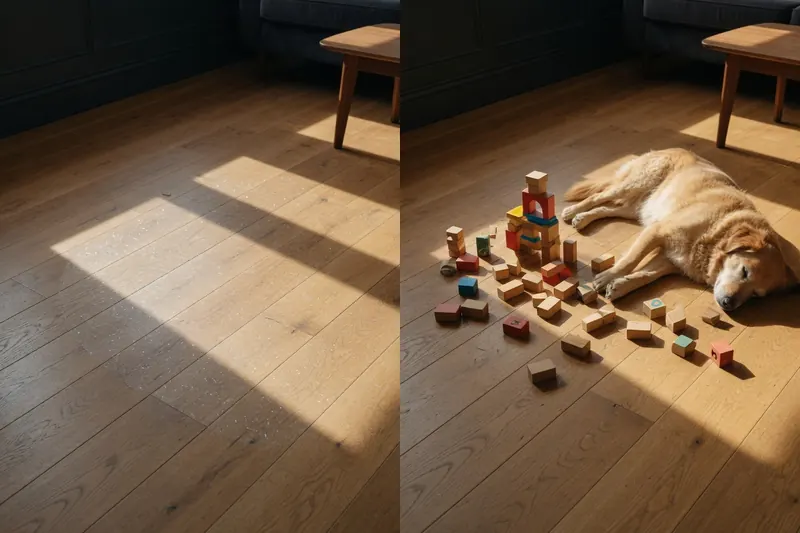
Consider something you've never thought about: last week, if it was hot and dry, your floorboards contracted by fractions of a millimeter. Next month, humid, they'll swell back. Every board in your house is quietly breathing with the weather, and the finish is flexing with it, thousands of micro-movements a year. A brittle finish — one that cured hard but not tough — develops hairline cracks along board seams within a few seasonal cycles, and that's where dulling and moisture sneak in. A properly engineered wear layer is formulated for flexibility under exactly this stress. You never noticed any of it. It happened anyway, twice a year, every year you've owned the house.
Back to the spaghetti
So — Tuesday evening, a full plate, five-year-old oak. The plate hit flat and went to pieces the way glass does, sauce reaching the baseboards two meters out. My client's youngest finally looked up from her homework, said something we won't print, and the dog came trotting in to volunteer for cleanup.
Here's the damage report an hour later. The meatballs were a loss — the dog disagrees. The plate was a write-off. And the floor? A damp mop and two paper towels. No red shadow soaking into the grain. No etched, dull patch where the tomato acid sat while everyone took photos first. No hairline scratches from the shards when they were swept. Just floor, doing its impersonation of an ordinary Tuesday.
What actually happens in the six months after the movers leave? Usually, life — and usually, the floor quietly pays for it. This time the bill never came. That's not a miracle coating; that's a cross-linked aluminum-oxide wear layer taking one for the team, exactly as engineered. The best protection is the kind you forget is there — right up until the day it saves you, and even then it lets you forget again by dessert.
So here's the question worth sitting with: it's five years from today. Your dog is older, your kids are louder, and the sun has had 1,800 more mornings to work on that living room. What do you want to see when you pull the rug back?
If you're not sure what your current floor is standing behind, that's the place to start — find out whether your finish is still doing its job. Check the wear layer spec on your flooring, or run a fingertip across the traffic lane and compare it to the boards under the couch. And if you're choosing new floors, choose the ones guarded by Adamantine — so the next spaghetti night is just a cleanup, not a story.