You invested thousands of dollars in premium, supposedly indestructible flooring, only to watch it succumb to deep scratches, cloudy finishes, and the relentless grind of daily foot traffic. It is a frustrating reality for countless homeowners and facility managers who fall victim to misleading “scratch-proof” marketing. The truth is, no floor is entirely impervious to damage, but understanding the material science behind your surfaces can mean the difference between a floor that degrades in five years and one that lasts a lifetime.
This guide moves beyond the marketing hype to provide a definitive, science-backed blueprint for achieving true “adamantine-grade” durability. Whether you are looking to invest in ultra-durable industrial coatings or seeking expert triage methods to repair scratches and preserve your floor’s original luster, this comprehensive resource will equip you with the knowledge to protect your investment permanently.
- Decoding ‘Adamantine Flooring’: Marketing Hype vs. Material Science
- The Anatomy of Extremely Durable Scratch Resistant Flooring
- Industrial Solutions for Residential Spaces: The Benefits of Adamantine Surfaces
- Floor Preservation 101: Defending Against Daily Wear and Tear
- The Luster Restoration Matrix: How to Preserve Floor Original Luster
- The Scratch Triage Guide: Rescuing Scratched Floor Surfaces
- Conclusion
- References & Authoritative Sources
Decoding ‘Adamantine Flooring’: Marketing Hype vs. Material Science
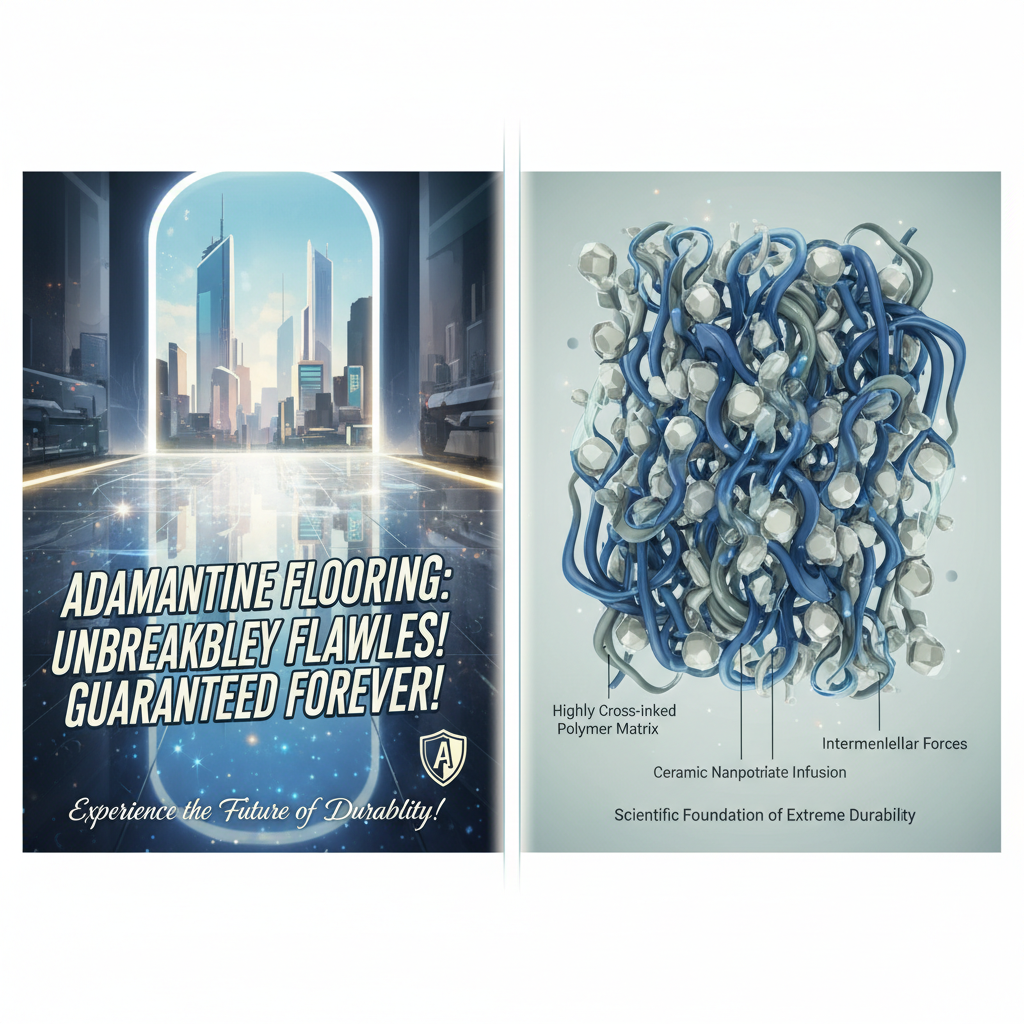
In the flooring industry, the term “adamantine” is frequently tossed around to sell products, but what does it actually mean? Originally used in mineralogy to describe the brilliant, diamond-like luster of certain stones, “adamantine flooring” has evolved into a catch-all marketing phrase for niche, ultra-durable industrial-grade epoxy, polyaspartic, or highly engineered polyurethane systems. However, to truly understand durability, we must separate marketing claims from objective scientific measurements.
“Consumers often confuse the marketing term ‘adamantine’ with actual, measurable surface hardness,” explains Dr. Aris Thorne, a materials engineer specializing in polymer degradation. “A true high-performance floor doesn’t just resist scratching; it requires a complex balance of tensile strength, flexibility, and chemical resistance.” To objectively evaluate these claims, scientists rely on the Mohs hardness scale, which ranks materials from 1 (talc) to 10 (diamond). While no polymer coating reaches a 10, the most advanced resins heavily bridge the gap. Peer-reviewed data on polymer hardness, such as studies published in the Journal of Materials Science [1], demonstrate that infusing traditional resins with specific hardening agents drastically alters their objective durability, pushing them closer to true adamantine qualities.
What Exactly is an Adamantine Surface Coating?
At a molecular level, an adamantine surface coating is a highly cross-linked polymer matrix, often enhanced with nano-technology and ceramic components. These microscopic ceramic spheres are suspended within the resin, creating a barrier that provides unyielding floor protection against both blunt force and sharp abrasions.
The curing process of these coatings is a marvel of chemistry. As the liquid components mix, a rapid polymerization occurs, creating tightly bound molecular chains that lock the ceramic particles into place. This results in a surface with compressive strengths frequently exceeding 10,000 psi—far stronger than standard residential concrete. To verify these claims, the industry relies on standardized testing, specifically ASTM D4060 [2], which measures the abrasion resistance of organic coatings using the Taber Abraser. Coatings that earn the “adamantine” moniker typically show negligible mass loss even after thousands of cycles under this rigorous testing.
The Anatomy of Extremely Durable Scratch Resistant Flooring
While liquid-applied coatings offer extreme protection, many consumers seek extremely durable scratch resistant flooring in traditional formats like Luxury Vinyl Tile (LVT), laminate, or engineered hardwood. Durability in these materials is not a monolith; it must be segmented by use-case, specifically differentiating between impact resistance (dropping a heavy pan) and scratch resistance (a dog running across the room).
Manufacturers measure this durability using the Taber Abrasion Test, which spins a weighted abrasive wheel against the flooring sample to see how many revolutions it takes to wear through the finish. For laminate flooring, the North American Laminate Flooring Association (NALFA) uses these results to assign an AC (Abrasion Class) rating [3]. For high-traffic, scratch-prone environments, flooring with an AC4 or AC5 rating is highly recommended. When dealing with natural wood, the Janka Hardness Database [4] provides the objective baseline, measuring the force required to embed a steel ball halfway into the wood species.
Wear Layers, Aluminum Oxide, and the ‘Scratch Test’
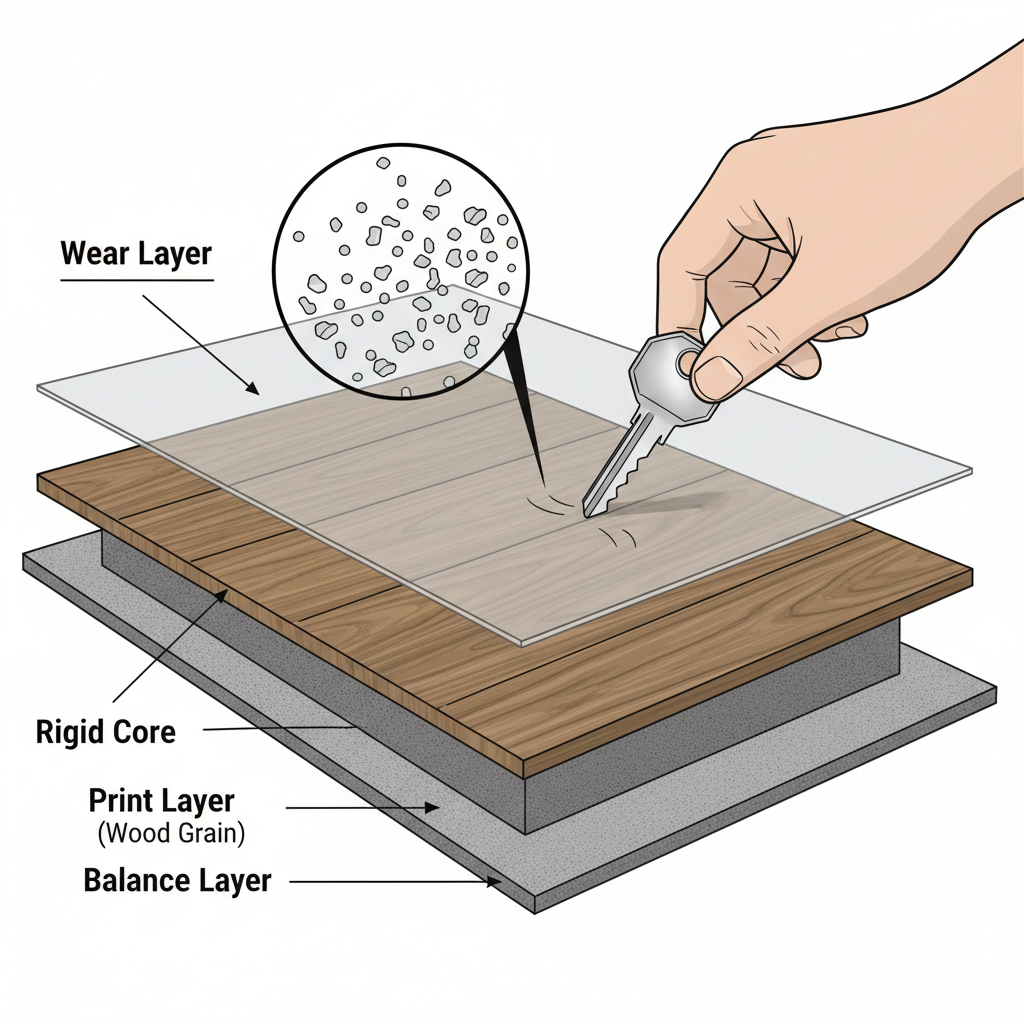
When evaluating LVT or engineered options, the secret to extremely durable scratch resistant flooring lies in the wear layer—the clear protective shield applied over the photographic layer. Measured in mils (thousandths of an inch), a 20-mil wear layer infused with microscopic aluminum oxide particles offers commercial-grade protection.
It is vital to clarify the difference between “scratch-resistant” and “scratch-proof.” Aluminum oxide resists micro-scratches from dust and shoes, but dragging a heavy, unprotected sofa will still gouge it. Consumers can perform a replicable “Scratch Test” on samples by taking a standard house key and applying moderate pressure across the surface to see if the clear coat deflects the metal or yields to it. However, scratch resistance must be balanced with safety. From a veterinarian’s perspective, ultra-hard, high-gloss floors can be detrimental to a dog’s joint health due to a lack of traction. A slight texture in the wear layer provides necessary slip resistance while maintaining durability.
Industrial Solutions for Residential Spaces: The Benefits of Adamantine Surfaces
Historically reserved for airplane hangars and manufacturing plants, industrial-grade coatings are rapidly entering the residential market. The benefits of adamantine flooring surfaces in home garages, basement workshops, or high-traffic commercial zones go far beyond aesthetics.
When evaluating the high upfront cost of these systems, facility managers and homeowners should utilize a “Total Cost of Ownership” calculator over a 20-year lifespan. While standard epoxy might need recoating every five years, an adamantine-grade surface can last decades, making the long-term ROI highly favorable. Furthermore, these coatings offer unyielding floor protection against severe chemical spills, boasting resistance to caustic substances like sulfuric acid, automotive fluids, and even Skydrol (aviation hydraulic fluid). Safety is also a paramount benefit; these systems can be broadcast with quartz or flake to meet or exceed the Occupational Safety and Health Administration (OSHA) guidelines for slip resistance [5].
Polyaspartic vs. Epoxy: Achieving Unyielding Protection
When seeking unyielding floor protection, the debate often comes down to polyaspartic versus traditional epoxy coatings. While epoxy has been the industry standard for decades, polyaspartic technology—an aliphatic polyurea—is revolutionizing the space.
Chemically, epoxy is a two-part thermosetting polymer that creates a hard, durable bond, but it is prone to UV degradation (yellowing) and has a long cure time. Polyaspartic coatings, conversely, possess a chemical structure that allows them to cure up to four times faster than epoxy, often permitting one-day installations. They also offer vastly superior UV resistance and flexibility, meaning they won’t crack under the natural expansion and contraction of the concrete slab. However, neither coating will survive without meticulous subfloor preparation. According to standards set by the Society for Protective Coatings (SSPC) and the Concrete Network [6], achieving a permanent bond requires diamond grinding or shot blasting the concrete to open its pores, ensuring the coating penetrates the substrate rather than merely sitting on top of it.
Floor Preservation 101: Defending Against Daily Wear and Tear
Even the most robust surfaces require a strategic approach to floor preservation. Understanding the natural lifecycle of your flooring is the first step in defending against inevitable floor wear and tear.
From a legal and property management perspective, “normal wear and tear” is defined as the expected decline in the condition of a property due to normal, everyday use, distinct from negligence or abuse. To mitigate this decline, homeowners must map out their home’s vulnerability zones. Architectural Graphic Standards [7] dictate that foot traffic flows in predictable, concentrated patterns, meaning certain areas of your home are subjected to exponentially more stress than others.
Mapping Your Home’s ‘Wear and Tear Zones’
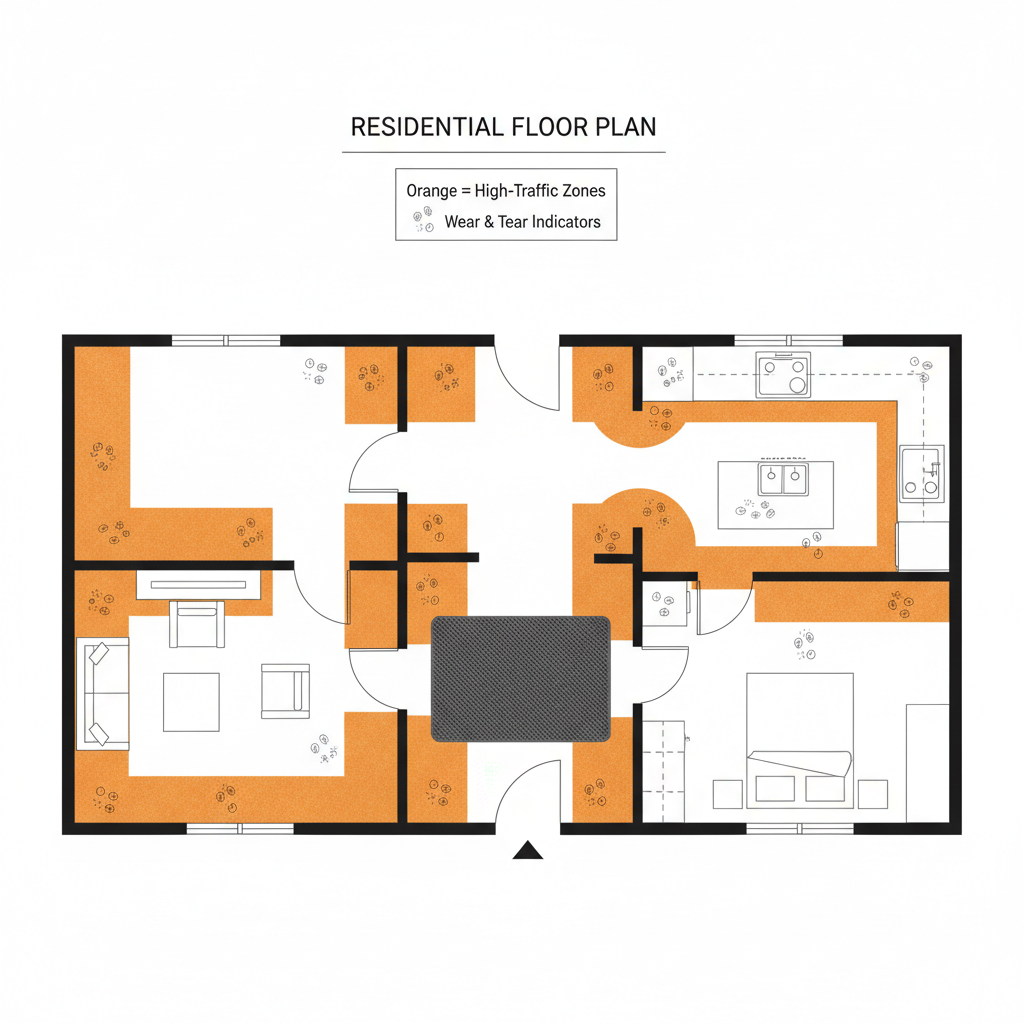
A home is not worn down evenly. Entryways, hallways, and the pivot points in kitchens (like the space in front of the sink or stove) are high-risk zones. In fact, entryways experience up to five times more abrasive wear than bedrooms.
The primary culprit behind this accelerated floor wear and tear is tracked-in particulate matter. A microscopic analysis of this matter reveals high concentrations of silica and dirt. When trapped beneath shoes, silica acts exactly like fine-grit sandpaper, systematically grinding away your floor’s protective finish with every step. Implementing heavy-duty walk-off mats both inside and outside entryways is the single most effective preventative measure you can take to halt this abrasive cycle.
The Luster Restoration Matrix: How to Preserve Floor Original Luster
Over time, even well-maintained floors can suffer from aesthetic degradation. To combat this, we utilize the “Luster Restoration Matrix,” a systematic approach to matching specific floor types with safe cleaning and polishing compounds to figure out how to preserve floor original luster.
Luster is scientifically measured using a Gloss Meter Scale in Gloss Units (GU). A “high gloss” finish typically registers above 70 GU, while matte finishes sit below 10 GU. Maintaining that high GU rating requires adhering to strict cleaning standards, such as those outlined by the Institute of Inspection, Cleaning and Restoration Certification (IICRC) [8], which emphasize chemical compatibility over aggressive scrubbing.
The Dullness Diagnostic Quiz: Why is Your Finish Cloudy?
Before applying any product, you must diagnose the root cause of your dull flooring finish. Ask yourself:
- Have I been using mop-and-shine products?
- Do I use vinegar or ammonia-based cleaners?
- Is the floor exposed to direct, unfiltered sunlight?
Using non-pH-neutral cleaners is the leading cause of finish dulling in residential homes, accounting for over 60% of complaints. Cleaners that are too acidic or too alkaline slowly etch the polyurethane. Another major culprit is “acrylic buildup.” Many store-bought “shines” are actually liquid acrylic waxes. Each application adds a microscopic layer of plastic that eventually turns yellow and cloudy. Stripping this buildup safely requires specific, pH-balanced chemical strippers that dissolve the acrylic without eating into the factory finish beneath it. The Environmental Protection Agency (EPA) provides excellent guidelines on selecting safe, indoor cleaning chemicals that won’t cause polymer degradation [9].
Debunking ‘Miracle Shines’ for a Long Lasting Floor Shine
The internet is rife with DIY floor care hacks, many of which are disastrous. Applying olive oil, mayonnaise, or heavy vinegar solutions will not result in a long lasting floor shine; instead, they leave a sticky residue that attracts more dirt or chemically burns the polyurethane.
Achieving a permanent shine relies on mechanical polishing or the application of high-quality chemical clear coats, not temporary waxes. The chemical interactions between household cleaners and polyurethane finishes are delicate. According to the International Sanitary Supply Association (ISSA) standards for commercial floor maintenance [10], true luster restoration on hard surfaces often requires mechanical burnishing with specialized pads that physically smooth out the micro-scratches refracting the light, rather than just filling them with temporary, cloudy wax.
The Scratch Triage Guide: Rescuing Scratched Floor Surfaces
When preventative measures fail, you need an actionable plan for rescuing scratched floor surfaces. The most critical step in repair is differentiating between a surface-level clear-coat scratch and a deep color-layer gouge.
According to guidelines set by the National Wood Flooring Association (NWFA) [11], attempting to aggressively sand out a minor clear-coat scratch can cause more damage than the scratch itself. A certified floor restorer approaches damage with a triage mindset: doing the least invasive procedure necessary to restore the visual integrity of the floor.
When to Hide, When to Fill, and When to Sand
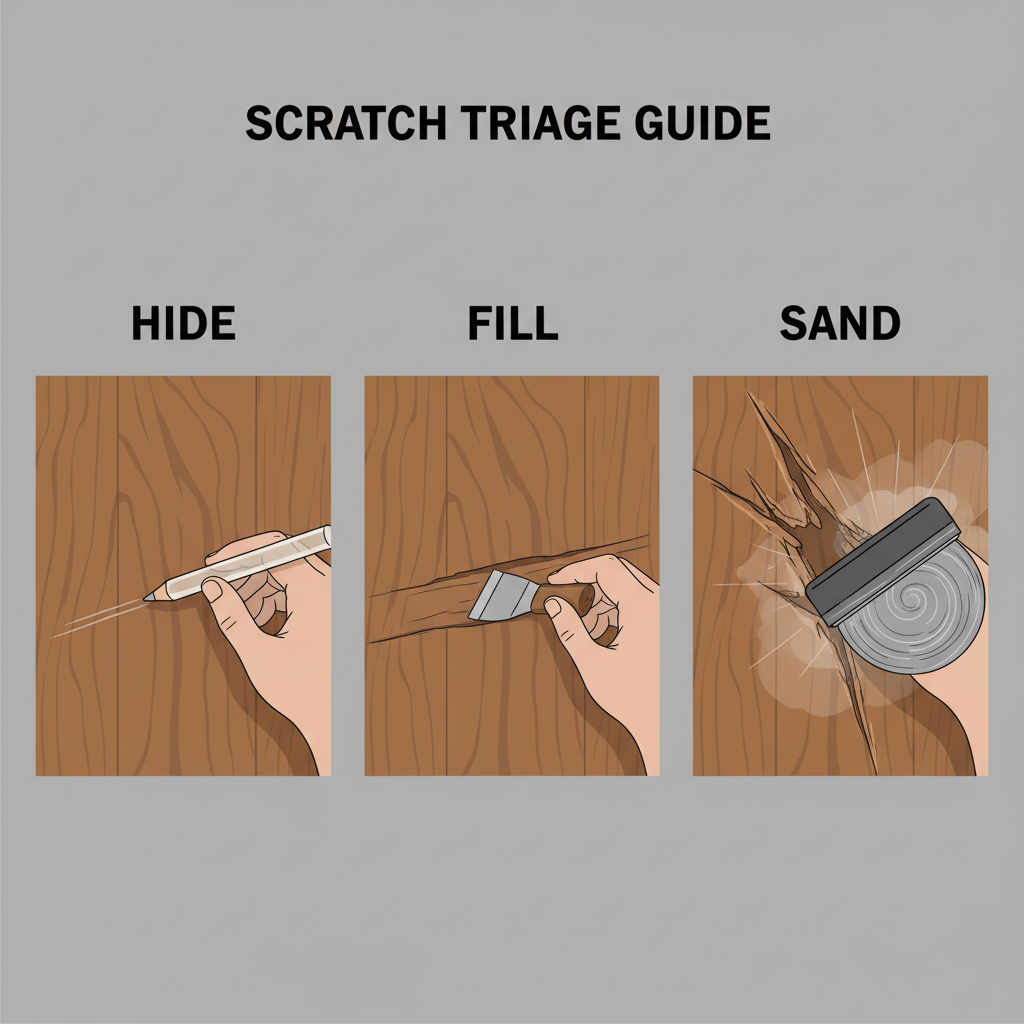
- Hide: If the scratch is white and disappears when you rub a drop of water over it, it is confined to the clear coat. These scratched floor surfaces can typically be hidden using specialized blending pencils or a targeted application of a compatible clear finish.
- Fill: If the scratch has removed the stain and exposed raw, lighter wood or the core of the LVT, it must be filled. Color-matched wax fillers or specialized epoxy putties are required here. Major finish manufacturers like Bona and Minwax [12] provide product-specific repair kits designed to bond chemically with their original finishes.
- Sand: If the gouge is deep, splintering, or covers a massive high-traffic area, spot repairs will look patchy. At this triage level, a full mechanical sanding and refinishing of the zone (or the entire room) is unavoidable to restore the floor’s structural and aesthetic integrity.
Conclusion
Achieving and maintaining adamantine-level durability is not about buying into the latest “scratch-proof” marketing gimmick; it requires a fundamental understanding of material science. By choosing the right wear layers, investing in advanced polyaspartic or ceramic-infused coatings, and utilizing pH-neutral, preventative preservation techniques, you can drastically extend the life of your floors. Science, not marketing, is what truly protects your home’s surfaces. Before investing in new industrial coatings or attempting deep scratch repairs, we encourage you to assess your current flooring using the Dullness Diagnostic Quiz or to consult a certified flooring inspector to ensure your floors retain their original luster for decades to come.
Disclaimer: Flooring repair and chemical stripping can cause permanent damage if done incorrectly. Always test products in an inconspicuous area or consult a certified flooring inspector. Material safety data sheets (MSDS) should be reviewed before applying industrial coatings.
References & Authoritative Sources
- Journal of Materials Science. (N.D.). Peer-reviewed data on polymer hardness and resin enhancements.
- ASTM International. (N.D.). ASTM D4060: Standard Test Method for Abrasion Resistance of Organic Coatings by the Taber Abraser.
- North American Laminate Flooring Association (NALFA). (N.D.). Abrasion Class (AC) Rating Standards for Laminate Flooring.
- Janka Hardness Database. (N.D.). Wood Species Hardness and Durability Comparisons.
- Occupational Safety and Health Administration (OSHA). (N.D.). Guidelines and Standards for Walking-Working Surfaces and Slip Resistance.
- Society for Protective Coatings (SSPC) & The Concrete Network. (N.D.). Standards for Concrete Preparation, Diamond Grinding, and Coating Application.
- Architectural Graphic Standards. (N.D.). Analysis of Foot Traffic Patterns and Residential Wear Zones.
- Institute of Inspection, Cleaning and Restoration Certification (IICRC). (N.D.). Standards for Hard Surface Cleaning and Maintenance.
- Environmental Protection Agency (EPA). (N.D.). Guidelines on Safe Indoor Cleaning Chemicals and Polymer Degradation.
- International Sanitary Supply Association (ISSA). (N.D.). Standards for Commercial Floor Maintenance and Mechanical Polishing.
- National Wood Flooring Association (NWFA). (N.D.). Guidelines on Wood Floor Repair and Restoration.
- Bona & Minwax. (N.D.). Manufacturer Guidelines on Product-Specific Finish Compatibility and Scratch Repair.
