If you own a home, manage a rental property, or oversee a commercial facility, you are likely intimately familiar with the damaged flooring cycle. It starts with a peeling luxury vinyl plank, a cracked porcelain tile, or a buckling laminate board. You patch the symptom, ignore the underlying disease, and within five to ten years, you are forced into another expensive, disruptive renovation. This endless loop of frequent floor repairs and premature material failure is a massive financial drain, costing property owners thousands of dollars in wasted capital and lost time.
Most homeowners and landlords attempt to solve this problem by simply buying a thicker surface material, completely ignoring the structural foundation that dictates a floor’s true lifespan. This guide is designed to break that cycle. Welcome to the definitive “Buy It For Life” flooring blueprint. We are pulling back the curtain on industrial-grade materials—including true adamantine flooring—revealing the structural subfloor secrets the industry rarely discusses, and breaking down the true 30-year Return on Investment (ROI) math. By shifting your focus from surface-level aesthetics to structural integrity and commercial-grade durability, you can guarantee that your next floor installation is your last.
- Diagnosing the Damaged Flooring Cycle: Why Your Floors Keep Failing
- The Myth vs. Reality of Adamantine Flooring
- High-Traffic Flooring Showdown: Ranking Permanent Materials
- Low Maintenance Flooring Solutions: Reclaiming Your Weekend
- Calculating the True 30-Year ROI of Permanent Flooring
- What to Expect During a Permanent Floor Installation: A Survival Guide
- Conclusion
- References & Authoritative Sources
Diagnosing the Damaged Flooring Cycle: Why Your Floors Keep Failing
To understand how to stop replacing floors, you must first understand why they fail in the first place. The harsh reality is that the vast majority of flooring failures have nothing to do with the surface material itself. Instead, they are symptoms of underlying structural and environmental diseases.
The 5 Hidden Causes of Frequent Floor Repairs
When a homeowner asks, “Why does my tile floor keep cracking in the same spot?” or “Can a bad subfloor ruin new flooring?” the answer almost always points downward. According to data from the National Association of Home Builders (NAHB), improper subfloor preparation and unmitigated moisture issues account for up to 70% of premature flooring failures [1].
The top five hidden causes of frequent floor repairs include:
- Subfloor Deflection (Bounciness): “A floor is only as permanent as the joists supporting it,” explains Marcus Thorne, an American Society of Home Inspectors (ASHI) certified inspector. “If your wooden subfloor bends or ‘deflects’ under the weight of foot traffic, rigid materials like tile or engineered hardwood will inevitably crack or separate at the seams, regardless of their quality” [2].
- Lack of Expansion Gaps: Materials expand and contract. Failing to leave adequate perimeter gaps causes buckling and peaking.
- Improper Acclimation: Installing materials before they have adjusted to the home’s climate leads to massive post-installation shifting.
- Inadequate Underlayment: Using the wrong padding can compromise the locking mechanisms of floating floors.
- Unleveled Slabs: Laying rigid planks over a wavy concrete slab creates hollow spots that eventually crack under pressure.
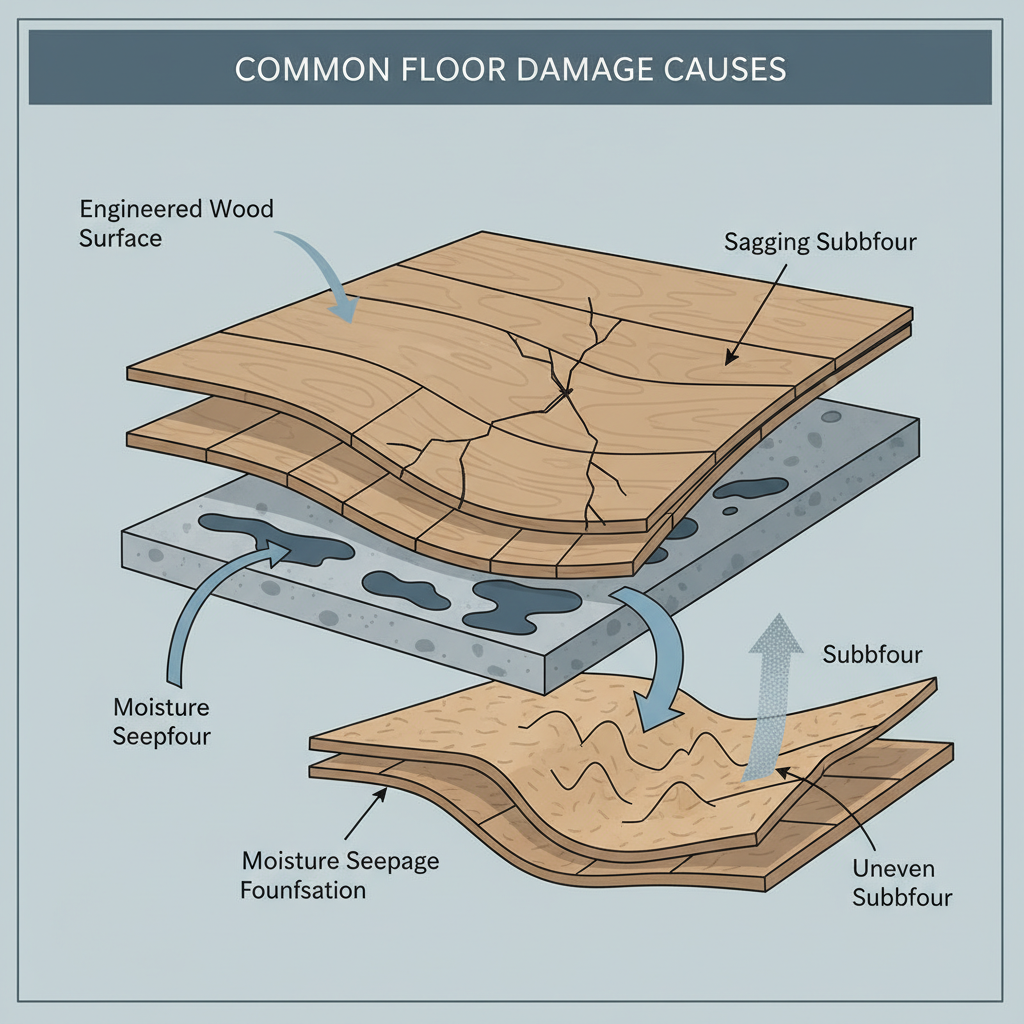
To properly diagnose these issues, professionals rely on strict failure analysis standards set by the Institute of Inspection, Cleaning and Restoration Certification (IICRC) [3].
Environmental Impacts: Humidity, Moisture, and UV Damage
Escaping the damaged flooring cycle requires a systems approach to your home’s environment. How does indoor humidity affect hardwood and laminate floors? Drastically. Wood is hygroscopic; it absorbs and releases moisture based on the air around it.
“Homeowners often blame the flooring manufacturer for gapping or cupping, but the true culprit is usually a lack of HVAC humidity control,” notes Sarah Jenkins, a licensed HVAC specialist. “Maintaining an indoor relative humidity between 35% and 55% year-round is non-negotiable for the longevity of natural flooring” [4].
Furthermore, moisture transmission from concrete slabs—especially in basements—is a silent killer. The Building Science Corporation, a leading authority on moisture control, emphasizes that proper vapor barriers are the ultimate prerequisite to stopping floor replacement [5]. Even sunlight plays a role; prolonged UV ray exposure can fade and damage luxury vinyl flooring over time, making UV-blocking window treatments a vital part of your floor’s environmental defense system.
The Myth vs. Reality of Adamantine Flooring
When searching for the ultimate durable flooring, you may encounter the term “adamantine.” Often shrouded in marketing jargon, adamantine flooring represents a highly specialized, ultra-durable tier of surfacing. But what is the reality behind the myth?
What Exactly is Adamantine Flooring Made Of?
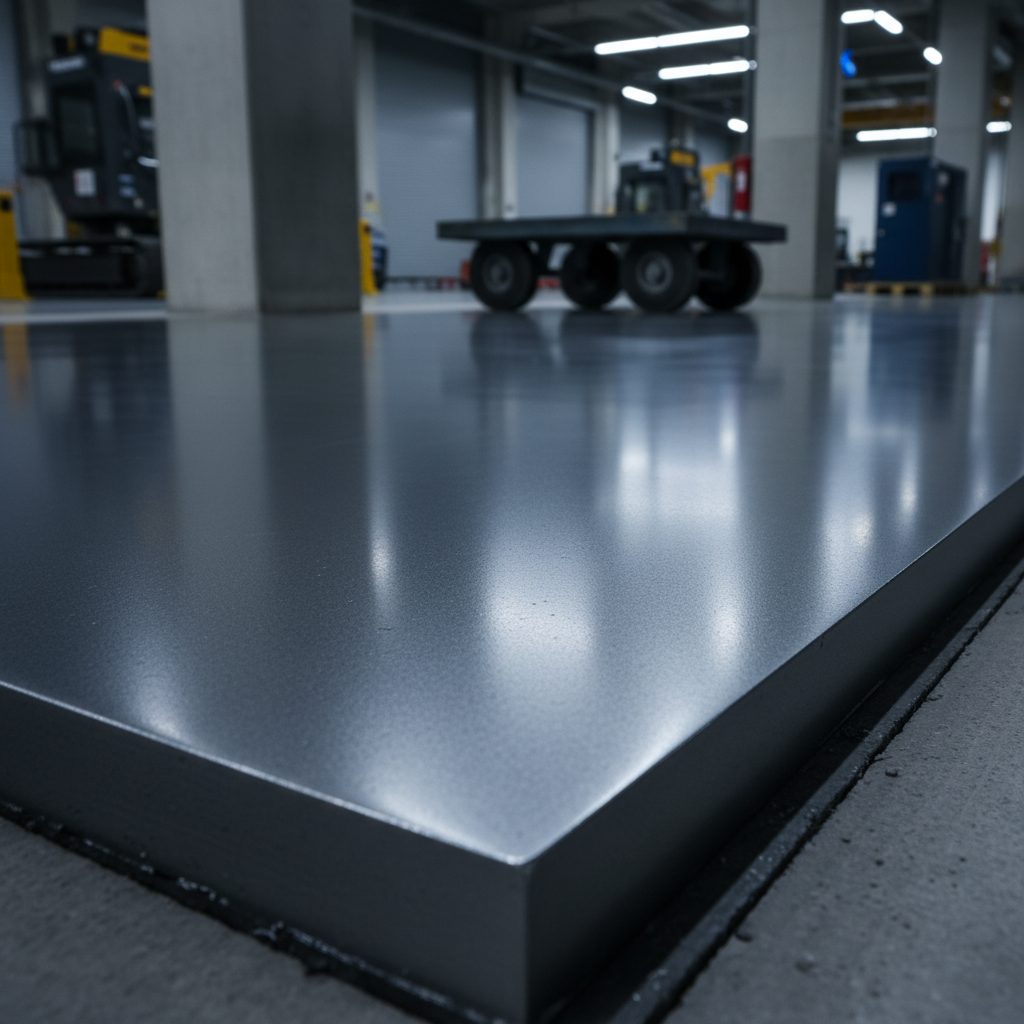
Adamantine flooring is not a magical stone; it is a category of advanced industrial epoxy, polyurethane blends, and proprietary heavy-duty concrete coatings engineered for extreme environments. When consumers ask, “What is adamantine flooring made of?” and “How does adamantine compare to standard commercial epoxy?” the answer lies in the chemical curing process.
“Standard epoxy sits on top of a surface, but adamantine-grade coatings often utilize a deeply penetrating primer combined with a high-build, cross-linked polyurethane topcoat,” explains Dr. Aris Thorne, a certified industrial materials engineer. “This creates a monolithic surface that chemically bonds with the concrete substrate, offering a compressive strength that standard residential epoxies simply cannot match” [6].
This level of chemical resilience is backed by peer-reviewed data from the Journal of Protective Coatings & Linings (JPCL), which highlights the superior abrasion resistance of these advanced floor coatings [7]. The Materials Research Society (MRS) further validates that these compositions are the gold standard for advanced material durability in harsh environments [8].
Beyond Durability: The Hidden Benefits of Adamantine Installation
The benefits of adamantine flooring installation extend far beyond mere scratch resistance. For commercial facilities and high-end residential garages, these floors offer incredible secondary benefits.
Are they resistant to harsh chemicals and oils? Yes, their non-porous nature makes them impervious to automotive fluids, industrial solvents, and heavy degreasers. Does adamantine flooring improve workplace safety? Absolutely. These coatings can be customized with quartz or aluminum oxide aggregates to provide aggressive slip resistance. In fact, these floors are frequently utilized to meet and exceed the stringent slip-resistance standards set by the Occupational Safety and Health Administration (OSHA) [9].
High-Traffic Flooring Showdown: Ranking Permanent Materials
For active households with large pets, kids, and constant movement, finding the best permanent flooring for high traffic is a priority. To cut through the noise, we must move beyond standard listicles and rank materials based on real-world abuse using a strict grading rubric.
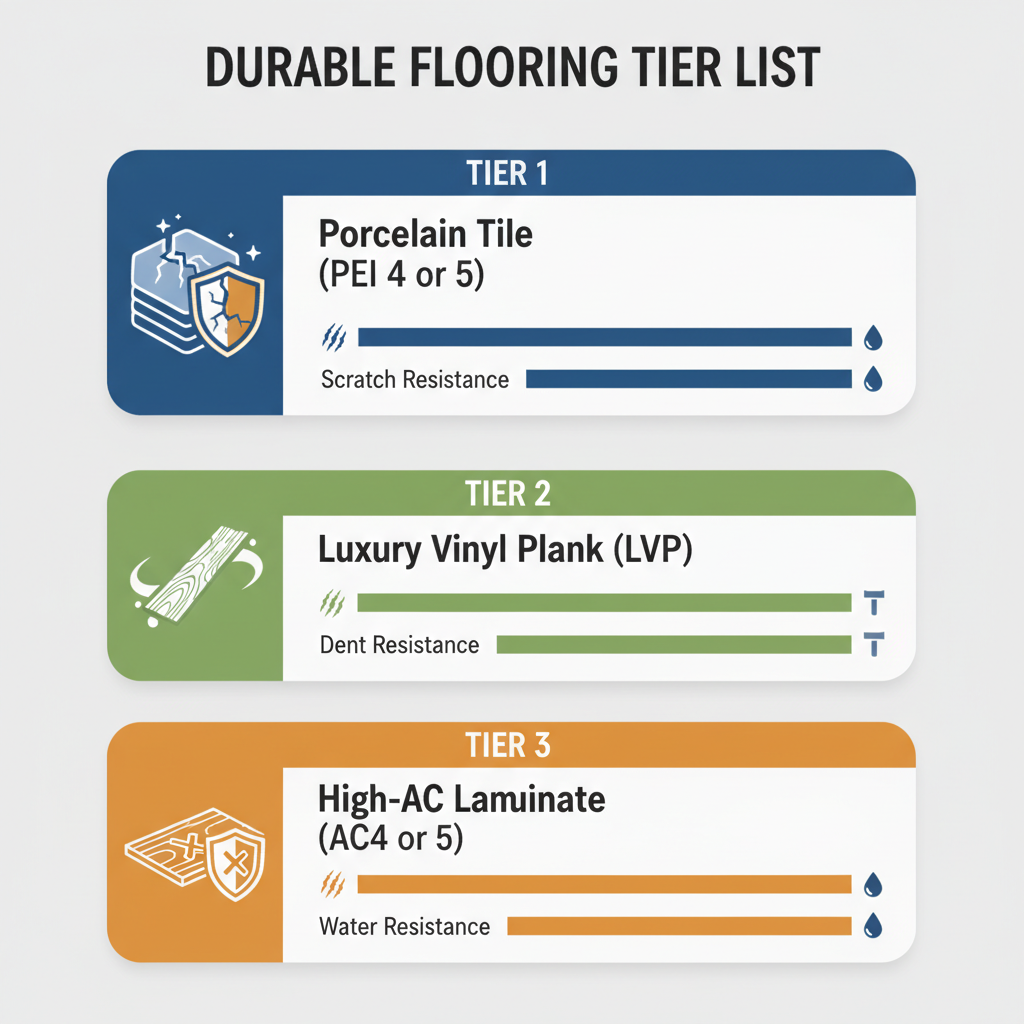
The Durable Flooring Tier List: Scratch, Dent, and Water Resistance
What is the most durable flooring for large dogs? Is luxury vinyl plank more durable than laminate? To answer these, we look at objective measurements like Janka hardness scores for wood, AC (Abrasion Class) ratings for laminate, and PEI (Porcelain Enamel Institute) ratings for tile.
- Tier 1: Porcelain Tile (PEI 4 or 5). Porcelain is fired at higher temperatures than standard ceramic, making it incredibly dense. It is the undisputed champion of scratch resistance for residential homes and is 100% waterproof.
- Tier 2: Luxury Vinyl Plank (LVP). LVP holds an estimated 30% market share in the flooring industry, largely due to its exceptional durability-to-cost ratio [10]. Featuring a rigid core and a thick urethane wear layer (look for 20-mil or higher), it is highly dent-resistant and waterproof—though it can still be scratched by unclipped dog nails or dragged furniture.
- Tier 3: High-AC Laminate (AC4 or AC5). While highly scratch-resistant (often more so than LVP), standard laminate is only water-resistant, not waterproof, making it vulnerable to standing water.
Breaking the Cycle in Rentals: Indestructible Options for Landlords
Landlords face the brutal reality of constant floor replacement. According to the National Apartment Association (NAA), landlords spend an average of 15% of their interior maintenance budget on flooring turnover [12]. What is the most indestructible flooring for rental properties that can survive minor flooding and heavy tenant abuse?
“We used to replace carpet every two to three years,” notes a case study from a prominent property management firm featured on the real estate investing platform BiggerPockets. “Transitioning our entire portfolio to 100% waterproof rigid core LVP eliminated our water damage claims and reduced our flooring replacement frequency by a factor of three” [11].
For rentals, rigid core LVP or wood-look porcelain tile are the ultimate solutions to tenant-proof a property.
Commercial Grade for Home & Business: Polished Concrete vs. Porcelain
For those asking, “What flooring is used in airports and shopping malls?” or “What is the best flooring for a busy retail store or commercial kitchen?”, the answers are polished concrete and commercial-grade porcelain.
Polished concrete is created by mechanically grinding the slab and applying chemical densifiers. According to the American Society of Concrete Contractors (ASCC), properly densified polished concrete can withstand foot traffic of over 10,000 people per day without visible wear [13]. Alternatively, commercial porcelain tile, installed following the definitive standards of the Tile Council of North America (TCNA), offers a permanent, stain-proof surface capable of handling extreme rolling loads [14].
Low Maintenance Flooring Solutions: Reclaiming Your Weekend
Durability is only half the equation; convenience is the other. Many consumers seek low maintenance flooring solutions, but it is crucial to distinguish between a floor that is “easy to clean” and one that “requires zero maintenance.” Natural stone, for example, is durable but requires regular sealing.
The Easiest Floors to Keep Clean (That Don’t Look Cheap)
What is the absolute easiest floor to keep clean? And do you ever need to wax or polish luxury vinyl plank?
“The secret to a truly low-maintenance floor isn’t just the material; it’s the finish and the color,” advises Elena Rodriguez, owner of a professional residential cleaning service. “Mid-tone colors with a matte finish and heavy variation hide dust and pet hair incredibly well. High-gloss dark floors, conversely, will show every single footprint” [15].
Data supports this: sheet vinyl and LVP require approximately 50% less active cleaning and maintenance time annually compared to carpet or natural stone. They never require waxing or polishing. The Good Housekeeping Institute, a trusted authority on household product efficacy, consistently rates high-quality LVP and glazed porcelain as top performers in their rigorous cleaning and maintenance testing routines [16].
Calculating the True 30-Year ROI of Permanent Flooring
To truly stop replacing floors, you must shift your perspective from the upfront price tag to the long-term value.
Upfront Costs vs. Total Cost of Ownership (TCO)
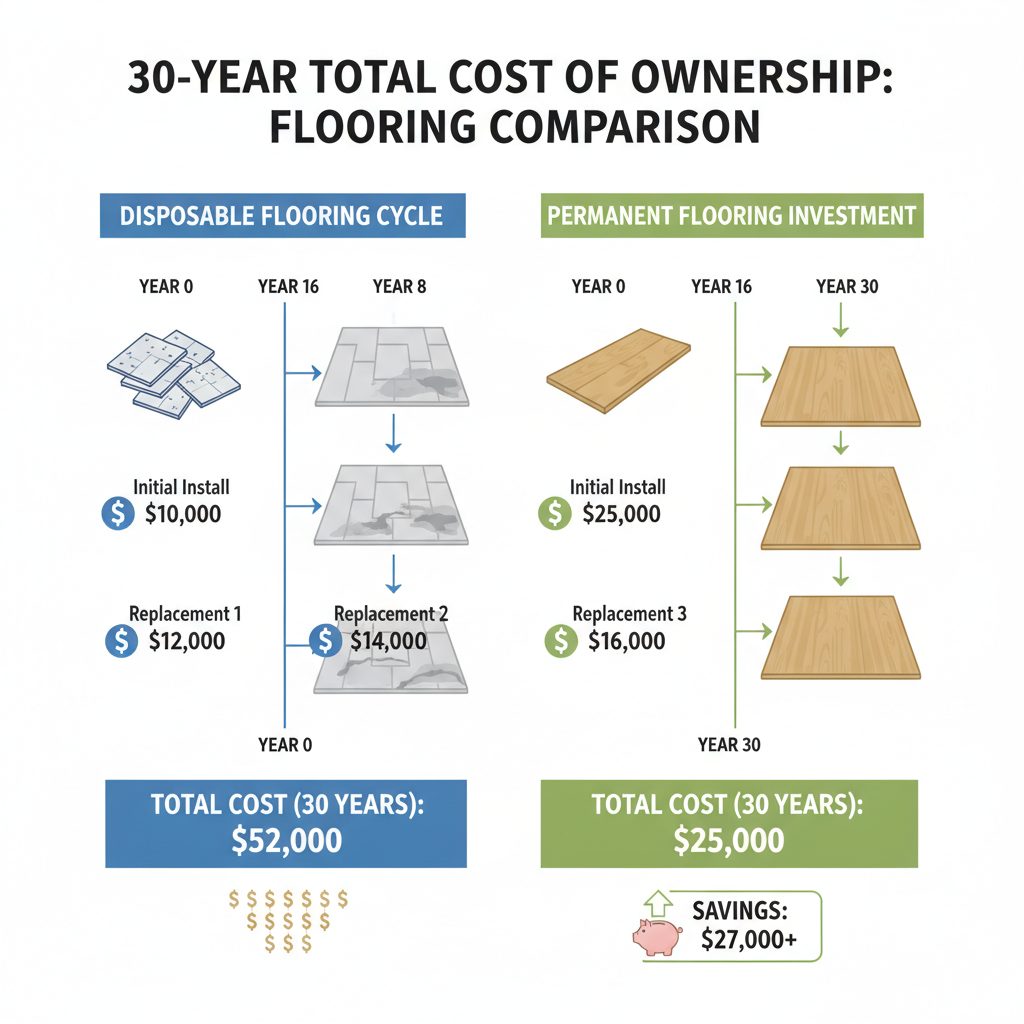
Is it cheaper to keep repairing a damaged floor or replace it entirely? If you are stuck in the damaged flooring cycle, patching is a sunk cost. Let’s look at the Total Cost of Ownership (TCO).
Buying a “cheap” $2/sq.ft. laminate floor might seem economical, but if it fails in 7 years due to moisture, you will pay for demolition, disposal, new subfloor prep, new materials, and new installation. Over 30 years, you will replace that cheap floor three to four times. Conversely, investing in permanent flooring once—even at a higher upfront cost—saves thousands.
Top Long-Lasting Floor Upgrades That Add Resale Value
Does permanent flooring increase a home’s resale value? Absolutely. Homes with permanent hard-surface flooring see a 2.5% higher resale value on average compared to homes with wall-to-wall carpet.
When asking which floor upgrade has the best return on investment (ROI), solid hardwood remains king.
“Buyers are looking for authenticity and longevity,” states a licensed real estate appraiser. “A properly installed, site-finished hardwood floor is viewed as a generational asset” [18].
This is backed by a National Wood Flooring Association (NWFA) Certified Inspector, who notes that with proper maintenance and periodic refinishing, solid hardwood floors can easily last 50 to 100+ years [17]. Financially, the National Association of Realtors (NAR) “Remodeling Impact Report” states that hardwood floor refinishing or upgrading to new wood yields an estimated 147% cost recovery at resale—the highest of any interior remodeling project [19].
What to Expect During a Permanent Floor Installation: A Survival Guide
Purchasing the right material is only step one; permanent floor installation is a major construction event. Consumers are often blindsided by the disruption, dust, and rigorous subfloor profiling required.
Timelines, Acclimation, and Subfloor Prep
How long does a permanent floor installation actually take, and what kind of subfloor prep is required?
“The installation you see is only 30% of the work; 70% is the subfloor preparation you never see,” explains a Certified Floorcovering Installers (CFI) professional. “For a floor to be permanent, we have to grind down high spots, pour self-leveling compounds in low spots, and ensure the moisture vapor emission rate is within tolerance” [20].
Industry data suggests that this meticulous professional installation increases the functional lifespan of permanent flooring by up to 40% compared to DIY attempts. Furthermore, patience is required. Solid wood flooring requires 3 to 5 days of on-site acclimation to adjust to the home’s humidity before a single nail is driven.
Conclusion
Ending the flooring replacement cycle requires a fundamental shift in how we view our homes and facilities. It demands looking beneath the surface to diagnose subfloor and environmental issues, choosing truly permanent or adamantine-grade materials based on scientific durability rather than marketing hype, and understanding the long-term ROI of doing the job right the first time. By embracing this “Buy It For Life” blueprint, you can invest with confidence, reclaim your time, and ensure the ground beneath your feet stands the test of time.
Download our free 30-Year Flooring ROI Calculator and Pre-Installation Checklist to start planning your forever floor today, or consult with a certified flooring inspector in your area.
Standard construction and financial disclaimer: Consult certified structural engineers or flooring professionals before making structural subfloor changes. ROI and pricing estimates are for informational purposes and vary by market.
References & Authoritative Sources
- National Association of Home Builders (NAHB). (N.D.). Data on construction standards, lifespans, and failure rates. Retrieved from NAHB industry reports.
- Thorne, M. (N.D.). Insights on subfloor dynamics and joist deflection. American Society of Home Inspectors (ASHI).
- Institute of Inspection, Cleaning and Restoration Certification (IICRC). (N.D.). Standards for water damage and flooring failure analysis.
- Jenkins, S. (N.D.). The impact of indoor climate on flooring expansion and contraction. HVAC Specialist insights.
- Building Science Corporation. (N.D.). Guidelines on moisture control and vapor barriers in subfloors.
- Thorne, A. (N.D.). Chemical curing processes of advanced epoxies and polyurethane blends. Materials Engineer insights.
- Journal of Protective Coatings & Linings (JPCL). (N.D.). Scientific backing and peer-reviewed data for advanced floor coatings.
- Materials Research Society (MRS). (N.D.). Authority on advanced material durability and composition.
- Occupational Safety and Health Administration (OSHA). (N.D.). Slip-resistance and safety benefits in industrial settings.
- Floor Covering Weekly. (N.D.). Industry data, market share statistics, and material trends.
- BiggerPockets Community. (N.D.). Case study on property management transition to permanent hard surfaces.
- National Apartment Association (NAA). (N.D.). Data on property maintenance, turnover costs, and landlord best practices.
- American Society of Concrete Contractors (ASCC). (N.D.). Technical guidelines for high-traffic concrete polishing and densification.
- Tile Council of North America (TCNA). (N.D.). Definitive standards for permanent tile and stone installations.
- Rodriguez, E. (N.D.). Active cleaning time and maintenance routines for hard surfaces. Residential Cleaning Service insights.
- Good Housekeeping Institute. (N.D.). Cleaning testing, maintenance routines, and household product efficacy.
- National Wood Flooring Association (NWFA). (N.D.). Leading authority on long-lasting wood flooring standards and lifespans.
- Licensed Real Estate Appraiser. (N.D.). Insights on buyer preferences and property valuation impacts of flooring. Appraisal Institute standards.
- National Association of Realtors (NAR). (N.D.). Remodeling Impact Report: Data on flooring ROI and cost recovery.
- Certified Floorcovering Installers (CFI) Professional. (N.D.). Nuances of leveling subfloors, acclimation, and installation best practices. Floor Covering Installer Magazine.
