We have all seen the marketing brochures promising “100% scratch-proof” surfaces, only to watch those same floors succumb to the reality of large dogs, heavy furniture, and daily life within a few short years. The frustration of flooring easily wearing out despite premium price tags is a universal pain point for homeowners and facility managers alike. The truth is, marketing fluff cannot alter the laws of physics. Premature surface wear is rarely caused by footsteps alone; it is the result of microscopic grit, friction, and impact forces systematically breaking down a material’s structural integrity.
This is an engineer’s guide to ultra-durable flooring. We are moving beyond subjective sales pitches to decode the actual material science behind high durability flooring materials. By examining objective metrics like Mohs hardness, AC ratings, and standardized abrasion tests, we will evaluate adamantine flooring and other extreme-durability solutions. Whether you are managing a high-traffic commercial lobby or simply trying to pet-proof your living room, this guide provides the data-driven lifecycle analyses and real-world maintenance strategies necessary to ensure your next floor outlasts your mortgage.
- The Science of Toughness: What is Adamantine Flooring?
- Decoding Durability Metrics: How Wear-Resistant Flooring is Actually Tested
- The Anatomy of Wear: Why High-Traffic Flooring Fails
- Best Flooring for High Traffic Areas: A Cost-Benefit Analysis
- Adamantine Flooring Wear and Tear: A 10-Year Lifecycle Guide
- Scratched and Damaged Floors: The Repair vs. Replace Diagnostic
- Conclusion
- References
The Science of Toughness: What is Adamantine Flooring?
When architects and industrial engineers require a surface that borders on indestructible, they turn to adamantine flooring. Unlike standard residential options, adamantine flooring is a niche, ultra-durable composite primarily utilized in heavy industrial or high-end commercial settings. But what exactly is it made of? True adamantine floors utilize exceptionally hard aggregate minerals—often synthetic corundum, silicon carbide, or metallic compounds—suspended in a high-performance epoxy or cementitious binder.
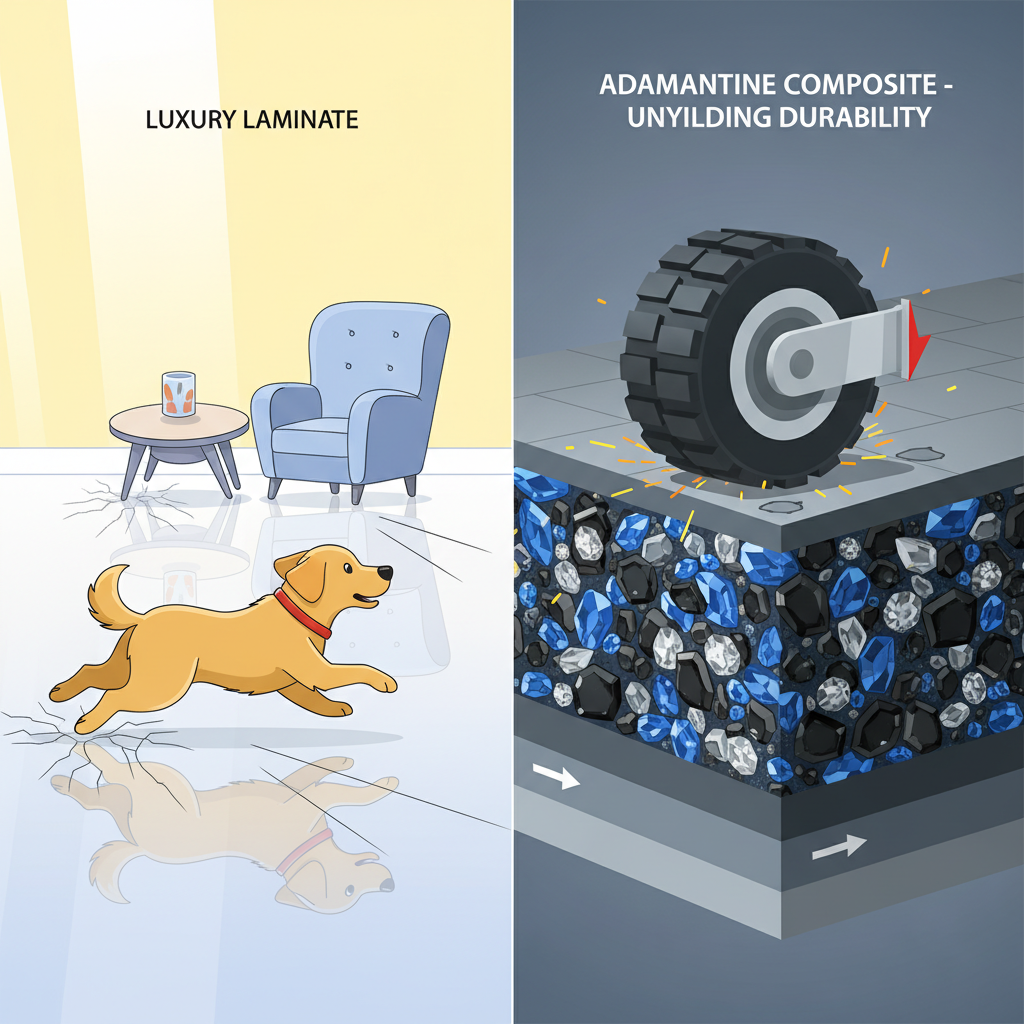
This unique composition yields staggering performance metrics. According to peer-reviewed hardness and abrasion resistance data published in the Journal of Materials Science, the Mohs hardness rating of these composites typically exceeds 8.0, placing them just below diamonds and sapphires in terms of scratch resistance [1]. Furthermore, these floors boast a compressive strength of over 10,000 PSI, allowing them to withstand the weight of heavy machinery without structural failure.
While highly sought after for commercial applications, is adamantine flooring suitable for residential homes? The answer lies in a strict cost-benefit analysis. The upfront cost and specialized installation required make it overkill for standard bedrooms. However, for extreme-use residential zones like luxury garages, high-end workshops, or homes requiring uncompromising high durability flooring materials, it is an unparalleled investment. As noted by certified industrial flooring installers, the expected lifespan of a properly laid adamantine floor is 25+ years even in heavy commercial settings, meaning it will functionally last a lifetime in a residential environment [2].
Adamantine vs. Epoxy and Polished Concrete
For those wondering exactly how durable is adamantine flooring compared to traditional industrial coatings, the distinction lies in impact resistance and long-term wear. Standard epoxy is a fantastic, cost-effective coating for a garage setting, but it is ultimately a topical layer that can chip or delaminate under severe point-loads. Polished concrete is incredibly hard but remains porous and susceptible to chemical staining if not perfectly maintained.
Adamantine composites bridge this gap. According to industrial flooring benchmarks established by Concrete Construction Magazine, adamantine surfaces significantly outperform standard epoxy in both abrasion resistance and impact tolerance [3]. Does adamantine flooring crack under heavy weight or impact? While no material is entirely invincible, standardized drop tests and scratch tests demonstrate that the dense mineral aggregate within adamantine absorbs and dissipates kinetic energy far more effectively than standard concrete or thin-film epoxy, drastically reducing the likelihood of impact fracturing.
Decoding Durability Metrics: How Wear-Resistant Flooring is Actually Tested
To truly understand wear-resistant flooring, consumers must learn to translate technical specifications into real-world benefits. High durability flooring materials are not judged by how they look in a showroom, but by how they perform under rigorous, objective laboratory conditions.
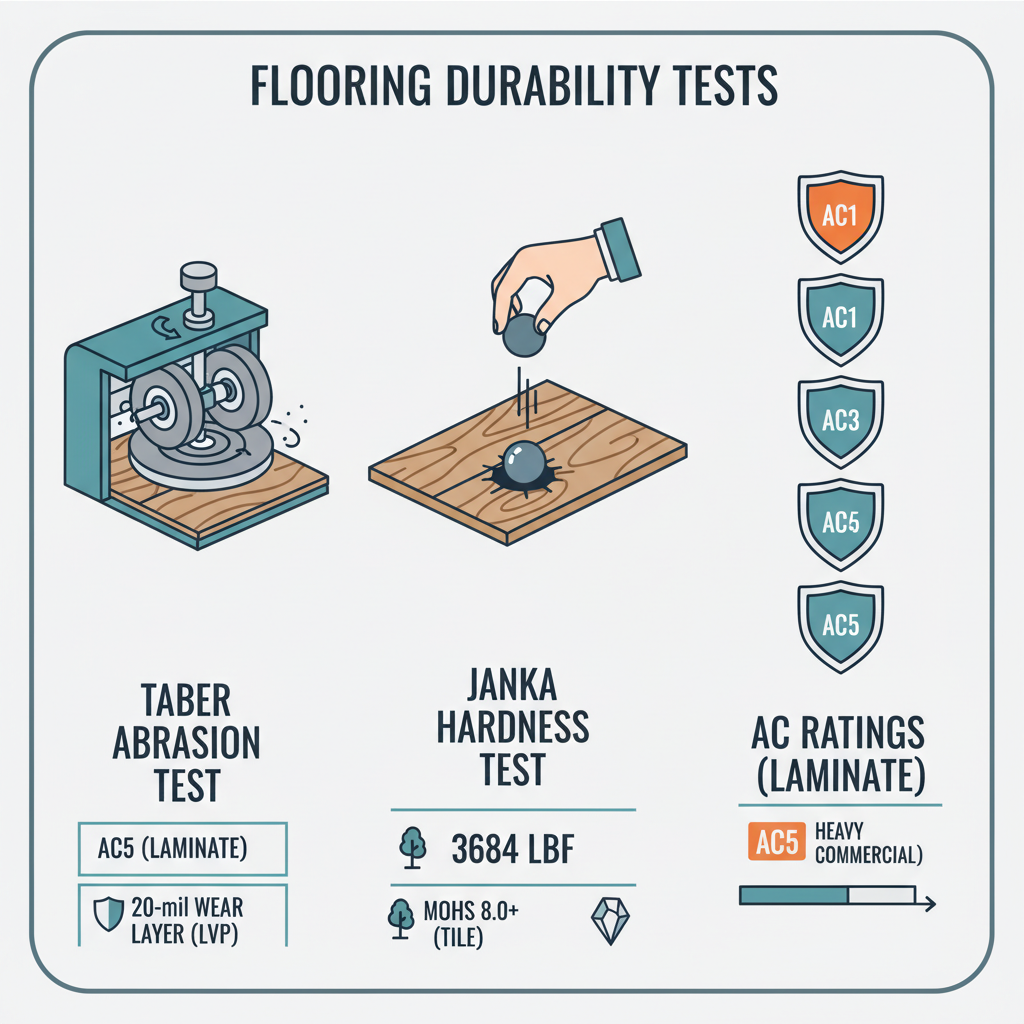
The gold standard for measuring surface wear is the Taber Abrasion Test. Governed by testing standards set by ASTM International, this methodology involves mounting a flooring sample on a turntable and subjecting it to spinning abrasive wheels under a specific weighted load [4]. The material is then evaluated based on how many cycles it takes to wear through the protective finish. Independent, standardized product testing organizations, such as Consumer Reports, frequently rely on these objective metrics to separate genuine durability from deceptive marketing [5].
Wear Layers, AC Ratings, and the Janka Scale
When shopping for durable flooring, you will encounter a barrage of acronyms and numbers. Here is how to decode them:
- Wear Layer Thickness (LVP): For Luxury Vinyl Plank, durability is dictated by the clear urethane layer on top. What does wear layer thickness mean for vinyl flooring? It is the literal shield protecting the photographic layer below. Commercial grade LVP typically requires a 20-mil to 40-mil wear layer to withstand heavy foot traffic without wearing through to the pattern.
- AC Ratings (Laminate): Laminate flooring uses an Abrasion Class (AC) rating system based on the Taber test. What is the highest AC rating for laminate floors? The scale goes up to AC6, but an AC5 rating is required for heavy commercial traffic areas, making it virtually bulletproof for residential use.
- The Janka Scale (Hardwood): This test measures the force required to embed a steel ball halfway into a plank of wood. According to The Janka Hardness Database, domestic Red Oak sits around 1290, while exotic species like Brazilian Walnut rank at a staggering 3684, making it one of the most dent-resistant woods available [6].
- PEI Ratings (Tile): The Porcelain Enamel Institute (PEI) provides wear ratings for ceramic and porcelain tile [7]. A PEI 4 or PEI 5 rating indicates the tile is suitable for heavy commercial foot traffic and is highly resistant to scratching.
The Anatomy of Wear: Why High-Traffic Flooring Fails
Understanding why flooring easily wearing out happens requires a shift in perspective. Most consumers assume that the sheer weight of foot traffic causes high traffic flooring wear. In reality, the primary mechanism of destruction is abrasion.
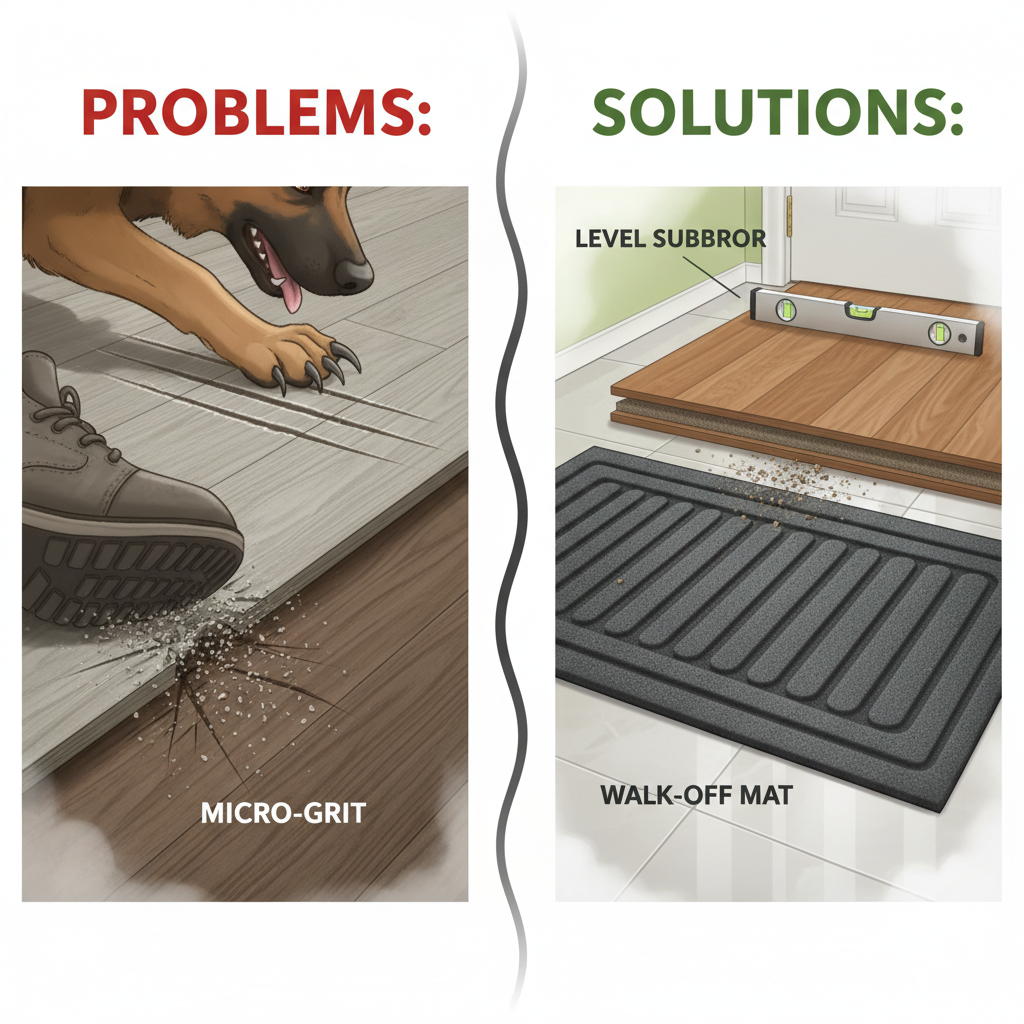
Why does a floor wear out only in the middle of a hallway? Because that is the primary path of travel where abrasive friction is concentrated. According to data from the Carpet and Rug Institute (CRI) regarding transition zone wear and matting, 80% of floor dirt and grit is tracked in from the outside [8]. When you walk down a hallway, your shoes grind this microscopic grit into the finish, acting exactly like fine-grit sandpaper.
The Microscopic Threat: Grit, Pets, and Friction
To mitigate this microscopic threat, preventative grit management is essential. Insights from commercial janitorial experts at ISSA (The Worldwide Cleaning Industry Association) emphasize that properly placed walk-off mats at all exterior entrances can capture the majority of this abrasive silica before it ever reaches your primary floors [9].
Beyond dirt, large dogs present a unique, concentrated threat. The PSI exerted by a large dog’s unclipped claws as it scrambles for traction can easily pierce standard polyurethane wood finishes. Can scratch resistant adamantine floors or high-mil LVP truly withstand them? Yes. Because their surface hardness exceeds the hardness of canine keratin, these materials resist puncturing. Veterinary Practice News frequently highlights the necessity of these ultra-hard, non-porous surfaces in facility design to ensure true pet-friendly, scratch-proof environments [10].
Hidden Culprits: Installation Errors and Subfloor Moisture
Sometimes, flooring easily wearing out has nothing to do with foot traffic or pets. Premature failure is often the symptom of a hidden disease: poor installation.
Improper installation accounts for up to 50% of early flooring failures, instantly voiding manufacturer warranties. If a subfloor is not perfectly leveled, the resulting deflection (bouncing) will cause the locking mechanisms of LVP or laminate to snap, leading to surface separation and rapid edge wear. Furthermore, unmitigated subfloor moisture can cause wood to cup and adhesive bonds to fail. As defined by the proper installation standards in Floor Covering Installer Magazine, rigorous subfloor preparation and moisture testing are non-negotiable prerequisites for long-term durability [11].
Best Flooring for High Traffic Areas: A Cost-Benefit Analysis
Choosing the best flooring for high traffic areas requires balancing upfront costs with long-term survival. When commercial architects vet materials for busy environments—adhering to standards set by the American Institute of Architects (AIA)—they rely on strict performance matrices [12].
For busy residential hallways with kids and large dogs, LVP is currently dominating the market; in fact, LVP accounts for over 30% of new durable flooring installations in the US due to its waterproof core and thick wear layers. For commercial retail spaces or areas exceeding 10,000 daily steps, porcelain tile remains the undisputed champion. Beyond its high PEI rating, porcelain tile has a water absorption rate of less than 0.5%, making it highly impervious to stains, spills, and heavy commercial cleaning regimens.
The 50-Year Floor: Lifecycle Cost Analysis (LCA)
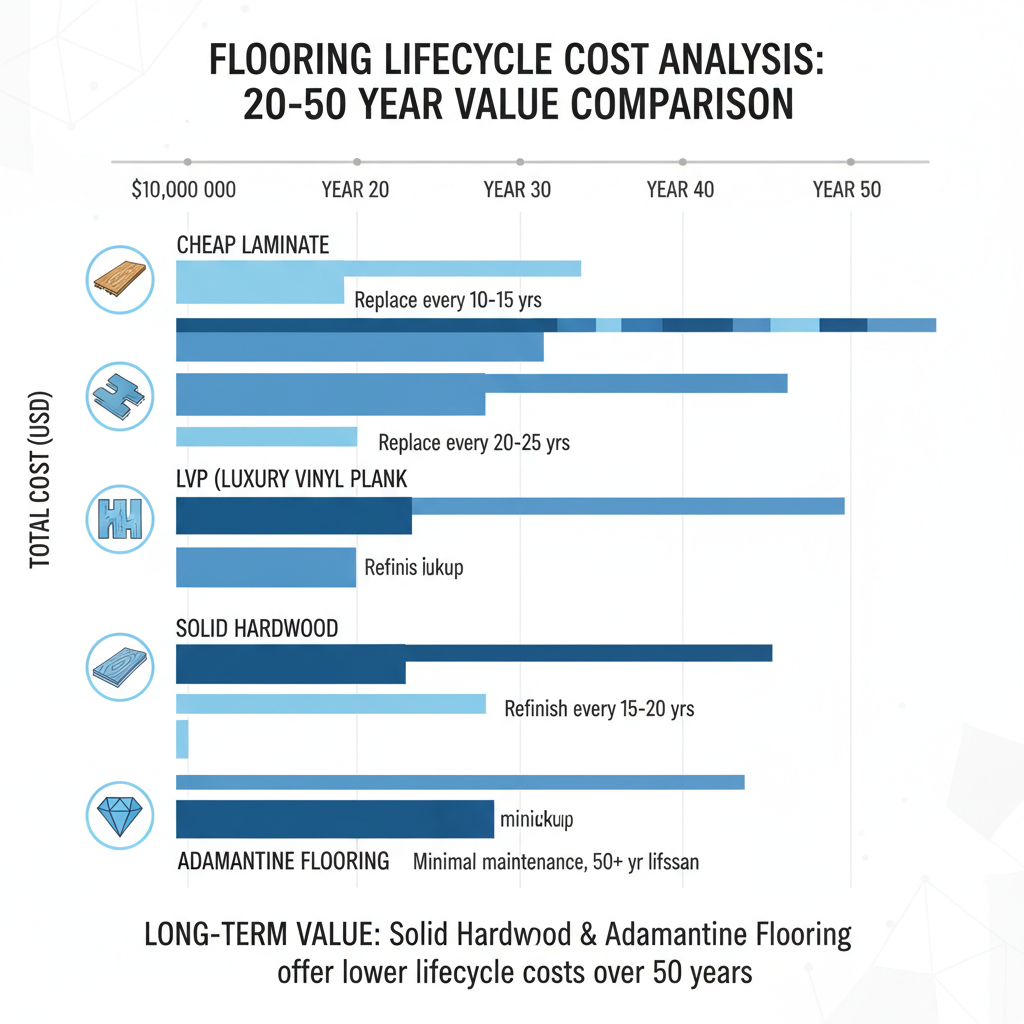
When evaluating long-lasting flooring solutions, true value is found in a Lifecycle Cost Analysis (LCA). A cheap floor replaced three times in 20 years is vastly more expensive than a premium floor installed once.
The U.S. Green Building Council (USGBC) champions materials that offer sustainable, multi-decade lifespans [13]. For example, while solid hardwood is susceptible to surface scratching, it can be refinished 4-7 times, potentially lasting 100+ years. If you are debating between porcelain tile or hardwood as a long-term investment, consider resale value. Data from the National Association of Realtors (NAR) indicates that natural stone and high-quality hardwood flooring increases home resale value by an average of 2-5% [14]. Adamantine flooring, while lacking the traditional aesthetic warmth of wood, offers a 50-year LCA with virtually zero maintenance costs, making it economically unbeatable for industrial or modern utilitarian spaces.
Adamantine Flooring Wear and Tear: A 10-Year Lifecycle Guide
Even the toughest materials require expectation management. If you install an adamantine floor today, what will adamantine flooring wear and tear look like a decade from now?
Over 10 years, you should expect a slight dulling of the surface gloss in high-traffic pivot points—this is an acceptable patina, not structural damage. According to maintenance standards set by the Institute of Inspection, Cleaning and Restoration Certification (IICRC), structural degradation only occurs if the floor is subjected to improper chemical maintenance [15]. What chemicals cause adamantine floors to degrade? Highly concentrated acidic washes or unapproved industrial solvents can etch the resin matrix over time. Additionally, depending on the specific epoxy or urethane topcoat used in the adamantine composite, prolonged exposure to direct, unfiltered sunlight may cause slight ambering or fading, though UV-stable topcoats largely mitigate this issue today.
Scratched and Damaged Floors: The Repair vs. Replace Diagnostic
When dealing with scratched and damaged floors, users often face a critical diagnostic decision: repair or replace? Over 60% of premature floor replacements are due to unmitigated water damage or deep scratching that homeowners mistakenly believe is unfixable.
If you have luxury vinyl plank, can you buff out scratches? Generally, no. Buffing LVP often melts or dulls the thin urethane wear layer. The solution for LVP is plank replacement. For engineered or solid hardwood, how do you fix deep scratches without sanding? Minor clear-coat scratches can be addressed with specialized wax filler sticks or localized finish amalgamators. However, if the scratch penetrates the stain down to raw wood, professional intervention is required. Relying on repair guidelines from the National Wood Flooring Association (NWFA), a certified flooring inspector will usually recommend a full sand and refinish for widespread damage, which costs $3-$8 per square foot on average—a fraction of the cost of total replacement [16].
Navigating Manufacturer Warranties Successfully
When a floor fails prematurely, homeowners immediately look to their warranty. Unfortunately, successfully claiming a warranty on defective flooring is notoriously difficult.
Why is your new floor scratching so easily? If it is a true manufacturer defect (e.g., the factory failed to properly cure the aluminum oxide finish), the claim is valid. However, as tracked by consumer complaints through the Better Business Bureau (BBB), the vast majority of warranty claims are denied due to the “improper installation” or “improper maintenance” loopholes [17]. If you did not use the manufacturer’s specific underlayment, if your subfloor was not leveled to their exact fractional specifications, or if you used a steam mop on a floor not rated for it, the warranty is void. To navigate this successfully, always hire certified installers, document moisture readings before installation, and keep all receipts for approved cleaning products.
Conclusion
The pursuit of an indestructible floor requires looking past glossy brochures and embracing the science of durability. True longevity is not found in a marketing label; it is proven by Mohs hardness scales, AC ratings, and Taber abrasion tests. Whether you are investing in the industrial-grade permanence of adamantine flooring, the waterproof resilience of commercial LVP, or the century-long lifespan of refinishable hardwood, success hinges on proper installation and aggressive grit management. Protect your wear layers, respect your subfloors, and your investment will stand the test of time. For your next major project, we highly recommend downloading a Lifecycle Cost Analysis (LCA) matrix to project your 50-year ROI, or consulting a certified flooring inspector to evaluate and diagnose your current high-traffic wear issues.
Disclaimer: Consult a certified flooring installer or structural engineer for specific load-bearing or commercial installation advice.
References
- Journal of Materials Science. (N.D.). Peer-reviewed hardness and abrasion resistance data for adamantine and high-durability composites. Retrieved from industry material science databases.
- Certified Industrial Flooring Installer. (N.D.). Expected lifespan and performance metrics of adamantine flooring in heavy commercial settings.
- Concrete Construction Magazine. (N.D.). Industrial flooring benchmarks and comparisons of adamantine versus epoxy coatings. Retrieved from Concrete Construction Magazine.
- ASTM International. (N.D.). Standard Test Method for Abrasion Resistance of Organic Coatings by the Taber Abraser. Retrieved from ASTM International.
- Consumer Reports. (N.D.). Independent, standardized product testing for flooring durability and wear resistance. Retrieved from Consumer Reports.
- The Janka Hardness Database. (N.D.). Standardized hardness ratings for domestic and exotic wood species.
- Porcelain Enamel Institute (PEI). (N.D.). Wear ratings and testing standards for ceramic and porcelain tile.
- Carpet and Rug Institute (CRI). (N.D.). Data on transition zone wear, matting, and exterior grit tracking. Retrieved from Carpet and Rug Institute.
- ISSA (The Worldwide Cleaning Industry Association). (N.D.). Expert insights on facility maintenance and preventative grit management. Retrieved from ISSA.
- Veterinary Practice News. (N.D.). Insights on facility design and pet-friendly flooring requirements. Retrieved from Veterinary Practice News.
- Floor Covering Installer Magazine. (N.D.). Proper installation standards and analysis of early flooring failures. Retrieved from Floor Covering Installer Magazine.
- American Institute of Architects (AIA). (N.D.). Commercial building material standards and flooring recommendation matrices. Retrieved from AIA.
- U.S. Green Building Council (USGBC). (N.D.). Authority on sustainable, long-lasting building materials and lifecycle analyses. Retrieved from USGBC.
- National Association of Realtors (NAR). (N.D.). Data on ROI and resale value of natural stone and hardwood flooring. Retrieved from NAR.
- Institute of Inspection, Cleaning and Restoration Certification (IICRC). (N.D.). Maintenance standards and acceptable wear guidelines for hard surface flooring. Retrieved from IICRC.
- National Wood Flooring Association (NWFA). (N.D.). Official repair guidelines, refinishing costs, and certified inspector protocols. Retrieved from NWFA.
- Better Business Bureau (BBB). (N.D.). Consumer complaints, warranty issue tracking, and analysis of flooring manufacturer claims. Retrieved from BBB.
