There are few homeownership moments more heartbreaking than hearing the sudden, sharp screech of a dragged piece of furniture, only to look down and find a deep gouge in your expensive new floor. For active households with pets and children, or facility managers overseeing high-traffic commercial spaces, the battle against everyday floor abrasions and unsightly black rubber scuff marks can feel endless. Complicating matters is the sea of misleading “scratch-proof” marketing fluff that leaves consumers frustrated and financially drained when their supposedly indestructible floors inevitably fail.
This guide cuts through the noise to provide a scientific, objective blueprint for understanding, choosing, and maintaining true “adamantine-grade” durable floors. By shifting the focus from marketing buzzwords to standardized industry testing, we will decode wear layers, compare the top ultra-durable materials, outline a preventative maintenance playbook, and provide safe damage control techniques. Whether you are building a new home or retrofitting a busy commercial hallway, this is your definitive roadmap to floors that truly last.
- What is ‘Adamantine’ Flooring? The Science of Extreme Durability
- The Ultimate Material Showdown: Top Adamantine-Grade Flooring Options
- The Floor Protection Playbook: Preventing Everyday Abrasions
- Damage Control: Safely Troubleshooting Scuffs and Scratches
- Conclusion
- References & Authoritative Sources
What is ‘Adamantine’ Flooring? The Science of Extreme Durability
Derived from the Greek word adamas, meaning “untameable” or “invincible,” the term “adamantine” is traditionally used in mineralogy to describe the brilliant, diamond-like luster and extreme hardness of certain gemstones. In the modern architectural context, “adamantine flooring” is not a specific brand, but rather a standard of extreme, industrial-grade durability.
To truly understand this standard, we must look to materials science. The Mohs hardness scale, which ranks materials from 1 (talc) to 10 (diamond) based on their ability to scratch softer materials, is a critical concept in flooring surface hardness. For a floor to resist everyday grit—which often contains silica sand (a 7 on the Mohs scale)—its protective topcoat must be engineered with compounds that rival or exceed that hardness. According to the World Floor Covering Association (WFCA), the authority on general flooring standards and classifications, true durability is never a single metric but a combination of surface hardness, structural stability, and wear resistance [1].
Decoding Wear Layers: Mil Thickness, AC Ratings, and Aluminum Oxide
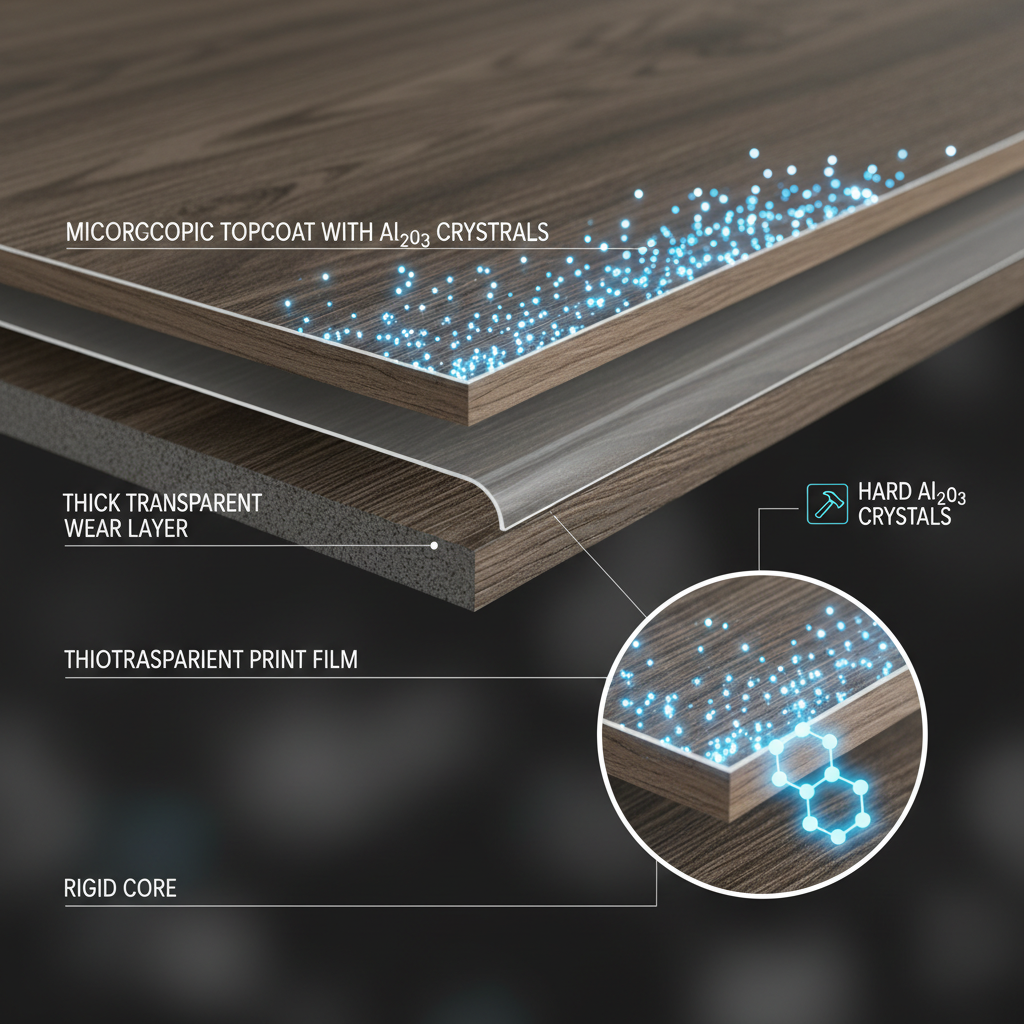
The secret to scratch resistant flooring lies almost entirely in its microscopic anatomy. If you were to look at a macro-photography cross-section of a premium luxury vinyl or laminate plank, you wouldn’t just see a single piece of material. You would see a highly engineered sandwich: a rigid core base, a high-definition photographic print film, a clear protective wear layer, and a specialized chemical topcoat.
For Luxury Vinyl Plank (LVP), this clear wear layer is measured in “mils” (one-thousandth of an inch, not to be confused with millimeters). While standard residential LVP might feature a 6-mil to 12-mil wear layer, adamantine-grade commercial floors require a 20-mil to 40-mil thickness to withstand heavy traffic.
For laminate flooring, durability is measured by Abrasion Class (AC) ratings, ranging from AC1 (light residential) to AC5 (heavy commercial). An AC5 rated laminate is built to withstand relentless foot traffic without the photographic layer wearing through.
The crown jewel of modern wear layers, however, is the Aluminum Oxide (Al2O3) finish. Commonly applied to engineered hardwood and premium laminates, aluminum oxide is a ceramic compound that ranks a 9 on the Mohs hardness scale—just one step below diamonds. When suspended in a urethane topcoat and cured with UV light, it creates a microscopic crystalline shield that drastically reduces the likelihood of surface scratches.
The Taber Abrasion Test Explained
How do manufacturers actually prove their floors are abrasion resistant flooring? They rely on rigorous, standardized laboratory testing, most notably the Taber Abrasion Test. Governed by standards such as ASTM D4060 set by ASTM International, this test provides empirical data on wear resistance [2].
During a Taber test, a sample of the flooring is mounted on a rotating turntable. Two weighted, abrasive wheels are lowered onto the surface, and the machine spins the sample for a set number of cycles. Technicians then measure the exact point at which the wear layer is breached and the underlying design layer is damaged. A floor that survives 500 cycles might be suitable for a guest bedroom, but a floor engineered for high-traffic commercial spaces might withstand 4,000 to over 10,000 cycles. Understanding these test results allows consumers to translate laboratory data into real-world years of use, ensuring they invest in genuinely durable flooring solutions.
The Ultimate Material Showdown: Top Adamantine-Grade Flooring Options
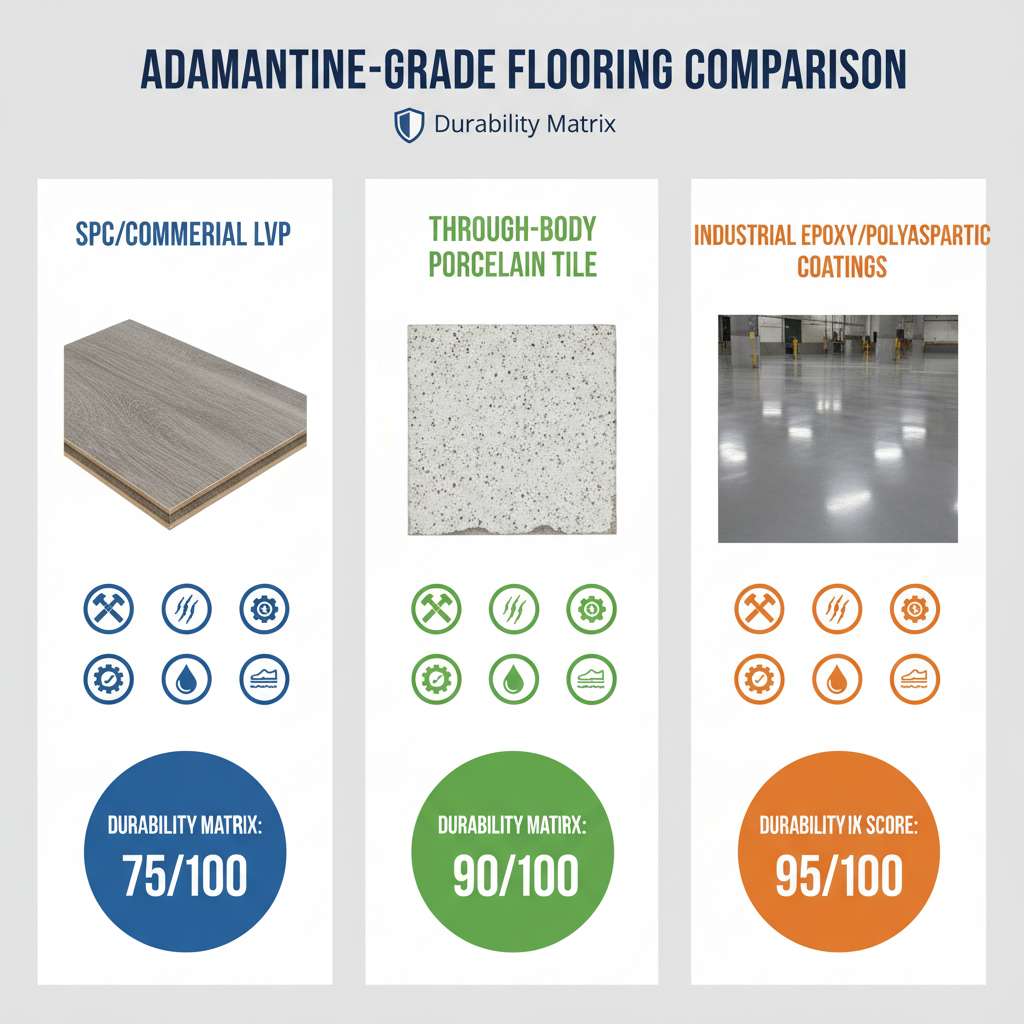
Not all durable flooring solutions are created equal, and the best choice depends heavily on the specific demands of the environment. To objectively compare these materials, we can utilize a proprietary “Durability Matrix” scoring system (ranked 1-100), which evaluates materials based on standardized tests for scratch resistance, dent resistance (impact load), and water resistance.
Furthermore, when selecting adamantine flooring for high traffic areas, durability must be balanced with safety. Commercial building codes heavily emphasize slip resistance, measured by the Dynamic Coefficient of Friction (DCOF). A highly durable floor is useless if it becomes a slip hazard when wet, making DCOF ratings a critical factor in the material showdown [3].
SPC and Commercial-Grade LVP: The Heavyweights
Scoring exceptionally high on our Durability Matrix (85/100) are Stone Plastic Composite (SPC) and commercial-grade Luxury Vinyl Plank (LVP). SPC features a core made of limestone powder and stabilizers, making it incredibly dense and highly resistant to dents from heavy furniture or dropped objects.
When paired with a 20mil+ wear layer enhanced with ceramic bead technology—where microscopic ceramic particles are embedded into the urethane finish—these floors become formidable opponents against wear. While no floor is entirely scuff proof flooring, commercial-grade LVP and SPC come remarkably close. They meet stringent standards set by the Resilient Floor Covering Institute (RFCI), ensuring they can handle the rigors of both active homes and busy commercial spaces without compromising their structural integrity [4].
Through-Body Porcelain Tile and Industrial Coatings
For environments that demand the absolute pinnacle of abrasion resistant flooring (Durability Matrix Score: 95-100/100), through-body porcelain tile and industrial coatings reign supreme.
Unlike glazed ceramic tile, where the color is only on the surface, through-body porcelain is fired at extreme temperatures, making it incredibly dense and ensuring the color permeates the entire tile. Even if it were to chip, the damage is nearly invisible.
For monolithic, seamless durability, industrial coatings like epoxy and polyaspartic finishes are the gold standard. Often used in garages, warehouses, and high-end modern homes, these liquid-applied coatings cure into a plastic-like shell that is impervious to chemicals, hot tire pickup, and heavy machinery. According to insights from the Society for Protective Coatings (SSPC), polyaspartic finishes, in particular, offer superior UV stability and abrasion resistance compared to traditional epoxies, making them a top-tier adamantine choice [5].
The Subfloor Factor: Why the Foundation Dictates Durability
A critical, often-overlooked reality of durable flooring solutions is that the surface is only as strong as what lies beneath it. Even the most indestructible through-body porcelain or SPC plank will fail, crack, or separate at the seams if the subfloor preparation is inadequate.
Installation standards dictate strict tolerances for subfloor flatness—typically no more than 3/16 of an inch variance over a 10-foot span. If a rigid adamantine floor is installed over an uneven, flexing subfloor, the resulting deflection will cause the locking mechanisms to break or the tiles to crack under pressure. As highlighted by installation authorities in Floor Covering Installer Magazine, investing in proper subfloor leveling and preparation is non-negotiable for achieving true, long-lasting durability [6].
The Floor Protection Playbook: Preventing Everyday Abrasions
Selecting the right material is only half the battle; the other half is preventative maintenance. To understand how to prevent abrasions on floors, we must look at the physics of light reflection. A brand-new floor has a smooth surface that reflects light in a single, concentrated direction (specular reflection), giving it a rich, glossy, or clear appearance. However, as everyday floor abrasions accumulate, they create microscopic peaks and valleys on the surface. These micro-scratches scatter light in multiple directions (diffuse reflection), causing the floor to look dull, cloudy, and worn. To maintain that specular reflection, major flooring manufacturers universally endorse strict, non-abrasive maintenance routines.
The Micro-Grit Threat: Walk-Off Mats and Proper Vacuuming
The greatest enemy of any floor finish is not heavy furniture, but micro-grit. Tracked-in dirt, household dust, and specifically silica sand act like microscopic sandpaper underfoot. Every step grinds these particles into the wear layer, causing gradual dulling and everyday floor abrasions.
The most effective defense is a robust walk-off mat strategy. Data from the Carpet and Rug Institute (CRI) demonstrates that strategically placed, high-quality walk-off mats at all entrances can trap up to 80% of dirt and moisture before it ever reaches your hard surfaces [7]. Furthermore, when cleaning, it is imperative to use vacuums designed for hard floors. Vacuum beater bars (the rotating bristle brushes meant for carpets) act as high-speed abrasives and will quickly degrade even an aluminum oxide finish. Always turn the beater bar off or use a suction-only floor attachment.
Footwear and Finish Sheen: Hiding Scuffs Before They Happen
When searching for the best flooring for preventing everyday scuffs, the finish sheen is just as important as the material itself. Scuffs are primarily caused by the friction of rubber-soled shoes heating up and transferring rubber onto the floor’s surface.
High-gloss floors act like mirrors, highlighting every single smudge, scuff, and speck of dust. Conversely, matte finishes and textured surfaces—such as hand-scraped or wire-brushed engineered wood—are vastly superior at hiding these marks. The irregular surface texture breaks up the visual plane, making minor rubber transfers practically invisible. Additionally, modern high-quality urethane topcoats are chemically engineered to resist this rubber transfer, preventing the scuff from permanently bonding to the floor.
Damage Control: Safely Troubleshooting Scuffs and Scratches
Despite the best preventative measures, accidents happen. When they do, it is crucial to understand the physical difference between the types of damage to apply the correct fix. A scuff is material transfer onto the floor (like rubber from a shoe). A scratch is material removed from the floor (a gouge into the wear layer or wood). Treating a scratch like a scuff, or vice versa, can lead to disastrous results.
Safely Removing Black Rubber Scuff Marks
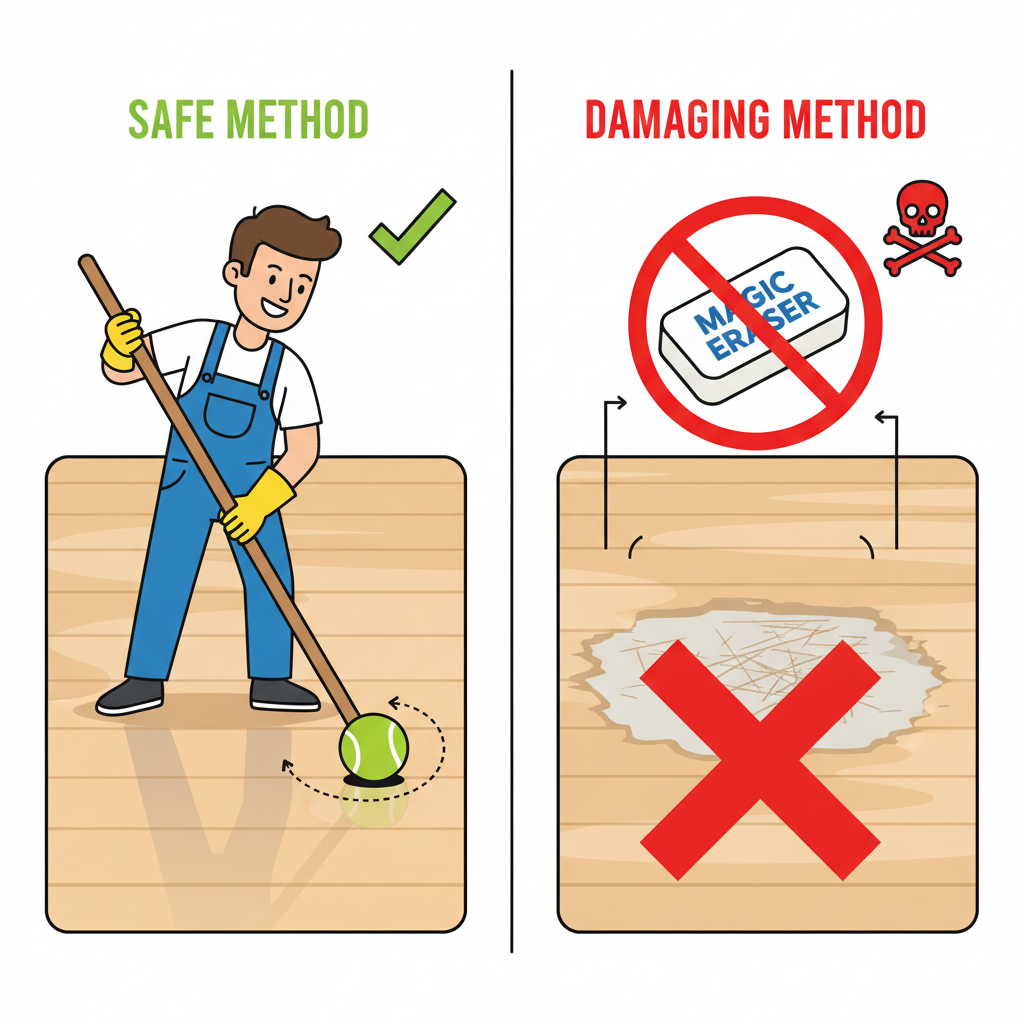
When dealing with floor scuff marks, the goal is to break the bond of the transferred material without degrading the floor’s protective topcoat. The safest, most effective method is the “tennis ball trick.” Cut a small “X” into a clean tennis ball, place it on the end of a broom handle, and firmly rub the scuff. The felt of the tennis ball provides just enough friction to heat and lift the rubber mark without scratching the floor. For stubborn scuffs, specific manufacturer-approved solvents can be used.
However, consumers must heed a critical warning: never use abrasive melamine foam (commonly known as Magic Erasers) on polyurethane wear layers or finished hardwood. Melamine foam acts like 3000-grit sandpaper. While it will quickly remove the scuff, it will also permanently strip the factory finish, leaving a dull, unprotected spot and instantly voiding major manufacturer warranties [8].
Repairing Scratched Hardwood: When to DIY vs. Call a Pro
Scratched hardwood floors induce high anxiety because they represent a significant financial investment. If you discover a scratch, first determine its depth. Surface scratches that only penetrate the clear coat can often be camouflaged using specialized blending pencils or tinted floor polishes designed for minor DIY touch-ups.
However, deep gouges that expose raw wood require professional intervention. It is also vital to note that modern, factory-applied aluminum oxide finishes are incredibly difficult to spot-repair because the surrounding finish is too hard to sand seamlessly by hand. According to guidelines from the National Wood Flooring Association (NWFA), significant damage to these ultra-hard finishes usually requires a professional screen-and-recoat process, or in severe cases, a full sanding and refinishing of the affected area to restore the floor’s integrity [9].
Conclusion
Achieving true adamantine flooring is not about chasing the latest marketing hype; it is about understanding the scientific metrics that dictate durability. By prioritizing thick wear layers, high AC ratings, and advanced chemical finishes like aluminum oxide, you can select materials that genuinely withstand the rigors of daily life. While no floor is 100% indestructible, choosing the right material—whether it be commercial-grade LVP, SPC, or through-body porcelain—and employing a strict protection playbook will ensure decades of beauty and performance.
Before your next showroom visit, evaluate your current flooring’s wear layer, consider the specific traffic demands of your space, and utilize the principles of the Durability Matrix to make an informed decision. For high-traffic or commercial installations, always consult a certified flooring professional to ensure proper subfloor preparation and material specification.
*Disclaimer: Always consult your specific flooring manufacturer’s warranty and care guidelines before applying any chemical cleaners or attempting scratch repairs, as improper methods can void warranties.*
References & Authoritative Sources
- World Floor Covering Association (WFCA). (N.D.). Flooring Standards and Classifications Guide. Retrieved from WFCA industry resources.
- ASTM International. (N.D.). ASTM D4060 – Standard Test Method for Abrasion Resistance of Organic Coatings by the Taber Abraser. Retrieved from ASTM standards database.
- Tile Council of North America (TCNA). (N.D.). Dynamic Coefficient of Friction (DCOF) Testing Standards. Retrieved from TCNA technical guidelines.
- Resilient Floor Covering Institute (RFCI). (N.D.). Performance Standards for Rigid Core and Resilient Flooring. Retrieved from RFCI industry publications.
- Society for Protective Coatings (SSPC). (N.D.). Guidelines on Polyaspartic and Epoxy Industrial Floor Coatings. Retrieved from SSPC technical resource center.
- Floor Covering Installer Magazine. (N.D.). Subfloor Preparation and Tolerances for Resilient Flooring. Retrieved from Floor Covering Installer archives.
- Carpet and Rug Institute (CRI). (N.D.). The Value of Walk-Off Mats in Soil Stoppage and Floor Protection. Retrieved from CRI research data.
- American Cleaning Institute & Major Flooring Manufacturer Warranties. (N.D.). Safe Chemical Usage and Abrasive Cleaner Warnings. Retrieved from consolidated manufacturer warranty documentation.
- National Wood Flooring Association (NWFA). (N.D.). Homeowner Maintenance Guidelines and Professional Repair Standards. Retrieved from NWFA technical literature.
