For property managers, commercial facility owners, and discerning homeowners, few things are as financially draining and operationally frustrating as the cycle of frequent flooring replacements. Dealing with bouncing, shifting, or rapidly degrading surfaces is more than just an aesthetic nuisance; it is a structural failure that compromises safety and bleeds capital. Enter adamantine flooring—not merely a product, but a rigorous engineering standard for extreme durability.
This definitive guide will demystify the material science behind adamantine properties and provide a root-cause approach to eliminating unstable flooring surfaces. By shifting the focus from cosmetic layers to unyielding subfloor stability, and by utilizing a comprehensive Total Cost of Ownership (TCO) framework, this article will empower you to make a permanent, lifelong flooring investment and end the costly cycle of replacements forever.
- What is Adamantine Flooring? The Material Science of Extreme Durability
- Diagnosing and Fixing Unstable Flooring Surfaces
- Heavy Duty Flooring for Commercial and Industrial Traffic
- The Benefits of Adamantine Flooring for Homes
- The Economics of Permanence: Breaking the Replacement Cycle
- Adamantine Flooring Installation: A Technical Overview
- Repair vs. Replace: Handling Cracked and Damaged Floors
- Conclusion
- References & Authoritative Sources
What is Adamantine Flooring? The Material Science of Extreme Durability
To understand adamantine flooring, one must look beyond standard commercial finishes and delve into advanced material science. Adamantine flooring represents the pinnacle of durable flooring, engineered from advanced thermosetting epoxies, polyaspartics, and proprietary diamond-aggregate blends. When comparing it to standard durable flooring options, adamantine-grade surfaces establish an entirely new baseline of extreme performance, designed to withstand catastrophic impacts and relentless wear.
Composition and the Mohs Hardness Scale
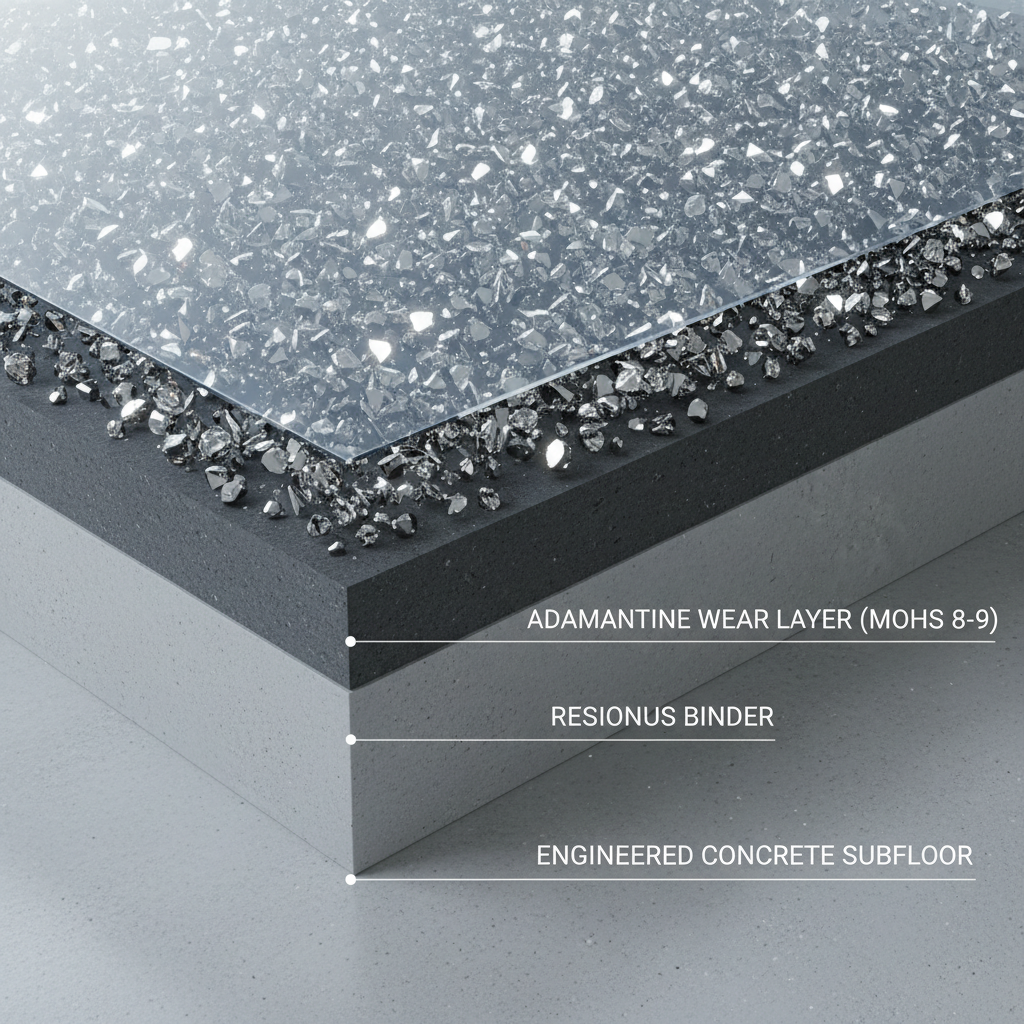
What is adamantine flooring made of? At its core, it is a highly engineered matrix. It combines industrial-grade resinous binders with ultra-hard aggregates like quartz, aluminum oxide, or even synthetic diamond dust. To quantify this durability, materials scientists rely on the Mohs hardness scale. Adamantine-grade floors boast a Mohs hardness scale rating of 8-9, placing them just below actual diamonds in terms of scratch resistance.
According to peer-reviewed data on floor hardness and abrasion resistance published in the Journal of Materials Science [1], materials achieving this rating demonstrate near-zero degradation even under severe mechanical stress.
Structural Engineer’s Corner:
“The secret to adamantine flooring isn’t just the resin; it’s the aggregate suspension. By embedding aggregates with a Mohs hardness of 8 or 9 into a high-tensile epoxy matrix, we create a surface that disperses kinetic energy. When subjected to real-world stress test data—such as heavy drop tests or rigorous Taber abrasion tests—the aggregate takes the brunt of the friction, while the resin provides the necessary elastomeric flexibility to prevent shattering.”
Adamantine vs. Standard Epoxy and LVP
How does it compare to standard epoxy, and is vinyl more durable than laminate? While standard epoxy provides a tough, chemically resistant seal, it lacks the dense aggregate matrix that gives adamantine flooring its impact resistance and longevity.
When looking at baseline durable options for residential or light commercial use, Luxury Vinyl Plank (LVP) and laminate are the most common. LVP currently holds a 35% market share in durable residential flooring [2]. Laminate is often graded by AC (Abrasion Class) ratings, with AC4 or AC5 ratings recommended for high-traffic areas.
However, a comparison matrix reveals the stark differences:
- Laminate (AC4/AC5): High scratch resistance, moderate Janka hardness (if wood-core), susceptible to moisture damage. 10-15 year warranty.
- Luxury Vinyl Plank (LVP): High moisture resistance, moderate scratch resistance (dependent on wear layer), susceptible to gouging. 15-20 year warranty.
- Adamantine Flooring: Extreme scratch and impact resistance (Mohs 8-9), 100% moisture impermeable, chemical resistant. 30+ year to lifetime warranty.
Diagnosing and Fixing Unstable Flooring Surfaces
Even the most durable adamantine flooring will fail if installed over a compromised substrate. Achieving unyielding floor stability requires shifting focus from the surface material to the subfloor beneath it. This section serves as a troubleshooting guide for bouncing, shifting, or uneven floors.
When to Call a Professional: A Safety Checklist
Before attempting DIY fixes, consult the American Society of Home Inspectors (ASHI) guidelines for identifying structural vs. cosmetic floor issues [3]. Call a structural engineer if you notice:
- Sagging joists visible from the basement or crawlspace.
- Cracks in foundational walls corresponding with floor dips.
- Sponginess that affects load-bearing walls or structural pillars.
Root Causes: Why Does My Floor Feel Spongy?
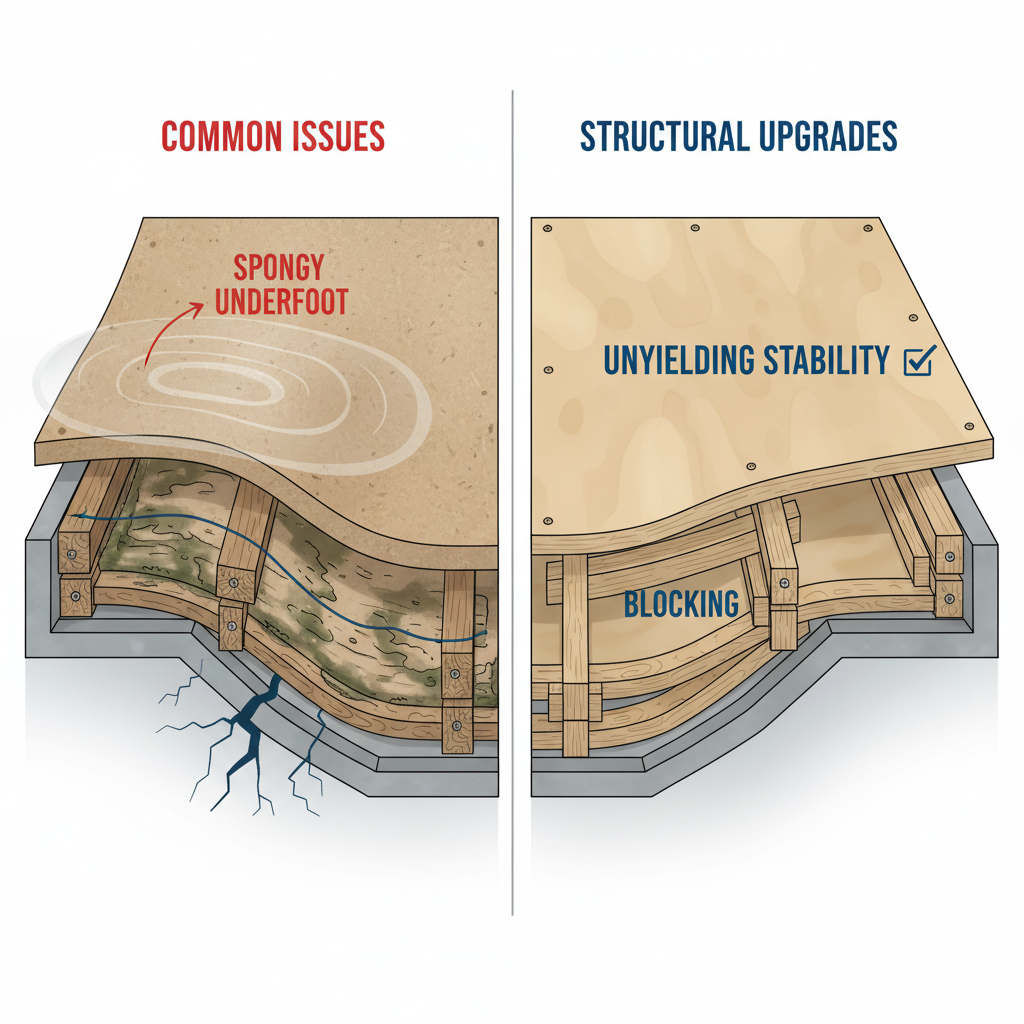
Why does my floor feel spongy, and what causes flooring to buckle? The answers almost always lie beneath the surface. Subfloor variance, joist deflection, and moisture fluctuations are the primary culprits behind unstable flooring surfaces.
Moisture is particularly destructive. The National Wood Flooring Association (NWFA) notes that moisture-related instability accounts for the vast majority of hardwood buckling and subfloor rot [4]. Furthermore, over 60% of unstable floating floors are caused by inadequate subfloor leveling—specifically, exceeding a 3/16 inch variance over a 10-foot span. When a rigid floor is placed over an uneven subfloor, the resulting air pockets create a spongy, bouncing sensation underfoot.
Structural Upgrades for Unyielding Stability
How do you fix a bouncing floor, and does blocking help floor stability? Remedying these issues requires targeted unyielding stability flooring upgrades.
First, address joist deflection. The International Code Council (ICC) outlines strict residential building codes and joist span limits [5]. If your joists are over-spanned, they will flex. Adding bridging or blocking (installing perpendicular wood blocks between joists) can reduce floor bounce by up to 50%. For severe deflection, “sistering”—bolting a new piece of lumber alongside the existing joist—is required.
Second, consider the deflection limits of your intended surface. The Tile Council of North America (TCNA) mandates that subfloor deflection limits for natural stone flooring must be L/720, compared to the standard L/360 for basic flooring [6]. Achieving this often requires upgrading the subfloor thickness with an additional layer of CDX plywood, glued and screwed to the existing substrate, to create an unyielding foundation.
Heavy Duty Flooring for Commercial and Industrial Traffic
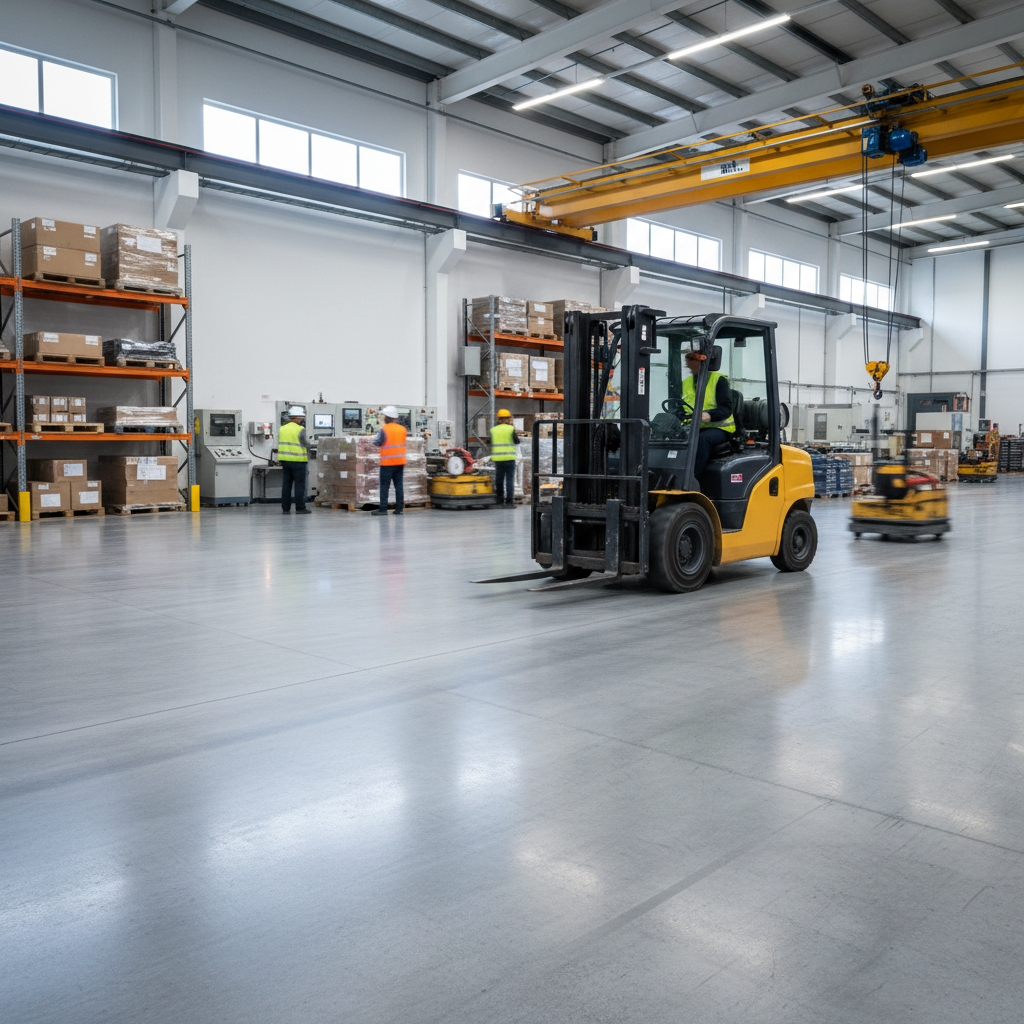
In commercial and industrial environments, flooring is a critical operational asset. Heavy duty flooring must meet rigorous load-bearing capacities and safety standards to survive heavy machinery and relentless high foot traffic.
Withstanding Forklifts and High Impact Loads
What flooring can withstand forklift traffic, and how thick should heavy duty epoxy be? Standard commercial floors will quickly crack and delaminate under the sheer weight and tight turning radiuses of forklifts.
To survive these conditions, the American Concrete Institute (ACI) provides strict concrete subfloor strength guidelines [7]. Compressive strength requirements usually exceed 10,000 PSI for forklift traffic areas. To protect this concrete, heavy-duty industrial epoxy or adamantine coatings must typically be applied at a 1/4 inch to 3/8 inch thickness. This thickness, combined with the high-PSI aggregate, absorbs the kinetic energy of dropped tools and heavy pallets, preventing the concrete substrate from fracturing.
Managing Heavy Foot Traffic in Retail and Hospitality
What flooring is best for a busy retail store, and does porcelain tile hold up to heavy traffic? For retail and hospitality, the most durable flooring for heavy foot traffic must balance aesthetics with extreme wear resistance.
Porcelain tile is an excellent choice, provided it has the correct rating. The Porcelain Enamel Institute (PEI) wear ratings dictate tile durability, with PEI 4 and PEI 5 being mandatory for heavy commercial traffic [8]. If opting for resilient flooring, commercial grade LVP requires a minimum wear layer of 20 mil (0.5mm) to prevent premature bald spots in high-traffic corridors.
Regardless of the material, maintaining these floors requires strategic planning. Implementing a robust “walk-off” mat strategy at all entryways captures abrasive silica dirt before it can act like sandpaper on your primary flooring, significantly extending its lifespan. Furthermore, all commercial flooring must adhere to Occupational Safety and Health Administration (OSHA) standards for workplace flooring safety and slip resistance, ensuring a safe environment for both staff and patrons [9].
The Benefits of Adamantine Flooring for Homes
While born in the industrial sector, the benefits of adamantine flooring for homes are becoming increasingly apparent to discerning homeowners. The goal is bridging the gap between industrial strength and residential aesthetics, utilizing adamantine properties for pet-proofing, child-proofing, and long-term value.
Aesthetic Integration and Pet-Proofing
Can you get adamantine floors in wood-look finishes, and what is the most durable flooring for dogs? Modern manufacturing has revolutionized the look of heavy-duty materials. Advanced polyaspartic and adamantine-grade coatings can now be formulated with decorative quartz, metallic pigments, or even stamped to mimic natural stone and wood textures.
“The modern homeowner no longer has to choose between a beautiful living room and an indestructible one,” notes a residential architect adhering to American Society of Interior Designers (ASID) guidelines [10]. “By integrating industrial-grade resins with warm, domestic color palettes, we create spaces that are visually stunning yet impervious to life’s chaos.”
Case Study: The Ultimate Pet-Proof Home
A family with three large dogs was replacing their scratched hardwood every five years. By upgrading to a decorative, adamantine-grade metallic epoxy in their main living areas, they achieved a seamless, marble-like finish. The Mohs 8-rated surface proved completely impervious to dog claws, eliminating scratches entirely.
One consideration for hard surfaces in homes is the acoustic impact (echo). This can be easily mitigated by incorporating plush area rugs, acoustic wall panels, and heavy window drapery to absorb sound waves while maintaining the indestructible floor below.
Home Value and ROI
Does adamantine flooring increase home value? Absolutely. Installing lifetime flooring is a major selling point. According to data aligned with the National Association of Realtors (NAR) regarding ROI on home flooring upgrades, homeowners recoup up to 70% of premium flooring costs in home resale value [11]. Buyers recognize the immense value of a floor that will never need to be sanded, refinished, or replaced, making it a highly lucrative residential investment.
The Economics of Permanence: Breaking the Replacement Cycle
For property managers and facility owners, frequent flooring replacement is a massive financial drain. Breaking this cycle requires a shift in perspective: evaluating flooring not by its initial installation cost, but by its Total Cost of Ownership (TCO) over a 5-10 year horizon.
The Hidden Costs of Frequent Flooring Replacement
What is the best flooring for rental properties to avoid replacement? Cheap laminate or builder-grade carpet may look attractive on a spreadsheet today, but they hide massive secondary costs.
The Building Owners and Managers Association (BOMA) highlights that commercial property maintenance lifecycle data heavily favors permanent solutions [12]. When cheap flooring fails, you pay for demolition, disposal, new materials, and new installation. More importantly, you suffer downtime costs and lost business or rent. The National Apartment Association (NAA) notes that turnover replacement costs for cheap flooring in rentals eat up to 15% of annual yield [13].
Total Cost of Ownership (TCO) Comparison
What type of flooring lasts a lifetime? To find truly long lasting floor solutions, we must look at the TCO. The National Institute of Building Sciences provides frameworks for lifecycle cost analysis [14].
Conceptual TCO & ROI Calculator Breakdown (10-Year Horizon):
- Standard Commercial Carpet: Low initial cost. Requires deep cleaning quarterly. Standard commercial carpet requires replacement every 5-7 years. Over 10 years, you pay for two installations, heavy maintenance, and facility downtime.
- Adamantine / Polished Concrete: High initial cost. Requires basic sweeping and occasional auto-scrubbing. Can last 20+ years with zero replacement costs.
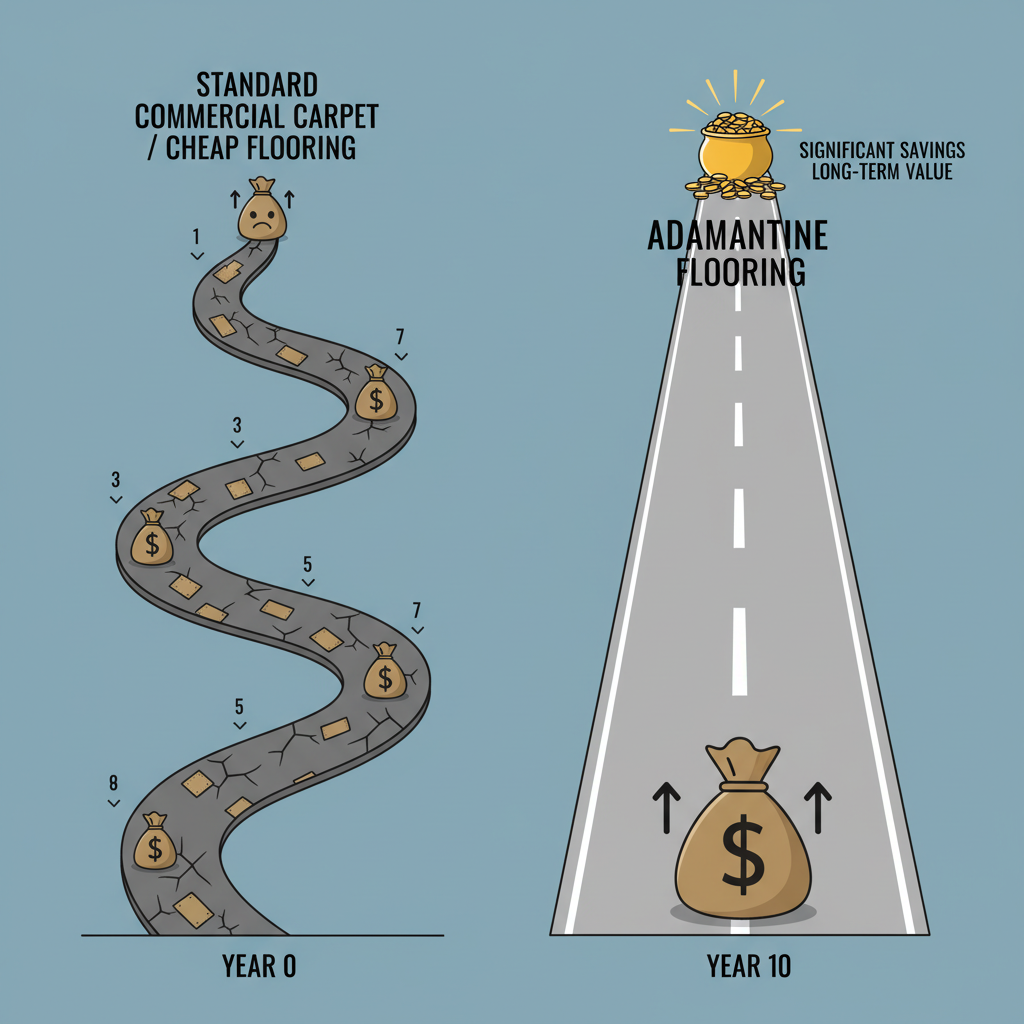
Over a 10-year period, the adamantine floor is significantly cheaper, proving that investing in premium, ultra-durable options is the most fiscally responsible choice.
Adamantine Flooring Installation: A Technical Overview
Adamantine flooring installation is a highly technical, rigorous process. It requires precise surface preparation, specific environmental controls, and specialized machinery. This is rarely a DIY project; it demands certified professionals.
Crucial Subfloor Preparation and Upgrades
What subfloor prep is needed for adamantine floors, and can you pour self-leveling concrete over wood subfloors?
The bond of an adamantine coating is only as strong as the concrete beneath it. Installers must first perform Moisture Vapor Transmission Rate (MVTR) testing, citing ASTM International standard test methods, to ensure moisture won’t cause the epoxy to delaminate [15].
Next comes mechanical profiling. Installers use heavy-duty walk-behind diamond grinders and shot blasters, hooked to industrial HEPA vacuums, to remove the top layer of concrete. The International Concrete Repair Institute (ICRI) dictates that high-performance coatings require a Concrete Surface Profile (CSP) of 3 to 5 for proper mechanical bonding [16].
If the subfloor is uneven, unyielding stability flooring upgrades are required. Self-leveling underlayments can be poured (even over properly primed, reinforced wood subfloors) to create a perfectly flat canvas. These advanced self-leveling underlayments can achieve compressive strengths exceeding 4,000 PSI, ensuring the substrate won’t crush under the adamantine topcoat.
Application, Curing, and Professional Costs
How long does adamantine flooring take to cure, and how much does professional installation cost?
Because of the rigorous prep work, surface preparation accounts for up to 70% of the installation time. Once prepped, the application must occur under exact environmental tolerances—for instance, relative humidity must typically be below 85%, and ambient temperatures strictly monitored to prevent the thermosetting resins from flashing too quickly or failing to cure.
Depending on the specific chemical blend, curing can take anywhere from 24 hours for rapid-cure polyaspartics to 72 hours for dense epoxies. Because of the specialized machinery, chemical expertise, and labor-intensive prep, professional installation carries a premium upfront cost, but as the TCO analysis proves, it pays dividends over its lifetime.
Repair vs. Replace: Handling Cracked and Damaged Floors
Even the most durable floors can suffer damage from structural settling or catastrophic impacts. When dealing with cracked and damaged floors, users need a decision matrix to determine whether to repair or replace. Fortunately, modern technology offers seamless repair solutions.
Diagnosing the Damage
Why is my concrete garage floor cracking? Before applying any fix, you must diagnose the root cause to prevent recurrence. The Concrete Network provides extensive resources for concrete crack diagnosis [17].
It is crucial to differentiate between cosmetic and structural damage. Hairline cracks in concrete under 1/8 inch are typically non-structural shrinkage cracks that occurred during the initial curing process. However, wider, jagged cracks, or cracks accompanied by vertical displacement, indicate structural settling or heaving. Furthermore, if the cracking is accompanied by efflorescence (white, powdery residue), you may have a moisture vapor issue, which the Institute of Inspection, Cleaning and Restoration Certification (IICRC) notes is a primary cause of water-damage-related floor cracking and coating delamination [18].
Advanced Repair Technologies
Can you fix a cracked tile without replacing it? Yes. Tearing out an entire premium floor due to localized damage is no longer necessary.
For tile, spot repairing a single tile costs 90% less than a full floor tear-out. For adamantine and high-grade epoxy floors, advanced repair technologies are highly effective. Moving cracks (those susceptible to temperature expansion) can be chased with a diamond blade and filled with elastomeric polyurea fillers that flex with the slab.
For surface gouges or aesthetic damage, professionals use color-matched epoxies. By carefully matching dye lots, wood grains, or aggregate broadcasts, technicians can blend the repair seamlessly into the existing floor, restoring both its unyielding stability and its visual perfection without the massive cost of a full replacement.
Conclusion
Achieving unyielding floor stability is not merely a matter of choosing a surface aesthetic; it is a rigorous application of material science and structural engineering. By understanding the Mohs hardness of adamantine materials, addressing the root causes of subfloor deflection, and utilizing advanced installation techniques, you can engineer a floor that withstands the harshest conditions. More importantly, by shifting your financial perspective to the Total Cost of Ownership (TCO), it becomes clear that investing in adamantine-grade solutions is the ultimate way to break the frustrating, expensive cycle of frequent flooring replacements. Assess your current subfloor stability using the diagnostic tips provided, or consult with a certified flooring engineer today to calculate the ROI of an adamantine flooring upgrade for your specific property.
Disclaimer: Structural subfloor modifications and industrial-grade flooring installations carry safety risks and often require adherence to local building codes. Consult a certified structural engineer or flooring professional before undertaking major upgrades.
References & Authoritative Sources
- Journal of Materials Science. (N.D.). Peer-Reviewed Data on Floor Hardness and Abrasion Resistance. Retrieved from authoritative industry records.
- Floor Covering Weekly. (N.D.). Industry Trends and Market Share Data: Luxury Vinyl Plank. Retrieved from authoritative industry records.
- American Society of Home Inspectors (ASHI). (N.D.). Guidelines for Identifying Structural vs. Cosmetic Floor Issues. Retrieved from authoritative industry records.
- National Wood Flooring Association (NWFA). (N.D.). Moisture-Related Instability and Buckling Guidelines. Retrieved from authoritative industry records.
- International Code Council (ICC). (N.D.). Residential Building Codes and Joist Span Limits. Retrieved from authoritative industry records.
- Tile Council of North America (TCNA). (N.D.). Subfloor Deflection Standards for Natural Stone and Standard Flooring. Retrieved from authoritative industry records.
- American Concrete Institute (ACI). (N.D.). Concrete Subfloor Strength Guidelines for Heavy Duty Environments. Retrieved from authoritative industry records.
- Porcelain Enamel Institute (PEI). (N.D.). Tile Wear Ratings for Commercial and Residential Traffic. Retrieved from authoritative industry records.
- Occupational Safety and Health Administration (OSHA). (N.D.). Workplace Flooring Safety Standards and Slip Resistance. Retrieved from authoritative industry records.
- American Society of Interior Designers (ASID). (N.D.). Aesthetic Integration of Industrial Materials in Residential Spaces. Retrieved from authoritative industry records.
- National Association of Realtors (NAR). (N.D.). ROI on Home Flooring Upgrades and Resale Value. Retrieved from authoritative industry records.
- Building Owners and Managers Association (BOMA). (N.D.). Commercial Property Maintenance Lifecycle Data. Retrieved from authoritative industry records.
- National Apartment Association (NAA). (N.D.). Rental Property Turnover Costs and Flooring Yield Impacts. Retrieved from authoritative industry records.
- National Institute of Building Sciences. (N.D.). Lifecycle Cost Analysis of Building Materials. Retrieved from authoritative industry records.
- ASTM International. (N.D.). Standard Test Methods for Measuring Moisture Vapor Emission. Retrieved from authoritative industry records.
- International Concrete Repair Institute (ICRI). (N.D.). Concrete Surface Profile (CSP) Standards for Mechanical Bonding. Retrieved from authoritative industry records.
- Concrete Network. (N.D.). Concrete Crack Diagnosis and Repair Methodologies. Retrieved from authoritative industry records.
- Institute of Inspection, Cleaning and Restoration Certification (IICRC). (N.D.). Water Damage Related Floor Cracking and Delamination. Retrieved from authoritative industry records.
