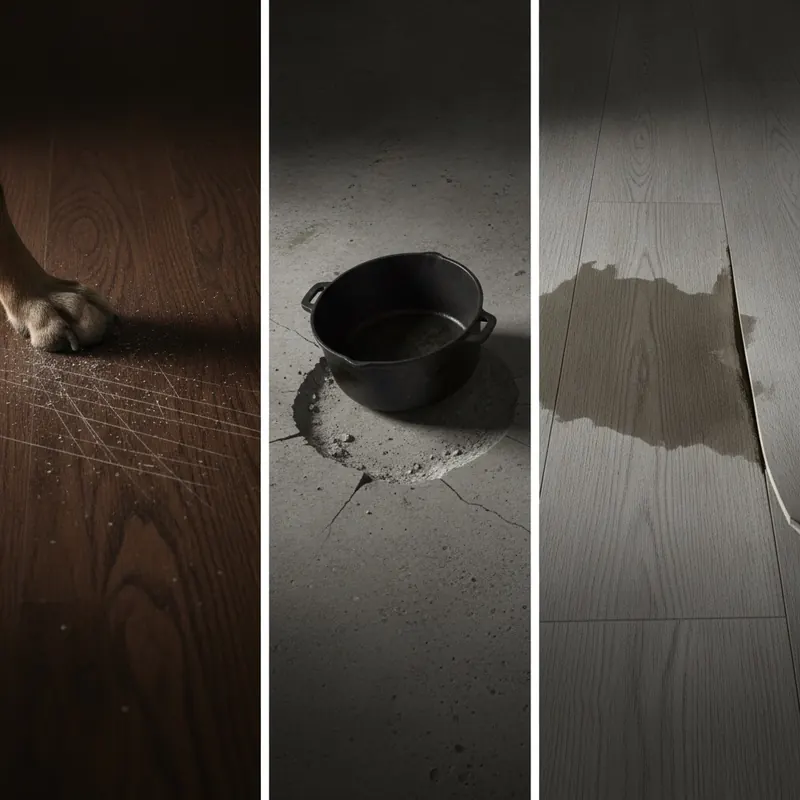
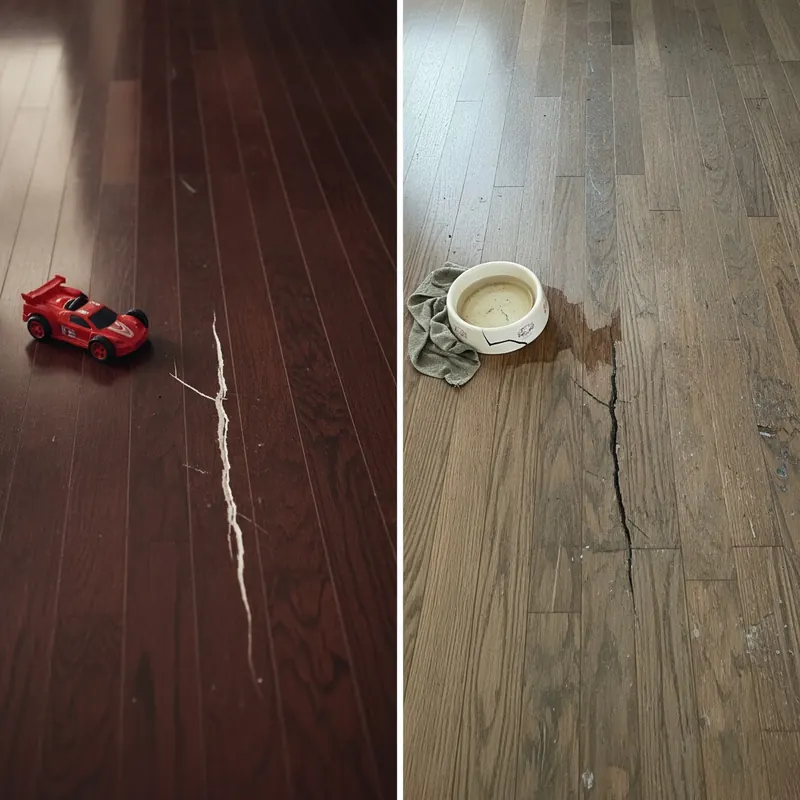
A beautiful new floor can transform a home, but that investment can quickly turn into a nightmare. The subtle waviness, the cupping edges, the alarming tent-like buckling—these are symptoms of a floor at war with its environment. Costly flooring failures are almost always rooted in one critical, often misunderstood concept: dimensional stability. But what if you could build a floor that was virtually bulletproof?
The secret isn’t just in choosing the most expensive plank. A truly high-performance, long-lasting floor is a complete system. It’s a holistic approach that balances the science of the material itself with the integrity of the subfloor beneath it and the precision of the installation that brings it all together.
This guide moves beyond simple product lists to give you the expert knowledge you need. We will demystify the science behind why floors fail, provide a definitive showdown of the most stable flooring materials, and reveal the three non-negotiable pillars of a flooring system that is built to last. By the end, you’ll be empowered to diagnose existing problems and invest confidently in a warp-proof floor that delivers uncompromised performance for decades.
- What is Dimensional Stability in Flooring (And Why It’s Critical)
- The Most Dimensionally Stable Flooring: A Material Showdown (Worst to First)
- The 3 Pillars of a Bulletproof Floor: A System-Based Approach
- Buyer’s Guide: Choosing Your High-Performance Flooring
- Your Foundation for a Lasting Investment
- References & Authoritative Sources
What is Dimensional Stability in Flooring (And Why It’s Critical)
In simple terms, dimensional stability is a flooring material’s ability to resist changing its size and shape when faced with fluctuations in its environment, primarily temperature and humidity. Materials with high dimensional stability remain flat and true, while those with low stability are prone to expanding, contracting, warping, and buckling.
To understand this, it helps to think of certain flooring materials, especially wood-based ones, as a sponge. They are hygroscopic, meaning they naturally absorb and release moisture from the air to match their surroundings. This process is a quest for what scientists at the U.S. Forest Products Laboratory (FPL) call Equilibrium Moisture Content (EMC), a state of balance with the ambient humidity[1].
When the air is humid, the “sponge” absorbs moisture and swells. When the air is dry, it releases moisture and shrinks. This movement is often imperceptible day-to-day, but over seasons, it can be dramatic. For a material like solid hardwood, a mere 1% change in its moisture content can cause a board to change its size by up to 0.25% across its grain[2]. Across a 10-foot-wide room, that can add up to a quarter-inch of movement, exerting immense pressure that leads to failure.
The Enemy of Floors: Understanding Humidity’s Impact
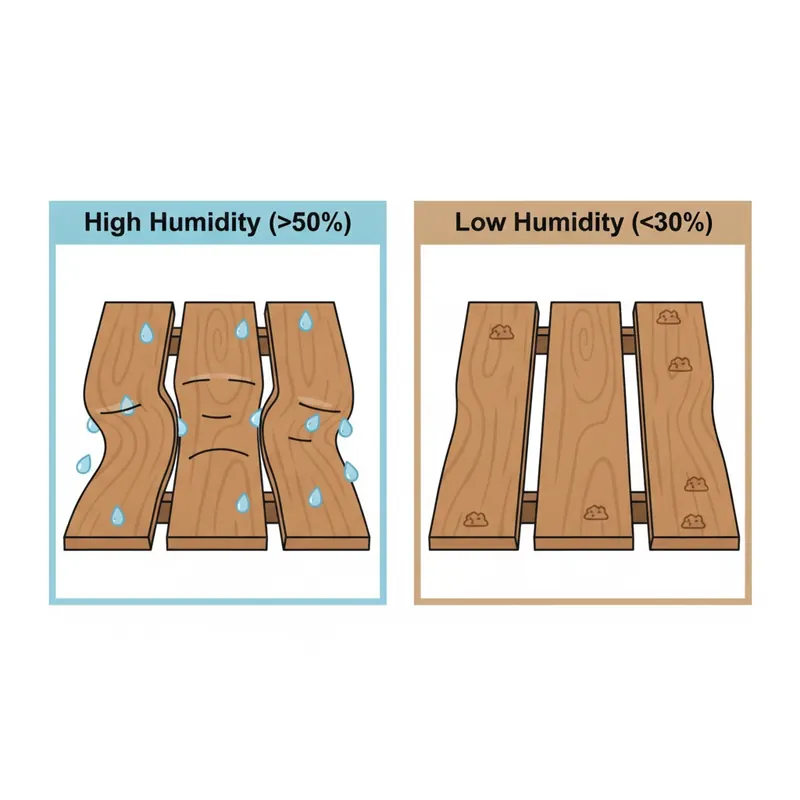
Humidity is the single most significant environmental factor affecting your floor’s stability. Both excessively high and low moisture levels can be destructive, and understanding the ideal range is crucial for protecting your investment.
Most flooring manufacturers, along with industry authorities like the National Wood Flooring Association (NWFA) and the American Society of Heating, Refrigerating and Air-Conditioning Engineers (ASHRAE), recommend maintaining a consistent indoor relative humidity level between 30% and 50% year-round[2], [3].
- High Humidity (>50%): In this range, hygroscopic materials absorb excess moisture and expand. This can lead to cupping, crowning, and eventually, buckling. Furthermore, the Environmental Protection Agency (EPA) warns that relative humidity levels sustained above 60% create an environment ripe for mold and mildew growth, posing health risks and causing further material degradation[4].
- Low Humidity (<30%): Often overlooked, dry conditions, common in winter or arid climates, can be just as damaging. As flooring releases its moisture, it shrinks. This can cause unsightly gaps to appear between planks, and in severe cases, can lead to splitting, cracking, and face-checking in wood floors.
Here is a general guide to recommended humidity ranges for common flooring types:
| Flooring Material | Recommended Relative Humidity |
|---|---|
| Solid Hardwood | 30% – 50% |
| Engineered Hardwood | 35% – 55% |
| Laminate Flooring | 30% – 60% |
| Vinyl (LVT/SPC) | Generally stable, but follow manufacturer specs |
| Porcelain/Ceramic Tile | Unaffected by humidity |
Flooring Failure Symptom Checker: Cupping vs. Crowning vs. Buckling
When a floor’s dimensional stability is compromised, it displays distinct visual symptoms. Identifying the specific type of failure is the first step in diagnosing the root cause.
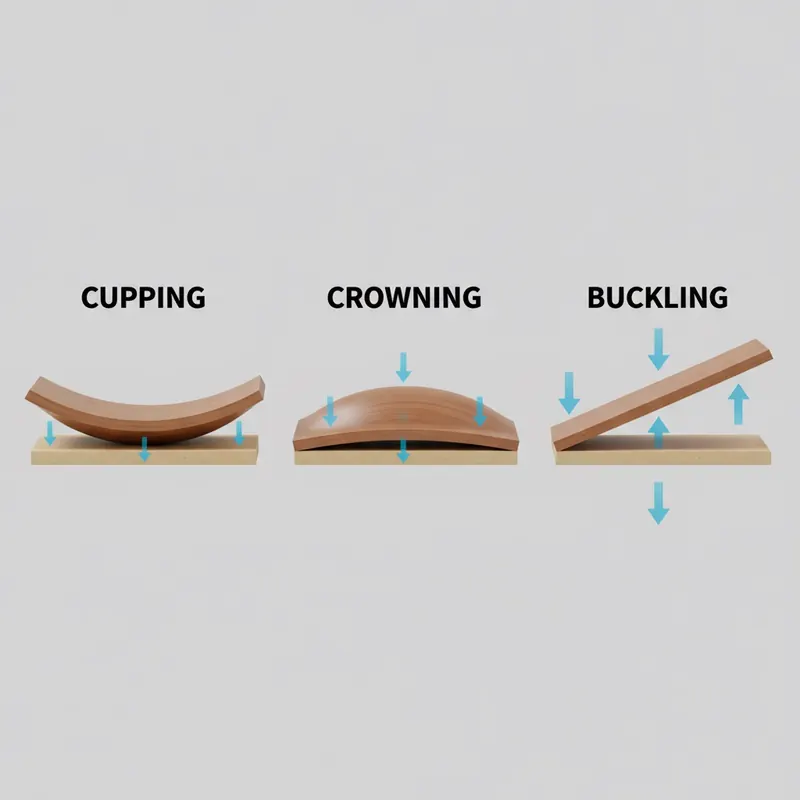
Cupping: This occurs when the bottom of a floorboard is wetter than the top. The moisture-laden underside expands, forcing the drier edges to curl upward. According to standards set by the Institute of Inspection, Cleaning and Restoration Certification (IICRC), a common cause is moisture vapor coming up from a damp subfloor, like a concrete slab in a basement[5].
Crowning: The opposite of cupping, crowning happens when the surface of the floorboard is wetter than the bottom. The top of the board swells and expands, pushing the center up while the edges are held down. This is often the result of a surface water spill that was left to sit or, ironically, an improper repair attempt where a cupped floor was sanded flat before it had fully dried out.
Buckling: This is the most severe and dramatic form of flooring failure. It happens when the flooring expands so much that it has nowhere to go, lifting completely off the subfloor. According to the NWFA’s technical manuals, this is almost always caused by a major water event (like a flood) or a critical installation error, such as failing to leave an adequate expansion gap around the perimeter of the room[2].
The Most Dimensionally Stable Flooring: A Material Showdown (Worst to First)
Choosing the right material for your specific environment is the first line of defense against warping and buckling. Here is a definitive ranking of common flooring materials, from least to most dimensionally stable, based on their inherent properties and performance under stress.
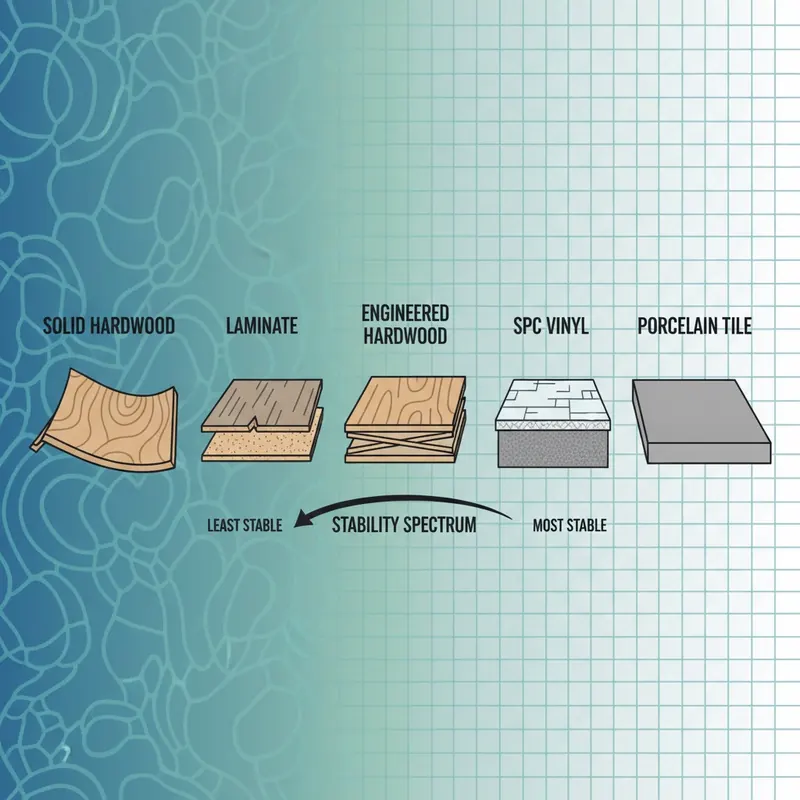
| Material | Core Composition | Water Resistance | Stability Score (1-10) | Best Use Case |
|---|---|---|---|---|
| Solid Hardwood | 100% Solid Wood | Low | 2/10 | Climate-controlled rooms, above grade |
| Laminate Flooring | High-Density Fiberboard (HDF) | Moderate (Varies) | 5/10 | General residential, not wet areas |
| Luxury Vinyl Tile (LVT) | 100% PVC Vinyl | High | 7/10 | Kitchens, laundry rooms, light commercial |
| Engineered Hardwood | Plywood or HDF Core | Moderate | 8/10 | All levels of the home, including basements |
| SPC Vinyl | Stone Plastic Composite | 100% Waterproof | 9.5/10 | Any room, including basements & bathrooms |
| Porcelain Tile | Fired Clay | 100% Waterproof | 10/10 | Any room, especially high-moisture areas |
The Champions of Stability: Porcelain Tile & SPC Vinyl
Porcelain Tile: As an inorganic material fired at extreme temperatures, porcelain tile is the undisputed king of stability. It is virtually inert and impervious to moisture. According to the Tile Council of North America (TCNA), porcelain is defined by its water absorption rate of less than 0.5%, making it an ideal choice for the most challenging environments like bathrooms, mudrooms, and basements[6]. It will not swell, shrink, or warp due to humidity.
SPC Vinyl (Stone Plastic Composite): A marvel of modern flooring technology, SPC is a high-performance, rigid core flooring. Its core is made from a dense mixture of natural limestone powder, polyvinyl chloride, and stabilizers. This composition makes the planks incredibly dense, rigid, and thermally stable. Data from the Resilient Floor Covering Institute (RFCI) supports that this core makes SPC flooring up to 75% more dimensionally stable than traditional LVT products[7]. It is 100% waterproof and exceptionally resistant to expansion and contraction, making it a top-tier choice for any room in the house.
The Smart Compromise: Engineered Hardwood
For those who desire the authentic look and feel of real wood, engineered hardwood offers a brilliant solution. Its construction features a top layer of real hardwood veneer bonded to multiple layers of cross-grained plywood or high-density fiberboard. This cross-ply construction counteracts the natural tendency of wood to expand and contract. As a result, industry research confirms that engineered hardwood is anywhere from 3 to 12 times more dimensionally stable than its solid counterpart. This stability allows it to be installed in areas where solid wood is not recommended, such as over concrete slabs, in basements, and over radiant heat systems.
The Contenders with Caveats: Modern Laminate & LVT
Laminate Flooring: Early generations of laminate earned a bad reputation for swelling at the slightest hint of moisture. However, modern high-quality laminate has made significant strides with water-resistant cores and advanced top coatings. The key difference lies in its core, which is typically a high-density fiberboard (HDF)—essentially wood fiber. While more stable than solid wood, it is still susceptible to moisture damage if penetrated. A crucial indicator of quality is its AC (Abrasion Class) rating; an AC4 or AC5 rating signifies a durable, well-made product suitable for heavy residential or light commercial use.
LVT (Luxury Vinyl Tile): Traditional LVT is made from 100% PVC, making it highly water-resistant. However, it is a more flexible product than SPC. This flexibility means it can be more susceptible to thermal expansion and contraction, and it will conform to any imperfections in the subfloor. While more stable than laminate, it doesn’t possess the rock-solid rigidity of an SPC core.
The Classic with Conditions: Solid Hardwood
Solid hardwood is timeless, beautiful, and can last for over a century. The National Association of Home Builders (NAHB) estimates its lifespan can exceed 100 years because it can be sanded and refinished multiple times[9]. However, it is the least dimensionally stable flooring material. As a single, solid piece of wood, it is fully exposed to the laws of physics and moisture. It will expand and contract significantly with seasonal changes—a movement of 1/4 inch over a 10-foot span is common[2]. To be successful, solid hardwood requires a strictly controlled environment (30-50% humidity) and meticulous adherence to the NWFA’s gold-standard installation guidelines[2]. It is a fantastic long-term investment, but one that demands respect for its nature.
The 3 Pillars of a Bulletproof Floor: A System-Based Approach
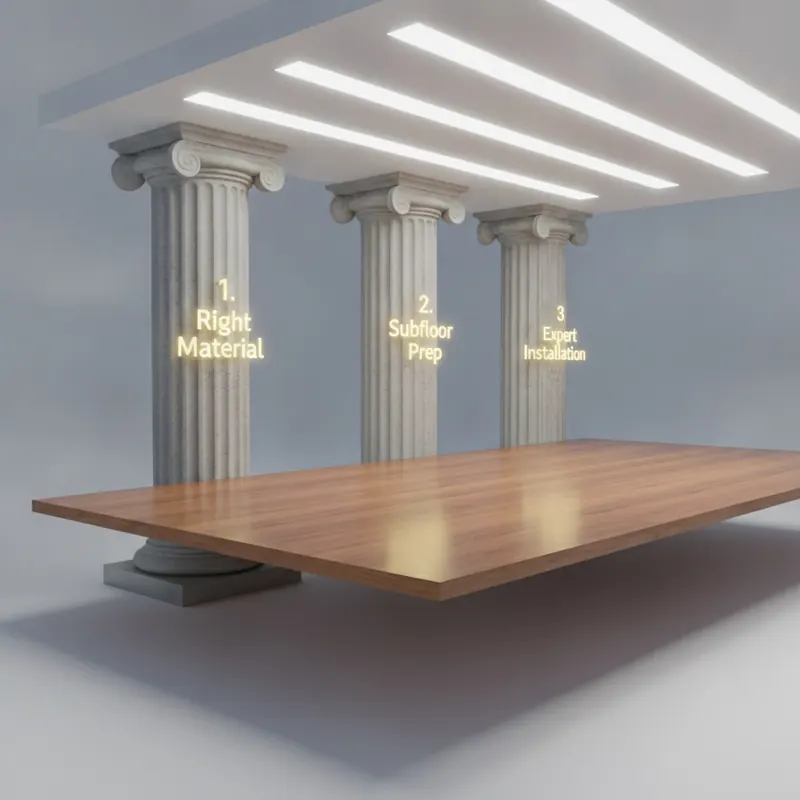
The biggest mistake a homeowner can make is believing that buying a high-quality flooring material guarantees a high-quality result. The pros know a secret: the plank you walk on is only one part of a complete system. A truly stable, long-lasting floor is built on three interconnected pillars.
As one master installer from the Certified Flooring Installers Association (CFI) puts it, “I’ve seen the most expensive flooring in the world fail because of a poorly prepped subfloor. The material is only as good as the foundation you put it on.”[10]
Pillar 1: Selecting the Right Material (A Quick Recap)
This is the foundation. As detailed in the material showdown, your first step is to choose a flooring material with the inherent dimensional stability required for your environment. Don’t fight nature by putting the least stable material in the most challenging location.
A simple decision process can guide you:
- Is the area below grade (basement) or prone to moisture (bathroom, kitchen)?
- Yes: Your primary choices are Porcelain Tile or SPC Vinyl.
- No: You can confidently consider Engineered Hardwood, high-quality Laminate, or Solid Hardwood (if your home’s climate is stable).
For a full comparison, refer back to our “Material Showdown” section.
Pillar 2: Subfloor Preparation is Non-Negotiable
The subfloor is the true, unseen foundation of your floor. If it’s uneven, dirty, or, most importantly, wet, it will telegraph those problems directly into your brand-new flooring, causing failures regardless of the material’s quality.
- It Must Be Flat: The universal industry standard, cited by both the NWFA and CFI, is that the subfloor must be flat to within 3/16 of an inch over a 10-foot radius[2], [10]. You can check this by laying a long, straight edge on the floor and looking for gaps. High spots must be ground down, and low spots must be filled with a suitable leveling compound.
- It Must Be Clean: The subfloor must be scraped, swept, and vacuumed until it is completely free of debris, drywall mud, paint, or old adhesive.
- It Must Be Dry: This is the most critical step. Moisture migrating from the subfloor is a primary cause of cupping and buckling. For concrete subfloors, a moisture test is not optional—it’s essential. While simple plastic sheet tests exist, the most reliable professional method is defined by ASTM International’s F2170 standard, which uses in-situ probes to measure the relative humidity within the slab itself[8].
Checklist: Prepping a Subfloor in a Humid Environment
- Conduct a professional moisture test (e.g., ASTM F2170).
- Grind any high spots and fill low spots with a moisture-resistant leveling compound.
- Ensure the subfloor is perfectly clean and free of contaminants.
- Install a 6-mil polyethylene vapor barrier over the entire subfloor, overlapping seams by 6-8 inches.
Pillar 3: The Science of Expert Installation
The final pillar is a professional installation that respects the physics of flooring. This is where science meets craftsmanship, and cutting corners can lead to catastrophic failure.
- Acclimation is Mandatory: The NWFA states that proper acclimation is one of the most important steps in preventing wood flooring failures[2]. This means letting the new, boxed flooring sit in the room where it will be installed for at least 48-72 hours. This allows the material to reach its Equilibrium Moisture Content (EMC) with the home’s environment before it’s locked into place.
- The Expansion Gap is Your Floor’s Breathing Room: All floating floors (like laminate, LVT, SPC, and most engineered wood) require a gap of 1/4 to 1/2 inch around the entire perimeter of the room. This space, which is later covered by baseboards, allows the entire floor to expand and contract as a single unit. A flooring inspector will tell you that buckling is frequently caused by installers forgetting this gap or nailing baseboards or cabinets directly through the floating floor, pinning it down[2].
- Use the Right Underlayment and Vapor Barrier: The underlayment provides cushioning and sound absorption, but in certain situations, its role is more critical. Over a concrete subfloor, a 6-mil polyethylene plastic sheeting is a non-negotiable vapor barrier that stops moisture migration. Many modern underlayments have a vapor barrier built-in, but it’s crucial to verify its specifications are suitable for your subfloor type.
Buyer’s Guide: Choosing Your High-Performance Flooring
Armed with an understanding of the flooring system, you can now make an informed purchasing decision. Use this guide to navigate the final steps of selecting the perfect high-performance floor for your needs.
Your High-Performance Flooring Buyer’s Checklist:
- Match Material to Environment: Have I chosen a material with the right dimensional stability for the room (e.g., SPC for a basement)?
- Check the Core: For laminate or engineered products, what is the core made of (HDF, plywood)? Is it rated for water resistance?
- Verify Wear Layer Thickness: For vinyl or laminate, is the wear layer thick enough for my traffic levels? (Look for 12 mil+ for residential, 20 mil+ for commercial).
- Read the Warranty: Does the warranty cover water damage? What are the specific humidity and installation requirements to keep the warranty valid? Many “lifetime” warranties are voided by improper installation or environmental conditions.
- Plan for Installation: Have I budgeted for proper subfloor preparation? Have I discussed acclimation and expansion gaps with my installer?
Best Flooring for Challenging Environments: Basements, Bathrooms, and Coastal Homes
These areas represent the ultimate test of dimensional stability. Success requires choosing the right material and controlling the environment.
- Basements: Because they are below grade and surrounded by earth, basements are prone to moisture from the concrete slab. For basements, SPC vinyl or porcelain tile are your safest, most reliable choices. They are 100% waterproof and unaffected by the ambient moisture common in these spaces.
- Bathrooms: Full bathrooms with showers and tubs experience constant, direct water exposure and high-humidity spikes. Again, porcelain or ceramic tile is the traditional, foolproof option. SPC and LVT are also excellent waterproof alternatives.
- Coastal Homes: Homes in humid, coastal climates face a year-round battle with high ambient humidity. While tile and SPC are top choices, homeowners can still use engineered hardwood if they have a robust, whole-home HVAC and dehumidification system. As recommended by programs like Energy Star, proper home sealing and ventilation are critical components of the total flooring system in these climates[11].
What is Adamantine Flooring? A Look at High-Performance Coatings
You may encounter the term “Adamantine Flooring” in your research. This is typically a brand name for a category of high-performance, seamless floor coatings, often based on epoxy or polyaspartic urethane chemistry. These are not planks or tiles but liquid systems applied directly to a concrete substrate, most commonly in garages, workshops, and industrial settings.
To evaluate these products, you must look past marketing claims and analyze their Technical Data Sheet (TDS). This document provides the real-world specifications. Organizations like The Society for Protective Coatings (SSPC/AMPP) set the standards for evaluating these industrial materials[12].
Adamantine/Epoxy Flooring: Fact vs. Fiction
| Marketing Claim (Fiction) | Technical Reality (Fact) |
|---|---|
| “A simple DIY weekend project.” | Requires meticulous, multi-day concrete preparation (grinding, cleaning, profiling). Improper prep is the #1 cause of failure (peeling, flaking). |
| “Indestructible and scratch-proof.” | Highly durable and chemical-resistant, but not scratch-proof. Compressive strength (often over 10,000 psi) measures resistance to crushing, not scratching. |
| “Just roll it on any concrete floor.” | Will fail if applied over concrete with moisture issues. A moisture test and vapor barrier primer are often required. |
These coating systems can create an incredibly durable, high-performance surface, but their success is 100% dependent on substrate preparation and professional application.
Your Foundation for a Lasting Investment
A beautiful, stable floor is not a product you buy; it’s a system you build. The path to a warp-proof, high-performance floor is paved with knowledge, not just money. By embracing this holistic approach, you can move beyond the fear of failure and make a truly confident investment.
The journey begins by choosing the right material with the inherent dimensional stability to match your home’s unique environment. But the work doesn’t stop there. True, lasting success is cemented in the two pillars that are often overlooked: a meticulously prepared subfloor and an expert installation that respects the unchangeable laws of physics. Investing in that preparation is the single best way to protect your investment in the beautiful planks you’ll walk on for decades to come.
Feeling confident to make your choice? Download our free ‘Flooring Project Checklist’ to ensure you and your installer cover every critical step for a bulletproof installation.
This article provides informational guidance. Always consult with a certified flooring professional and adhere strictly to the manufacturer’s installation instructions for your specific product to ensure warranty compliance and optimal performance.
References & Authoritative Sources
- U.S. Forest Products Laboratory. (N.D.). Wood Handbook–Chapter 13: Moisture Relations and Physical Properties of Wood. U.S. Department of Agriculture.
- National Wood Flooring Association (NWFA). (N.D.). Installation Guidelines. NWFA.
- American Society of Heating, Refrigerating and Air-Conditioning Engineers (ASHRAE). (N.D.). Standard 55-2020: Thermal Environmental Conditions for Human Occupancy. ASHRAE.
- Environmental Protection Agency (EPA). (N.D.). A Brief Guide to Mold, Moisture, and Your Home. EPA.gov.
- Institute of Inspection, Cleaning and Restoration Certification (IICRC). (N.D.). IICRC S500: Standard for Professional Water Damage Restoration. IICRC.
- Tile Council of North America (TCNA). (N.D.). ANSI A137.1 American National Standard Specifications for Ceramic Tile. TCNA.
- Resilient Floor Covering Institute (RFCI). (N.D.). Performance Standards and Data. RFCI.
- ASTM International. (N.D.). ASTM F2170: Standard Test Method for Determining Relative Humidity in Concrete Floor Slabs Using in situ Probes. ASTM.org.
- National Association of Home Builders (NAHB). (N.D.). Study of Life Expectancy of Home Components. NAHB.
- Certified Flooring Installers Association (CFI). (N.D.). Installation Standards and Training Materials. CFI.
- Energy Star. (N.D.). A Guide to Energy-Efficient Air Sealing and Insulation. A program of the U.S. Environmental Protection Agency (EPA).
- The Society for Protective Coatings (SSPC/AMPP). (N.D.). Coating and Material Standards. AMPP.org.