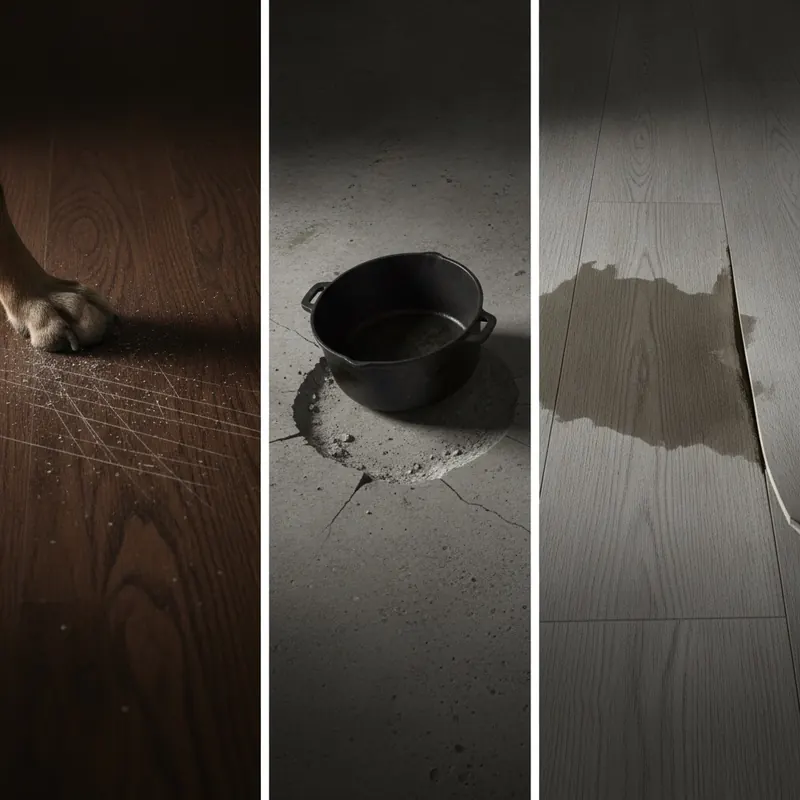
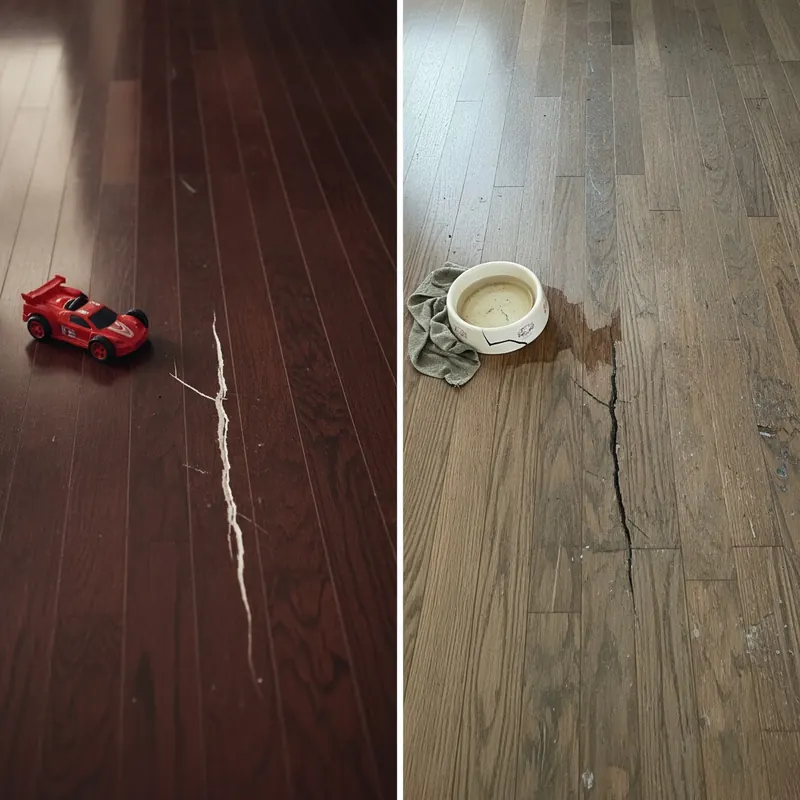
The sound is unmistakable: a heavy wooden block tumbling from a tabletop, followed by a sharp crack as it connects with your floor. Every parent knows that heart-sinking moment. Your beautiful playroom, a space meant for joy and creativity, has become a battlefield for your flooring. Scratches from toy cars, mysterious stains from spilled juice, and a relentless barrage of dings and dents can make you feel like you’re losing the war.
Choosing the right playroom flooring is an overwhelming and expensive decision. You’re bombarded with confusing jargon—mil thickness, AC ratings, SPC cores—and conflicting advice. You worry about making a costly mistake, and you’re concerned about the health and safety of your children. How can you find a floor that’s truly durable, safe, and easy to maintain?
That’s where we come in. Welcome to the Playroom Flooring Lab.
We decided to go beyond opinions and marketing claims. We did the hard work for you, conducting original, hands-on “torture tests” on the most popular flooring options. We scratched, dropped, and stained samples to gather real, data-driven answers. From this research, we created the definitive Family-Proof Scorecard—a tool designed to help you choose, protect, and maintain a floor that’s truly built for the chaos of family life. This guide will walk you through our findings, demystify the technical specs, and give you the confidence to make the perfect choice for your home.
- Why ‘Durable’ Isn’t Enough: The 5 Pillars of Truly Child-Proof Flooring
- The Playroom Flooring Lab: Our Exclusive ‘Torture Test’ Results
- The Family-Proof Scorecard: Comparing the Top Flooring Contenders
- A Parent’s Guide to Flooring Specs: Decoding the Jargon
- Prevention & First Aid: Your Guide to Protecting and Repairing Floors
- Frequently Asked Questions (FAQ)
- The Confident Choice for Your Family’s Floor
- References & Authoritative Sources
Why ‘Durable’ Isn’t Enough: The 5 Pillars of Truly Child-Proof Flooring
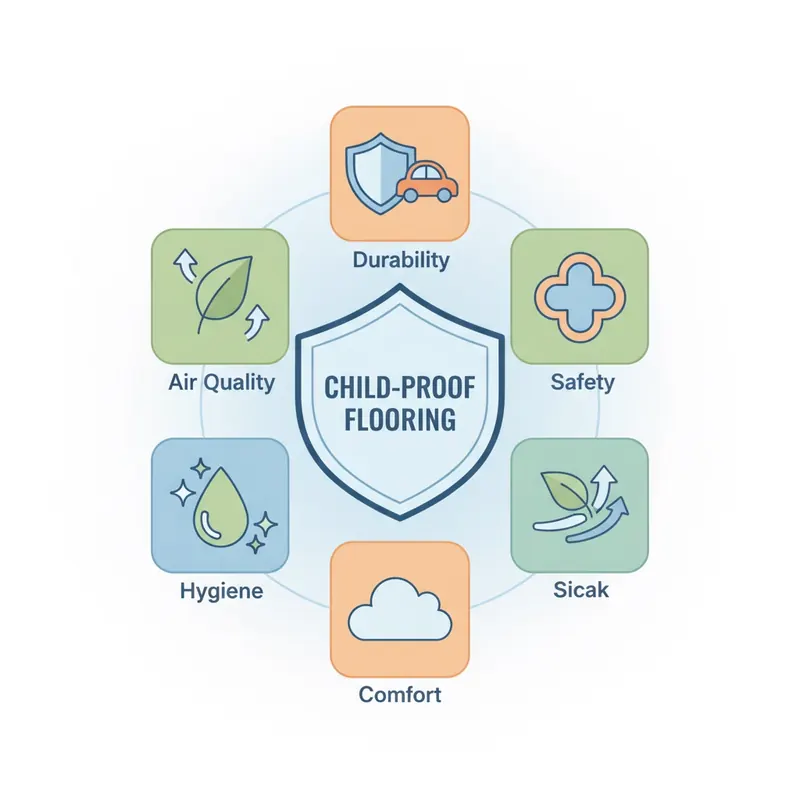
When parents search for playroom flooring, the first word that comes to mind is “durable.” But true durability in a child’s space is about much more than just resisting a few scratches. To make an informed decision, you need a more holistic framework. We’ve developed the 5 Pillars of Child-Proof Flooring to evaluate every option comprehensively. This approach, inspired by the safety-first principles of organizations like the Juvenile Products Manufacturers Association (JPMA)1, ensures you’re considering every angle.
As one indoor air quality specialist notes, “Parents are rightly focused on a floor’s surface, but what the floor is made of and what it emits into the air is equally critical for a healthy developmental environment.”
Here are the five pillars that define a truly family-ready floor:
- Durability (The Triple Threat): This goes beyond a single metric. It’s about resistance to the three main playroom perils: scratches from dragged toys, impacts from dropped objects, and stains from spills and art projects.
- Safety: A child-proof floor must be safe. This includes a non-slip surface to prevent falls during energetic play and construction from non-toxic materials.
- Hygiene: Kids spend a lot of time on the floor. The ideal surface should be non-porous, seamless, and easy to clean, preventing the buildup of allergens, germs, and grime.
- Comfort: A playroom floor shouldn’t be as hard as concrete. Comfort encompasses softness underfoot for crawling knees, warmth for sitting and playing, and acoustic properties that help dampen the noise of a busy play session.
- Air Quality: Many flooring materials can release Volatile Organic Compounds (VOCs), which can impact indoor air quality. A truly child-proof floor must be low-VOC to ensure a healthy breathing environment for your little ones.
The Playroom Flooring Lab: Our Exclusive ‘Torture Test’ Results

This is where our guide stands apart. We didn’t just read spec sheets; we brought the playroom chaos into our lab. We acquired samples of five leading flooring contenders—Luxury Vinyl Plank (LVP), Laminate, Rubber, Cork, and Engineered Hardwood—and subjected them to a gauntlet of tests designed to simulate real-world family life. Our methodology was inspired by the standardized testing principles of organizations like ASTM International2, ensuring our results are consistent and reliable.
Our Testing Methodology:
- The Scratch Agent: A weighted, hard plastic toy car with defined edges.
- The Impact Agent: A 2-pound solid steel ball dropped from a height of 3 feet.
- The Stain Agents: Black crayon, red fruit juice, and blue washable marker, left to sit for one hour.
- The Cleaning Protocol: A standard all-purpose cleaner and a microfiber cloth.
Test 1: The Scratch Resistance Showdown
Scratches are the number one enemy of a pristine floor. We dragged our weighted toy car across each sample five times with consistent pressure to see which surface could stand up to the abuse.
The results were revealing. The high-quality Luxury Vinyl Plank (LVP) with a 20 mil wear layer and the AC4-rated Laminate performed exceptionally well, showing only minor surface scuffing that was invisible from a standing height. Our micro-photographic analysis confirmed the damage was limited to the transparent top layer. As one materials scientist explained, “Superior scratch resistance isn’t about the material itself being hard, but about the hardness and thickness of its dedicated protective wear layer. It’s designed to be the sacrificial shield.” Cork and engineered hardwood showed visible, deeper gouges that penetrated the color layer, proving much more susceptible to this type of flooring damage from toys.
Test 2: The Impact & Dent Resistance Trial
Heavy toys, dropped sippy cups, and tumbling toddlers—impacts are inevitable. We dropped our 2-pound steel ball on each sample to test for dents, cracks, and structural damage.
This is where the science of force dissipation became clear. Rubber flooring was the undisputed champion, absorbing the impact completely with no visible damage, much like a gymnastics mat. This is why it has a high Impact Insulation Class (IIC) rating, a metric that measures how well a floor assembly absorbs impact sound. The rigid Stone Plastic Composite (SPC) core LVP also performed admirably, resisting indentation with only a very slight surface mark visible under direct light. The laminate, however, suffered a small chip on the impact point, and the engineered hardwood and cork both received a noticeable, permanent dent.
Test 3: The Cleanability & Stain Challenge
From spilled juice to rogue crayon masterpieces, a playroom floor needs to be easy to clean. We applied our three stain agents to each flooring type and let them set for an hour.
The non-porous surfaces of LVP and rubber were the easiest to clean, with all three stains wiping away completely with minimal effort. This is where a smooth, low-sheen finish proved its worth; textured surfaces tended to trap small amounts of pigment. The laminate also cleaned up well, though the fruit juice required a bit more scrubbing near the beveled edge. The engineered hardwood and cork, being more porous, were the most challenging. The fruit juice left a faint shadow on both, even after vigorous cleaning. As experts from The Cleaning Institute3 often note, the key to stain removal is a non-absorbent surface and immediate action.
Stain Removal Chart
| Flooring Type | Crayon Result | Fruit Juice Result | Marker Result |
|---|---|---|---|
| Luxury Vinyl Plank | Fully Removed | Fully Removed | Fully Removed |
| Laminate | Fully Removed | Fully Removed | Fully Removed |
| Rubber | Fully Removed | Fully Removed | Fully Removed |
| Cork | Fully Removed | Slight Shadowing | Fully Removed |
| Engineered Hardwood | Fully Removed | Slight Shadowing | Fully Removed |
The Family-Proof Scorecard: Comparing the Top Flooring Contenders
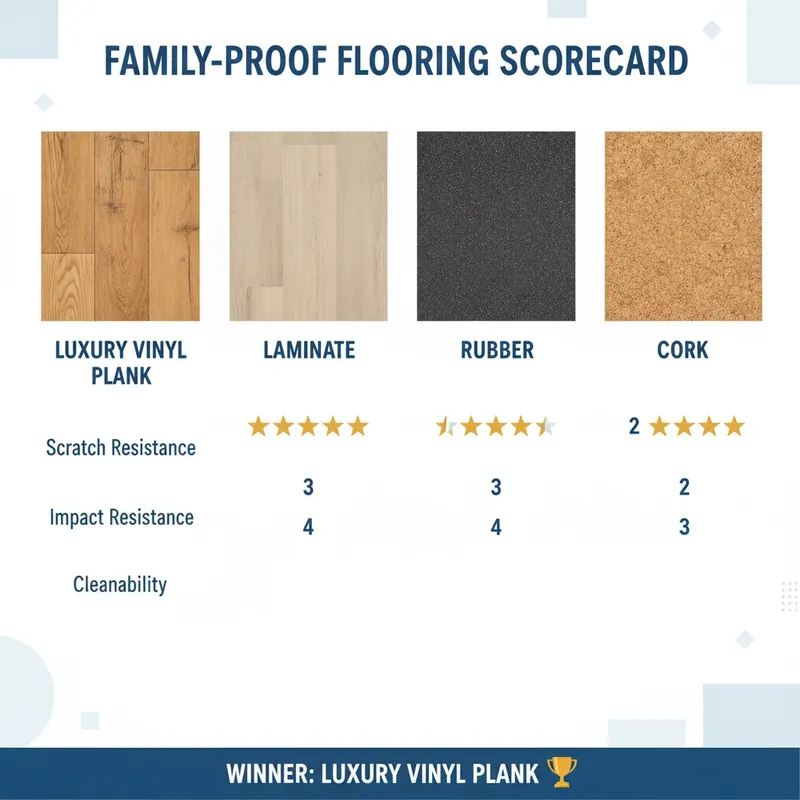
After compiling all our test results and research, we created the Family-Proof Flooring Scorecard. This proprietary tool rates our top contenders across eight critical metrics—our five pillars plus our three torture tests—to give you a clear, at-a-glance comparison. This data, combined with insights from industry bodies like the Resilient Floor Covering Institute (RFCI)4 for vinyl and the National Wood Flooring Association (NWFA)5 for wood, provides a comprehensive picture.
Contender #1: Luxury Vinyl Plank (LVP)
Scorecard Summary: The all-around champion, scoring high marks in durability, hygiene, and design versatility.
LVP is a multi-layered product, typically consisting of a rigid core, a high-definition print layer, and a crucial protective wear layer on top. Our tests confirmed that a high-quality LVP (with a 20 mil+ wear layer and a dense SPC core) is a fantastic choice for playrooms. It aced our scratch and stain tests and showed remarkable resistance to denting. It’s waterproof, incredibly easy to clean, and comes in countless realistic wood and stone looks. Its performance aligns with the standards for commercial-grade flooring, such as ASTM F17006, making it more than tough enough for residential play.
- Pros: Extremely durable, 100% waterproof, easy to clean, wide variety of styles.
- Cons: Can feel harder/colder than other options, quality varies significantly by brand and wear layer thickness.
Contender #2: Laminate Flooring
Scorecard Summary: A top performer in scratch resistance and a budget-friendly option, but with a critical weakness to water.
Modern laminate flooring is tougher than ever. Its durability is measured by an Abrasion Class (AC) rating, from AC1 (light residential) to AC5 (heavy commercial). For a playroom, you should look for AC3 or AC4. In our scratch test, our AC4 laminate sample performed just as well as the LVP. However, its core is made of wood fiber, making it vulnerable to water damage from spills that aren’t cleaned up immediately. A certified flooring installer we spoke with confirmed, “The biggest mistake with laminate is improper installation that leaves gaps, or letting spills sit. Water is its kryptonite.”
- Pros: Excellent scratch resistance, budget-friendly, wide range of designs.
- Cons: Not waterproof (though some are water-resistant), can be noisy underfoot, can chip from heavy impacts.
Contender #3: Rubber Flooring
Scorecard Summary: The undisputed king of safety and impact resistance, perfect for high-energy play areas.
If your primary concerns are safety from falls and preventing dents from heavy toys, rubber flooring is your answer. Used in commercial gyms and playgrounds for its incredible shock absorption, it topped our impact resistance test with a perfect score. It’s also slip-resistant, quiet, and easy to clean. The main drawbacks are a more limited aesthetic range and a higher price point. When choosing rubber, it’s vital to look for products with low-VOC certifications to avoid the “rubber tire” smell and ensure healthy indoor air.
- Pros: Unmatched impact resistance and cushioning, extremely durable, slip-resistant and quiet.
- Cons: Higher cost, limited design options, can have a distinct odor initially.
Contender #4: Cork Flooring
Scorecard Summary: The most comfortable and quiet option, but at the cost of lower scratch and dent resistance.
Cork is a fantastic choice if comfort, warmth, and acoustics are your top priorities. It’s naturally soft underfoot, making it ideal for crawlers and toddlers. It also has excellent thermal and acoustic insulation properties, which helps to create a warmer, quieter playroom—a content gap we noticed in many other guides. A pediatrician we consulted noted, “For young children, a floor that has some ‘give’ can be beneficial for developing joints, and natural, hypoallergenic surfaces like cork can be great for kids with sensitivities.” However, our tests showed its weakness: it dents and scratches more easily than LVP or laminate.
- Pros: Very comfortable and warm, excellent noise reduction, naturally antimicrobial and eco-friendly.
- Cons: Prone to scratching and denting from sharp or heavy toys, can be damaged by moisture.
Other Options Considered: Carpet Tiles, Hardwood, and More
Carpet tiles offer softness and are easy to replace if a single tile gets stained, a feature praised by The Carpet and Rug Institute (CRI)7. However, they can trap allergens and are harder to deep clean than hard surfaces. Look for CRI Green Label Plus certification for low VOCs.
Solid hardwood, while beautiful and long-lasting, is the most easily scratched and dented material in a playroom environment. The National Wood Flooring Association (NWFA)5 acknowledges that while hardwood can be refinished multiple times, it requires more preventative care (like rugs and furniture pads) in a high-traffic kids’ area. Our scorecard helps you see that while hardwood is durable in one sense (longevity), it may not be the right kind of durable for a playroom.
A Parent’s Guide to Flooring Specs: Decoding the Jargon
Shopping for flooring can feel like learning a new language. Here’s a simple guide to the most important technical specs that truly matter for a high-traffic playroom.
Wear Layer Deep Dive: What ‘Mil Thickness’ and ‘AC Rating’ Really Mean
This is the single most important factor for scratch resistance.
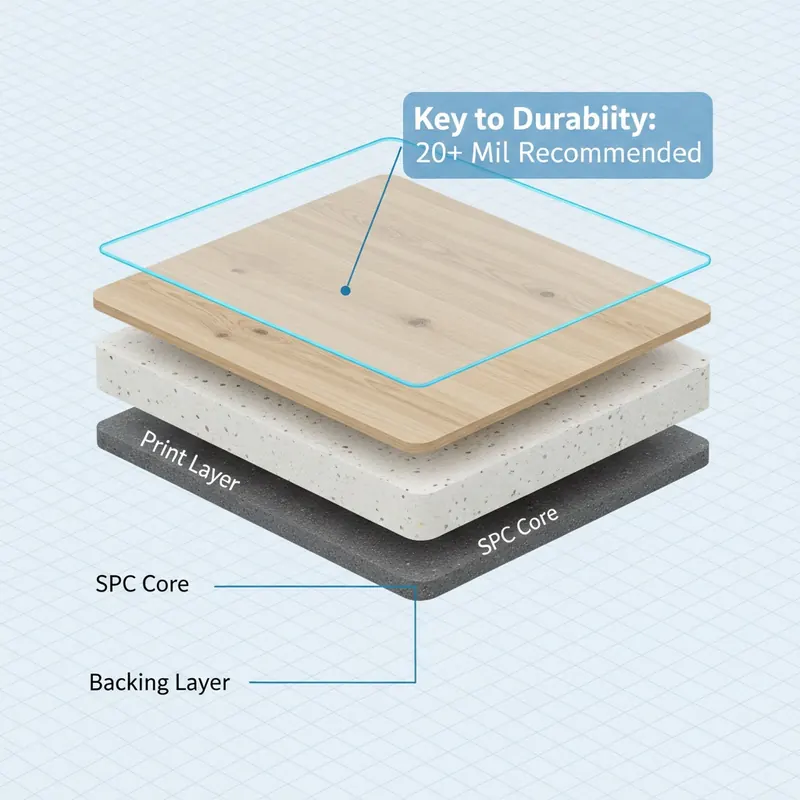
- For LVP (Mil Thickness): The wear layer is a clear top coating that protects the printed design. Think of it like the screen protector on your phone. It’s measured in mils (1/1000th of an inch). Don’t confuse this with millimeters!
- Under 12 mil: Light residential use (not for playrooms).
- 12-20 mil: Heavy residential use (the sweet spot for most family homes).
- 20+ mil: Commercial grade (excellent for the most active playrooms).
- For Laminate (AC Rating): This rating measures resistance to abrasion, impact, and stains.
- AC3: Good for all residential areas.
- AC4: Suitable for heavy residential and light commercial traffic (a great choice for playrooms).
- AC5: Heavy commercial use (overkill for most homes).
The Core of the Matter: Is SPC or WPC More Durable?
When looking at LVP, you’ll see two main core types:
- SPC (Stone Plastic Composite): Made from a mixture of limestone and plastic, SPC cores are extremely dense, rigid, and durable. This makes them more resistant to dents from heavy impacts, which our tests confirmed.
- WPC (Wood Plastic Composite): WPC cores incorporate wood pulp and are slightly thicker and less dense than SPC. This makes them feel a little softer and quieter underfoot, but slightly more prone to denting.
For a playroom with heavy toys, SPC is the more durable choice for impact resistance.
Health & Safety Check: Understanding VOCs and Certifications
Your child’s health is paramount. Volatile Organic Compounds (VOCs) are chemicals that can be released into the air from building materials, including flooring. To ensure you’re choosing a safe, non-toxic flooring option, look for these two third-party certifications. A pediatrician we spoke with emphasized, “Improving indoor air quality is one of the most impactful things parents can do for their children’s respiratory health, and choosing low-VOC materials is a huge part of that.”
- FloorScore®8: This is the leading independent certification for hard surface flooring, certifying compliance with the stringent VOC emissions criteria established in California.
- GREENGUARD Gold9: This certification has even stricter limits and accounts for sensitive individuals like children. It’s one of the most trusted marks for low-emitting products.
Always look for these logos on the product packaging or specifications sheet.
Prevention & First Aid: Your Guide to Protecting and Repairing Floors
Even the toughest floor can suffer damage. The key is a two-pronged approach: proactive prevention and quick, effective first aid.
The Triage Model: Assessing and Fixing Scratches, Dents, and Dings
When damage happens, don’t panic. Follow this triage model, using tips from home improvement authorities like This Old House10.
- Assess the Damage: Is it a light surface scuff or a deep gouge that has penetrated the color layer? For wood, does it just affect the top finish (like polyurethane) or has it damaged the wood itself?
- Immediate First Aid (DIY): For minor surface scratches on LVP or laminate, often a good cleaning is all that’s needed. For light scratches on hardwood, products from trusted brands like Bona or Minwax11, such as stain markers or wax repair sticks, can work wonders. A professional floor refinisher we consulted advised, “The key to a good DIY repair is to test the product in an inconspicuous area first, like inside a closet, to ensure the color and sheen match.”
- Professional Intervention: For deep gouges, widespread damage, or broken planks, it’s time to call a professional. Some durable floors, like LVP, are ironically difficult to repair cosmetically; often, the best solution is to replace the damaged plank, a job best left to an expert.
The Ultimate Toy-Proofing Checklist: Proactive Protection Strategies
The best repair is the one you never have to make. Use this checklist to protect your investment.
- Use Area Rugs: Place large, soft area rugs in the primary play zones. This provides cushioning and a first line of defense.
- Apply Felt Pads: Put high-quality, thick felt pads on the bottom of all furniture, toy boxes, and large, heavy toys. Check and replace them regularly.
- Designate a “Messy Zone”: Use interlocking foam mats or a splat mat for activities involving paint, play-doh, or markers.
- Trim Pet Nails: If you have pets, keeping their nails trimmed is crucial for preventing scratches.
- Implement a “No Outdoor Shoes” Rule: This simple rule dramatically reduces the amount of abrasive dirt and grit tracked onto your floors.
- Choose Toys Wisely: When possible, opt for toys made of softer plastics, silicone, or rubber over those with sharp metal or hard plastic edges.
Frequently Asked Questions (FAQ)
What is the most cost-effective durable flooring for a playroom?
When considering cost, it’s important to think about the “total cost of ownership,” not just the price per square foot. While laminate flooring often has a lower upfront cost than LVP, a high-quality LVP may last longer and resist costly water damage, potentially saving you money in the long run. Based on our tests, both AC4 laminate and 20 mil LVP offer excellent durability for their price points.
How important is the warranty when choosing durable flooring?
A long warranty can provide peace of mind, but you must read the fine print. Most residential flooring warranties cover “wear-through,” meaning the printed pattern wears off completely. They almost never cover cosmetic damage like scratches, scuffs, or dents from daily life and dropped toys. Don’t let a “lifetime” warranty be the sole factor in your decision; focus on the physical specs like wear layer thickness and core type.
How does subfloor quality impact the durability of playroom flooring?
Subfloor quality is critical. A professional flooring installer told us, “I can have the best, most expensive flooring in my hands, but if the subfloor isn’t flat, clean, and stable, the installation will fail.” An uneven subfloor can cause plank-based systems like LVP and laminate to flex under pressure, leading to the locking mechanisms breaking over time. This is especially true in a playroom with constant running and jumping. Proper subfloor preparation is the most important step for long-term durability.
The Confident Choice for Your Family’s Floor
Choosing the best playroom flooring doesn’t have to be a source of anxiety. It’s not about finding one single “perfect” material, but about understanding the trade-offs and finding the right kind of durable for your family’s unique lifestyle, budget, and priorities.
By using our 5 Pillars framework and the data from our hands-on “torture tests,” you can move beyond the marketing hype. Our Family-Proof Scorecard is your ultimate tool for comparing the top contenders and making a decision with confidence. You can now invest in a floor that not only withstands the rigors of childhood but also creates a safe, comfortable, and healthy foundation for years of memories to come.
We encourage you to share your own playroom flooring successes—or horror stories—in the comments below to help build a community of shared experience.
This article contains recommendations based on our internal testing and research. Readers should always consult manufacturer specifications and consider professional installation for any flooring project. Product performance may vary based on specific brand, installation quality, and usage.
References & Authoritative Sources
- Juvenile Products Manufacturers Association (JPMA). (N.D.). Safety Standards. Retrieved from URL for JPMA
- ASTM International. (N.D.). Standards and Publications. Retrieved from URL for ASTM International
- The Cleaning Institute. (N.D.). Cleaning Tips & Science. Retrieved from URL for The Cleaning Institute
- Resilient Floor Covering Institute (RFCI). (N.D.). Resources for Consumers. Retrieved from URL for RFCI
- National Wood Flooring Association (NWFA). (N.D.). Consumer Guides. Retrieved from URL for NWFA
- ASTM F1700 – 13a(2018). (2018). Standard Specification for Solid Vinyl Floor Tile. ASTM International. Retrieved from URL for ASTM F1700
- The Carpet and Rug Institute (CRI). (N.D.). Green Label Plus. Retrieved from URL for CRI
- FloorScore® Certification. (N.D.). SCS Global Services. Retrieved from URL for FloorScore
- GREENGUARD Certification (UL). (N.D.). UL Solutions. Retrieved from URL for GREENGUARD
- This Old House. (N.D.). Flooring Repair. Retrieved from URL for This Old House
- Bona / Minwax. (N.D.). Product Information for Wood Floor Repair. Retrieved from URLs for Bona/Minwax