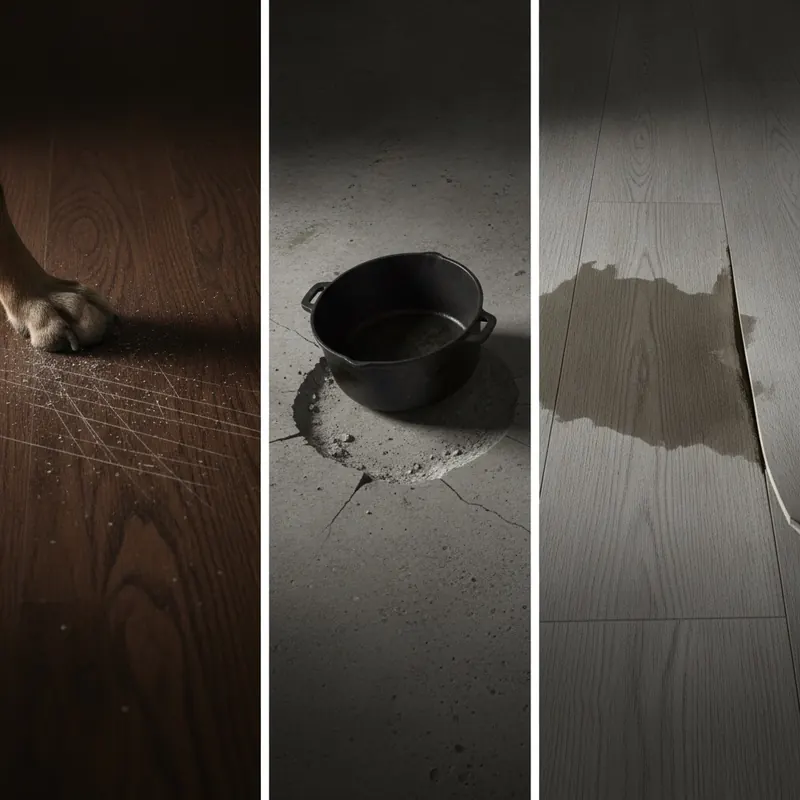
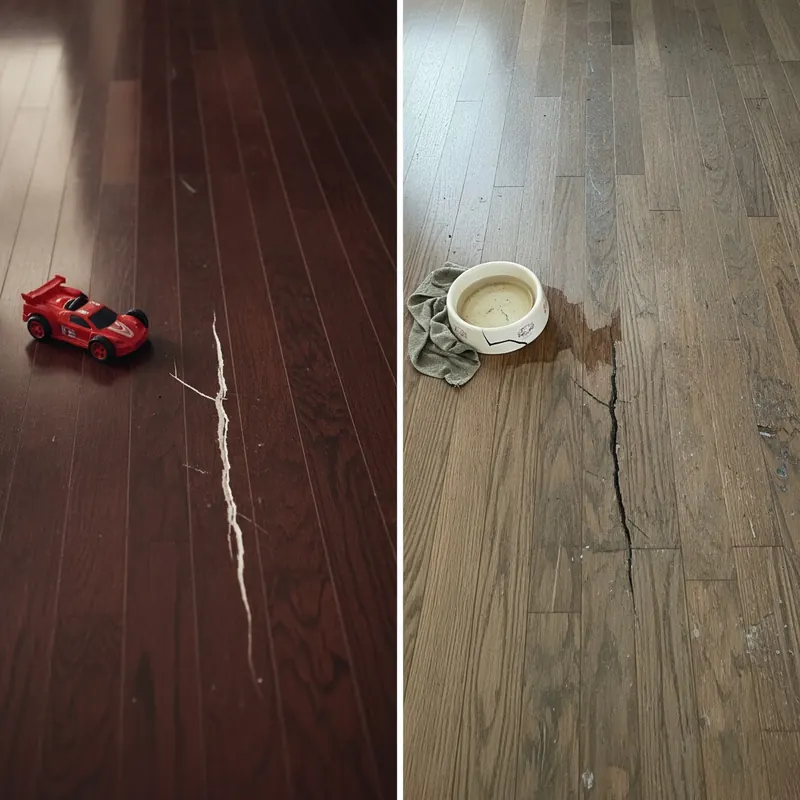
There is no sound more disheartening to a homeowner than the creak and pop of a warping wood floor. You invested in the timeless beauty of hardwood, only to see it betray you, with edges curling up in a “cupped” grimace or the centers bulging in a “crowned” arch. This isn’t just a cosmetic issue; it’s a costly, frustrating sign that your floor is losing a battle with its greatest enemy: moisture.
For decades, the solution was a compromise. You could have the authentic look of wood, but you had to accept its inherent vulnerability. Or you could choose a waterproof material that lacked wood’s warmth and character. That compromise is now over.
This is an engineer’s guide to achieving a bulletproof floor. We will dissect the science behind why traditional floors fail, providing you with the knowledge to diagnose and understand the problem. Then, we will introduce Adamantine flooring—a modern, durable wood alternative engineered from the ground up to defeat moisture and eliminate the risks of cupping and crowning. We will compare it objectively against other materials using our proprietary ‘Flooring Stability Scorecard,’ empowering you to select a floor with the confidence that it is built to last, no matter your home’s environment.
- The Science of Flooring Failure: Why Your Wood Floor is Warping
- Introducing Adamantine Flooring: Engineered for Ultimate Stability
- The Flooring Stability Scorecard: Ranking the Best Wood Floor Alternatives
- The Proactive Homeowner’s Playbook: Preventing Moisture Damage Before It Starts
- Frequently Asked Questions (FAQ)
- Conclusion
- References
The Science of Flooring Failure: Why Your Wood Floor is Warping
Before we can explore the solution, we must understand the fundamental problem. Wood is a natural, hygroscopic material, which means it acts like a sponge, absorbing and releasing moisture from its environment. This property is the root cause of nearly all warping, cupping, and crowning issues. When the moisture content within a wood plank becomes unbalanced, the physical shape of the board changes.
According to the National Wood Flooring Association (NWFA), maintaining a consistent indoor humidity level, typically between 30-50%, is critical for the long-term stability of hardwood floors[1]. When humidity spikes or a water source is introduced, wood fibers swell. When the air is too dry, they shrink. The problem intensifies when this change happens unevenly across a single plank.
Visual Guide: Cupping vs. Crowning
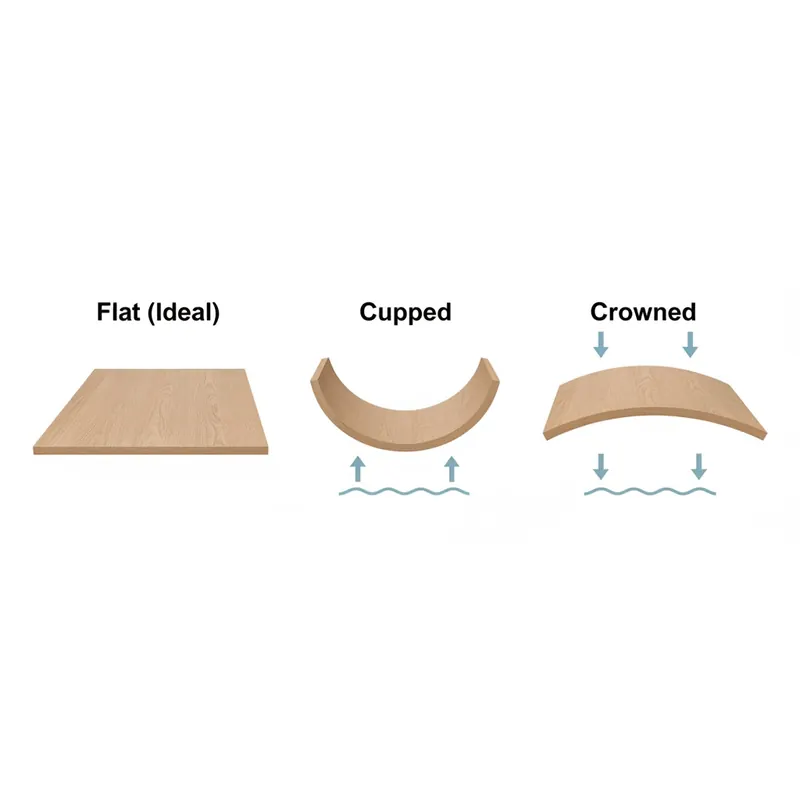
- Cupped Board: The edges of the plank are higher than its center, creating a concave, “U” shape. This is caused by the bottom of the board being wetter than the top.
- Flat Board: The ideal state. The surface of the plank is perfectly level from edge to edge.
- Crowned Board: The center of the plank is higher than its edges, creating a convex, slight arch. This is often caused by the top surface being wetter than the bottom, or by an improper repair of a cupped floor.
What is Wood Floor Cupping? The #1 Sign of a Moisture Problem
Wood floor cupping is the most common form of moisture-related damage. It occurs when the bottom of the floorboards absorbs more moisture than the top surface. This moisture imbalance causes the wood cells on the underside to expand more than the cells on the top, forcing the edges of the board to curl upward.
The sources of this excess moisture can be varied and sometimes difficult to detect:
- Subfloor Moisture: This is a frequent culprit, especially in basements or homes built on a concrete slab. Concrete is porous and can wick moisture from the ground, transferring it directly to the underside of your flooring. A damp crawlspace is another common source.
- High Ambient Humidity: In persistently humid climates, the air itself can create a moisture imbalance, especially if the space beneath the floor (like a basement) is cooler and damper than the living area above.
- Leaks and Spills: While a single large spill can cause localized cupping, slow, undetected leaks from plumbing, appliances, or foundations can create the perfect conditions for widespread damage.
Understanding Hardwood Crowning: When the Fix Becomes the Problem
Crowning is the inverse of cupping: the center of the board is higher than its edges. While this can happen if the surface of the floor is exposed to significant water (like a flood or repeated mopping) while the bottom remains dry, the most common cause is ironically a premature attempt to fix a cupping problem.
When a floor is cupped, a homeowner’s first instinct might be to sand down the high edges to make the floor flat again. This is a critical mistake if the wood has not completely dried and stabilized. If you sand a cupped floor flat while the bottom is still wet, the surface will be thinner at the edges. As the board eventually dries out and the bottom shrinks back to its normal size, those now-thinner edges will pull down lower than the untouched center, creating a crowned board.
Expert Insight: The Perils of Impatience
According to certified floor refinishing professionals, the number one mistake that turns a fixable cupping issue into a permanent crowning problem is a lack of patience. “Homeowners are understandably eager to get their floors looking normal again,” a hypothetical expert might say. “But sanding a floor is an irreversible action. You must first identify and eliminate the moisture source, then give the wood weeks, sometimes months, to fully acclimate and return to its equilibrium moisture content. Only then can you assess if sanding is necessary. Rushing the process almost guarantees you’ll be dealing with crowning.” Best practices from flooring refinishing associations emphasize verifying moisture content with a professional meter before any sanding begins[2].
Introducing Adamantine Flooring: Engineered for Ultimate Stability
Understanding the science of wood’s failure highlights the need for a material that simply doesn’t play by the same rules. Adamantine flooring is that solution—a durable wood alternative engineered at a molecular level to be impervious to the moisture that plagues traditional hardwood. It offers the aesthetic beauty of wood without any of its inherent structural weaknesses.
This stability isn’t magic; it’s material science. Unlike wood, the core of Adamantine flooring is composed of non-hygroscopic materials that do not absorb water. This means there is no swelling, contracting, or warping, regardless of ambient humidity, subfloor moisture, or topical spills. Manufacturer specifications often boast a water absorption rate of less than 0.05% and superior dimensional stability ratings, ensuring the planks remain flat and locked together for the life of the floor.
Anatomy of an Adamantine Plank
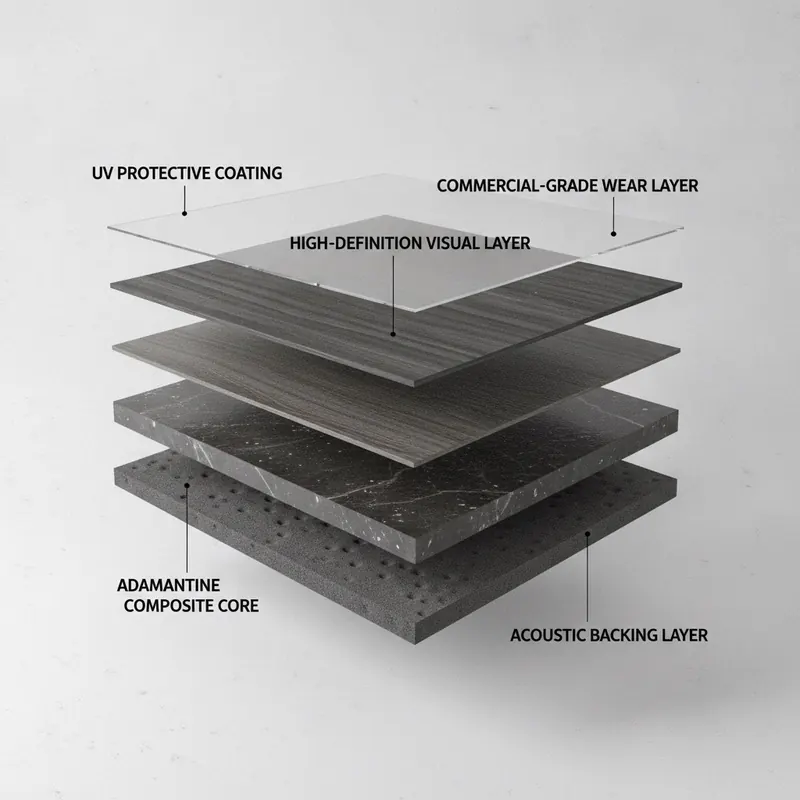
- UV Protective Coating: The topmost layer, providing resistance to fading and making the surface easy to clean.
- Commercial-Grade Wear Layer: A thick, transparent layer that protects the visual design from scratches, scuffs, and stains. This is the key to its durability.
- High-Definition Visual Layer: A hyper-realistic printed film that captures the authentic look and texture of natural wood.
- Adamantine Composite Core: The revolutionary heart of the plank. This ultra-dense, 100% waterproof core provides extreme stability and impact resistance.
- Acoustic Backing Layer: An attached underlayment that provides sound dampening, comfort underfoot, and can help smooth over minor subfloor imperfections.
What is Adamantine Flooring Made Of?
The secret to Adamantine flooring’s performance lies in its composite core. While specific formulations are proprietary, it is typically a type of stone-polymer composite (SPC), which blends natural limestone powder, polyvinyl chloride, and stabilizers. This mixture is fused under intense heat and pressure to create an incredibly dense, rigid, and water-impermeable core.
Think of it this way: a wood plank is like a sponge. It’s full of pores and fibers designed to transport water. An Adamantine plank is like a solid piece of stone. Water can sit on its surface, but it cannot penetrate and compromise its structural integrity. This fundamental difference in composition is why Adamantine is a flooring that doesn’t cup or crown.
Key Advantages Over Traditional Hardwood
When you place Adamantine flooring head-to-head with traditional solid hardwood, the advantages in performance and peace of mind become crystal clear.
| Feature | Adamantine Flooring | Solid Hardwood |
|---|---|---|
| Dimensional Stability | Exceptional. Core is inert and unaffected by moisture or humidity changes. | Poor. Naturally expands and contracts, leading to cupping, crowning, and gapping. |
| Waterproof | 100% Waterproof. Can be installed in kitchens, bathrooms, and basements without worry. | Not Waterproof. Highly susceptible to permanent damage from spills, leaks, and moisture. |
| Scratch Resistance | Excellent. A thick commercial-grade wear layer resists scratches from pets, kids, and furniture. | Fair to Poor. Dents and scratches easily, requiring careful maintenance and eventual refinishing. |
| Maintenance | Low. Simple sweeping and occasional damp mopping is all that’s required. No waxing or refinishing ever. | High. Requires specific cleaners, is sensitive to water, and will need costly sanding and refinishing every 7-10 years. |
The Flooring Stability Scorecard: Ranking the Best Wood Floor Alternatives
To help you make a truly informed decision, we’ve developed the proprietary Flooring Stability Scorecard. This system moves beyond vague marketing terms to provide an objective, data-driven comparison of the most popular wood floor alternatives. We’ve rated each material on a 10-point scale across the criteria most critical for preventing moisture-related failures.
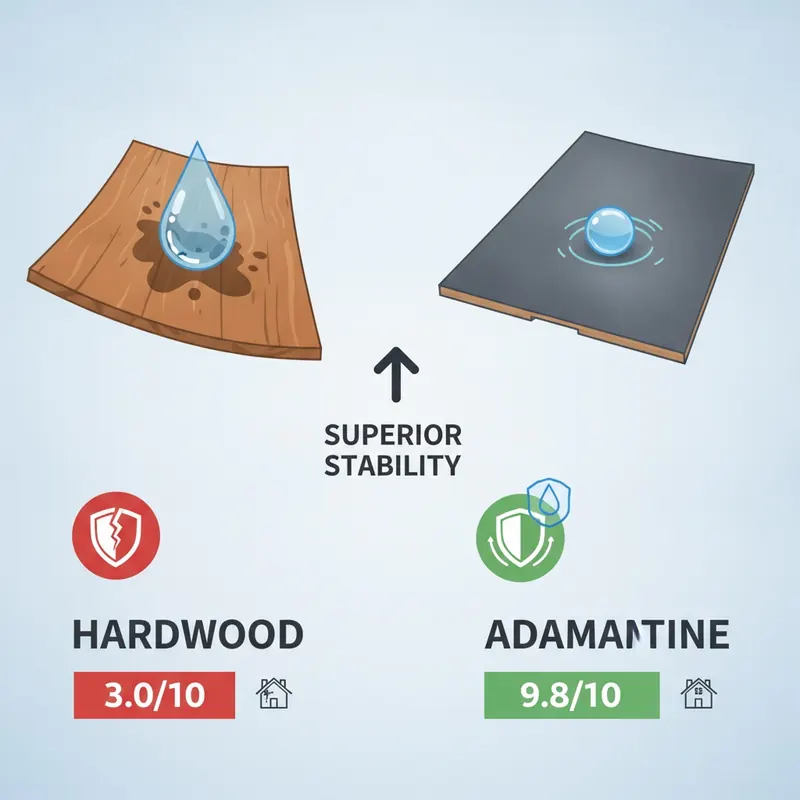
Scorecard Criteria:
- Core Material: Evaluates the inherent water resistance and stability of the core composition.
- Water Resistance (1-10): Rates the material’s ability to withstand everything from topical spills to flooding.
- Dimensional Stability (1-10): Measures resistance to expansion, contraction, cupping, and crowning due to environmental changes.
- Repairability (1-10): Assesses the ease and effectiveness of repairing localized damage.
| Flooring Type | Core Material | Water Resistance | Dimensional Stability | Repairability | Overall Stability Score |
|---|---|---|---|---|---|
| Adamantine Flooring | Stone-Polymer Composite | 10 | 10 | 6 | 9.8 / 10 |
| Porcelain Tile | Fired Clay/Ceramic | 10 | 10 | 5 | 9.5 / 10 |
| SPC Vinyl | Stone-Plastic Composite | 10 | 9 | 6 | 9.2 / 10 |
| WPC Vinyl | Wood-Plastic Composite | 9 | 8 | 6 | 8.0 / 10 |
| Engineered Hardwood | Plywood/HDF Core | 4 | 7 | 8 | 6.5 / 10 |
| Laminate | Fiberboard Core | 3 | 5 | 3 | 4.0 / 10 |
| Solid Hardwood | Solid Wood | 1 | 2 | 9 | 3.0 / 10 |
Scorecard Winner: Adamantine Flooring (Score: 9.8/10)
Adamantine flooring earns the top spot with near-perfect scores in the categories that matter most for long-term, worry-free performance. Its stone-polymer composite core is completely inert to water, giving it a perfect 10 for Water Resistance and Dimensional Stability. It will not swell, cup, or warp, period. While its repairability is lower than sandable wood (a damaged plank typically needs to be replaced), its exceptional resistance to damage in the first place makes this a minor trade-off for ultimate peace of mind.
Excellent Alternatives: SPC Vinyl & Porcelain Tile (Scores: 9.2-9.5/10)
Sharing the top tier are Stone Plastic Composite (SPC) Vinyl and Porcelain Tile. SPC is the broader category to which Adamantine flooring belongs, and it shares the same benefits of a rigid, waterproof limestone core. It is an outstanding choice for any area of the home.
Wood-look porcelain tile is also a stability champion. Because it is fired in a kiln, it is non-porous and completely waterproof, making it immune to cupping and crowning. Its durability is measured by a PEI (Porcelain Enamel Institute) rating, which indicates its hardness and suitability for different traffic levels[3]. For most residential applications, a PEI rating of 3 or 4 is more than sufficient. The main drawbacks are that it’s cold and hard underfoot, and installation can be more complex and costly.
Good, But With Caveats: Engineered Hardwood (Score: 6.5/10)
Many homeowners ask, “Does engineered hardwood cup less than solid hardwood?” The answer is yes, which is why it scores significantly higher on our chart. Its construction features a core of layered plywood or high-density fiberboard with the grain running in perpendicular directions. This cross-ply construction counteracts wood’s natural tendency to expand and contract in one direction, making it more dimensionally stable than a solid plank.
However, its critical weakness remains: the top layer is still real wood. This makes it vulnerable to water damage from the surface, and it can still cup or delaminate if exposed to significant subfloor moisture. It is a good choice for controlled environments but is not recommended for basements or bathrooms.
The Proactive Homeowner’s Playbook: Preventing Moisture Damage Before It Starts
Choosing a stable flooring material like Adamantine is the most important step, but a successful installation is a system. Even a waterproof floor can have issues if the environment and subfloor are not properly prepared. This playbook will ensure your investment is protected from day one.
Ask a Flooring Inspector: “Can My Waterproof Floor Still Fail?”
Yes, but not in the way you think. A waterproof floor like Adamantine will not be damaged by water itself. The planks will not cup or warp. However, if you have a major, unaddressed moisture issue in your subfloor (e.g., a leaking foundation or plumbing), that moisture can become trapped underneath the waterproof flooring. This can lead to the growth of mold and mildew on the subfloor, which is a serious health and structural concern. This is why proper subfloor preparation is non-negotiable, even with the best flooring. For more on water damage remediation, consulting standards from the Institute of Inspection, Cleaning and Restoration Certification (IICRC) is recommended[4].
Choosing the Best Flooring for Humid Climates and Basements
For challenging environments like below-grade basements or homes in persistently humid climates, your flooring choice must be uncompromising. Materials with any wood fiber content, including engineered hardwood and laminate, are high-risk.
The only truly worry-free options are those with a 100% synthetic or non-porous core. Adamantine, SPC vinyl, and porcelain tile are the top recommendations. They are unaffected by the constant presence of moisture vapor from concrete slabs or high ambient humidity. In these installations, using a high-quality vapor barrier underlayment is still a crucial best practice to protect the subfloor and maintain healthy indoor air quality.
The Unseen Hero: Why Your Subfloor and Underlayment Matter
The most beautiful, durable flooring in the world will only perform as well as the foundation it’s laid upon. Before installation, your subfloor must be:
- Flat: Most manufacturers require the subfloor to be flat within 3/16 of an inch over a 10-foot span. High or low spots can cause planks to flex and locking systems to fail.
- Clean: All debris, dust, old adhesive, and dirt must be removed to ensure a solid bond and prevent bumps.
- Dry: This is the most critical step. For concrete subfloors, a simple DIY test involves taping a 2’x2′ square of plastic sheeting to the floor. After 24-48 hours, if condensation appears under the plastic, you have a moisture issue that must be addressed with a sealant or professional remediation before flooring is installed.
The right underlayment also plays a key role. For Adamantine flooring with a pre-attached pad, you often don’t need another layer. For other types, an underlayment can provide a moisture barrier, smooth over minor imperfections, and dampen sound.
Frequently Asked Questions (FAQ)
Will cupped wood floors go back to normal on their own?
Minor cupping caused by temporary high humidity can sometimes relax on its own if the moisture source is removed and the wood is allowed to dry out slowly and naturally. However, severe cupping, or cupping caused by a direct water leak, will likely not flatten completely. After the wood is fully stabilized, it may require professional sanding and refinishing to be made flat again. Remember, sanding too soon will cause crowning.
What is the difference between ‘moisture-resistant’ and ‘waterproof’ flooring?
This is a critical distinction that many manufacturers blur.
| Term | Meaning | Examples |
|---|---|---|
| Moisture-Resistant | Can withstand topical spills if they are wiped up quickly. The core is still susceptible to damage from prolonged water exposure. | Laminate Flooring, Engineered Hardwood |
| Waterproof | The material itself is impervious to water. It will not swell, crack, or warp even if fully submerged. | Adamantine, SPC Vinyl, Porcelain Tile, Sheet Vinyl |
What is an AC rating for flooring?
The AC (Abrasion Class) rating is a standardized measure of durability, primarily used for laminate flooring, but the principle applies to the wear layers of vinyl products as well[5]. It rates a floor’s resistance to abrasion, impact, stains, and burns.
| Rating | Traffic Level | Recommended Use |
|---|---|---|
| AC1 | Light Residential | Bedrooms, Closets |
| AC2 | Moderate Residential | Living Rooms, Dining Rooms |
| AC3 | Heavy Residential / Light Commercial | Any room in the home, small offices |
| AC4 | General Commercial | Boutiques, Cafes, Salons |
| AC5 | Heavy Commercial | Public buildings, Department Stores |
What is the best flooring for people with large dogs or kids?
For homes with heavy traffic from pets and children, the key is scratch resistance. Look for:
- Adamantine or SPC Vinyl: Choose a product with a thick wear layer, which is the protective top coating. A 20 mil (0.5mm) wear layer or thicker is considered commercial-grade and will stand up exceptionally well to claws and toys.
- Wood-Look Porcelain Tile: With a PEI rating of 4 or 5, porcelain tile is virtually scratch-proof.
Conclusion
Your home’s floors are more than just a surface; they are the foundation of your daily life and a significant financial investment. For too long, homeowners have been forced to accept the inherent risk that comes with traditional wood flooring—the constant, quiet battle against moisture that can lead to devastating cupping and crowning.
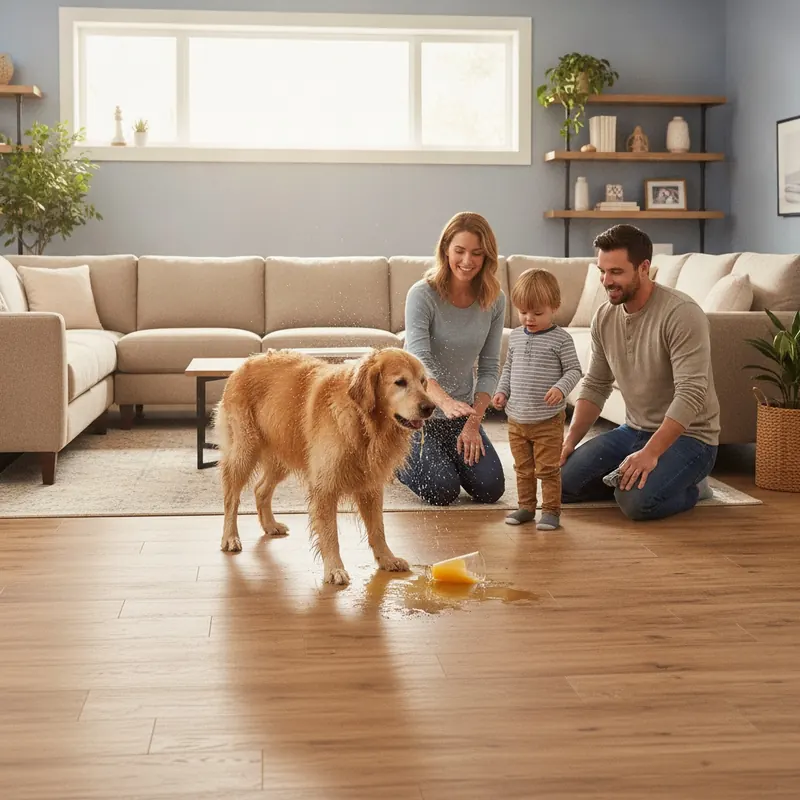
The science is clear: wood’s natural properties make it vulnerable. But modern materials science has provided a definitive solution. As our Flooring Stability Scorecard demonstrates, materials engineered with waterproof composite cores have fundamentally solved the problem. Adamantine flooring stands at the pinnacle of this innovation, offering the timeless beauty of wood with none of the structural anxieties. It is a floor designed for real life, ready to handle spills, humidity, pets, and kids without warping, bending, or failing.
Stop letting moisture dictate the life of your floors. Experience the peace of mind that comes with superior engineering.
Click here to explore the Adamantine Flooring collection and order your free sample today.
This article provides detailed information on flooring stability and materials. Always consult with a certified flooring professional for installation advice specific to your home’s conditions. This post may contain affiliate links.
References
- National Wood Flooring Association. (n.d.). Maintaining Your Wood Floor.
- Flooring Refinishing Association. (n.d.). Sanding & Finishing Guidelines.
- Porcelain Enamel Institute. (n.d.). PEI Rating System for Ceramic Tile.
- Institute of Inspection, Cleaning and Restoration Certification. (n.d.). IICRC S500 Standard for Professional Water Damage Restoration.
- European Committee for Standardization. (n.d.). EN 13329: Laminate floor coverings – Specifications, requirements and test methods.