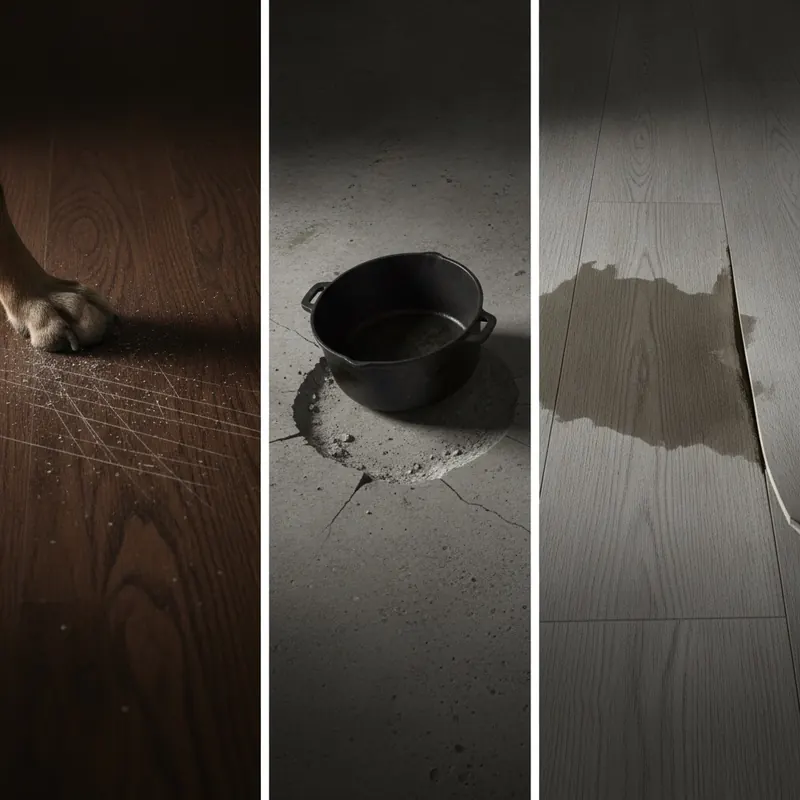
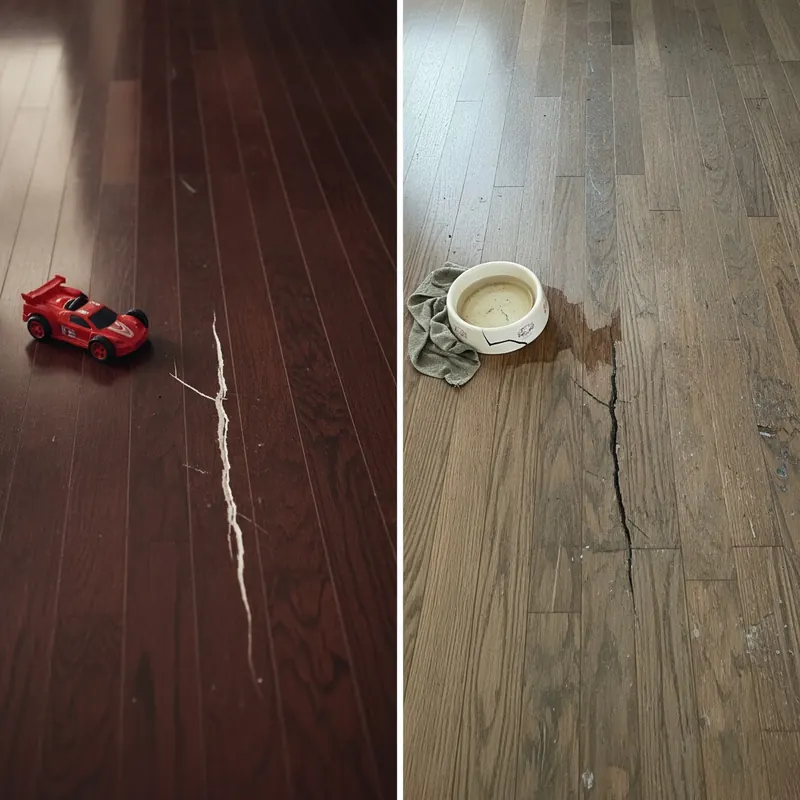
The deep gouge from a pallet jack. The spiderweb of scratches radiating from office chairs. The dull, worn pathway carved by thousands of footsteps. For any facility manager or business owner, these aren’t just cosmetic flaws; they are symptoms of a costly problem: premature floor failure. Choosing the right commercial flooring often feels like a gamble, but it doesn’t have to be. It’s time to stop thinking about flooring as a disposable surface and start treating it as a long-term, high-performance asset.
This is where the concept of “Adamantine” flooring comes in. It’s not a specific brand, but a benchmark—a standard of ultimate durability, resilience, and longevity inspired by the mythical, unbreakable material. This guide is designed to help you achieve that standard. We will move beyond simple product lists and delve into a strategic asset management framework. By focusing on the data-driven principles of Total Cost of Ownership (TCO) and the science of wear and tear, you can make an informed investment that pays dividends for years to come.
In this comprehensive guide, you will discover:
- The science behind why floors fail under the stress of commercial use.
- A data-driven comparison of the top flooring champions built to withstand rolling loads.
- How to calculate the Total Cost of Ownership to see beyond the upfront price tag.
- A complete lifetime maintenance playbook to keep your investment in pristine condition.
- What is ‘Adamantine’ Flooring? Decoding the Gold Standard of Durability
- The Science of Failure: Why Commercial Floors Break Down Under Pressure
- The Champions of Durability: A Data-Driven Comparison of Rolling Load Resistant Flooring
- Beyond Upfront Cost: Calculating the Total Cost of Ownership (TCO)
- The Lifetime Maintenance Playbook: How to Maintain Pristine Floors
- Conclusion: Your Floor is a Strategic Asset, Not a Commodity
- References & Authoritative Sources
What is ‘Adamantine’ Flooring? Decoding the Gold Standard of Durability
The term “adamantine” originates from the Greek word adamas, meaning “unconquerable” or “invincible.” Historically, it described the hardest materials imaginable, often associated with diamonds and mythical metals. In the context of flooring, “Adamantine flooring” is not a single product you can buy off the shelf. Instead, it represents a performance ideal—a floor so robust, so wear-resistant, and so resilient that it stands up to the most demanding commercial environments without failure.
To understand what gives a floor this “adamantine” quality, we need to look at material science. The durability of a surface is often measured by its hardness, which is its ability to resist scratching and abrasion. A well-known metric for this is the Mohs scale of mineral hardness, which ranks materials from 1 (Talc) to 10 (Diamond). While flooring isn’t typically rated on the Mohs scale, the principle is the same: a harder, denser surface is better equipped to resist the daily grind.
Modern flooring systems achieve this ideal through advanced engineering and composition. The true “Adamantine” floors of today are systems like:
- Densified and Polished Concrete: Chemically treated and mechanically ground to create an incredibly hard, abrasion-resistant surface.
- High-Solids Epoxy and Urethane Mortar Systems: Resin-based floors that cure into a seamless, monolithic surface with immense compressive strength and chemical resistance.
- Commercial-Grade Porcelain Tile: Fired at extremely high temperatures, creating a tile with very low porosity and exceptional surface hardness.
These real-world solutions embody the adamantine concept by providing a wear-resistant flooring solution that delivers a long service life and a strong return on investment.
The Science of Failure: Why Commercial Floors Break Down Under Pressure
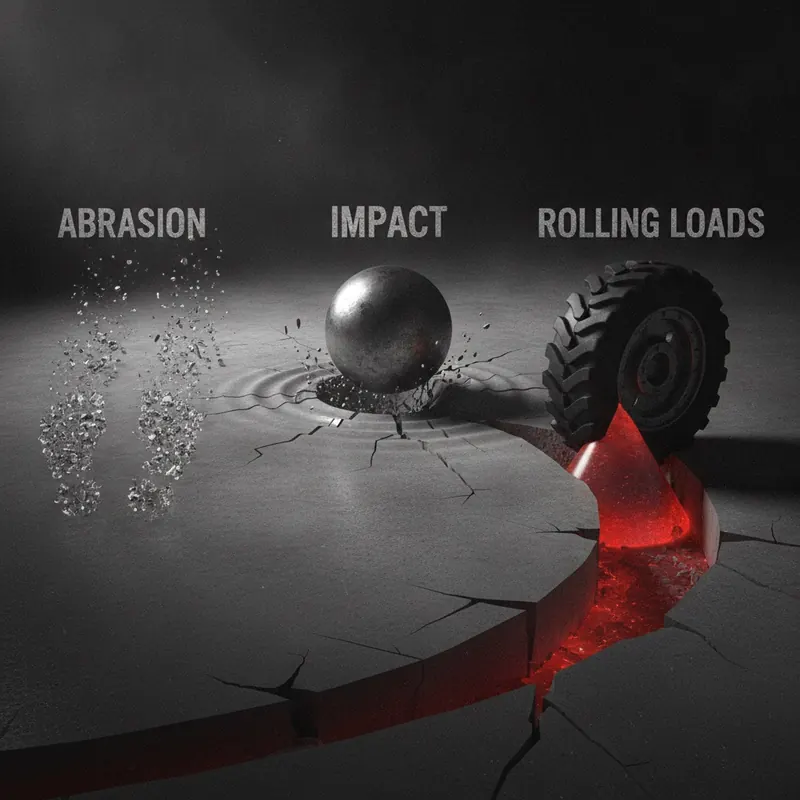
To select a floor that won’t fail, you must first understand how and why they do. Commercial floor degradation isn’t random; it’s the result of specific forces acting on the material over time. At its core, the breakdown of a high-traffic floor can be attributed to three primary enemies: Abrasion, Impact, and the unique stresses of Rolling Loads. Understanding these forces is the first step in selecting a material engineered to defeat them.
Enemy #1: Abrasion – The Grind of Daily Foot Traffic
Abrasion is the slow, relentless process of a floor being worn away by friction. The primary culprits are the thousands of tiny, sharp particles of dirt, sand, and grit tracked in on the soles of shoes. These particles act like fine-grit sandpaper, scratching and scuffing the floor’s protective finish with every step. Over time, this microscopic damage accumulates, leading to a dull, hazy appearance in main traffic paths and a complete erosion of the surface layer.
You can learn to “read” your floor by analyzing these wear patterns. A general dullness in a main corridor indicates a loss of finish due to high foot traffic. Concentrated scuffing near doorways or pivot points reveals areas of intense abrasive stress. According to standards developed by organizations like the Association for European Producers of Laminate Flooring (EPLF), flooring materials can be rated for their resistance to this type of wear. For example, laminate flooring uses an Abrasion Class (AC) rating, from AC1 (light residential use) to AC5 (heavy commercial use), to quantify its durability against this very enemy.
Enemy #2: Impact – The Threat of Dropped Objects and Static Loads
Impact damage is sudden and often severe. A dropped tool in a workshop, a heavy pallet set down too hard in a warehouse, or even a stiletto heel in a lobby can cause chipping, cracking, or denting. A material’s ability to withstand impact is a function of both its hardness and its brittleness.
This is a critical trade-off to understand. For example, porcelain tile is extremely hard and scratch-resistant, but it is also brittle and can shatter or crack under a sharp impact. Conversely, a resilient material like heavy-duty Luxury Vinyl Tile (LVT) may dent under a heavy impact but is far less likely to crack or shatter. Authoritative bodies like ASTM International have developed specific testing standards to measure a flooring material’s resistance to impact, providing a technical benchmark for its durability.
The Ultimate Challenge: Understanding Rolling Load Damage
Rolling loads—from 300-pound office chairs to 8,000-pound forklifts—represent the most complex and destructive force a commercial floor can face. Unlike static weight, which is distributed over a larger area, the entire load of a rolling object is concentrated onto the tiny contact patches of its wheels. This creates immense pressure, measured in pounds per square inch (PSI), that can crush, deform, and tear at the floor’s surface.
The physics of this interaction is critical. Hard, narrow wheels (like hard plastic or nylon) concentrate the load intensely, making them highly destructive. Softer, wider wheels (like soft polyurethane) distribute the load more broadly, reducing the stress on the floor. The Caster and Wheel Manufacturers Institute (CWMI) provides extensive guidance on selecting appropriate wheel materials to protect flooring surfaces.
This concentrated pressure leads to several distinct types of damage:
- Rutting and Indentation: The floor surface permanently deforms or compresses along the most frequent travel paths.
- Gouging: Sharp turns or dragging wheels can tear or cut into the flooring material.
- Delamination: The stress can cause layers within the flooring system (e.g., the wear layer on LVT) to separate.
- Spalling: In concrete, the edges of joints can chip and break away under the repeated impact of hard wheels.
A floor’s ability to withstand these forces is known as its rolling load capacity, a specification often determined by rigorous testing methods like the ASTM F2752 standard. This is arguably the most important metric for any facility with constant cart, chair, or vehicle traffic.
The Champions of Durability: A Data-Driven Comparison of Rolling Load Resistant Flooring
Choosing the best flooring for constant rolling traffic requires moving beyond marketing claims and focusing on technical specifications. Below is a data-driven showdown of the top contenders, comparing them across the key performance metrics that matter most in a high-stress commercial environment.

| Flooring Type | Compressive Strength (PSI) | Rolling Load Capacity | Typical Lifespan | Avg. Maintenance Cost | Best For |
|---|---|---|---|---|---|
| Polished Concrete | 4,000 – 8,000+ | Very High | 20+ years | Low | Warehouses, Logistics, Big-Box Retail, Industrial |
| Epoxy/Resin Mortar | 10,000 – 15,000+ | Excellent | 15-20 years | Low-Medium | Manufacturing, Healthcare, Labs, Food Processing |
| Heavy-Duty LVT | Varies (by composition) | Good-Very Good | 15-20 years | Low-Medium | Healthcare, Education, Corporate, Retail |
| Porcelain Tile | 20,000+ | Good-Very Good | 20+ years | Low | Lobbies, Airports, High-End Retail, Restrooms |
1. Polished & Hardened Concrete: The Unyielding Foundation
Polished concrete is the bedrock of durable flooring. The process involves treating the concrete slab with a chemical densifier that hardens the surface, followed by progressive grinding with diamond abrasives to achieve a smooth, reflective finish.
- Pros: Its compressive strength is immense, easily handling heavy forklift and pallet jack traffic. According to the American Concrete Institute (ACI), a properly designed and finished concrete floor is one of the most durable surfaces available. It is seamless over large areas and has a very low lifetime maintenance cost.
- Cons: It can be loud and unforgivingly hard underfoot. If the underlying slab is not properly prepared or cracks, the repair can be complex and visible. The quality of the installation is paramount.
2. Epoxy & Resin-Based Systems: The Seamless Protector
Resinous flooring systems, like epoxy mortar or urethane cement, are applied as a liquid that cures to form a hard, seamless, and incredibly strong surface. These systems are not just coatings; they are robust, multi-layer floors built on-site.
- Pros: They offer some of the highest compressive strengths available, often exceeding 15,000 PSI. Their seamless nature is a key advantage, as it eliminates joints and grout lines—the primary failure points for wheeled traffic on tiled floors. They also provide excellent chemical and moisture resistance.
- Cons: Installation is highly technical and requires a skilled, certified installer. The subfloor must be meticulously prepared. While durable, a deep gouge can be difficult to repair seamlessly.
3. Heavy-Duty LVT & Vinyl Tile: Resilient and Repairable
Commercial-grade Luxury Vinyl Tile (LVT) is an engineered product designed for durability and flexibility. Its strength against rolling loads comes from a dense, rigid core and, most importantly, a thick protective wear layer.
- Pros: LVT offers excellent resilience, meaning it can absorb impacts and resist denting better than more brittle materials. A key metric is the wear layer thickness, typically measured in mils (thousandths of an inch). A commercial-grade product should have a wear layer of at least 20 mil, with heavy-duty options offering 30 or 40 mil for extreme traffic. The Resilient Floor Covering Institute (RFCI) provides standards and guidance on the performance of these materials. Its modular tile format also means a damaged piece can be replaced relatively easily.
- Cons: The seams between planks can be a vulnerability for heavy, constant rolling loads or high moisture. The quality of the subfloor is critical to prevent planks from flexing and breaking under pressure.
4. Porcelain Tile: The Classic Wear-Resistant Choice
Porcelain tile is a classic choice for areas that need to be both beautiful and tough. Made from finer, denser clay and fired at higher temperatures than standard ceramic, it is exceptionally hard and resistant to wear.
- Pros: Its durability is standardized by the Porcelain Enamel Institute (PEI) rating, which classifies tiles based on their abrasion resistance. The Tile Council of North America (TCNA) recommends a PEI rating of IV (Moderate to Heavy Traffic) or V (Heavy to Extra-Heavy Traffic) for most commercial applications. When properly installed, it can last for decades.
- Cons: The grout lines are the system’s Achilles’ heel. Under heavy rolling loads, grout can crack and erode, and the edges of the tiles (the tile lippage) can be chipped. Using a high-strength epoxy grout and minimizing joint width can mitigate this risk, but it remains a critical point of potential failure.
Beyond Upfront Cost: Calculating the Total Cost of Ownership (TCO)
One of the biggest mistakes in commercial flooring is choosing a product based solely on the initial material and installation price. A cheap floor that fails in five years and requires constant, costly maintenance is no bargain. To make a true asset management decision, you must calculate the Total Cost of Ownership (TCO) over the floor’s entire expected lifecycle.
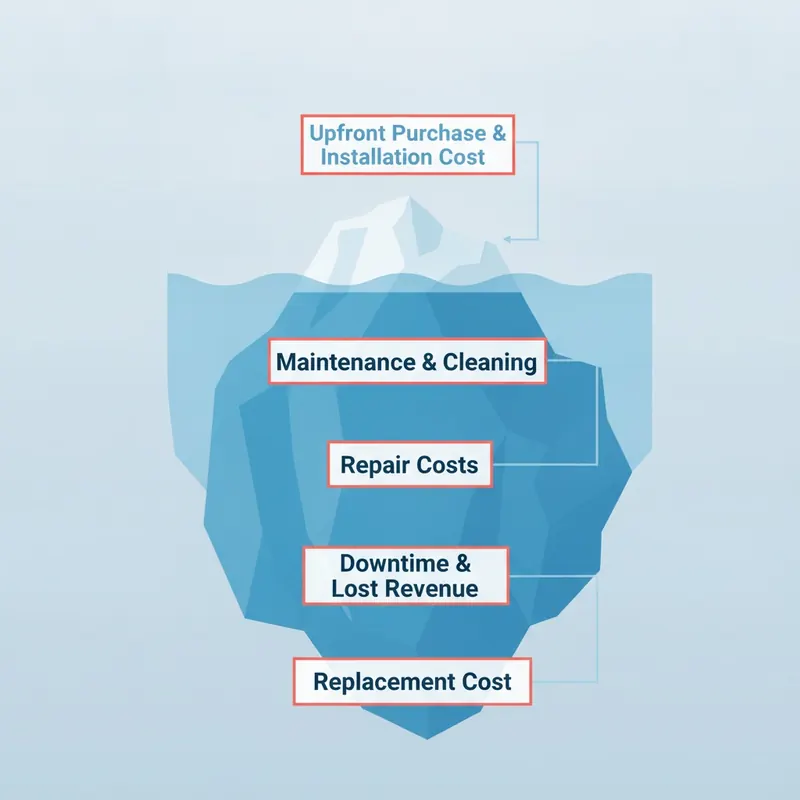
TCO transforms your perspective from a one-time expense to a long-term investment. Industry data from organizations like BOMA International helps establish benchmarks for the average lifespan of various flooring materials, which is a critical component of this calculation.
Key TCO Factors: Installation, Maintenance, Repairs, and Lifespan
A comprehensive TCO analysis includes:
- Initial Cost: The price of materials plus the cost of labor for installation. This must also include the cost of subfloor preparation, which is critical for long-term durability. A cheap floor installed over a poor subfloor is guaranteed to fail.
- Maintenance Costs: The cumulative cost of labor, cleaning chemicals, and equipment needed for daily, weekly, and periodic deep cleaning over the floor’s life. A low-maintenance floor like polished concrete has a significant TCO advantage here.
- Repair Costs: The anticipated cost of fixing common issues like scratches, chips, or damaged tiles. Consider both the material cost and the specialized labor required.
- Lifespan & Replacement Cost: How long will the floor last before it needs to be completely replaced? Divide the total initial cost by the expected lifespan (in years) to get the true annual cost of the asset.
- Cost of Downtime: This is a crucial and often overlooked factor. How much revenue is lost when a retail space has to close for a floor replacement? What is the operational impact of shutting down a section of a warehouse or hospital? A durable, long-lasting floor minimizes this disruptive and expensive cycle.
To help you make a data-driven decision, we recommend using a TCO calculator to compare your options side-by-side.
The Lifetime Maintenance Playbook: How to Maintain Pristine Floors
Selecting a durable floor is only half the battle. A proactive, systematic maintenance program is essential to protect your investment, preserve its appearance, and maximize its lifespan. This isn’t just about reactive cleaning; it’s about creating a defense system that stops damage before it starts.
A highly effective framework is the 3-Zone Floor Protection System, a strategy endorsed by cleaning industry leaders like ISSA, The Worldwide Cleaning Industry Association. This system is designed to capture dirt and moisture before they can damage your interior floors.
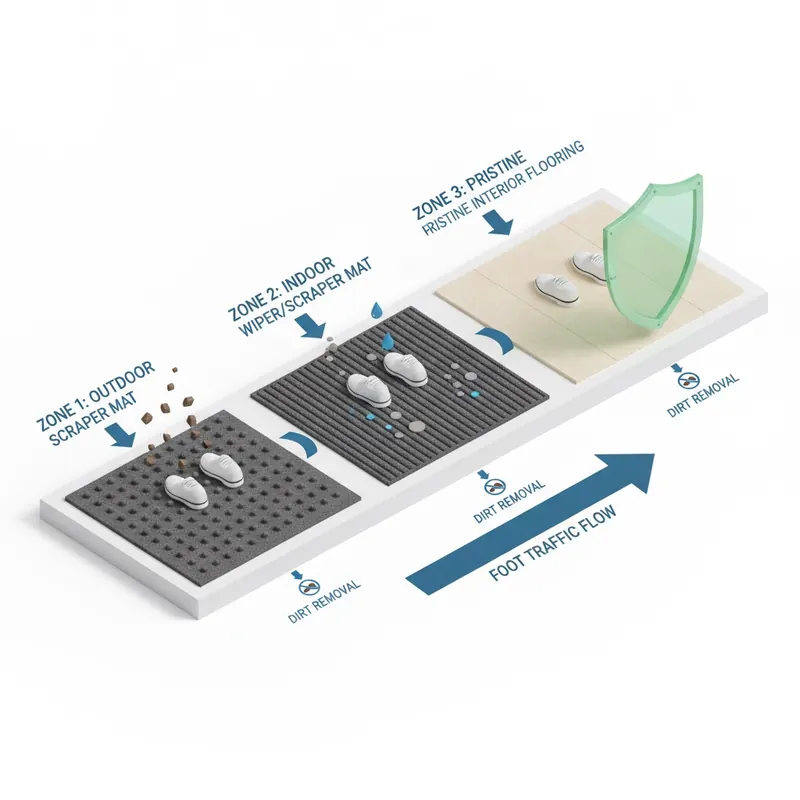
- Zone 1: The Outdoor Zone: The first line of defense is aggressive scraper matting outside the building entrance to remove heavy soil, grit, and snow.
- Zone 2: The Entry Zone: Inside the entrance, a large wiper/scraper mat removes any remaining particles and moisture. The National Floor Safety Institute (NFSI) recommends at least 10-15 feet of matting to ensure most dirt is captured from shoes.
- Zone 3: The Indoor Zone: This is the floor you are protecting. With the first two zones in place, the daily cleaning routine becomes far more effective and less intensive.
Preventative Care: Your First Line of Defense
Beyond matting, several other preventative strategies are crucial:
- Furniture Protectors: Ensure all furniture legs have high-quality, non-marking felt or rubber pads that are appropriately sized and regularly checked for wear.
- Caster Wheels: As discussed, the single most important preventative measure for rolling load damage is choosing the right wheels. Swap out hard plastic casters on office chairs and carts with softer, floor-friendly polyurethane or rubber wheels.
- Regular Cleaning: Implement a daily sweeping or dust-mopping routine to remove the abrasive grit that dulls finishes and causes micro-scratches.
The Master Guide to Scratch Repair
Even with the best preventative care, scratches can happen. The key is to address them correctly based on their severity and the flooring material.
- Level 1: Surface Scuffs & Micro-Scratches: These are often marks on the floor’s finish, not the material itself. For polyurethane-finished floors (like LVT or hardwood), these can often be buffed out with a soft cloth and a manufacturer-approved cleaner or polish. For polished concrete, a simple re-burnishing can often restore the shine.
- Level 2: Shallow Scratches: These have penetrated the finish but not the core of the flooring material. For many surfaces, specialized repair kits are available. The National Wood Flooring Association (NWFA) provides definitive guides on repairing finishes on hardwood floors. For LVT, kits often include a filler that can be color-matched to the plank.
- Level 3: Deep Gouges: These have cut through the wear layer and into the flooring material itself. For modular flooring like LVT or tile, the best solution is often to replace the single damaged piece. For monolithic floors like epoxy or concrete, a deep gouge requires a professional repair, which involves routing out the damaged area and patching it with a compatible compound. Attempting a DIY fix on a deep gouge can often make the problem worse.
Conclusion: Your Floor is a Strategic Asset, Not a Commodity
The journey from a failing floor to an adamantine-level surface begins with a shift in perspective. Your commercial flooring is not a disposable commodity to be replaced every few years; it is a foundational asset that impacts your operations, your brand perception, your safety, and your bottom line.
By understanding the science of why floors fail, you can arm yourself against their primary enemies. By making a selection based on data-driven metrics and a comprehensive Total Cost of Ownership analysis, you can ensure your choice is a wise long-term investment. And by implementing a proactive, systematic maintenance plan, you can protect that investment and keep it performing at its peak for decades. Treating your floor as a strategic asset is the key to breaking the expensive cycle of premature failure and maximizing the return on one of your facility’s most critical components.
Ready to make a data-driven flooring decision? Download our free Total Cost of Ownership (TCO) Calculator to compare your options and find the best long-term investment for your facility.
The information provided is for educational purposes. Flooring selection and installation are complex processes. Always consult with a certified flooring professional and refer to manufacturer’s technical data sheets before making a final purchasing decision.
References & Authoritative Sources
- National Park Service. (N.D.). Mohs Hardness Scale. Retrieved from https://www.nps.gov/articles/mohs-hardness-scale.htm
- Stribeck, R. (1902). Die wesentlichen Eigenschaften der Gleit- und Rollenlager (The key qualities of sliding and roller bearings).
- The Association for European Producers of Laminate Flooring (EPLF). (N.D.). AC Ratings.
- ASTM International. (N.D.). Flooring Standards. Retrieved from https://www.astm.org/products-services/standards-and-publications/standards/flooring-standards.html
- Caster and Wheel Manufacturers Institute (CWMI). (N.D.). Official Standards and Resources.
- ASTM International. (N.D.). ASTM F2752 – Standard Practice for Assessment of Resilient Floor Coverings Using a Synchronous Rolling Load Tester. Retrieved from https://www.astm.org/f2752-10.html
- American Concrete Institute (ACI). (N.D.). ACI 302.1R-15: Guide to Concrete Floor and Slab Construction. Retrieved from https://www.concrete.org
- Resilient Floor Covering Institute (RFCI). (N.D.). Official Standards and Resources. Retrieved from https://rfci.com
- Tile Council of North America (TCNA). (N.D.). PEI Rating System. Retrieved from https://www.tcnatile.com
- Building Owners and Managers Association (BOMA) International. (N.D.). Industry Standards and Research. Retrieved from https://www.boma.org
- ISSA (The Worldwide Cleaning Industry Association). (N.D.). Cleaning Standards and Best Practices. Retrieved from https://www.issa.com
- National Floor Safety Institute (NFSI). (N.D.). NFSI B101.6 – Standard Guide for Commercial Entrance Matting in Reducing Slips, Trips, and Falls. Retrieved from https://nfsi.org
- National Wood Flooring Association (NWFA). (N.D.). Technical Guidelines for Repair. Retrieved from https://www.nwfa.org