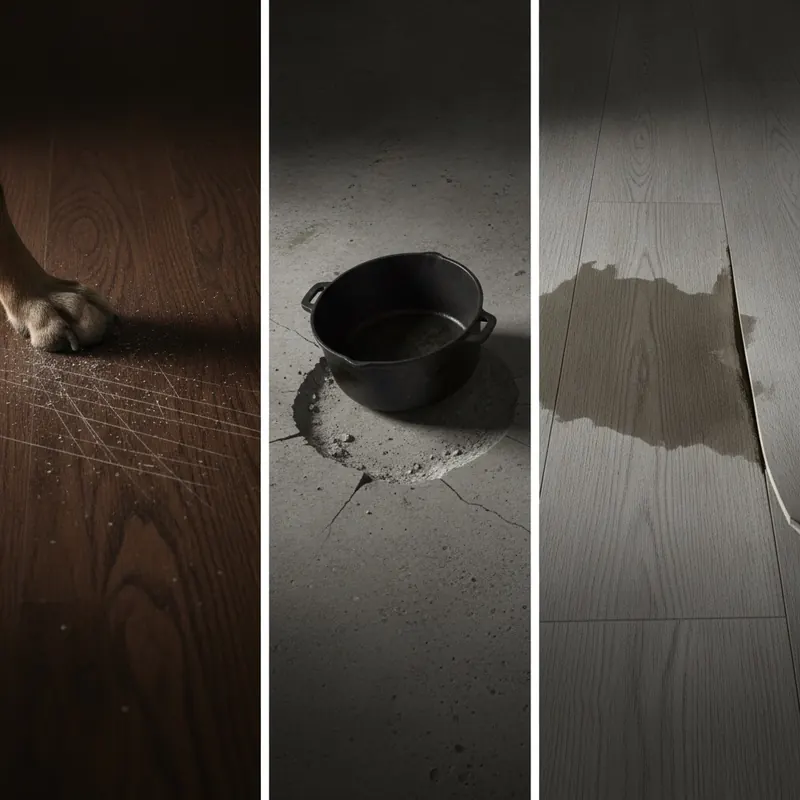
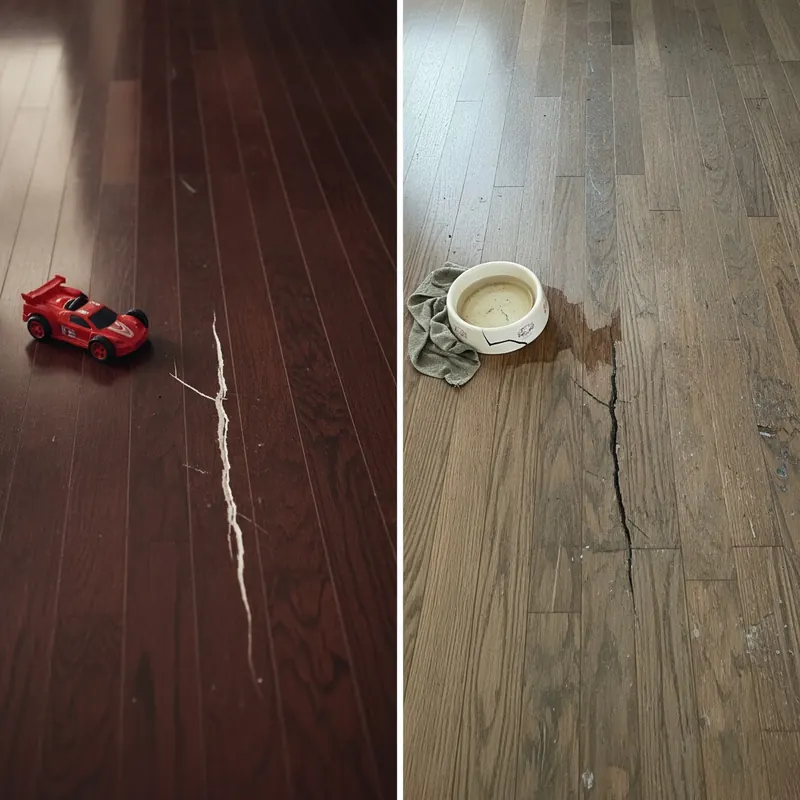
Do you wince at the sound of a chair scraping across the floor? Does the sight of another scratch from your dog’s nails or a dent from a dropped toy fill you with frustration? You invested in a beautiful floor, only to watch it become a map of daily life’s accidents and wear. You’re not alone, and you’re right to demand better.
This is not another list of “durable” floors based on marketing claims. This is your definitive guide to understanding the science behind true, long-lasting durability. We will move beyond subjective opinions to arm you with the material science, data-driven comparisons, and long-term value analysis needed to make your next flooring decision your final flooring decision.
In this guide, we will diagnose exactly why your current floor is failing, deconstruct the advanced science that creates an indestructible surface, and put the revolutionary Adamantine flooring to the test in a head-to-head showdown with its top competitors. By the end, you will have the knowledge and confidence to choose a solution that ends the cycle of scratches, dents, and disappointment for good.
- Why Your Floors Are Failing: A Diagnosis of Scratches, Dents, and High-Traffic Wear
- The Science of Strength: What Makes a Floor Truly Durable?
- Deep Dive: The Advanced Composition of Adamantine Flooring
- The High-Traffic Showdown: Adamantine vs. The Competition
- The True Cost of a Floor: A 20-Year Value Analysis
- Your Action Plan: The Ultimate Guide to Floor Replacement
- Your Floor, Your Final Choice
- References
Why Your Floors Are Failing: A Diagnosis of Scratches, Dents, and High-Traffic Wear
Before finding the right solution, it’s crucial to understand the problem. The constant battle against scratches, scuffs, and dulling isn’t just bad luck; it’s a matter of material science. When your floor scratches easily or shows wear in high-traffic areas, it’s a sign of a fundamental failure in its composition.
The most common culprit is the invisible enemy: abrasive grit. According to ISSA, The Worldwide Cleaning Industry Association, up to 24 pounds of soil can be tracked into a building by just 1,000 people over a 20-day period.[1] This dirt, sand, and debris act like sandpaper, grinding away at your floor’s finish with every step. For homeowners, especially those with pets and kids, this effect is amplified in entryways, hallways, and kitchens.
To help you pinpoint the cause of your flooring frustration, use this simple checklist.
Scratch Diagnosis Checklist:
- Problem: Fine, surface-level scratches are visible in certain light.
- Likely Cause: A low-quality or thin factory finish is being abraded by fine dust and dirt. The floor’s protective top layer is failing.
- Problem: Deeper scratches and gouges are appearing.
- Likely Cause: The wear layer is being penetrated by sharper objects like pet claws, dragged furniture, or small rocks stuck in shoe treads.
- Problem: The floor has dents and impressions.
- Likely Cause: The core material is too soft to resist impact. This is common in softer wood species. The National Wood Flooring Association (NWFA) uses the Janka hardness test to measure a wood’s resistance to denting, which is why a soft pine floor dents far more easily than a hard maple.[2]
- Problem: A dull, worn “path” has appeared in hallways or main walkways.
- Likely Cause: This is classic high-traffic floor damage. The cumulative effect of footsteps has eroded the finish, creating micro-scratches that diffuse light and make the area appear dull.
The Anatomy of a Scratch: Understanding Wear Layers and Finishes
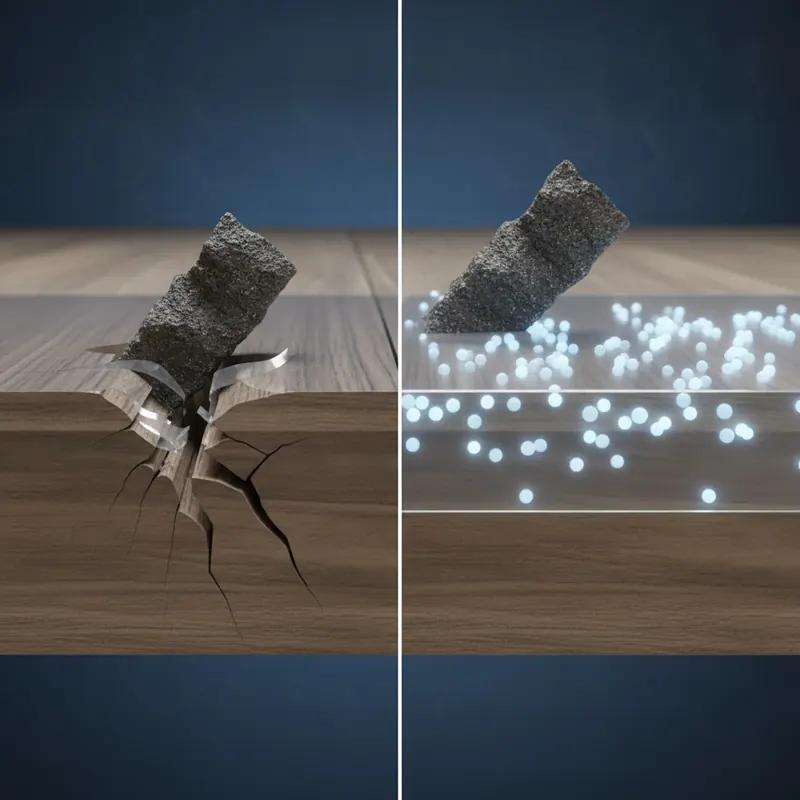
The single most important component for preventing scratches is the wear layer. This is the transparent top coating that takes the brunt of all traffic, spills, and impacts. Its failure is why your brand new floor might already have scratches.
A wear layer’s effectiveness depends on two factors: thickness and composition. In products like Luxury Vinyl Plank (LVP), thickness is measured in mils (one-thousandth of an inch). A cheap, entry-level product might have a 6-mil wear layer, while a robust commercial-grade plank will feature a 20-mil layer or thicker. A thin wear layer can be worn through quickly, exposing the printed design layer beneath to permanent damage.
However, composition is just as critical. High-performance flooring incorporates ultra-hard additives into the finish itself, creating a surface that actively resists abrasion. Proper maintenance is also key. The Institute of Inspection, Cleaning and Restoration Certification (IICRC) advises against using harsh, abrasive cleaners that can prematurely erode the floor’s finish, making it more susceptible to damage.[3]
The ‘Wear Path’ Phenomenon: How High Traffic Damages Floors
The dull, lifeless trail snaking from your front door to the kitchen is what professionals call a “wear path.” This high-traffic floor damage isn’t a single event but the result of thousands of micro-abrasions that slowly grind down the floor’s surface. This finish erosion is what causes the dulling, as the once-smooth surface no longer reflects light uniformly.
To combat this, you can implement a strategy of “Preventative Architecture.” This involves designing your space to stop the abrasive forces before they reach your main floor. The most effective tool is a proper walk-off matting system. Research from the Carpet and Rug Institute (CRI) shows that a matting system of 10-15 feet can trap up to 85% of outside dirt and debris before it’s tracked through your home or business.[4] This simple step starves the “sandpaper effect” of its grit, dramatically extending the life of your floor’s finish.
The Science of Strength: What Makes a Floor Truly Durable?
True durability isn’t a marketing slogan; it’s a result of deliberate engineering and advanced material science. To create a high-performance flooring solution that resists the forces we’ve diagnosed, manufacturers combine different materials into a composite structure where each layer serves a specific purpose—much like how layers of glass and polymer are combined to create bulletproof glass.
The secret to scratch resistance often lies in microscopic additives. Many of today’s most durable wear layers are fortified with aluminum oxide, a ceramic compound that is incredibly hard. On the Mohs scale of mineral hardness, which ranks materials from 1 (Talc) to 10 (Diamond), aluminum oxide scores a 9. By embedding these microscopic, diamond-hard particles into the finish, the surface becomes exceptionally resistant to abrasion from dirt, dust, and daily traffic. This is the kind of advanced composition that separates truly durable flooring from its competitors, a topic frequently explored in scientific journals from sources like the American Chemical Society (ACS) Publications.[5]
The Core of the Matter: UHDF vs. SPC vs. WPC
Beneath the wear layer lies the core, the heart of the plank that provides stability and impact resistance. The composition of this core is what determines whether a dropped can leaves a permanent dent.
- Stone Plastic Composite (SPC): This is a leading core for durability. Composed of approximately 75% limestone and PVC, SPC is incredibly dense, rigid, and thermally stable. Its high density provides superior resistance to dents and impacts.
- Wood Plastic Composite (WPC): WPC incorporates wood pulp or flour with a foaming agent, making it lighter and more comfortable underfoot than SPC. However, it is generally less dense and therefore more susceptible to denting from heavy objects.
- Ultra-High-Density Fiberboard (UHDF): This core represents the next evolution in strength. Made from wood fibers compressed under extreme heat and pressure, UHDF is significantly denser and more water-resistant than traditional laminate or HDF cores. This density provides exceptional impact resistance and creates an incredibly stable plank that is less prone to expansion and contraction. Many modern flooring solutions also incorporate fiberglass in their backing layers to provide additional dimensional stability and prevent the planks from curling or warping over time.
Wear Layer Technology: Beyond Thickness to Composition
While wear layer thickness is a useful metric, the future of durability lies in its chemical makeup. The most advanced manufacturers are essentially creating a form of liquid ceramic that is applied to the floor’s surface. This involves more than just aluminum oxide; many proprietary formulas now include microscopic ceramic beads that add another layer of texture and toughness.
This advanced composition for floor durability is where companies innovate and compete. They patent their unique chemical formulas for these wear layers, which are then tested using standardized industrial methods. One such method is the Taber Abrasion Test, where a weighted abrasive wheel is spun on the floor’s surface to measure how many rotations it takes to wear through the finish. A higher number of cycles indicates a more durable surface. This rigorous, data-driven testing is what validates claims of extreme durability.
Deep Dive: The Advanced Composition of Adamantine Flooring
Now that we understand the science of failure and strength, we can deconstruct a next-generation solution designed to solve these problems at a molecular level: Adamantine Flooring. This high-performance flooring is engineered with an advanced composite structure that delivers one of the highest levels of durability available today.
The key to its performance is a multi-layer system created through a high-pressure thermal fusion process. This method uses immense heat and pressure to meld all four layers into a single, incredibly dense and stable plank, eliminating the risk of delamination that can occur with glued layers.
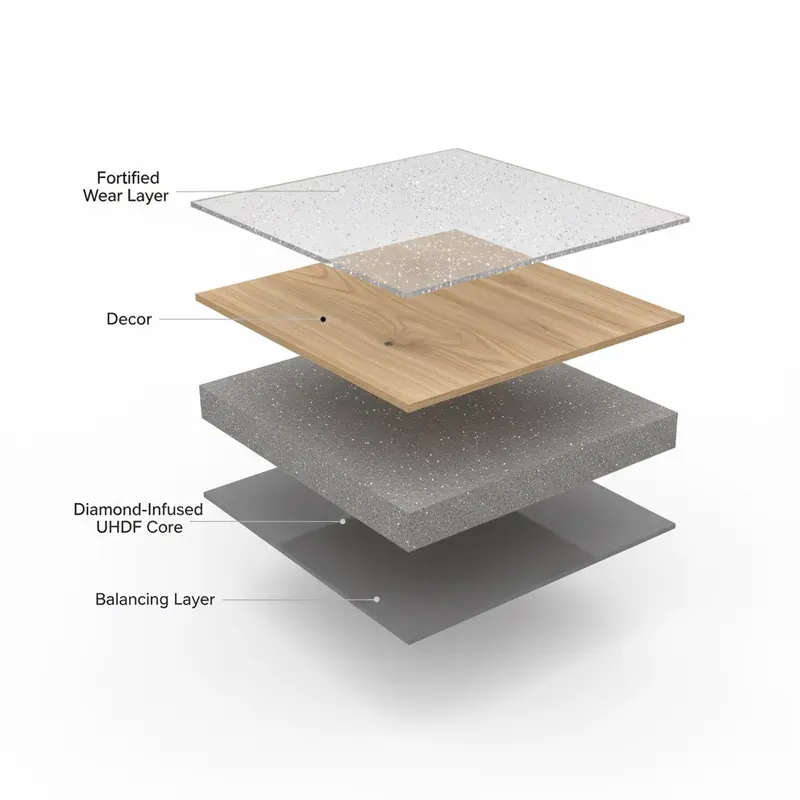
Let’s break down its composition:
- Multi-Coat Fortified Wear Layer: The top surface is not a simple urethane finish. It’s a multi-coat layer infused with a dense concentration of aluminum oxide and ceramic beads. This composition gives the surface a hardness rating that approaches 9 on the Mohs scale, making it exceptionally resistant to the scratches, scuffs, and abrasion that destroy lesser floors.
- High-Definition Decor Layer: This layer provides the realistic wood or stone visual, protected beneath the nearly impenetrable wear layer.
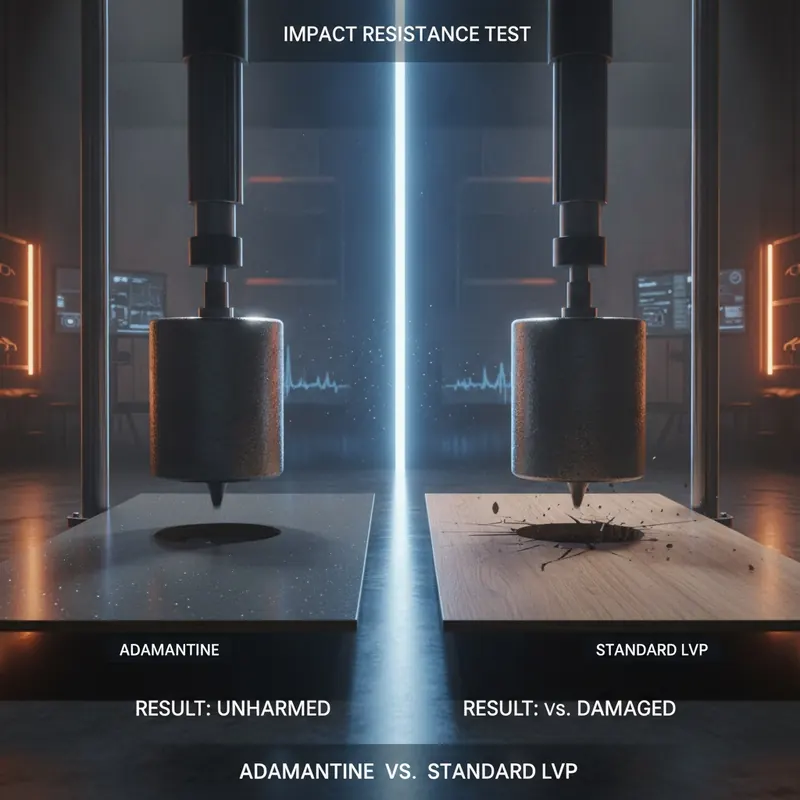
- Diamond-Infused UHDF Core: This is the engine of Adamantine’s durability. It starts with an Ultra-High-Density Fiberboard (UHDF) core, already superior in its impact resistance. This core is then infused with a proprietary blend of microscopic, industrial-grade diamond particles. This infusion dramatically increases the core’s rigidity and compressive strength, providing unparalleled resistance to dents from heavy impacts.
- Melamine Resin Balancing Layer: The bottom layer is a resin-impregnated backing that provides foundational stability and moisture resistance. It ensures the plank remains perfectly balanced, preventing warping, cupping, or bowing after installation.
This advanced composition results in a flooring solution that directly addresses the most common points of failure, offering extreme durability for the most demanding residential and commercial environments.
The High-Traffic Showdown: Adamantine vs. The Competition
Talk is cheap. To truly understand where Adamantine flooring stands, we need a data-driven comparison against the other leading categories of durable flooring. We’ve created a “Scratch-Resistance Scorecard” to rate each option on the key metrics that matter for a long-lasting flooring solution.
Scratch-Resistance Scorecard
| Feature | Adamantine Flooring | Commercial LVP (20+ mil) | AC5 Laminate | Porcelain Tile (PEI 5) |
|---|---|---|---|---|
| Surface Hardness (Mohs) | 9 | 3-4 | 8-9 | 6-7 |
| Wear Layer Toughness | Excellent | Very Good | Excellent | Excellent |
| Impact/Dent Resistance | Excellent | Good | Good | Excellent |
| Water Resistance | Excellent | Excellent | Good | Excellent |
| Best For | Demanding homes, high-traffic commercial | Retail, healthcare, offices | Heavy commercial, busy homes | Any high-traffic area, wet areas |
This scorecard reveals that while options like AC5 Laminate and Porcelain Tile are exceptionally tough, Adamantine Flooring offers a unique combination of top-tier scratch resistance, superior impact resistance from its diamond-infused core, and the aesthetic appeal of realistic wood looks.
Understanding the Ratings: What AC, PEI, and Mil Really Mean
The flooring industry uses several rating systems that can be confusing. Here’s a simple breakdown:
- AC Rating (Abrasion Class): Used for laminate flooring, this rating (from AC1 to AC5) measures resistance to abrasion, impact, stains, and burns. AC5 is the highest rating, specified for heavy commercial use like in department stores. If it can handle that, it can handle your home.
- PEI Rating (Porcelain Enamel Institute): This rating applies to the glaze on ceramic and porcelain tile and indicates its wear resistance.[6] A PEI 5 rating is suitable for the heaviest residential and commercial traffic, like in shopping malls. Standards for tile quality are set by bodies like the American National Standards Institute (ANSI), such as the ANSI A137.1 specification for ceramic tile.[7]
- Mil Thickness: Used for vinyl flooring, this refers to the thickness of the wear layer. A 6-12 mil layer is fine for a bedroom, but for high-traffic areas, you should look for 20 mil or higher to ensure a long-lasting finish.
Beyond the Usual: Where Epoxy and Polished Concrete Fit In
For the most extreme durability flooring needs, such as in warehouses, auto shops, or factories, industrial solutions are required.
- Epoxy Flooring: This is a resinous coating applied over concrete. It creates a seamless, non-porous surface that is highly resistant to chemical spills, heavy machinery, and extreme impact. Industrial epoxy can have a compressive strength of over 10,000 psi.
- Polished Concrete: This involves grinding and polishing an existing concrete slab to a high-gloss finish. It’s incredibly durable and low-maintenance. The International Concrete Repair Institute (ICRI) provides technical guidelines for achieving a durable, high-quality polished concrete surface.[8]
While these are fantastic for industrial settings, their aesthetic and feel are often too harsh for residential or mainstream commercial applications. Adamantine flooring bridges this gap, offering industrial-grade durability with high-end design.
The True Cost of a Floor: A 20-Year Value Analysis
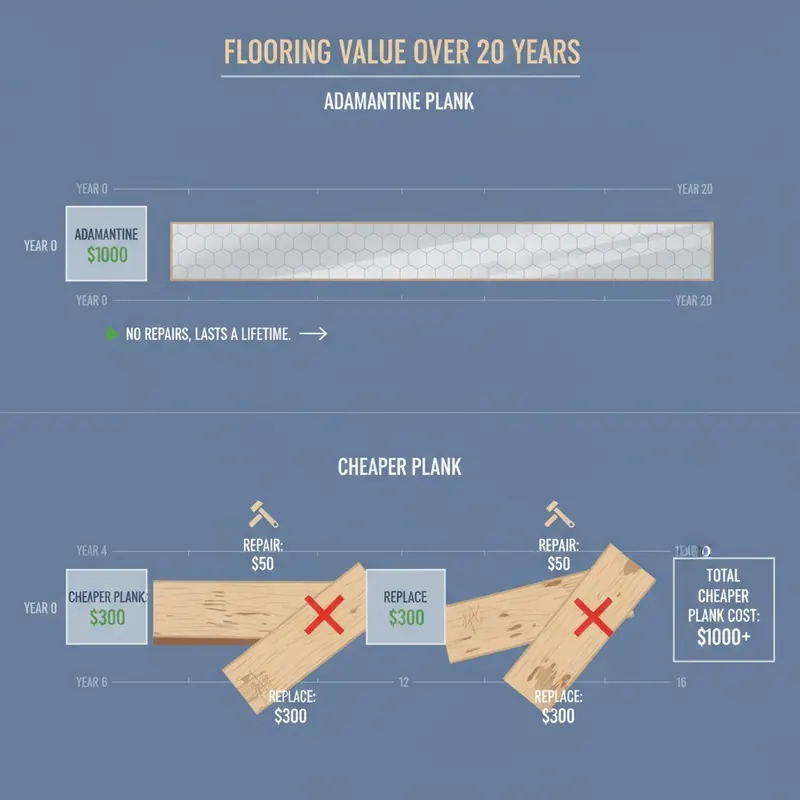
A smart flooring investment goes beyond the initial price per square foot. To find a truly long-lasting flooring solution, you must consider the total cost of ownership over the life of the product. A cheaper floor that needs to be replaced in 7-10 years will ultimately cost far more than a premium, durable floor that lasts for 25 years or more.
Let’s analyze the estimated 20-year cost for a 500 sq. ft. space, factoring in initial cost, potential refinishing or replacement, and maintenance.
Total Cost of Ownership: 20-Year Projection (500 sq. ft.)
| Flooring Type | Initial Cost (Materials + Labor) | Lifespan | Maintenance/Replacement Costs over 20 Years | 20-Year Total Cost |
|---|---|---|---|---|
| Builder-Grade LVP | $2,500 | 5-10 years | $2,500 (1 replacement) | $5,000 |
| Mid-Grade Hardwood | $6,000 | 100+ years | $2,500 (1 refinishing) | $8,500 |
| Porcelain Tile | $7,000 | 50+ years | $500 (grout sealing/repair) | $7,500 |
| Adamantine Flooring | $5,500 | 30+ years | $0 | $5,500 |
This analysis, a method often employed by trusted sources like Consumer Reports in their product evaluations,[9] shows that investing in a floor with extreme durability and a long lifespan, like Adamantine, can provide the lowest total cost over time. Organizations like the World Floor Covering Association (WFCA) consistently emphasize the importance of considering product standards and warranties as key indicators of long-term value.[10]
Decoding Warranties: What Does ‘Lifetime’ Really Mean?
Warranties are a critical indicator of a manufacturer’s confidence in their product. However, the term “lifetime” can be misleading. It often refers to the expected lifetime of the product under “normal” residential wear and tear, and it’s almost always non-transferable if you sell your home.
Before you buy, ask these questions about the warranty:
- Is it prorated (meaning the coverage value decreases over time)?
- What specific damages are excluded (e.g., scratches, water damage, installation errors)?
- Does it cover both the material and the labor for a replacement?
- What are the maintenance requirements to keep the warranty valid?
A strong, clear warranty that covers finish wear-through and manufacturing defects for 25+ years or offers a lifetime structural guarantee is a powerful signal of a quality, long-lasting flooring solution.
Your Action Plan: The Ultimate Guide to Floor Replacement
If you’re ready to stop the cycle of repairs and frustration, it’s time to plan your floor replacement project. This process goes smoothly when you’re prepared. We recommend using a Floor Replacement Project Planner—a simple document or spreadsheet to track your budget, timeline, product choices, and contractor bids.
A critical step often overlooked by homeowners is subfloor preparation. After the old floor is removed, the subfloor must be perfectly clean, flat, and dry. Any imperfections can telegraph through to the new flooring, causing clicks, gaps, or premature failure.
Step 1: Budgeting and Cost Estimation
Your total floor replacement cost will have three main components:
- Materials: The price per square foot of your chosen flooring.
- Removal: Tearing out and disposing of the old floor can cost $1 to $5 per square foot.
- Installation Labor: This typically ranges from $3 to $10 per square foot, depending on the material and complexity of the job.
A DIY installation can save money, but it requires specialized tools (like a tapping block, pull bar, and potentially a power saw) and a significant time commitment. For a flawless, warrantied result, professional installation is often the best investment.
Step 2: Choosing and Vetting Your Contractor
Hiring the right installer is just as important as choosing the right floor. The National Association of the Remodeling Industry (NARI) sets ethical and professional standards for contractors, emphasizing the importance of clear communication and detailed contracts.[11]
Use this checklist before you sign any contract:
10 Questions to Ask Your Flooring Contractor:
- Are you licensed and insured? Can I see proof?
- How many years have you been installing this specific type of flooring?
- Can you provide 2-3 recent references?
- Who will be performing the work—you or a subcontractor?
- How will you protect my home from dust and damage during installation?
- How do you handle subfloor preparation, and is that included in the quote?
- What is the estimated timeline from start to finish?
- What does your installation warranty cover and for how long?
- Is removal and disposal of the old flooring included in the price?
- Can you provide a detailed, itemized quote that breaks down all costs?
Your Floor, Your Final Choice
You no longer have to accept floors that scratch, dent, and wear out before their time. By understanding the material science behind durability, you can see past the marketing hype and identify the features that truly matter: a hardened, multi-additive wear layer, a dense and impact-resistant core, and a manufacturing process that creates a stable, unified plank.
You are now equipped with the diagnostic tools, the scientific knowledge, and the data-driven scorecards to compare your options like an expert. You understand that the smartest investment is not always the lowest upfront price, but the one that delivers the greatest long-term value and freedom from worry. You have a clear action plan to move forward with confidence.
Ready to end the cycle of worn-out floors? Explore our Adamantine Flooring collection and see the science of durability for yourself.
References
- ISSA (The Worldwide Cleaning Industry Association). (N.D.). The Value of Clean. Retrieved from industry publications and data on soil tracking in commercial buildings.
- National Wood Flooring Association (NWFA). (N.D.). Janka Hardness Scale. Retrieved from NWFA official guidelines and educational materials.
- Institute of Inspection, Cleaning and Restoration Certification (IICRC). (N.D.). Standards for Hard Surface Floor Care. Retrieved from IICRC’s official standards and best practice guides.
- Carpet and Rug Institute (CRI). (N.D.). Walk-Off Matting Systems Research. Retrieved from CRI’s published research and industry recommendations on soil removal.
- American Chemical Society (ACS) Publications. (N.D.). Research on Polymers and Composite Materials. Retrieved from peer-reviewed journals published by the ACS.
- The Tile Council of North America (TCNA). (N.D.). PEI Rating System for Ceramic Tile. Retrieved from TCNA’s official standards and consumer information.
- American National Standards Institute (ANSI). (N.D.). ANSI A137.1: American National Standard Specifications for Ceramic Tile. Retrieved from ANSI’s published standards.
- International Concrete Repair Institute (ICRI). (N.D.). Technical Guidelines for Polished Concrete. Retrieved from ICRI’s official publications and industry standards.
- Consumer Reports. (N.D.). Flooring Buying Guides and Ratings. Retrieved from long-term product testing and analysis published by Consumer Reports.
- World Floor Covering Association (WFCA). (N.D.). Flooring Industry Standards and Information. Retrieved from WFCA’s consumer and industry resources.
- National Association of the Remodeling Industry (NARI). (N.D.). Ethical and Professional Standards for Remodelers. Retrieved from NARI’s official code of ethics and contractor selection guides.