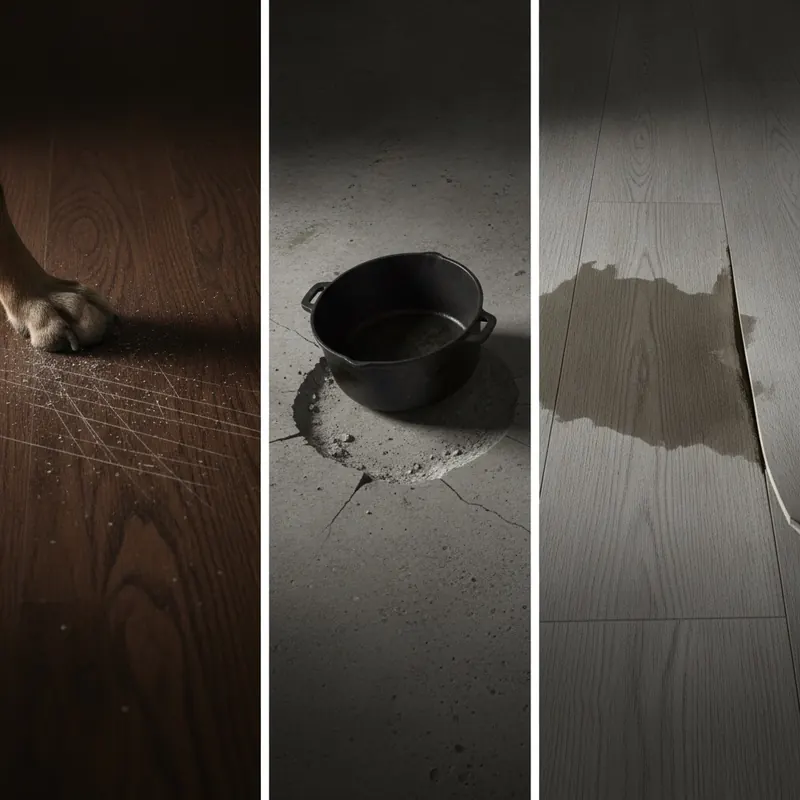
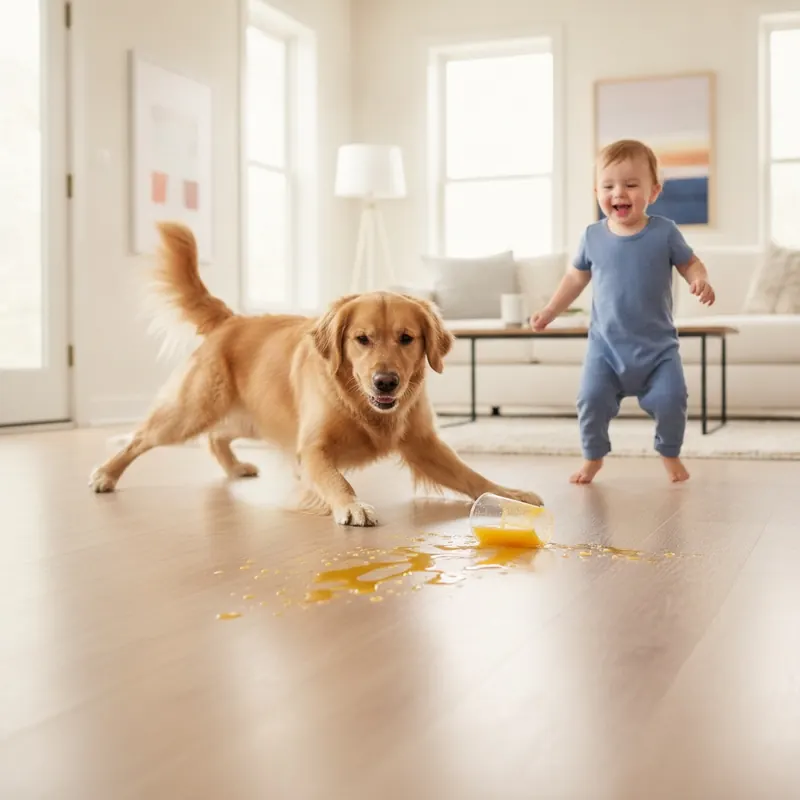
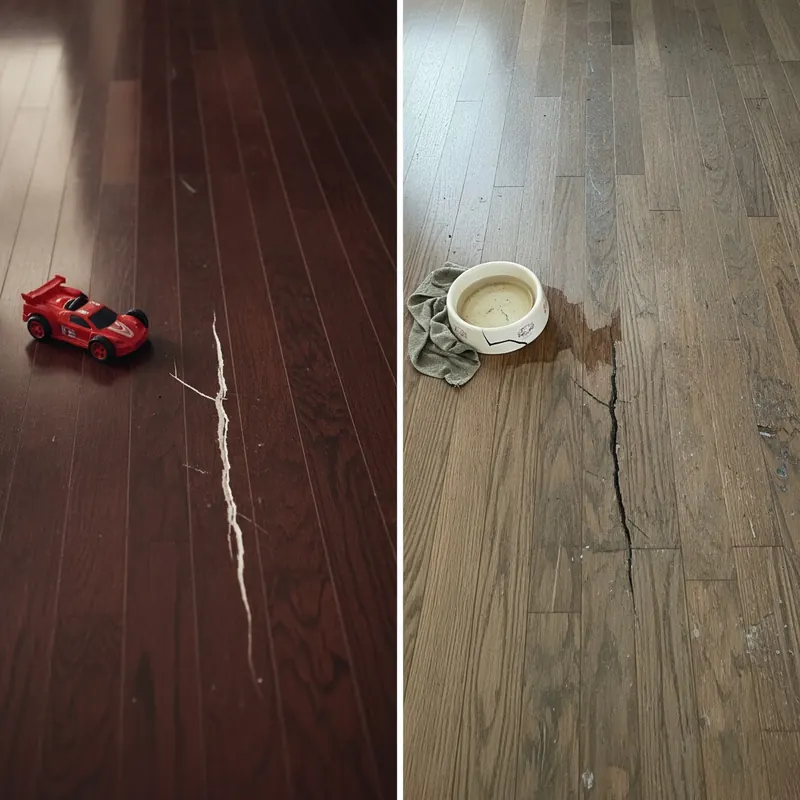
Your home is a stage for life’s best moments—and its messiest. It’s where toddlers learn to walk, pets chase their favorite toys, and family gatherings turn into dance parties. But the evidence of this active living is often etched into your floors as a constellation of scratches, dings, and scuffs. For too many homeowners, the frustration is real: you invest in beautiful new flooring, only to watch it succumb to the daily chaos, leading to the expensive and disruptive cycle of frequent flooring replacement.
What if you could break that cycle? What if you could choose a floor not just for how it looks today, but for how it will perform for decades to come?
This is the definitive homeowner’s playbook for a ‘buy it for life’ floor. We’re moving beyond simple lists of materials to give you a strategic decision-making framework. We will introduce you to the concept of Adamantine Flooring—not a specific brand, but a new standard of structural resilience. This guide will decode the technical jargon, stress-test the top materials against real-world family challenges, and empower you to invest with absolute confidence in a floor that’s truly built for your life.
- What is Adamantine Flooring? The New Standard in Structural Resilience
- Decoding Durability: How to Measure What Truly Matters in Flooring
- The Ultimate Material Showdown: Best Flooring for Homes with Pets and Kids
- The Economics of Longevity: Calculating the True Cost of Your Floor
- Protecting Your Investment: Proactive Maintenance for a Lifetime of Performance
- Your Floor, Built for Life
- References
What is Adamantine Flooring? The New Standard in Structural Resilience
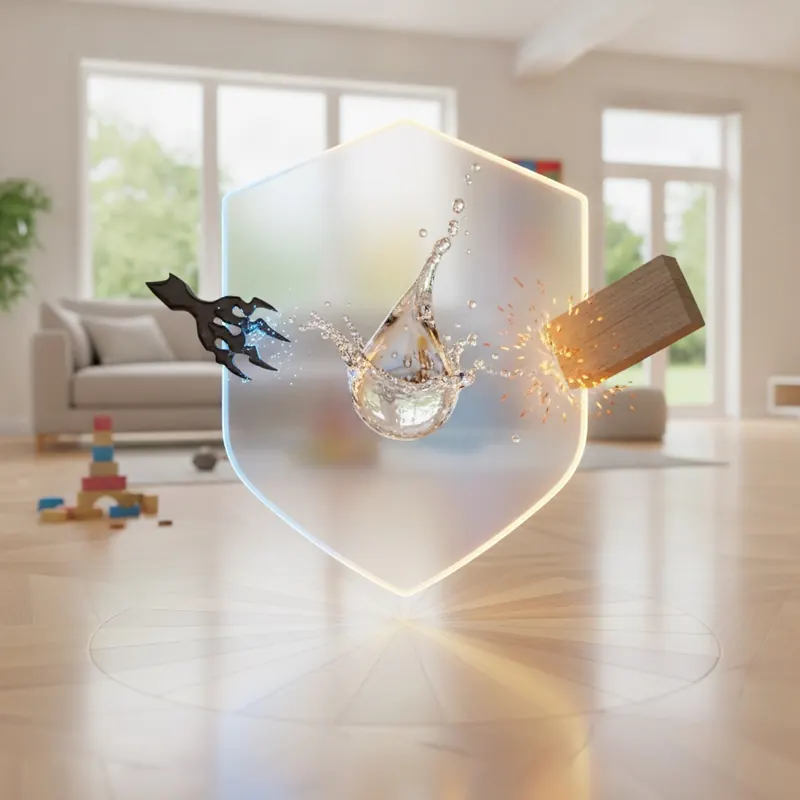
The term “Adamantine” implies something unbreakable, legendary in its toughness. When applied to flooring, it represents a philosophy of choosing a surface based on ultimate durability and longevity. It’s about shifting the focus from fleeting design trends to the core principles of structural performance that allow a floor to withstand the intense demands of an active home.
An Adamantine Floor is defined by its mastery of four key pillars:
- Impact Resistance: The ability to resist dents and dings from dropped objects, from a toy truck to a child’s wooden block.
- Scratch & Abrasion Resistance: The capacity to fend off scratches from pet claws, dragged furniture, and the grit tracked in on shoes.
- Water & Stain Resistance: Imperviousness to spills, pet accidents, and moisture, preventing warping, swelling, and permanent stains.
- Dimensional Stability: The material’s ability to resist expanding, contracting, or warping with changes in temperature and humidity, ensuring a flat, stable surface for years.
As Dr. Evelyn Reed, a materials scientist specializing in polymer composites, explains, “True structural resilience in flooring isn’t about one single feature. It’s the synergistic combination of a dense, stable core, a hardened, non-porous surface, and a robust wear layer. This trifecta creates a composite material engineered to dissipate energy from impacts and resist the abrasive forces of daily life.” Choosing an Adamantine Floor means you’re investing in this engineered resilience, creating a foundation for your home that lasts.
Decoding Durability: How to Measure What Truly Matters in Flooring
The flooring market is filled with vague marketing terms like “heavy-duty,” “ultra-durable,” and “long-lasting.” To make an informed decision, you need to look past the sales pitch and understand the objective, industry-standard metrics that quantify true durability. These ratings are your secret weapon for comparing products and ensuring you get the performance you pay for.
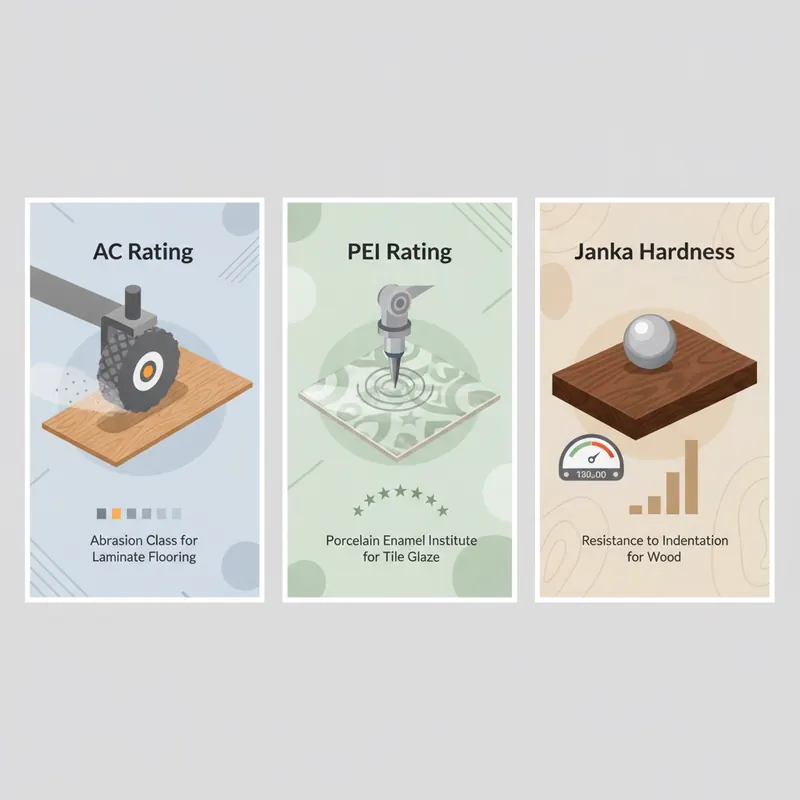
Laminate & LVP: Understanding AC (Abrasion Class) Ratings
When evaluating laminate and some modern Luxury Vinyl Plank (LVP) flooring, the most important metric is the Abrasion Class, or AC rating. This standard, established by the European Producers of Laminate Flooring (EPLF), measures a floor’s resistance to abrasion, impact, stains, and scuffs[1]. The scale is simple: the higher the number, the more durable the floor.
- AC1 (Moderate Residential): Suitable for low-traffic areas like bedrooms.
- AC2 (General Residential): Designed for medium-traffic spaces like living rooms.
- AC3 (Heavy Residential/Moderate Commercial): An excellent choice for all residential areas, including high-traffic hallways and kitchens.
- AC4 (General Commercial): Built for busy residential use and light commercial settings.
- AC5 (Heavy Commercial): Extremely durable, designed for department stores and public buildings—and a fantastic option for the most demanding homes.
For an active family, an AC rating of AC4 or AC5 is the gold standard, ensuring the floor’s wear layer can handle the relentless traffic of pets, kids, and daily life.
Porcelain & Ceramic Tile: The PEI (Porcelain Enamel Institute) Rating
For tile, the key durability indicator is the PEI rating, which measures the hardness and durability of the tile’s glaze—its primary defense against scratches and wear. The Tile Council of North America (TCNA) uses this scale to classify tile for its appropriate application[2].
- PEI Class 1 (No Foot Traffic): For walls only.
- PEI Class 2 (Light Traffic): Best for bathroom floors where soft-soled shoes are worn.
- PEI Class 3 (Light to Moderate Traffic): Suitable for all residential areas where normal foot traffic is expected.
- PEI Class 4 (Moderate to Heavy Traffic): Ideal for all residential applications, including high-traffic areas, and even light commercial use.
- PEI Class 5 (Heavy to Extra-Heavy Traffic): The most durable class, designed for heavy commercial use and perfect for any area of a home.
For entryways, kitchens, and hallways in a busy home, look for a tile with a PEI rating of 4 or 5 to guarantee it won’t show wear patterns over time.
Hardwood & Bamboo: The Janka Hardness Scale
The Janka Hardness Test is the industry standard for measuring a wood’s resistance to denting and wear. The test, as detailed by forestry institutions like the U.S. Forest Service, measures the force required to embed a 0.444-inch steel ball halfway into a sample of wood[3]. The resulting number, or Janka rating, tells you how well the wood can withstand impacts.
A higher Janka rating means a harder, more dent-resistant wood. Here’s a quick comparison:
| Wood Species | Janka Hardness Rating (approx.) |
|---|---|
| Douglas Fir | 660 |
| Red Oak | 1290 |
| White Oak | 1360 |
| Hard Maple | 1450 |
| Hickory | 1820 |
| Brazilian Cherry | 2350 |
For a home with active kids and pets, choosing a wood species with a Janka rating of 1300 or higher is crucial to minimize the appearance of dents from dropped toys and furniture.
The Ultimate Material Showdown: Best Flooring for Homes with Pets and Kids
Now that you speak the language of durability, let’s put the top contenders through a real-life stress test. We’ll evaluate each material against the challenges every active family faces: pet claws, spilled juice, and dropped toys.
As family-focused interior designer Maria Flores notes, “My clients need floors that grant them peace of mind. They don’t want to be constantly worried about every little spill or accident. My go-to recommendation is always a material that scores high in both scratch and water resistance, because those are the two biggest daily stressors in a home with kids and pets.”
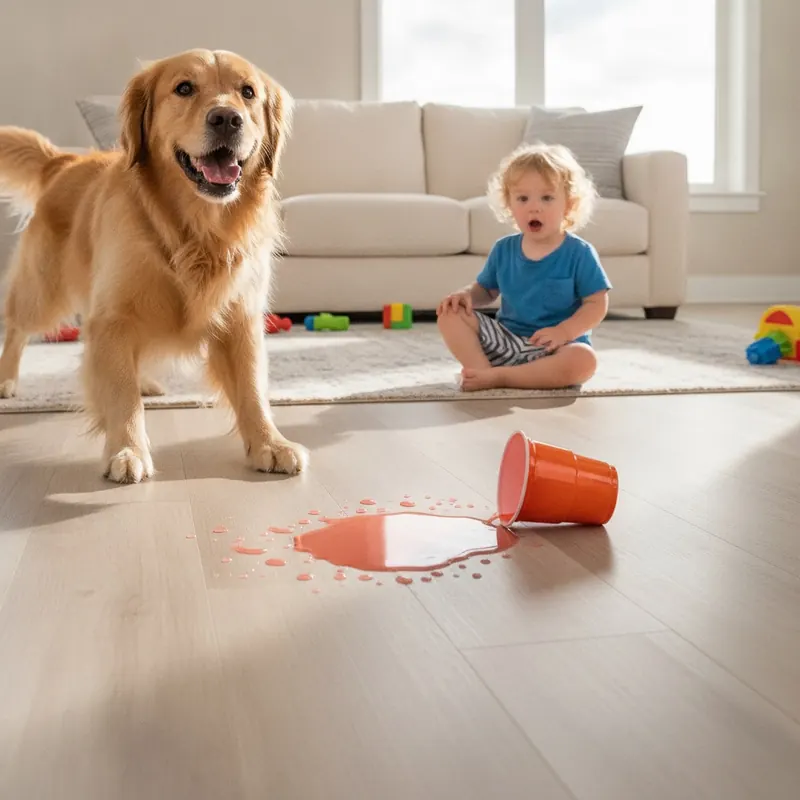
Contender 1: Luxury Vinyl Plank (LVP) & Tile (LVT)
Modern LVP is a performance powerhouse. It combines a realistic wood or stone look with a multi-layered construction designed for durability. Its key strength is its core, which is often 100% waterproof.
- Stress Test Report Card:
- Scratch Resistance: B+ to A (Depends heavily on wear layer thickness. Look for 20 mil or greater for excellent performance.)
- Water Resistance: A+ (Most products are fully waterproof, making them ideal for kitchens, bathrooms, and basements.)
- Impact Resistance: B (Softer than tile, it can be dented by very heavy, sharp objects, but is more forgiving for falls.)
- Comfort & Sound: A (Warmer and quieter underfoot than tile.)
Verdict: An outstanding all-around choice for active families, especially those prioritizing waterproof performance and comfort. The key is to invest in a high-quality product with a thick wear layer (at least 20 mil) to stand up to pet claws.
Contender 2: Porcelain & Ceramic Tile
When it comes to sheer toughness, porcelain tile is the undisputed champion. Formed under immense pressure and heat, its dense body and hardened glaze make it nearly impervious to common household damage.
- Stress Test Report Card:
- Scratch Resistance: A+ (With a PEI rating of 4 or 5, it is virtually scratch-proof against pets and furniture.)
- Water Resistance: A+ (Porcelain is non-porous and completely waterproof.)
- Impact Resistance: B- (Extremely hard, but this means it can crack if a very heavy object is dropped on it. It is also less forgiving for falls.)
- Comfort & Sound: C (Can be cold and hard underfoot, and it reflects sound.)
Verdict: The ultimate choice for maximum scratch and water resistance. It’s perfect for high-traffic entryways and kitchens. The main trade-offs are its hardness, cold feel, and the need for periodic grout maintenance.
Contender 3: Modern Laminate Flooring
Laminate flooring has evolved significantly. Once seen as a budget option with a weakness for water, today’s premium laminates feature incredibly tough, scratch-resistant top layers and innovative water-resistant core technologies.
- Stress Test Report Card:
- Scratch Resistance: A (A high-quality laminate with an AC4 or AC5 rating has one of the toughest surfaces available, often outperforming real wood.)
- Water Resistance: B to A- (Look for products specifically marketed with water-resistant or waterproof technology, which often includes sealed edges and a dense core.)
- Impact Resistance: B+ (Excellent resistance to dents from dropped objects.)
- Comfort & Sound: B+ (Feels solid underfoot, especially with a quality underlayment.)
Verdict: A superb option for families who need top-tier scratch resistance on a budget. If you have pets with active claws, a high-AC-rated laminate is one of your best defenses against scratched floors. Just be sure to select a modern, water-resistant variety for kitchens and entryways.
Contender 4: Engineered & High-Density Hardwood
For those who love the timeless beauty of real wood, all is not lost. The key is to choose wisely. Engineered hardwood, with its layered construction, offers greater dimensional stability than solid wood, while selecting a very hard species is non-negotiable.
- Stress Test Report Card:
- Scratch Resistance: C+ to B (Even the hardest woods will scratch. A durable, factory-applied aluminum oxide finish is essential.)
- Water Resistance: C (Highly susceptible to water damage. Spills must be wiped up immediately.)
- Impact Resistance: B to A (Depends entirely on the Janka rating. Hickory or Brazilian Cherry will resist dents far better than Pine or Oak.)
- Comfort & Sound: A+ (The benchmark for warmth, comfort, and classic appeal.)
Verdict: Best for families who are committed to the look and feel of real wood and are willing to accept a higher level of maintenance and care. To make it work, choose a species with a Janka rating over 1800 and a premium factory finish, and be vigilant about spills.
The Economics of Longevity: Calculating the True Cost of Your Floor
It’s tempting to choose flooring based on the upfront price per square foot, but this often leads to the costly cycle of frequent replacement. A truly durable floor is a long-term investment. To understand its real value, you need to calculate its Total Cost of Ownership (TCO).
Here’s a simple formula:
(Initial Material Cost + Installation Cost + Lifetime Maintenance Costs) / Expected Lifespan in Years = Annual Cost
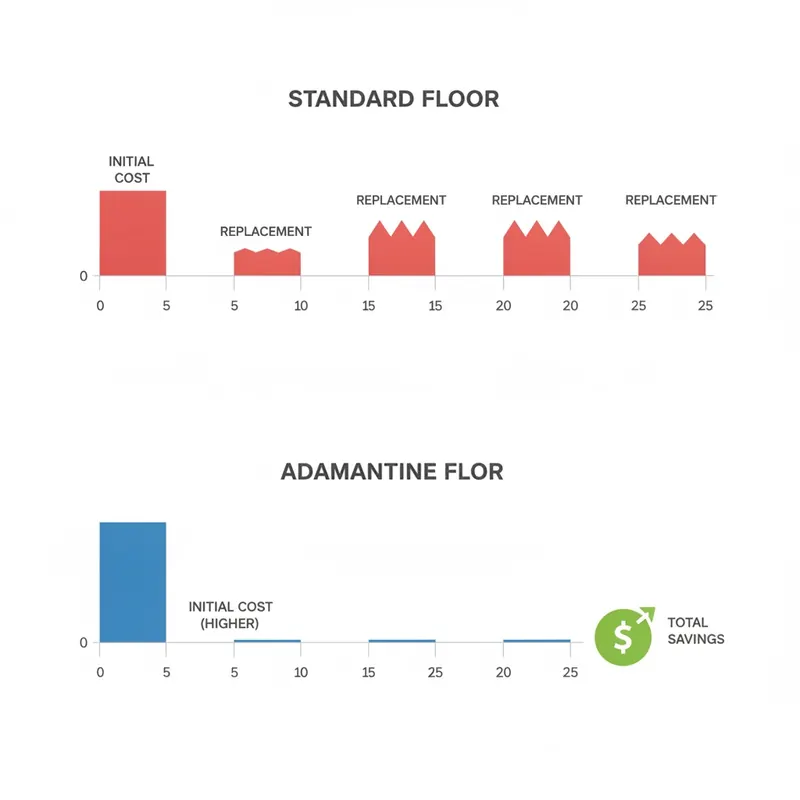
Let’s look at a hypothetical case study for a 500-square-foot space:
- Floor A (Budget-Friendly): Costs $1,500 installed. It looks great initially but scratches easily and needs to be replaced in 5 years. Its TCO is $300 per year.
- Floor B (Adamantine-Rated): Costs $4,000 installed. It’s highly scratch- and water-resistant and is warranted to last 25 years. Its TCO is $160 per year.
While the initial investment for Floor B is higher, its superior durability makes it nearly twice as cost-effective over the long run, not to mention the savings in hassle and disruption.
Protecting Your Investment: Proactive Maintenance for a Lifetime of Performance
Choosing a durable material is the first step. The second is implementing simple, proactive maintenance routines to prevent wear and tear before it starts.
“The single most effective habit is frequent dry cleaning,” advises professional cleaner Alex Chen. “Using a microfiber mop or vacuum daily prevents the tiny particles of grit and sand from acting like sandpaper underfoot, which is the number one cause of finish degradation on any floor type.”
The Universal Rules: Furniture Pads, Doormats, and Regular Cleaning
These three simple actions have the biggest impact on the longevity of any floor:
- Felt Pads on Everything: Place high-quality felt pads on the bottom of every piece of furniture—chairs, tables, sofas, and entertainment centers. Check and replace them annually.
- Doormats at Every Entrance: Use a coarse scraping mat outside and a softer, absorbent mat inside to trap the vast majority of damaging dirt, grit, and moisture at the door.
- The “No Shoes Inside” Rule: If your family is on board, this is the ultimate way to protect your floors from the abrasive grit and debris of the outside world.
Material-Specific Care: From Grout Sealing to Hardwood Recoating
Beyond the basics, each material has unique needs to keep it performing at its peak:
- For Tile: Clean and reseal your grout lines every 1-2 years in high-moisture or high-traffic areas. This prevents staining and moisture from seeping into the subfloor.
- For LVP & Laminate: Use a pH-neutral cleaner. Avoid wax-based polishes, steam mops (unless approved by the manufacturer), and abrasive scrubbing pads, which can dull the finish.
- For Hardwood: When the original finish starts to look dull or shows fine surface scratches after 5-10 years, consider a “screen and recoat.” This process lightly abrades the top finish and applies a new coat of urethane, refreshing the floor’s protection without a full, dusty sanding.
Your Floor, Built for Life
Choosing a floor for your home is one of the most significant investments you’ll make in your property. By moving beyond aesthetics and embracing the Adamantine philosophy of structural resilience, you can end the frustrating cycle of damaged, worn-out floors.
The key takeaways are simple: a durable floor is a long-term investment in your home’s value and your family’s peace of mind. Understanding the objective durability ratings—AC for laminate/LVP, PEI for tile, and Janka for hardwood—is your non-negotiable first step. From there, you can confidently select the right material to stand up to your home’s unique stressors, whether it’s the click-clack of pet nails, the chaos of toddler playtime, or the constant foot traffic of a busy household. By using this decision-making framework, you can choose a true “life-proof” floor that will serve as the beautiful, resilient foundation for your family’s memories for years to come.
Ready to find the perfect life-proof floor for your home? Explore our collection of Adamantine-rated flooring options or contact our flooring experts for a personalized consultation today.
This article provides general guidance for choosing durable flooring. It is recommended to consult with a professional flooring installer or designer to assess your specific needs and home conditions before making a final purchase.
References
- European Producers of Laminate Flooring (EPLF). (n.d.). Technical Bulletins: Abrasion Resistance. The EPLF establishes the standards for AC ratings used to classify laminate flooring durability across residential and commercial applications.
- Tile Council of North America (TCNA). (n.d.). TCNA Handbook for Ceramic, Glass, and Stone Tile Installation. The TCNA outlines industry standards, including the use of the PEI rating system to determine the appropriate application for different types of tile based on glaze hardness and wear resistance.
- U.S. Forest Service, Forest Products Laboratory. (n.d.). Wood Handbook—Wood as an Engineering Material. This comprehensive resource details the methodologies for testing wood properties, including the Janka Hardness Test used to measure the dent and wear resistance of various wood species.