We live in an era of disposable culture, where the thrill of a new purchase is quickly followed by the frustration of its inevitable failure. From smartphones that mysteriously slow down just as their sealed batteries die, to “fast furniture” that chips and wobbles after a single move, consumers are trapped in a relentless, expensive cycle of replacing easily broken products. But a growing movement of conscious consumers, homeowners, and tech-enthusiasts is pushing back against planned obsolescence. They are demanding a return to—and an evolution of—goods that are built for life.
Welcome to “The Adamantine Standard.”
This standard is a consumer manifesto that bridges the mythological concept of ultimate durability with cutting-edge real-world material science and heritage craftsmanship. In this comprehensive guide, we will equip you with the objective frameworks necessary to escape the trap of contrived durability. By understanding the true Cost-Per-Use (CPU), recognizing the hallmarks of premium craftsmanship, and utilizing rigorous third-party certifications like the LONGTIME label, you can confidently identify and invest in products that are truly built to last.
- From Myth to Material Science: Defining Adamantine Products
- The Anatomy of Failure: Escaping the Trap of Easily Broken Products
- The Pillars of Premium Craftsmanship: Building the Heirloom Economy
- The Economics of Longevity: Why Replacing Cheap Materials Pays Off
- The “Buy It For Life” Blueprint: Identifying Long Lasting Quality Goods
- References & Authoritative Sources
From Myth to Material Science: Defining Adamantine Products
When you hear the word “adamantine,” your mind might immediately jump to the realms of fantasy lore. In tabletop games like Dungeons & Dragons or the intricate simulations of Dwarf Fortress, adamantine is revered as a mythological alloy—often a blend of adamant, silver, and electrum—known for being virtually indestructible. However, the concept of adamantine products has transcended fiction. Today, it represents the pinnacle of modern material science and engineering, answering the question: Is adamantine a real material? While you won’t find dwarven forges crafting it, scientists and engineers are synthesizing materials that mimic these legendary properties.
The Fantasy Lore vs. Real-World Engineering
The mythological appeal of an unyielding, shatter-proof material perfectly encapsulates the modern consumer’s desire for an adamantine built to last design. This philosophy has moved from the pages of fantasy into the blueprints of real-world structural engineering. For instance, architectural and engineering firms like Adamantine Design have adopted the namesake to represent a commitment to structures that endure generations, satisfying the navigational intent of those seeking a real-world application of the “built to last” philosophy [1]. This transition from lore to literal application proves that the desire for unyielding durability is a fundamental human pursuit, driving innovation in how we build our homes and the products we fill them with.

The Future of Extreme Durability: Diamond-Integrated Tech
In the realm of advanced electronics and thermal management, a durable adamantine design is no longer a metaphor; it is a scientific reality. The future of extreme durability is being forged in laboratories through diamond-integrated technology. Companies like Diamond Quanta are pioneering real-world Adamantine-branded diamond materials specifically engineered for optics and high-performance thermal management [2].
Through advanced material science techniques—such as high-resolution STEM (Scanning Transmission Electron Microscopy) analysis—eng
The Anatomy of Failure: Escaping the Trap of Easily Broken Products
To appreciate true durability, one must first understand the mechanics of failure. Modern manufacturing is often plagued by a race to the bottom, resulting in easily broken products that drain consumer wallets and fill landfills. This is not always an accident of cheap manufacturing; frequently, it is a deliberate engineering choice. By learning the “anatomy of failure,” consumers can spot inferior materials and predatory design tactics before making a purchase.
Contrived Durability and Planned Obsolescence Explained
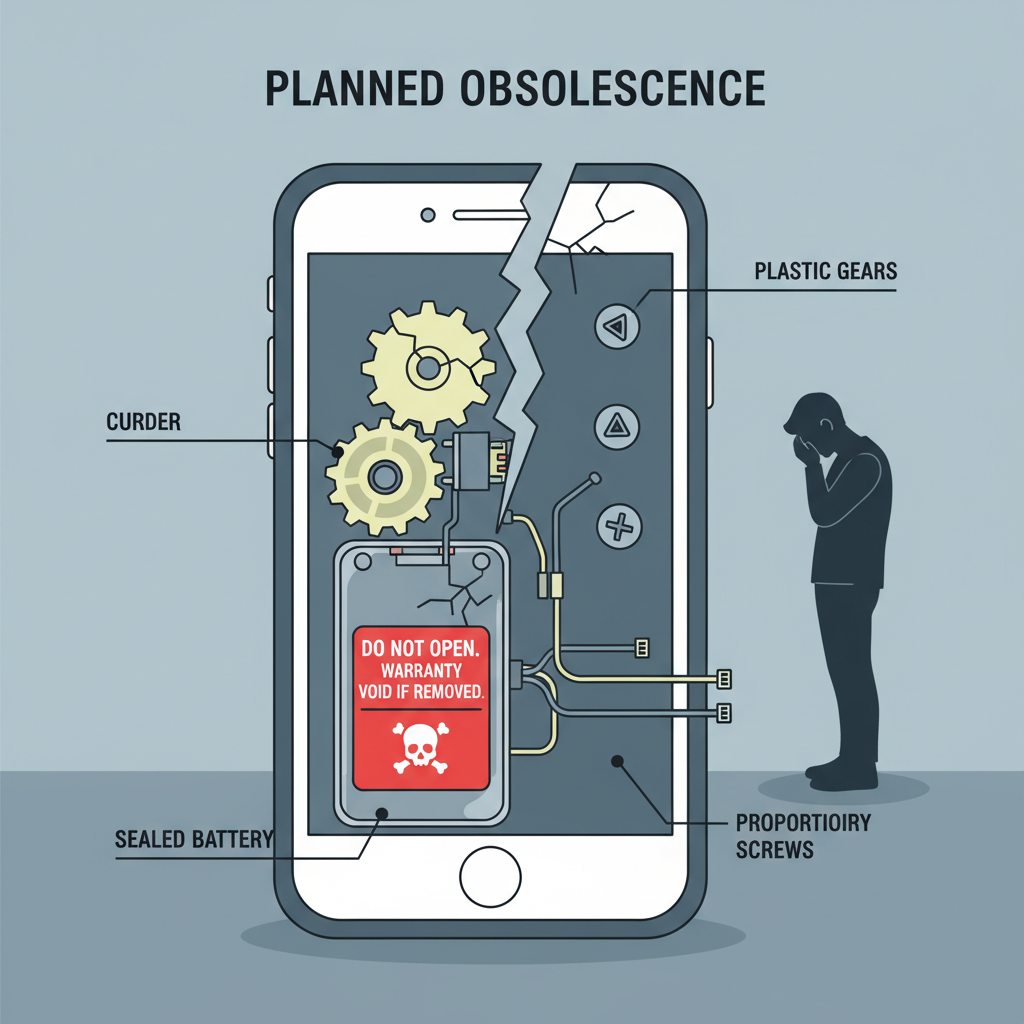
Why are modern products designed to fail? The answer lies in the economic strategy of planned obsolescence. This concept has historical precedents dating back decades, perhaps most infamously illustrated by the deliberate weakening of DuPont nylon stockings in the mid-20th century to ensure repeat purchases [3]. Today, industrial designers use precise tactics known as “contrived durability” and “perceived obsolescence.”
Educational authorities on industrial design, such as Product Design Online, highlight how manufacturers intentionally compromise stress-bearing parts [3]. This includes replacing metal load-bearing gears in kitchen appliances with plastic alternatives, or using proprietary screws and sealed battery compartments in electronics to render them unrepairable. To combat this, consumers must seek out right-to-repair resources and actionable guides that teach how to bypass these artificial barriers, allowing them to fix items that manufacturers intentionally designed for the trash bin.
Reading the Room: Spotting Poor Quality Craftsmanship
The trap of poor quality craftsmanship extends far beyond small consumer goods; it is a massive liability in the construction and home-building industry. For homebuyers and renovators, learning to “read the room” is an essential skill. Superficial cosmetic flaws are rarely isolated incidents; they are highly reliable indicators of deeper, hidden structural negligence.
Experienced home builders, such as Newmark Homes, advise that sloppy caulk lines, uneven paint finishes, and misaligned baseboards are immediate red flags [4]. If a contractor rushes the visible finishes, it is highly probable they cut corners on the electrical wiring, plumbing, or framing behind the walls. Furthermore, legal authorities like Florida Hardhat Law emphasize the critical importance of distinguishing between a design defect (a flaw in the architectural blueprint) and a workmanship defect (improper installation or lack of attention to detail by the builder) [5]. Understanding these distinctions empowers homeowners to hold contractors accountable for industry standards and avoid safety hazards.
The Pillars of Premium Craftsmanship: Building the Heirloom Economy
Escaping the cycle of disposable goods requires a shift toward the “Heirloom Economy.” Premium craftsmanship is defined by meticulous attention to detail, the use of superior materials, and a steadfast rejection of mass-production techniques. But what separates genuine artisanal quality from clever marketing fluff? It comes down to the technical realities of how a product is made.
The Invisible Hours: Artisanal Techniques vs. Mass Production

True luxury is found in the “invisible hours”—the hidden time, generational knowledge, and eco-friendly processes that mass manufacturing simply cannot replicate. When you seek out inspiring premium craftsmanship goods, you are looking for specific, verifiable techniques. In woodworking, this means identifying a dovetail or mortise-and-tenon joint rather than staples and glue. In textiles, it is the presence of a selvedge edge that prevents unraveling.
Furthermore, premium craftsmanship is inherently tied to sustainability. Artisanal brands like the Croatian leatherworking studio Običaj champion eco-friendly, vegetable-tanning methods that take weeks to complete, entirely avoiding the toxic heavy metals used in mass-produced chromium tanning [6]. Similarly, authorities on handcrafted decor like House of Motifs emphasize the sustainable nature of small-batch production [7]. Unlike synthetic alternatives that peel and crack, premium materials like full-grain leather or solid hardwood age gracefully, developing a rich patina over time that tells the story of its use.
Why Handcrafted Goods Are a Financial Investment
It is a common misconception that artisanal goods are merely an aesthetic indulgence. In reality, when you invest in premium craftsmanship, you are making a financially sound decision. Authorities on artisanal furniture, such as Nolita Harbour, highlight the structural superiority of bespoke pieces, noting that the prioritization of stability in every joint ensures unmatched longevity [8]. Similarly, experts at The Spalty Dog advocate for the philosophy of quality over quantity in handcrafted wood furniture, framing these purchases as functional art [9].
Consider the financial analysis of depreciation: mass-produced “fast furniture” loses almost all of its monetary value the moment it is assembled, destined for a landfill within a few years. In stark contrast, bespoke artisanal pieces retain their value and, in many cases, appreciate as collectible antiques. By purchasing handcrafted goods, you are investing in an heirloom that will outlast you, effectively eliminating the need to ever buy that item again.
The Economics of Longevity: Why Replacing Cheap Materials Pays Off
The transition to the Adamantine Standard requires a fundamental reframing of the word “cheap.” In the context of durable design, cheap does not mean cost-effective; it means low quality and ultimately more expensive over time. By utilizing mathematical frameworks and exploring sustainable material alternatives, we can objectively prove the remarkable Return on Investment (ROI) of durable goods.
Cost-Per-Use (CPU) and the True ROI of Durable Goods
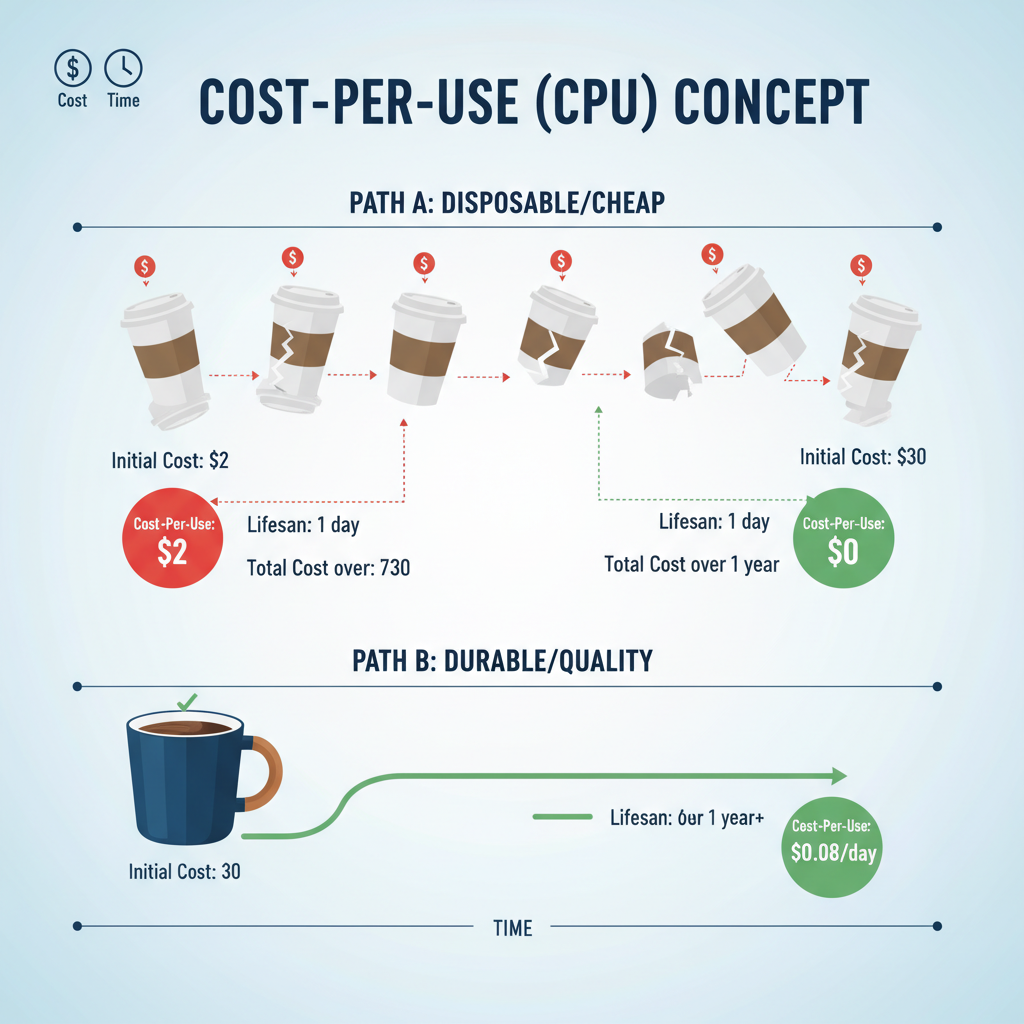
To make informed purchasing decisions, consumers must utilize the Cost-Per-Use (CPU) mathematical breakdown. CPU is calculated by taking the upfront cost of an item and dividing it by the number of times it will be used over its lifespan.
Formal economic definitions classify durable goods as products designed for long-term use, typically lasting for three years or more [10]. However, true “Buy It For Life” items last decades. If you buy a $20 pair of mass-produced boots that fail after 100 wears, your CPU is $0.20. If you invest in a $300 pair of Goodyear-welted, repairable heritage boots that last for 3,000 wears, your CPU drops to $0.10. A long-term ROI calculator quickly reveals that the upfront cost of premium, long-lasting products is dwarfed by the lifetime savings of not repeatedly buying disposable counterparts.
Sustainable Alternatives: Swap This for That
This economic principle applies heavily to construction and home improvement, where replacing cheap materials with innovative, sustainable alternatives yields massive long-term savings.
Contractors and industry authorities like Bayshore Exteriors and Contractor Foreman provide compelling real-world pricing data for these swaps [11], [12]. For example, recycling concrete blocks costs around $21 per ton, compared to landfill disposal which runs up to $140 per ton [11]. When looking at structural materials, bamboo typically costs 20-30% less than conventional lumber while offering superior tensile strength [12]. Furthermore, advanced green materials like Hempcrete cost between $10 and $15 per square foot, making it highly competitive with traditional brick (which runs $10 to $20 per square foot) while providing vastly superior insulation and carbon-sequestering properties [12]. Exploring materials like AshCrete and Ferrock further proves that sustainable, durable design is the most cost-effective path forward.
The “Buy It For Life” Blueprint: Identifying Long Lasting Quality Goods
Understanding the theory of durability is only half the battle; the other half is practical application. To navigate a market saturated with false promises, consumers need a highly actionable blueprint to objectively evaluate and curate high quality long lasting products.
Objective Evaluation: The LONGTIME Label and Repairability Indexes
Subjective online reviews can be easily manipulated, which is why objective criteria—such as material hardness, warranty length, and repairability—are paramount. Third-party certifications take the guesswork out of finding long lasting quality goods.
The LONGTIME label, an independent European certification body, is the gold standard for this objective evaluation [13]. How does the LONGTIME label certify product durability? It uses strict, transparent criteria, including the mandatory absence of unproven, highly-breakable technologies, the guaranteed use of high-quality key parts, and a rigorous assessment of the product’s repairability index. Consumers should actively look for these certifications or use the label’s criteria as a personal checklist to assess the repairability and structural integrity of a design before purchasing.
The Red Flag Checklist for Consumers
To avoid the pitfalls of contrived durability, consumers must adopt a defensive shopping strategy. When evaluating potential purchases, use this “red flag” checklist to identify items that are not built to last:
- Sealed Battery Compartments: If a device’s battery cannot be accessed and replaced with standard tools, the product has a predetermined death date.
- Plastic Load-Bearing Hinges or Gears: In appliances and electronics, moving parts under stress must be metal. Plastic in these areas guarantees eventual failure.
- Lack of Replacement Parts: If the manufacturer does not sell OEM replacement parts directly to consumers, the item is not meant to be repaired.
- “Lifetime” Warranties with Loopholes: Read the fine print. A true lifetime warranty covers wear and tear, not just “manufacturer defects” for a limited window.
When you apply these strict criteria, the true “Buy It For Life” champions emerge. Aggregate long-term user data supports this methodology; benchmark products like premium noise-cancelling earphones with over 12,000 reviews maintaining a 4.2-star average, or heritage cast iron skillets boasting over 3,000 reviews with 4.4-star averages, prove that when manufacturers prioritize material integrity over planned obsolescence, the products truly last a lifetime.
Conclusion
Escaping the financial and environmental drain of disposable culture requires a fundamental shift in mindset. By adopting the Adamantine Standard, we move away from the allure of initial cheapness and embrace the profound value of cost-per-use, repairability, and genuine premium craftsmanship. Whether it is the atomic-level engineering of diamond-integrated thermal tech or the generational artistry of a dovetail joint, investing in durable design pays immense dividends.
We encourage you to audit your next major purchase using the Cost-Per-Use framework and the Red Flag checklist provided in this guide. Demand transparency, seek out repairable goods, and invest in the Heirloom Economy.
Disclaimer: Readers are advised to independently verify specific product warranties, third-party certifications, and material claims with manufacturers before making purchasing decisions.
References & Authoritative Sources
- Adamantine Design. (N.D.). Architectural and Engineering Firm. Retrieved from adamantine-design.com
- Diamond Quanta. (N.D.). Adamantine-branded diamond materials for optics and thermal management. Retrieved from diamondquanta.com
- Product Design Online. (N.D.). The Mechanics of Contrived Durability and Planned Obsolescence. Retrieved from productdesignonline.com
- Newmark Homes. (N.D.). Identifying Sloppy Finishes and Uneven Surfaces in Home Building. Retrieved from newmarkbuilding.com
- Florida Hardhat Law. (N.D.). Distinguishing Between Design Defects and Workmanship Defects. Retrieved from floridahardhatlaw.com
- Običaj. (N.D.). Premium Leather Craftsmanship and Sustainable Tanning.
- House of Motifs. (N.D.). Elevating Everyday Luxury Through Handcrafted Textiles. Retrieved from houseofmotifs.com
- Nolita Harbour. (N.D.). The Lasting Value and Structural Superiority of Artisanal Furniture. Retrieved from nolitaharbour.com
- The Spalty Dog. (N.D.). Quality Over Quantity in Handcrafted Wood Furniture. Retrieved from thespaltydog.com
- Maker’s Row. (N.D.). Economic Definitions of Durable Goods and American Craftsmanship. Retrieved from makersrow.com
- Bayshore Exteriors. (N.D.). Real-world Pricing and Application Data for Alternative Exterior Materials. Retrieved from bayshoreexteriors.com
- Contractor Foreman. (N.D.). Green Building Materials: Hempcrete, Ferrock, and AshCrete. Retrieved from contractorforeman.com
- LONGTIME Label. (N.D.). Independent European Certification for Durable, Solid, and Repairable Products. Retrieved from longtimelabel.com
