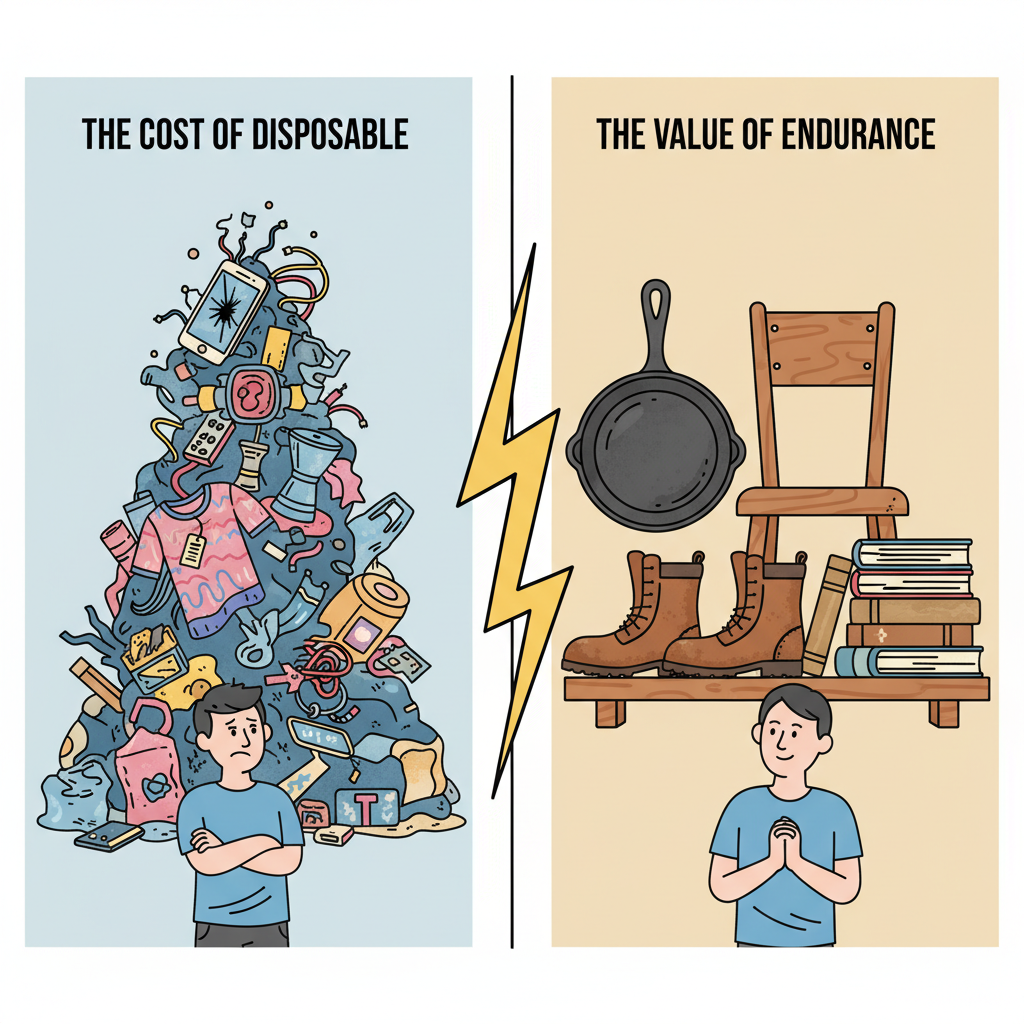
We have all experienced the uniquely modern frustration of a relatively new appliance suddenly dying, a favorite shirt unraveling after a few washes, or a tool snapping the second it faces real resistance. In an era dominated by disposable culture, it feels as though everything we buy is destined for the landfill before the receipt even fades. This cycle of constant replacement is not just a psychological drain; it is a massive financial burden and an environmental catastrophe.
But what if we refused to participate in the cycle of planned obsolescence? What if we demanded goods that were virtually unbreakable? Welcome to “The Adamantine Standard”—a definitive, data-driven framework that bridges the gap between material science and personal finance. By learning how to identify genuine premium craftsmanship, calculate the true Return on Investment (ROI) of your purchases, and invest in “Buy It For Life” items, you can escape the trap of disposable goods and surround yourself with products built to last a lifetime.
- The Anatomy of Failure: Why Modern Products Break So Easily
- Demystifying “Adamantine”: The Material Science of Unbreakable Goods
- Premium Craftsmanship & Durable Design: Building for the Next Generation
- The Financial Mathematics of Quality: Investing in Durable Design
- The “Swap This for That” Guide: High-Quality, Long-Lasting Alternatives
- Conclusion
- References & Authoritative Sources
The Anatomy of Failure: Why Modern Products Break So Easily
To solve the problem of products that break easily, we first have to understand why the market is flooded with them. The shift toward disposable goods is not an accident; it is the result of systemic manufacturing trends that prioritize volume and repeat purchases over longevity. The environmental toll of this shift is staggering. According to data from the Environmental Protection Agency (EPA) and global watchdogs, e-waste generated by short-lifespan electronics recently reached a record 53.6 million metric tons globally [1].
Simultaneously, the economic burden has been quietly shifted onto the consumer. The U.S. Public Interest Research Group (PIRG) notes that the average lifespan of a major household appliance has plummeted from a respectable 10 to 15 years down to a mere 6 to 9 years over the last two decades [2]. This drastic reduction in a short product lifespan forces consumers to spend thousands of dollars replacing items that previous generations only had to buy once.
The Hidden Cost of Planned Obsolescence
The phenomenon of a short product lifespan is heavily tied to the concept of planned obsolescence—a strategy where products are artificially limited in their useful life to guarantee future sales. Historical data and insights from repair advocacy groups like The Restart Project point to early examples like the Phoebus cartel of the 1920s, which intentionally standardized and shortened the lifespan of incandescent lightbulbs [3]. Today, this practice has evolved into un-replaceable batteries in smartphones, proprietary screws that prevent home repair, and software updates that purposefully slow down older hardware. It is a hidden tax on the consumer, disguised as technological progress.
Spotting Poor Manufacturing Quality: A Red Flags Checklist
The best defense against planned obsolescence is learning how to spot poor manufacturing quality before you hand over your credit card. When evaluating products that break easily, visual and tactile cues tell the real story.
First, look at the joining methods. In metal goods, spot welding (small, isolated dots of weld) is a common cost-cutting measure that creates weak points, whereas continuous welding indicates a manufacturer willing to invest in structural integrity. In appliances, the use of plastic gears instead of metal gears in high-torque areas (like stand mixers or blenders) is a guaranteed point of future failure.
Furthermore, authoritative bodies like the American Society for Quality (ASQ) and international standards like ISO 9001 dictate what proper Quality Assurance (QA) and Quality Control (QC) should look like [4]. A company adhering to strict QA tolerances will not ship garments with glued seams instead of reinforced stitching, nor will they allow misaligned hinges on furniture. If a product feels unusually light, features excessive plastic in moving parts, or relies heavily on adhesives rather than mechanical fasteners, it is a glaring red flag.
Demystifying “Adamantine”: The Material Science of Unbreakable Goods
In fantasy literature, “adamantine” refers to a mythical, unbreakable stone or metal. In the real world, consumers searching for Adamantine products are driven by a desire for ultra-durable, virtually indestructible goods. To find true adamantine long lasting quality items, we must look past marketing fluff and ground our expectations in real-world metallurgy and material science.
Myth vs. Reality: What is the Hardest Material in Consumer Goods?
Many brands use words like “military-grade,” “indestructible,” or “adamantine” as mere buzzwords. However, true material hardness is an objective science. According to the Journal of Materials Science, the hardest materials practically utilized in consumer goods—such as high-end everyday carry (EDC) knives, luxury watch faces, and industrial tools—are synthetic sapphire (corundum), tungsten carbide, and synthetic diamond [5].
To understand these claims, we look to the Mohs hardness scale, which ranks materials from 1 (talc) to 10 (diamond). While a standard steel knife might sit around a 5.5 on the Mohs scale, a tungsten carbide ring sits at a 9, making it highly resistant to scratching but potentially brittle under blunt force. By understanding the material testing protocols established by the American Society for Testing and Materials (ASTM), consumers can cut through the marketing noise and evaluate Adamantine products based on verifiable scientific data rather than hyperbole [6].

Introducing “The Adamantine Standard” Rating System
To help consumers identify genuine adamantine long lasting quality items, we propose “The Adamantine Standard”—a proprietary, structured methodology for evaluating everyday durability. This standard does not just look at raw hardness; it evaluates impact resistance, wear, and material density.
A product meeting The Adamantine Standard must score highly on recognized industrial metrics. For textiles and upholstery, this means surviving a high count on the Martindale rub test, which simulates natural wear and tear. For metals, it requires a high rating on the Rockwell scale, which measures indentation hardness. Furthermore, items should ideally carry safety and durability certifications from independent benchmark organizations like Underwriters Laboratories (UL) [7]. When a product passes these rigorous, objective tests, it earns its place as a lifetime investment.
Premium Craftsmanship & Durable Design: Building for the Next Generation
There is a common misconception that ruggedness and luxury are mutually exclusive. However, true premium craftsmanship inherently relies on durable design. When you invest in premium craftsmanship and durable design, you are buying an item engineered to withstand heavy, daily use while maintaining—and often improving—its aesthetic appeal over time.
According to the Industrial Designers Society of America (IDSA), the core principles of durable design involve material honesty, structural integrity, and timeless aesthetics that outlast fleeting trends [8]. Similarly, The Crafts Council emphasizes that genuine artisan heritage is defined by an uncompromising attention to detail and a deep understanding of how materials behave over decades [9].
Heirloom Quality: Where Luxury Meets Ruggedness
Heirloom quality is the pinnacle of premium craftsmanship and durable design. These are items that age gracefully, developing a rich patina rather than simply degrading. The secret lies in the specific artisan techniques utilized during creation.

For example, a master woodworker will use dovetail joinery—a mechanical interlocking technique that allows wood to expand and contract without breaking—rather than relying on cheap dowels and glue. In footwear, a Goodyear welt stitches the upper, insole, and sole together in a way that allows the shoe to be infinitely resoled, rather than being thrown away when the rubber wears thin. As noted by preservation experts at The Smithsonian Institution, it is these exact historical manufacturing techniques that allow well-crafted artifacts to survive for centuries [10].
Sustainable by Design and the Right to Repair
Physical durability is inextricably linked to environmental sustainability. Investing in durable design and premium craftsmanship solutions is one of the most effective ways to reduce your personal carbon footprint. The Ellen MacArthur Foundation, a leading authority on the circular economy, reports that extending a product’s lifespan by just 9 months reduces its carbon, water, and waste footprints by 20% to 30% [11].
However, even the best products eventually require maintenance. This is where the “Right to Repair” movement becomes crucial. Organizations like iFixit advocate for modularity in consumer goods, ensuring that when a single component fails, it can be easily swapped out without discarding the entire unit [12]. True premium craftsmanship solutions are never sealed shut with proprietary glue; they are designed to be opened, serviced, and kept in circulation for generations.
The Financial Mathematics of Quality: Investing in Durable Design
For many, the barrier to investing in durable design is the initial price shock. A $300 pair of boots or a $1,200 solid wood dining table can feel intimidating compared to their fast-fashion or flat-pack alternatives. However, overcoming this hurdle requires a shift in perspective: you are not just buying a product; you are making a financial investment.
Academic insights from the Journal of Consumer Research show that consumers who shift their focus toward long-term value perception ultimately spend less money over their lifetimes [13]. Personal finance authorities, such as The Financial Diet, echo this sentiment, advocating for smart spending habits that prioritize quality over quantity [14]. Buying products built to last a lifetime is a mathematical strategy to protect your wealth from the recurring tax of cheap goods.
Calculating Your Return on Investment (ROI) and Cost Per Use (CPU)
To mathematically justify investing in durable design, you must calculate the Cost Per Use (CPU). The formula is simple: (Total Cost of Item + Maintenance Costs) / Number of Uses.
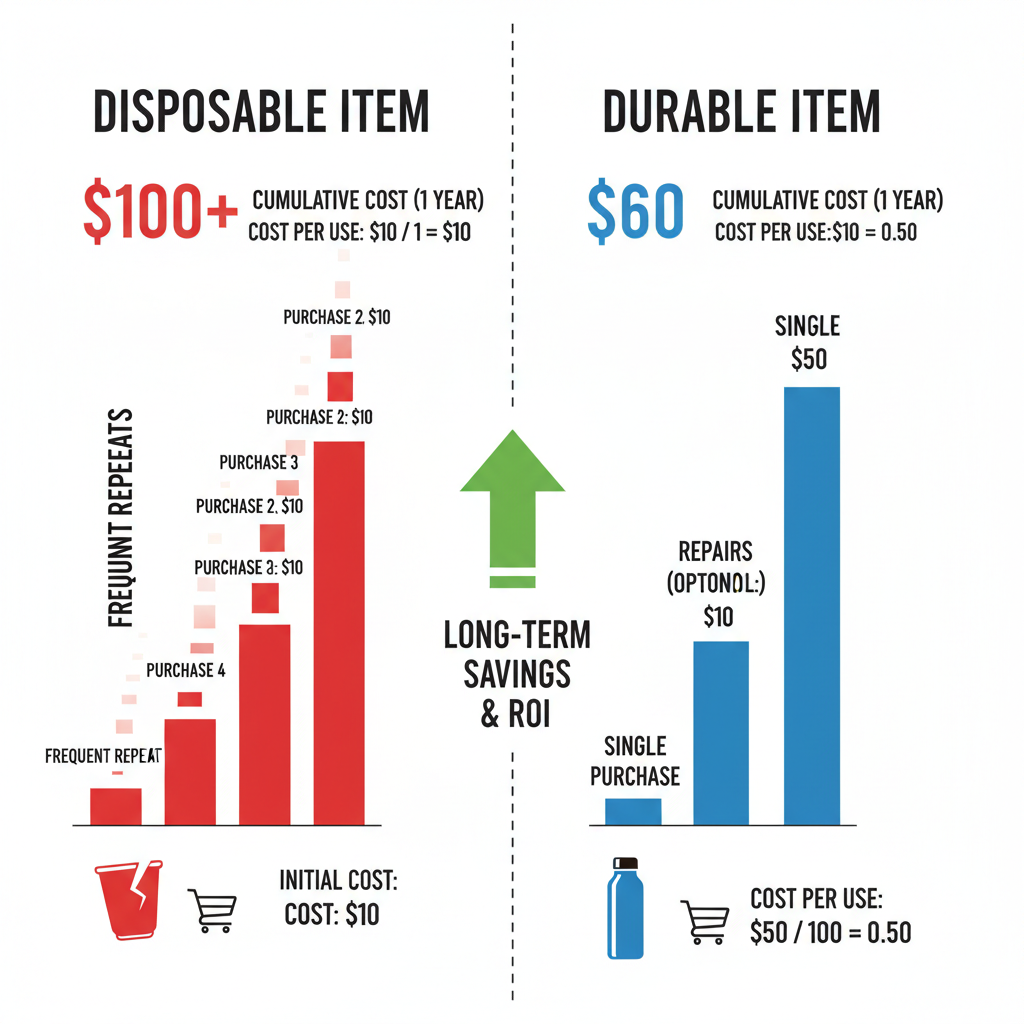
Consider the data: investing in high-quality, durable furniture can save consumers an average of $3,000 over a 20-year period compared to repeatedly buying and replacing “fast furniture” that breaks every few years. Certified Financial Planners (CFPs) frequently apply this “cost per wear” or “cost per use” concept to everyday purchases. A $50 synthetic coat that lasts one winter has a CPU of $0.56 per wear (assuming 90 wears). A $300 heritage wool coat that lasts 15 winters has a CPU of just $0.22 per wear. By spending more upfront, your ROI yields massive savings over a 10-to-20-year horizon.
Navigating “Lifetime” Warranties: Reading the Fine Print
When searching for products built to last a lifetime, consumers naturally gravitate toward “lifetime warranties.” However, as an impartial auditor of brand claims, it is vital to read the fine print.
The Federal Trade Commission (FTC) enforces strict warranty laws and consumer rights, but legal loopholes exist [15]. A “limited lifetime warranty” often refers to the product’s expected market lifetime, not the buyer’s lifetime, and frequently excludes “normal wear and tear.” To identify brands that actually stand by their craftsmanship, consult independent testing and warranty evaluations from organizations like Consumer Reports [16]. Look for ironclad, unconditional guarantees—often dubbed “No BS” warranties—where the manufacturer promises to repair or replace the item regardless of how it broke.
The “Swap This for That” Guide: High-Quality, Long-Lasting Alternatives
Knowing the science and the math is only half the battle; the next step is taking action. If you are ready to upgrade your life, you need high-quality, long-lasting alternatives to the disposable items currently failing you.
To select these premium craftsmanship solutions, we rely on a transparent, hands-on testing methodology mirroring the rigorous standards set by independent reviewers like Wirecutter [17]. Furthermore, we prioritize recommendations from B-Corp certified businesses, verified by B Lab, to ensure that the ethical and sustainable manufacturing of these alternatives matches their physical durability [18].
Everyday Upgrades for a “Buy It For Life” Household
Transitioning to a durable lifestyle happens one swap at a time. Here are the most impactful high-quality, long-lasting alternatives you can make today, backed by material science:
- Swap Teflon Non-Stick Pans for Seasoned Cast Iron or Carbon Steel: Teflon and synthetic non-stick coatings rely on polymers that inevitably degrade, scratch, and lose their slickness within 2 to 5 years (often releasing microplastics in the process). Cast iron, on the other hand, utilizes polymerized oils baked into the iron’s porous surface. If a cast iron pan loses its non-stick quality, you simply re-season it. It is a mechanical superiority that allows cast iron to easily outlast its owner.
- Swap Fast Fashion Basics for Heavyweight Cotton and Merino Wool: Cheap, blended synthetic fabrics pill, stretch, and hold onto odors. Swap them for 100% heavyweight cotton (which features longer, stronger fibers that resist tearing) or Merino wool (which is naturally antimicrobial and highly elastic).
- Swap Plastic Food Storage for Tempered Glass and Stainless Steel: Plastic containers warp in the dishwasher and absorb food stains. Tempered glass resists thermal shock, while food-grade stainless steel offers an unbreakable, non-porous alternative that will never warp, crack, or leach chemicals.
Conclusion
Embracing “The Adamantine Standard” is a rejection of the disposable culture that drains our wallets and pollutes our planet. While premium craftsmanship and durable design undeniably require a higher upfront investment, the long-term financial ROI, the reduction in environmental waste, and the sheer joy of using beautifully engineered tools make it a profoundly wise choice.
We challenge you to audit your next major purchase. Before you check out, run the item through the Red Flags Checklist, calculate its estimated Cost Per Use, and ask yourself if it truly meets the Adamantine Standard. By choosing to invest in quality, you are not just buying a product; you are acquiring an heirloom.
What are the longest-lasting “Buy It For Life” items you currently own? Share your most durable discoveries in the comments below.
Financial Disclaimer: ROI and Cost Per Use (CPU) calculations are estimates based on average consumer data.
Affiliate Disclaimer: This article may contain affiliate links to rigorously vetted durable goods.
References & Authoritative Sources
- Environmental Protection Agency (EPA). (N.D.). Data regarding global e-waste generation reaching 53.6 million metric tons.
- U.S. Public Interest Research Group (PIRG). (N.D.). Reports on consumer advocacy tracking the decrease of major household appliance lifespans from 10-15 years to 6-9 years.
- The Restart Project. (N.D.). Historical insights on the intentional shortening of product lifecycles and the Phoebus cartel.
- American Society for Quality (ASQ) / International Organization for Standardization (ISO). (N.D.). ISO 9001 standards for manufacturing Quality Assurance (QA) and Quality Control (QC).
- Journal of Materials Science. (N.D.). Peer-reviewed data on the hardness of commercial materials including tungsten carbide and synthetic diamond.
- American Society for Testing and Materials (ASTM). (N.D.). Global authority standards on material testing protocols and structural integrity.
- Underwriters Laboratories (UL). (N.D.). Global safety certification and durability testing benchmarks.
- Industrial Designers Society of America (IDSA). (N.D.). Professional standards and core principles of durable industrial design.
- The Crafts Council. (N.D.). Guidelines and authority on artisan standards, heritage crafts, and material behavior.
- The Smithsonian Institution. (N.D.). Authority on the historical preservation of artifacts and traditional manufacturing techniques.
- Ellen MacArthur Foundation. (N.D.). Studies on the circular economy, noting that extending a product’s lifespan by 9 months reduces carbon, water, and waste footprints by 20-30%.
- iFixit. (N.D.). Leading authority on product teardowns, repairability, and Right to Repair advocacy.
- Journal of Consumer Research. (N.D.). Academic insights on purchasing behavior, long-term value perception, and consumer spending habits.
- The Financial Diet. (N.D.). Authority on personal finance, budgeting, and the mathematics of smart spending.
- Federal Trade Commission (FTC). (N.D.). Government authority on warranty laws, legal loopholes, and consumer rights.
- Consumer Reports. (N.D.). Independent, non-profit product testing authority and warranty evaluations.
- Wirecutter. (N.D.). Renowned authority on rigorous, independent product testing methodologies.
- B Lab. (N.D.). Authority on B-Corp certified businesses, ensuring sustainable and ethical manufacturing practices.
