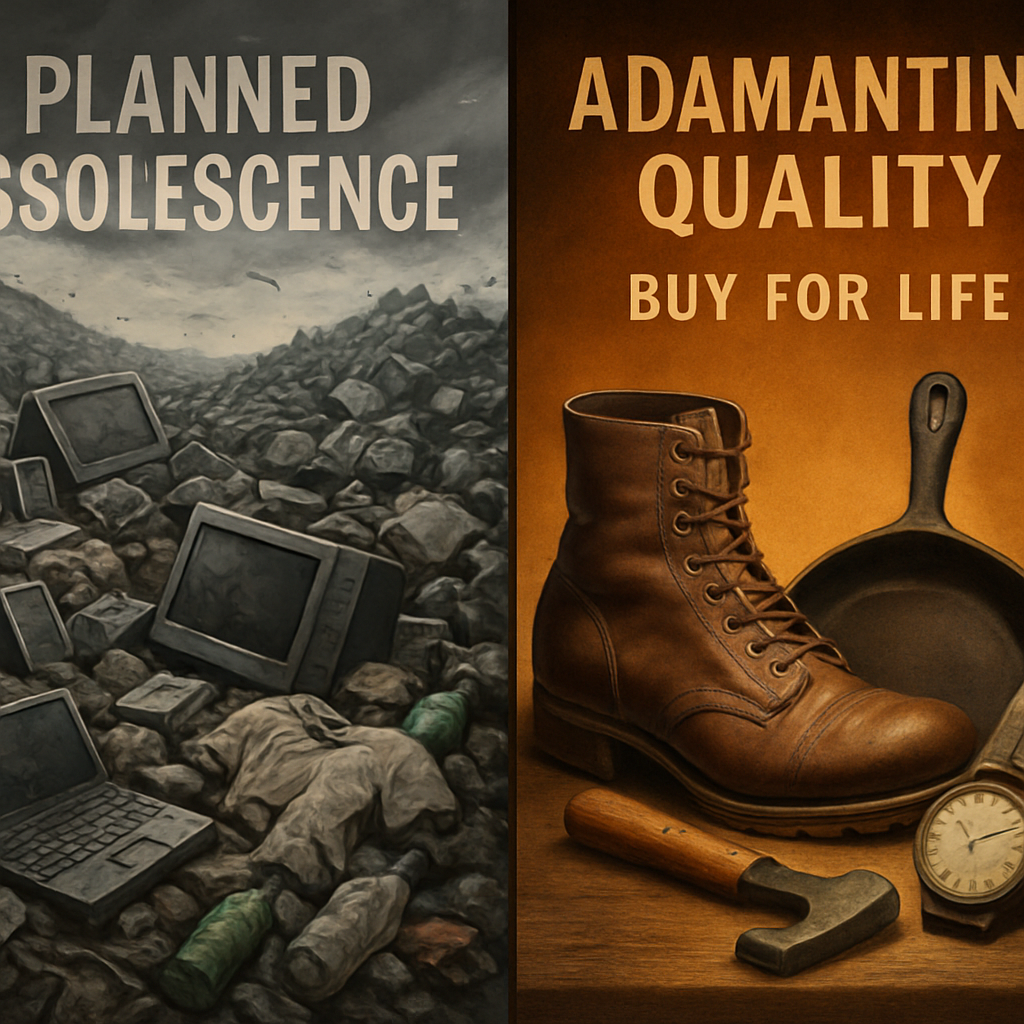
Does this sound familiar? You buy a new gadget, appliance, or piece of clothing. It works perfectly—for a while. Then, almost like clockwork, it sputters, frays, or breaks down just days after the warranty expires. You’re left with a piece of junk, a lighter wallet, and a nagging sense of frustration. This isn’t bad luck; it’s often by design. Welcome to the throwaway culture.
But what if there was an antidote? A powerful philosophy for choosing items not for their fleeting novelty, but for their unbreakable promise of enduring quality. This is the pursuit of Adamantine Quality.
The word “adamantine” means unconquerable, unshakeable, and utterly resilient. It’s the standard we should demand from the products we welcome into our lives. This article is your complete playbook for doing just that. We will empower you to escape the cycle of disposable goods, identify true durability, save significant money over the long term, and make choices that are better for both you and the planet.
Together, we will explore:
- The Problem: Unmasking the hidden strategy of planned obsolescence that drains your bank account.
- The Philosophy: Embracing the “Buy It For Life” mindset and the true meaning of adamantine quality.
- The Method: Learning a simple, 4-step framework for spotting quality in any product.
- The Arsenal: Discovering a curated list of vetted, built-to-last products you can trust.
It’s time to stop renting your belongings and start owning them for a lifetime.
- The Problem: Why Everything Breaks — Deconstructing Our Throwaway Culture
- The Philosophy: Embracing an Adamantine Mindset for Enduring Quality
- The Method: A 4-Step Durability Checklist for Finding Built-to-Last Products
- The Arsenal: A Curated List of Vetted ‘Buy It For Life’ Products
- Conclusion: Your First Step Towards an Adamantine Future
- Sources & References
The Problem: Why Everything Breaks — Deconstructing Our Throwaway Culture
Before we can find the solution, we must diagnose the disease. The constant need to replace our belongings is fueled by a system that profits from failure. This system is built on a foundation of planned obsolescence and a flood of low-quality, disposable consumer goods that harm our finances and our world.
What is Planned Obsolescence?
At its core, planned obsolescence is a business strategy where a product is deliberately designed with a limited lifespan, ensuring it will become outdated or non-functional after a certain period. As the financial resource Investopedia defines it, this is done “so that consumers will feel a need to purchase new products and services that the manufacturer brings out as replacements”.[1]
This isn’t a new concept. One of the most famous historical examples is the Phoebus cartel of the 1920s, an international committee of lightbulb manufacturers that colluded to artificially limit the lifespan of their bulbs to around 1,000 hours. Before this, bulbs that lasted over 2,500 hours were common.[2] By engineering a shorter life, they guaranteed repeat sales. This same principle is now applied to everything from smartphones to washing machines.
The Many Faces of Failure: Types of Designed Obsolescence
Planned obsolescence isn’t always as simple as a part that’s designed to break. It takes several insidious forms that are crucial to recognize:
- Contrived Durability: This is the most direct approach, where manufacturers use lower-quality materials or components in critical areas to ensure a product fails after a certain amount of use. Think plastic gears in an appliance where metal ones are needed, or thin fabric in clothing that quickly wears out.
- Prevention of Repairs: A product might be physically durable, but impossible or prohibitively expensive to fix. This includes using proprietary screws, gluing components like batteries into a sealed chassis, or failing to make spare parts available. Apple’s “batterygate” incident, where software updates throttled the performance of older iPhones with aging batteries—which were difficult for users to replace—is a well-documented case study of this practice.
- Systemic Obsolescence: This occurs when a product becomes obsolete because the ecosystem around it changes. A perfectly functional smartphone might lose its utility when its operating system is no longer supported by security updates or new apps. As explained in detailed analyses of industrial history, this makes the hardware useless even if it hasn’t physically failed.[3]
The True Cost of ‘Cheap’: Financial Drain and Environmental Disaster
The allure of a low price tag is powerful, but it masks a much higher long-term cost. Buying a $30 pair of shoes every year for a decade costs you $300. Investing in a $200 pair of well-made, repairable shoes that lasts for that same decade not only saves you $100 but also spares you the hassle of constant replacement.
The environmental consequences are even more staggering. Our throwaway culture generates mountains of waste. The fast fashion industry, a prime example of planned obsolescence, is a major contributor. According to environmental advocacy groups, it is responsible for over 18 million tonnes of clothing waste annually.[2] These disposable consumer goods—from single-use plastics to quickly discarded electronics—leach chemicals into our soil and water, consume vast amounts of energy in their production, and deplete finite natural resources.
The Philosophy: Embracing an Adamantine Mindset for Enduring Quality

Rejecting throwaway culture requires more than just smarter shopping; it requires a shift in mindset. It means moving from a consumer to an owner. It means embracing an adamantine philosophy—a resolute commitment to enduring quality, value, and sustainability.
What Does ‘Adamantine Quality’ Truly Mean?
The word “adamantine” is far richer than a simple synonym for “hard.” According to Merriam-Webster, its etymological root is the Greek word adamas, meaning “unconquerable” or “invincible”.[4] This is the same root that gives us the word “diamond.”
Its meaning extends across multiple disciplines, giving us a complete picture of what we should seek:
- In Mythology: Adamantine was an unbreakable, mythical material. The chains that bound Prometheus to the rock were said to be adamantine. It represents ultimate resilience against all forces.
- In Mineralogy: The term “adamantine luster” describes the brilliant, reflective surface of a diamond—a shine that doesn’t dull, signifying inherent, visible quality.
- In Character: To have an “adamantine will” is to possess unshakeable resolve and integrity.
When we apply this to products, “adamantine quality” means an item is not just durable, but well-crafted, reliable, repairable, and possesses a timeless design. It is built with integrity. To clarify a common point of confusion, academic resources break down the nuances between related terms:[6]
| Term | Core Meaning | Application to Products |
|---|---|---|
| Adamant | An unshakeable belief or refusal to be persuaded. | A company’s adamant refusal to compromise on quality standards. |
| Adamantine | Possessing the unbreakable, brilliant qualities of a diamond. | A product of adamantine quality, built to be unconquerable by time and wear. |
| Diamond | The literal gemstone known for its hardness and brilliance. | The material standard to which adamantine quality aspires. |
The ‘Buy It For Life’ (BIFL) Movement: A Community Against Disposability
You are not alone in this pursuit. A vibrant and growing community has formed around the “Buy It For Life” (BIFL) philosophy. This movement, most famously centered on the Reddit community /r/BuyItForLife, is a practical, crowdsourced effort to identify and celebrate products that are built to last.
This community has become such a credible source for consumer research that it’s frequently referenced by mainstream media outlets like TODAY.com.[7] Members share decades-old stories of their still-functioning appliances, post reviews of newly discovered durable brands, and offer advice on how to repair and maintain cherished items. It’s a powerful testament to the demand for quality and a treasure trove of real-world experience, with authentic user submissions validating which products truly stand the test of time.[8]
The Data-Backed Case for Long-Lasting Goods
Choosing enduring quality over disposability isn’t just a feeling—it’s a demonstrably smarter strategy with measurable benefits. Research from government institutions and consumer surveys confirms the powerful impact of this choice.
The U.S. National Institute of Standards and Technology (NIST) highlights the profound environmental benefits. Their research found that if a product’s life expectancy increases by 50%, it decreases the need for replacements and the associated environmental impacts by approximately 33%.[5] This simple choice directly reduces resource extraction, manufacturing pollution, and landfill waste.
Furthermore, consumers are actively demanding this change. A survey of European consumers revealed that 64% wanted their digital devices to last at least five years, signaling a widespread frustration with the short lifespans of modern electronics.[5] Investing in quality is a vote with your wallet for a more sustainable and economically sound future.
The Method: A 4-Step Durability Checklist for Finding Built-to-Last Products
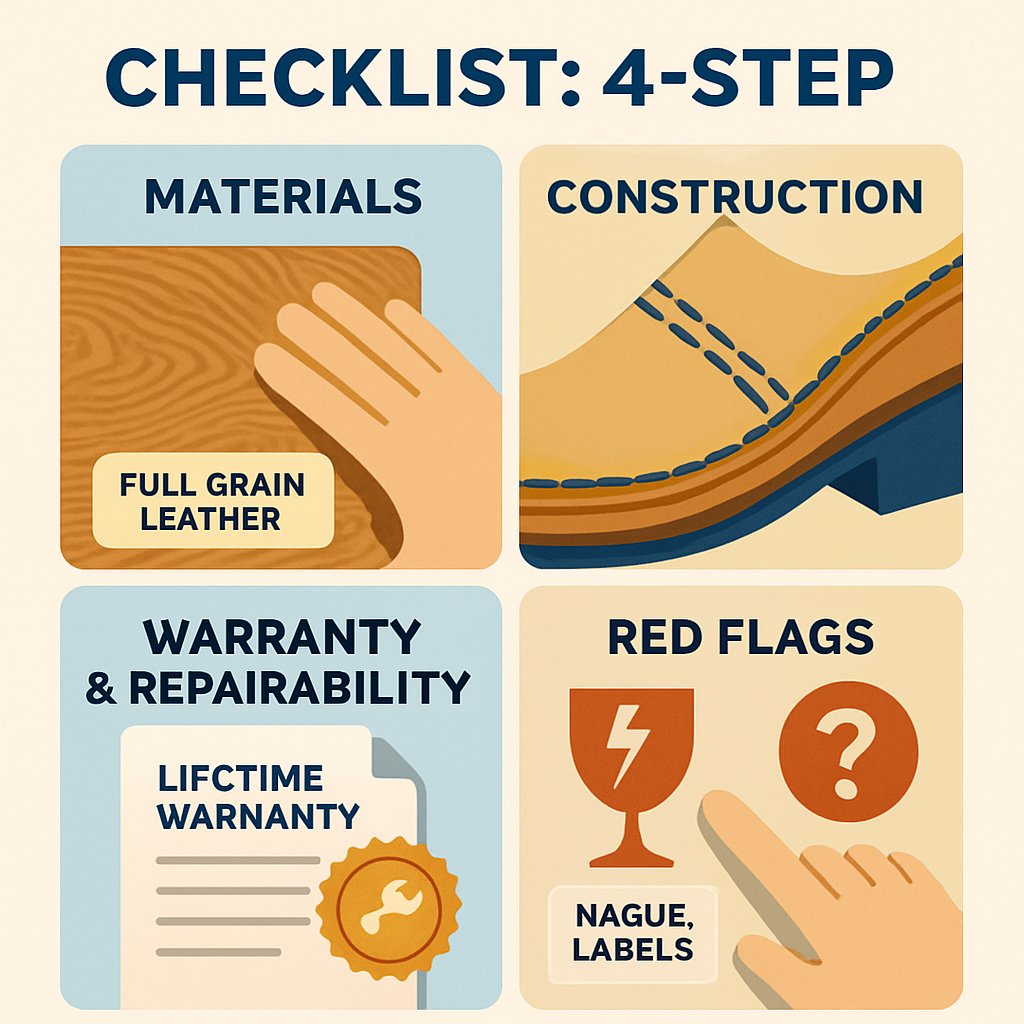
Embracing the philosophy is the first step. Now, it’s time for the practical application. How do you walk into a store or browse online and confidently separate the truly durable from the deceptively disposable?
This 4-step checklist is your systematic framework for evaluating any product. It moves beyond marketing claims and empowers you to become an expert assessor of quality. As noted by business experts, manufacturers who build lasting products focus on superior materials and stand behind their work—these are the signals we need to find.[9]
Step 1: Interrogate the Materials
A product is only as strong as its weakest component. The materials are its foundation. Learn to recognize the difference between high-quality inputs and cheap substitutes.
Materials Cheat Sheet:
- Leather: Look for Full-Grain or Top-Grain Leather, which are durable and develop a beautiful patina over time. Avoid Bonded Leather, which is a composite of leather scraps and polyurethane that quickly peels and cracks.
- Fabrics: Seek out dense, heavyweight natural fibers like high-density cotton, wool, and linen. As fashion designer Justine Leconte advises, check for straight grain and high-quality prints that are dyed into the fabric, not printed on top.[10] Be wary of thin, synthetic blends that are prone to pilling and losing their shape.
- Metals: Stainless Steel, Carbon Steel, and Titanium are signs of quality in cookware, tools, and gear. Be cautious of plated plastic or thin, lightweight pot metals that are designed to look like solid metal but will easily dent, chip, and break.
- Wood: Solid Hardwoods like oak, maple, and walnut are strong and can be refinished for a lifetime of use. Avoid Particle Board and MDF (Medium-Density Fiberboard) with thin veneers, which are easily damaged by moisture and cannot be effectively repaired.
Step 2: Scrutinize the Construction & Craftsmanship
How a product is assembled is just as important as what it’s made of. Poor workmanship can make even the best materials fail. Train your eye to spot the hallmarks of quality construction.
- Stitching: On clothing and upholstery, look for high stitch density (more stitches per inch), straight lines, and no loose threads. Low-quality items often have sloppy, uneven stitching that can unravel after a few washes.
- Fasteners & Hardware: Check zippers, buttons, and clasps. A high-quality YKK zipper on a bag is a good sign. Solid metal buttons that are securely attached are superior to flimsy plastic ones.
- Joinery: In furniture, look for solid joinery like dovetail or mortise-and-tenon joints. In tools and appliances, an all-metal gearbox is a key indicator of durability compared to one with plastic components.
- Footwear: For boots and dress shoes, a Goodyear welt is a gold standard. This is a method of construction where a strip of leather (the welt) is stitched to the upper and the sole. This makes the shoe highly water-resistant and, most importantly, allows it to be easily and repeatedly resoled, dramatically extending its life.
Step 3: Vet the Warranty and Repairability
A company’s confidence in its own product is reflected in its warranty. This is their promise to you.
Look for brands that offer a lifetime warranty or a robust, long-term guarantee. Read the fine print to understand what’s covered. A true lifetime guarantee, like the famous 100% satisfaction guarantee from L.L. Bean, is a powerful signal of quality. As personal finance experts at The Penny Hoarder note, these warranties are a significant money-saving tool over the long run.[11]
Beyond the warranty, consider repairability. Can the product be fixed? Are spare parts available from the manufacturer? The growing “Right to Repair” movement advocates for products that are designed to be serviceable. A product that can be repaired is a product that can be kept out of a landfill.
Red Flags: How to Spot a Low-Quality Product in Disguise
Just as important as knowing what to look for is knowing what to avoid. Manufacturers of low-quality goods are masters of disguise. Here are some common red flags:[12]
- Unusual Lightness: If a product feels suspiciously light for its size (e.g., a “metal” kitchen tool that feels like plastic), it likely is.
- Vague Material Descriptions: Terms like “man-made materials,” “genuine leather” (which can be the lowest grade), or proprietary names without explanation can hide inferior quality.
- Over-reliance on Marketing Hype: If the packaging and marketing focus on trendy features rather than materials and construction, be skeptical.
- Identical Failures in Reviews: When browsing customer reviews, look for patterns. One or two complaints about a specific failure might be a fluke. A dozen complaints about the same button breaking or seam ripping is a clear red flag of a design flaw.
Editor’s Tip: I once bought a stylish-looking desk lamp that boasted a “brushed metal finish.” It felt solid enough in the store. Within a year, the finish began to peel away at the base, revealing it was just cheap plastic with a metallic coating. This taught me a valuable lesson: always question the surface. If you can, find an inconspicuous spot to tap or feel the material underneath to verify its authenticity.
The Arsenal: A Curated List of Vetted ‘Buy It For Life’ Products
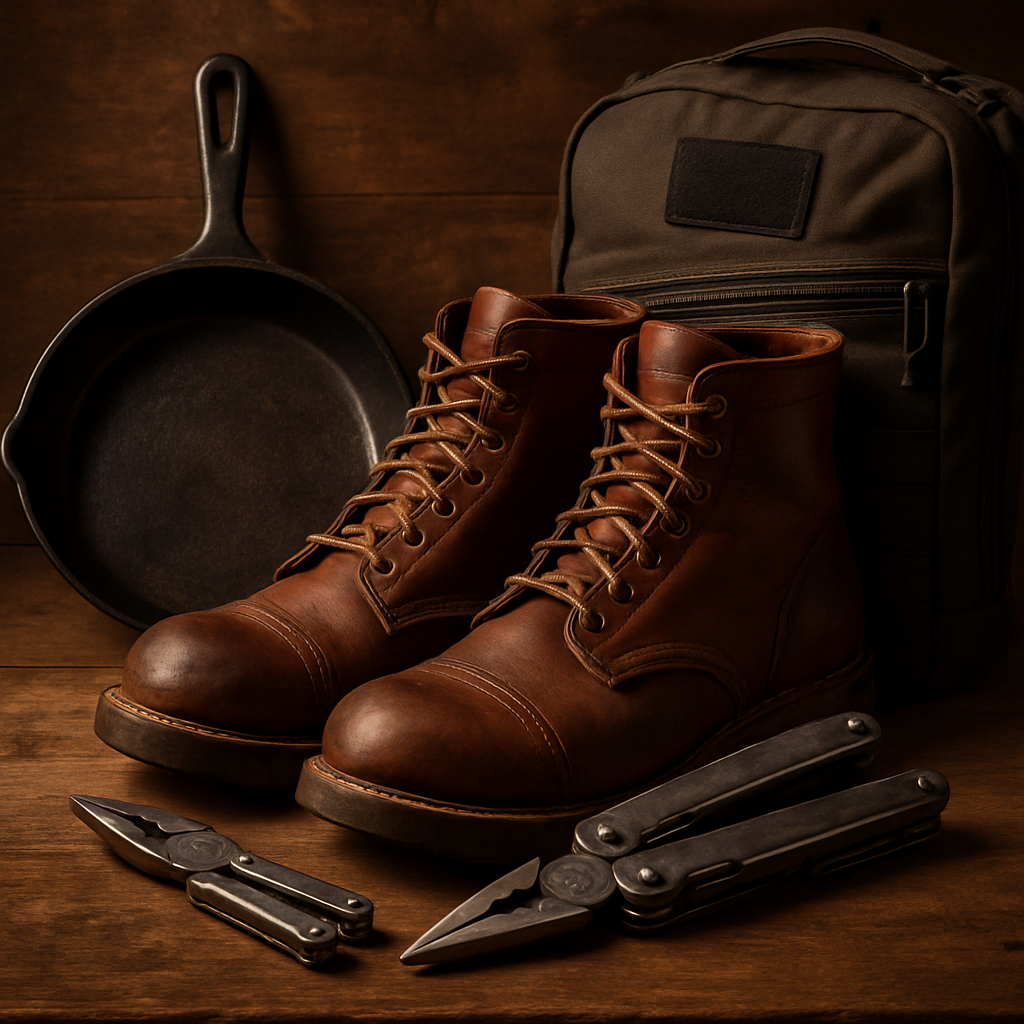
Putting the theory into practice, this section provides concrete recommendations for products and brands celebrated for their enduring, adamantine quality. These suggestions are synthesized from the rigorous testing of expert review sites like Wirecutter, the long-term experience of publications like WIRED, and the collective wisdom of BIFL communities.
Kitchen: Heirloom-Worthy Cookware & Appliances
The kitchen is where durability is tested daily. Investing here pays dividends in performance and longevity.
- Cast-Iron Skillets (e.g., Lodge, Griswold): A well-seasoned cast-iron skillet is virtually indestructible, provides a superior non-stick surface, and can be passed down for generations.
- All-Clad D3 Stainless Steel Cookware: Recommended by countless professional chefs and testing outlets like Wirecutter for its even heating and bombproof construction, these pans are an investment that will last a lifetime.[13]
- Miele Vacuums: This German brand is legendary in the BIFL community for its robust engineering. Miele vacuums are famously designed and tested to have a 25-year lifespan, a stark contrast to competitors that fail after just a few years.
Wardrobe: Clothing & Footwear That Endures
Escape the fast-fashion cycle with items designed for decades, not seasons.
- Red Wing Heritage Boots: Made in the USA with a Goodyear welt construction, these boots are famous for their durability. With proper care and the ability to be resoled, they can easily last 10 to 30 years, molding to your feet and looking better with age.
- L.L. Bean Products: From their iconic “Bean Boots” to their flannel shirts, L.L. Bean has built its reputation on a legendary satisfaction guarantee. They stand by their products, making them a trusted choice for outdoor and casual wear.
- Patagonia Clothing: Known for its “Ironclad Guarantee” and commitment to repairability, Patagonia makes high-performance outdoor gear that is built to withstand the elements and can be sent back for repair, often for free.
Workshop & Home: Tools That Outlast You
For tools and home goods, reliability is paramount. These brands are known for building things that work, every time.
- DeWalt Power Tools: Many professional-grade tools are built for durability, but DeWalt is often cited for design choices that enhance lifespan. For example, drills like the DCD771 feature an all-metal gearbox, a critical component that gives them an estimated lifespan of 10+ years under heavy use.
- Leatherman Multi-Tools: Backed by a 25-year warranty, a Leatherman is a compact toolbox built from high-quality steel. They are designed to be used, abused, and relied upon for decades.
- GoRuck Backpacks: As noted by long-term gear reviewers at WIRED and niche durability experts, GoRuck bags are built to military specifications with hyper-durable materials and come with a “SCARS Lifetime Guarantee” to repair any damage.[15][14]
Editor’s Long-Term Test: My own All-Clad 10-inch skillet was a wedding gift over 12 years ago. It has been used at least four times a week since then—for searing steaks, sautéing vegetables, and making pan sauces. It has been scorched, scrubbed, and put through the dishwasher countless times. Aside from some minor cosmetic scratches, it performs exactly as it did on day one. The handle is still rock-solid, and it heats as evenly as ever. It has outlasted three different non-stick pans that have come and gone in the same period. This is the definition of buying once and buying right.
Conclusion: Your First Step Towards an Adamantine Future
The world of disposable goods and planned obsolescence is frustrating, expensive, and unsustainable. It’s a system designed to fail you. But as we’ve seen, the solution is not only attainable but also deeply rewarding.
By embracing an Adamantine Mindset, you trade the fleeting high of a cheap purchase for the lasting satisfaction of true ownership. You arm yourself with knowledge, turning from a passive consumer into a discerning investor in your own life. The 4-Step Durability Checklist is not just a shopping guide; it is your framework for making intentional, powerful choices.
Choosing quality is a vote. It’s a vote for better products, for more responsible companies, for a healthier planet, and for a more financially secure future for yourself. You now have the playbook.
Your journey starts with a single choice. This week, use the 4-Step Durability Checklist to research one item you need to replace. Share what you discover in the comments below!
This article may contain affiliate links. If you purchase a product through one of our links, we may earn a small commission at no extra cost to you. This helps support our research and content.
Sources & References
- Investopedia. (N.D.). Planned Obsolescence: Definition, How It Works, and Examples. Retrieved from https://www.investopedia.com/terms/p/planned_obsolescence.asp
- Population Matters. (2024). From lightbulbs to smartphones: the practice of planned obsolescence. Retrieved from https://populationmatters.org/news/2024/04/from-lightbulbs-to-smartphones-the-practice-of-planned-obsolescence/
- Reliance Foundry. (N.D.). Planned Obsolescence and Product Sustainability. Retrieved from https://www.reliance-foundry.com/blog/planned-obsolescence-sustainability
- Merriam-Webster. (N.D.). Adamantine. In Merriam-Webster.com dictionary. Retrieved from https://www.merriam-webster.com/dictionary/adamantine
- National Institute of Standards and Technology (NIST). (N.D.). Product Longevity. Retrieved from https://www.nist.gov/el/applied-economics-office/manufacturing/circular-economy/product-longevity
- StudyGuides.com. (N.D.). Classification of the word adamantine. Retrieved from https://studyguides.com/study-methods/overview/cmfrd6auh0bsr016x68xqc4yl
- TODAY.com. (2024). 35+ products with lifetime warranties that are actually worth it. Retrieved from https://www.today.com/shop/products-lifetime-warranties-rcna137766
- BuzzFeed. (N.D.). 31 Long-Lasting Products That Are So Good, You’ll Probably Never Have To Buy Them Again. Retrieved from https://www.buzzfeed.com/maitlandquitmeyer/long-lasting-products
- Entrepreneur.com. (2017). 3 Tips for Manufacturing Products That Last a Lifetime. Retrieved from https://www.entrepreneur.com/growing-a-business/3-tips-for-manufacturing-products-that-last-a-lifetime/290935
- Leconte, J. (N.D.). How to tell good from poor quality in clothes. Retrieved from https://www.justineleconte.com/blogs/news/poor-vs-good-quality-in-clothes
- The Penny Hoarder. (N.D.). 32 Companies That Offer a Lifetime Warranty. Retrieved from https://www.thepennyhoarder.com/save-money/companies-with-lifetime-warranties/
- Simplicable. (N.D.). 16 Examples of Low Quality. Retrieved from https://simplicable.com/en/low-quality
- The New York Times (Wirecutter). (2024). The Things We Own That Have Lasted for Years. Retrieved from https://www.nytimes.com/wirecutter/reviews/best-buy-for-life-wirecutter-products/”
- Wellrigged.com. (N.D.). Durable Brands: 200+ Companies That Build Products To Last. Retrieved from https://www.wellrigged.com/durable-brands-built-to-last/”
- WIRED. (2023). 25 Durable Goods You Can Buy Once and Keep for Life. Retrieved from https://www.wired.com/story/buy-it-for-life/”
