If you live in a “high-chaos” household—one filled with active children, large dogs scrambling for traction, and a revolving door of guests—you already know the underlying stress of maintaining your home’s foundation. You invest heavily in beautiful surfaces, only to be met with vague marketing promises that ultimately leave you staring at scratched wood, dented vinyl, and hidden water damage. It is a frustrating cycle of buyer’s remorse, driven by a flooring industry that often prioritizes aesthetics over actual, measurable resilience.
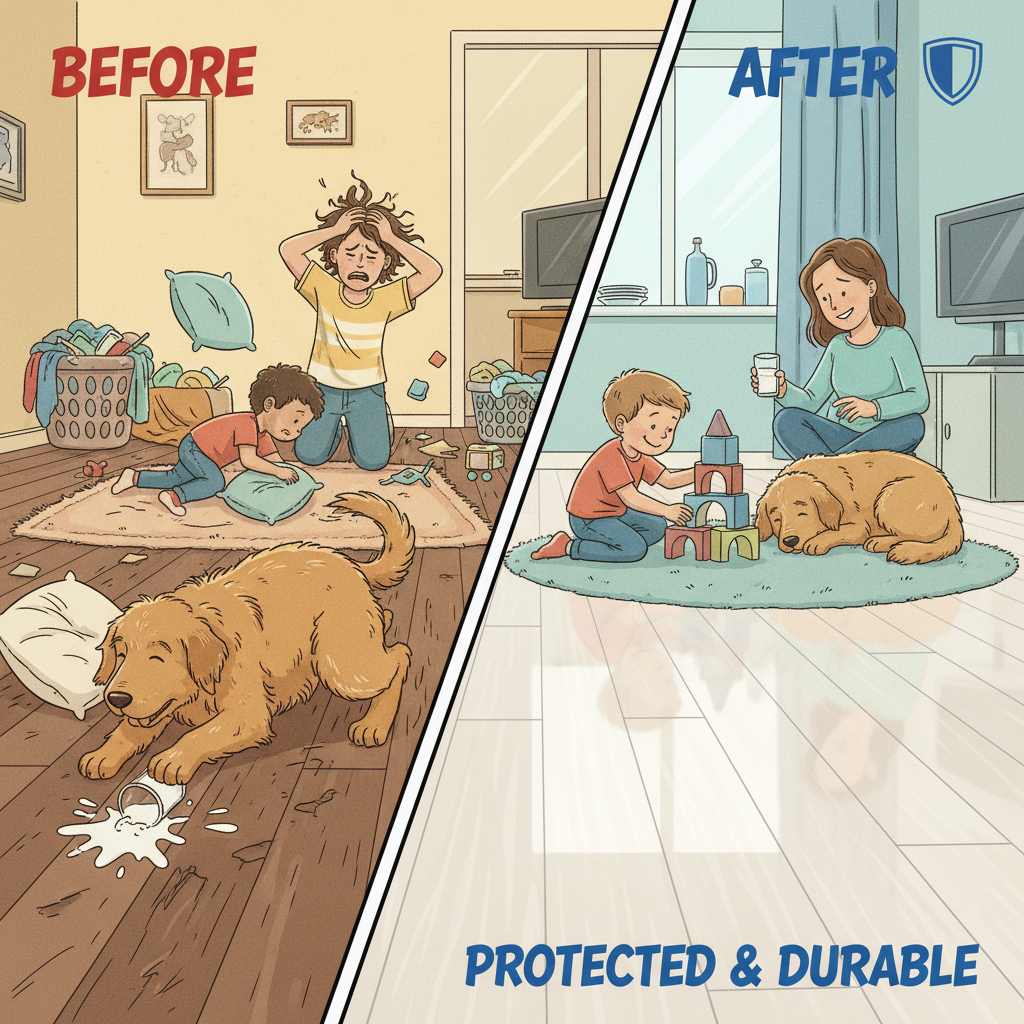
To truly protect your home, we must move beyond basic marketing claims and introduce the “Household Chaos” Flooring Matrix. This approach evaluates flooring not by how it looks in a showroom, but by the actual physics of durability—measuring Pounds per Square Inch (PSI), the Mohs hardness scale, and mil wear layers. By understanding the science of damage, you can see exactly why premium, ultra-durable solutions like Adamantine flooring offer the ultimate return on investment, protecting both your surface aesthetics and your home’s vulnerable subfloor.
- The Science of Durability: Deconstructing Scratches and Dents
- What is Adamantine Flooring? The Ultimate in Home Protection
- The “Household Chaos” Material Showdown
- The Subfloor Myth: Waterproof vs. Water-Resistant
- Damage Triage: Real-World Fixes for Scratches, Dents, and Floods
- Spill-Proof Floor Protection for Construction and Daily Life
- Conclusion
- References
The Science of Durability: Deconstructing Scratches and Dents
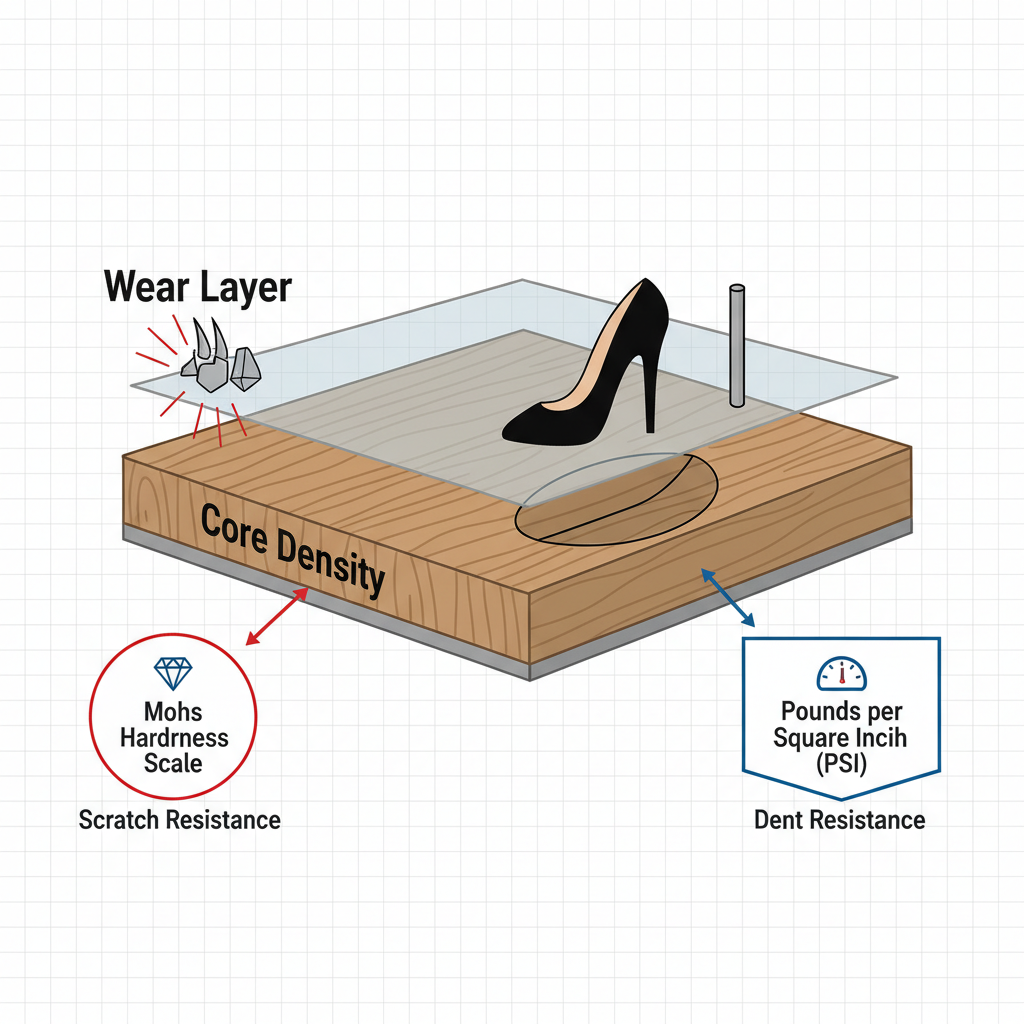
To make an informed decision, you must first understand the physical forces your floors battle every day. Floor damage generally falls into two distinct categories: surface scratches and structural dents. The technical difference between scratch resistant flooring and dent-resistant flooring comes down to the distinction between the surface wear layer and the core density of the plank itself.
Scratch resistance is dictated by the top coating—often measured by an AC (Abrasion Class) rating in laminates or the thickness of a polyurethane wear layer in vinyl. The hardness of these materials can be conceptualized using the Mohs hardness scale, a materials science standard that measures a substance’s resistance to being scratched by another [1]. If a dog’s claw or a piece of grit dragged under a shoe has a higher Mohs rating than your floor’s finish, a scratch is inevitable.
Dents, however, are a matter of core density and pressure. When dealing with floor dents from heavy furniture, we must look at Pounds per Square Inch (PSI). It is a shocking but true law of physics: a 125-pound person walking in stilettos exerts more PSI on a floor than a full-grown elephant [2]. When all that weight is concentrated into a tiny point—like a stiletto heel or a narrow couch leg—it easily crushes the core of softer woods and standard vinyl, leaving permanent indentations. Preventing dents requires a high-density core capable of dispersing that massive localized pressure.
What is Adamantine Flooring? The Ultimate in Home Protection
When homeowners reach their breaking point with easily damaged surfaces, they often ask: what is the absolute toughest option available, and why choose adamantine waterproof flooring? In materials science, “adamantine” refers to a diamond-like hardness and brilliant luster [1]. In the flooring industry, Adamantine flooring represents the pinnacle of ultra-premium, virtually indestructible home protection, engineered specifically to survive extreme residential and commercial abuse.
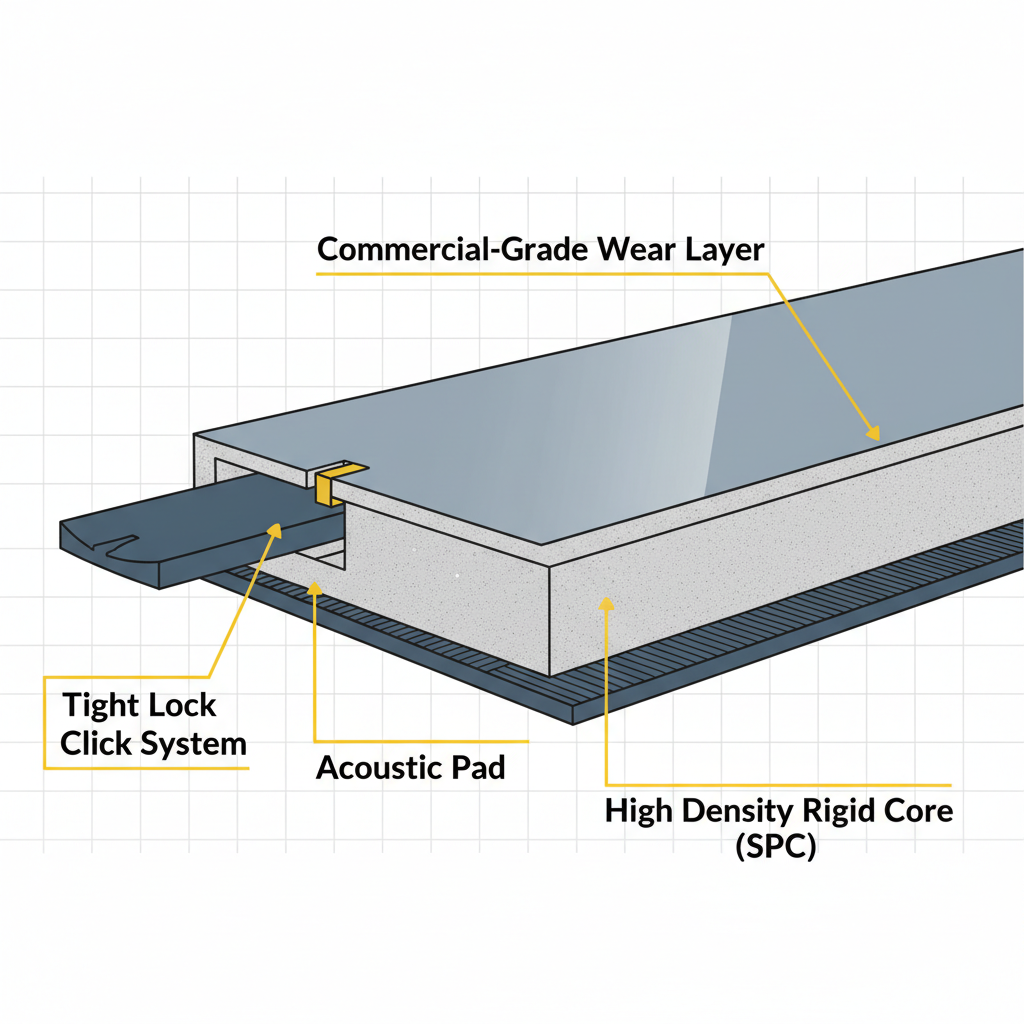
To understand its resilience, we must deconstruct the layers of premium adamantine-grade flooring with technical accuracy. It begins at the base with an attached Acoustic Pad, which dampens sound and provides slight flex. Above this sits the High Density Rigid Core—often a specialized Stone Plastic Composite (SPC) that provides the immense structural density required to resist high-PSI impacts and prevent dents. Finally, it is topped with a commercial-grade Wear Layer (often exceeding 20 to 30 mils) that acts as an impenetrable shield against claws, cleats, and sliding furniture.
Furthermore, these premium lines utilize advanced Tight Lock Click Systems, which offer up to five times more contact points at the seams than standard laminate. This is critical for preventing moisture penetration. While the initial price per square foot may be higher than big-box alternatives, a “Cost of Failure” analysis reveals its true value. The upfront cost of premium Adamantine flooring is significantly lower than the long-term, compounding costs of replacing cheap, delaminating laminate and repairing rotting subfloors every five to seven years.
The “Household Chaos” Material Showdown
Selecting the right material requires matching the product to your specific lifestyle. We can categorize the best durable flooring for active homes by looking at the “Household Chaos” levels. A home with Dual Income, No Kids (DINKs) has vastly different requirements than a home with three toddlers and two Golden Retrievers.
For maximum longevity, porcelain tile is a titan; with proper installation, it can easily last 50+ years [3]. Polished concrete offers similar industrial-grade longevity. However, both come with a severe “hardness vs. comfort” trade-off—they are unforgiving on joints and cold underfoot. For the active family seeking a balance of comfort and resilience, Luxury Vinyl Plank (LVP) and SPC are the reigning champions of scratch and dent resistant flooring options. However, data dictates that for a home with pets and kids, you must demand an LVP with a wear layer of 20 mils or higher to prevent premature degradation [3].
Dent-Proof vs. Shatter-Proof: The Drop Test Reality
When evaluating dent proof flooring, we must look at objective testing methodologies, such as the rigorous durability and drop testing protocols pioneered by experts like Li Wang at Consumer Reports [3].
Many consumers mistakenly rely on the Janka hardness scale, but this metric is designed exclusively for wood and fails to account for the impact resistance of modern synthetics and stone. This brings us to “The Drop Test.” If you drop a heavy cast-iron pan in your kitchen, porcelain tile—while completely dent-proof—is rigid and prone to shattering or cracking under blunt force trauma. Conversely, a high-density rigid core vinyl (SPC) might sustain a microscopic, barely visible dent, but it will not shatter. For active kitchens with heavy appliances and frequent drops, SPC often wins the real-world drop test.
The Subfloor Myth: Waterproof vs. Water-Resistant
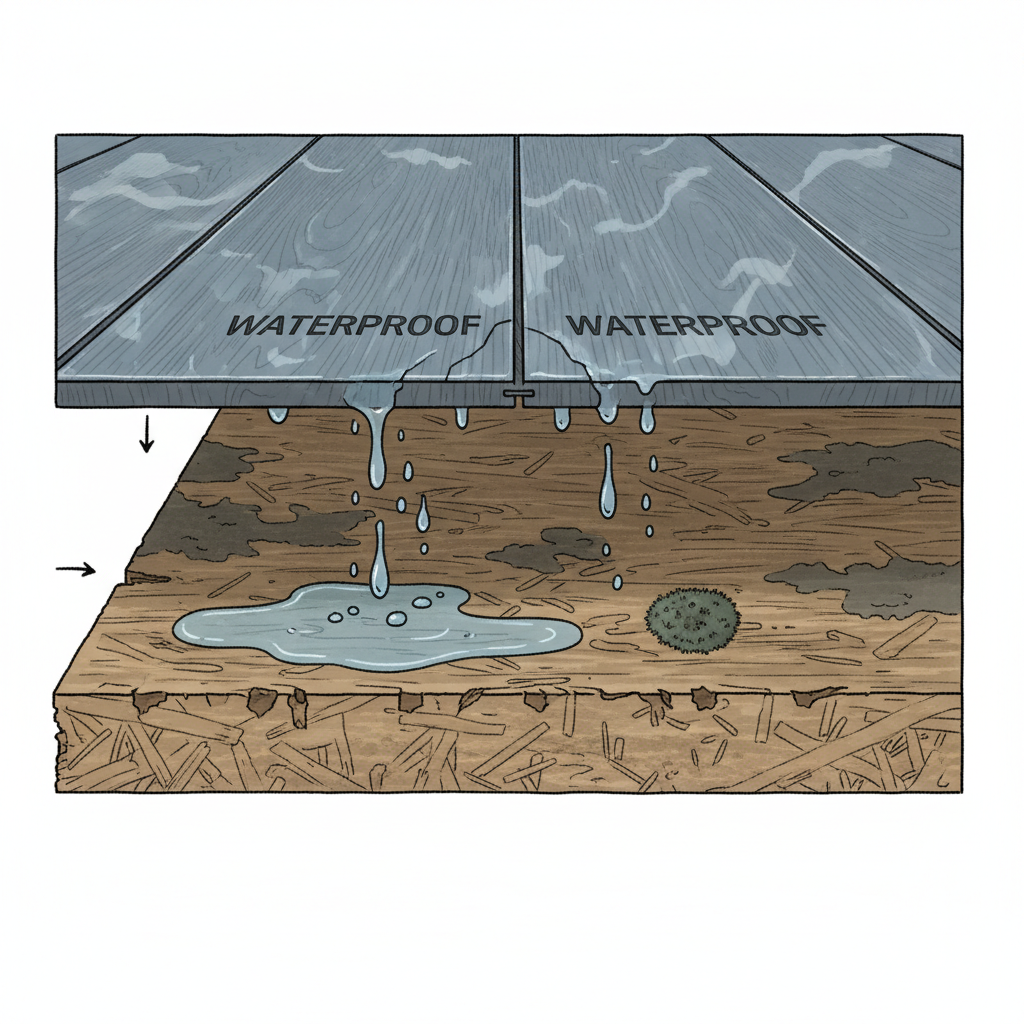
Perhaps the most dangerous misconception in home improvement is the belief that surface-level waterproof flooring protects the entire house from leaks. This is the Subfloor Myth.
When a product claims to be “100% waterproof,” it strictly means the plank itself will not swell, warp, or degrade when submerged in water. However, the floor system as a whole is not a watertight bathtub. If a dishwasher leaks, standing water will eventually seep through the microscopic seams between the planks. Once water bypasses the surface, it becomes trapped between the flooring’s acoustic pad and your home’s wooden subfloor.
According to the Institute of Inspection, Cleaning and Restoration Certification (IICRC) water damage standards, trapped moisture that cannot evaporate is the primary catalyst for catastrophic structural rot and toxic mold [4]. Therefore, while your waterproof planks may survive a flood perfectly intact, the vulnerable subfloor beneath them can be completely destroyed if the water is not properly mitigated.
Damage Triage: Real-World Fixes for Scratches, Dents, and Floods
Even with the most durable home flooring, life happens. When damage inevitably occurs, knowing how to execute a proper DIY triage can save you thousands of dollars in professional repairs.
For scratched hardwood floors, triage depends on depth. Surface-level scuffs in the polyurethane finish can often be masked with a Tibet Almond Stick or a walnut rubbed into the scratch. However, if the gouge cuts past the stain and into raw wood, surface markers will fail, and localized sanding or professional board replacement is required.
For floor dents in wood, the “wet towel and iron” trick is a highly effective remedy. By placing a damp cloth over the dent and applying a hot iron in short bursts, the steam forces the crushed wood fibers to swell back to their original shape [5]. Similarly, heavy furniture dents in carpet can often be lifted by letting an ice cube melt into the fibers, followed by a gentle fluffing with a spoon or steam iron [5].
The 48-Hour Water Damage Timeline
When dealing with flooring water damage, time is your greatest enemy. If you experience a leak, understanding the 48-hour timeline is critical for saving your subfloor.
- 0-12 Hours: Water seeps through seams and begins pooling on the subfloor. Immediate extraction using wet vacuums and high-velocity fans is required.
- 12-24 Hours: Hardwood floors will begin to cup (edges raise higher than the center) as the bottom of the board absorbs moisture faster than the top. Laminate cores will begin irreversible delamination.
- 24-48 Hours: Mold spores begin to germinate in the dark, damp space between the floor and subfloor.
If you catch the damage early enough, authoritative guidelines recommend using a phosphate cleaning solution (4 to 6 tablespoons of Trisodium Phosphate to a gallon of water) to clean the subfloor and halt mildew growth before reinstalling the dried planks [6].
Spill-Proof Floor Protection for Construction and Daily Life
Finally, true home protection bridges the gap between permanent flooring and temporary spill proof floor protection. Whether you are undergoing a major renovation, moving heavy furniture, or simply trying to protect the floor beneath a toddler’s highchair or a sloppy dog’s water bowl, the right barrier is essential.
For daily life, aesthetic, easy-clean silicone mats provide excellent localized protection. However, for construction and renovations, you must rely on heavy-duty surface protectors. The critical science here is “breathability.” If you cover newly finished hardwood or curing concrete with non-breathable plastic sheeting, you will trap rising moisture emissions, causing the new finish to cloud or the wood to warp. Professional-grade surface protectors are engineered to be waterproof from the top down (stopping paint and spills) while remaining breathable from the bottom up, allowing the floor beneath to safely cure [7].
Conclusion
Navigating the “Household Chaos” matrix proves that the best flooring isn’t just about the color or the finish; it is about matching the physical demands of your life to the scientific capabilities of the material. By understanding PSI, wear layers, and the critical difference between surface waterproofing and subfloor protection, you can bypass the marketing fluff. Investing in premium, high-mil wear layer solutions like Adamantine flooring ensures that your home is fortified against the scratches, dents, and spills of daily life. Before your next flooring purchase, always check the exact mil wear layer specifications of the product, and consider consulting with an NWFA-certified installer to evaluate the health of your subfloor.
Disclaimer: The DIY floor repair methods described in this article are for informational purposes. Always test repair techniques on an inconspicuous area first. Regarding water damage mitigation, strict health and safety precautions must be taken. Always turn off electricity to flooded areas to avoid severe electrical hazards. Do not attempt DIY mitigation on “black water” (sewage or floodwaters containing biohazards), and consult a certified remediation professional if mold growth is present or suspected.
References
- Materials Science and Engineering Journals. (N.D.). Defining Adamantine: The Mohs Hardness Scale in Materials Science. Retrieved from authoritative materials science definitions.
- Carter’s Floor and Surface Care. (N.D.). The Physics of Floor Dents: PSI and Indentations. Retrieved from professional restoration insights.
- Wang, L. (N.D.). Flooring Durability and Drop Testing Protocols. Consumer Reports. Retrieved from Consumer Reports objective durability testing.
- Institute of Inspection, Cleaning and Restoration Certification (IICRC). (N.D.). Standards for Water Damage Restoration. Retrieved from IICRC water damage standards.
- Room for Tuesday. (N.D.). DIY Floor Repair: Fixing Dents and Scratches in Wood and Carpet. Retrieved from practical DIY repair methods.
- University of Michigan EHS / FEMA. (N.D.). Mold Prevention and Flooded Home Recovery Protocols. Retrieved from scientifically backed mold prevention guidelines.
- Trimaco. (N.D.). Breathable Surface Protection Specifications for Construction. Retrieved from manufacturer technical data sheets.
