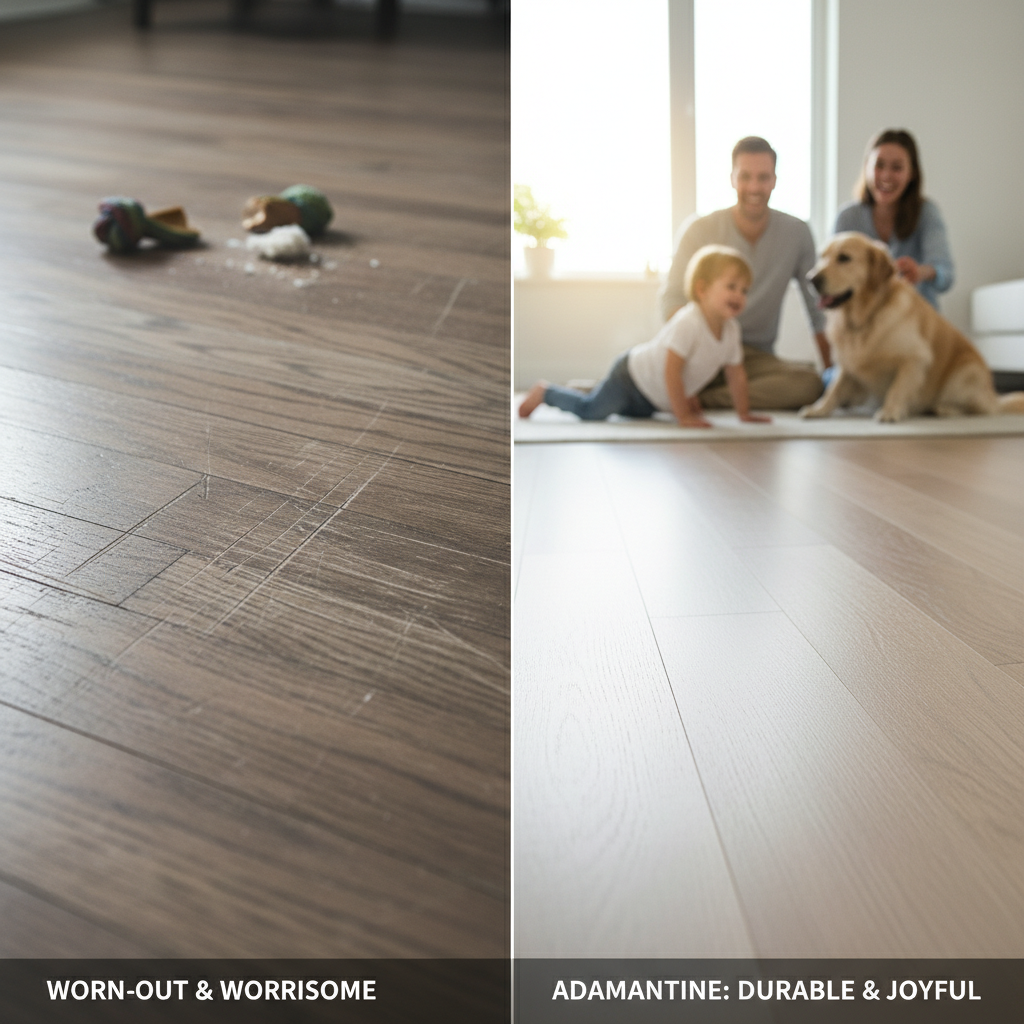
There are few things more frustrating for a homeowner than watching a significant financial investment degrade before their eyes. For active households, chronic cosmetic floor degradation—deep scratches from large pets, scuffs from heavy furniture, and the inevitable damage from high-traffic zones—is a daily battle. Traditionally, the solution has been solid hardwood, which comes with the heavy financial burden and lifestyle disruption of a 7-to-10-year sanding and refinishing cycle. But what if your flooring could simply withstand the chaos?
Welcome to the definitive, unbiased breakdown of “Buy It For Life” flooring options. In this comprehensive guide, we will move beyond marketing fluff to evaluate the true science of extreme durability. We will provide a detailed evaluation of Adamantine flooring’s proprietary aluminum oxide technology, offering a complete roadmap that covers triage for your current floors, material science, 30-year cost-amortization, and the precision installation required to make your next floor your last.
- Diagnosing Worn Out Home Floors: Triage, Repair, or Replace?
- The Science of Durable Home Flooring: What Makes a Floor ‘Buy It For Life’?
- Adamantine Flooring Performance: A Deep Dive into Aluminum Oxide Technology
- Adamantine vs. Traditional Hardwood: The 30-Year Cost Amortization
- Contractor’s Corner: The Complete Adamantine Installation Blueprint
- Maintenance Protocols: Protecting Your 50-Year Warranty
- Conclusion
- References & Authoritative Sources
Diagnosing Worn Out Home Floors: Triage, Repair, or Replace?
Before investing in new materials, you must accurately assess your current situation. Many homeowners struggle to determine if their worn out home floors are merely suffering from superficial cosmetic wear or if they are experiencing systemic structural failure. Categorizing this damage correctly is the critical first step in deciding whether to salvage your existing floors or upgrade to a more resilient residential flooring solution.
According to guidelines established by the National Wood Flooring Association (NWFA) regarding hardwood refinishing standards and limitations, a floor’s viability depends heavily on its remaining thickness and structural integrity [1].
To help you decide, use this clear diagnostic checklist:
- Signs You Should Refinish: Surface-level scratches in the polyurethane topcoat, minor fading from UV exposure, and localized scuffs that do not penetrate the wood grain.
- Signs You Should Replace: Severe water damage resulting in irreversible cupping or crowning, deep structural cracks, spongy subfloors, or engineered wood that has already been sanded down to its final veneer layer.
Assessing High Traffic Floor Damage and Deep Scratches
High traffic floor damage rarely happens overnight; it is a gradual erosion. The mechanics of this damage are simple but destructive: tracked-in winter salt and microscopic grit act exactly like sandpaper against your floor’s finish. The chemical and physical damage caused by winter salt on polyurethane finishes is particularly severe, as the sharp crystalline structure of the salt grinds into the protective wear layer while its hygroscopic nature draws out moisture, leading to premature cracking and peeling [2].
If you are dealing with scratched residential flooring, immediate triage can prevent further degradation. For minor scuffs on hard surfaces, a DIY baking soda paste (three parts baking soda to one part water) rubbed gently over the mark can buff out superficial blemishes. However, for deeper gouges in modern synthetic floors, professional intervention or specific replacement techniques are required. Professional flooring installers note that one of the greatest advantages of modern click-lock systems is localized structural repair; it is entirely possible to replace a single damaged Luxury Vinyl Plank (LVP) by carefully cutting out the damaged section and gluing down a replacement plank with a modified tongue, entirely without pulling up the whole floor [3].
The Refinish vs. Replace ROI Calculator
When facing worn out home floors, the ultimate question is: Is it cheaper to refinish or replace? The answer lies in the physical limitations of your current material. Solid wood is highly valued because it can be sanded and refinished multiple times over decades. Engineered wood, however, has a finite veneer thickness (usually 1mm to 4mm) and can only be sanded once or twice. Laminate cannot be sanded at all; once the photographic top layer is breached, the floor is ruined.
You must also factor in what lies beneath. Licensed General Contractors emphasize that subfloor integrity and structural repairs should heavily influence your decision [4]. If your floors suffer from chronic squeaks, unevenness, or moisture vapor transmission from the concrete slab below, paying to refinish the surface is a waste of money. Visual indicators of a floor that is “too far gone”—such as wide, unfillable gaps between planks, splintering edges, and nails showing through the surface—mean that replacement is not just an aesthetic choice, but a structural necessity.
The Science of Durable Home Flooring: What Makes a Floor ‘Buy It For Life’?
Transitioning from problem to solution requires understanding the actual science of durable home flooring. A true “Buy It For Life” floor balances two concepts: durability (how well it resists damage) and restorability (how easily it can be fixed if damaged). Furthermore, when evaluating a long-lasting floor replacement, consumers must consider the impact of changing interior design trends. A floor might have a physical lifespan of 50 years, but if its aesthetic lifespan is only 10 years before it looks hopelessly dated, it is not a true lifetime investment.
To separate marketing claims from reality, we look to standardized testing methods used by independent organizations like Consumer Reports, which utilize abrasive machine testing to quantify exactly how much abuse a floor can take before failing [5].
Decoding Resilient Residential Floors: Wear Layers and AC Ratings
The flooring industry is filled with jargon. To start, “resilient flooring” is officially defined by the Resilient Floor Covering Institute (RFCI) as a category of highly engineered materials including vinyl, linoleum, cork, and rubber [6]. Modern resilient residential floors, such as LVP and SPC (Stone Plastic Composite), are constructed in distinct layers: an attached acoustic underlayment, a rigid or semi-rigid core, a high-definition print film, and a clear protective wear layer.
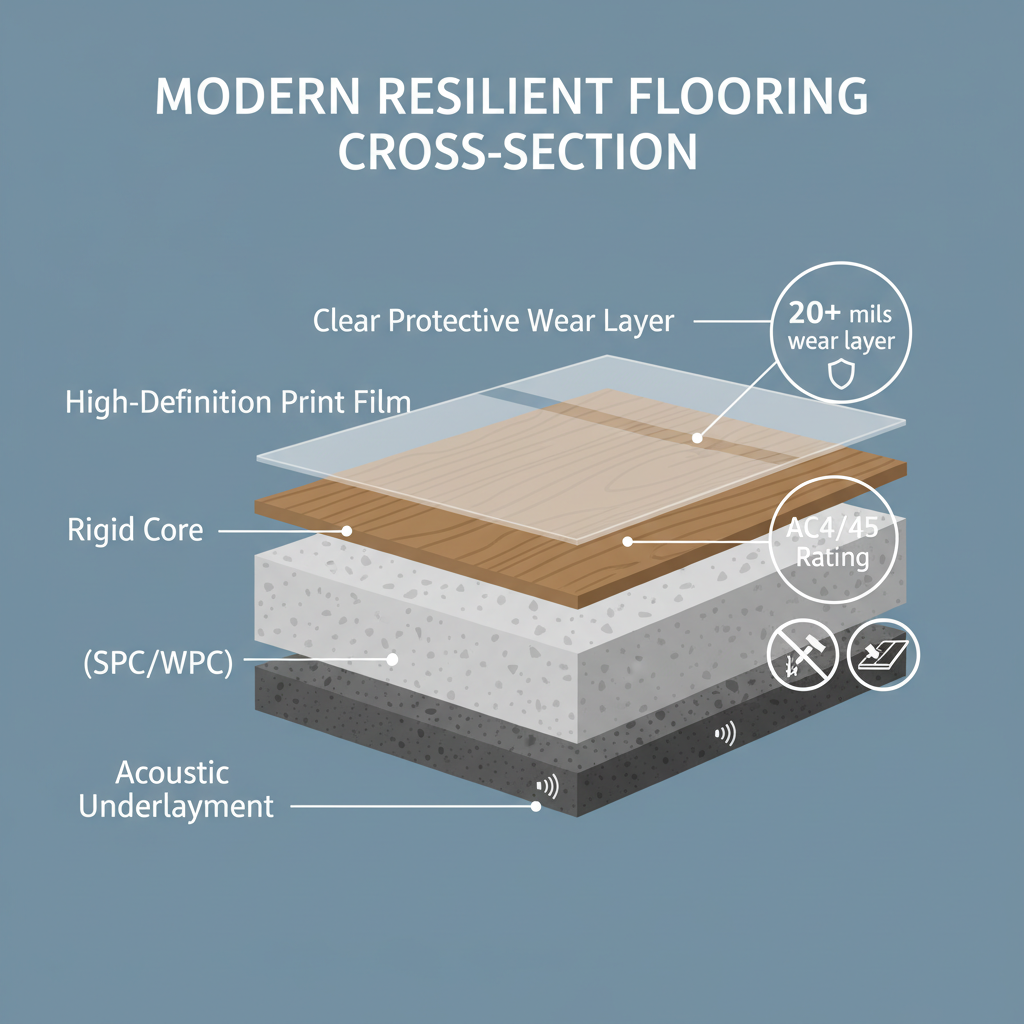
When shopping, you must explicitly understand the difference between the scratch resistance of the wear layer and the dent resistance of the core.
- Wear Layers (Vinyl/SPC): Measured in “mils” (one-thousandth of an inch). For active households with pets, a wear layer of 20+ mils is highly recommended to prevent surface scratching.
- AC Ratings (Laminate): Laminate durability is measured by Abrasion Class (AC) ratings. AC1 is for light residential use, while AC4 or AC5 is required for heavy traffic and commercial spaces.
Furthermore, modern resilient options have made massive strides in environmental safety, with many top-tier products meeting strict GreenGuard standards for low VOC (Volatile Organic Compound) emissions, ensuring your durable floor doesn’t compromise your indoor air quality [7].
High-Performance Residential Flooring Options: The Durability Matrix
To find the best high-performance residential flooring options, we must compare materials head-to-head across a “Durability vs. Comfort” matrix.
- Porcelain Tile: The undisputed king of raw durability. According to data from the Tile Council of North America (TCNA), porcelain tile is fired at incredibly high temperatures, making it 20 to 30 percent harder than granite [8]. It is entirely waterproof and scratch-proof. However, it is cold, brutally hard underfoot, and highly slippery for older pets.
- SPC (Stone Plastic Composite): Features a limestone core. It is exceptionally dent-resistant and 100% waterproof, making it one of the top scratch resistant flooring solutions when paired with a thick wear layer. It is firmer underfoot than traditional vinyl.
- WPC (Wood Plastic Composite): Features a wood-flour core. It is softer and warmer underfoot than SPC, offering better acoustic properties, but is slightly more prone to heavy-impact denting.
- Luxury Vinyl Plank (LVP): A broad term, but generally refers to traditional flexible vinyl. It is highly water-resistant but requires a perfectly smooth subfloor to prevent telegraphing (imperfections showing through).
Li Wang, Consumer Reports Flooring Test Lead, notes regarding standardized surface-wear tests that while traditional solid and engineered wood offer classic beauty, they generally receive satisfactory or less-than-satisfactory ratings in raw abrasion resistance when compared directly to high-quality laminate and vinyl [9].
Adamantine Flooring Performance: A Deep Dive into Aluminum Oxide Technology
For homeowners unwilling to compromise between the aesthetic beauty of hardwood and the extreme durability of porcelain or SPC, Adamantine flooring has emerged as the premium hybrid solution. Adamantine flooring performance bridges this gap through proprietary surface engineering.
According to Adamantine Official Manufacturer Specifications, the product is backed by a comprehensive 50-year residential warranty, a testament to its unique material composition [10]. The secret to its longevity—and the answer to the common query of how durable is adamantine flooring—lies in its use of aluminum oxide. Materials Science Journals confirm that aluminum oxide (corundum) is a crystalline compound with a Mohs hardness of 9, placing it just below diamond and on par with sapphire and ruby gemstones [11].
What is Adamantine Flooring Made Of?
Adamantine flooring is not traditional wood, nor is it standard vinyl; it is a 100% waterproof hybrid construction. According to Adamantine Technical Specifications, the anatomy of the plank consists of a rigid, waterproof mineral core fused with a real wood veneer [12].
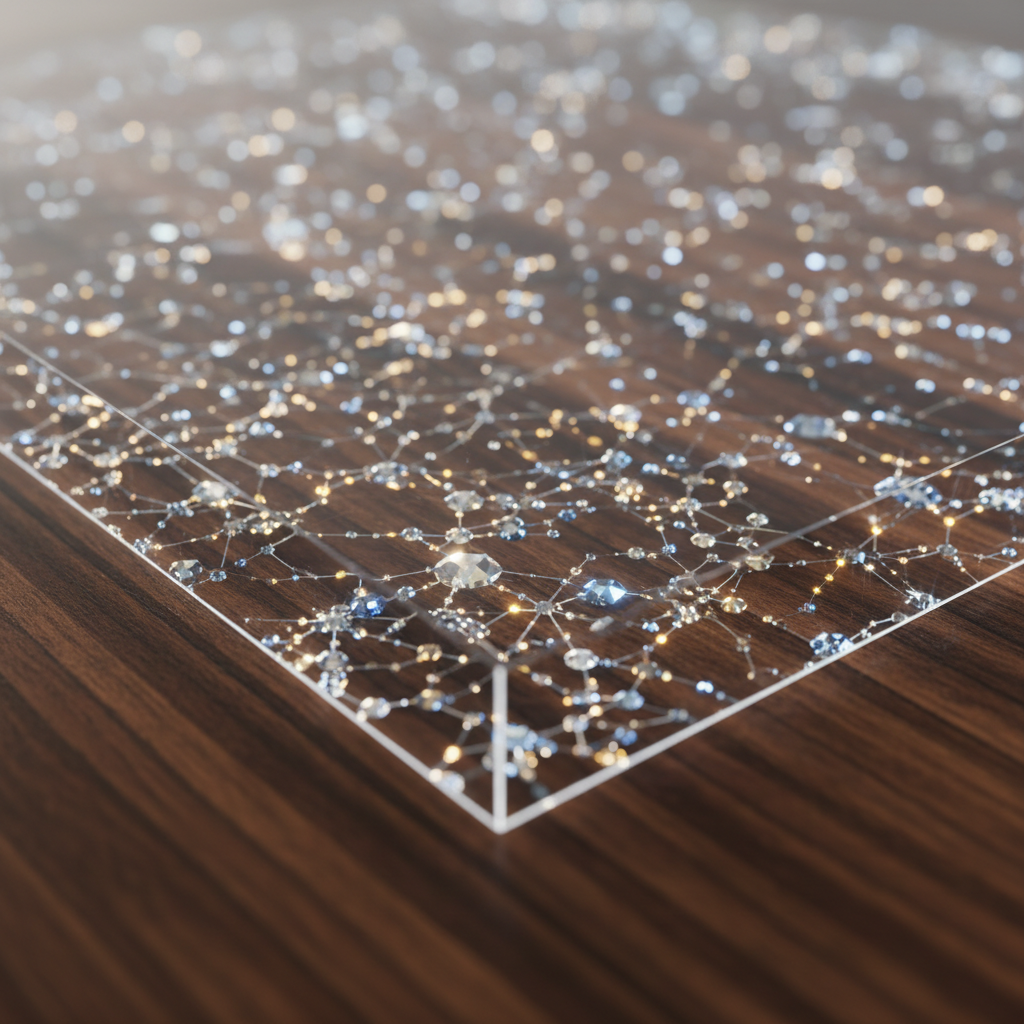
The defining feature, however, is the finish. Unlike traditional polyurethane that simply sits on top of the wood and is easily scratched off, Adamantine utilizes a specialized UV-curing process during manufacturing. This process bonds millions of microscopic aluminum oxide nanoparticles into a crystal-clear protective barrier. This liquid glass-like finish penetrates multiple layers of the wood surface, reinforcing the cellular structure of the veneer itself. Additionally, the dense hybrid core provides excellent acoustic performance, drastically reducing sound transmission in multi-story homes compared to standard hollow-sounding laminates.
Room-by-Room Adamantine Flooring Performance in Homes
When evaluating Adamantine flooring performance in homes, the real-world application is what matters. Because of its 100% waterproof mineral core, Adamantine can be installed in full bathrooms and kitchens—environments where traditional hardwood would warp, cup, and fail within months due to moisture exposure.
In high-traffic hallways and entryways, the gemstone-infused finish proves its worth. Independent third-party testing, specifically utilizing the rigorous Taber Abrasion Test, demonstrates that Adamantine features 3x greater scratch resistance than standard polyurethane finishes [13]. Case studies and 5+ year wear-and-tear photographic evidence from active residential installations consistently show floors that look virtually brand new, having easily withstood the daily assault of large dog claws, dropped toys, and heavy foot traffic without the micro-scratching that plagues traditional gloss finishes.
Adamantine vs. Traditional Hardwood: The 30-Year Cost Amortization
To truly understand the value of Adamantine flooring as a long-lasting floor replacement, we must look at the 30-year cost amortization. The initial purchase price of premium flooring is only a fraction of its lifetime cost.
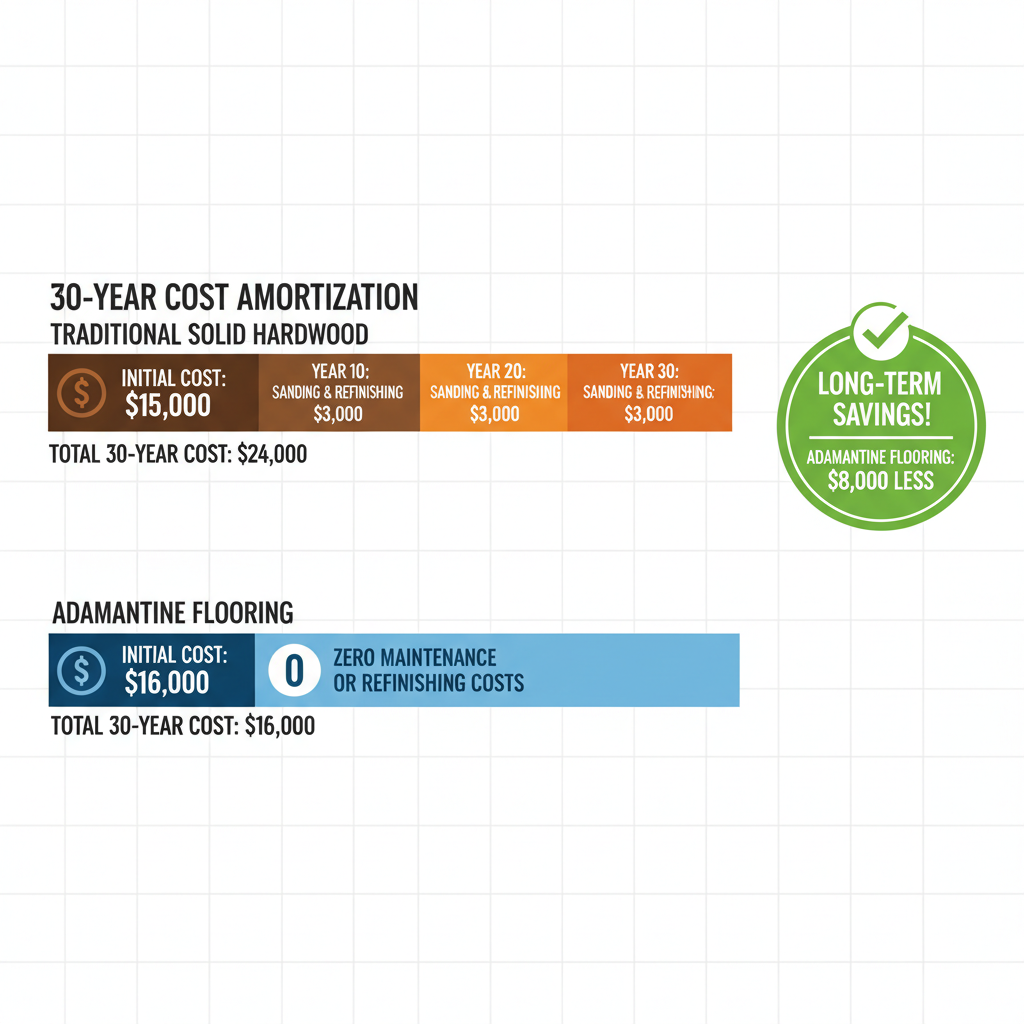
Let’s compare 1,000 square feet of traditional solid hardwood versus Adamantine over a 30-year period:
- Traditional Hardwood: Initial installation costs are high. Furthermore, to maintain its appearance, polyurethane-coated hardwood requires professional sanding and refinishing every 7-10 years. Over 30 years, you will pay for the initial floor, plus three separate refinishing jobs. This easily doubles or triples the true lifetime cost of the floor, not to mention the recurring lifestyle disruption of vacating your home for days at a time.
- Adamantine Flooring: Initial installation costs are comparable to mid-to-high-end hardwood. However, Adamantine explicitly provides 25+ year durability with zero refinishing required. The 30-year cost is simply the initial installation.
A common question is: What happens after the 25+ year lifespan if the floor cannot be traditionally sanded and refinished? Because the core is structurally sound and waterproof, if the surface eventually sustains extreme, localized damage decades down the line, individual planks can be professionally extracted and replaced, or the ultra-thin profile allows it to serve as a perfect, flat subfloor for a future floating floor overlay.
Contractor’s Corner: The Complete Adamantine Installation Blueprint
Even the most advanced flooring in the world will fail if installed incorrectly. For DIYers and professionals alike, understanding how to install adamantine flooring requires strict adherence to rigid core tolerances.
According to aggregated Fixr and HomeAdvisor data, national average installation costs for premium hybrid flooring range from $1,500 to $3,500 (averaging $2,207), with professional labor running $4 to $8 per square foot [14]. To protect this investment, environmental acclimation is non-negotiable. Adamantine Installation Manuals dictate strict environmental requirements prior to installation: the flooring must acclimate to the home’s standard living conditions, and the room temperature must not exceed 85°F (29°C) during the installation process [15].
Crucial Subfloor Preparation and Expansion Gaps
The most common point of failure for any rigid hybrid floor is an uneven subfloor. The subfloor flatness tolerance is incredibly strict—typically no more than a 3/16-inch variance over a 10-foot span. If the subfloor has dips or peaks, the rigid planks will flex under foot traffic, eventually causing the locking joints to snap and break.
Equally critical is the expansion gap. Rigid core flooring expands and contracts with temperature changes. A minimum 1/4 inch (7-8mm) expansion gap is strictly required along all walls, cabinets, and fixed vertical obstacles. If the floor is pinched against a wall, it will buckle. Furthermore, transition strips must be used for any continuous installation longer than 40 feet in any direction to allow for independent movement.
When working with the click-lock mechanism, a vital troubleshooting tip is to insert the tongue of the new plank at a low angle (roughly 15 to 20 degrees) before pressing it down and tapping it into place with a tapping block to ensure a seamless, watertight joint. Complex cuts around door jambs and heating vents require an undercut saw to allow the plank to slide under the trim, maintaining that crucial hidden expansion gap.
Maintenance Protocols: Protecting Your 50-Year Warranty
While Adamantine and high-end SPC are elite scratch resistant flooring solutions, it is vital to remember that “scratch-resistant” does not mean “scratch-proof.” Protecting your 50-year warranty requires a professional-grade maintenance schedule and avoiding catastrophic DIY cleaning mistakes.
The most critical rule: never use a steam mop. The intense heat can delaminate the layers of hybrid floors and cloud the finish. Furthermore, avoid high-gloss topical polishes or waxes; these do not protect the floor but instead act as a magnifying glass for micro-scratches and trap dirt. Bona, a leading authority on approved hardwood and hybrid floor cleaning solutions, recommends using only pH-neutral, residue-free cleaners specifically formulated for urethane or aluminum oxide finishes [16]. Additionally, never use a vacuum with an engaged beater-bar on hard surfaces, as the stiff bristles will rapidly degrade the finish.
The High-Traffic Defense Plan
To mitigate high traffic floor damage, you must adopt a proactive defense plan. ServiceMaster Clean, an authority on commercial and high-traffic residential cleaning protocols, emphasizes that 80% of floor dirt is tracked in from the outside [17].
Implement a robust walk-off mat system at all exterior doors—a coarse mat outside to scrape heavy debris, and a softer, absorbent mat inside to capture moisture. Designing a dedicated “drop zone” or mudroom to capture this debris before it reaches main living areas will exponentially extend the life of your floors. Your daily routine should include sweeping or dry dust-mopping, followed by targeted damp mopping only when necessary. Finally, Furniture Protection Manufacturers strongly advise applying heavy-duty felt pads, rubber bumpers, or silicone glides to the legs of all furniture, particularly dining chairs, to drastically reduce friction and prevent deep gouging [18].
Conclusion
When evaluating the vast landscape of residential flooring, the data is clear. While traditional hardwood offers undeniable classic appeal, it comes tethered to a relentless, expensive cycle of maintenance and refinishing. By leveraging the science of aluminum oxide nanoparticle technology and 100% waterproof hybrid construction, Adamantine flooring emerges as the superior “Buy It For Life” choice for active, high-traffic homes.
It provides unmatched scratch resistance, a 50-year lifespan, and a 30-year ROI that heavily outpaces traditional materials. However, unlocking this ultimate performance requires respecting the material through precise subfloor preparation, strict adherence to expansion gaps, and chemical-free maintenance protocols. Evaluate your home’s current flooring damage using our triage guide above, and request a free sample of Adamantine flooring to test its gemstone-level hardness for yourself.
Disclaimer: Pricing and installation costs mentioned are national averages and may vary by location. Always consult the manufacturer’s official installation guidelines to maintain warranty validity.
References & Authoritative Sources
- National Wood Flooring Association (NWFA). (N.D.). Hardwood Refinishing Standards and Assessment Guidelines. Retrieved from NWFA Consumer Education.
- Materials Science & Flooring Chemistry Data. (N.D.). The Chemical and Physical Impact of Winter Salt on Polyurethane Finishes.
- Professional Flooring Installers Network. (N.D.). Structural Repair and Localized LVP Plank Replacement Techniques.
- Licensed General Contractors Association. (N.D.). Subfloor Integrity, Moisture Vapor Transmission, and Structural Repair Standards.
- Consumer Reports. (N.D.). Flooring Durability and Abrasive Machine Testing Methodology. Retrieved from Consumer Reports Flooring Division.
- Resilient Floor Covering Institute (RFCI). (N.D.). Industry Standards and Definitions for Resilient Flooring.
- GreenGuard. (N.D.). Low Chemical Emissions and VOC Standards for Interior Flooring Products.
- Tile Council of North America (TCNA). (N.D.). Porcelain Hardness and High-Temperature Firing Standards vs. Natural Stone.
- Wang, Li. (N.D.). Standardized Surface-Wear Tests: Wood vs. Laminate and Vinyl. Consumer Reports Flooring Test Lead.
- Adamantine Official Manufacturer Specifications. (N.D.). Proprietary 50-Year Residential Warranty and Material Composition Data.
- Materials Science Journals. (N.D.). The Hardness and Properties of Aluminum Oxide (Corundum) Nanoparticles vs. Sapphire and Ruby.
- Adamantine Technical Specifications. (N.D.). Hybrid Core Anatomy, Waterproof Capabilities, and Acoustic Performance Metrics.
- Independent Flooring Testing Data. (N.D.). Taber Abrasion Test Results: Aluminum Oxide vs. Standard Polyurethane Scratch Resistance.
- Fixr / HomeAdvisor Data. (N.D.). Aggregated National Average Flooring Installation and Labor Costs.
- Adamantine Installation Manuals. (N.D.). Environmental Acclimation, Temperature Tolerances, and Expansion Gap Requirements.
- Bona. (N.D.). Approved Cleaning Solutions and Maintenance Protocols for Hardwood and Hybrid Floors.
- ServiceMaster Clean. (N.D.). Commercial and High-Traffic Residential Cleaning Protocols and Walk-Off Mat Systems.
- Furniture Protection Manufacturers Data. (N.D.). Friction Reduction and Floor Protection Guidelines for Heavy Furniture.
