We live in an era defined by disposable culture and planned obsolescence. From smartphones that degrade after two years to kitchen appliances with plastic gears designed to fail, the modern consumer is trapped in an endless, expensive cycle of replacing broken everyday items. But a growing movement of value-driven consumers, sustainability advocates, and gear enthusiasts are pushing back. They are searching for a higher benchmark of quality—what we call “The Adamantine Standard.”
Bridging the mythical concept of an unbreakable metal with cutting-edge, real-world material science, The Adamantine Standard is a mindset of valuing extreme durability, repairability, and true lifetime value over cheap replacements. This definitive, BS-free guide will decode deceptive lifetime warranties, provide a rigorous “Repair vs. Replace” matrix, and reveal the exact construction methods you need to look for to ensure your next purchase is truly designed to last a lifetime.

- The Myth vs. Reality of Adamantine Products
- The Science of Indestructible Materials in the Real World
- Most Durable Materials for Everyday Use
- The Economics of Lifetime Durability: Buy It For Life (BIFL)
- Navigating Lifetime Guarantee Products and Warranties
- The Repair vs. Replace Matrix for Broken Everyday Items
- Normal Wear and Tear vs. Property Damage
- Conclusion
- References & Authoritative Sources
The Myth vs. Reality of Adamantine Products
To understand the pinnacle of durability, we first have to look at the origins of the word itself. Historically, “adamantine” is a mythological or fantasy material renowned for being entirely unbreakable. If you are wondering what is adamantine material used for in popular culture, look no further than tabletop role-playing games. According to the Dungeon Master’s Guide (page 246), wearing adamantine armor in Dungeons & Dragons 5e completely negates critical hits, and forging weapons from the material costs an additional 500 gold pieces [1]. Similarly, in the Pathfinder universe, adamantine alloy armor provides a highly coveted Damage Reduction (DR) of 2/- [2].
However, in the real world, “adamantine products” take on a different, yet equally fascinating, meaning. Modern industrial branding leverages the mythical weight of the word to market exceptionally tough goods. According to experts in the Journal of Materials Science, when the term “adamantine” is applied in real-world commerce, it typically refers to ultra-hard industrial coatings, specialized steel alloys, or diamond-like carbon (DLC) finishes designed to withstand extreme friction and wear [3]. While you cannot mine adamantine from a fantasy dwarven forge, the real-world equivalents engineered in modern laboratories are achieving feats of durability that border on magic.
The Science of Indestructible Materials in the Real World
When we search for indestructible materials, we are actually looking for materials that can withstand highly specific types of extreme stress. In physics, no single material is universally indestructible; rather, durability is a balancing act between hardness (resistance to scratching and localized deformation) and toughness (resistance to fracturing under heavy impact).
For example, Diamond scores a perfect 10 on the Mohs scale of mineral hardness, making it incredibly scratch-resistant, but it can be shattered with a well-placed hammer blow. Conversely, Kevlar is incredibly tough but can be cut with specialized shears. When looking at pure structural limits, the MIT Department of Materials Science and Engineering notes that Graphene—a single layer of carbon atoms arranged in a two-dimensional honeycomb lattice—boasts a staggering tensile strength of 130 gigapascals, making it one of the strongest known materials on Earth [4]. The American Chemical Society extensively studies these molecular structures, proving that true indestructibility relies on atomic bonds rather than sheer mass [5].

How High Durability Manufacturing is Changing the Game
Translating these advanced materials into usable consumer and industrial goods requires high durability manufacturing. The U.S. manufacturing sector, which contributed a massive $2.9 trillion to the GDP in 2023, is increasingly relying on advanced techniques to maximize material lifespans.
According to AMT – The Association For Manufacturing Technology, processes like CNC (Computer Numerical Control) machining and Additive Manufacturing (3D printing) are revolutionizing how we use materials like Titanium and Inconel [6]. Additive manufacturing allows engineers to vary the material composition within a single part, optimizing durability exactly where stress occurs while reducing overall weight. Experts at Components By Design highlight that these high-strength alloys and precision manufacturing techniques are no longer just for aerospace and automotive applications; they are slowly trickling down into high-end consumer tools and everyday carry (EDC) items [7].
Most Durable Materials for Everyday Use
You don’t need aerospace-grade Inconel to achieve extreme longevity in your home. Finding the most durable materials for everyday use requires translating high-level material science into practical consumer advice. Whether you are looking at fabrics, woods, or metals, construction impacts longevity just as much as the raw material itself.
For clothing and upholstery, fabric weight and weave are paramount. Heavy-duty Canvas fabrics, for instance, weigh between 340 and 680 g/m² (GSM), providing a dense barrier against abrasion. To measure this, the textile industry relies on rigorous standards like the Wyzenbeek or Martindale abrasion tests. According to textile authorities at FabricSight [8] and workwear specialists at Thread Logic [9], specific weave structures significantly contribute to everyday durability. A Ripstop crosshatch weave prevents small tears from spreading, while a diagonal Twill weave hides dirt and resists friction far better than a standard plain weave.
Protecting Fragile Consumer Goods
Of course, not everything can be made of heavy canvas or machined titanium. When dealing with fragile consumer goods—like glassware, delicate electronics, or musical instruments—durability shifts from the product itself to the logistics of protecting it.
Supply chain authorities at Inbound Logistics [10] and 3PL experts at Buske Logistics [11] emphasize that protecting non-durable items requires strict adherence to ISTA (International Safe Transit Association) drop-test standards. This involves precise shock absorption techniques, custom foam inserts, and specialized dunnage (void fill) to ensure that fragile internal mechanics survive the brutal reality of global shipping networks.
The Economics of Lifetime Durability: Buy It For Life (BIFL)
Extreme durability isn’t just a matter of material science; it’s a financial strategy. The “Buy It For Life” (BIFL) movement is centered on the economic ROI of lifetime durability. While BIFL items carry a higher upfront price tag, calculating the “cost-per-use” proves the immense value of high-quality goods over cheap, disposable alternatives.
Consider that well-crafted musical instruments from the 1920s and 1950s are still actively used today—and often sound better with age—proving that products designed to last a lifetime are a reality, not a marketing gimmick. Financial and gear authorities at WIRED [12] and The Penny Hoarder [13] frequently highlight the historical context and massive financial ROI of investing in BIFL gear like cast-iron cookware, full-tang knives, and solid hardwood furniture. Furthermore, the ISO (International Organization for Standardization) provides strict guidelines on product lifecycles, helping manufacturers design goods that defy the standard consumer replacement cycle [14].
The Anatomy of Repairability

A critical, often overlooked aspect of products designed to last a lifetime is that they are rarely maintenance-free. True lifetime products are defined by their modularity and repairability.
A mechanical watch or a pair of Goodyear welted boots can last a century not because they never wear down, but because they are designed to be taken apart and serviced. Teardowns of BIFL appliances consistently show internal components made of milled metal gears rather than the planned-obsolescence plastic gears found in budget models. To achieve true lifetime durability, consumers must embrace the routine maintenance—oiling leather, seasoning cast iron, servicing movements—required to keep these modular items functioning indefinitely.
Navigating Lifetime Guarantee Products and Warranties
Consumers actively seek out lifetime guarantee products to protect their investments, but the fine print is often riddled with loopholes. A “lifetime” warranty usually refers to the expected manufacturing lifespan of the product, not the human lifespan of the buyer.
For example, the renowned hatmaker Tilley offers a legendary guarantee, but it requires product registration within 60 to 90 days of purchase to activate. Miss that window, and your lifetime guarantee is void. Similarly, Craftsman hand tools are famous for offering a full lifetime warranty, but consumers must navigate how corporate buyouts—such as Craftsman being acquired by Stanley Black & Decker—affect the fulfillment of legacy warranties. Warranty industry experts at JoinClyde [15] and financial analysts at The Penny Hoarder [13] stress the importance of understanding the legal difference between a “limited lifetime warranty” (which often only covers specific manufacturing defects and excludes normal wear) and a “full lifetime warranty.”
The Repair vs. Replace Matrix for Broken Everyday Items
Even with the best materials, things break. When replacing broken everyday items, consumers face a tension between the sustainability of the repair movement and harsh economic realities.
According to sustainability reporting by The Guardian, the “right-to-repair” movement is gaining legislative traction, encouraging consumers to fix rather than toss [16]. However, an actionable “Repair vs. Replace” matrix must account for cost and safety. For instance, replacement blenders can be purchased for around $30, and basic replacement TV remotes can be found for under $10. In these cases, sourcing parts and paying for labor is economically unviable.
More importantly, consumer safety guidelines dictate when an item must be replaced. A scratched wooden table is a minor aesthetic issue that can be sanded and repaired; however, flaking Teflon non-stick cookware or a space heater with frayed wiring presents severe toxic and fire hazards. If an item’s structural integrity compromises your safety, replacement is the only option.
Normal Wear and Tear vs. Property Damage
The concept of material degradation over time also extends to real estate and rental agreements, where the legal distinction between “wear and tear” and “damage” can cost thousands of dollars.
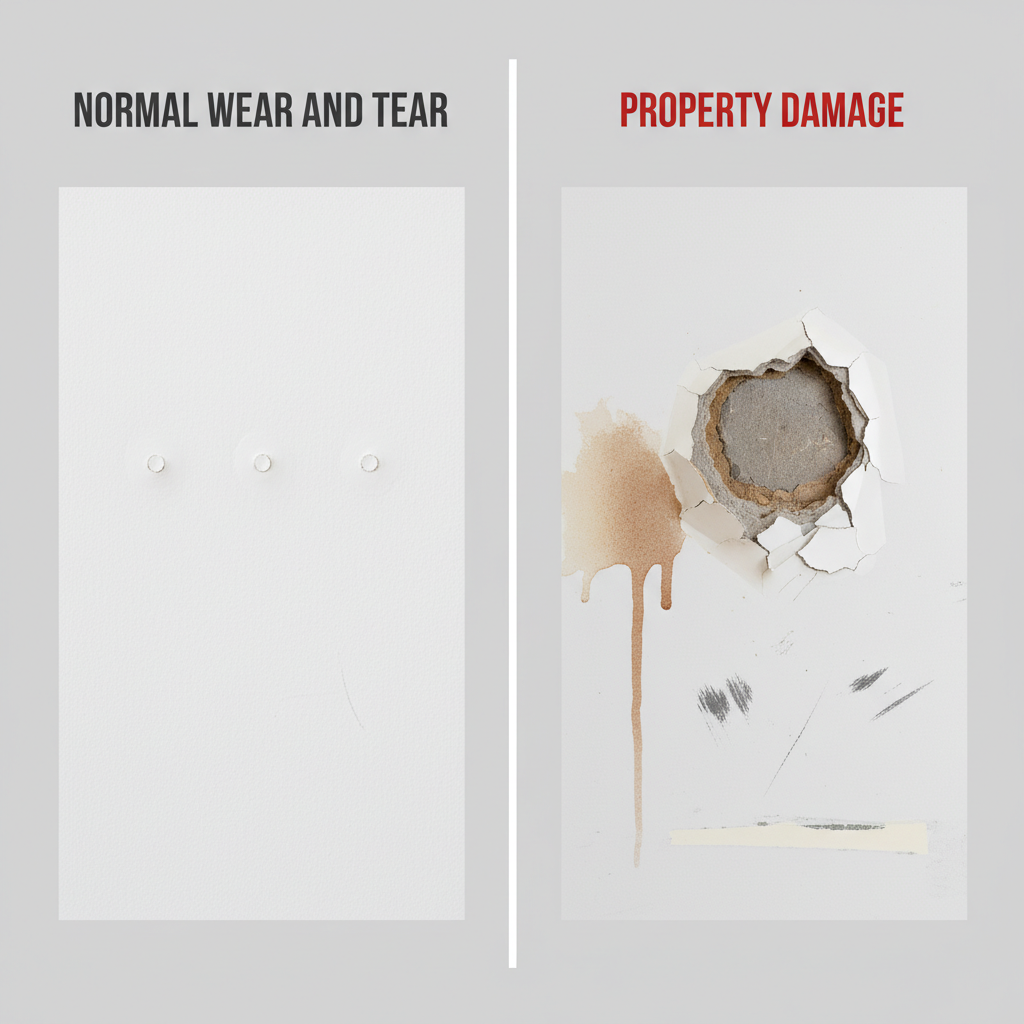
When a tenancy ends, landlords and tenants often clash over security deposits. Legal authorities and property management experts at Grace Property Management & Real Estate [17] and financial platforms like Baselane [18] establish strict guidelines to differentiate the two. “Normal wear and tear” refers to the expected depreciation of a property—such as faded paint, worn carpet paths, or scuffed hardwood. Conversely, “property damage” is the result of negligence or abuse.
A perfect visual matrix of this distinction involves hanging pictures. In many jurisdictions, the specific legal threshold for acceptable small nail holes under normal wear and tear is a 6 penny nail (which is 2 inches long). Anything larger—such as massive drywall anchors, fist-sized holes, or deep pet stains—crosses the line into property damage, making the tenant financially responsible.
Conclusion
True, mythological indestructibility may be a fantasy, but extreme durability and lifetime value are entirely achievable through informed purchasing and proactive maintenance. By adopting The Adamantine Standard, you shift your mindset from a passive consumer of disposable goods to an active curator of quality.
Audit your next major purchase: Before buying, check the fabric GSM, read the warranty fine print for strict registration windows, and ask yourself if the item is modular enough to be repaired. By valuing material science and repairability over cheap, temporary replacements, you can finally break the cycle of planned obsolescence and invest in products truly designed for life.
Legal & Financial Disclaimer: Warranty terms and real estate laws regarding ‘wear and tear’ vary by jurisdiction. Information provided is for educational purposes. Always consult specific manufacturer warranties and local tenancy laws.
References & Authoritative Sources
- Wizards of the Coast. (N.D.). Dungeon Master’s Guide (Dungeons & Dragons 5th Edition).
- PathfinderWiki. (N.D.). Adamantine. Retrieved from Pathfinder community database.
- Journal of Materials Science. (N.D.). Studies on ultra-hard industrial coatings and specialized steel alloys.
- MIT Department of Materials Science and Engineering. (N.D.). Research on the tensile strength and molecular structure of Graphene.
- American Chemical Society. (N.D.). Data on atomic bonds and material hardness.
- AMT – The Association For Manufacturing Technology. (N.D.). Reports on U.S. manufacturing GDP and Additive Manufacturing innovations.
- Components By Design. (N.D.). Applications of high-strength alloys in CNC machining.
- FabricSight. (N.D.). Technical fabric specifications and weave durability.
- Thread Logic. (N.D.). Workwear fabric wear-and-tear and abrasion testing.
- Inbound Logistics. (N.D.). Supply chain best practices for fragile goods.
- Buske Logistics. (N.D.). ISTA drop-test standards and 3PL packaging protocols.
- WIRED. (N.D.). Historical context and testing of Buy It For Life (BIFL) gear.
- The Penny Hoarder. (N.D.). Financial analysis of BIFL ROI and lifetime warranty fine print.
- ISO (International Organization for Standardization). (N.D.). Guidelines on manufacturing standards and product lifecycles.
- JoinClyde. (N.D.). Expert analysis on limited vs. full lifetime warranties.
- The Guardian. (N.D.). Reporting on the sustainability and right-to-repair movement.
- Grace Property Management & Real Estate. (N.D.). Professional property management guidelines on wear and tear vs. damage.
- Baselane. (N.D.). Financial and management guidelines for landlords regarding property depreciation.
